
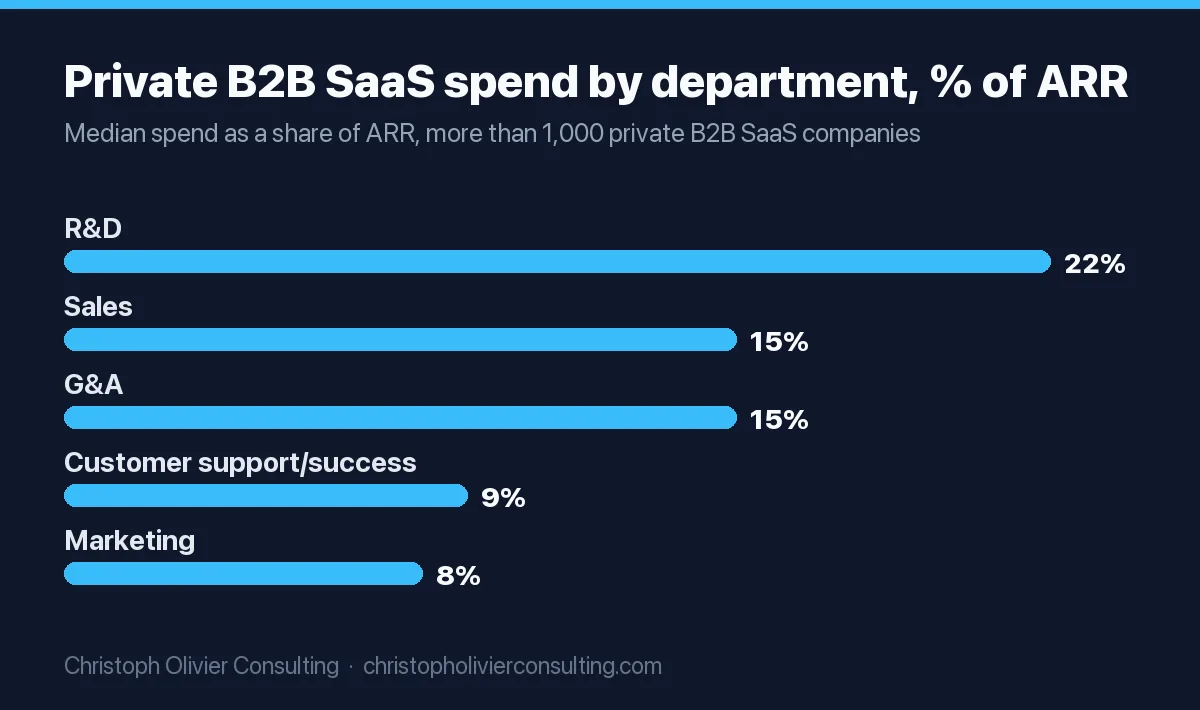
A fractional CMO for SaaS is a part-time head of marketing who owns your pipeline target, your positioning and how the marketing budget splits between new logos and expansion, usually for 5 to 20 hours a week. Published 2026 rates run from about $3,000 a month at seed stage to $10,000 to $15,000 a month at Series B and later, and B2B SaaS specialists price 20 to 30% above generalists. For most SaaS companies the fee only fits once ARR is in the low millions, because a typical private SaaS company spends just 8% of ARR on marketing.
Short answer: Expect $3,000 to $5,000 a month at pre-seed or seed, $5,000 to $10,000 at Series A and $10,000 to $15,000 at Series B and later (MarketerHire, April 2026). Hourly rates run $150 to $350. At the median private SaaS marketing budget of 8% of ARR (SaaS Capital, June 2026), a $5,000 a month retainer is 75% of the whole marketing budget at $1 million ARR and 15% at $5 million. That ratio, not the hourly rate, decides whether you should hire one.
What a fractional CMO owns in a SaaS company
In SaaS, marketing has to answer to three numbers finance already tracks: how fast acquisition spend pays back, how much revenue existing customers keep and add (net revenue retention, or NRR), and whether growth comes from self-serve signups, a sales team or both. A SaaS fractional CMO owns the plan behind those numbers. Your marketers, agencies and freelancers do the work.
| Area | The fractional CMO owns | Your team or vendors do | What you should see in writing |
|---|---|---|---|
| Pipeline and ARR target | The new ARR, pipeline or trial-to-paid number marketing commits to, by quarter | Report weekly against it | A target sheet with the baseline and where each number comes from (CRM, billing system, product analytics) |
| Ideal customer profile | Which segments to sell to, based on who activates, retains and expands | Rebuild targeting, lists and ad audiences | An ICP defined by retention data, not by who buys fastest |
| Go-to-market motion | Where self-serve ends and sales begins: free plan, trial, demo, sales-assist | Product, growth and sales implement the handoffs | A written definition of a product-qualified lead and the hand-off rule to sales |
| Budget | The marketing budget split by channel, with a payback cap for each | Run spend inside the caps | Budget by channel with a maximum CAC and payback period per channel |
| Expansion and retention | Marketing’s part in upsell, cross-sell and adoption campaigns | Customer success runs accounts; lifecycle marketer runs emails | An expansion plan with an owner per motion |
| Board reporting | The marketing slides: CAC, payback, pipeline coverage, channel mix | RevOps builds the data | Definitions agreed with finance before the first board meeting |
Expansion belongs on that list because public SaaS companies live on it. HubSpot’s 2025 10-K reports net revenue retention of 103.5%, up from 101.8% in 2024. Asana’s 10-K for the year to January 31, 2026 reports a dollar-based net retention rate of 96%, which means its existing customers shrank on balance and every dollar of growth had to come from new ones.
What a fractional CMO for SaaS costs: published 2026 rates
Every figure below is published by a firm that sells fractional marketing talent or services, and none cites an independent survey. Treat them as asking prices and always ask how many hours sit behind a monthly quote.
| Stage or engagement | Published monthly rate | Scope or hours | Source |
|---|---|---|---|
| Pre-seed or seed | $3,000 to $5,000 | Strategy and light advisory, 5 to 10 hours a week | MarketerHire, April 15, 2026 |
| Series A | $5,000 to $10,000 | Strategy and execution oversight, 15 to 20 hours a week | MarketerHire, April 2026 |
| Series B and later | $10,000 to $15,000 | Full strategic leadership and team management | MarketerHire, April 2026 |
| Hourly | $150 to $350 an hour | 5 to 15 hours a week | MarketerHire, April 2026 |
| Strategic leadership (most common tier) | $5,000 to $12,000 | Weekly meetings, priorities, roadmap | Kalungi, June 29, 2026 |
| Embedded fractional CMO | $12,000 to $25,000 and up | Leads the function, manages staff and agencies | Kalungi, June 2026 |
| Fractional CMO plus execution team | $15,000 to $40,000 and up | Adds content, SEO, paid media, RevOps, design | Kalungi, June 2026 |
| Series A ($2 million to $5 million ARR) | $8,000 to $15,000 | Not stated | GTM 80/20, updated November 22, 2026; its own engagements start at $7,000 |
| One named firm’s entry price | From $10,000, 90-day minimum | Fractional CMO leadership for B2B SaaS | Geisheker Group, updated October 5, 2026 |
Two adjustments change the number more than anything else. MarketerHire says a fractional CMO with deep specialization, its example being someone who has scaled three B2B SaaS companies from Series A to C, prices 20 to 30% above a generalist, and Bay Area or New York CMOs charge 15 to 25% more. And the higher Kalungi tiers include an execution team, so a $25,000 quote may be mostly content and paid media, not leadership. To compare quotes fairly, divide the leadership portion by monthly hours (weekly hours x 52 / 12). A $10,000 retainer for 15 hours a week is 65 hours a month, or $154 an hour. The non-SaaS tiers are in our fractional CMO cost guide.
If you already have two or three proposals, you can book a consultation and we will put each one against this table: stage, hours, what is leadership and what is execution.
What SaaS companies actually spend on sales and marketing
A fractional CMO’s fee comes out of the marketing budget, so you need to know how big that budget normally is. Public SaaS companies do not report marketing alone; they report one combined sales and marketing line in the 10-K. Here is what five of them reported for their latest fiscal year, compiled from their filings on SEC EDGAR in November 2026.
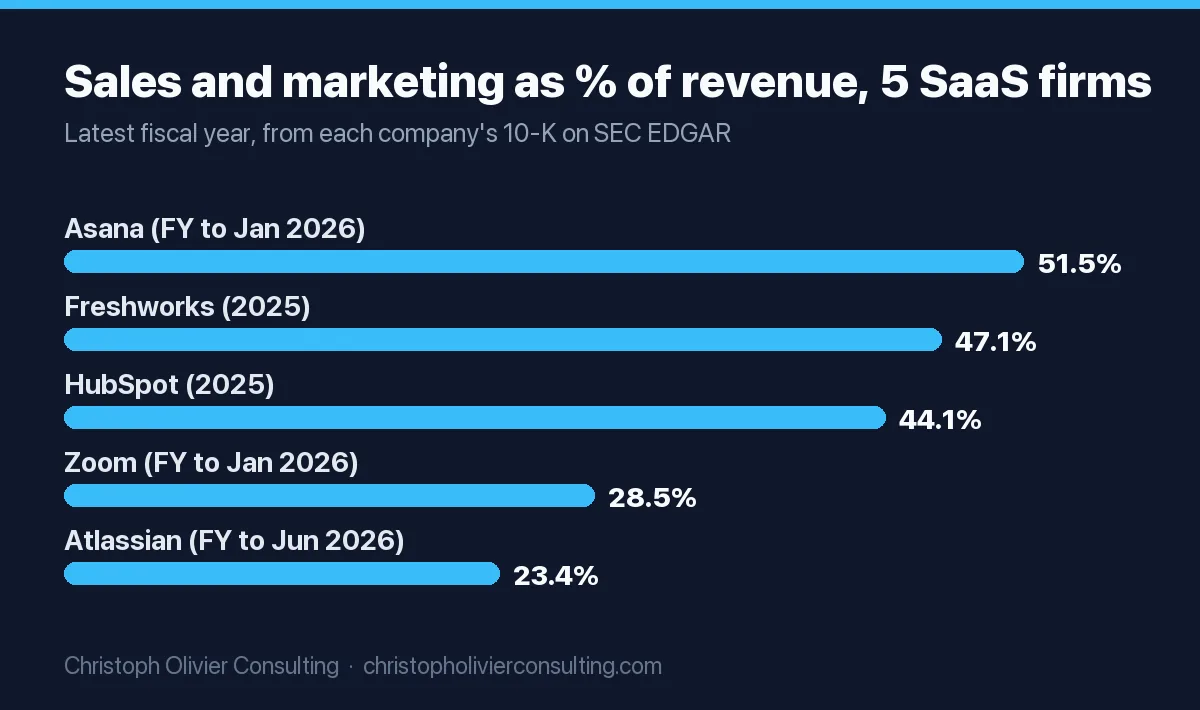
| Company (fiscal year) | Revenue | Sales and marketing | S&M as % of revenue | Retention metric reported | Go-to-market as described in the 10-K |
|---|---|---|---|---|---|
| HubSpot (year to Dec 31, 2025) | $3.131 billion | $1.379 billion | 44.1% | Net revenue retention 103.5% | Freemium products, then paid hubs, sales and Solutions Partners |
| Asana (year to Jan 31, 2026) | $790.8 million | $407.0 million | 51.5% | Dollar-based net retention 96% | Hybrid: product-led model, direct sales and channel partners |
| Freshworks (year to Dec 31, 2025) | $838.8 million | $394.8 million | 47.1% | Net dollar retention 108% (104% in constant currency) | Product-led motion plus direct sales and channel partners |
| Zoom (year to Jan 31, 2026) | $4.869 billion | $1.388 billion | 28.5% | Enterprise net dollar expansion 98% | Self-serve online customers plus enterprise direct sales |
| Atlassian (year to Jun 30, 2026) | $6.572 billion | $1.541 billion | 23.4% | None disclosed as a single rate | Low-touch, self-service purchasing; direct sales focused on expanding large customers |
The spread is the useful part. Atlassian says its low-touch model means “lower customer acquisition costs and go-to-market expenses for new customers,” and it spends 23.4% of revenue on sales and marketing. Asana, which runs product-led and sales-led motions side by side, spends 51.5%. Your motion sets your cost structure, which is why the first job of a SaaS fractional CMO is often deciding where self-serve stops and sales starts. Our breakdown of how much SaaS companies spend on marketing covers more companies and their advertising lines.
Private companies are leaner. SaaS Capital’s 2026 spending benchmarks, from more than 1,000 private B2B SaaS companies surveyed in March 2026, put median marketing spend at 8% of ARR and sales at 15%, with equity-backed companies spending 100% more on marketing than bootstrapped ones. Benchmarkit’s 2025 SaaS Performance Metrics report (calendar 2024 data) uses revenue rather than ARR and finds combined sales and marketing at 37% of revenue at the median, 45% for VC-backed companies and 33% for PE-backed ones. The two surveys measure different things, so do not mix them.
Does a fractional CMO fit your ARR? A budget-fit model
This table is our own calculation, not a published benchmark. Assumptions: marketing budget = 8% of ARR (the SaaS Capital 2026 median), fees = MarketerHire’s 2026 stage ranges x 12, and the mapping of ARR to funding stage is ours. The last column applies a rule of thumb I use, not a survey finding: leadership should cost under about 30% of the marketing budget, so most of the money still reaches buyers.
| ARR | Marketing budget at 8% of ARR | Typical stage fee, per year | Fee as share of marketing budget | Read |
|---|---|---|---|---|
| $1 million | $80,000 | $36,000 to $60,000 (seed) | 45% to 75% | Too expensive as an ongoing retainer. Founder-led marketing plus a one-off strategy project |
| $3 million | $240,000 | $60,000 to $120,000 (Series A) | 25% to 50% | Fits at the low end of the range, with at least one marketer to direct |
| $5 million | $400,000 | $60,000 to $120,000 (Series A) | 15% to 30% | The sweet spot: budget is big enough to waste, too small for a full-time executive |
| $10 million | $800,000 | $120,000 to $180,000 (Series B and later) | 15% to 23% | Fits, but a full-time VP at about $250,000 loaded (31%) is now affordable |
| $20 million | $1,600,000 | $120,000 to $180,000 | 8% to 11% | Hire full-time. Use fractional as a bridge during the search or as an advisor |
Two caveats. SaaS Capital’s marketing figure already includes marketing salaries, so if you employ two marketers at $3 million ARR, your program budget is much smaller than $240,000. And equity-backed companies spend about twice the median on marketing, so a funded seed company can carry a retainer that a bootstrapped one cannot.
Fractional vs full-time SaaS CMO: the year-one math
The federal government does not publish a CMO salary series. The nearest is BLS marketing managers: median $166,790 in May 2025, top 10% above $293,610, and a median of $192,600 in the information industry, the BLS sector that includes software publishers. Employer costs on top of salary come from the BLS Employer Costs for Employee Compensation, June 2026: private-industry management, business and financial jobs cost $59.85 an hour in wages, $8.47 in paid leave and $20.31 in other benefits. Since salary already includes paid leave, the load is 20.31 / (59.85 + 8.47) = 29.7%.
| Option (our calculation) | Math | Year-one cost | Time to impact |
|---|---|---|---|
| Fractional CMO, seed | $3,000 to $5,000 x 12 | $36,000 to $60,000 | 2 to 4 weeks ramp |
| Fractional CMO, Series A | $5,000 to $10,000 x 12 | $60,000 to $120,000 | 2 to 4 weeks ramp |
| Fractional CMO, Series B and later | $10,000 to $15,000 x 12 | $120,000 to $180,000 | 2 to 4 weeks ramp |
| Full-time head of marketing, information-industry median | $192,600 x 1.297 | $249,856, plus a $50,000 to $100,000 recruiter fee if used | 3 to 6 months ramp |
| Full-time CMO, top-decile marketing manager pay | $293,610 x 1.297 | $380,894 before bonus, equity and recruiter fee | 3 to 6 months ramp |
Ramp times and recruiter fees are MarketerHire’s estimates. MarketerHire also puts the tipping point to full-time at fractional fees above $12,000 to $15,000 a month for six months or more, a marketing team past 10 people, or a board that wants a named C-suite leader. The full pay picture for full-time SaaS marketing leaders is in our CMO salary guide.
Then hold either option to a payback bar, the same way you hold a channel to one. Our calculation: year-one fee divided by gross margin is the new ARR needed to cover it within a year. At the 81% median subscription gross margin in the Benchmarkit report, a $120,000 Series A year needs about $148,000 of new ARR attributable to the engagement; a $60,000 year needs about $74,000.
CAC payback: the benchmark your fractional CMO will be judged on
CAC payback is the number of months of gross-margin-adjusted revenue it takes to earn back the sales and marketing spent to win a customer. The formula: sales and marketing spend on new customers / (new ARR x gross margin) x 12. Bessemer Venture Partners (September 2021) sets targets of under 12 months for SMB-focused companies, under 18 for mid-market and under 24 for enterprise. Benchmarkit’s 2025 report found a median of $2.00 of sales and marketing spend to win $1.00 of new-customer ARR. Our calculation at 81% gross margin: 2.00 / 0.81 x 12 = about 30 months implied payback, which is above all three Bessemer targets. Benchmarkit reports payback directly on a different sample, so treat 30 months as a rough read, not its published median. If your payback is long, a fractional CMO should cut the weakest channels before adding new ones. Our LTV to CAC ratio guide walks through the inputs.
What is the 3 3 2 2 2 rule of SaaS, and the Rule of 40?
Both come up in SaaS board meetings. The 3 3 2 2 2 rule is T2D3, set out by Battery Ventures partner Neeraj Agrawal in TechCrunch on February 1, 2015: from $2 million ARR, triple to $6 million, triple to $18 million, then double to $36 million, $72 million and $144 million. The Rule of 40, as Bessemer describes it, says growth rate plus profit margin should be 40% or more. For marketing this matters because the Rule of 40 caps how much unprofitable acquisition spend the board will accept for a given growth rate.
When a fractional CMO makes sense for a SaaS company, and when it does not
Sometimes the right answer is not to hire one. Find your row.
| Your situation | Better option | Why |
|---|---|---|
| Under about $1 million ARR, founder still closes most deals, no repeatable channel yet | Do it yourself, plus one fixed-fee strategy project or a few hours of advisory | A seed retainer is 45% to 75% of an 8%-of-ARR budget. The founder’s sales conversations are the research a CMO would charge for |
| Pure self-serve product, growth comes from signups and in-app conversion | A growth or lifecycle marketer working with product, or the trial conversion work done in-house | The levers sit in onboarding and pricing pages, which product teams own |
| You only need content or organic search | A specialist or a SaaS SEO agency with a clear scope | You need production, not a leader |
| NRR under 100% and churn is the main leak | Customer success and product first; marketing supports | Asana’s 96% NRR shows growth has to outrun shrinkage. More leads into a leaky product make payback worse |
| $2 million to $10 million ARR, one to five marketers or agencies, nobody senior setting direction | Fractional CMO | Fee is 15% to 50% of budget in the model above, and the team is big enough to execute a plan |
| Raising a round within a year and nobody can defend CAC, payback and channel mix to investors | Fractional CMO for two to three quarters | Board-ready definitions and a clean data story are a leadership job |
| Over about $20 million ARR, team of 10 or more, or board wants a named executive | Full-time VP or CMO, with fractional as a search bridge | Leadership at about $250,000 loaded is now about 16% of an 8% budget, and MarketerHire’s tipping points apply |
Not sure which row your SaaS company is in?
Bring your ARR, marketing budget, team and any fractional CMO quotes to a free consultation. We will check them against the fit table and the budget model, including whether a cheaper option is the better call.
A 90-day plan for a SaaS fractional CMO
MarketerHire says the first 30 days of a fractional CMO engagement are diagnostic and that ROI needs at least a 90-day runway. Use this as the scope of work. The pass criteria are my standards; adjust them, but write them into the agreement.
| Days | Work | Deliverable | Pass if |
|---|---|---|---|
| 1 to 10 | Access to CRM, billing system, product analytics, ad accounts and agency reports, all under company-owned logins | Access log with an owner per system | No system is held only by an agency or a former employee |
| 11 to 30 | Baseline for the last four quarters: new ARR by source, CAC and payback by channel, trial or free-to-paid conversion, NRR and gross retention by segment | Baseline sheet with the definition and source of every number | Marketing-sourced new ARR reconciles to the billing system within 10% |
| 30 | Diagnosis and plan | Memo: three priorities, budget by channel with payback caps, owner and stop date for each | Every initiative has a dollar budget and a metric finance agrees with |
| 31 to 45 | ICP and motion: which segments retain best, where self-serve hands off to sales | ICP from retention data, written product-qualified lead definition | Sales and product sign the hand-off rule |
| 46 to 75 | Two or three channel or expansion tests; agency and team decisions | Test plan with hypothesis, budget cap and kill rule; keep, fix or cut call per vendor | Nothing launches without a stop rule |
| 90 | Review with CEO and finance | Results against the day-30 plan and the next quarter’s board slides | A clear call: continue, rescope hours, start a full-time search, or end with a handover |
Interview questions for a SaaS fractional CMO
These separate SaaS operators from generalists. The good answers are what I would listen for.
- “How do you calculate CAC payback, and what was it at your last SaaS company?” Good answer: gross-margin adjusted, new customers only, with a number and a segment. Weak answer: a blended CAC from ad platforms.
- “Where should self-serve end and sales start for a product at our price point?” Good answer: a rule based on account size or usage, tied to your ACV. Weak answer: “it depends” with no rule.
- “What would you cut first if payback doubled?” Good answer: names the channel and the test that would prove it. Weak answer: more top-of-funnel spend.
- “How does marketing move NRR?” Good answer: expansion campaigns, adoption content and ICP tightening, with customer success owning accounts. Weak answer: “that’s customer success.”
- “Which hours are leadership and which are execution in your quote?” Good answer: a split by week. Weak answer: a single monthly fee with no hours.
- “What would make you recommend we stop working with you?” Good answer: a specific threshold, such as a full-time hire becoming affordable. Weak answer: none.
For the content side of the plan, our SaaS content marketing playbook shows what a product-led program looks like.
Where CO Consulting fits for a SaaS company
To be plain: CO Consulting’s published focus is professional-service firms and 7-figure service businesses, and SaaS is not one of the nine industries on our services page. If you want someone who has scaled several SaaS companies from Series A to C, the specialist premium MarketerHire describes buys exactly that, and you should ask any provider, including us, for SaaS references. Where we fit is a B2B SaaS company in the $2 million to $10 million range that needs senior direction over an existing team or agencies. Our fractional CMO services start with an audit and a prioritized 90-day plan, run as a 20 to 40 hour a month retainer with a 3 to 6 month minimum, a fixed project such as a go-to-market plan, or a few hours a week of advisory. The fractional CMO owns direction and accountability; writing, ad builds, design and video production are done by the team we direct, not by us. If that matches the row you found in the fit table, book a consultation and bring your ARR, budget and current CAC payback.
Ready to scale your revenue?
Book a free 30-min consultation. We’ll diagnose your growth bottleneck and map out the 3 highest-leverage moves for your business.
Frequently asked questions
How much does a fractional CMO for SaaS cost?
MarketerHire's April 2026 guide puts fractional CMOs at $3,000 to $5,000 a month at pre-seed or seed, $5,000 to $10,000 at Series A and $10,000 to $15,000 at Series B and later. Kalungi lists $5,000 to $12,000 for strategic leadership and up to $40,000 or more when an execution team is included. B2B SaaS specialists price about 20 to 30% above generalists.
How much does a fractional CMO charge per hour?
MarketerHire publishes $150 to $350 an hour for 5 to 15 hours a week, and GTM 80/20 lists $200 to $500. To compare monthly retainers, divide the fee by monthly hours (weekly hours x 52 / 12). A $10,000 retainer for 15 hours a week works out to about $154 an hour. Always ask which hours are leadership and which are execution.
When should a SaaS startup hire a fractional CMO?
Usually between about $2 million and $10 million ARR, once there is at least one marketer or agency to direct and nobody senior setting the plan. Below $1 million ARR, a seed retainer equals 45% to 75% of a marketing budget at SaaS Capital's 8%-of-ARR median, so founder-led marketing plus a one-off strategy project is usually the better use of money.
Fractional CMO for B2B SaaS vs full-time CMO: which costs less?
In year one, fractional costs less because you buy fewer hours. Series A fractional fees total $60,000 to $120,000 a year. A full-time head of marketing at the BLS information-industry median of $192,600, plus a 29.7% benefits load, costs about $249,856, plus a recruiter fee of $50,000 to $100,000 if you use one, and takes 3 to 6 months to ramp.
What does a SaaS CMO actually own?
The pipeline or new ARR target, the ideal customer profile based on who retains and expands, where self-serve hands off to sales, the marketing budget by channel with payback caps, marketing's part in expansion and NRR, and the marketing section of board reporting. Writing, ad builds and design are done by the team or agencies the CMO directs.
What is the 3 3 2 2 2 rule of SaaS?
It is T2D3, a growth path set out by Battery Ventures partner Neeraj Agrawal in TechCrunch in February 2015. Starting from $2 million ARR, a company triples to $6 million, triples to $18 million, then doubles three times to $36 million, $72 million and $144 million. It is an aspiration for venture-backed companies, not a benchmark most SaaS businesses hit.
What is the Rule of 40 in SaaS?
The Rule of 40 says a SaaS company's growth rate plus its profit margin should total 40% or more. Bessemer Venture Partners notes in its 2021 Scaling to $100 Million report that the average for its cloud index was closer to 50%. For marketing, it caps how much unprofitable acquisition spend a board will accept at a given growth rate.
Fractional CMO: cost, fit and industries