
A fractional CMO for ecommerce is a part-time chief marketing officer who owns your store’s marketing plan, budget and margin math, and directs the agencies, freelancers or staff who run the channels. Published 2026 rates for ecommerce brands run from $5,000 to $8,000 a month below $2 million in revenue, $7,000 to $15,000 a month between $2 million and $10 million, and $12,000 to $22,000 a month between $10 million and $30 million, according to MarketerHire’s July 2026 ecommerce guide. The model pays its way most often between about $2 million and $30 million in revenue. Below that, a channel specialist or a one-off audit is usually the better buy.
Short answer: Expect $5,000 to $22,000 a month for a fractional ecommerce CMO, depending on revenue stage and 10 to 25 hours a week. A full-time marketing leader at the BLS median costs about $216,373 a year once benefits are added. Before you sign, divide the annual fee by your contribution margin: that is the extra revenue the engagement has to produce just to break even.
Below: every published rate with its date, what the role should own in an online store, what four public DTC brands actually spend on marketing according to their 2025 10-Ks, a year-one cost comparison, a payback model you can run on your own numbers, an honest fit table (including the cases where you should not hire one), a 90-day plan and interview questions with pass and fail answers.
What a fractional CMO for ecommerce costs in 2026
All of these figures are asking prices published by companies that sell fractional or consulting talent. None comes from an independent survey, so use them as a range to test quotes against, and always ask how many hours sit behind a monthly fee.
| Engagement | Published rate | Hours | Source and date |
|---|---|---|---|
| Ecommerce fractional CMO, seed to $2M revenue | $5,000 to $8,000 a month | About 10 a week | MarketerHire, July 14, 2026 |
| Ecommerce fractional CMO, $2M to $10M | $7,000 to $15,000 a month | 15 to 20 a week | MarketerHire, July 14, 2026 |
| Ecommerce fractional CMO, $10M to $30M | $12,000 to $22,000 a month | 20 to 25 a week | MarketerHire, July 14, 2026 |
| Ecommerce fractional CMO, $30M and up | $18,000 to $30,000+ a month | About 25 a week | MarketerHire, July 14, 2026 |
| Fractional CMO, any industry, hourly | $150 to $350 an hour | 5 to 15 a week | MarketerHire cost guide, April 15, 2026 |
| Ecommerce fractional CMO | $6,000 to $20,000 a month | Not stated | GTM 8020, undated |
| Executives-as-a-service firm, retainer | $1,500 to over $30,000 a month, about $300 to $500 an hour equivalent | Not stated | Chief Outsiders, updated October 26, 2026 |
| Independent marketing consultant | $100 to $200 an hour, some $450 and up | Not stated | Chief Outsiders, updated October 26, 2026 |
| Fractional channel specialist (paid social, email and similar) | $3,000 to $8,000 a month per specialist | 5 to 10 a week | Prose, April 8, 2025 |
Two cautions. MarketerHire’s own text gives a narrower $7,000 to $12,000 for $2 million to $10 million brands than its table does, so treat the upper end as the less certain number. And several ecommerce specialists that rank for this search, including Chief Outsiders’ ecommerce page and The Source Approach, publish no prices at all, so you will only see their number in a proposal.
To compare two quotes fairly, convert each to an effective hourly rate: monthly fee divided by (weekly hours x 52 / 12). A $9,000 retainer for 15 hours a week is 65 hours a month, or $138 an hour. A $15,000 retainer for 20 hours a week is 86.7 hours, or $173 an hour. If you already have a proposal and want someone to check its hours and scope against this table, you can book a free consultation and go through it line by line. The general, non-ecommerce rate tiers are in our fractional CMO cost guide.
What makes ecommerce marketing leadership different
A fractional CMO for a law firm or a SaaS company spends most of the week on pipeline and positioning. In an online store the job is closer to finance: every acquisition decision is a bet against gross margin, shipping cost and inventory. Four facts from primary sources shape the role.
- The market is big and still growing faster than retail. The US Census Bureau’s quarterly estimate, released November 19, 2026, puts third-quarter 2026 retail ecommerce sales at $347.3 billion seasonally adjusted, 17.9% of all retail sales and up 10.4% from a year earlier. More of our sourced figures are in our ecommerce statistics roundup.
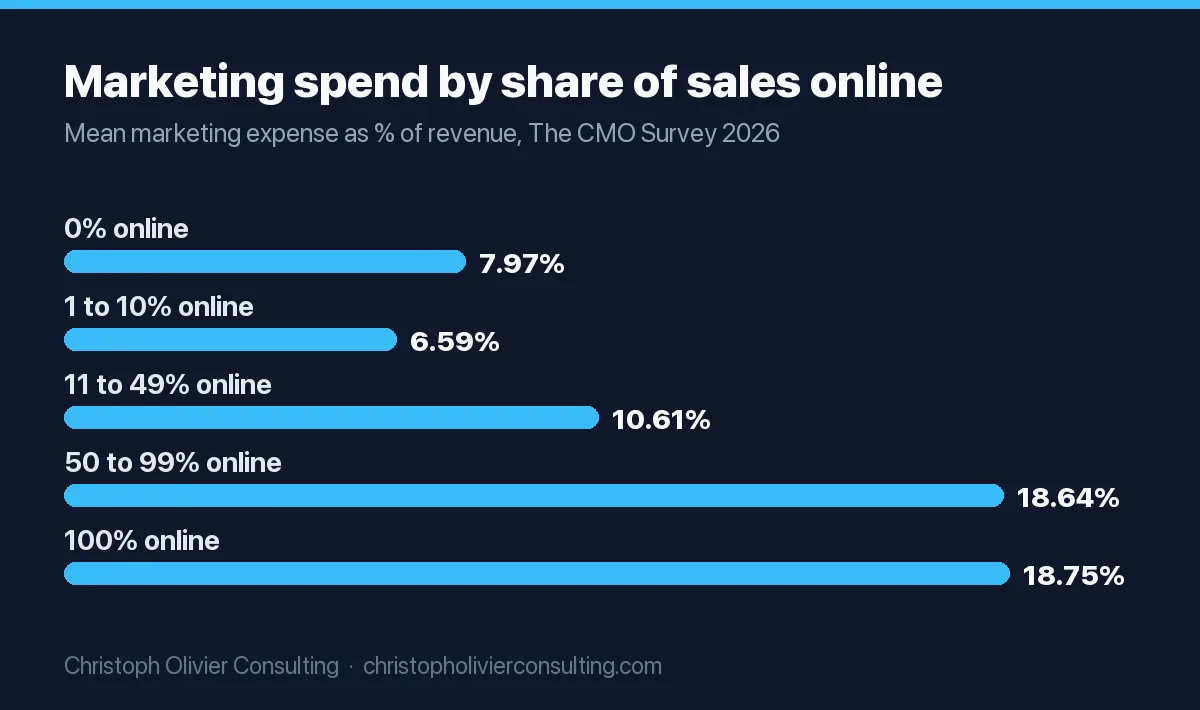
- Online sellers spend more of their revenue on marketing. In The CMO Survey 2026 breakout report (p. 125), companies with 50 to 99% of sales online reported marketing at a mean 18.64% of revenue, against 7.97% for companies with no online sales. Fully online companies averaged 18.75%. Those groups are small (11 and 4 responses, against 56 for no online sales), so read this as direction, not a target.
- Ecommerce is not marketing’s job by default. In the 2026 Topline Report (p. 30), marketing was primarily responsible for e-commerce in only 33.7% of companies, and for pricing in 28.2%. If you want your CMO judged on store revenue or promotions, write it into the scope.
- Seasonality concentrates the risk. Allbirds’ 2025 10-K notes that its sales are “typically higher during the end-of-year holiday period that falls within our fourth quarter.” A CMO who joins in October inherits a plan someone else built.
What public DTC brands spend on marketing
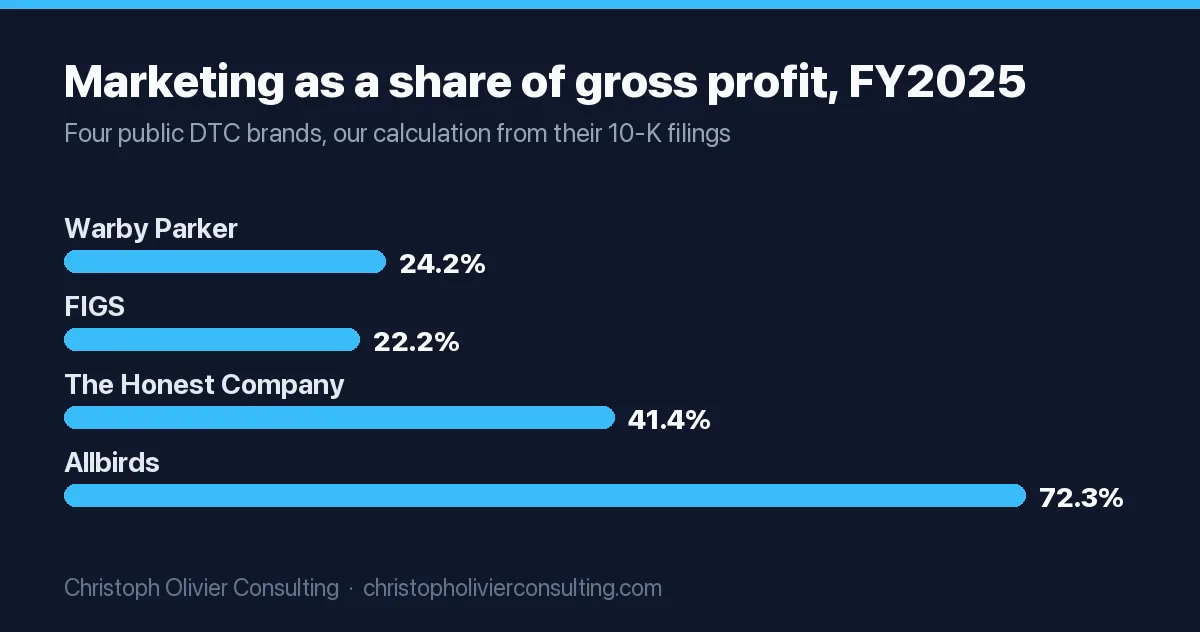
Agency blogs quote “spend 10 to 20% of revenue” without a source. Public direct-to-consumer brands have to report the real number. The table below is our own compilation from their fiscal 2025 annual reports. The last two columns are our calculations: marketing as a share of gross profit (how much of each margin dollar goes back into marketing) and revenue per marketing dollar, a company-level version of the blended MER (marketing efficiency ratio) a fractional CMO should report to you.
| Company (FY2025 10-K) | Net revenue | Marketing line, as reported | % of revenue | Gross margin | Marketing as % of gross profit | Revenue per marketing $ |
|---|---|---|---|---|---|---|
| Warby Parker | $871.9M | $113.9M advertising (includes sponsored search, online ads, Home Try-On) | 13.1% | 54.0% | 24.2% | 7.7x |
| FIGS | $631.1M | $93.1M marketing (mainly performance marketing, email and SMS) | 14.8% | 66.5% | 22.2% | 6.8x |
| The Honest Company | $371.3M | $51.2M marketing (includes retail customer marketing and point of purchase displays) | 13.8% | 33.3% | 41.4% | 7.3x |
| Allbirds | $152.5M | $45.2M marketing (advertising to acquire and retain customers and build awareness) | 29.7% | 41.0% | 72.3% | 3.4x |
Figures are as reported for the year ended December 31, 2025; gross margin is gross profit divided by net revenue (for Honest, net revenue minus reported cost of revenue). Each company defines its marketing line differently, so compare patterns, not decimals. The pattern is clear enough: three brands put 13 to 15% of revenue into marketing, which consumed 22 to 41% of gross profit. Allbirds raised marketing 8.6% in 2025 while net revenue fell from $189.8 million to $152.5 million, so marketing took 72.3% of its gross profit. That ratio, not platform ROAS, is the number an ecommerce CMO is hired to watch. The customer-level version of the same math is in our LTV to CAC guide.
What an ecommerce fractional CMO should own
A fractional CMO decides; your team, freelancers and agencies execute. In ecommerce the decisions sit closer to merchandising and finance than in most industries. Put each row below into the scope in writing.
| Area | The fractional CMO owns | Your team or vendors do | Evidence you should see |
|---|---|---|---|
| Unit economics | Break-even acquisition cost per first order and per customer, by channel | Pull order, fee and shipping data | One sheet: average order value, gross margin, fulfillment, payment fees, break-even CAC |
| Budget and channel mix | How much goes to paid social, search, marketplaces, email and SMS, affiliates and retail | Run the campaigns | A monthly budget split with a reason for each line |
| Measurement | Blended MER, new-customer CAC and contribution margin reconciled to store revenue | Build and maintain dashboards | A monthly report that ties to your Shopify or books, not to ad-platform claims |
| Retention | Repeat purchase targets and the flows that drive them | Write and build emails and SMS | Cohort repeat rates at 30, 60 and 90 days |
| Promotions and calendar | Discount depth, launch timing and the Q4 plan, agreed with whoever owns inventory | Produce creative and landing pages | A 12-month calendar signed off by operations |
| Agencies and hires | Agency scopes, performance reviews, hire or no-hire calls | Daily channel management | Rewritten scopes with exit terms and a monthly scorecard |
The measurement row matters most. MarketerHire’s ecommerce guide lists blended CAC, contribution margin per order, LTV to CAC, 30, 60 and 90-day retention and MER as the metrics a fractional CMO should own, and calls impressions and email opens “read-outs, not accountability targets.” Our fractional CMO role guide covers the role outside ecommerce.
Fractional vs full-time vs agency: year-one cost
Salary is not the cost of a hire. The BLS does not track “ecommerce CMO” or “head of ecommerce” as separate jobs; the closest series is marketing managers, with a median wage of $166,790 in May 2025 and a top 10% above $293,610. The BLS Employer Costs for Employee Compensation for June 2026 puts private-industry management, business and financial jobs at $59.85 an hour in wages, $8.47 in paid leave and $28.78 in total benefits. Because a salary already covers paid leave, the extra load is (28.78 minus 8.47) / (59.85 + 8.47) = 29.7%. For a retained search, Korn Ferry’s fiscal 2026 annual report says its fee is “generally one-third of the estimated first-year cash compensation of the placed candidate.”
| Option | Math (our calculation) | Year-one cost | Hours a year |
|---|---|---|---|
| Fractional ecommerce CMO, seed to $2M | $5,000 to $8,000 x 12 | $60,000 to $96,000 | About 520 |
| Fractional ecommerce CMO, $2M to $10M | $7,000 to $15,000 x 12 | $84,000 to $180,000 | 780 to 1,040 |
| Full-time marketing leader, BLS median, own network | $166,790 x 1.297 | $216,373 | 2,080 paid |
| Same, with retained search | $216,373 + one-third of $166,790 base | $271,970 | 2,080 paid |
| Full-time CMO, BLS top-decile pay, retained search | $293,610 x 1.297 + one-third of $293,610 | $478,764 | 2,080 paid |
| Ecommerce agency, all-in with execution | $15,000 to $60,000 a month (MarketerHire estimate) x 12 | $180,000 to $720,000 | Not comparable: buys execution, not leadership |
The search-fee rows use base salary only; a bonus raises both the cash compensation and the fee. The break-even is $216,373 / 12 = $18,031 a month: a fractional CMO billing more than that all year costs more than a median full-time hire found without a recruiter. MarketerHire’s general guide puts its own tipping point at fractional fees that consistently exceed $12,000 to $15,000 a month for six months or more. If you are weighing an agency instead, our guide to hiring an ecommerce marketing agency covers scopes and contract terms.
Will the fee pay for itself? A payback model for online stores
Here is the test nobody in the current search results runs. A fractional CMO is a fixed cost. It pays back only if the extra sales it produces leave enough contribution margin to cover the fee. Copy this formula:
Revenue lift needed per year = (monthly fee x 12) / contribution margin %, where contribution margin is what is left of each extra sales dollar after product cost, fulfillment and shipping, payment fees and the ad spend that produced the sale.
Our calculation below runs MarketerHire’s published ecommerce fees through two contribution margins, 25% and 35% (assumptions, not benchmarks; use your own). The last column compares the fee with a marketing budget at The CMO Survey’s 18.64% of revenue for mostly-online companies.
| Stage and published fee | Annual fee | Lift needed at 25% margin | Lift needed at 35% margin | Example revenue | Lift at 35% as % of revenue | Fee as % of an 18.64% marketing budget |
|---|---|---|---|---|---|---|
| Seed to $2M: $5,000 to $8,000 a month | $60,000 to $96,000 | $240,000 to $384,000 | $171,429 to $274,286 | $1.5M | 11.4% to 18.3% | 21.5% to 34.3% |
| $2M to $10M: $7,000 to $15,000 a month | $84,000 to $180,000 | $336,000 to $720,000 | $240,000 to $514,286 | $5M | 4.8% to 10.3% | 9.0% to 19.3% |
| $10M to $30M: $12,000 to $22,000 a month | $144,000 to $264,000 | $576,000 to $1,056,000 | $411,429 to $754,286 | $20M | 2.1% to 3.8% | 3.9% to 7.1% |
Read it from the bottom up. At $20 million, the engagement has to add 2 to 4% to revenue to cover itself, a modest bar. At $1.5 million it has to add 11 to 18%, and the fee alone would eat a fifth to a third of a typical online seller’s marketing budget. That is why the fit table below says no for most stores under about $2 million. The same logic applies to any quote: if the lift it needs is larger than the growth you could plausibly add, the price is wrong for your stage, whoever is selling it.
When hiring a fractional CMO makes sense, and when it does not
Find the row that matches your store. Several of them say you should buy something cheaper, and those are the rows that save the most money.
| Your situation | Best option | Why |
|---|---|---|
| Under about $1M revenue, founder runs the ads | Do it yourself, plus a one-off 20 to 40 hour audit ($2,000 to $8,000 at Chief Outsiders’ published independent-consultant rates) | The payback table needs double-digit growth just to cover a monthly retainer |
| One channel is the problem (Meta costs rising, email flows missing) | A channel specialist at $3,000 to $8,000 a month | You need hands, not a strategy; start with our ecommerce email flows guide if retention is the gap |
| Most sales come from Amazon or another marketplace | A marketplace specialist or agency first | Listing, advertising and inventory rules inside the marketplace drive results more than brand strategy |
| Gross margin is thin or falling and discounts are frequent | Fix pricing, product cost and shipping with finance first | No marketing plan pays back on a margin that cannot carry acquisition; our fractional CFO vs CMO comparison helps decide who to bring in |
| $2M to $30M, two or more agencies or freelancers, nobody owns blended MER or contribution margin | Fractional CMO | The budget is large enough that misallocation is expensive, and the fee clears the payback bar at a realistic lift |
| Preparing to raise capital or sell, and need clean marketing numbers | Fractional CMO for 6 to 12 months | Investors and buyers ask for cohort, CAC and margin data that someone senior has to stand behind |
| Above $30M, or a marketing team of 10 or more | Full-time CMO, with a fractional leader only as a bridge | MarketerHire’s tipping point (team over 10, fees above $12,000 to $15,000 for six months) is usually crossed |
| You need creative, video or a new Shopify build | A production studio, agency or developer | A CMO directs that work; paying CMO rates for production is the most common mismatch |
Not sure which row your store is in?
Bring your last 12 months of revenue and margin, your agency invoices and any proposal you have. In a free consultation we will run the payback math with you, including whether a cheaper option fits better.
The first 90 days in an online store
MarketerHire’s ecommerce guide splits the first quarter into diagnose (days 1 to 30), plan (31 to 60) and execute (61 to 90). The pass and fail tests are my working rules, not published standards.
- Days 1 to 30: get one version of the truth. Reconcile ad-platform revenue to store revenue, calculate contribution margin per order by channel and by top products, and read every agency contract. Pass: a single monthly report your finance person agrees with. Fail: the CMO is still quoting platform ROAS in week four.
- Days 31 to 60: set the budget and the calendar. Write the channel budget with a break-even CAC for each line, the retention plan with cohort targets, and a 12-month promotion calendar agreed with inventory. Pass: every budget line has a stop rule. Fail: the plan is a list of tactics with no numbers.
- Days 61 to 90: run it and make the first hard call. Weekly reviews against the plan, one decision on each agency (keep, rescope or end) and one on hiring. Pass: at least one change you would not have made yourself, with the reason in writing. Fail: the CMO has started doing the execution work instead of directing it.
Ecommerce marketing consultant, fractional CMO or head of ecommerce?
These titles get used interchangeably in search results, but they buy different things.
| Title | What you are buying | Typical published price |
|---|---|---|
| Ecommerce marketing consultant | Advice or a defined project: an audit, a channel plan, a pricing test. Does not manage your team | $100 to $200 an hour (Chief Outsiders, independent consultants); $2,000 to $5,000 a month (MarketerHire, marketing consultant) |
| Fractional CMO | Ongoing ownership of the marketing plan, budget, measurement and vendors | $5,000 to $22,000 a month by stage (MarketerHire, July 2026) |
| Head or VP of ecommerce (often called an ecommerce director) | The storefront itself: site, merchandising, conversion, marketplace operations. Often reports to the CEO or CMO | No BLS series of its own; marketing managers are the nearest federal benchmark at a $166,790 median |
| Ecommerce agency | Execution across channels, with strategy included to varying depth | $15,000 to $60,000 a month all-in (MarketerHire estimate) |
If your problem is that the site converts poorly or the catalog is a mess, you need ecommerce operations help, not a CMO. If the problem is that nobody can tell you which marketing dollar makes money, you need a CMO.
Questions to ask before you hire a DTC fractional CMO
Copy these into your interview notes. A strong candidate answers with your numbers in mind; a weak one answers with theirs.
| Question | Pass | Fail |
|---|---|---|
| How do you calculate our break-even CAC on a first order? | Average order value x gross margin, minus fulfillment, shipping and payment fees; asks for your figures | Names a ROAS target without asking about margin |
| Which numbers will you report to me every month? | Blended MER, new-customer CAC, contribution margin and cohort repeat rate, tied to store revenue | Platform ROAS, impressions, open rates |
| What will you not do yourself, and who does it? | A clear list (ad builds, design, development) with a named owner for each | “Whatever you need” |
| How do you plan Q4? | Starts with inventory and cash, then promotion depth, then media | Starts with a discount |
| How many hours a week, and what happens to unused hours? | A written number and a rule for rollover or credit | “It flexes” |
| When would you tell us not to hire you? | Names conditions such as thin margins, one broken channel or revenue too small for the fee | Cannot name one |
Once you have a candidate, put the hours, the owned metrics and the exit terms into the agreement; our fractional CMO contract template has the clauses.
Where CO Consulting fits
To be plain about what we offer: CO Consulting provides fractional CMO services as a monthly retainer of 20 to 40 hours a month with a 3 to 6 month minimum, as a fixed project, or as a few hours a week of advisory work. The CMO directs content, ad builds, design and video production rather than doing them, and our published client focus is professional-service firms and service businesses, not online retail. Our services do include paid advertising on Google, Meta and YouTube, email and SMS automation and SEO, so for a store the useful first step is a short conversation about whether your situation matches the fit table above. If you need a Shopify developer, a marketplace specialist or a production studio instead, we will say so. Book a consultation and bring your numbers and any quotes you have.
Ready to scale your revenue?
Book a free 30-min consultation. We’ll diagnose your growth bottleneck and map out the 3 highest-leverage moves for your business.
Frequently asked questions
How much does a fractional CMO charge for an ecommerce brand?
MarketerHire's July 2026 ecommerce guide lists $5,000 to $8,000 a month below $2 million in revenue, $7,000 to $15,000 between $2 million and $10 million, and $12,000 to $22,000 between $10 million and $30 million, at roughly 10 to 25 hours a week. Hourly fractional CMOs publish $150 to $350 an hour. These are seller asking prices, so convert any quote to an effective hourly rate before comparing.
What does an ecommerce marketing consultant do?
An ecommerce marketing consultant gives advice or delivers a defined project, such as a channel audit, a retention plan or a pricing test, without managing your team. Chief Outsiders publishes $100 to $200 an hour for independent consultants. A fractional CMO is different: it takes ongoing ownership of the marketing plan, budget, measurement and agencies, usually on a monthly retainer.
How much should I pay a marketing consultant for my online store?
Published rates run $100 to $200 an hour for independent consultants (Chief Outsiders, October 2026) and $2,000 to $5,000 a month for a marketing consultant retainer (MarketerHire, April 2026). For a store under about $1 million in revenue, a one-off 20 to 40 hour audit, about $2,000 to $8,000 at those hourly rates, is usually a better buy than a monthly retainer.
Is a fractional CMO worth it for a DTC brand?
It depends on whether the fee can pay back. Divide the annual fee by your contribution margin to get the revenue lift needed. At a 35% margin, a $7,000 to $15,000 monthly fee needs $240,000 to $514,286 of extra revenue a year, about 5 to 10% growth for a $5 million brand but far more for a $1.5 million one. Most fits fall between $2 million and $30 million.
What is an ecommerce director or head of ecommerce?
A head of ecommerce, often titled ecommerce director, runs the storefront itself: the site, merchandising, conversion and marketplace operations. A CMO owns the marketing plan, budget and measurement that bring buyers to it. The BLS does not track the role separately; its nearest series, marketing managers, had a median wage of $166,790 in May 2025.
When should an ecommerce brand hire a full-time CMO instead?
Consider full-time when your fractional fees would exceed about $18,031 a month all year, the loaded cost of a BLS-median marketing leader, or when MarketerHire's tipping points apply: fractional fees above $12,000 to $15,000 a month for six months or more, or a marketing team of 10 or more people. Above about $30 million in revenue that is usually the case.
Fractional CMO: cost, fit and industries