
A fractional CMO for a private equity portfolio company is a part-time chief marketing officer, usually brought in after the deal closes, who owns the marketing part of the value creation plan: the growth targets, the budget, the agencies and the reporting the board and the next buyer will check. Published rates for PE-backed companies run from $5,000 to $15,000 a month, or about $60,000 to $180,000 a year. A median full-time marketing leader hired through retained search costs about $276,000 in year one. Whether either one pays back depends on one number your deal team already has: the annual EBITDA growth the plan needs.
Short answer: MarketerHire lists $8,000 to $15,000 a month for a fractional CMO at a PE-backed or post-acquisition company that is building marketing from scratch (April 2026), and $5,000 to $12,000 a month for 10 to 20 hours a week in its PE guide (June 2026). Bain says a typical buyout now needs 10% to 12% annual EBITDA growth to hit a 2.5x return. A fractional CMO fits portfolio companies where a full-time leader would eat most of that growth target; above roughly $30 million to $50 million in revenue, a full-time hire usually wins.
Below: why marketing in a portfolio company runs on a different clock, every published rate with its source, year-one math against a full-time hire, an EBITDA payback test built for this page, what marketing should own at each stage of the hold, a 100-day plan with pass/fail tests, an honest fit table, and an exit-ready data checklist.
Why portfolio company marketing runs on a different clock
A founder can wait three years for a brand to compound. A sponsor usually cannot, and the math has become harder. In its Global Private Equity Report 2026 (February 2026), Bain estimates that a typical 2015 deal needed about 5% annual EBITDA growth to return 2.5x over a five-year hold. Today it needs closer to 10% to 12%, because falling rates and rising multiples, which powered over 50% of buyout returns in the earlier era, are mostly gone. Bain’s benchmark multiples were 10.0x entry and 12.5x exit for 2015, against 14.0x entry and 15.0x exit for 2025.
Bain’s press release for the same report (February 23, 2026) adds that holding periods at exit now hover around seven years, with 32,000 unsold companies worth $3.8 trillion, and quotes Bain’s Rebecca Burack: “Generating attractive returns now requires significantly more operational improvement and revenue growth.” Revenue growth is the part marketing can own.
The exit side points the same way. EY’s Global PE Exit Readiness Study 2026 (100 PE executives and 100 executives of recently exited portfolio companies, surveyed February to April 2026) found:
- 86% of GPs said exit preparation improved their exit valuations.
- Firms that started preparing 12 to 24 months before the sale reported the strongest results, with roughly 50% saying preparation delivered “much” or “a great deal” of improvement. Firms that started less than six months out reported materially weaker outcomes.
- 60% of GPs called building a solid set of data and KPIs their hardest finance-function issue, down from 72% the year before.
- Evidencing value creation initiatives in exit EBITDA was the top challenge and had the biggest impact on outcomes. EY’s own example is a roll-up that claims cross-selling success but lacks customer-level data to prove it.
That last point is marketing’s real job in a portfolio company: not only producing growth, but producing growth a buyer’s diligence team can verify, by customer and by segment.
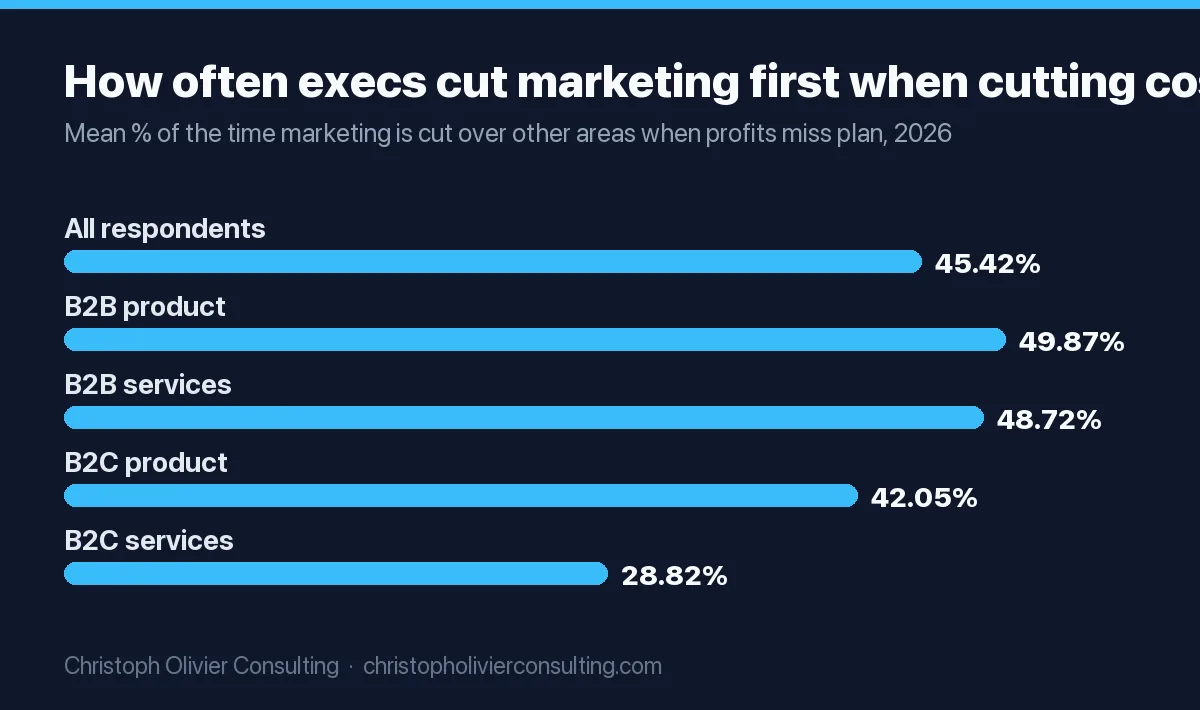
There is a structural risk too. In The CMO Survey 2026 breakout report (Duke Fuqua, Deloitte and the AMA), when profits ran below plan and leadership decided to cut costs, executives cut marketing ahead of other areas 45.42% of the time on average (160 responses). In a hold period with quarterly EBITDA reviews, that reflex is the default unless someone senior defends the budget with numbers.
What a fractional CMO costs a portfolio company: published rates
All figures below come from firms that sell fractional or consulting talent. None cites an independent survey, so treat them as asking-price benchmarks and always ask for the hours behind a monthly number.
| Engagement | Published rate | Hours or scope | Source |
|---|---|---|---|
| Fractional CMO, PE-backed or post-acquisition | $8,000 to $15,000 a month | Build the marketing function from scratch | MarketerHire cost guide, April 2026 |
| Fractional CMO or VP Marketing in a PE-backed company | $5,000 to $12,000 a month | 10 to 20 hours a week | MarketerHire PE guide, June 2026 |
| Fractional channel specialists | $3,000 to $8,000 a month each | 10 to 20 hours a week each | MarketerHire PE guide, June 2026 |
| Lean fractional team, $10M to $20M revenue company | $15,000 to $30,000 a month | CMO plus specialists plus tools, media separate | MarketerHire PE guide, June 2026 |
| Fractional CMO, strategy only (any company) | $3,000 to $6,000 a month | 5 to 10 hours a week | MarketerHire cost guide, April 2026 |
| Fractional CMO, strategy plus execution oversight | $7,000 to $12,000 a month | 15 to 20 hours a week | MarketerHire cost guide, April 2026 |
| Fractional CMO | $8,000 to $15,000 a month | 10 to 15 hours a week | Prose, April 2025 |
| Executives-as-a-service firm, retainer | $1,500 to over $30,000 a month, about $300 to $500 an hour equivalent | Not stated | Chief Outsiders, updated October 2026 |
| Independent marketing consultant | $100 to $200 an hour, some $450 and up | Not stated | Chief Outsiders, updated October 2026 |
| Senior agency management | $300 to $600 an hour | Not stated | Chief Outsiders, updated October 2026 |
Two quotes are only comparable at the same hours. Convert each to an hourly rate: monthly fee divided by (weekly hours x 52 / 12). A $12,000 retainer for 15 hours a week is 65 hours a month, or $185 an hour. If you already have a proposal from a fractional firm or an independent operator, you can book a consultation and we will check its hours, scope and term against this table with you. The tier-by-tier detail for non-PE companies is in our fractional CMO cost guide.
Fractional vs full-time CMO in a portfolio company: year-one cost
Salary is not the cost of a hire. Three public inputs give a defensible number:
- Salary. The BLS puts the median marketing manager wage at $166,790 in May 2025, with the top 10% above $293,610. BLS has no separate CMO series; our CMO salary guide uses the same anchors.
- Benefits. In BLS Employer Costs for Employee Compensation, June 2026, private-industry management, business and financial jobs cost $88.63 an hour: $59.85 wages, $8.47 paid leave, $4.89 supplemental pay and $28.78 total benefits. Since salary already covers paid leave, the load is ($28.78 minus $8.47) / ($59.85 + $8.47) = 29.7%.
- Search fee. Korn Ferry’s fiscal 2026 annual report says its search fee is “generally one-third of the estimated first-year cash compensation of the placed candidate,” plus a percentage for expenses.
| Option | Math (our calculation) | Year-one cost |
|---|---|---|
| Fractional CMO, low end of PE guide range | $5,000 x 12 | $60,000 |
| Fractional CMO, PE-backed tier | $8,000 to $15,000 x 12 | $96,000 to $180,000 |
| Full-time leader at BLS median, own network | $166,790 x 1.297 | $216,373 |
| Full-time leader at BLS median, retained search | $216,373 + one-third of $178,728 first-year cash (salary plus 7.16% supplemental pay) | $275,949 |
| Full-time leader at BLS top decile, retained search | $293,610 x 1.297 = $380,894; + one-third of $314,624 first-year cash | $485,769 |
The search fee is not the only delay cost. A full-time search takes months, and the 100-day plan starts at close. That gap is why many sponsors put an interim or fractional leader in first; the trade-offs between those two are in our fractional vs interim CMO comparison. MarketerHire’s PE guide suggests considering a full-time leader past $30 million to $50 million in revenue, and its cost guide puts the tipping point at fractional fees that consistently exceed $12,000 to $15,000 a month for six months or more.
The EBITDA test: what a marketing leader has to earn back
This is the table we have not seen on any page that ranks for this topic. It takes Bain’s 10% to 12% EBITDA growth bar and asks how much of it a marketing leader’s own cost uses up, before the leader has produced anything.
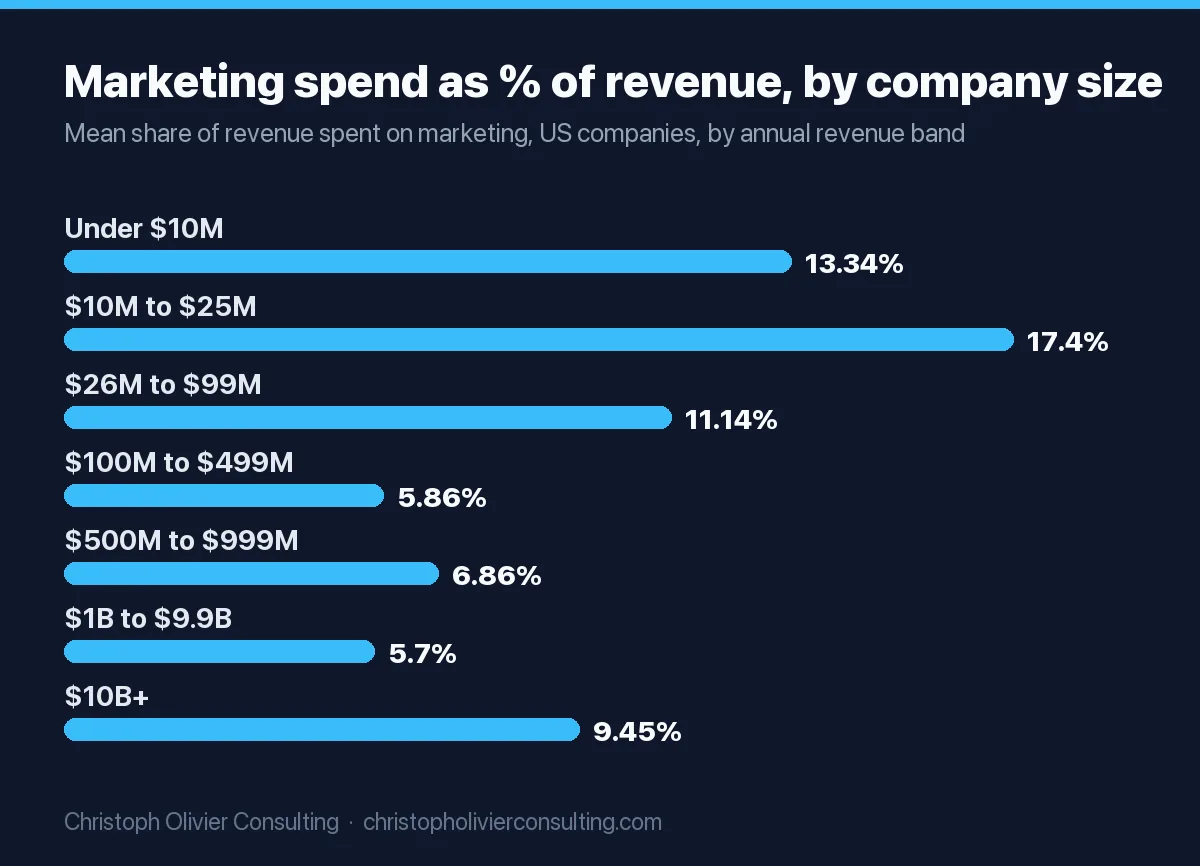
Our calculation. Assumptions: Company A has $12 million revenue at a 15% EBITDA margin. Company B has $40 million revenue at a 12.5% margin. Both are illustrative, not data. New revenue converts to EBITDA at an assumed 30% incremental margin; use your own contribution margin. Leadership costs come from the table above. Exit multiples are Bain’s 2015 and 2025 benchmarks; smaller companies usually trade lower, as the deal data in our home services EBITDA multiples report shows.
| Line | Company A: $12M revenue, $1.8M EBITDA | Company B: $40M revenue, $5.0M EBITDA |
|---|---|---|
| Year-one EBITDA growth target at 10% to 12% | $180,000 to $216,000 | $500,000 to $600,000 |
| Fractional CMO, $96,000 to $180,000, as share of that target | 44% to 100% | 16% to 36% |
| Full-time median hire via search, $275,949, as share of that target | 128% to 153% | 46% to 55% |
| New revenue needed just to cover a $180,000 fractional year at 30% margin | $600,000 | $600,000 |
| New revenue needed just to cover the $275,949 full-time year | $919,830 | $919,830 |
| Exit value lost if a $180,000 run-rate cost produces nothing, at 12.5x / 15.0x | $2.25M / $2.70M | $2.25M / $2.70M |
| Exit value lost if a $275,949 run-rate cost produces nothing, at 12.5x / 15.0x | $3.45M / $4.14M | $3.45M / $4.14M |
| Marketing budget at The CMO Survey means (B2B product 7.02%, B2B services 10.07%) | $842,400 to $1,208,400 | $2,808,000 to $4,028,000 |
How to read it: at Company A, a full-time leader costs more than the whole first-year EBITDA growth target, so to still hit the target the business has to add roughly 25% to 27% to EBITDA in year one, counting the hire’s own cost. A fractional leader at the lower end of the range is the only option that leaves room. At Company B, both work on paper, and the deciding question becomes how many leadership hours the plan really needs. A run-rate cost is capitalized at the exit multiple in reverse, which is why a sponsor should hold any marketing leader, fractional or full-time, to a written revenue target before the engagement starts. Our LTV:CAC guide covers the unit economics that target should rest on.
What marketing should own at each stage of the hold
Chief Outsiders’ PE page splits a hold into four deal stages: due diligence, early post-acquisition, mid-investment and pre-exit. The table below uses the same split and adds what a marketing leader should hand over at each stage, with the evidence a buyer will later look for.
| Stage | Marketing owns | Deliverable | Evidence that survives diligence |
|---|---|---|---|
| Diligence and close | Testing the revenue growth assumptions in the deal model | A list of which growth levers in the model rely on marketing, with a baseline for each | Customer and pipeline data reconciled to the general ledger |
| First 100 days | Baseline, measurement, budget reset, quick wins | A marketing section of the value creation plan with quarterly targets | One KPI definition sheet signed off by the CFO |
| Hold years 1 to 3 | Building a repeatable demand engine; integrating add-ons | Channel mix with stop rules; brand decision for each add-on | Cohort revenue by acquisition channel and by customer segment |
| 12 to 24 months before exit | The growth story and the data behind it | Marketing section of the equity story; clean CRM history | Cross-sell and retention proven at customer level, the gap EY flags |
| Sale process | Supporting management presentations and data room requests | Answers to buyer questions on pipeline, CAC and churn | Numbers that match what finance reports |
The first 100 days after close: a plan with pass/fail tests
MarketerHire’s PE guide sequences an audit in days 1 to 14, metric alignment in days 7 to 10, tracking in days 10 to 30, a channel test in days 20 to 40 and a 12-month plan in days 60 to 90. The version below keeps that order and adds a pass/fail test to each step, so the operating partner can tell at day 100 whether the engagement is working. The pass thresholds are ours, not industry standards.
- Days 1 to 14: audit. Inventory every channel, agency contract, tool and the last 24 months of spend. Pass: a one-page spend table that matches the general ledger within 5%. If the company has never had an outside review, our page on what a marketing audit costs shows what one should include.
- Days 7 to 21: one set of definitions. Agree with the CFO what counts as a lead, an opportunity, a new customer and CAC. Pass: the board pack and the marketing dashboard report the same new-customer count.
- Days 15 to 45: tracking. Every closed deal or order traceable to a source. Pass: at least 80% of last month’s new revenue has a recorded source.
- Days 30 to 60: budget reset. Cut or pause channels with no traceable revenue; move the money to one or two tests. Pass: each remaining line has a maximum cost per customer and a kill date.
- Days 45 to 90: team and vendors. Rewrite agency scopes, decide hire or no-hire for execution roles. Pass: every vendor has a written scope with a measurable deliverable.
- Days 75 to 100: the marketing plan inside the value creation plan. Pass: quarterly revenue targets the CFO has signed, tied to the EBITDA growth figure in the deal model.
When a fractional CMO makes sense for a portfolio company, and when it does not
A fractional CMO is not the right answer for every portfolio company. Sometimes a cheaper option, or a full-time hire, is better. The revenue thresholds below are our rules of thumb, except the $30 million to $50 million line, which is MarketerHire’s.
| Situation | Better option | Why |
|---|---|---|
| Under about $5M revenue, one channel produces most new customers | A channel specialist plus founder or CEO oversight | At $3,000 to $8,000 a month, a specialist fixes the channel; CMO fees would take most of the EBITDA growth target |
| $5M to $30M revenue, no senior marketer, 100-day plan due | Fractional CMO | Leadership hours matched to need, starts within weeks, cost leaves room in the growth target |
| Strong marketing manager in place, needs direction only | Advisory a few hours a week, or growth consulting | You are buying decisions, not management |
| CMO just left, team is senior, search under way | Interim or fractional as a bridge | Keeps the plan moving until the hire starts |
| Over $30M to $50M revenue, multiple teams, marketing is a core growth lever | Full-time CMO | Fractional fees would pass the $12,000 to $15,000 a month tipping point MarketerHire describes |
| Growth problem is really sales capacity or pricing | Sales leadership or a pricing project | More leads will not fix a closing or margin problem |
| Only need diligence on a target before you buy | A commercial due diligence provider | That is transaction work, not ongoing marketing leadership |
Check your portfolio company against the EBITDA test
Bring revenue, EBITDA, the growth target in your plan and any marketing proposals you have. In a free consultation we will work out which row of the fit table you are in, including whether you need a fractional CMO at all.
Exit-ready marketing data: a pass/fail checklist
EY found that most firms struggle to prove value creation in exit EBITDA, and that the earliest preparers did best. Run this checklist at least 18 months before a planned sale. Each line is pass or fail; the thresholds are ours.
| Check | Pass if |
|---|---|
| Revenue by acquisition source | 24+ months of new-customer revenue tagged by source, reconcilable to finance |
| Cohort retention | Revenue retention by annual customer cohort, by segment |
| Cross-sell proof (platforms with add-ons) | Customer-level records of which acquired customers bought a second service line |
| CAC and payback | Fully loaded CAC (people, agencies, tools, media) by quarter, with the method written down |
| Pipeline history | Stage-by-stage pipeline snapshots kept monthly, not overwritten |
| Brand and domains | Every acquired brand has a documented keep, merge or retire decision; domains and accounts owned by the company, not an agency |
| Owner dependence | No single person, inside or outside, holds the only login or knowledge of a key channel |
Questions to ask before you sign a fractional CMO
- Which line of our value creation plan will you own, and what number will you commit to by quarter?
- How many hours a month does the fee buy, and what happens to unused hours?
- What will you do personally, and what will you direct others to do?
- Have you worked under a board or operating partner reporting cadence? Show us a redacted monthly report.
- How would you handle a quarter where the CFO wants to cut marketing to protect EBITDA?
- What is the minimum term, and what does a clean handover to a full-time hire look like?
- Who owns the accounts, data and agency contracts you set up?
Put the answers to questions 2, 6 and 7 into the agreement. Our fractional CMO contract template has clauses for hours, term, handover and data ownership.
Where CO Consulting fits
To be plain about what we do: CO Consulting provides fractional CMO leadership to companies, typically service businesses in roughly the $2 million to $50 million revenue range. Our fractional CMO services run as a monthly retainer of 20 to 40 hours a month with a 3 to 6 month minimum, as a fixed project such as an audit, rebrand plan or go-to-market strategy, or as advisory a few hours a week. The fractional CMO owns strategy, budget allocation, vendor decisions, team leadership and hiring input, KPI and attribution reporting, and sales and marketing alignment, and directs rather than performs content writing, ad building, design and video. We do not do transaction work such as commercial due diligence on a target or sell-side materials; we work inside the company once it is yours. If your portfolio company fits the middle rows of the fit table, book a consultation and bring the numbers from the EBITDA test.
Ready to scale your revenue?
Book a free 30-min consultation. We’ll diagnose your growth bottleneck and map out the 3 highest-leverage moves for your business.
Frequently asked questions
How much does a fractional CMO charge a private equity portfolio company?
MarketerHire lists $8,000 to $15,000 a month for PE-backed or post-acquisition companies building marketing from scratch (April 2026), and $5,000 to $12,000 a month for 10 to 20 hours a week in its June 2026 PE guide. That is roughly $60,000 to $180,000 a year. These are seller-published ranges, so always ask how many hours a month the fee buys.
Should a PE portfolio company hire a fractional or full-time CMO?
Compare the leader's year-one cost with the EBITDA growth the plan needs. Bain says typical buyouts now need 10% to 12% annual EBITDA growth. A median full-time marketing leader found through retained search costs about $275,949 in year one by our BLS-based math, more than the whole growth target at a $1.8 million EBITDA company. Above roughly $30 million to $50 million in revenue, full-time usually fits better.
What should a fractional CMO do in the first 100 days after an acquisition?
Audit spend and contracts against the general ledger, agree KPI definitions with the CFO, fix tracking so new revenue has a recorded source, reset the budget toward one or two tests with kill dates, rewrite agency scopes, and deliver the marketing section of the value creation plan with quarterly revenue targets signed off by finance by day 100.
How much should I pay a marketing consultant?
Chief Outsiders' October 2026 cost guide puts independent marketing consultants at $100 to $200 an hour, with some at $450 and up, and executives-as-a-service firms at about $300 to $500 an hour equivalent. MarketerHire lists fractional CMOs at $150 to $350 an hour. Compare quotes by converting monthly retainers to an hourly rate at the hours promised.
When should a portfolio company start preparing marketing for exit?
EY's Global PE Exit Readiness Study 2026 found that firms starting exit preparation 12 to 24 months before a sale reported the strongest results, while those starting under six months out did materially worse. For marketing, that means clean source-tagged revenue, cohort retention and customer-level cross-sell data at least 18 months before a planned process.
Fractional CMO: cost, fit and industries