
A fractional CMO for a cybersecurity company is a part-time marketing executive who owns positioning, pipeline targets, the budget and the vendor bench for a security vendor or security services firm, usually 8 to 25 hours a week on a monthly retainer. Cybersecurity specialists publish rates from about $7,000 to $18,000 a month in 2026, or $84,000 to $216,000 a year, against roughly $250,000 a year for a full-time marketing manager in the information sector once benefits are added. The model fits best between founder-led sales and the point where pipeline targets need a full-time leader every day.
Short answer: Expect $7,000 to $9,000 a month for advisory work at 8 to 10 hours a week, $9,000 to $13,000 for a standard engagement, and $13,000 to $18,000 for an embedded build of demand generation, ABM and analyst relations, per one cybersecurity specialist’s August 2026 rate table. A full-time hire at the BLS information-industry median costs about $249,856 a year with benefits, before a search fee. Fractional wins on cost until the retainer passes about $20,800 a month.
Below: published rates with sources, what public security vendors actually spend on sales and marketing according to their own 10-Ks, a year-one cost model, an honest fit and no-fit table, a 90-day plan built around a long security sales cycle, and interview questions with pass/fail answers. If you already have quotes in hand, I am happy to check your quote and scope against these tables on a free call, whether or not you hire us.
What a cybersecurity fractional CMO costs: published 2026 rates
Every figure below comes from a firm that sells fractional or agency marketing, so treat them as asking prices, not survey data. Ask every candidate for the weekly hours behind a monthly number, then compare effective hourly rates.
| Engagement | Published monthly rate | Hours a week | Source and date |
|---|---|---|---|
| Cybersecurity fractional CMO, advisory or strategy only | $7,000 to $9,000 | About 8 to 10 | MarkCMO rate table, checked August 20, 2026 |
| Cybersecurity fractional CMO, standard | $9,000 to $13,000 | About 10 to 18 | MarkCMO, August 2026 |
| Cybersecurity fractional CMO, embedded GTM build (demand gen, ABM, analyst relations) | $13,000 to $18,000 | About 18 to 25 | MarkCMO, August 2026 |
| Cybersecurity fractional CMO, month to month | From $7,000 | Not stated | GTM 80/20, updated November 22, 2026 |
| Generalist fractional CMO, Series A stage | $5,000 to $10,000 | 15 to 20 | MarketerHire, April 15, 2026 |
| Generalist fractional CMO, Series B and later | $10,000 to $15,000 | Not stated | MarketerHire, April 2026 |
| Executives-as-a-service firm retainer | $1,500 to over $30,000 (about $300 to $500 an hour) | Not stated | Chief Outsiders, updated October 26, 2026 |
| Independent marketing consultant, hourly | $100 to $200 an hour, some $450 and up | As needed | Chief Outsiders, October 2026 |
MarketerHire adds that a fractional CMO with deep vertical expertise charges roughly 20 to 30% more than a generalist. Apply that to its Series A band and you get $6,000 to $13,000 a month (our calculation: $5,000 x 1.2 and $10,000 x 1.3), which lines up with the specialist rate cards above. In other words, the “cybersecurity premium” is real but modest. The bigger price driver is hours.
Convert every quote to an hourly rate: monthly fee divided by (weekly hours x 52 / 12). On MarkCMO’s own table, the advisory tier works out to about $202 to $208 an hour, while the standard tier ranges from $115 an hour ($9,000 at 18 hours a week) to $300 an hour ($13,000 at 10 hours). Two quotes that look $4,000 apart can be the same effective rate with different hours. The broader rate set for all industries is in our fractional CMO cost guide.
What a cybersecurity marketing agency costs instead
Agencies sell execution, not a seat at the leadership table, and their published prices sit higher because they include production hours. MarketerHire’s July 22, 2026 agency guide lists content-only retainers at $5,000 to $10,000 a month, demand generation at $10,000 to $25,000, ABM at $15,000 to $40,000 and full service at $25,000 to $75,000. For PR, 5W Public Relations says its tech and cybersecurity retainers start around $15,000 a month and run to $75,000 or more (November 2026). Neither cites a survey; both are sellers.
What public security vendors spend on sales and marketing
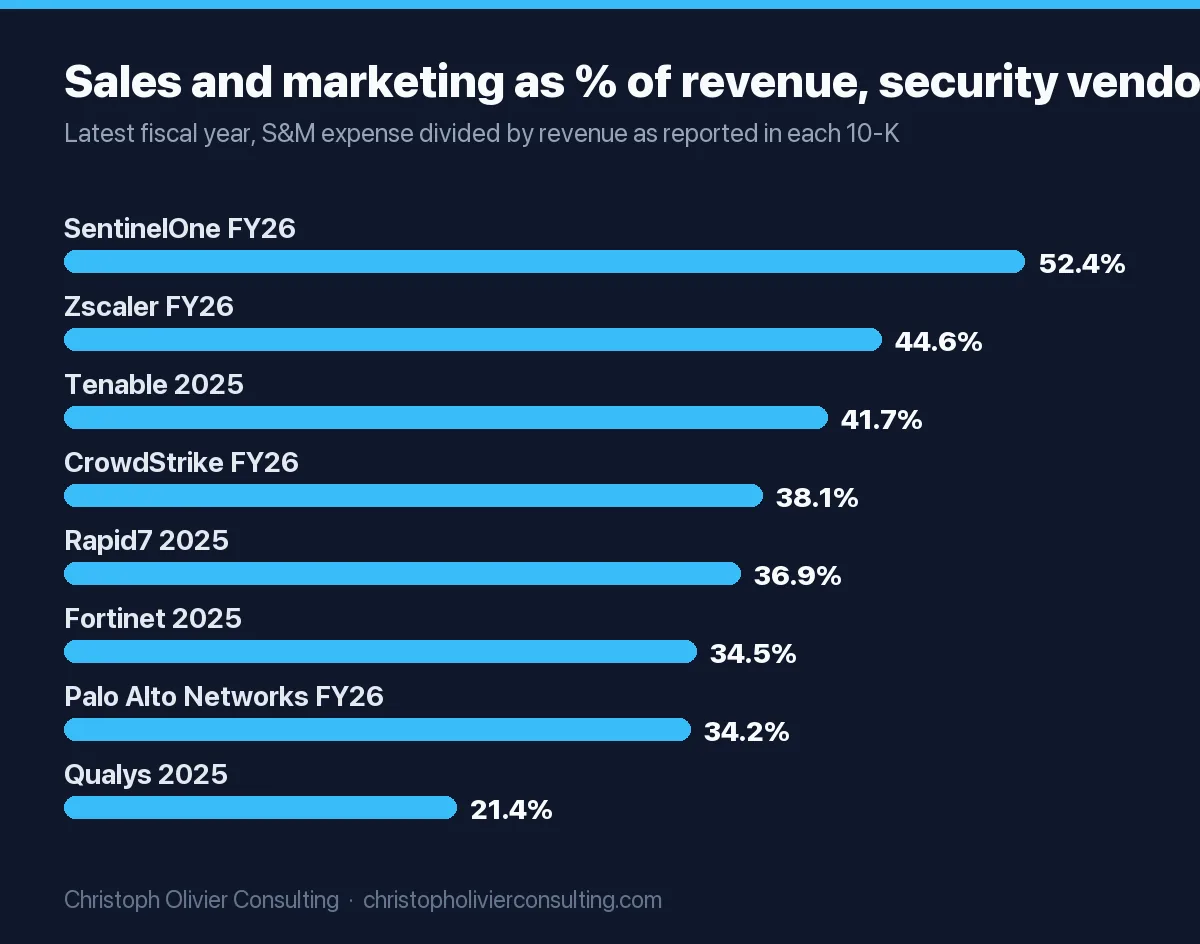
No survey reliably reports marketing budgets for private cybersecurity startups, so the best public benchmark is the 10-K. The table below is compiled from each company’s latest annual report on SEC EDGAR. Sales and marketing (S&M) here is the line reported in the income statement; it includes sales headcount, commissions, sales engineers, events and partner programs, not just marketing.
| Company | Fiscal year | S&M expense (reported) | Revenue (reported) | S&M as % of revenue (our calculation) |
|---|---|---|---|---|
| SentinelOne 10-K | FY ended Jan 31, 2026 | $525.2M | $1,001.3M | 52.4% |
| Zscaler 10-K | FY ended Jul 31, 2026 | $1,495.8M | $3,352.5M | 44.6% |
| Tenable 10-K | FY 2025 | $416.9M | $999.4M | 41.7% |
| CrowdStrike 10-K | FY ended Jan 31, 2026 | $1,831.3M | $4,812.0M | 38.1% |
| Rapid7 10-K | FY 2025 | $317.7M | $859.8M | 36.9% |
| Fortinet 10-K | FY 2025 | $2,347.5M | $6,799.6M | 34.5% |
| Palo Alto Networks 10-K | FY ended Jul 31, 2026 | $3,931M | $11,480M | 34.2% |
| Qualys 10-K | FY 2025 | $143.5M | $669.1M | 21.4% |
Two things matter for a smaller company hiring a fractional CMO.
- Advertising is a small slice. Three of these 10-Ks break out advertising inside S&M: Tenable $19.8 million in 2025, SentinelOne $26.3 million in fiscal 2026 and Zscaler $29.5 million in fiscal 2026. That is 4.7%, 5.0% and 2.0% of each company’s S&M line (our calculation). The money goes to people, partners and events. A cybersecurity CMO who mainly wants to buy media is solving the wrong problem.
- The programs are named. CrowdStrike lists “paid media, web marketing, industry and trade conferences (including our annual Fal.Con conference), analyst engagements, whitepaper development, demand generation via digital and web, and targeted displacement campaigns.” Zscaler names its Zenith Live conference, a Public Sector Summit and joint marketing with channel partners. Tenable says it runs “tailored marketing programs for security executives (i.e. CISOs), functional managers, security practitioners, managed service providers and consultants.” That is the menu a fractional CMO has to prioritize on a startup budget.
Do not copy a 38% ratio into a seed-stage plan. These are public companies with large field sales teams. Use the table to see where security vendors put the money, then size your own budget from your pipeline math, as covered in our SaaS company marketing spend breakdown.
Why cybersecurity marketing needs a different kind of CMO
Our cybersecurity marketing guide covers channels and content. For a hiring decision, four sourced constraints decide whether a general B2B marketer will cope.
The sales cycle is long, and vendors say so in their risk factors
Tenable’s 10-K states: “Our average sales cycle with an enterprise customer is approximately four months,” and warns that larger deals could lengthen it. Zscaler and CrowdStrike both write that customers “frequently require considerable time to evaluate, test and qualify” the platform and that large enterprises and government entities “often undertake a significant evaluation process.” Practical effect: a fractional CMO hired for one quarter will not see closed revenue from new programs in that quarter. Judge the first 90 days on leading indicators, and map the stages with our sales cycle guide.
Buyers discount marketing that lacks technical proof
In a 2026 study by NOLA Marketing and the Ponemon Institute of 320 enterprise cybersecurity decision-makers (posted June 15, 2026), peer recommendations were the top discovery source at 55%, and research and survey reports had the strongest direct impact on vendor selection at 46%. 52% said vendor messaging lacks technical depth and 49% cited insufficient ROI justification. Only 58% agreed that marketers provide the information they need to make a purchase decision. A CMO who cannot sit with your sales engineers and turn detection data, test results or architecture detail into buyer content will produce the generic messaging these buyers already ignore.
Security claims carry legal exposure
The FTC’s advertising guidance says advertisers need “a reasonable basis” for claims, meaning objective evidence, and that “any tests or studies must be conducted using methods that experts in the field accept as accurate.” Claims such as “stops 100% of ransomware” or “blocks every zero-day” are exactly the objective claims that need substantiation. Your CMO should run a claims review with product and legal before launch, not after a competitor complains.
The CISO’s board now asks harder questions
Since the SEC’s July 26, 2023 cybersecurity disclosure rule, public companies must report a material incident on Form 8-K within four business days of determining it is material, and describe the board’s oversight of cybersecurity risk in the 10-K. For vendors selling to public companies, that changes the message: the buyer needs material they can take to a risk committee, not just a feature list. Analyst validation counts too. SentinelOne’s 10-K cites MITRE Engenuity ATT&CK evaluations and the Gartner EPP Magic Quadrant as third-party proof.
Fractional vs full-time vs agency: year-one cost model
Our calculation, with every input linked. Full-time salaries come from the BLS Occupational Outlook Handbook for marketing managers (May 2025): median $166,790, information-industry median $192,600, top 10% above $293,610. BLS does not track “CMO” as a separate job; our CMO salary guide explains why the 90th percentile is a fair floor for a CMO at a smaller company. Benefits load: the BLS Employer Costs for Employee Compensation, June 2026 puts private-industry management, business and financial jobs at $59.85 an hour in wages, $8.47 in paid leave and $20.31 in other benefits, so the load on a salary is 20.31 / 68.32 = 29.7%. Search fee: Korn Ferry’s fiscal 2026 10-K says its fee is “generally one-third of the estimated first-year cash compensation.” We apply one-third to base salary only and leave out equity and bonus, so the full-time rows understate true cost.
| Option | Math | Year-one cost | What you get |
|---|---|---|---|
| Cybersecurity fractional CMO, advisory | $7,000 to $9,000 x 12 | $84,000 to $108,000 | Positioning, plan, budget, about 8 to 10 hours a week |
| Cybersecurity fractional CMO, standard | $9,000 to $13,000 x 12 | $108,000 to $156,000 | Leadership of a small team and vendors, about 10 to 18 hours |
| Cybersecurity fractional CMO, embedded build | $13,000 to $18,000 x 12 | $156,000 to $216,000 | Demand gen, ABM and analyst relations build, about 18 to 25 hours |
| Demand generation agency | $10,000 to $25,000 x 12 | $120,000 to $300,000 | Execution; strategy ownership usually stays with you |
| ABM agency | $15,000 to $40,000 x 12 | $180,000 to $480,000 | Execution against a target account list |
| Full-time marketing leader, information-industry median, own network | $192,600 x 1.297 | $249,856 | 40 hours a week, one person |
| Same hire through retained search | $249,856 + $64,200 | $314,056 | Same, plus a search process of several months |
| Full-time CMO at top-decile pay, retained search | $293,610 x 1.297 + $97,870 | $478,764 | Before bonus and equity |
The break-even is $249,856 / 12 = $20,821 a month. A fractional engagement that bills more than that for a full year costs more than a median full-time hire found without a recruiter. Every published cybersecurity fractional rate above sits below that line, which is why the model works: you buy fewer hours, not cheaper ones. The trade-off is availability. A 10-hour-a-week CMO will not join every pipeline review or late-quarter deal push.
Then set a payback bar. Year-one cost divided by gross margin is the new gross revenue the hire must help produce. At an illustrative 75% gross margin, a $108,000 advisory year needs $144,000 of new revenue, and a $314,056 full-time year needs $418,741. Our CAC benchmark guide covers how to turn that into a cost-per-customer ceiling.
When a fractional CMO makes sense for a security company, and when it does not
Plenty of security companies should not hire a fractional CMO yet, and some should skip it entirely. Find your row.
| Your situation | Better choice | Why |
|---|---|---|
| Pre-product-market fit, founder closing every deal, under about 10 customers | Founder-led sales plus a one-off positioning project or a 20 to 40 hour consultant audit ($2,000 to $8,000 at Chief Outsiders’ $100 to $200 hourly range) | No repeatable motion exists for a CMO to scale yet |
| You only need content, a website refresh or a PR push | A content agency ($5,000 to $10,000 a month) or a PR firm on a defined scope | Paying for leadership when the gap is production wastes the budget |
| Repeatable deals, a sales team of two or more, no senior marketer, pipeline is founder-dependent | Fractional CMO, standard tier | This is the gap the model was built for |
| Agency spend above $15,000 a month and no one internal can judge its output | Fractional CMO, advisory tier, to own the scope and measurement | A $7,000 to $9,000 seat that redirects a $180,000-plus agency year can pay for itself, but only if it has authority to cut |
| You need Gartner or Forrester analyst relations, MITRE evaluation positioning or federal sales readiness | A specialist with documented security analyst-relations experience, fractional or full-time | These programs run on relationships and category knowledge a generalist will not have |
| Board expects a named marketing exec in every forecast meeting, or targets require a team of five or more | Full-time CMO or VP Marketing; fractional only as a bridge during the search | Above about $20,800 a month the fractional cost advantage is gone |
| Security services firm (MSSP, pen-testing, vCISO or compliance consultancy) selling to mid-market buyers | Fractional CMO with professional-services experience | The buying motion looks more like a consultancy than a product launch: referrals, proof, partner channels |
Not sure which row your security firm sits in?
Bring your current agency invoices, a fractional quote or your hiring plan. We will walk through the cost model and the fit table with you and tell you plainly if a cheaper option fits better.
What a cybersecurity fractional CMO should deliver in the first 90 days
Because a four-month enterprise cycle means little closes inside one quarter, write the first 90 days around outputs you can check. This plan is our own framework, not a vendor standard.
| Weeks | Deliverable | Pass if | Fail if |
|---|---|---|---|
| 1 to 4 | Win/loss review of your last 10 to 20 closed and lost deals, with sales engineers in the room | Names the 2 or 3 technical reasons buyers chose you, in their words | A persona deck with no deal evidence |
| 1 to 4 | Claims inventory: every performance claim on the site, decks and datasheets, with its proof | Each claim has a test, dataset or customer-approved source, or is rewritten | “Industry-leading” and “100%” claims survive with no evidence |
| 5 to 8 | Positioning and message map for each buying role (CISO, security architect, practitioner, procurement) | Sales uses it on live calls within two weeks | Sales has not seen it |
| 5 to 8 | Budget by program with stop rules: events, partners, paid, content, analyst relations | Every program has a cost ceiling and a leading indicator | Budget is split by channel with no kill rule |
| 5 to 8 | One proof asset buyers can take to their board: original research, test results or a technical brief | Built on data you own and can publish | Recycled third-party statistics |
| 9 to 12 | Pipeline dashboard reconciled to the CRM: sourced and influenced pipeline, stage conversion, days in stage | Finance and sales agree on the numbers | Marketing reports MQLs that sales does not recognize |
| 9 to 12 | Vendor and hiring decision: which agencies stay, the first hire and its job description | Written, with a cost and a 6-month test | “Let’s see how it goes” |
For ABM-heavy plans, our ABM playbook covers target account selection. Put the deliverables and exit terms in the contract; our fractional CMO contract template has the clauses.
Interview questions for a cybersecurity marketing consultant or CMO
Use these on any candidate, fractional or full-time. The strong answer is specific and checkable.
- “Walk me through a claim you refused to publish.” Pass: a concrete example of pushing back on an unsubstantiated performance claim and what replaced it. Fail: no example, or “legal handles that.”
- “How do you work with sales engineers?” Pass: a named process, such as monthly content sessions or SE review of every technical asset. Fail: marketing writes, SEs approve at the end.
- “What would you measure in month two, knowing our cycle is about four months?” Pass: target-account engagement, meetings with the right roles, stage conversion. Fail: closed revenue or raw lead volume.
- “How do you split budget between events, partners and paid?” Pass: asks about your channel mix and deal sources first. Fail: a fixed formula.
- “What is your experience with analyst relations?” Pass: specific briefings, evaluations or reports, or an honest “none, here is who I would bring in.” Fail: vague familiarity.
- “How many hours a week, and who does the execution?” Pass: a number and a named execution plan. Fail: “as needed.”
- “What would make you tell us to hire full-time instead?” Pass: a clear trigger, such as team size or retainer cost. Fail: no trigger.
How CO Consulting fits, and where it does not
CO Consulting’s published focus is professional-service firms and 7-figure service businesses, not venture-backed security product companies. If you run a security services firm, such as an MSSP, a penetration testing shop or a vCISO practice, that experience transfers directly: our fractional CMO service covers the audit, written strategy, budget, vendor leadership and KPI reporting on a 90-day plan with weekly check-ins, and the CMO role directs your team and vendors rather than doing hands-on production such as video. We do not run Gartner or Forrester analyst relations or PR placement; if that is your main gap, the fit table above points you to a specialist. If you want an honest read on which option fits your firm, book a free consultation and bring your numbers.
Ready to scale your revenue?
Book a free 30-min consultation. We’ll diagnose your growth bottleneck and map out the 3 highest-leverage moves for your business.
Frequently asked questions
How much does a fractional CMO for a cybersecurity company cost?
Cybersecurity specialists publish about $7,000 to $9,000 a month for advisory work at 8 to 10 hours a week, $9,000 to $13,000 for a standard engagement and $13,000 to $18,000 for an embedded build including ABM and analyst relations, per MarkCMO's August 2026 rate table. GTM 80/20 lists month-to-month engagements from $7,000. These are seller-published prices, so always ask for the hours behind the fee.
What does a cybersecurity marketing consultant do?
A cybersecurity marketing consultant usually advises on positioning, messaging and channel choices for a security vendor or services firm, often on an hourly or project basis. A fractional CMO goes further: owns the pipeline target, budget, vendor bench and reporting. Chief Outsiders lists independent consultants at about $100 to $200 an hour in October 2026, with some at $450 and up.
Is a fractional CMO cheaper than a full-time cybersecurity CMO?
Usually, because you buy fewer hours. A full-time marketing manager at the BLS information-industry median of $192,600 costs about $249,856 a year with a 29.7% benefits load from BLS June 2026 data, or $314,056 with a one-third retained search fee. That is a break-even of about $20,821 a month, above every published cybersecurity fractional rate.
How much does a cybersecurity marketing agency cost?
MarketerHire's July 2026 guide lists content-only retainers at $5,000 to $10,000 a month, demand generation at $10,000 to $25,000, ABM at $15,000 to $40,000 and full service at $25,000 to $75,000. 5W Public Relations says its tech and cybersecurity PR retainers start around $15,000 a month and reach $75,000 or more. Agencies sell execution; strategy ownership often stays with you.
How much do public cybersecurity companies spend on sales and marketing?
In their latest 10-Ks, sales and marketing expense ran from 21.4% of revenue at Qualys to 52.4% at SentinelOne, with CrowdStrike at 38.1% and Zscaler at 44.6% (our calculations from reported figures). Advertising is a small part: Tenable, SentinelOne and Zscaler reported advertising of 2% to 5% of their sales and marketing expense.
When should a cybersecurity startup hire a fractional CMO?
Typically once deals repeat, a sales team of two or more exists and there is no senior marketer, so pipeline still depends on the founder. Before product-market fit, a one-off positioning project or consultant audit is cheaper. Once targets need a full team or the retainer passes about $20,800 a month, hire full-time and use fractional only as a bridge.
Fractional CMO: cost, fit and industries