
A fractional CMO for healthcare is a part-time chief marketing officer who owns a practice’s or health company’s marketing plan, budget and patient or customer growth target for roughly 5 to 20 hours a week, while staying inside HIPAA’s marketing and tracking rules. Published US rates for fractional CMOs run $3,000 to $15,000 a month, and the one live healthcare-specific benchmark we found puts healthcare fractional CMOs at about $178 an hour, close to the $168 all-industry average. A full-time marketing manager in a physician office costs about $178,000 a year once benefits are added, so fractional usually wins below about $10 million in revenue.
Short answer: Expect about $3,000 to $5,000 a month for light strategy and advisory at 5 to 10 hours a week, and $5,000 to $15,000 a month for strategy plus oversight of your agency or staff, based on MarketerHire’s published April 2026 rate card. A healthcare specialist may ask 20 to 30% more. The healthcare part of the job is real: a fractional CMO should audit every pixel and tag on your patient portal and booking flow before spending a dollar on ads, because HHS treats data sent from authenticated pages as protected health information.
One naming note before the numbers. In a hospital, “CMO” usually means chief medical officer, a clinical leadership role. Several pages ranking for “healthcare CMO” are about that job. This page is about the chief marketing officer: the person who owns patient acquisition, referral marketing, brand and the marketing budget.
What a fractional CMO costs in healthcare: published 2026 rates
None of these figures come from an independent survey. They are asking prices and rate cards published by firms that sell fractional talent, so use them to sanity-check a quote, not as a market average. Always ask for the weekly hours behind any monthly fee.
| Engagement | Published rate | Hours | Source and date |
|---|---|---|---|
| Fractional CMO, monthly retainer (all industries) | $3,000 to $15,000 a month | 10 to 20 a week | MarketerHire, April 15, 2026 |
| Fractional CMO by stage (all industries) | $3,000 to $5,000 (strategy and light advisory, 5 to 10 hours a week); $5,000 to $10,000 (strategy plus execution oversight, 15 to 20 hours); $10,000 to $15,000 (full leadership and team management); $8,000 to $15,000 PE-backed | As stated | MarketerHire, April 15, 2026 |
| Fractional CMO, hourly | $150 to $350 an hour | 5 to 15 a week | MarketerHire, April 15, 2026 |
| Fractional CMO, fixed project | $5,000 to $25,000 | Fixed duration | MarketerHire, April 15, 2026 |
| Healthcare fractional CMO, live benchmark | $178 an hour average (all industries: $168) | Not stated | GoFractional, jobs and profiles active in the 90 days to November 27, 2026 |
| Healthcare marketing consultant, talent asking rate | $140 an hour average, 14 observations | Not stated | GoFractional, August 30 to November 28, 2026 |
| Healthcare fractional CMO, one firm’s own price range | $6,000 to $20,000 a month | Not stated | GTM 8020, accessed November 2026 |
| Executives-as-a-service firm, retainer | $1,500 to over $30,000 a month, about $300 to $500 an hour equivalent | Not stated | Chief Outsiders, updated October 26, 2026 |
| Independent marketing consultant | $100 to $200 an hour, some $450 and up | Not stated | Chief Outsiders, updated October 26, 2026 |
MarketerHire also says a fractional CMO with deep vertical experience prices “20-30% higher” than a generalist, and Bay Area or New York CMOs another 15 to 25% higher. Applied to its $3,000 to $15,000 range, a vertical premium implies roughly $3,600 to $19,500 a month (our calculation, not a published rate). GoFractional’s live data shows a smaller observed gap for healthcare: $178 against $168 an hour, about 6%. At 10 hours a week (43.3 hours a month) $178 an hour is $7,713 a month; at 20 hours a week it is $15,427. Those GoFractional figures refresh hourly, so the number you see may differ from the one quoted here on November 28, 2026.
If you already have two or three proposals, I am happy to look at them against this table on a free 20-minute call and point out where the hours, scope or term do not match the fee.
To compare quotes fairly, convert each to an effective hourly rate: monthly fee divided by (weekly hours x 52 / 12). A $6,000 retainer for 10 hours a week is $138 an hour. A $12,000 retainer for 20 hours a week is also $138 an hour. If two quotes differ by 2x at the same effective rate, you are comparing hours, not expertise. Our general fractional CMO cost guide breaks down every pricing tier outside healthcare.
Fractional vs full-time vs agency: the year-one cost in healthcare
The federal government does not publish a “CMO” wage series, but it does publish marketing manager pay by healthcare setting, which is the closest full-time comparison for a practice or clinic group. The table below pulls the May 2025 figures for occupation 11-2021 from the BLS Occupational Employment and Wage Statistics industry files and adds benefits using the BLS Employer Costs for Employee Compensation, June 2026.
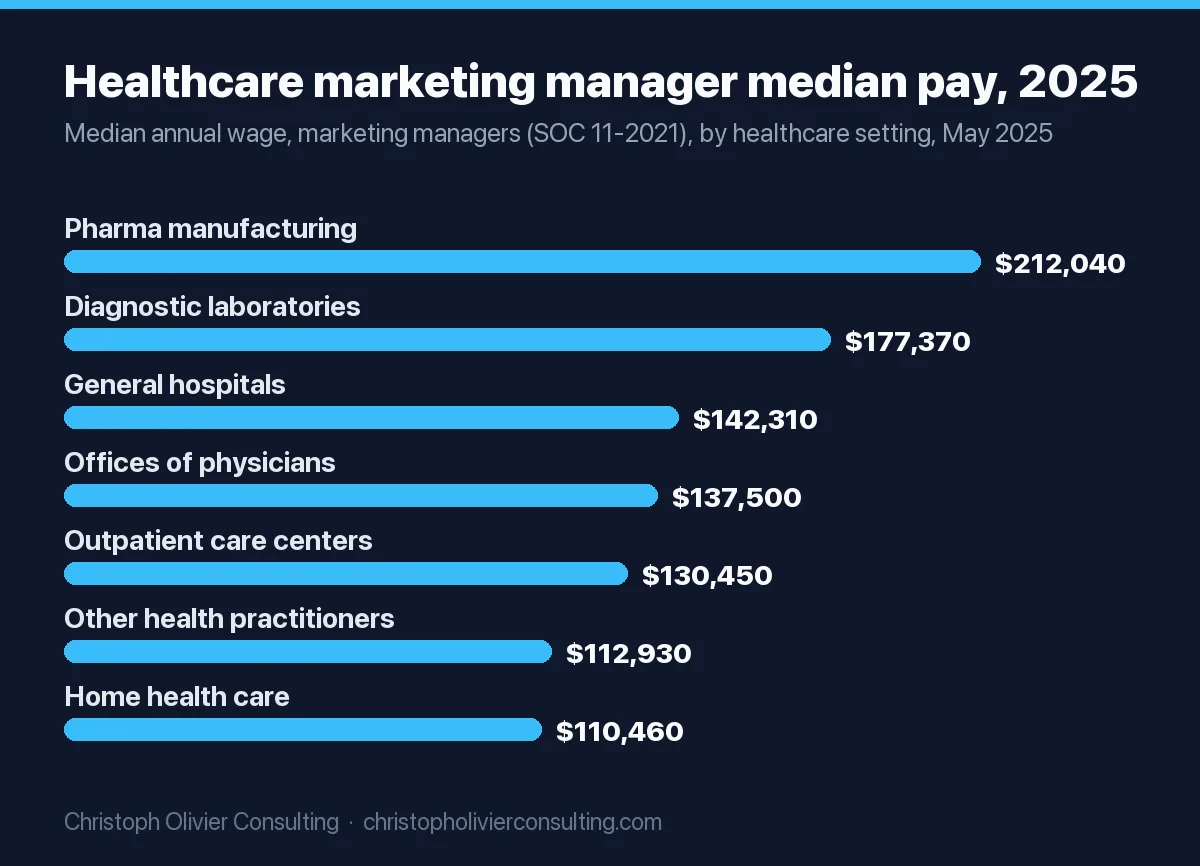
The benefits load works like this: private-industry management, business and financial jobs cost $88.63 an hour, of which $59.85 is wages and $8.47 paid leave. A salary already covers paid leave, so the remaining $20.31 of benefits and supplemental pay is a 29.7% load on salary, a multiplier of 1.297.
| Healthcare setting (NAICS) | Marketing managers employed | Median salary, May 2025 | 90th percentile | Median x 1.297 (our calculation) |
|---|---|---|---|---|
| Offices of physicians (6211) | 1,900 | $137,500 | $257,240 | $178,376 |
| Outpatient care centers (6214) | 660 | $130,450 | $210,360 | $169,230 |
| Offices of other health practitioners (6213) | 550 | $112,930 | $196,410 | $146,502 |
| General medical and surgical hospitals (6221) | 2,510 | $142,310 | $289,750 | $184,616 |
| Home health care services (6216) | 1,240 | $110,460 | $200,720 | $143,297 |
| Medical and diagnostic laboratories (6215) | 720 | $177,370 | $288,900 | $230,098 |
| Pharmaceutical and medicine manufacturing (3254) | 3,360 | $212,040 | $305,940 | $275,075 |
| All industries, for comparison | Not applicable | $166,790 | $293,610 | $216,373 |
Two things stand out. Provider settings pay marketing managers less than the all-industry median, so the full-time hire a practice can afford is often a mid-level manager, not an executive. And the 90th percentile, a fair floor for someone who can actually run strategy, is $257,240 in physician offices and $289,750 in general hospitals before benefits. Our CMO salary guide explains why we use the 90th percentile as the CMO anchor.
Now put the options side by side for year one. Fractional rows use MarketerHire’s published range; full-time rows use the physician-office figures above.
| Option | Math (our calculation) | Year-one cost | What you get |
|---|---|---|---|
| Fractional CMO, light strategy | $3,000 to $5,000 x 12 | $36,000 to $60,000 | Plan, budget, vendor direction, monthly review |
| Fractional CMO, strategy plus oversight | $5,000 to $15,000 x 12 | $60,000 to $180,000 | Weekly leadership of staff and agencies |
| Healthcare marketing consultant, hourly audit | 30 hours x $140 (GoFractional healthcare asking rate) | $4,200 one time | A diagnosis, no ongoing ownership |
| Full-time marketing manager, physician office median | $137,500 x 1.297 | $178,376 | 2,080 paid hours, usually a manager, not a CMO |
| Full-time marketing leader, physician office 90th percentile | $257,240 x 1.297 | $333,712 | A senior full-time leader, before any search fee |
The break-even is $178,376 / 12 = $14,865 a month. A fractional CMO billing more than that for a full year costs more than a median full-time physician-office marketing manager, though the fractional person is usually more senior. MarketerHire’s own tipping point to full time is fees above $12,000 to $15,000 a month for six months or more, a marketing team past 10 people, or a board that needs a dedicated executive.
An agency is not on this table because it does a different job. Chief Outsiders lists senior agency management at $300 to $600 (the guide does not state the unit) in the same cost guide, but agencies are paid to execute channels. A fractional CMO decides which channels, which agencies and how much. Many practices need both, and the common failure is paying an agency to set strategy it is also paid to deliver.
What makes healthcare marketing different: the rules a fractional CMO must own
A generalist CMO can learn your service lines in a month. The rules below are where an inexperienced hire creates legal exposure, so test every candidate on them. These summaries are not legal advice; your privacy officer or healthcare counsel signs off.
| Rule | What it says | What the CMO must do |
|---|---|---|
| HHS OCR guidance on online tracking technologies (published November 18, 2022) | Tracking on user-authenticated pages (patient portals, logged-in booking) may access PHI such as diagnosis, prescription and billing information. A tracking vendor that receives PHI is a business associate and needs a signed BAA; a privacy policy notice is not enough. Mobile app data collected by or for a regulated entity “generally is PHI.” | Inventory every pixel, tag and SDK on the site and app. Remove ad pixels from authenticated pages unless the vendor signs a BAA, or route data through a vendor that will sign one and de-identify it first, an option HHS names. |
| AHA v. Becerra, N.D. Texas, June 20, 2024 (noted on the same HHS page) | The court vacated the part of the guidance saying HIPAA applies when a technology links an IP address to a visit to an unauthenticated public page about specific conditions or providers. | Public pages carry less HIPAA risk than they did in 2023, but the authenticated-page and app guidance still stands. Do not treat the ruling as permission to track the portal. |
| HIPAA marketing rule (45 CFR 164.501, 164.508(a)(3)) | Using PHI to send communications that encourage buying a product or service generally needs the patient’s written authorization. Communications about your own health-related services, refill reminders, face-to-face talks and nominal promotional gifts are excepted. If anyone pays you to market their product to your patients, authorization is required and must say remuneration is involved. | Classify every email and SMS campaign before it goes to the patient list. Never accept co-marketing money from a device maker or pharma brand to message patients without authorizations. |
| FTC Health Breach Notification Rule (amended, announced April 26, 2024) | Covers health apps and similar products not covered by HIPAA. Sharing health data with an ad network without authorization can itself be a breach. Notice to individuals within 60 calendar days; civil penalty up to $53,088 per violation. | For digital health and wellness companies outside HIPAA, audit SDKs and ad integrations as strictly as a covered entity would. |
| FTC v. GoodRx, February 1, 2023 | First action under the rule: a $1.5 million civil penalty for sharing users’ medications and health conditions with Facebook, Google, Criteo and others. | Use it as the reference case when an agency wants to “just add the pixel.” |
| Google Ads healthcare and medicines policy and personalized advertising policy | Certification required for prescription drug services and telemedicine, addiction services (LegitScript in the US and Canada), health insurance and pharmaceutical manufacturers. Health is a restricted category: customer match and your own data segments are not supported for it. | Plan paid search on keyword and location targeting, not remarketing lists. Start certification before the launch date, not after ads are disapproved. |
| FTC rule on fake reviews and testimonials, August 14, 2024, and FTC health products compliance guidance | Bans fake, bought and undisclosed insider reviews and review suppression, with civil penalties for knowing violators. Health benefit claims need competent and reliable scientific evidence, generally randomized controlled human trials; “results not typical” disclaimers do not cure dramatic testimonials. | Write the review request policy (no incentives tied to positive reviews) and a claims review step for every ad and landing page. |
State medical board advertising rules sit on top of these. Our guides on whether doctors are allowed to advertise and what hospitals may advertise cover them in detail.
Practice, health system or health company: who is buying
“Healthcare” covers very different buyers, and the right marketing leader differs with them. The AMA Physician Practice Benchmark Survey found 42.2% of physicians worked in private practice in 2024, down from 60.1% in 2012. The AHA’s Fast Facts 2026 counts 6,100 US hospitals, and 3,567 of the 5,121 community hospitals, about 70%, are part of a system.
| Buyer | Who signs the engagement | Marketing goal | What a fractional CMO typically owns |
|---|---|---|---|
| Independent practice or clinic group (dental, dermatology, PT, behavioral health) | Owner physician or practice administrator | New patients by service line, at a cost per new patient the margin can carry | Service-line priorities, local search and reviews, agency scope, intake and call conversion |
| Private equity backed platform | Platform CEO, with the sponsor watching | Same-store growth plus a repeatable playbook for acquired locations | Brand architecture across acquisitions, shared tracking, budget by location |
| Hospital or health system | VP or chief of marketing, often a committee including compliance | Service-line volume (orthopedics, cardiology, maternity), physician referrals | Usually a bridge or advisory role; system-level privacy and legal review already exist |
| Digital health, medtech or healthtech company | Founder or CEO | Pipeline from employers, payers or providers, or app subscribers | Positioning, buyer committee messaging, HBNR or HIPAA status of the product data |
How much budget there is to direct shapes the decision. In The CMO Survey 2026 Firm and Industry Breakout Report (p. 126), healthcare respondents reported marketing at a mean of 5.88% of revenue (17 responses), against 8.96% across all 154 respondents and 6.80% in pharma and biotech (5 responses). Small samples, mostly larger firms, so treat this as a starting point.
When hiring a fractional CMO makes sense, and when it does not
My rule of thumb, not a survey finding: keep marketing leadership under about 30% of the total marketing budget, so most of the money still reaches patients. Run that through the CMO Survey’s 5.88% healthcare mean:
| Annual revenue | Marketing budget at 5.88% | Leadership cap at 30% | What fits (our calculation) |
|---|---|---|---|
| $2 million | $117,600 | $35,280 | Light strategy only ($3,000 a month), or a one-time audit |
| $5 million | $294,000 | $88,200 | Fractional CMO at $5,000 to $7,000 a month directing an agency |
| $10 million | $588,000 | $176,400 | Fractional with oversight, or a median full-time manager at $178,376 |
| $25 million | $1,470,000 | $441,000 | Full-time senior leader; fractional as advisor or interim |
Revenue is only half of fit. Use this situational table to decide whether you need a fractional CMO at all.
| Your situation | Best option | Why |
|---|---|---|
| Solo or two-provider practice, schedule mostly full from referrals | Do it yourself: Google Business Profile, review requests, a clean website | A $36,000 strategy year can exceed the entire marketing budget |
| You need one channel fixed (Google Ads, SEO, or the website) | A specialist or agency with healthcare experience | The problem is execution, not direction |
| Unsure whether your tracking is HIPAA-safe | Your privacy officer plus counsel, then a one-time technical tag audit | A compliance question first, a marketing question second |
| Two or more agencies, no one internal judging their work, $200,000 or more a year in spend | Fractional CMO, strategy plus oversight | Someone senior has to set targets, cut waste and hold vendors to cost per new patient |
| Opening locations or integrating acquisitions | Fractional CMO for 6 to 12 months | Brand, tracking and budget rules need to be set once and reused |
| Full-time marketing manager in place who needs senior direction | Fractional CMO, light strategy, monthly | Cheaper than replacing the manager with an executive |
| Board or sponsor wants a full-time executive, team over 10 people | Hire full time; use fractional only to bridge the search | Past MarketerHire’s tipping point |
Not sure which row your practice is in?
Bring your revenue, current marketing spend and any agency or fractional quotes to a free consultation. You will leave with a clear call on whether you need a fractional CMO, a specialist, or neither yet.
The first 90 days of a healthcare fractional CMO engagement
This plan is our working template, with pass/fail tests you can hold any candidate to. It adds the healthcare steps to the general sequence in our guide to what a fractional CMO does.
- Days 1 to 15: access and tracking audit. Admin access to Google Ads, Analytics, Business Profiles, the website, the phone system and the CRM or practice management export. A written inventory of every pixel, tag and SDK, marked by page type (public, authenticated, booking, app) and whether the vendor has a BAA. Pass: the inventory exists and your privacy officer has reviewed it.
- Days 15 to 30: baseline. Twelve months of new patients by service line and by source (referral, search, ads, reviews, walk-in), cost per new patient by channel, and call answer and booking rates. Pass: every number reconciles to the practice management system, not just ad dashboards.
- Day 30: diagnosis. Three priorities, a budget by channel with a maximum cost per new patient for each, and a list of what stops. Pass: fits on two pages and names the service lines with spare capacity.
- Days 30 to 60: fixes and tests. Intake and call handling first (cheap wins), then two or three channel tests, each with a budget and a kill rule. Google certification started where required. Pass: tests live with written stop rules.
- Days 60 to 75: vendor scopes. Agency scopes rewritten with deliverables, reporting tied to new patients, and BAA status confirmed. Pass: every vendor knows its number.
- Day 90: decision. Continue, rescope, hire full time, or end with a handover. Pass: the decision is written down with the data behind it.
Questions to ask before you hire a healthcare fractional CMO
| Question | A strong answer includes | Red flag |
|---|---|---|
| How would you handle the Meta or Google pixel on our patient portal? | Removing it or using a BAA-signing vendor, citing HHS tracking guidance and the 2024 court ruling correctly | “Everyone uses it” or “we just hash the emails” |
| Which of our patient emails need HIPAA authorization? | The own-services exception versus third-party paid marketing | No distinction drawn |
| How many hours a week, and who does the execution? | A number, plus named agencies or staff doing the work | A monthly fee with no hours |
| What will you measure in month one? | New patients by source and service line, cost per new patient, booking rate | Impressions, followers, traffic only |
| How do you collect reviews? | Asks every patient, no incentives tied to positive reviews, response policy that protects PHI | Review gating or paid reviews |
| What is the minimum term and exit? | Clear term, 30 day notice, handover of all accounts and data | 12 month lock-in with no exit |
Our fractional CMO contract template turns these answers into scope, term and exit clauses.
What does a healthcare marketing specialist do, compared with a fractional CMO?
A specialist runs one function: paid search, SEO, social, email or the website. A fractional CMO sets the targets and budget those specialists work to and judges their results. If your problem is one channel performing badly, hire the specialist. If nobody can tell you which channels produce new patients at a profit, you need the leadership role. The channel-level playbooks are in our healthcare marketing guide and our guide to digital marketing for doctors.
Working with CO Consulting
CO Consulting’s fractional CMO service covers a marketing audit, a written strategy and roadmap, leadership of your staff and agencies, and a KPI and reporting framework, over the same assess, plan, oversee sequence shown above. It does not include day-to-day writing, ad building, design or video production; those stay with your team or agencies, and we direct them. We are not a HIPAA compliance firm and do not replace your privacy officer or counsel; we make sure marketing decisions go through them. No honest provider can promise a number of new patients, and we do not. If you want a second opinion on your plan, your quotes or whether you need a fractional CMO at all, book a free consultation.
Ready to scale your revenue?
Book a free 30-min consultation. We’ll diagnose your growth bottleneck and map out the 3 highest-leverage moves for your business.
Frequently asked questions
How much does a fractional CMO for healthcare cost per month?
Published 2026 rate cards put fractional CMOs at $3,000 to $15,000 a month for 10 to 20 hours a week (MarketerHire, April 2026), with deep vertical specialists pricing 20 to 30% higher. GoFractional's live healthcare benchmark was $178 an hour in November 2026, which is about $7,700 a month at 10 hours a week and $15,400 at 20 hours.
How much does a fractional CMO charge per hour?
MarketerHire publishes $150 to $350 an hour. GoFractional's live data showed $178 an hour for healthcare fractional CMOs and $168 across all industries in the 90 days to November 27, 2026. Chief Outsiders says its retainers work out to roughly $300 to $500 an hour. Convert any monthly quote to an hourly rate before comparing.
What is a fractional CMO salary in healthcare?
Fractional CMOs are paid a retainer, not a salary. A $5,000 to $15,000 monthly retainer is $60,000 to $180,000 a year. For comparison, BLS data for May 2025 put the median marketing manager in physician offices at $137,500 and in general hospitals at $142,310, or about $178,000 to $185,000 once benefits are added.
How much should I pay a healthcare marketing consultant?
GoFractional's talent asking rate for healthcare marketing consultants averaged $140 an hour across 14 observations from August to November 2026. Chief Outsiders lists independent consultants at $100 to $200 an hour, with some at $450 and up. A one-time 30-hour audit at $140 an hour costs about $4,200, which suits practices that need a diagnosis rather than ongoing leadership.
Can a fractional CMO run Facebook or Google pixels on a patient portal?
Not without care. HHS OCR guidance says tracking on user-authenticated pages may disclose PHI, and a vendor receiving PHI needs a signed business associate agreement. A June 2024 court ruling vacated only the part about unauthenticated public pages. Google also restricts customer match and remarketing lists for health. Have your privacy officer review any tracking before launch.
Can you be a healthcare CMO without an MD?
Yes, if CMO means chief marketing officer, which is a business role with no medical degree requirement. In hospitals, CMO also stands for chief medical officer, a clinical leadership role. Check which job a listing or firm means: several pages that rank for healthcare CMO describe fractional chief medical officers, not marketing leaders.
When is a fractional CMO not worth it for a medical practice?
When the fee would swallow the marketing budget or the problem is one channel. At the CMO Survey 2026 healthcare mean of 5.88% of revenue, a $2 million practice spends about $117,600 on marketing, so a $36,000 strategy year is already 30% of it. Solo practices with full schedules usually do better with reviews, a Google Business Profile and a good specialist.
Fractional CMO: cost, fit and industries