
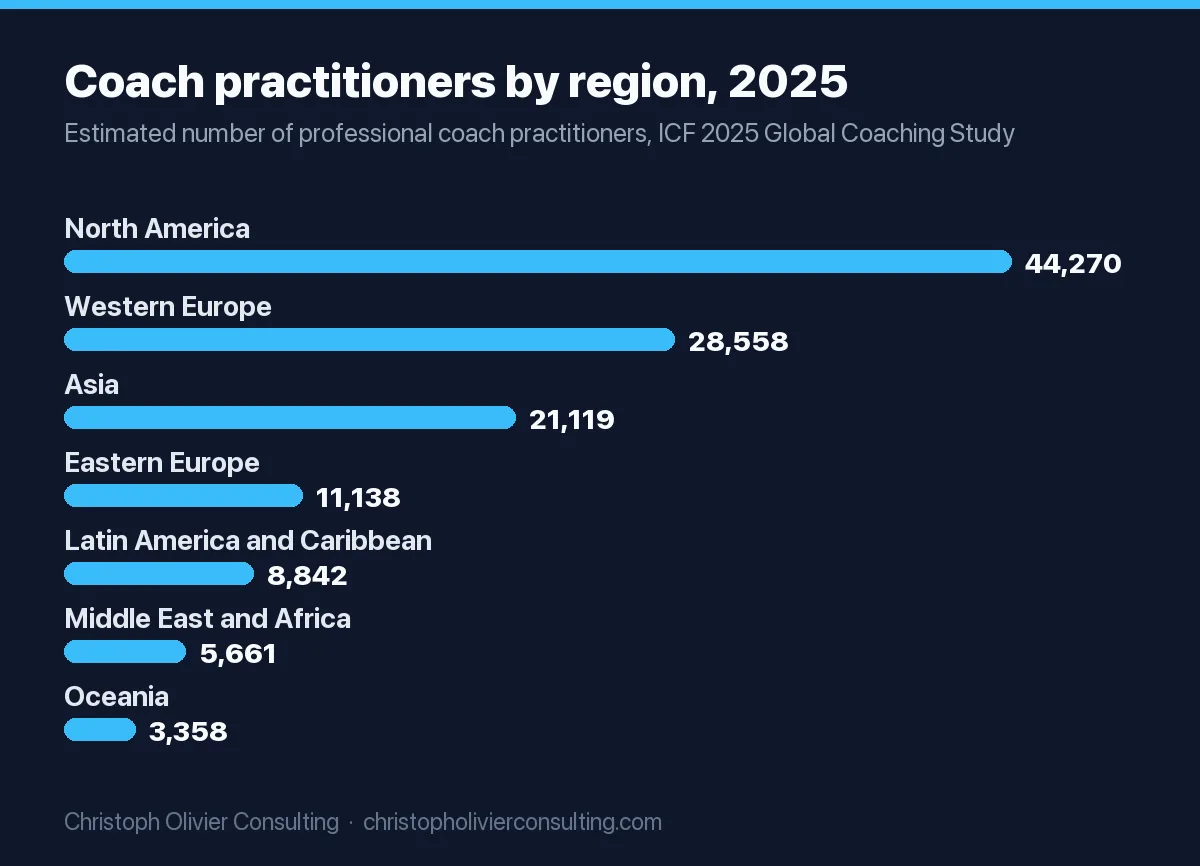
There are an estimated 122,974 professional coach practitioners worldwide, 44,270 of them in North America, according to the 2025 ICF Global Coaching Study (survey fielded February 28 to April 23, 2025), and together they earned $5.34 billion from coaching in the prior year. The average active coach earned $49,283 from coaching and charged $234 for a one-hour session; in North America the averages were $71,719 and $297.
No one publishes a United States only count of coaches. The ICF region “North America” is the closest official figure, and US government data cannot fill the gap because the 2022 NAICS manual has no coaching industry: the word “coaching” appears in it once, for doula services. Below are the ICF numbers in full, our own calculations from them, the Census categories coaches actually file under, and the market-size claims that do not hold up.
Coaching industry statistics at a glance (2025 and 2026 data)
| Statistic | Value | Source and period |
|---|---|---|
| Coach practitioners worldwide | 122,974 (up 12.6% from 109,200) | ICF 2025 study vs 2023 study; change is our calculation |
| Coach practitioners with active clients | 110,492 (90%) | ICF 2025 |
| Coach practitioners in North America | 44,270 (36.0% of the world, up 29.4%) | ICF 2025 vs 2023 |
| Global revenue from coaching | $5.340 billion (up 17%) | ICF 2025, prior 12 months |
| North America revenue from coaching | $2.889 billion (54.1% of global) | ICF 2025; share is our calculation |
| Average annual coaching revenue per active coach | $49,283 global, $71,719 North America | ICF 2025 |
| Average fee for a one-hour session | $234 global, $297 North America | ICF 2025 |
| Average weekly coaching hours and active clients | 11.6 hours, 12.4 clients | ICF 2025 |
| Coaches whose main specialty is business-related | 77% (73% in North America) | ICF 2025 |
| Coaches who are women | 72% | ICF 2025 |
| Consumers aware of coaching / who have been coached | 74% / 17% | ICF 2026 Global Consumer Awareness Study |
| Consumers who prefer human-led coaching | 80% | ICF 2026 Consumer Awareness Study |
| US solo businesses in consulting (Census proxy, not coaching only) | 1,187,781 in 2024, up 29.1% since 2019 | Census Nonemployer Statistics, NAICS 5416 |
If you run a coaching or consulting practice and want these benchmarks turned into a pricing, niche and client-acquisition plan for your own firm, book a consultation and we will work through your numbers against them.
How many coaches are there?
It depends on who counts. ICF builds its estimate from its membership records, survey responses and other coaching bodies’ memberships, adjusted for people in several bodies or none, so it counts trained professional coaches, not everyone with “coach” in their bio.
| Population | Count | As of | Source |
|---|---|---|---|
| Coach practitioners worldwide | 122,974 | 2025 study | ICF 2025 executive summary |
| Coach practitioners in North America | 44,270 | 2025 study | ICF 2025 final report |
| Managers and leaders using coaching skills, worldwide | 15,900 (North America: 3,000) | 2019, latest published | ICF 2020 executive summary |
| ICF members | More than 62,000 in over 150 countries | 2025 | ICF 2025 executive summary |
| US coaches, all types (vendor estimate) | 232,000+ (120,000+ health coaches, about 48,000 life coaches) | Nov 2025 | Marketdata via MarketResearch.com |
| Sports coaches and scouts, US jobs | 298,800 | 2025 | BLS Occupational Outlook Handbook |
How many coaches are there in the US?
The honest answer is “not published.” The 44,270 North America figure includes Canada, and ICF does not split it by country. Marketdata’s 232,000+ is five times larger because it adds health coaches and uses its own, paywalled method. BLS tracks no “life coach” or “business coach” occupation at all.
The growth is clear even without a US split. North America’s coach count rose from 23,300 in 2019 to 34,200 in 2022 and 44,270 in the 2025 study, up 90% in two survey cycles by our math.
If you searched “how many coaches are there” for sports, the BLS figure is the one you want: 298,800 coach and scout jobs in 2025, a median wage of $47,320 in May 2025, and 6% projected growth from 2025 to 2035. The rest of this page covers professional coaching (executive, business, leadership, life and career).
Coaching industry market size: $5.34 billion, or $20 billion?
Search “coaching industry market size” and you get numbers that differ by a factor of four. They are not competing measurements of the same thing. Each counts a different market:
| Estimate | Value | What it counts | Method public? |
|---|---|---|---|
| ICF 2025, global | $5.340 billion | Revenue from coaching earned by active coach practitioners, prior 12 months | Yes: active coaches times average revenue, adjusted for zero-revenue responses |
| ICF 2025, North America | $2.889 billion | Same, North America only | Yes |
| Mordor Intelligence, global life coaching | $3.64 billion (2025), $6.12 billion forecast for 2031 | Gross revenue from fee-based coaching engagements, excluding therapy and self-help books | Summary only (page updated Sept 11, 2026) |
| Marketdata, US | $16 billion, forecast $23.8 billion by 2030 | Life, health and executive/business coaching combined | No, paid report (Nov 16, 2025) |
| IBISWorld, US business coaching | $20.0 billion (2026), 1.9% a year since 2021 | Classified under NAICS 61143, short courses and seminars for management and professional development | No, paid report (Aug 2026) |
Use the ICF figure when you mean money paid to coaches for coaching. It is the only one with a published method, and it counts coaching revenue only (the 2020 study states that income from other services is excluded), even though 60% of coaches also sell training, 57% consulting and 55% facilitation. The IBISWorld number is closer to a corporate training market; it also counts 75,590 “businesses,” far more than ICF’s North American coach count.
Is the coaching industry growing?
Yes, by headcount and total revenue, but not by income per coach. Across the last three ICF studies, the number of coaches and total revenue rose sharply while average revenue per coach was nearly flat globally.
| Measure | 2019 (2020 study) | 2022 (2023 study) | 2025 study | Change, 2023 to 2025 study | Change, 2019 to 2025 study |
|---|---|---|---|---|---|
| Coach practitioners, global | 71,000 | 109,200 | 122,974 | +12.6% | +73.2% |
| Revenue from coaching, global | $2.849B | $4.564B | $5.340B | +17.0% | +87.4% |
| Average revenue per active coach, global | $47,100 | $52,800 | $49,283 | minus 6.7% | +4.6% |
| Coach practitioners, North America | 23,300 | 34,200 | 44,270 | +29.4% | +90.0% |
| Revenue from coaching, North America | $1.296B | $2.088B | $2.889B | +38.4% | +122.9% |
| Average revenue per active coach, North America | $62,500 | $67,800 | $71,719 | +5.8% | +14.8% |
| North America share of global revenue | 45.5% | 45.7% | 54.1% | +8.4 points | +8.6 points |
Own calculation from the ICF 2020, 2023 and 2025 study figures. Each study reports roughly the year before its publication; the 2025 survey asked about the “past year.” Revenue is in nominal US dollars, so currency moves affect non-US regions.
If you treat the 2025 study as covering 2024, North American coaching revenue compounded at about 17.4% a year from 2019, against 13.4% globally (our calculation). Almost all of that came from more coaches, not higher pay: North American revenue per coach grew 2.8% a year over the same span.
Is coaching in high demand?
Demand is rising faster in emerging regions than in mature ones. In the 2025 study, 43% of coaches globally saw demand for their services increase over the past 12 months, but only 39% in North America, 38% in Western Europe and 36% in Oceania. Looking ahead, 59% expect revenue to rise, mostly from more clients (60%) and more sessions (51%); only 37% expect to raise fees.
On the buyer side, the 2026 ICF Global Consumer Awareness Study (with PwC, published October 23, 2026) found 74% of consumers are aware of coaching but only 17% have taken part, and 86% of those coached report satisfaction. Per ICF’s summary, 74% of consumers not considering coaching say they do not feel they need it. The gap between awareness and purchase is the marketing problem, which is why client acquisition and retention is the top internal worry for coaches: 66% globally and 68% in North America in the study’s table.
Coaching industry statistics by region
| Region | Coach practitioners | Change vs 2023 study* | Revenue (USD M) | Share of global revenue* | Average revenue per coach | Average fee per hour | Weekly hours |
|---|---|---|---|---|---|---|---|
| North America | 44,270 | +29.4% | $2,889 | 54.1% | $71,719 | $297 | 12.7 |
| Western Europe | 28,558 | minus 7.3% | $1,175 | 22.0% | $44,712 | $227 | 11.9 |
| Asia | 21,119 | +145.6% | $522 | 9.8% | $28,745 | $204 | 9.1 |
| Eastern Europe | 11,138 | +11.4% | $207 | 3.9% | $21,132 | $139 | 9.4 |
| Latin America and the Caribbean | 8,842 | minus 47.7% | $213 | 4.0% | $27,996 | $129 | 12.2 |
| Middle East and Africa | 5,661 | +15.5% | $164 | 3.1% | $34,119 | $175 | 10.5 |
| Oceania | 3,358 | minus 9.2% | $170 | 3.2% | $54,994 | $249 | 12.6 |
| Global | 122,974 | +12.6% | $5,340 | 100% | $49,283 | $234 | 11.6 |
Source: ICF 2025 Global Coaching Study final report; 2023 comparison from the 2023 executive summary. *Columns marked with an asterisk are our calculations.
Read the regional swings with care. A 145.6% jump in Asia and a 47.7% drop in Latin America in three years are more likely to reflect changes in survey response and membership data than real exits, since the estimate is anchored on association memberships. North America’s position is consistent across all three studies: about a third of the world’s coaches and, now, more than half of the money.
Our calculation: what a coach’s revenue actually buys
Two ratios built from the same ICF table show how much paid coaching sits behind the averages. “Fee-equivalent hours” is average annual revenue divided by the average hourly fee. “Revenue per client slot” is average annual revenue divided by the average number of active clients at the time of the survey.
| Region | Fee-equivalent hours per year | Per week (52 weeks) | Reported coaching hours per week | Revenue per active client slot |
|---|---|---|---|---|
| North America | 241 | 4.6 | 12.7 | $5,273 (13.6 clients) |
| Western Europe | 197 | 3.8 | 11.9 | $3,726 |
| Oceania | 221 | 4.2 | 12.6 | $3,459 (15.9 clients) |
| Global | 211 | 4.1 | 11.6 | $3,974 (12.4 clients) |
Own calculation from ICF 2025 averages. Averages of averages, so treat as orders of magnitude. Client slots turn over during the year, so revenue per actual client is lower.
The typical North American coach reports 12.7 hours a week working as a coach but earns the equivalent of 4.6 hours at full fee. ICF’s own “hourly revenue recovered” measure points the same way: $109 in North America, 37% of the $297 reported fee. ICF does not break the gap down; non-billable work, packages priced below the hourly rate and discounts are the likely parts of it. If you are setting prices or a marketing budget, plan from recovered revenue, not list fee; our guide on how much business coaches should spend on marketing works from that starting point.
Business coaching statistics
Business coaching is the core of the profession. ICF groups leadership, executive, business and organizational, small business, career, team, sales and agile coaching as “business” specialties, and 77% of coaches name one as their main area. Leadership coaching alone is the main specialty of 36% of coaches globally and 43% in North America; executive coaching accounts for 18% and 20%. Experience pushes coaches toward business work: 80% of coaches with more than 10 years in practice focus on it, against 48% of those with under a year.
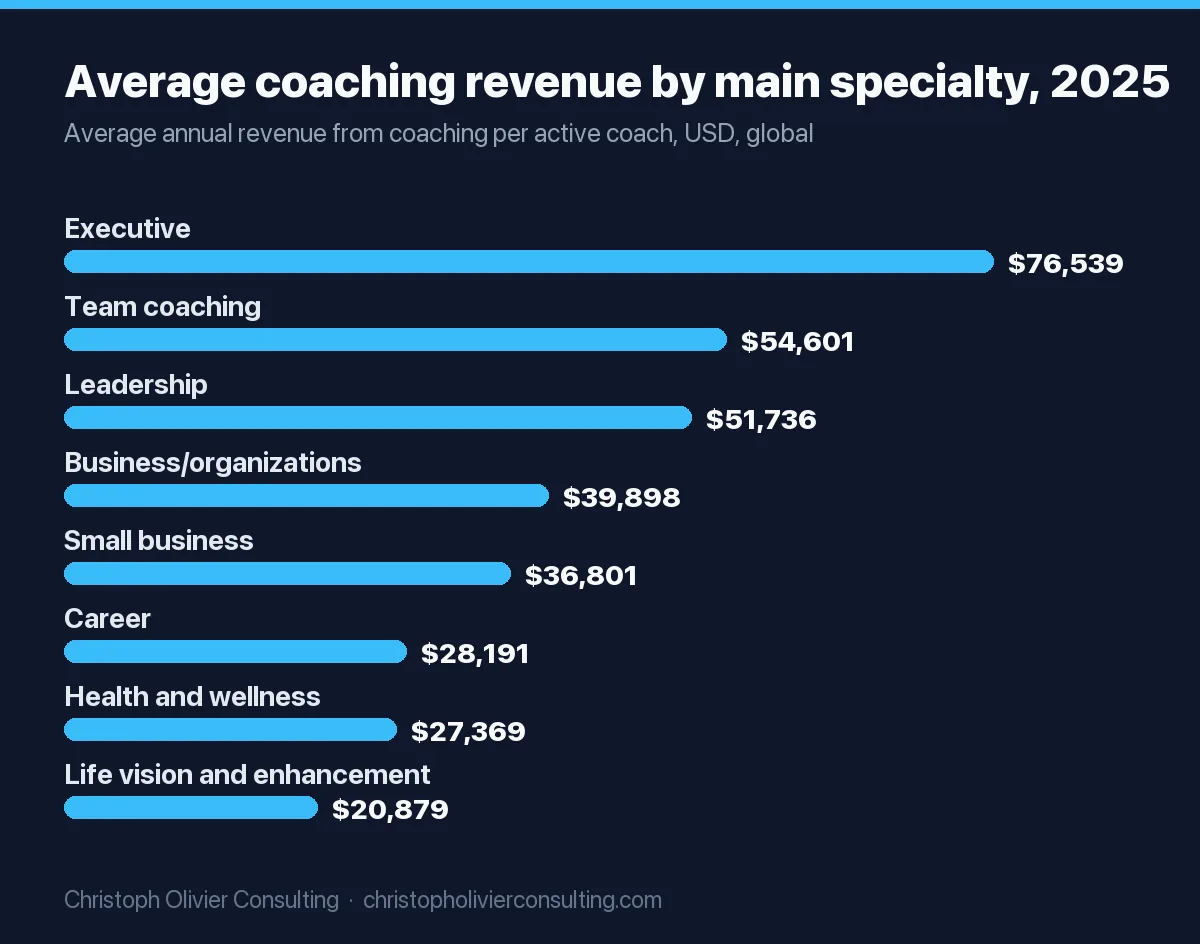
| Main area of coaching | Share of coaches (global) | Average annual revenue | Average fee per hour | Active clients | Revenue vs global average* | Revenue per client slot* |
|---|---|---|---|---|---|---|
| Executive | 18% | $76,539 | $338 | 13.4 | 1.55x | $5,712 |
| Team coaching | 3% | $54,601 | $228 | 10.8 | 1.11x | $5,056 |
| Leadership | 36% | $51,736 | $245 | 13.2 | 1.05x | $3,919 |
| Business/organizations | 8% | $39,898 | $201 | 11.7 | 0.81x | $3,410 |
| Small business | 2% | $36,801 | $176 | 12.4 | 0.75x | $2,968 |
| Career | 9% | $28,191 | $165 | 12.3 | 0.57x | $2,292 |
| Health and wellness | 3% | $27,369 | $160 | 12.8 | 0.56x | $2,138 |
| Life vision and enhancement | 9% | $20,879 | $148 | 9.2 | 0.42x | $2,269 |
Source: ICF 2025 Global Coaching Study final report, global averages. *Own calculation against the $49,283 global average.
Who the client is matters as much as the label on the coach. Coaches whose clients are mostly executives average $82,949 a year at $357 an hour. Those serving mostly business owners average $51,646 at $220, managers $36,933 at $204, and personal clients $22,303 at $138. Managers (31%) and executives (25%) are the main clients for 56% of coaches; in North America the split is 29% and 27%, with business owners at 9%.
Sponsorship is the other lever. Coaches with 76% to 100% sponsored clients (coaching paid for by someone other than the client) average $59,413 and $270 an hour; those with 25% or fewer sponsored clients average $34,020 and $184. ICF reports a 66% sponsored-client figure for coaches with more than 10 years’ experience, against 73% self-paying (“primary”) clients for coaches with under a year. That pattern is why narrowing to a buyer who has a budget, covered in how to niche and position a coaching business, pays off more than a new title.
Turn coaching benchmarks into a client pipeline
Two-thirds of coaches say finding and keeping clients is their biggest worry for the year ahead. Bring your fee, niche and client numbers to a call and we will map them to a marketing plan for your practice.
Coach income by experience
| Years coaching | Average annual revenue from coaching | Average fee per hour | Active clients | Hours per week |
|---|---|---|---|---|
| Less than 1 year | $14,484 | $172 | 6.1 | 6.2 |
| 1 to 2 years | $19,032 | $178 | 7.2 | 7.3 |
| 3 to 4 years | $28,493 | $186 | 9.3 | 8.6 |
| 5 to 10 years | $43,259 | $219 | 12.9 | 11.6 |
| More than 10 years | $69,721 | $282 | 15.0 | 14.1 |
Source: ICF 2025 Global Coaching Study final report, global averages.
A coach with more than a decade in practice earns 4.8 times what a first-year coach earns (our calculation), but the fee only rises 64%. The rest comes from 2.5 times as many clients and 2.3 times the weekly hours. In North America, 29% of coaches earn more than $75,000 a year from coaching, against 5% in Eastern Europe. Coaches with a membership in a coaching body average $50,626 against $36,312 for those without; those with a coach-specific credential average $50,007 against $40,779. For how these fees translate into a launch budget, see our marketing plan for business coaches.
Who becomes a coach: workforce and pipeline
- Age: 53% of coaches are Generation X, 35% Baby Boomers and 11% Millennials. Gen X rose from 49% in the 2023 study while Boomers fell from 38%. In North America, Millennials are under 10%.
- Gender: 72% of coaches are women, from 62% in Asia to 81% in Eastern Europe. Male coaches average $56,543 against $46,226 for women, a gap ICF links partly to the older age mix of male coaches.
- Experience: 72% have coached for five years or more.
- Education: two-thirds hold a master’s degree or doctorate.
- Work model: 78% are external coaches, 5% internal and 16% both.
- Credentials: 73% agree clients increasingly expect certification; 80% of North American coach respondents hold an ICF certification or credential, a figure that reflects ICF’s role in fielding the survey. In the consumer study, 77% value credentials when choosing a coach and 76% want evidence of results, which is where FTC-compliant testimonials and case studies come in.
- Pipeline: 43% of coaches earned more qualifications in the past year and 38% plan to in the next one to three years.
Coaching in Census data: the closest NAICS codes
Because NAICS has no coaching code, US coaches file under whatever category fits their business. On the 2025 IRS Schedule C business code list, the nearest options for a sole proprietor are 541600 (management, scientific and technical consulting services), 611000 (educational services) and 812990 (all other personal services). Census Nonemployer Statistics, built from those tax returns, shows how large and fast-growing those pools are. These are not coach counts: they include engineers, tutors, wedding planners and many others.
| Census category | Businesses, 2024 | Receipts, 2024 | Average receipts* | Change in count, 2019 to 2024* |
|---|---|---|---|---|
| Nonemployer, 5416 management, scientific and technical consulting | 1,187,781 | $71.7B | $60,339 | +29.1% |
| Nonemployer, 81299 all other personal services | 774,283 | $28.7B | $37,118 | +20.2% |
| Nonemployer, 611 educational services | 924,679 | $17.3B | $18,746 | +3.4% |
| Employer establishments, 611430 professional and management development training | 8,067 (60,279 employees) | n/a | n/a | 2023 only |
| Employer establishments, 541611 administrative and general management consulting | 104,494 (83.6% with under 5 employees*) | n/a | n/a | 2023 only |
Sources: Census Nonemployer Statistics 2024 and 2019; County Business Patterns 2023. Nonemployer data are published at this level of detail only. *Our calculations.
The solo consulting pool is where most independent business coaches compete for attention, and it is crowded at the low end: 59.1% of 5416 nonemployers reported under $25,000 in 2024 receipts and only 14.1% reported $100,000 or more (our calculation from the receipt-size classes). The ICF’s 44,270 North American coaches would be 3.7% of that one category.
Solo consultants per 10,000 residents, by state (2024)
| Rank | State | Nonemployer businesses, NAICS 5416 | Per 10,000 residents* | Average receipts* |
|---|---|---|---|---|
| 1 | District of Columbia | 7,124 | 103.1 | $77,497 |
| 2 | Wyoming | 3,289 | 56.1 | $130,948 |
| 3 | Colorado | 31,163 | 52.0 | $58,461 |
| 4 | Utah | 17,157 | 49.0 | $60,626 |
| 5 | Florida | 112,043 | 48.2 | $71,539 |
| 6 | Vermont | 3,006 | 46.5 | $48,747 |
| 7 | Maryland | 28,896 | 46.3 | $55,236 |
| 8 | Massachusetts | 32,971 | 46.2 | $70,163 |
| 9 | New Hampshire | 5,972 | 42.4 | $67,187 |
| 10 | New Jersey | 39,598 | 41.7 | $69,782 |
| 15 | New York | 79,222 | 39.6 | $64,724 |
| 16 | California | 153,608 | 39.0 | $62,760 |
| 22 | Texas | 108,932 | 34.8 | $64,709 |
| 47 | Iowa | 6,625 | 20.5 | $41,105 |
| 48 | Alabama | 10,496 | 20.3 | $47,239 |
| 49 | Mississippi | 5,776 | 19.6 | $45,938 |
| 50 | Kentucky | 8,903 | 19.4 | $46,024 |
| 51 | West Virginia | 2,570 | 14.5 | $43,268 |
| United States | 1,187,781 | 34.9 | $60,339 |
*Own calculation: Census Nonemployer Statistics 2024 state file divided by Census Vintage 2025 population estimates for July 1, 2024. Category includes all solo consultants, not only coaches. Wyoming’s high average receipts likely reflect entities registered there for tax reasons.
Will coaching be replaced by AI?
Neither coaches nor clients are moving that way yet. In the 2026 consumer study, 80% of consumers prefer human-led coaching, and their top concerns about AI in coaching are loss of empathy (43%), loss of understanding (38%) and reduced human connection (36%). On the supply side, 53% of coaches in the 2025 study do not use any digital coaching platform, and only 6% use AI-powered coaching or chatbots. Just 19% invested in new technology last year, though 27% plan to in the next one to three years, and 37% call adapting to technology a major concern.
Delivery is already hybrid: 87% of coaches use audio-video platforms and 73% still coach in person. Where AI is changing the business fastest is discovery, since buyers now ask chatbots for coach recommendations; we cover that in how business coaches get cited by AI search.
What are the 70/30 and 80/20 rules in coaching?
They are informal rules of thumb, usually about how much of a session the client should be talking, and neither has a published standard behind the numbers. The 2025 ICF Core Competencies, released September 2025, set no talk-time ratio; competency 6, “Listens Actively,” asks the coach to focus “on what the client is and is not saying.” The 80/20 label is the general Pareto idea applied to clients or effort. Treat both as habits, not statistics.
Where to find reliable coaching industry data
| Source | Best for | Cost and cadence |
|---|---|---|
| ICF Global Coaching Study (with PwC) | Coach counts, revenue, fees, hours by region, specialty and client type | Free executive summary; final report $95 for ICF members, $295 for non-members. Every two to four years (2007, 2012, 2016, 2020, 2023, 2025) |
| ICF Global Consumer Awareness Study | Buyer awareness, satisfaction, AI attitudes | Free summary; 2022 and 2026 editions |
| Census Nonemployer Statistics and County Business Patterns | Counts and receipts of solo and employer firms in proxy codes, by state | Free, annual |
| BLS Occupational Outlook Handbook | Sports coaches only | Free, annual |
| IBISWorld, Marketdata, Mordor Intelligence | Vendor market-size models | Paid; methods not public |
Popular coaching statistics we could not verify
- “Coaches grew 15% since 2023.” ICF’s press release and study page say 15%, but its own final report says 13%, and 109,200 to 122,974 is 12.6%. We use 12.6%.
- “Revenue nearly doubled from $2.849 billion in 2023.” ICF’s study page says this, but $2.849 billion was the 2019 estimate from the 2020 study. The 2023 study reported $4.564 billion, so the increase to $5.34 billion is 17%.
- “The average US coach earns $71,719.” Repeated on coaching blogs. $71,719 is the ICF average for North America, which includes Canada; no US-only figure is published.
- “The coaching industry is worth $20 billion” (or $16 billion). These are vendor models for US business coaching (IBISWorld, classified as management training) and for US life, health and executive coaching combined (Marketdata). Their methods are paywalled and they are not comparable to ICF’s $5.34 billion.
- “86% of companies recouped their coaching investment” and “7x ROI.” Both trace to the 2009 ICF Global Coaching Client Study. We could not load the original report, secondary sources describe the 86% base differently (all companies vs those able to calculate ROI), and the data are 17 years old.
- “Executive coaching returns 788%.” Usually credited to a 2001 single-company study. We found no primary document online and do not quote it.
- “56% of coaching revenue comes from virtual delivery (ICF 2025).” We could not find this figure in the 2025 final report. What it does report: 87% of coaches use audio-video platforms and 73% coach in person.
- Counts of managers using coaching skills for 2025. ICF’s method estimates this group, but we found no 2025 count in the final report; the last published figure is 15,900 for 2019.
Methodology and how to cite this page
ICF figures come from the 2025 ICF Global Coaching Study executive summary and final report (10,035 valid responses from 127 countries and territories, fieldwork February 28 to April 23, 2025, conducted by PwC), the 2023 study executive summary (14,591 responses, fieldwork October to December 2022) and the 2020 study executive summary (2019 data). ICF figures are survey-based estimates anchored on association memberships, in nominal US dollars. Census figures come from the 2019 to 2024 Nonemployer Statistics US and state files and 2023 County Business Patterns; nonemployer counts are noise-infused for confidentiality. State rates use Census Vintage 2025 estimates for July 1, 2024. All percent changes, shares, ratios, per-capita rates and growth rates labeled “our calculation” were computed by us from those published figures.
How to cite this page: Christoph Olivier Consulting, “Coaching Industry Statistics,” compiled from the 2020, 2023 and 2025 ICF Global Coaching Studies, the 2026 ICF Global Consumer Awareness Study and US Census Nonemployer Statistics (2019 to 2024), https://christopholivierconsulting.com/coaching-industry-statistics/, published November 2026.
The numbers point one way: more coaches every cycle, flat income per coach, and buyers who know coaching exists but have not bought it. Winning in that market is a positioning and demand problem. Our marketing for business coaches and consultants hub lays out the channels, a fractional CMO for business coaches can run them for you, and you can book a consultation to map these benchmarks to your own practice.
Ready to scale your revenue?
Book a free 30-min consultation. We’ll diagnose your growth bottleneck and map out the 3 highest-leverage moves for your business.
Frequently asked questions
How many coaches are there in the world?
The 2025 ICF Global Coaching Study estimates 122,974 professional coach practitioners worldwide, up 12.6% from 109,200 in the 2023 study, and 110,492 of them (90%) had active clients. North America has the most, 44,270, followed by Western Europe with 28,558 and Asia with 21,119. The estimate is anchored on coaching association memberships, so it counts trained coaches rather than everyone who uses the title.
How many coaches are there in the US?
No US-only count is published. The ICF figure for North America, which includes Canada, is 44,270 coach practitioners in the 2025 study. Marketdata estimates more than 232,000 US coaches, but that vendor figure includes more than 120,000 health coaches and its method is not public. BLS has no occupation for life or business coaches; its 298,800 coaches and scouts are sports coaches.
What is the coaching industry market size?
Coach practitioners earned $5.34 billion from coaching worldwide in the year before the 2025 ICF study, up 17% from $4.564 billion in the 2023 study. North America accounted for $2.889 billion, or 54.1%. Vendor figures such as IBISWorld's $20.0 billion for US business coaching or Marketdata's $16 billion US estimate count training, health coaching and other services, so they are not comparable.
Is the coaching industry growing?
Yes in headcount and total revenue. Global coach numbers rose 73% and coaching revenue 87% between the 2019 estimate and the 2025 ICF study, by our calculation. Income per coach barely moved: the global average was $47,100 in 2019 and $49,283 in 2025. In the 2025 survey, 43% of coaches saw demand rise in the past year and 59% expect revenue to increase.
How much do coaches charge per hour?
The 2025 ICF Global Coaching Study puts the average fee for a one-hour session at $234 globally and $297 in North America. Executive coaches average $338 an hour, leadership coaches $245 and life vision coaches $148. Coaches whose clients are mostly executives average $357. Fees rise with experience, from $172 for coaches in their first year to $282 for those with more than 10 years.
Will coaching be replaced by AI?
Current data says no. In the 2026 ICF Global Consumer Awareness Study, 80% of consumers prefer human-led coaching, citing worries about lost empathy (43%) and understanding (38%). Among coaches in the 2025 ICF study, only 6% use AI-powered coaching or chatbots and 53% use no digital coaching platform. AI is changing how buyers find coaches faster than how coaching is delivered.
Industry and marketing statistics by profession