

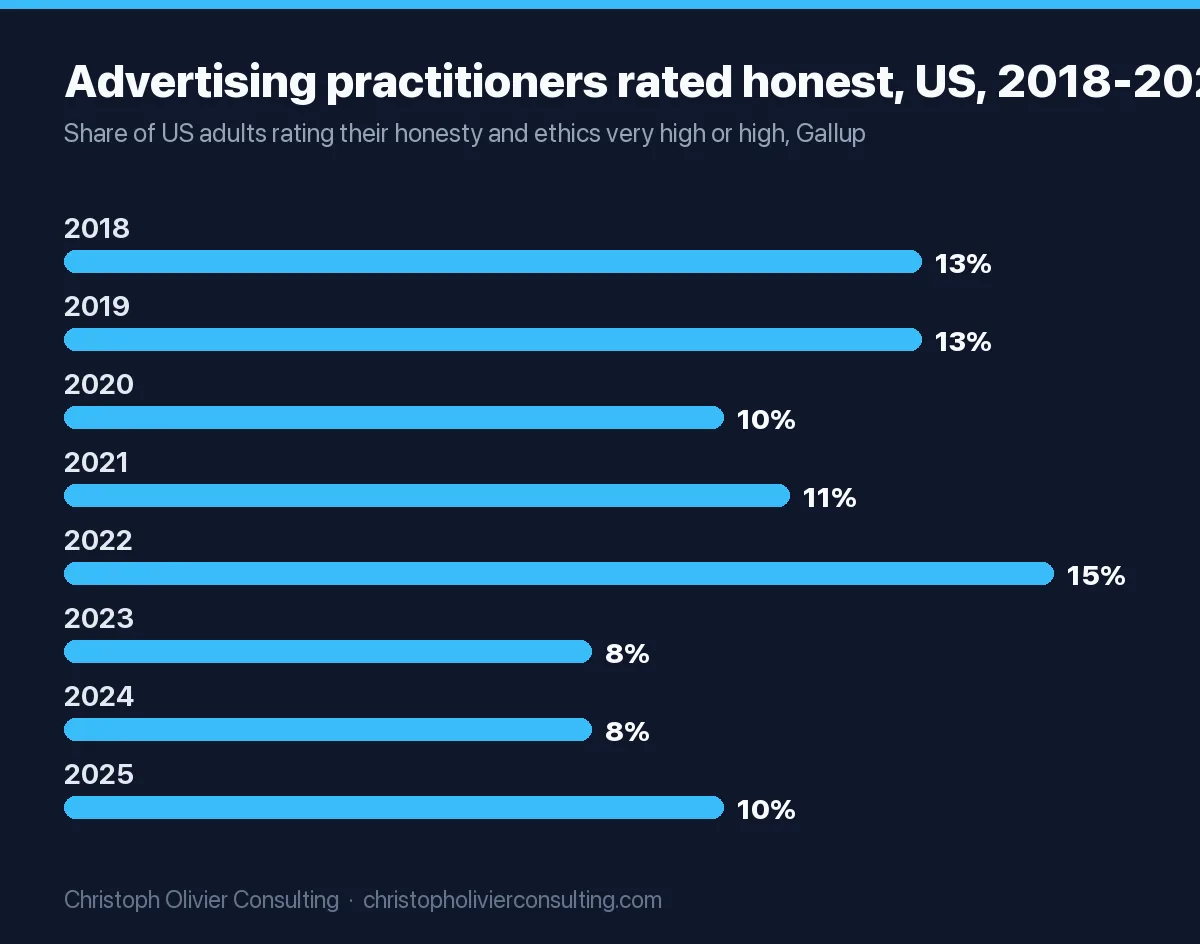
Trust in advertising is low, but not as low as trust in the people who make it. In the UK, 40% of adults said they trusted advertising in 2025, the highest level in five years (Credos Trust Tracker). In the US, only 10% of adults rate the honesty and ethics of advertising practitioners as high or very high, while 45% rate them low or very low (Gallup, December 2025).
At the same time, trust is now a purchase criterion on par with price: 88% of consumers say trusting the brand is important or critical when they buy, level with value (88%) and just behind quality (89%) (Edelman, 2026). Every figure below was checked against the publisher’s own page or data file, with the year, country and sample stated. At the end you get a trust signal table that turns each finding into a specific change for your ads and landing pages.
Consumer trust in advertising statistics at a glance (2026)
| Finding | Figure | Source, fieldwork, geography |
|---|---|---|
| Adults who trust advertising | 40% (up from 31% in 2021) | Credos Trust Tracker 2025, run quarterly with Kantar, about 2,000 UK adults a year |
| Adults who distrust advertising | 25% (33% neither) | Credos 2025, UK |
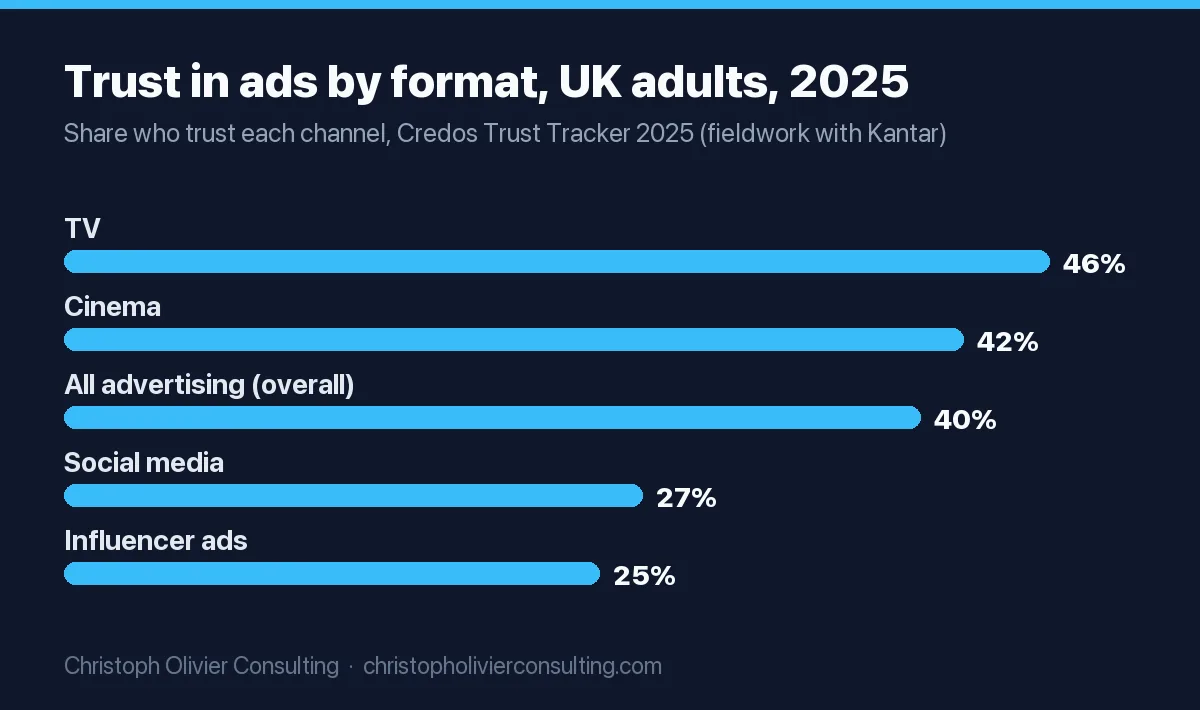
| Most trusted ad channel | TV, 46% (33% in 2021) | Credos 2025, UK |
| Least trusted ad channel | Influencer ads, 25% | Credos 2025, UK |
| Advertising practitioners rated high or very high on honesty | 10% | Gallup, Dec 1 to 15, 2025, 1,016 US adults by phone |
| Rated low or very low | 45% | Gallup, Dec 2025, US |
| Trusting the brand is an important or critical purchase criterion | 88% | Edelman Trust Barometer Special Report, Apr 23 to May 11, 2026, 17,688 people in 15 countries |
| Trust in business as an institution | 64% (employer 78% among employees, government 53%) | 2026 Edelman Trust Barometer, Oct 23 to Nov 18, 2025, nearly 34,000 people in 28 countries |
| People who trust recommendations from people they know more than any other channel | 88% | Nielsen Trust in Advertising Study, Sept 2021, 40,000+ consumers online |
| Trust in information from social media sites | 37% (national news 56%, local news 70%) | Pew Research Center, Sept 8 to 14, 2025, 5,195 US adults |
| Would trust a brand less if its content were AI-generated | 32% (15% would trust it more) | Meltwater and YouGov, released Apr 21, 2026, nearly 10,000 consumers in 7 markets |
| Fraud reports to the FTC in 2025 | 3 million, $15.9 billion reported lost | FTC Consumer Sentinel data, March 25, 2026 testimony |
Two rules for using these: say the country, and say the year. A UK channel figure quoted as “consumers” in a US pitch deck is the most common way these numbers get misused.
Which ad formats people trust most
The most current format-level trust data comes from the UK. The Credos 2025 Trust Tracker, as reported by Marketing Week on February 5, 2026, put TV at 46% trust, cinema at 42%, social media at 27% and influencer ads at 25%. Radio ranked third, but no percentage was published. Every channel rose versus 2021, when TV and cinema both sat at 33%, social media at 20% and influencer ads at 19%.
The overall trend from the same tracker: 31% in 2021, 30% in 2022, 36% in 2023, 39% in 2024 (Advertising Association data, January 2025) and 40% in 2025. In 2025, 11% of people were very trusting of ads and 29% fairly trusting, per Research Live.
Global data is older and thinner than most stat roundups suggest. What Nielsen’s own public pages actually say:
- Nielsen, 2021: 88% of global respondents trust recommendations from people they know more than any other channel, and 50% more people trust recommendations than lesser-ranked channels such as online banner ads, mobile ads, SMS messages and search ads. Trust in advertising is lowest in North America and Europe, up to 20% lower than in Africa, the Middle East and Latin America. The survey covered more than 40,000 consumers online in September 2021.
- Nielsen’s December 15, 2021 release (Japanese edition) says the same study covered 56 countries, that friends and family recommendations were the most trusted in every region, that 71% completely or somewhat trust influencers, and that tobacco ads drew the lowest trust.
- Nielsen, 2015: recommendations 83%, branded websites 70%, consumer opinions posted online 66%, emails people signed up for 56%.
Kantar measures preference rather than trust. In Media Reactions 2025 (published October 2, 2025, 21,000+ consumers in 30 markets and 1,000+ marketers), point-of-sale ads led consumer rankings again, in-person sponsored events came second, out-of-home ads made the top five, and online sponsored events ranked seventh, the highest ever for a native online channel. Among media brands, Kantar found Twitch had the most trustworthy ads of the global brands it measured.
The pattern behind all three sources: formats people choose to be in front of (a store shelf, an event, a cinema seat, a friend) beat formats that interrupt them. That fits the ad avoidance data in our ad blocking statistics, and it is why Credos names “bombardment” as the number one driver of distrust.
How Americans rate the honesty of advertising practitioners
Gallup has asked Americans to rate the honesty and ethical standards of professions for decades. In the December 1 to 15, 2025 wave (1,016 US adults, telephone, margin of error plus or minus 4 points), advertising practitioners scored:
| Rating | Advertising practitioners | Business executives | Nurses (top of list) | Telemarketers (bottom) |
|---|---|---|---|---|
| Very high or high | 10% | 10% | 75% | 5% |
| Average | 41% | 43% | 21% | 31% |
| Low or very low | 45% | 44% | 4% | 62% |
Only four of the 21 professions rated in 2025 scored lower on “very high or high”: stockbrokers (9%), members of Congress (7%), car salespeople (7%) and telemarketers (5%). Advertising’s score has stayed between 8% and 15% every year since 2009. The low point was 8% in 2023 and 2024; the high was 15% in 2022.
The split by age is worth knowing if you sell to younger buyers: 13% of 18 to 34 year olds rate advertisers high or very high, versus 6% of those 55 and older. The people behind the US advertising industry statistics work in one of the least trusted fields in the country, which is why borrowed credibility (customers, reviewers, independent data) does more work than anything the ad says about itself.
Trust in brands versus institutions: Edelman 2026
The 2026 Edelman Trust Barometer, released January 18, 2026, puts trust in business at 64% globally, 14 points behind “my employer” (78% among employees) and 11 points ahead of government (53%). Business is the only institution seen as both ethical and competent, and for the first time it scored as more ethical than NGOs (20 versus 17 on Edelman’s ethics score).
- 70% of US respondents are unwilling or hesitant to trust someone with different values or information sources, on par with the global average.
- Nearly 7 in 10 fear institutional leaders are deliberately misleading the public.
- The US scores 47 on the Trust Index, among the lowest of the 28 countries; the US gap between high and low income respondents is 29 points.
Edelman’s separate brand studies are the closest thing to a direct measure of brand trust:
| Edelman brand report | Key figures | Method |
|---|---|---|
| 2026: Brand Growth in an Insular World | 88% say trusting the brand is important or critical to buying (quality 89%, value 88%). 66% are hesitant to trust people different from them; 30% of those are unwilling to use brands used by people who differ from them. Over two-thirds say it matters that a brand is headquartered in their country, up 5 points since 2023. Consumers are almost 2x more willing to support a brand’s expansion when it has both trust and relevance. | Online, Apr 23 to May 11, 2026, 17,688 respondents, 15 countries |
| 2025: Brand Trust, From We to Me | 80% trust the brands they use, more than trust business, media, government or NGOs. Of the 55% who use generative AI, 91% use it for shopping in some way. Domestic brands are trusted 15 points more than foreign ones on average. 73% say their trust would rise if a brand authentically reflected today’s culture. | Online, Apr 24 to May 5, 2025, 15,000 respondents, 15 countries |
Edelman’s 2026 conclusion for marketers is blunt: what people not paid by the brand say about it matters far more than what the brand says about itself, so “lead with earned, scale with paid.” That lines up with Nielsen’s 88% and with Gallup’s 10%.
Trust in the media your ads run next to
Your ad borrows, or loses, credibility from the place it appears. Pew Research Center’s September 2025 survey of 5,195 US adults found 56% have at least some trust in information from national news organizations, down 11 points since March 2025 and 20 points since 2016. Local news holds up better at 70%, down from 80% in March. Social media sites are trusted by 37% (5% a lot, 32% some, per the topline), down from 42% in March 2025.
One age detail matters for targeting: adults under 30 are now about as likely to trust information from social media (50%) as from national news organizations (51%). For buyers over 50, social placements start with a bigger credibility deficit.
AI-generated ads and trust
AI creative is the newest trust risk. In the Meltwater and YouGov report released April 21, 2026 (nearly 10,000 consumers across seven markets), 32% said they would trust brands less if content is AI-generated, 15% would trust them more, and 86% said AI-generated content should be disclosed.
Marketers see it too: Kantar’s Media Reactions 2025 found 57% of marketers are concerned about generative AI being used to create fake ads. And in the UK, Credos reported that “suspicious advertising” grew significantly as a driver of distrust in 2025. Credos defines it to include scams, misleading ads, undisclosed ads, greenwashing and manipulated images. Undisclosed ads are the same problem the FTC targets in sponsored content, covered in our native advertising statistics.
What breaks trust: deceptive ads, fake reviews and the FTC
The FTC’s Consumer Sentinel Network is the largest US record of what happens when ads and offers turn out to be false. From the FTC’s March 25, 2026 testimony to Congress’s Joint Economic Committee:
- 3 million fraud reports in 2025, with $15.9 billion in reported losses, up from 2.6 million reports and over $12 billion in 2024.
- Imposter scams: over 1 million reports and over $3.5 billion lost. Investment scams: over $7.9 billion lost, about half of all reported losses.
- Social media is the top contact method by losses: over $2 billion in FY 2025 where consumers named social media as the way they were contacted.
- Reported losses have risen nearly 430% since 2020.
Sentinel has no single “deceptive advertising” bucket. The closest category, online shopping, was the second most reported fraud category in 2024, behind imposter scams (FTC, March 10, 2025). For the enforcement side, our FTC advertising enforcement statistics track cases and penalties, and these false advertising examples show the claims that got brands sued.
The FTC fake reviews rule (16 CFR Part 465)
The FTC announced the Consumer Reviews and Testimonials Rule on August 14, 2024, by a 5 to 0 vote. Its Q&A confirms it went into effect on October 21, 2024. It bans:
- Fake reviews and testimonials, including AI-generated ones, and buying or spreading reviews you knew or should have known were fake.
- Incentives conditioned on a review expressing a particular sentiment.
- Insider reviews that do not clearly disclose the reviewer’s material connection.
- Company-controlled “independent” review sites.
- Suppressing negative reviews through groundless legal threats, intimidation or false accusations.
- Buying or selling fake social media indicators such as bot followers or views.
On December 22, 2025, FTC staff sent warning letters to 10 companies, noting civil penalties of up to $53,088 per violation, the maximum in effect since January 17, 2025. Two details from the FTC Q&A most firms get wrong: incentives for reviews are allowed as long as they are not tied to a positive review, and asking only happy customers (“review gating”) is not specifically banned by the rule but can still violate the FTC Act. Our guide on how to get more Google reviews shows request wording that stays inside both lines.
Trust signal table: turn each finding into an ad or landing page change
This is the part most statistics pages skip. Each row takes one sourced finding above and turns it into one change you can make this week, with a pass or fail test so you know it is done.
| Finding | Change to make | Pass if |
|---|---|---|
| 88% trust recommendations from people they know above any other channel (Nielsen 2021); earned voices beat brand voices (Edelman 2026) | Put one named client quote or third-party review rating directly beside the main call to action, not on a separate testimonials page | Every primary CTA has a verifiable third-party proof element within one screen of it |
| 10% of Americans rate ad practitioners’ honesty high (Gallup 2025) | Rewrite superlatives as checkable claims: a number, what it measures, and the date | No “best”, “#1” or “leading” on the page unless the next sentence says who measured it and when |
| In 2017, 64% of US adults wanted stronger requirements for proving ad claims, up from 58% in 2014 (YouGov) | Footnote result claims with the source, sample and time period | Each statistic or result on the page links to its source or states its sample |
| Bombardment is the top driver of distrust (Credos 2025) | Set a frequency cap on retargeting and stop serving ads to people who already converted | A cap is set in every active retargeting campaign and a converter exclusion list is attached |
| “Suspicious advertising” (undisclosed ads, manipulated images) is a rising distrust driver (Credos 2025) | Label sponsored posts and paid partnerships in the first line, and stop retouching before-and-after images | A viewer can tell it is an ad without clicking “more” |
| 32% would trust a brand less if content is AI-generated; 86% want disclosure (Meltwater and YouGov 2026) | Use real photos of your team, office and clients; disclose any AI-generated person or scene | No undisclosed AI-generated faces in ads or on landing pages |
| Consumer Review Rule in force since October 21, 2024, up to $53,088 per violation (FTC) | Send review requests to every customer with neutral wording; offer any incentive regardless of rating; have staff disclose their connection | Your request template contains no “5-star” wording and no incentive tied to a positive review |
| 88% call trust an important or critical purchase criterion, level with value (Edelman 2026) | Move trust proof (licences, credentials, review count, guarantee terms) onto pricing and booking pages, where the decision happens | The pricing page shows at least two trust elements above the fold |
| Point-of-sale ads top consumer preference (Kantar 2025) | Treat the checkout, booking or contact form as an ad placement: add a short proof line and what happens next | The form page states response time and shows one proof element |
| Social media trusted by 37% of US adults (Pew 2025); top contact method for fraud losses (FTC) | Send social ad traffic to a landing page with independent proof rather than asking for a form fill inside the platform | Social campaigns point to a page with your full business name, address and third-party reviews |
| 91% of generative AI users use it for shopping (Edelman 2025) | Get your firm described accurately in third-party sources AI tools read: directories, review sites, trade press | Searching your firm name plus your service in an AI assistant returns correct facts |
| Influencer ads trusted by 25%, TV by 46% (Credos 2025) | If you use creators, pair the post with a verifiable result or demo, and disclose the paid relationship up front | Every creator post carries a disclosure and one checkable claim |
My view: the first two rows do the most for professional service firms, because buyers are already primed to distrust the pitch, so a named client beside the button and a dated, sourced number in the headline carry more weight than any design change. If you want a second pair of eyes on which rows apply to your funnel, you can book a consultation.
Trust statistics that are often quoted wrong
Many roundups recycle numbers that are years old or that the original publisher never published. Check these before you put them in a deck:
| Commonly quoted | What the primary source shows | Use instead |
|---|---|---|
| “Only 23% trust influencer ads (Nielsen 2021)” | Nielsen’s public 2021 article gives no influencer figure; Nielsen’s December 2021 release reports 71% completely or somewhat trust influencers | Credos 2025: 25% of UK adults trust influencer ads, and say it is UK data |
| “83% trust recommendations from friends (Nielsen)” | That is the 2015 global figure | 88%, Nielsen 2021, global |
| “80% of people trust the brands they use (Edelman)” | Correct for 2025; the 2026 brand report leads with a different measure | 88% say trusting the brand is important or critical to buying (Edelman 2026) |
| “8% of Americans rate advertisers’ honesty high (Gallup)” | That was 2023 and 2024 | 10%, Gallup December 2025 |
| “39% trust advertising (Credos)” | That was 2024 | 40%, Credos 2025, UK |
| “61% of Americans trust ads (YouGov)” | A March 2017 YouGov figure (50% in 2014); no newer US YouGov trust-in-ads number was found | Cite it as 2017, or use Gallup 2025 for a current US measure |
When you cite any number on this page, include three things: the publisher, the fieldwork year and the country. “40% of UK adults trusted advertising in 2025 (Credos)” survives scrutiny. “40% of consumers trust ads” does not.
Frequently asked questions
What percentage of consumers trust advertising?
In the UK, 40% of adults said they trusted advertising in 2025, up from 31% in 2021, per the Credos Trust Tracker run with Kantar. 25% distrust ads and 33% are neutral. There is no equivalent current US measure; the closest is Gallup's December 2025 poll, where only 10% of Americans rated advertising practitioners' honesty high or very high and 45% rated it low or very low.
What is the most trusted form of advertising?
Recommendations from people you know. Nielsen's 2021 Trust in Advertising Study found 88% of global respondents trust them more than any other channel. Among paid formats, TV is the most trusted in the UK at 46% in 2025 (Credos), followed by cinema at 42%. Kantar's 2025 Media Reactions found point-of-sale ads and in-person sponsored events are the formats consumers prefer most.
Do consumers trust influencer ads?
Less than any other channel Credos tracks: 25% of UK adults trusted influencer ads in 2025, up from 19% in 2021, versus 46% for TV. Be careful with the widely repeated claim that only 23% trust influencer ads per Nielsen 2021. Nielsen's public 2021 article does not give that figure, and its December 2021 release reported 71% completely or somewhat trust influencers.
How do Americans rate the honesty of advertising practitioners?
Poorly. In Gallup's December 1 to 15, 2025 survey of 1,016 US adults, 10% rated advertising practitioners' honesty and ethics very high or high, 41% average and 45% low or very low. Only stockbrokers, members of Congress, car salespeople and telemarketers scored lower. Advertising's high or very high score has ranged between 8% and 15% every year since 2009.
Does brand trust affect purchase decisions?
Yes, as much as price. In Edelman's 2026 Trust Barometer Special Report, 17,688 people in 15 countries were surveyed from April 23 to May 11, 2026, and 88% said trusting the brand is an important or critical purchase criterion. That is level with value at 88% and just behind quality at 89%. Edelman also found earned voices, such as customers and unpaid advocates, build trust more than what a brand says about itself.
Do people trust AI-generated ads?
A sizeable minority distrust them. In the Meltwater and YouGov report released April 21, 2026, covering nearly 10,000 consumers in seven markets, 32% said they would trust a brand less if its content were AI-generated, 15% would trust it more, and 86% said AI-generated content should be disclosed. Kantar found 57% of marketers worry about generative AI being used to create fake ads.
When did the FTC fake reviews rule take effect?
The Consumer Reviews and Testimonials Rule, 16 CFR Part 465, took effect on October 21, 2024, after the FTC approved it 5 to 0 on August 14, 2024. It bans fake and AI-generated reviews, sentiment-conditioned incentives, undisclosed insider reviews, fake independent review sites, review suppression and fake follower counts. The FTC sent its first warning letters to 10 companies on December 22, 2025, citing penalties up to $53,088 per violation.
More original research from CO Consulting
- Small Business Website Speed: A 320-Site Performance Study (2026)
- US Advertising and Marketing Industry Statistics 2026: Revenue, Employment, and Wages
- The AI Search Readiness Study 2026: 15 Data Points on How Small-Business Websites Score for AI Citation
- FTC Advertising and Endorsement Enforcement: 12 Compliance Statistics for 2026
- Podcast and Audio Advertising Statistics for 2026: 27 Verified Data Points
- 27 Connected TV and Streaming Advertising Statistics for 2026
- 31 Online Reviews and Reputation Statistics for 2026
- US Digital Advertising Spend: 42 Statistics, Trends, and Data Points for 2026
Advertising & ad-tech research
More Marketing Research guides
- Marketing Cost & CAC Benchmark by Industry 2026: The True Cost Per Acquired Client
- Marketing Employment and Salary Statistics 2026: 45 Verified Data Points From the U.S. Bureau of Labor Statistics
- Small Business Website Speed: A 320-Site Performance Study (2026)
- US Advertising and Marketing Industry Statistics 2026: Revenue, Employment, and Wages
- US Digital Advertising Spend: 42 Statistics, Trends, and Data Points for 2026
- The AI Search Readiness Study 2026: 15 Data Points on How Small-Business Websites Score for AI Citation
- All Marketing Research guides →