

On a small budget, the digital ad platforms with the best ROI are the ones that reach people who are already looking for you: Google Search ads, Google Local Services Ads (you pay per lead, not per click) and Microsoft Advertising. Add Meta retargeting as a cheap second line. LinkedIn, TikTok, connected TV and programmatic platforms such as Simpli.fi, StackAdapt and Vibe can pay off too, but their minimums, audiences or measurement work better once search is already profitable.
Below: 10 platforms ranked with the minimum spend each one publishes, how it charges and who it fits; a break-even test to see whether any platform can return a profit for your numbers; an honest Simpli.fi vs other ad tech comparison built only from what the vendors publish; retargeting tools for limited budgets; and three budget plans at $500, $1,500 and $5,000 a month with the math shown.
What digital ad platforms offer the best ROI for small budgets?
Return depends on two things you control: how much a lead costs, and how often a lead turns into a paying customer. Small budgets favor platforms where intent is high and the entry price is low, because you cannot afford weeks of learning on a cold audience. In order:
- Google Search ads. No minimum. Google says bidding amounts “are ultimately up to you” and that you should “choose a bid amount and budget you’re comfortable with” (Google Ads pricing). The all-industry average is a $5.42 click and a $66.69 lead (LocaliQ search benchmarks, updated June 1, 2026).
- Google Local Services Ads, if your trade or profession is eligible. You are “charged for each valid lead,” and repeat contact from the same number or email within 15 days is not charged again (Google LSA help).
- Microsoft Advertising. The same search intent on Bing, with a USD minimum daily budget of $0.05 in Microsoft’s own documentation (Microsoft Advertising currencies). Add it once your Google campaigns are converting.
- Meta retargeting and lead ads. Floors of $1 a day for impression-billed ad sets and $5 a day for click or conversion goals, per PodVector’s summary of Meta’s Business Help Center (Sept 26, 2026). A Meta lead averages $27.39 (LocaliQ Facebook benchmarks, updated Sept 23, 2026), but those leads are colder than search leads.
- Everything else (Nextdoor, Yelp, LinkedIn, TikTok, YouTube, CTV and programmatic) earns a slot when it fits a specific audience or goal, which the table below spells out.
The deciding number is not a platform’s average. It is the most you can pay per lead and still make money, which the break-even section below works out for four example businesses.
Paid ad channels ranked by ROI for small businesses
Ranked for a business spending under $5,000 a month that wants leads or sales. The ranking weighs three things: how much buying intent the platform’s audience shows, how low its published minimum is, and how directly you can tie spend to a sale. That weighting is my judgment; every minimum and price in the table comes from the linked source.
| Rank | Platform | Published minimum | How you pay | Price you can plan with | Best fit |
|---|---|---|---|---|---|
| 1 | Google Search | None. Google may spend up to 2 times your average daily budget on a day, but no more than 30.4 times it in a month (Google Ads Help) | Per click (CPC auction) | $5.42 CPC, $66.69 cost per lead, all industries (LocaliQ, June 2026) | Anyone whose customers search for the service |
| 2 | Google Local Services Ads | No dollar minimum; Google recommends “a minimum budget of 10 leads per week for optimal results” (LSA bidding help) | Per valid lead; bid modes Maximize leads, Target cost per lead, Max per lead | Not published; set by competing bids, location and job type | Eligible local trades and professional services |
| 3 | Microsoft Advertising | $0.05 a day, $5 a month in USD, “subject to change” (Microsoft Learn) | Per click | No published average | Search advertisers who already run Google |
| 4 | Meta (Facebook, Instagram) | $1 a day per ad set billed on impressions; $5 a day for clicks or conversions; 5 times your target with a cost goal (PodVector, citing Meta) | CPM auction, optimized to your goal | $0.60 traffic CPC; $27.39 lead-ad CPL (LocaliQ, Sept 2026); $4.93 CPM (Digiday, April 30, 2026) | Retargeting, consumer offers, testing creative |
| 5 | Nextdoor Ads Manager | None stated; you set a daily goal or a lifetime budget and are billed when your balance hits a threshold (Nextdoor) | Bid types set per campaign | No published average | Home services: Nextdoor says 77% of its users are homeowners and 1 in 3 US households are on it |
| 6 | Yelp Ads | “Spend as little as $5 per day on average”; no term contracts for self-serve (Yelp Ads) | Per click: “you only pay once someone clicks” (LocaliQ on Yelp Ads) | Yelp Ads “starts at $150/month”; Upgrade Package $180 a month (Yelp pricing) | Restaurants, salons, movers, trades with Yelp traffic |
| 7 | LinkedIn Ads | $10 a day; $100 lifetime for a new campaign; LinkedIn suggests $25 a day for new advertisers (LinkedIn) | Per impression or click, by objective | $760 a month at the suggested $25 a day | B2B and professional services with high fees |
| 8 | TikTok Ads | Daily budget “must exceed $50” per campaign and “$20” per ad group (TikTok Ads help) | CPM auction, optimized to your goal | $3.12 CPM (Digiday, 2026) | Consumer brands with native video; about $1,520 a month to clear the floor |
| 9 | YouTube | Runs on your Google Ads budget; no separate minimum | CPM or per view | $3.82 CPM (Digiday, 2026) | Retargeting with video, demand creation |
| 10 | Self-serve programmatic and CTV: Simpli.fi Autopilot AI, StackAdapt, Vibe, Viant via AdTegral | Simpli.fi Autopilot AI and StackAdapt: no minimum; Vibe: $50 per strategy; Viant via AdTegral: “no spend minimum levels” (details below) | CPM | Few platforms publish a rate; see the comparison below | Local awareness, geo-fencing, streaming TV once search is working |
Two readings matter more than the rank. First, the top three all buy intent: the person typed what they want. Second, the bottom of the list is not worse advertising; it is advertising that needs a bigger budget, better creative or a longer test to prove itself. If you plan to spend on Google first, our Google Ads budget guide for small businesses shows how to size the daily budget against your keyword prices.
Cost per lead decides ROI: check your break-even before you pick a platform
A platform has positive ROI for you only if its cost per lead sits under your break-even cost per lead. Work it out in two steps:
- Maximum cost per customer = first-year gross margin from one customer ÷ the return you want. A 3:1 target means you keep $2 of margin for every $1 of ad spend.
- Maximum cost per lead = maximum cost per customer × the share of leads you close.
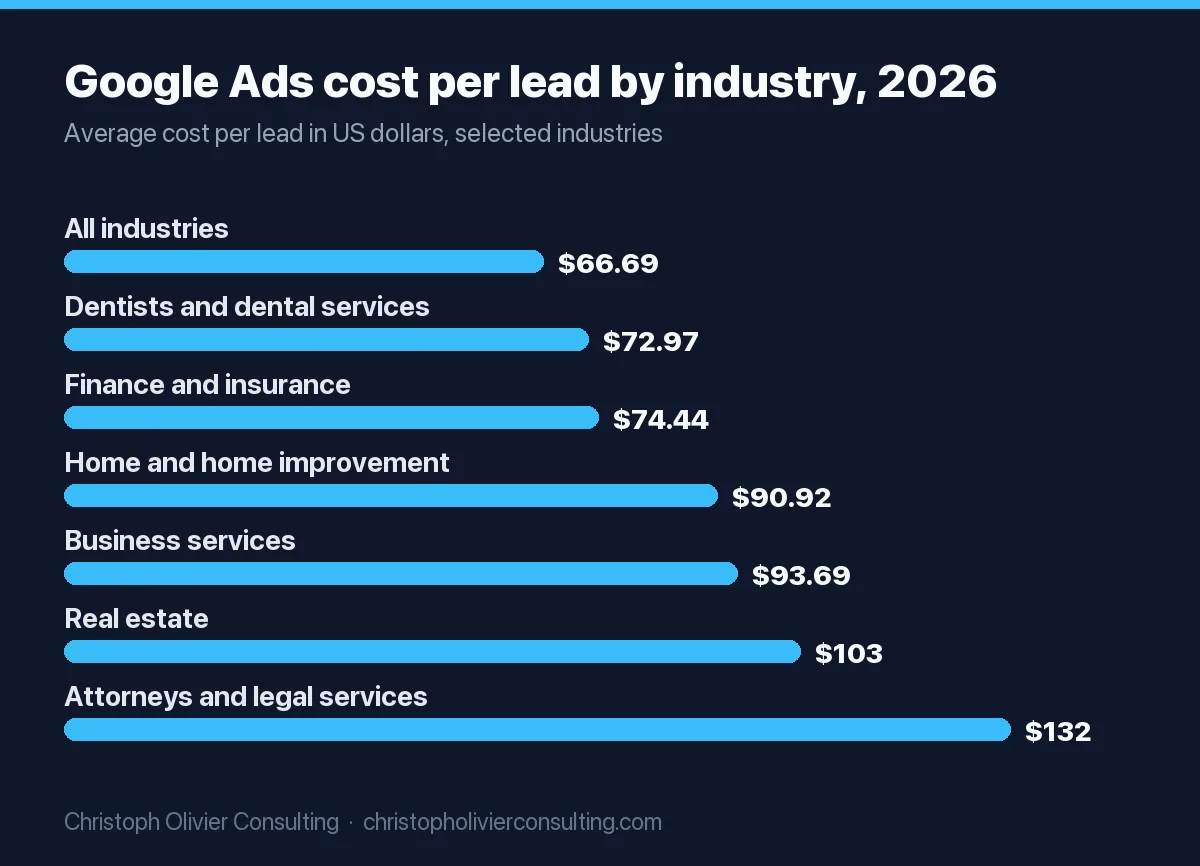
Here is the test run for four example businesses against LocaliQ’s 2026 Google Ads averages for their industry. The margin and close-rate inputs are illustrations; replace them with yours.
| Example business | First-year margin per customer | Max cost per customer at 3:1 | Close rate | Break-even cost per lead | LocaliQ industry average CPL | Verdict |
|---|---|---|---|---|---|---|
| Home services contractor | $1,800 | $600 | 25% | $150 | $90.92 (Home and Home Improvement) | Pass, $59 of room |
| Law firm | $6,000 | $2,000 | 10% | $200 | $131.63 (Attorneys and Legal Services) | Pass, $68 of room |
| Dental practice | $900 | $300 | 30% | $90 | $72.97 (Dentists and Dental Services) | Pass, $17 of room: tight |
| Bookkeeping firm | $2,400 | $800 | 10% | $80 | $93.69 (Business Services) | Fail by $13.69: fix close rate or offer first |
The same math explains why the cheapest lead is often not the best one. A $27.39 Meta lead that closes at 5% costs $547.80 per customer. A $66.69 Google lead that closes at 20% costs $333.45. Those close rates are assumptions for the example, so track close rate by source in your CRM and rerun this with your own numbers after 30 days.
When a business fails the test on every platform, the problem is the offer, the landing page or the follow-up, not the channel. Paid traffic multiplies the conversion rate you already have.
Simpli.fi vs other ad tech platforms: targeting and ROI for small businesses
Simpli.fi, StackAdapt, Vibe, Viant and AdRoll are programmatic platforms: they buy ads across many websites, apps and streaming TV services instead of one company’s feed. None of them publishes an audited ROI figure, so an honest comparison is about minimums, fees, targeting and how you can measure results. This is what each vendor states on its own pages.
| Platform | How a small business buys | Published minimum | Published fees | Targeting strengths it states | Best fit |
|---|---|---|---|---|---|
| Simpli.fi | Autopilot AI (self-serve) or the full platform through sales | Autopilot AI: “no minimum spend” with “pay-as-you-go credit card billing” (Simpli.fi release, Jan 14, 2025). Full platform: none published | None published | Addressable geo-fencing matched to property lines, “up to one million addresses” per list (Simpli.fi); Conversion Zones that track store or office visits; keyword targeting; CTV, paid search, paid social, native, audio and DOOH in one platform (Simpli.fi) | Local and multi-location businesses that want foot traffic measured |
| StackAdapt | Self-serve, managed or hybrid; five tiers from Basic to Enterprise | “No minimum spend required to get started”; “most teams hit their stride around $5k a month” (StackAdapt) | No percentage; “no hidden tech fees” | Basic tier gives “full control” self-serve; higher tiers add managed support | B2B and content-led campaigns at $5,000 a month or more |
| Vibe | Self-serve streaming TV | “Each strategy requires a minimum budget of $50” (Vibe help) | No platform, subscription, seat or joining fees | Streaming TV audiences, including Walmart Audiences announced Oct 28, 2026 (Vibe blog) | A first streaming TV test |
| Viant (through AdTegral) | Co-managed by AdTegral’s team, with a path into Viant’s DSP | “No spend minimum levels to access” (Viant and AdTegral release, Aug 21, 2025) | None published | Aimed at small and mid-sized advertisers in retail, healthcare and consumer goods | Advertisers who want a managed CTV and programmatic buy |
| AdRoll | Self-service or managed | “AdRoll does not have a minimum spend amount” (AdRoll pricing) | “Dynamic pricing based on CPM” | Retargeting, cross-channel attribution and social ads as add-ons | Ecommerce and service sites with steady traffic to retarget |
Where Simpli.fi is stronger. Its targeting is built for local results. Addressable geo-fencing lets you serve ads to specific households from a list, Conversion Zones count visits to your location, and keyword targeting reaches people based on terms they searched or read. Simpli.fi says it serves “over 2,000 media teams, agencies, and brands” and runs over 140,000 campaigns for 40,000 advertisers in a typical month, a company claim from the same release. Because its customers are mostly media teams and agencies, ask a local agency or media group whether it resells Simpli.fi before you contact sales.
Where others are stronger. StackAdapt and Vibe publish more of their terms up front: StackAdapt states no minimum and no hidden tech fees, and Vibe states a $50 floor and no platform fees. For the full Simpli.fi platform, fees and minimums depend on your contract or reseller, so get them in writing. Simpli.fi’s case studies, such as a law firm that reported a $6.48 cost per in-office visit (Simpli.fi geo-fencing), are vendor-reported results for one client, not a benchmark.
Which gives the best ROI? None of these vendors publishes independent proof, so test it yourself:
- Pick one platform and one goal you can count: booked calls, form fills or store visits.
- Hold out a matched area. Run ads in one set of ZIP codes and none in a similar set for at least 30 days.
- Compare leads or visits per 1,000 households in the two areas, not the platform’s own attributed conversions.
- Divide spend by the extra leads or customers. Keep the platform only if that cost clears your break-even from the section above.
For DSP fee structures at The Trade Desk, Google DV360 and Amazon DSP, and the supply-path checks that keep a programmatic buy off low-quality sites, see our programmatic media buying guide. If geo-fencing is the reason you are looking at Simpli.fi, our geofencing marketing guide covers how the targeting works and where it breaks.
What retargeting software gives the best return for a small business with a limited budget?
Start with the retargeting built into the ad accounts you already pay for. It costs nothing extra, and the people it reaches have already visited your site. Add a separate retargeting platform only when you need reach beyond Google and Meta.
| Tool | Extra fee or minimum | Audience size needed | Use it when |
|---|---|---|---|
| Google Ads remarketing (your data segments) | None beyond your ad spend | At least 100 active visitors or users in the last 30 days for Search, Display and YouTube (Google Ads Help) | You already run Search; show ads again to visitors who did not convert |
| Meta custom audiences | None beyond spend; $1 a day per ad set on impressions | Site visitors tracked by the Meta pixel | Cheapest way to stay visible to past visitors |
| AdRoll | No minimum spend; CPM pricing | Steady site traffic | You want retargeting across many sites plus email and attribution |
| StackAdapt | No minimum | Steady site traffic | You want one programmatic platform for retargeting and prospecting |
| Simpli.fi | Autopilot AI: no minimum | Site visitors, or keyword and household lists | You want search-keyword or address-based retargeting for a local area |
In the $500 plan below, Meta retargeting gets $75 a month. That buys about 15,200 impressions at Digiday’s $4.93 Facebook CPM, which is enough to show a few thousand recent visitors an ad several times. For the difference between retargeting ads and remarketing emails, read retargeting vs remarketing.
Budget plans: what $500, $1,500 and $5,000 a month buy
These plans use the same splits and all-industry averages as the starter plans in our internet advertising guide, with swaps for local businesses. Results are planning math, not forecasts. Replace the cost per click and cost per lead with your own after 30 days.
$500 a month: one intent channel
| Line | Monthly | Daily | Math | Planned result |
|---|---|---|---|---|
| Google Search, high-intent keywords only | $425 | $14 | $425 ÷ $5.42 CPC; $425 ÷ $66.69 CPL | About 78 clicks, 6 leads |
| Meta retargeting, billed on impressions | $75 | $2.47 | $75 ÷ $4.93 × 1,000 | About 15,200 impressions |
Local swap: if your category is eligible for Local Services Ads, test LSA with part of the $425. Watch the budget: Google recommends budgeting for 10 leads a week for best results, which a $500 plan covers only if your leads cost under about $11.50 ($500 ÷ 4.34 weeks ÷ 10 leads). Below that level, LSA may deliver unevenly. Skip LinkedIn, TikTok and CTV at this budget. TikTok’s $50 daily campaign floor alone is about $1,520 a month.
$1,500 a month: search plus a social test
| Line | Monthly | Daily | Math | Planned result |
|---|---|---|---|---|
| Google Search | $1,000 | $33 | $1,000 ÷ $5.42; $1,000 ÷ $66.69 | About 185 clicks, 15 leads |
| Meta lead campaign | $300 | $9.87 | $300 ÷ $27.39 CPL; $300 ÷ $1.80 CPC | About 11 leads, 167 clicks |
| Meta retargeting | $200 | $6.58 | $200 ÷ $4.93 × 1,000 | About 40,600 impressions |
Local swap: a home services or restaurant business can replace the $300 Meta lead test with Yelp Ads at its $150 starting price plus $150 on Nextdoor, then keep whichever produces booked jobs at the lower cost. Judge every line on booked appointments or sales, not on cost per lead.
$5,000 a month: a small portfolio
| Line | Monthly | Math | Planned result |
|---|---|---|---|
| Google Search | $2,500 | $2,500 ÷ $5.42; $2,500 ÷ $66.69 | About 461 clicks, 37 leads |
| LinkedIn, one tightly defined audience (B2B), or LSA (local consumer) | $760 | LinkedIn’s suggested $25 a day × 30.4 | Enough to test one offer by job title and company size |
| Meta lead campaign | $540 | $540 ÷ $27.39 | About 20 leads |
| Meta retargeting | $200 | $200 ÷ $4.93 × 1,000 | About 40,600 impressions |
| YouTube in-stream to your audiences | $500 | $500 ÷ $3.82 × 1,000 | About 131,000 impressions |
| Test slot: Simpli.fi Autopilot AI geo-targeted CTV or a Vibe streaming TV strategy | $500 | Both clear their published minimums | One local streaming TV or geo-fence test with a holdout area |
Add lines one at a time, a month apart, so you can see what each one adds to booked revenue. Kill any line that cannot beat your break-even cost per lead after a full 30-day test.
Which delivers better ROI for professional services: TikTok ads or LinkedIn ads?
For a firm that sells to businesses, LinkedIn usually wins, even though its clicks cost more. Dreamdata’s 2026 LinkedIn Ads Benchmarks Report, built on its customers’ data across 66 million sessions, put LinkedIn’s cost per click at €5.98 against €1.60 on Meta, but LinkedIn’s cost per company influenced was lower (€70.11, against €128.70 on Meta and €110.37 on Google Search) and its return on ad spend was 121%, against 51% on Meta and 67% on Google Search. Those figures come from Dreamdata’s own B2B customer base and are in euros, not a market average.
| Factor | LinkedIn Ads | TikTok Ads |
|---|---|---|
| Minimum to run | $10 a day, about $304 a month | Over $50 a day per campaign, about $1,520 a month |
| Targeting | Job title, company and company size | Interests, behavior and demographics |
| Creative you need | A document, single image or short video with a clear offer | Native vertical video, refreshed often |
| Better fit | Accountants, consultants, law firms selling to companies, B2B services | Consumer-facing practices: dental, med spa, fitness, home services |
For targeting and offer ideas, our LinkedIn ads strategy guide covers audience sizes and campaign setup.
Do small businesses get ROI from video advertising?
Most marketers who use video say yes, but the evidence is self-reported. In Wyzowl’s 2026 video marketing survey, 82% of video marketers said video has given them a good ROI, down from 93% in 2025. 85% said it generated leads and 83% said it directly increased sales. The survey had 266 respondents in late 2025, so treat it as direction, not proof.
For a small business, the cheaper test is video aimed at people who already know you. YouTube impressions averaged about $3.82 per 1,000 in 2026 (Digiday), so $500 a month buys about 131,000 impressions to your site visitors and customer lists. Streaming TV costs more per view but now has low entry points: Vibe’s floor is $50 per strategy, and Simpli.fi’s Autopilot AI has no minimum. Measure video on lift in branded searches and booked calls in the areas you target, because few people click a TV ad.
Which PPC agencies are best for small businesses? A 5-point test
No list of agency names can answer this for your budget, but these checks separate a good fit from an expensive one:
- Verify the Google Partner badge. Partner status requires a 70% optimization score, $10,000 in ad spend across managed accounts over 90 days, and at least half of account strategists certified; Premier Partners are the top 3% in their country each year (Google Partners requirements). It shows scale and training, not results for your industry.
- Compare the fee to your spend. In my view, below about $1,500 a month in spend, a management fee often costs more than it saves, and a tight campaign you review weekly is the better deal.
- Insist the ad accounts are in your name. You keep the data and history if you leave.
- Ask for reporting on booked revenue, not clicks and impressions. If they cannot connect to your CRM, they cannot manage to your break-even.
- Check the exit terms. Month-to-month after a short ramp is normal. Long lock-ins on a small budget are a warning sign.
Our PPC management guide breaks down the common fee models. If you want an outside read on whether your numbers support paid ads at all, you can book a consultation and start with the break-even math above.
Frequently asked questions
What digital ad platforms offer the best ROI for small budgets?
Google Search ads and Google Local Services Ads usually return the most on a small budget because they reach people already searching for the service, and neither has a published dollar minimum. Microsoft Advertising is next for the same intent. Meta retargeting is the cheapest second line, with floors of $1 to $5 a day per ad set. Confirm with your own break-even cost per lead.
Is Simpli.fi good for small businesses compared with other ad tech platforms?
Simpli.fi is strongest for local targeting: addressable geo-fencing, Conversion Zones that count store or office visits, and keyword targeting. Its Autopilot AI tool states no minimum spend with pay-as-you-go card billing. Full-platform fees are not published. StackAdapt and Vibe publish more of their terms, so compare written quotes and run a holdout test before committing.
What retargeting software gives the best return for a small business with a limited budget?
Start with the remarketing already inside Google Ads and Meta, because it adds no software fee. Google needs at least 100 active visitors in the last 30 days for a segment to serve on Search, Display or YouTube. Add AdRoll, StackAdapt or Simpli.fi, all of which state no minimum spend, only when you need reach across more sites or address-based targeting.
Do small businesses get ROI from video advertising?
Many report that they do: in Wyzowl's 2026 survey, 82% of video marketers said video gave a good ROI, down from 93% in 2025, though the sample was only 266 respondents. The lowest-risk test for a small business is YouTube video shown to past site visitors at roughly $3.82 per 1,000 impressions, measured on booked calls rather than views.
Which delivers better ROI for professional services: TikTok ads or LinkedIn ads?
LinkedIn usually wins for firms that sell to businesses, because it targets by job title and company. Dreamdata's 2026 report found LinkedIn's cost per company influenced (EUR 70.11) below Meta and Google Search despite pricier clicks. TikTok suits consumer-facing practices with native video, and its $50 daily campaign floor means about $1,520 a month.
How much should a small business spend on paid ads per month?
Start where one channel can collect enough data: about $500 a month on Google Search buys roughly 78 clicks and 6 leads at 2026 averages. At $1,500, add a Meta lead test and retargeting. At $5,000, a small portfolio with LinkedIn or LSA, YouTube and one streaming TV test becomes realistic. Cap spend at your break-even cost per lead.
Which PPC agencies are best for small businesses?
Pick on fit, not a ranking. Verify any Google Partner badge (it requires a 70% optimization score and $10,000 in managed spend over 90 days), keep ad accounts in your name, ask for reporting on booked revenue, and avoid long lock-ins. Below about $1,500 a month in spend, a management fee often costs more than it saves.
More Paid Advertising guides