
Opening a new general dental practice in the US costs roughly $630,000 to $790,000 for a lean 3-operatory office and $970,000 to $1.2 million for a 5-operatory office, once you count the build-out, equipment at list price and the cash you burn before the office pays its own bills. Those are my calculations from public prices and filings, not a survey. The build-out is the swing item: 102 dental finish-outs registered with Texas regulators since January 2025 had a median estimated cost of $150 per square foot, with the middle half between $117 and $182 (TDLR TABS, my calculation).
Short answer: Plan on about $733,577 for a 3-operatory startup, $1,134,504 for 5 operatories and $2,009,984 for 8 operatories, including working capital, in my itemized model below. Roughly a fifth to a third of the total is cash to cover losses until the office breaks even, which took 15 to 16 months for the smaller offices in my model. Get your own bids early: with a 25th percentile Texas build-out and 20% off equipment, or a 75th percentile build-out at list prices, the 5-operatory total moves between $973,652 and $1,217,704.
Most pages that rank for this question give one round range with no math behind it. A $500,000 figure gets quoted a lot. In ADA News (March 2025), a lender’s co-founder wrote that opening a practice “often costs $500,000 at minimum”. Below I show every line, where each number comes from, how a 7(a) loan changes the monthly picture, and a pass/fail test you can run before you sign a lease.
Dental practice startup costs, itemized at 3, 5 and 8 operatories
This is the original asset on this page. The scenarios are a solo general dentist in 1,800 square feet with 3 operatories, a solo dentist in 2,600 square feet with 5, and a two-dentist office in 4,000 square feet with 8. The square footages are my assumptions. The 2,600 figure is close to the 2,636 square foot median of the Texas dental finish-out filings. Equipment is priced at the list prices shown on Patterson Dental’s overstock pages in November 2026, so a negotiated package will usually come in lower.
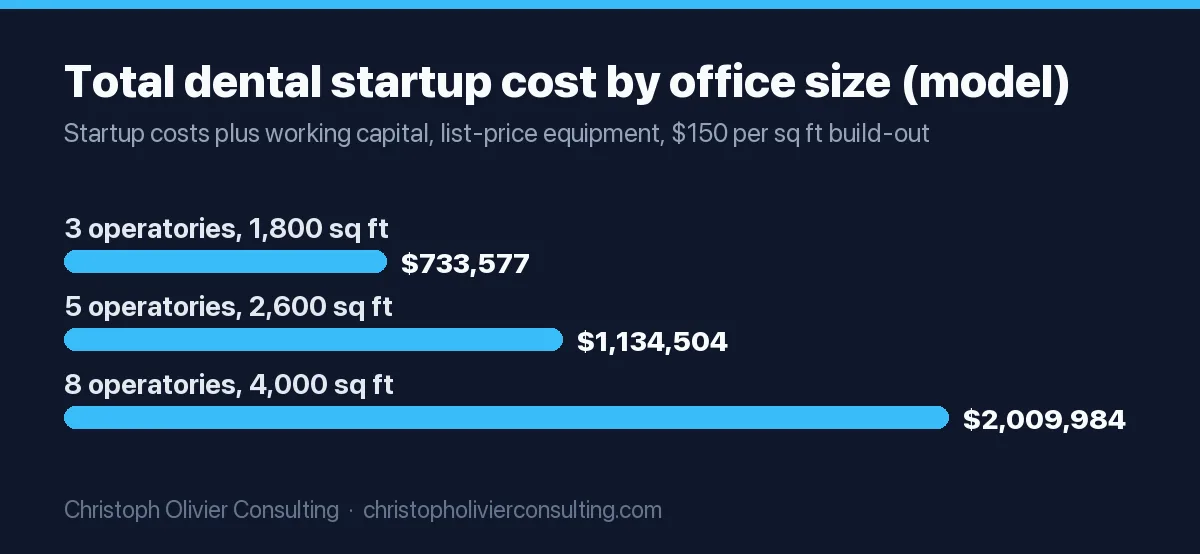
| Line item | 3 operatories | 5 operatories | 8 operatories | Source or basis |
|---|---|---|---|---|
| Leasehold build-out | $270,000 | $390,000 | $600,000 | Square feet x $150, the median of 102 Texas dental finish-outs, 2025 to 2026 (TDLR TABS, my calculation) |
| Architect, engineering, drawings | $15,000 | $15,000 | $15,000 | $15,000 line in a 2023 dental franchise Item 7 (One Endo FDD, as reported by FranchisePayback) |
| Operatory equipment (chair, delivery unit, light, 2 stools, side cabinet, wall x-ray, 3 handpieces) | $146,821 | $244,702 | $391,523 | Operatories x $48,940, list prices in the next section |
| Ultrasonic scaler packages for hygiene rooms | $3,265 | $6,529 | $9,794 | $3,264.74 list each, 1, 2 or 3 rooms (Patterson) |
| Imaging: panoramic or CBCT unit plus digital sensors | $24,166 | $50,050 | $58,934 | Pano $11,998 (3 ops) or 3D pano/CBCT $28,998 (5 and 8 ops) (DuraPro 2026 price guide); size 1 sensor kits $8,884.20 and one size 2 kit $3,283.89 (Patterson) |
| Intraoral scanner | $0 | $22,332 | $22,332 | Primescan 2, $22,332 list (Patterson); skipped in the lean 3-op office |
| Vacuum and air compressor | $15,822 | $15,822 | $31,644 | Vacuum system $11,234.88 and compressor $4,587.18 list, doubled for 8 ops (Patterson) |
| Sterilization center, sterilizer, ultrasonic cleaner | $32,835 | $32,835 | $39,902 | Sterilization cabinetry $24,208.88, cassette sterilizer $7,066.55 (2 for 8 ops), cleaner $1,560.06 (Patterson, Patterson) |
| Intraoral camera | $2,992 | $2,992 | $2,992 | $2,992.50 list (Patterson) |
| Computers, software setup, card terminal | $6,000 | $9,000 | $12,000 | Within the $6,000 to $12,000 range in the Clear Lakes Dental 2023 FDD (as reported); size-based pick is mine |
| Security and surveillance | $7,000 | $8,500 | $10,000 | Within the FDD range of $7,000 to $10,000 |
| Signage | $6,000 | $9,000 | $12,000 | Within the FDD range of $6,000 to $12,000 |
| Initial clinical and office supplies | $20,000 | $40,000 | $60,000 | Within the FDD range of $20,000 to $60,000 |
| Licenses and permits | $500 | $750 | $1,000 | Within the FDD range of $500 to $1,000 |
| Insurance deposits | $1,000 | $3,000 | $5,000 | Within the FDD range of $1,000 to $5,000 |
| Rent: deposit plus 3 months during build-out | $15,312 | $22,117 | $34,027 | Square feet x $25.52 a year, the Q3 2026 average medical office asking rent (CBRE), 4 months |
| Payroll for 1 month of hiring and training | $16,576 | $30,041 | $30,041 | Launch team in the staffing table below |
| Launch advertising | $2,100 | $2,100 | $2,100 | FDD figure of $2,100 for 3 months; most new offices need more, see the marketing note below |
| Startup costs before opening | $585,389 | $904,772 | $1,338,290 | Sum of the lines above |
| Working capital: peak cash shortfall after opening, before loan payments | $148,188 | $229,732 | $671,694 | My ramp model, explained in the runway section |
| Total project cost (model) | $733,577 | $1,134,504 | $2,009,984 | My calculation |
| Low case: $117 per sq ft and equipment 20% below list | $628,997 | $973,652 | $1,766,560 | 25th percentile Texas finish-out; the discount is my assumption |
| High case: $182 per sq ft at list prices | $791,177 | $1,217,704 | $2,137,984 | 75th percentile Texas finish-out |
Three things this table shows that a single headline number hides:
- Build-out plus equipment is 85% to 87% of the pre-opening spend in every scenario (my calculation). Software, signs and supplies barely move the total.
- Cost per operatory stays between $226,901 and $251,248 all in, because build-out, rent and equipment all scale with rooms. A bigger office is not cheaper per chair; the 8-operatory office costs the most per room because its second dentist ramps up later.
- Working capital is the line people forget. In the 5-operatory model it is $229,732, about a fifth of the total, and it nearly doubles if loan payments start the month you open.
Not included: buying land or a building, specialty equipment such as a mill or a laser, patient financing fees, and any income the owner needs to live on during the ramp. Ongoing software is small: Open Dental charges new US customers $199 a month per location on a 12-month contract, plus $20 a month per provider above three.
Dental office build-out cost per square foot: 250 Texas filings
Texas requires projects with an estimated cost of $50,000 or more to be submitted for accessibility review through the Texas Department of Licensing and Regulation (TDLR FAQ). Each registration in the public TABS database lists the estimated cost, the square footage, the type of work and a short scope. I pulled every project with “dental” in its name registered from January 3, 2025 to November 20, 2026: 250 filings. Then I sorted them by scope text into first-generation finish-outs of an empty shell, remodels of existing space, ground-up buildings and additions, and divided cost by square feet.
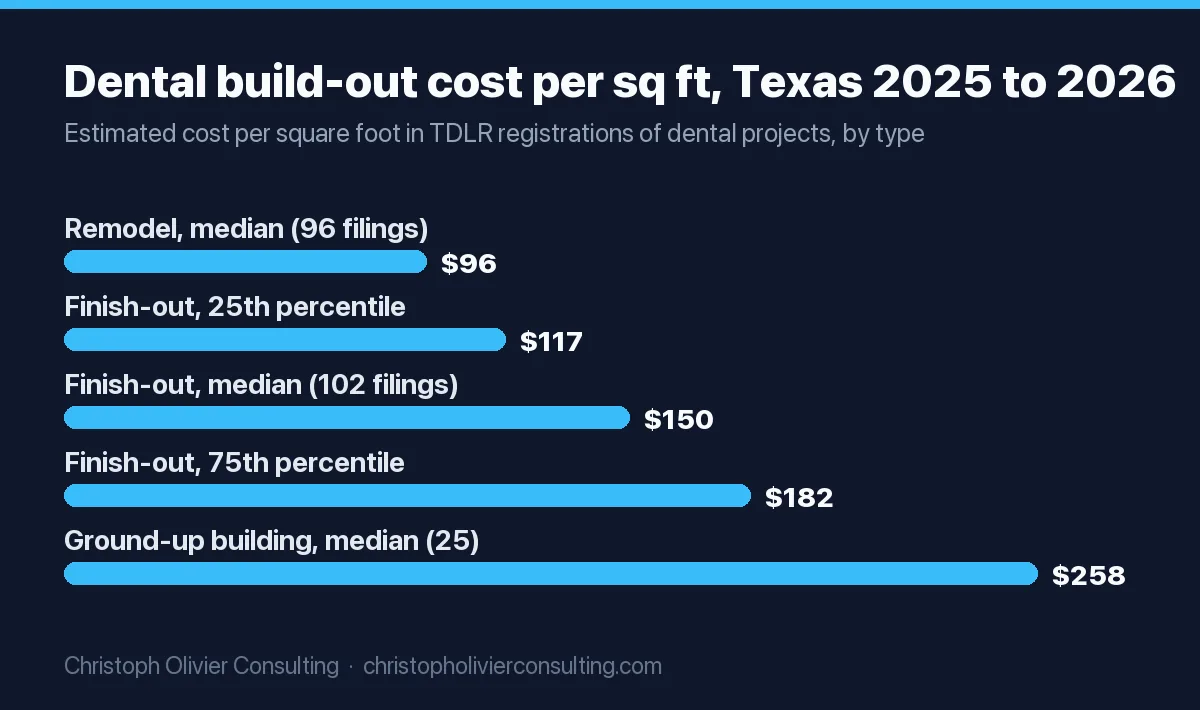
| Project type (my classification of the scope) | Filings used | 25th percentile | Median cost per sq ft | 75th percentile | Median size |
|---|---|---|---|---|---|
| Finish-out of new or shell space (the typical startup lease) | 102 | $117 | $150 | $182 | 2,636 sq ft (median cost $367,300) |
| Remodel or renovation of existing space | 96 | $65 | $96 | $143 | 3,200 sq ft |
| Ground-up new building | 25 | $160 | $258 | $334 | 4,604 sq ft (median cost $1.1 million) |
How to read it. These are estimates entered at registration, not final invoices. Filings under $50,000 are not required, so very cheap jobs are missing. I excluded 2 filings with impossible figures (over $15,000 per square foot) and 2 with no usable size. Texas labor and material costs are not your state’s, so treat the median as a sanity check on a bid, not as a quote. If a contractor prices a shell finish-out at $250 per square foot, it is well above three quarters of these Texas filings, and you should ask what is driving it: plumbing to every chair, medical gas, x-ray shielding or upgraded HVAC are the usual suspects. Also ask your landlord for a tenant improvement allowance: 113 of the 250 filings (45%) said the tenant was funding the work.
Dental equipment cost: what one operatory costs at list price
Guides that rank for this query give equipment ranges as wide as $25,000 to $400,000 (Curve Dental’s guide). That is too wide to plan with. Here is one fully equipped general operatory, priced from list prices on Patterson Dental’s public overstock pages (November 2026). The overstock prices themselves ran 11% to 60% below list across the 151 items I checked on those pages (median 26%), which is why my low case takes 20% off.
| Item | Model priced | List price | Source |
|---|---|---|---|
| Patient chair | Cefla Anthos R7 | $19,938.47 | Patterson overstock |
| Delivery unit | Summit 1407H all-in-one | $4,420.00 | Patterson overstock |
| Operatory light | A-dec 574L LED | $6,690.00 | Patterson overstock |
| Doctor and assistant stools | A-dec 521 and 522 | $3,111.77 | Patterson overstock |
| Side cabinet | A-dec Inspire 593 side console | $9,345.00 | Patterson overstock |
| Wall-mount intraoral x-ray | MyRay RXDC Extend | $1,814.40 | Patterson overstock |
| Handpieces | 2 high-speed turbines and 1 contra-angle (W&H Synea) | $3,620.68 | Patterson overstock |
| Per operatory | $48,940 | My sum |
Shared equipment adds more than most first budgets expect. A 3D panoramic unit with a cone beam CT listed at $28,998 and a 2D panoramic at $11,998 in a March 2026 dealer price guide, which also listed a refurbished large-field CBCT at $85,408. A sterilization center cabinet alone listed at $24,208.88. All in, the equipment lines in my model come to $225,901 for 3 operatories, $375,262 for 5 and $557,121 for 8. In my view, pre-owned and display units are the fastest way to cut this: a 20% saving on the 5-operatory equipment list is about $75,052, more than every technology, signage and supply line combined.
How much does it cost to open a dental practice? Other public figures compared
Franchise disclosure documents are the other public place where dental startup costs are itemized in a standard format, in an Item 7 table of the estimated initial investment. I could not open the filed documents myself, so the figures below are as reported by franchise directories that quote the FDD.
| Source | What it covers | Figure |
|---|---|---|
| Clear Lakes Dental FDD, 2023 (as reported) | Full general dental office, Item 7 total including a $62,000 franchise fee, 3 months of payroll and rent | $550,300 to $1,505,200 |
| Comfort Dental FDD (as reported, 2024 document) | Item 7 total, $75,000 franchise fee | $802,400 to $841,500 |
| FLOSS Dental FDD, 2021 (as reported) | Item 7 total; Item 19 average gross revenue $974,811 | $491,000 to $712,750 |
| ADA News, March 2025 | Lender columnist’s estimate | “$500,000 at minimum” |
| My model (this page) | Independent office, list-price equipment, working capital included | $628,997 (3 ops, low) to $2,137,984 (8 ops, high) |
The Clear Lakes Dental line items line up with mine where they overlap: construction and leasehold improvements of $100,000 to $500,000, and fixtures, furnishings and equipment of $200,000 to $600,000. My 5-operatory model lands inside both ranges ($390,000 build-out, $375,262 in equipment).
Financing a dental startup: SBA 7(a) terms and the monthly payment
If you borrow, the SBA 7(a) program is the public benchmark, because its limits are published:
| SBA 7(a) rule | What it says | Source |
|---|---|---|
| Maximum loan | $5 million | SBA |
| Term | 10 years or less, unless the loan finances real estate (up to 25 years) or equipment with a useful life over 10 years | SBA lender terms |
| Maximum variable rate, loans over $350,000 | Base rate plus 3.0%. With the prime rate at 7.00% on November 24, 2026 (Federal Reserve H.15), the cap is 10.00% | SBA lender terms |
| SBA guaranty | 75% of loans over $150,000 | SBA lender terms |
| Equity injection | 10% of project costs for start-up businesses and changes of ownership, under SOP 50 10 8, effective June 1, 2025 | Congressional Research Service, IN12549 |
| Collateral and insurance | Collateral for almost all loans over $50,000; life insurance on principals when the business depends on them | CRS, IN12549 |
Worked example (my calculation): financing 90% of each model total over 10 years at the 10.00% cap.
| Scenario | Total project | Your 10% cash | Loan | Monthly payment at 10%, 10 years |
|---|---|---|---|---|
| 3 operatories | $733,577 | $73,358 | $660,219 | $8,725 |
| 5 operatories | $1,134,504 | $113,450 | $1,021,054 | $13,493 |
| 8 operatories | $2,009,984 | $200,998 | $1,808,986 | $23,906 |
The cap is a ceiling, not a quote, and a lower rate cuts the payment. The same ADA News column says dental-specific lenders may offer “up to 100% financing”. That is conventional bank lending, not 7(a), which now requires the 10% injection for startups. Whichever route you choose, ask three questions in writing: is there an interest-only or deferred period after opening, is working capital part of the loan or a separate line, and what debt service coverage the lender tests at year two.
Ramp and runway: how long until a new dental office covers its costs
The runway is what turns a $585,389 build into a $733,577 project in the 3-operatory case. Here is how I modeled it, with every assumption labeled.
Staff costs. Wages are 2025 averages: full-time hygienists in general practices earned $48.80 an hour and full-time dental assistants $25.10 (ADA HPI Survey of Dental Practice), and receptionists in dental offices averaged $22.32 (BLS OEWS, May 2025; BLS shows $24.07 for assistants and $47.77 for hygienists in dental offices). I gross these up for benefits, because wages were 70.0% of private employer compensation costs in June 2026 (BLS ECEC). That gives a loaded annual cost of $145,006 per full-time hygienist, $74,583 per assistant and $66,322 per front desk hire at 2,080 hours.
| Scenario | Launch team (my assumption) | Staff cost per month | Rent per month | Collections at maturity (per year) |
|---|---|---|---|---|
| 3 operatories | 1 assistant, 1 front desk, hygienist 2 days a week | $16,576 | $3,828 | $484,617: ADA 25th percentile solo GP billings ($595,820) x 81.3% |
| 5 operatories | 2 assistants, 1 front desk, 1 full-time hygienist | $30,041 | $5,529 | $809,375: ADA median solo GP billings ($995,100) x 81.3% |
| 8 operatories | 5-op team in year one, then 2 hygienists, 3 assistants, 2 front desk plus an associate at $165,520 from month 13 | $30,041, then $53,867 | $8,507 | $1,242,571: 2 x ADA median nonsolo billings per dentist ($763,850) x 81.3% |
Why 81.3%. ADA billings are fees charged, not cash collected. ADA defines net income for an unincorporated owner as billings collected minus expenses, so I add the 2025 averages for general dentist owners ($228,980 net income plus $556,450 in expenses) and divide by their average billings ($965,660). That ratio of averages, 81.3%, is my rough proxy for what is collected. Other costs (supplies, lab, software, insurance, utilities, ongoing marketing) are set at 12% of collections plus $4,000 a month. That calibrates the mature 5-operatory office to about 71% total expenses, matching the ADA ratio of expenses to collections for general dentist owners. The ramp: collections start at 15% of the mature level in month one and rise in a straight line to 100% in month 24. That is an assumption, not a measured curve; your local market can be faster or slower. The associate’s pay is the ADA 2025 median net income of employed general dentists.
| 5-operatory office, month | Collections that month | Cash result that month (before loan payments) | Cumulative cash |
|---|---|---|---|
| 1 | $10,117 | -$30,667 | -$30,667 |
| 3 | $15,102 | -$26,280 | -$85,421 |
| 6 | $22,580 | -$19,700 | -$151,101 |
| 9 | $30,058 | -$13,119 | -$197,039 |
| 12 | $37,536 | -$6,539 | -$223,236 |
| 15 | $45,014 | $42 | -$229,690 |
| 18 | $52,492 | $6,623 | -$216,403 |
| 24 | $67,448 | $19,784 | -$130,604 |
| 36 | $67,448 | $19,784 | $106,801 |
Results from the model, before any owner pay:
- 3 operatories: first month with positive operating cash in month 16; peak cash shortfall $148,188. If full loan payments start at opening, the shortfall grows to $308,166.
- 5 operatories: positive in month 15; peak shortfall $229,732, or $466,724 with loan payments from day one.
- 8 operatories: positive in month 30, because the second dentist and full team arrive before their schedule fills; peak shortfall $671,694.
Two practical points. First, the owner draws nothing during the ramp in this model, so you also need personal savings to live on until at least month 15 or 16, when the office first covers its costs. Second, the ramp is driven by new patients, so budget launch marketing from your patient target, not from a percentage of revenue you do not have yet. The bottom-up method is in my guide to a dental office marketing budget, and the patient capacity math for a given number of hygienists is in how many patients a dentist sees a day.
How profitable is owning a dental practice?
Owners do earn more than employed dentists on average, but the gap at the median is smaller than most people think. These are 2025 figures from the ADA Health Policy Institute’s 2026 Survey of Dental Practice (ADA HPI; 1,113 responses, 1.9% response rate, weighted).
| General dentists, 2025 net income | 25th percentile | Median | Average | 75th percentile |
|---|---|---|---|---|
| Solo owners | $115,200 | $179,360 | $207,520 | $270,210 |
| Nonsolo owners | $171,230 | $217,490 | $262,880 | $318,090 |
| All owners | $137,010 | $199,140 | $228,980 | $295,370 |
| Employed general dentists | $129,280 | $165,520 | $164,510 | $191,470 |
| Specialist owners | $190,820 | $259,550 | $372,460 | $436,420 |
At maturity, my 5-operatory model leaves about $237,408 a year before loan payments and about $75,492 after principal and interest, which shows why the first 10 years of owner income look thin next to the ADA averages. Many surveyed owners have long since paid off their build-out. For revenue benchmarks, the average US dental office location took in $1,176,698 in 2022 ($160.2 billion across 136,140 locations, Census SUSB, my calculation), and my page on dental practice average revenue breaks that down by size band and state.
Can a general dentist make $500,000 a year owning a practice?
It happens, but it is well above the norm. $500,000 is about 1.7 times the 75th percentile for all general dentist owners ($295,370), and ADA does not publish a 90th percentile. In my view, getting there usually means billings far above the solo median of $995,100, a strong hygiene department, or a second location. In my model, a mature 5-operatory office at median billings does not get close.
Can a dentist make $1 million a year?
$1 million in revenue is ordinary: the median solo general dentist billed $995,100 in 2025, and the 75th percentile billed $1,332,630. $1 million in personal income is a different thing. It falls far outside the published ADA quartiles for both general dentists and specialists, and you should treat claims about it as exceptions, not a plan.
Is opening a dental office worth it?
On ADA medians, an owner general dentist earned $33,620 more than an employed one in 2025 ($199,140 vs $165,520), before the risk and the debt. A startup earns that premium only after the ramp and usually only once the loan is largely paid down. It tends to pay off when you have a defined market (an ADA career article suggests at least a 1:3,000 dentist-to-population ratio to support a new office), a build-out you can keep near the median, and a ramp plan with real new-patient numbers. ADA research also finds that most dentists still become owners eventually, just later in their careers than earlier generations (ADA HPI, 2025).
Start up or buy an existing practice?
| Question | Startup | Acquisition |
|---|---|---|
| SBA equity injection | 10% of project cost | 10% of project cost for a full change of ownership (CRS) |
| Revenue on day one | Close to zero; the ramp is the risk | The seller’s patient base and staff, if they stay |
| Where the money goes | Build-out, new equipment, working capital | Goodwill and used equipment, priced off the seller’s collections |
| What you control | Location, layout, technology, culture from scratch | Inherited systems, fee schedules and payer contracts |
| Hidden cost | A slow ramp: every extra month at a $19,700 loss adds up | Equipment replacement and patient attrition after the sale |
I did not find a primary public dataset of dental practice sale prices, so I am not putting a number on acquisitions here. If you are weighing both, run the same pass/fail test below on each option’s real figures.
Pass/fail checklist before you sign a lease or a loan
Run this with real quotes. If any line fails, fix it before you sign. The thresholds are my own, built from the model above.
- Build-out bid per square foot. Pass: at or below about $182 for a shell finish-out (the Texas 75th percentile), or you can explain the premium line by line. Fail: a lump sum with no square footage.
- Equipment quote vs list. Pass: the quote shows list and net prices, and the net is at least 10% below list. Fail: a package price with no line items.
- Rent as a share of mature collections. Pass: rent is under 10% of the collections you expect at maturity. In my 5-op model it is 8.2%.
- Working capital in the plan. Pass: the financing covers at least the peak shortfall from your own ramp model, plus your personal living costs. Fail: working capital is “whatever is left”.
- Debt coverage at maturity. Pass: mature monthly operating profit is at least 1.25 times the loan payment. My 3-op model is at 1.28x, my 5-op model at 1.47x and my 8-op model at 0.46x. That means an 8-operatory, two-dentist startup fails unless collections reach about $1,500,675 a year.
- Break-even collections you can defend. Pass: you can show how many new patients a month you need to reach the collections that clear the test above ($481,503 a year for my 3-op office, $769,585 for the 5-op), and what each one costs to acquire.
- Loan terms in writing. Pass: rate, term, any interest-only period and the coverage test are written down. Fail: a verbal “we do 100% financing”.
If you want a second set of eyes on the ramp and the new-patient plan before you commit, you can book a consultation.
Ready to scale your revenue?
Book a free 30-min consultation. We’ll diagnose your growth bottleneck and map out the 3 highest-leverage moves for your business.
Frequently asked questions
How much does it cost to open a dental practice?
In my itemized model built from public prices, a new general dental office costs about $733,577 with 3 operatories, $1,134,504 with 5 and $2,009,984 with 8, including working capital. Build-out at the Texas median of $150 per square foot and equipment at list price make up most of it. Negotiated equipment and a cheaper build-out can cut the 5-operatory total to about $973,652.
How much does a dental operatory cost to equip?
One general operatory priced at list on Patterson Dental's overstock pages in November 2026 comes to about $48,940: a $19,938 chair, $4,420 delivery unit, $6,690 light, $3,112 in stools, $9,345 side cabinet, $1,814 wall x-ray and $3,621 in handpieces. Shared items such as a panoramic or CBCT unit, sensors, vacuum, compressor and sterilization add about $79,000 to $166,000 per office in my model.
What does a dental office build-out cost per square foot?
Across 102 dental finish-outs of new or shell space registered with Texas regulators from January 2025 to November 2026, the median estimated cost was $150 per square foot, with the middle half between $117 and $182. Remodels of existing space had a median of $96, and ground-up buildings $258. These are registration estimates, and costs in your state will differ.
Can I get an SBA loan to start a dental practice?
Yes. SBA 7(a) loans go up to $5 million, usually with a term of 10 years or less unless real estate is involved. Since June 1, 2025, start-ups must inject 10% of project costs. For loans over $350,000 the variable rate is capped at prime plus 3.0%, which was 10.00% in late November 2026. Some dental lenders offer up to 100% conventional financing instead.
How long does it take a new dental practice to become profitable?
In my ramp model, where collections rise from 15% to 100% of the mature level over 24 months, a 3 or 5-operatory office first covers its monthly operating costs in month 16 (3 operatories) or month 15 (5 operatories). That is before loan payments. If full payments start at opening, it takes longer, and the cash reserve you need roughly doubles. Your own ramp depends on new-patient flow.
How much does a dentist make owning their own practice?
General dentist owners averaged $228,980 in net income in 2025, with a median of $199,140, according to the ADA Health Policy Institute. Solo owners had a median of $179,360 and specialist owners averaged $372,460. Employed general dentists had a median of $165,520, so the median owner premium was about $33,620 before the risk and debt of ownership.
Is it cheaper to start a dental practice or buy one?
A startup's cash cost is easier to price, because build-out and equipment can be quoted. An acquisition replaces the ramp with goodwill priced off the seller's collections. For SBA loans, both start-ups and full changes of ownership need a 10% equity injection. No primary public dataset of dental practice sale prices exists, so compare real offers using the same debt coverage test.
Practice economics benchmarks