

A CMO consultant is a senior marketer you hire to diagnose your marketing and tell you what to do, usually as a fixed-fee project or a light advisory retainer, without owning the marketing number afterwards. MarketerHire’s April 2026 cost guide calls anything below $3,000 a month consultant territory, “advisory only, no hands-on execution,” and prices fractional CMO projects at $5,000 to $25,000. A fractional CMO is different: they own the plan, the budget and the result for 5 to 20 hours a week, on a retainer.
For a business doing $1 million to $10 million, the choice is not “consultant or no consultant.” It is which of four models fits the gap you actually have. This page lays them side by side with published rates, shows what a consultant engagement should deliver, gives you interview questions with good and weak answers, and then covers what changes in tourism, professional services and home services.
Need senior marketing leadership without a full-time hire? See CO Consulting’s fractional CMO services.
CMO consultant vs fractional CMO vs interim CMO vs marketing agency
The four models differ on one question: who owns the outcome after the advice is given. Costs below are the published asking prices, not survey medians, and each row names its source.
| Model | What you buy | Owns the number? | Typical term | Published cost |
|---|---|---|---|---|
| CMO consultant, diagnostic project | An audit, a plan and a decision memo you execute yourself | No | Fixed scope, ends on delivery | $5,000 to $25,000 per project (MarketerHire, April 2026) |
| CMO consultant, advisory | Hours of senior judgment: plan reviews, agency reviews, board prep | No | Hours bank or small monthly retainer | Below $3,000 a month (MarketerHire); independents $100 to $200 an hour, some $450 and up (Chief Outsiders, updated October 2026) |
| Fractional CMO, strategy only | Ownership of plan, budget and targets | Yes | Retainer; MarketerHire says most start with 3-month minimums | $3,000 to $6,000 a month at 5 to 10 hours a week (MarketerHire) |
| Fractional CMO, strategy plus execution oversight | The above, plus managing your team and vendors | Yes | Retainer | $7,000 to $12,000 a month at 15 to 20 hours a week (MarketerHire) |
| Interim CMO | A full-time stand-in while you recruit, reorganize or recover | Yes, for the term | Fixed term, usually priced by the day | No independent US rate card; Prose says interim-heavy work “can go higher” than its $5,000 to $15,000 fractional band (Prose, March 2026) |
| Marketing agency | Execution in one or more channels | Usually not | Contract, often with a notice period | $5,000 to $25,000+ a month (MarketerHire) |
| Full-time CMO | A permanent executive | Yes | Employment | Base salary $192,996 (PayScale average) to $374,298 (Salary.com median); $596,208 in year one at top-decile pay with a 30% bonus and a retained search |
The full-time row comes from the sources compared in our CMO salary guide and the year-one math on the fractional CMO role and cost page. The rate for every other fractional seat, from paid search lead to content marketer, is on our fractional marketing pricing page.
Which model fits your gap
| Your situation | Hire | Why |
|---|---|---|
| You have a capable marketer or agency, but nobody agrees on what to do next | CMO consultant, diagnostic project | You need a decision, not a new manager |
| You have a plan and want a senior check on spend, agencies and hires each quarter | CMO consultant, advisory | A few hours a month is enough when someone else runs the work |
| Nobody owns the marketing number and you cannot fund a full-time executive | Fractional CMO | Advice without an owner turns into a slide deck |
| Your CMO just left, or you are integrating an acquisition | Interim CMO | The seat needs full-time coverage for a fixed period |
| Strategy is set and you need more volume in one channel | Agency or specialist | You are buying output, so pay output rates |
| The plan exists but nothing ships on time | Fractional marketing director | That is an execution gap, covered in our fractional marketing director vs CMO comparison |
Small business fractional CMO: the revenue test
Revenue decides whether a part-time CMO pays its way, because it caps the budget they direct. Our fractional CMO role and cost guide puts the line at about $1 million: below it the fee swallows most of a typical marketing budget, between $1 million and $3 million a part-time CMO pays its way, and around $10 million the question becomes which full-time executive to recruit. Below $1 million, a diagnostic project from a CMO consultant is usually the cost-effective CMO option: you get the plan once and execute it yourself.
Who can manage $300,000 a month in paid ad spend?
Not a CMO consultant on their own. At $300,000 a month you are spending $3.6 million a year, and every 5% of waste is $180,000, more than a full year of a strategy-plus-oversight fractional CMO ($84,000 to $144,000 at MarketerHire’s rates). At that level the accounts should be run day to day by a dedicated paid media team, in-house or agency. The CMO-level person, fractional or consultant, sets the target cost per customer, approves budget shifts and audits the account. Ask any candidate for an account they ran or audited at a similar spend, and what they changed in the first 30 days.
What a CMO consultant engagement looks like
Most CMO consultant work comes in two shapes. Chief Outsiders notes on its CMO consultant page that many consultants do not charge for the initial needs assessment, and that ongoing work is usually priced as a monthly retainer based on the share of the consultant’s time you need. What you should get for the money is less standard, so put it in the contract. The timings below are my typical scoping, not an industry survey.
| Deliverable | Diagnostic project (4 to 8 weeks, fixed fee) | Advisory retainer (monthly) | Pass/fail test |
|---|---|---|---|
| Revenue by source, reconciled | Built once from your CRM and books | Reviewed monthly | Totals match revenue in your accounting system within a few percent |
| Unit economics by channel | Cost per lead, cost per customer, payback in months | Updated each quarter | Every number shows its formula and source data |
| Customer and lost-deal interviews | 8 to 12 calls, summarized with quotes | Not included | You can read the raw notes, not only the summary |
| Positioning | One-sentence statement plus disqualifying traits for bad-fit buyers | Pressure-tested before launches | Your sales team can repeat it without notes |
| Budget allocation | Spend by channel with a stop rule for each | Monthly reallocation advice | Each line has a maximum cost per customer |
| 90-day plan | Tests with hypothesis, budget, owner and kill rule | Progress review against it | Each test names one owner on your side |
| Vendor and hiring scopes | Rewritten agency scopes, a hire or no-hire decision | Interview support, scope reviews | Scopes include deliverables and reporting dates |
| Handover | Decision memo plus a working session with your team | Not applicable | Your team can run the plan without the consultant |
If the project ends with a slide deck and no decision memo, the engagement failed its own test. The memo should say what to stop, what to start and what to fund, in one or two pages.
How to estimate your fractional CMO or consultant costs
Convert every quote to an hourly rate before you compare: monthly fee divided by (weekly hours x 52 / 12), or project fee divided by total hours. Example inputs: a $12,000 diagnostic for six weeks at 8 hours a week is 48 hours, or $250 an hour. That sits above the $100 to $200 an hour Chief Outsiders lists for independents and below the $300 to $500 hourly equivalent it gives for executives-as-a-service firms. A quote that does not state the hours cannot be compared at all, so ask for them.
How to vet a CMO consultant
Ask the same ten questions of every candidate and score the answers against the right-hand columns. A strong candidate answers most of them with numbers or named documents.
| Question | Good answer | Weak answer |
|---|---|---|
| 1. What do I have in hand on day 30? | Names the documents, the data access needed in week one and the decision you will be asked to make | “We start with discovery and go from there” |
| 2. Which numbers do you need from my books and CRM? | Revenue by source, gross margin, closed deals by lead source, and how they will reconcile ad platform figures to your accounting | Relies on ROAS reported by the ad platforms |
| 3. How do you define customer acquisition cost for a business like mine? | All marketing and sales cost for the period, divided by new customers, by channel, with payback in months of gross margin | Ad spend divided by leads |
| 4. What will you not do? | A clear line: for example, no ad buying, no copywriting, no hiring decisions without you | “Whatever you need” |
| 5. Tell me about an engagement that ended early. | A specific story where they own part of the failure | Blames the client, or says it has never happened |
| 6. Which of my current vendors would you keep, cut or rescope, and what would you need to see first? | Lists the evidence they would ask for before judging | Recommends replacing everyone in the first call |
| 7. When would you tell me to hire full-time instead? | Gives a threshold: a fee level, a team size or a revenue band | Never |
| 8. Do you take referral fees or commissions from agencies or software you recommend? | Discloses in writing, or says none | Changes the subject |
| 9. Who does the work, you or a team? | Names their personal hours per week and who else touches the account | Vague about who shows up after the sale |
| 10. How will we know at day 90 that this is not working? | Leading indicators with numbers and a kill rule | “Marketing takes time” with nothing measurable |
Reference-check script
Ask for two references, including one engagement that ended. Then read these questions word for word:
- “What was the business problem when you hired them, and what was the baseline number?”
- “What did they personally do, and what did they hand to your team or an agency?”
- “What did they get wrong, and what happened next?”
- “What changed in the number, over what period, and what else changed at the same time: pricing, a sales hire, the season?”
- “Did your team keep using what they built after the engagement ended?”
- “Would you hire them again for the same problem at the same fee?”
- “What would you set up differently at the start?”
How to read a fractional CMO case study
A case study is a sales document, so test it like one. Look for five things: the baseline and the date range, the denominator behind any percentage, other changes in the same period, the attribution method, and whether the client is named and willing to take your call. Testimonials carry legal weight too. The FTC’s final rule on fake reviews and testimonials, announced August 14, 2024, bans fake testimonials, undisclosed insider reviews and buying positive reviews, and lets the agency seek civil penalties against knowing violators. A consultant who suggests buying reviews for you is a red flag on that alone.
Red flags
- Fuzzy ownership. Prose calls it “the biggest red flag”: one fee that covers strategy, execution, operations and “unlimited access” with no line between them.
- Guaranteed growth. No one controls your market, your sales team and your pricing at the same time.
- No questions about your sales process. A candidate who never asks about your buying cycle, funnel definitions or CRM quality is pitching a template.
- Seniority without decision rights. If you will still override every budget call, buy advisory hours, not a CMO.
- No access for you. You should own every ad account, analytics property and CRM, with the consultant as a user.
You can run the ten questions on any consultant, including me: book a consultation and bring the scorecard.
Fractional CMO for tourism and hospitality
Tourism changes three things in the brief: demand is seasonal, a large share of bookings arrives through online travel agencies (OTAs) that charge per booking, and destination marketing organizations (DMOs) and Google offer channels that most other industries do not have. A CMO consultant for a tour operator, attraction or independent hotel should be fluent in all three.
Seasonality: plan by booking window, not calendar month
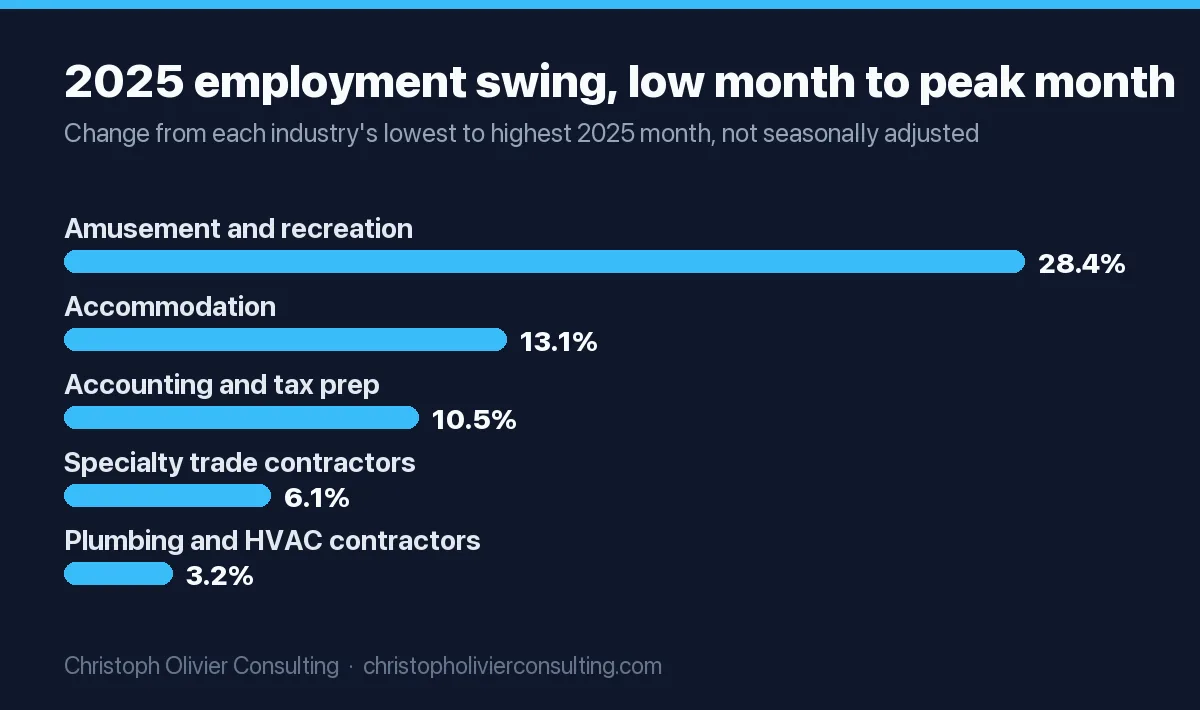
Federal payroll data shows how hard the swing is. In 2025, employment in amusement, gambling and recreation rose from 1,718,600 in January to 2,207,300 in July, a 28.4% swing, according to BLS Current Employment Statistics (not seasonally adjusted). Accommodation moved 13.1%, from 1,841,000 to 2,082,100 (BLS series CEU7072100001). National figures flatten local peaks, so a beach or ski market swings harder. The practical rule: spend lands in the months guests book, which come before the months they travel, and the plan should say which lead time each product uses.
OTA commission dependence: what the platforms publish
| Platform | What its own pages say | Planning implication |
|---|---|---|
| Booking.com | No public rate. Its partner help page says the percentage depends on your country, property type and agreement, is charged on the total booking amount including cleaning, service, no-show and cancellation fees, and rises if you join programs such as Preferred Partner or Visibility Booster | Read your reservation statement, not your contract, to get the real rate. Unmarked no-shows after 48 hours are billed at full commission |
| Airbnb | Its service fee page says most hosts on the host-only fee pay 15.5% (others typically 14% to 16%), and Experiences hosts typically pay 20% | A published percentage you can plug straight into a direct booking comparison |
| Expedia Group | No public lodging rate. Its 2025 annual report shows a total revenue margin of 12.3% of gross bookings (11.3% B2C, 13.6% B2B) | A blended figure across products, not your commission; your contract sets your rate |
Booking.com invoices once a month for guests who checked out the previous month, so commission shows up a month or more after the stay. A consultant should rebuild your channel mix from those statements before recommending any shift to direct. The full direct-versus-OTA math, with a calculator and break-even cost per click, is in our OTA commission and direct booking guide.
DMO co-op programs
State and local tourism offices sell or subsidize co-op advertising, and the rules differ on who can join. The Travel Texas Advertising Co-Op is open to destination organizations, hotels, restaurants, attractions and other visitor businesses at discounted rates: for FY27 the offerings deck posted October 27, 2026, enrollment opens November 5, 2026 and closes July 9, 2027. New Mexico’s Cooperative Marketing and Advertising Program is limited to tourism nonprofits and local and tribal governments, with a 2:1 match, and its FY27 applications run March 10 to April 7. A private operator in a state like New Mexico gets in through the local DMO, so the question for your consultant is which co-op cycles you will enter, through whom, and by which deadline.
Google Hotel Ads, free booking links and Things to do
- Free booking links cost nothing per click, and Google’s Hotel Center help says bids have no effect on their ranking. Google ranks them on consumer preference, value, landing page experience and price accuracy. Hotels on a reservation system may already be connected through their provider.
- Hotel Ads are now pay per click only. Google sunset commission-based bidding on February 20, 2025, so you carry the risk of clicks that do not book.
- Things to do covers tours, activities and attractions with free listings and paid ads. Google’s Things to do help page recommends that individual operators connect through an approved connectivity partner rather than integrating directly.
Four questions to ask a tourism CMO consultant: What share of last year’s bookings came through each OTA, at what rate after program uplifts? Which booking window does each product use? Which co-op cycles would you enter this year? Are our rates live in free booking links or Things to do today?
Other verticals: professional services and home services
The same four models apply in every industry. What changes is the rulebook and the demand curve, and a consultant who does not know them will write a plan you cannot run.
Professional services: law and accounting firms
Referral marketing is regulated. ABA Model Rule 7.2(b) bars a lawyer from giving anything of value for a recommendation, with exceptions that include the reasonable cost of advertising, a qualified referral service, and reciprocal referral agreements that are not exclusive and are disclosed to the client. Rule 7.2(d) requires every ad to name at least one responsible lawyer or firm. For CPAs, the AICPA Code (1.520.001) requires a member who pays or accepts a referral fee to disclose it to the client. Seasonality is real here too: employment in accounting, tax preparation and payroll services peaked at 1,200,400 in March 2025 and bottomed at 1,086,100 in September, a 10.5% swing (BLS). A consultant should plan advisory-service campaigns for the months after filing season, when capacity returns. More on scope for firms is in our fractional CMO guide for accounting firms.
Home services: HVAC, plumbing and trades
Lead buying is the core decision. Google’s Local Services Ads help says you pay per valid lead, a missed call during business hours counts as a lead if the caller stays on the line more than 20 seconds, repeat contact from the same customer within 15 days is not charged again, and low-quality leads are credited automatically. That makes answering the phone a marketing cost control, not just an operations issue. Headcount is steadier than in tourism: plumbing, heating and air-conditioning contractor employment moved 3.2% between January and July 2025 (BLS). Crews are a fixed cost while demand peaks, so the marketing job is filling shoulder months, not buying more peak-season calls. Our fractional CMO guide for HVAC contractors covers the scope in detail.
Work with CO Consulting
Senior marketing leadership, without the full-time hire
- One senior owner of strategy, budget, vendors and the weekly scorecard
- Audit first, then a prioritized 90-day plan with measurable milestones
- Weekly team leadership, monthly strategic reviews and quarterly planning
- No guarantees we cannot back up; reporting tied to pipeline
Frequently asked questions
What does a CMO consultant do?
A CMO consultant diagnoses your marketing and recommends what to do, then hands the plan to your team. Typical work is a fixed-fee diagnostic (reconciled revenue by source, unit economics by channel, positioning, a budget with stop rules and a 90-day plan) or a small advisory retainer for reviewing agencies, hires and spend. Unlike a fractional CMO, a consultant does not own the marketing number afterwards.
How much does a CMO consultant cost?
MarketerHire's April 2026 guide treats anything under $3,000 a month as consultant work, advisory only, and prices fractional CMO projects at $5,000 to $25,000. Chief Outsiders lists independent marketing consultants at $100 to $200 an hour, some at $450 and up. Always ask for the hours behind a quote and convert it to an hourly rate before comparing.
What is the difference between a CMO consultant and a fractional CMO?
Ownership. A CMO consultant advises and leaves execution and results with you. A fractional CMO owns the plan, budget and marketing target for 5 to 20 hours a week on a retainer. MarketerHire prices strategy-only fractional work at $3,000 to $6,000 a month and strategy plus execution oversight at $7,000 to $12,000 a month.
Is a fractional CMO worth it for a small business?
It depends mostly on revenue. Below about $1 million, a fractional retainer tends to swallow most of a typical marketing budget, so a one-off diagnostic from a CMO consultant is usually the better buy. Between $1 million and $3 million, a part-time CMO can pay its way. Around $10 million, compare it with recruiting a full-time executive.
What should a fractional CMO for tourism focus on?
Three things: seasonality (BLS data shows recreation employment swinging 28.4% between January and July 2025), OTA dependence (Booking.com sets commission by contract and adds program uplifts; Airbnb's host-only fee is 15.5% for most hosts), and channels such as DMO co-op programs, Google free booking links and Things to do listings.
How do I estimate my fractional CMO costs?
Divide the monthly fee by weekly hours x 52 / 12 to get an hourly rate, then multiply by 12 for the year. A $6,000 retainer at 10 hours a week is about $138 an hour and $72,000 a year. Compare that with a full-time hire's loaded cost, and divide either figure by gross margin to see the revenue it must produce.
How do I evaluate a fractional CMO case study?
Check five things: the baseline and date range, the denominator behind any percentage, what else changed in the same period (pricing, a sales hire, the season), how results were attributed, and whether the client is named and will take your call. Ask for a reference from an engagement that ended, not only the best one.
More in Fractional Cmo
Related articles in this cluster
More Fractional CMO guides
- Revenue Operations (RevOps): What It Is
- Roofing Lead Generation: The Channels, Costs, and System That Actually Book Jobs
- RPA in Marketing: ROI and Real Use Cases
- SaaS Content Marketing: A Product-Led Playbook
- The 7 Sales Process Steps (and How to Run Each One)
- Sales Representative Job Description (Template + Skills)
- All Fractional CMO guides →