

The main types of sales sort along a few axes: who buys (B2B, B2C, B2G), where the selling happens (inside or outside/field), how the deal is sold (transactional, consultative, enterprise), where leads come from (inbound or outbound), and the route to market (direct, channel partner, account-based, self-serve). Consumer selling adds four formats: retail, direct-to-consumer, e-commerce and subscription. One deal usually carries several labels at once, so the useful question is not “which type am I” but “which combination fits my price point and buyer.”
Below is every type in one master table with deal size, cycle and team anchors from published sources, real companies that run each model (with the filing that says so), May 2025 federal wage data for the people who do the selling, and a decision table for picking your model.
The types of sales at a glance
This is the full map: 18 types of sales on six axes. Where a benchmark exists, it is sourced. Where the column shows an ACV band marked “rule of thumb,” it comes from the cost-of-sale math in our comparison of B2B sales channels, not from a study. ACV means annual contract value.
| Type of sales | Axis | Deal size anchor | Cycle anchor | Who sells | Sourced benchmark |
|---|---|---|---|---|---|
| B2B | Buyer | $50,000 median selling price in the Bridge Group SDR sample (83% SaaS) | 10.1 months for committee purchases (6sense, 2025); 3.8 months for software (TrustRadius, 2025) | Account executives (AEs), SDRs, sales engineers | 48% of AEs at quota in 2026 (Bridge Group) |
| B2C | Buyer | Warby Parker glasses from $95; Costco membership $65 a year | Usually one visit or one session | Retail salespeople, e-commerce and lifecycle marketing | Retail salespersons: median pay $35,410 (BLS, May 2025) |
| B2G (government) | Buyer | Palantir booked $2.40 billion from government customers in 2025 | Set by formal procurement rules | Field AEs, capture and contracts staff | Government was 53.7% of Palantir’s 2025 revenue (10-K) |
| Inside sales | Location | $10,000 to $100,000 ACV (rule of thumb) | Medium | Remote AEs, SDRs | Median AE OTE $200,000, quota $960,000 (Bridge Group, 2026; no inside/field split published) |
| Outside (field) sales | Location | $100,000+ ACV (rule of thumb) | Longest | Field AEs, sales engineers | Sales engineers: median pay $124,900 (BLS, May 2025) |
| Transactional | Approach | Low price, low risk; at $5,000 ACV one AE needs 192 deals a year to cover median quota | One call or one checkout | Telemarketers, retail floor, self-serve | Telemarketers: median pay $35,450 (BLS, May 2025) |
| Consultative / solution | Approach | Mid to high ticket where scope varies per client | Discovery, proposal, decision: several meetings | AE or partner, solutions consultant | The buyer evaluates about 5 vendors (6sense, 2025) |
| Enterprise (complex) | Deal size | $100,000+ a year (TrustRadius definition) | 6.6 months on average; 65% close within 6 months (TrustRadius, 2025) | AE, sales engineer, executive sponsor, legal | Average AE ramp 6.2 months (Bridge Group, 2026) |
| SMB / mid-market (velocity) | Deal size | Under $25,000 ACV (rule of thumb) | 3.8 months average; 86% close within 6 months (all software deals, TrustRadius) | Inside AEs, SDRs, self-serve checkout | Zoom runs an “online channel” for “high-volume, high-velocity, self-service sales” (10-K) |
| Inbound | Lead source | Any | Buyers make first contact 61% of the way through their journey (6sense, 2025) | SDR or AE who answers fast | 94% of buying groups had ranked their shortlist before first contact (6sense) |
| Outbound | Lead source | $25,000+ ACV to justify an in-house SDR (rule of thumb) | Adds a prospecting stage before discovery | SDRs and BDRs | Median SDR OTE $80,000; quota 10 held meetings a month; 60% at quota (Bridge Group, 2025) |
| Channel / partner | Route to market | Any; best for segments or regions you cannot staff | Medium, slow to ramp | Partner managers; partners sell | Top PartnerStack vendors paid 23.5% average commission in 2023 |
| Account-based | Targeting | $100,000+ named accounts (rule of thumb) | Long, multi-threaded | AE, SDR and marketer per account list | No reliable public cycle benchmark; measure your own |
| Self-serve / product-led | Route to market | Under $10,000 ACV, or an entry offer (rule of thumb) | Buyer-paced | Product and growth team; sales-assist reps for expansion | 67% of B2B buyers prefer a rep-free experience (Gartner, March 2026) |
| Retail (in-store) | Consumer format | Single purchase | Same visit | Retail salespersons | 3.90 million retail salespersons employed (BLS, May 2025) |
| Direct-to-consumer (D2C) | Consumer format | Brand’s own price list | Same visit or session | Brand-owned stores and site | Nike Direct revenue $17.7 billion in fiscal 2026 (10-K) |
| E-commerce | Consumer format | Basket size | One session, plus abandoned-cart follow-up | Merchandising, CRO, paid media | 17.1% of US retail sales in Q2 2026 (Census Bureau) |
| Subscription | Pricing model | Recurring fee: Costco $65 a year; Netflix billed monthly | First sale, then every renewal | Lifecycle marketing, retention, customer success | Costco: 84.1 million paid members at fiscal 2026 year end (10-K) |
How to read it: pick one row per axis for your main offer. A tax advisory firm selling $30,000 engagements to business owners is B2B, inside, consultative, inbound-led and direct. A SaaS tool at $3,000 a year is B2B, self-serve, transactional and product-led, with inside reps only for expansion. Naming your row on each axis tells you what to hire, how to pay and what to measure.
Two types of sales: the splits people usually mean
When someone asks for “the two types of sales,” they almost always mean B2B (selling to businesses) versus B2C (selling to consumers). That is the split that changes the most: the size of the deal, how many people decide, and whether a salesperson is involved at all. Three other two-way splits come up often:
| Split | Side A | Side B | The question it answers |
|---|---|---|---|
| B2B vs B2C | Business buyer, committee, contract | Individual buyer, one decision, checkout | Who pays? |
| Inside vs outside | Remote: video, phone, email | In person, on territory | Where does the rep sell? |
| Direct vs indirect | Your own reps or website close | A partner, reseller, distributor or marketplace closes | Who owns the customer? |
| Inbound vs outbound | Buyer reaches out first | Seller reaches out first | Who starts the conversation? |
The splits are independent. Palo Alto Networks is B2B and indirect at the same time: it sells through distributors and resellers. Netflix is B2C, digital, direct and subscription.
B2B, B2C, and B2G: sales types by who buys
The buyer sets the tempo more than the product does. Business purchases involve committees and long research. In 6sense’s 2025 buyer experience research, the average B2B buying cycle was 10.1 months globally (11.1 months in North America), buyers evaluated about five vendors, and 94% had already ranked their shortlist before talking to any seller. Software buying is faster: TrustRadius’s 2025 buyer report put the average software deal cycle at 3.8 months, with 86% of deals closing in six months or less. Those two numbers look contradictory until you match them to deal size, which is why the master table shows both.
B2C selling runs on volume, price and convenience. The salesperson, when there is one, is usually a retail employee, not a quota-carrying closer. The federal wage data makes the difference concrete: the 3.90 million retail salespersons in the May 2025 BLS Occupational Employment and Wage Statistics earned a median $35,410, while B2B sales representatives for wholesale and manufacturing (non-technical products) earned a median $72,080.
B2G, selling to government, is B2B with procurement law attached. It can be large. Palantir’s 10-K for 2025 (filed February 17, 2026) reports $2.40 billion of government revenue against $2.07 billion commercial, so government was 53.7% of its $4.48 billion total. Few service firms start in B2G, but if your buyers are agencies, plan for solicitation timelines and contract vehicles, not sales cadences.
For a professional-service firm, the practical answer is almost always B2B. The buyer data in our B2B sales statistics page, with fieldwork dates for each number, is the reference for planning cycle length and quota.
Inside vs outside sales: types by where selling happens
Inside sales happens remotely by video, phone and email. Outside or field sales happens in person, with reps covering a territory. Large companies run both and say so in their filings. Salesforce’s fiscal 2026 10-K (filed March 2, 2026) says it sells “primarily through our direct sales force, which comprises sales personnel based in regional hubs, field sales personnel based in territories close to their customers and self-service offerings.” HubSpot’s 2025 10-K describes the inside model: its reps “use phone, email, web meetings, and AI-enhanced engagement tools to interact with prospects and customers.”
The cost is what separates them. The Bridge Group’s 2026 AE study (158 B2B companies, surveyed Q1 to Q2 2026) puts median AE on-target earnings at $200,000 and median quota at $960,000, with an average ramp of 6.2 months. It does not split inside from field, so field reps cost at least that plus travel. Divide the median quota by your average deal to see what one rep has to close:
| Average deal (ACV) | Deals per AE per year to hit $960,000 | Per month | What that implies |
|---|---|---|---|
| $5,000 | 192 | 16 | Too many for a rep; self-serve or transactional inside sales |
| $25,000 | 38.4 | 3.2 | Inside sales, possibly with SDR support |
| $40,000 | 24 | 2 | Inside sales plus outbound to named accounts |
| $100,000 | 9.6 | 0.8 | Field travel starts to pay for itself |
| $250,000 | 3.8 | 0.3 | Field and account-based selling |
Build inside first unless your deals are six figures and your buyers expect a site visit. It is cheaper to staff and easier to measure.
Transactional vs consultative vs enterprise sales: types by motion
Transactional sales close fast on simple, low-risk purchases, often in one call or one checkout. Consultative (or solution) sales diagnose the buyer’s problem before proposing a scoped answer, which takes several meetings. Enterprise or complex sales are large, multi-stakeholder deals with procurement, legal and security review. TrustRadius defines enterprise purchases as products costing $100,000 a year or more; those deals averaged 6.6 months, versus 3.8 months across all software deals.
| Motion | What the rep optimizes for | Pay plan that fits | Metric to watch | Typical failure |
|---|---|---|---|---|
| Transactional | Speed and volume | Higher variable, paid per sale | Conversion rate per call or visit | Scripts so rigid that slightly bigger buyers walk |
| Consultative | Diagnosis and proposal quality | Balanced base and variable | Discovery-to-proposal and proposal-to-close rates | Free consulting that never turns into a signed scope |
| Enterprise | Coverage of the buying committee | Higher base, quota on annual bookings | Pipeline coverage, stage aging | Single-threaded deals that stall when one contact leaves |
The pay-plan column is a design principle, not a study finding. The most expensive mistake I see is running one motion’s comp plan on another motion’s deals: a volume plan on six-figure engagements pushes reps to force closes that need three meetings and a second stakeholder. If you sell both a small retainer and a large program, split them into two motions with two quotas. The four selling styles behind the consultative motion are compared in our guide to choosing a sales approach.
Inbound vs outbound sales: types by who starts the conversation
Inbound sales starts when the buyer raises a hand: a form, a call, a booking, a referral. Outbound starts when your team contacts an account that has not asked. They need different people and different numbers.
Inbound buyers arrive late and decided. 6sense found first seller contact came 61% of the way through the buying journey in 2025, and buyers ultimately bought from their top-ranked vendor 77% of the time. Your inbound job is to respond fast and confirm fit, a process laid out stage by stage in our inbound sales process guide.
Outbound is a staffing decision with known unit economics. The Bridge Group’s 2025 SDR report (351 B2B companies, published February 6, 2025) gives a median SDR OTE of $80,000 split $55,000 base and $25,000 variable, a median quota of 10 held meetings a month, 3.0 months average ramp, 1.9 years average tenure, one SDR for every 2.4 AEs, and only 60% of SDRs at quota. The sample’s median selling price was $50,000, so if your deals are a fraction of that, outbound has to be founder-led or very targeted. Our breakdown of when to hire an SDR turns these medians into a cost per held meeting and a break-even deal size you can rerun with your own win rate.
Channel and self-service sales: types that scale without more reps
Channel sales sell through partners: referral partners, agencies, resellers, distributors or cloud marketplaces. Self-service sales let the buyer purchase alone. Both trade control or margin for reach, and both show up in public filings at real scale:
- Partner-led, at scale. HubSpot’s 2025 10-K says Solutions Partners and the customers they referred “represented approximately 25% of our Customers as of December 31, 2025, and approximately 49% of our revenue.”
- Two-tier distribution. Palo Alto Networks’ fiscal 2026 10-K (filed September 10, 2026) describes a “two-tier, indirect fulfillment model” in which it sells to distributors, which sell to resellers, which sell to end customers. Two distributors made up 30% of its total revenue in fiscal 2026.
- Self-serve first, sales later. Atlassian’s fiscal 2026 10-K (filed August 14, 2026) says it lands new customers through “a frictionless flywheel with an emphasis on self-service,” which “allows our sales force to focus primarily on expanding and deepening strategic relationships with our existing large enterprise customers.” Its sales-led motion uses “field sales, solution sales, and a global network of channel partners.”
- Freemium plus reps. HubSpot’s filing also says its freemium products and in-product cross-sell “help close new business with little or no interaction by our sales representatives.”
What partners cost: PartnerStack’s research found its top vendors paid an average commission of 23.5% in 2023, with 20%, 25% and 30% the best-performing offers. For a service firm, the first channel is usually referral partners who already serve your buyer, such as accountants referring to attorneys. The full program design, from tiers to deal registration rules, is in our channel sales strategy guide.
Self-serve fits when the offer is simple enough to buy without a call. Gartner’s March 2026 survey release reported that 67% of B2B buyers prefer a rep-free experience. For a service firm that does not mean a “Buy now” button on a $50,000 engagement. It means published price ranges, a scoping form and a self-booking calendar, so buyers can qualify themselves before the first call.
Retail, D2C, e-commerce and subscription: consumer sales models with examples
Consumer selling splits by format rather than by rep type. Most large brands mix all four, and their filings show the mix:
| Model | Public example | What the filing shows | Source |
|---|---|---|---|
| Wholesale vs D2C | Nike | Fiscal 2026: NIKE Brand wholesale revenue $27.5 billion, NIKE Direct $17.7 billion (down from $18.8 billion), NIKE Brand Digital $8.6 billion | 10-K, filed July 15, 2026 |
| D2C with stores and online | Warby Parker | 2025 revenue $871.9 million: retail stores $631.0 million (72.4%), e-commerce $240.9 million (27.6%); glasses from $95 including prescription lenses | 10-K, filed February 26, 2026 |
| Membership retail | Costco | US annual membership fee $65; 84.1 million paid members at the end of fiscal 2026 | 10-K, filed October 7, 2026 |
| Subscription | Netflix | 2025 streaming revenue $45.18 billion; most deferred revenue is membership fees recognized within the next month | 10-K, filed January 23, 2026 |
| E-commerce (market level) | All US retailers | $340.2 billion of e-commerce sales in Q2 2026, 17.1% of total retail sales (seasonally adjusted) | Census Bureau quarterly report |
Warby Parker is the useful counterexample to “D2C means online.” A company that calls itself “a pioneer of the direct-to-consumer model” now earns about 72% of revenue in its own stores. Direct-to-consumer describes who you sell to and who owns the relationship, not the channel.
On the B2B side, e-commerce is bigger than most people assume. The Census Bureau’s E-Stats report found e-commerce was 67.8% of manufacturing shipments and 33.3% of merchant wholesaler sales in 2019, against 10.7% of retail sales. In manufacturing and wholesale, online and electronic ordering is already the norm, not the exception.
Sales models examples: 10 companies and the model their filings describe
Every example below quotes the company’s own annual report. That matters because blog lists of “sales model examples” often guess.
| Company | Sales model | Evidence (latest 10-K) |
|---|---|---|
| Salesforce | Direct enterprise: field plus inside plus self-service | Regional hubs, field sales in territories, self-service offerings; partners “to a lesser extent” |
| HubSpot | Inside sales plus freemium plus partner channel | Partners and referred customers: about 49% of 2025 revenue |
| Atlassian | Product-led self-serve, sales-led expansion | Self-service flywheel lands customers; field sales, solution sales and channel partners expand enterprises |
| Zoom | Hybrid: online self-serve, direct, resellers | “Our online channel supports high-volume, high-velocity, self-service sales” |
| Palo Alto Networks | Channel: two-tier distribution | Distributor to reseller to end customer; two distributors were 30% of fiscal 2026 revenue |
| Palantir | B2G plus enterprise B2B | Government 53.7% of 2025 revenue |
| Nike | Wholesale plus D2C | Wholesale $27.5 billion vs Direct $17.7 billion in fiscal 2026 |
| Warby Parker | D2C, store-led | Stores 72.4% of 2025 revenue |
| Costco | Membership retail | $65 US fee, 84.1 million paid members |
| Netflix | Consumer subscription | $45.18 billion streaming revenue in 2025, billed as memberships |
Notice how few of these companies run a single type of sales. The pattern is one primary motion that lands customers, plus a second one for the segment the first cannot reach economically.
What each type of sales pays: May 2025 BLS wages
The type of sales you choose decides who you hire and what they cost. The Bureau of Labor Statistics’ May 2025 national estimates cover employees only, not the self-employed, and its technical notes state that the wages include incentive pay such as commissions but exclude nonproduction bonuses and benefits.
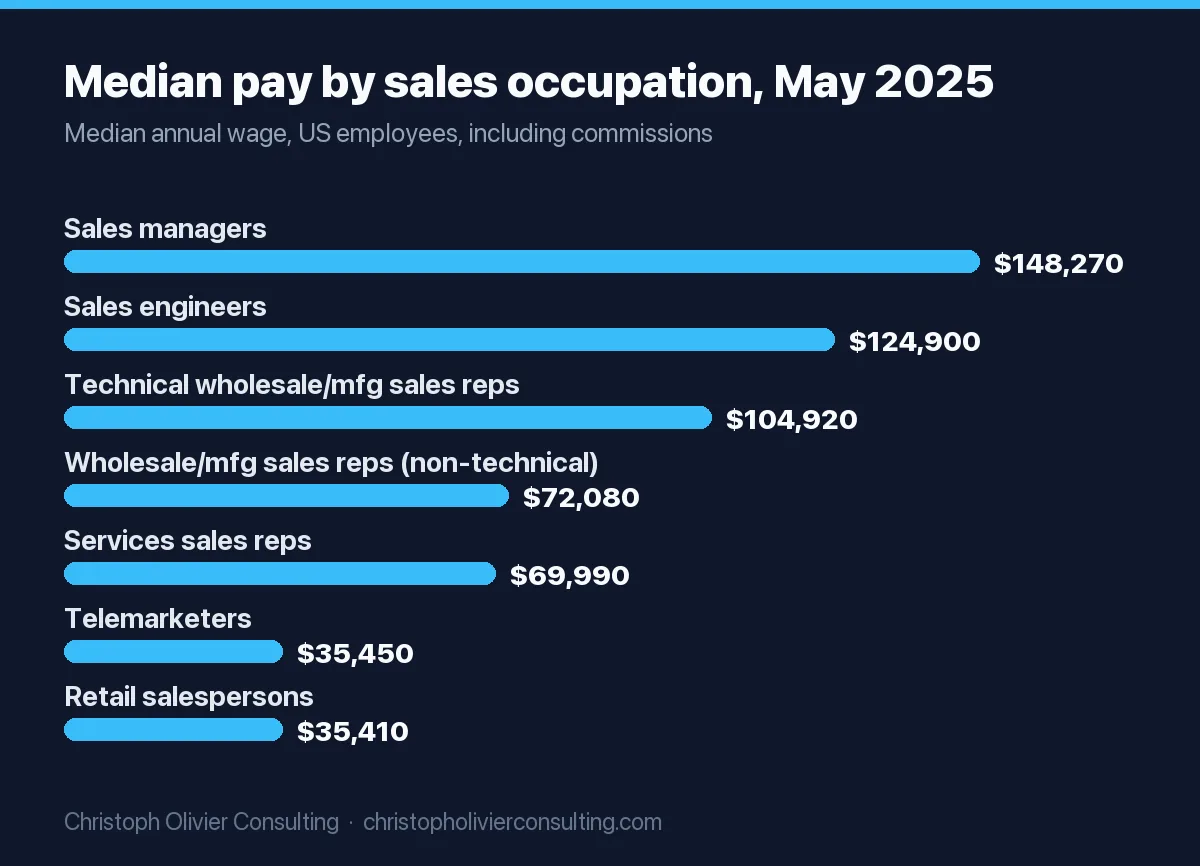
| Occupation (SOC code) | Closest type of sales | Employment | Median annual wage | Mean annual wage |
|---|---|---|---|---|
| Sales managers (11-2022) | Leads any B2B team | 637,080 | $148,270 | $164,350 |
| Sales engineers (41-9031) | Technical, enterprise | 51,790 | $124,900 | $130,140 |
| Sales reps, wholesale and manufacturing, technical and scientific products (41-4011) | Field and technical B2B | 284,800 | $104,920 | $119,730 |
| Sales reps, wholesale and manufacturing, except technical (41-4012) | B2B product sales | 1,238,190 | $72,080 | $82,530 |
| Sales reps of services (41-3091) | B2B and B2C service sales | 1,256,010 | $69,990 | $82,430 |
| Telemarketers (41-9041) | Transactional outbound | 58,430 | $35,450 | $37,370 |
| Retail salespersons (41-2031) | Retail B2C | 3,897,860 | $35,410 | $37,310 |
Source: BLS Occupational Employment and Wage Statistics, May 2025 national file. Compare these with the Bridge Group’s $200,000 median AE OTE: the BLS figures are actual pay across all employers and industries, while the Bridge Group figure is target pay at mostly venture-backed SaaS companies. Use BLS for a services or product sales hire, and Bridge Group only if you compete with SaaS for the same people.
Which type of sales should your business staff first?
Staff the motion your main offer demands, prove it, then add a second. The table below is a decision aid built from the benchmarks above. The ACV bands are rules of thumb, not study findings; adjust them to your own margins.
| If your business looks like this | Primary type of sales | Add second, once the first works | Avoid for now |
|---|---|---|---|
| Consumer product under about $100, repeat purchase | E-commerce and D2C | Retail or wholesale for reach; subscription if usage repeats | Quota-carrying reps |
| B2B offer under $5,000 a year | Self-serve or transactional inside sales | Affiliates or referral partners | Field sales, SDRs |
| B2B service or software at $5,000 to $25,000 | Inside sales behind a published-price page | Referral partners on 20% to 25% commission | Field sales |
| Professional services at $25,000 to $100,000 | Inside, consultative, inbound and referral-led | Founder-led or SDR outbound to named accounts | Volume comp plans |
| Contracts over $100,000 with buying committees | Enterprise field sales with account-based targeting | Channel partners or cloud marketplace for procurement | Self-serve as the main path |
| Other firms already serve your exact buyer | Channel or referral partners, at any price | Direct inside sales for top accounts | Paying partners before you can close yourself |
| Government agencies as buyers | B2G with contracts and capture staff | Partnering with prime contractors | Standard outbound cadences |
Then sequence the build:
- Name your row on each axis. Buyer, location, motion, lead source and route to market, using the master table.
- Run the deals-per-rep math. Divide $960,000 (the Bridge Group median quota) or your own quota by your ACV. My rule of thumb: if the answer is above about 40 deals a year, a rep-led model will struggle.
- Match pay to motion. One comp plan per motion. Never share a transactional plan with enterprise deals.
- Build inside before outside. Add field coverage only for the segment where deal size covers travel.
- Add partners after you can close. A partner multiplies a process that converts. They rarely fix one that does not.
- Give the low end a self-serve path. Let small, simple buys close without a rep so your sellers spend time on deals that need a person.
If you can place your offer in two rows of the decision table and are not sure which to build first, that is the kind of call worth a second opinion. You can book a consultation and bring your ACV, win rate and current lead sources.
Frequently asked questions
What are the types of sales?
The main types of sales sort by axis. By buyer: B2B, B2C and B2G. By location: inside and outside (field). By approach: transactional, consultative and enterprise. By lead source: inbound and outbound. By route to market: direct, channel partner, account-based and self-serve. Consumer selling adds retail, direct-to-consumer, e-commerce and subscription. Most businesses combine one type from each axis.
What are the two types of sales?
The two types of sales people usually mean are B2B, selling to businesses, and B2C, selling to consumers. B2B deals involve buying committees and longer cycles; 6sense measured an average B2B buying cycle of 10.1 months in 2025. B2C purchases are usually made by one person in one visit or session. Other common two-way splits are inside vs outside, inbound vs outbound and direct vs indirect.
What are some sales models examples?
Public filings show clear examples. Salesforce sells through field and inside reps plus self-service. HubSpot gets about 49% of revenue from Solutions Partners and the customers they refer. Atlassian lands customers through self-service and expands with field sales. Palo Alto Networks sells through two-tier distribution. Nike splits wholesale and Nike Direct, and Costco and Netflix run membership and subscription models.
What is the difference between inside and outside sales?
Inside sales reps sell remotely by video, phone and email. Outside or field reps sell in person within a territory. Inside sales costs less per deal because nobody travels, so it fits most deals between roughly $10,000 and $100,000 a year. Field sales earns its cost on six-figure contracts with buying committees, where Bridge Group's median AE quota of $960,000 means only a handful of deals a year.
Which type of sales job pays the most?
In the May 2025 BLS wage data, sales managers had the highest median pay at $148,270, followed by sales engineers at $124,900 and technical wholesale and manufacturing reps at $104,920. Non-technical wholesale and manufacturing reps earned a median $72,080 and services sales reps $69,990. Retail salespersons and telemarketers earned about $35,400. The figures include commissions but exclude benefits.
What is the difference between B2B and B2C sales?
B2B sales sell to businesses, with several decision makers, contracts and longer cycles. TrustRadius found software deals averaged 3.8 months in 2025 and 6.6 months for enterprise purchases of $100,000 a year or more. B2C sales sell to individuals, usually in one session, at prices like Warby Parker's $95 glasses. B2B relies on reps and partners; B2C relies on stores, websites and marketing.
More Growth, Strategy & Sales guides
- ChatGPT for Sales: Outreach Playbook
- Managing a Sales Force: The Operating System for Structuring, Coaching, and Paying a Team That Hits Quota
- Pipeline Marketing & Sales Alignment
- Sales and Marketing Plan Example: A Filled-In Sample for a Service Business
- Sales and Marketing Solutions: How to Build a Stack That Closes the Loop
- Sales and Marketing Strategy: One Revenue System, Not Two Plans
- All Sales Process & CRM guides →