
A webinar marketing strategy is the full plan for turning a live or recorded session into registrations, attendance, and closed pipeline: one clear goal, a four-week promotion runway, a reminder cadence that protects your show rate, and a follow-up sequence that does most of the selling after the session ends. Most webinars fail on promotion and follow-up, not on slide quality.
Last reviewed: October 2026

This guide is the tactical, benchmark-backed layer beneath the broader content marketing strategy hub. It is written for a B2B founder or marketer who has to hit a real registration and pipeline number, not just publish an event and hope. Every section stands on its own so you can lift the part you need.
What is a webinar marketing strategy?
A webinar marketing strategy is a documented plan covering one primary goal, the audience and topic, the promotion channels and timeline, the registration page, the reminder and follow-up sequences, and the metrics you will judge it by. The strategy is the connective work around the event, not the event itself. Sessions with no single primary goal convert poorly at every goal.
Pick one job per webinar: net-new lead capture, sales-qualified pipeline, product activation, or customer expansion. A pipeline webinar wants a tight ideal customer profile and a demo-adjacent topic. A top-of-funnel awareness webinar wants a wide, shareable topic and a partner co-host. Trying to serve all four at once dilutes the call to action and the follow-up.
How do you choose a webinar topic and format?
Choose a topic your buyer already searches for and a format that matches your goal: a teaching session for demand, a panel for reach, a live demo for pipeline, or a customer case study for expansion. The best topics answer a specific, expensive problem your product touches, so the follow-up to a sales conversation is natural rather than forced.
Formats trade reach against intent. A solo teaching webinar is fastest to produce and best for owned-audience demand. A partner or panel webinar borrows a second audience and lifts registrations, at the cost of message control. A live product walkthrough pulls smaller numbers but higher buying intent.
| Format | Best for | Typical reach | Buying intent |
|---|---|---|---|
| Solo teaching session | Owned-audience demand | Medium | Medium |
| Partner or panel | New audience reach | High | Lower |
| Live product demo | Sales pipeline | Lower | High |
| Customer case study | Expansion and proof | Medium | High |
What does a webinar promotion timeline look like?
Promote across at least four channels for 21 to 28 days, with email as the primary driver and LinkedIn as the B2B amplifier. Email generates the majority of B2B webinar registrations, often in the 57 to 70 percent range, so treat every other channel as support for the email push, not a replacement for it.
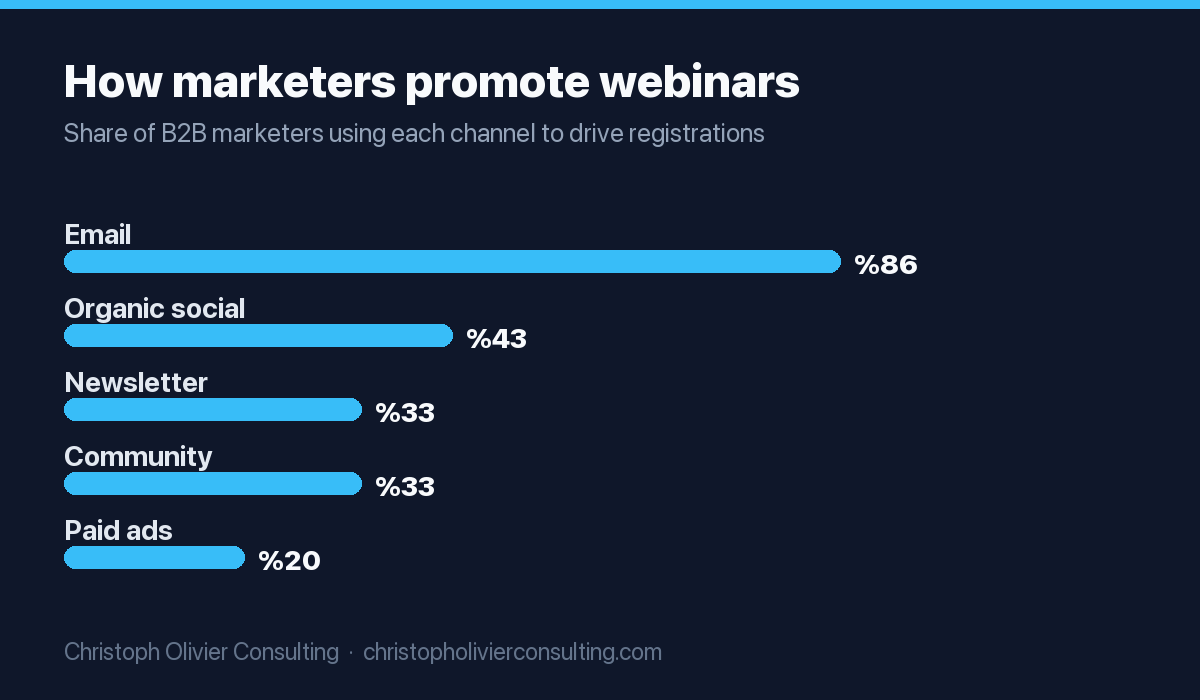
Run promotion as a sequence, not a single blast. Each touch has a distinct job, from the first announcement to the day-of join reminder.
- Three weeks out: announcement email to your list plus an organic LinkedIn post and event page. State the one problem the session solves.
- Two weeks out: speaker or panelist spotlight. Give the human reason to attend and start any partner co-promotion here.
- One week out: content preview email. Share one slide, stat, or teardown the audience will get live.
- One to two days out: urgency email plus a second LinkedIn post. Name the deadline and what they lose by missing it.
- Day of: morning reminder email with the join link, and a short social post one hour before start.
Paid amplification is optional and works best as retargeting: run LinkedIn or Meta ads to people who visited the registration page but did not sign up. For a full-funnel plan around the event, connect this timeline to your B2B lead generation strategies so the registrations feed one pipeline, not a disconnected list.
How do you build a high-converting registration page?
A strong webinar registration page converts 35 to 45 percent of visitors, well above a standard landing page, because the offer is specific and the form is short. Lead with the outcome and the date, list three to four concrete takeaways, name the speakers with photos, and ask for only the fields sales actually needs.
Keep the form to name, work email, and one qualifying field such as company or role. Every extra field costs registrations. Put the target keyword in the page title and headline so the page can also earn organic traffic between promotions. Add a one-line privacy note and a visible time zone to remove friction.
Why does the reminder sequence protect your show rate?
Registration is not attendance. The 2026 cross-industry median registration-to-live-attend rate sits near 41.6 percent, with a healthy planning band of 40 to 45 percent. A three-reminder cadence, one day before, one hour before, and roughly five minutes before start, lifts attendance by around 27 percent over a single reminder.
Send reminders from a real person, not a no-reply address, and include a one-click calendar file at registration so the event holds a slot in the buyer’s day. Add value to the reminders instead of repeating the title: a preview question, an agenda line, or a resource attendees receive live. The reminder sequence is where most of your recovered attendance comes from.
Live or on-demand: which should you run?
Run both. Roughly 40 to 50 percent of registrants attend live, while replays commonly drive up to 47 percent of total views, so a webinar is a hybrid asset by default. Treat the live session as the promotion event and the recording as an evergreen page that keeps generating leads long after.
On a rolling 30-day window, recorded replays can pull more than twice the unique viewers of the live session, with most replay watch time landing in the first 14 days. Automated or on-demand webinars convert at roughly 70 to 85 percent of live rates while running without your calendar. Gate the replay behind the same short form, and keep the follow-up sequence identical for live and replay registrants.
What does a webinar follow-up sequence look like?
The follow-up sequence is where the revenue is: attendees who receive a personalized post-event sequence of four or more touches within 14 days can convert to customers at roughly 17 percent, close to double the rate of a single thank-you email. About a quarter of webinar-influenced sales happen after the event, so the follow-up is not optional cleanup.
Segment the follow-up by behavior. Live attendees, replay-only viewers, and no-shows each need a different first message.
- Live attendees: recording, slides, the specific CTA (demo, trial, or consult), and a direct sales reply-to.
- Registered no-shows: the replay link with a short note on what they missed, then the same CTA on a delay.
- High-intent signals: anyone who asked a question, clicked the CTA, or stayed to the end goes to sales for a personal follow-up within 48 hours.
Route the recording to your social channels as clips as well; short cuts from the session feed ongoing social media lead generation and pull replay registrations for months.
Which webinar metrics actually matter?
Judge a webinar on the chain from registration to pipeline, not on raw attendance. The four numbers that decide whether to run the next one are registration conversion, show rate, engagement, and sourced or influenced pipeline. Vanity metrics like total registrations hide a weak show rate or a dead follow-up.
| Metric | What it measures | 2026 planning benchmark |
|---|---|---|
| Registration page conversion | Visitors who sign up | 35 to 45 percent |
| Show rate (reg-to-live) | Registrants who attend live | 40 to 45 percent median band |
| Replay share of views | On-demand vs live viewing | Up to about 47 percent of total views |
| Post-event conversion | Attendees to customers with 4+ follow-up touches | Roughly 17 percent |
Tie the final number to revenue. Tag every registrant with the webinar source in your CRM, then report sourced and influenced pipeline 30, 60, and 90 days out. That closed-loop reporting is what justifies the next event and the budget behind it.
A realistic worked example
Consider a B2B software team promoting a 45-minute teaching webinar to a 6,000-person list plus a partner audience. At a 40 to 45 percent page conversion on click-through traffic they might land around 350 registrations, and at a 42 percent show rate roughly 145 attend live. That is a normal, healthy result, not a failure.
The replay then does the heavy lifting: over the next 30 days it can add more unique viewers than the live room held. With a four-touch, 14-day follow-up split by behavior, a mid-teens post-event conversion on the engaged segment turns a modest live turnout into a meaningful pipeline number. The team that skips the follow-up sequence keeps only the live 145 and wonders why webinars underperform.
Where a webinar fits your wider marketing
A webinar is a content engine, not a one-off event: one session becomes a gated replay, a blog recap, a clip series, and a sales-enablement asset. That repurposing is what makes the four weeks of promotion worth it, because the asset keeps earning after the live date.
If you want the promotion timeline, registration page, reminder cadence, and follow-up built and measured as one system tied to pipeline, that is the kind of work a fractional CMO runs directly. See how that engagement is structured on the fractional CMO services page.
Frequently asked questions
How far in advance should I promote a webinar?
Start promotion 21 to 28 days before the live date and run it as a sequence across at least four channels. A common cadence is an announcement at three weeks, a speaker spotlight at two weeks, a content preview at one week, an urgency email one to two days out, and a day-of reminder with the join link. Email should carry the majority of registrations, with LinkedIn as the B2B amplifier.
What is a good webinar show rate?
The 2026 cross-industry median registration-to-live-attend rate is near 41.6 percent, so treat 40 to 45 percent as your planning band rather than a ceiling. Below roughly 28 percent signals weak reminders or a mismatched audience. A three-reminder cadence, one day before, one hour before, and about five minutes before start, typically lifts attendance around 27 percent over a single reminder.
How many follow-up emails should a webinar have?
Send four or more personalized touches within 14 days of the event, segmented by behavior. Attendees who receive a four-plus-touch sequence can convert at roughly 17 percent, close to double the rate of a single thank-you email. Split the follow-up so live attendees, registered no-shows, and high-intent viewers who asked questions or clicked the CTA each get a different first message.
Are live or on-demand webinars better?
Run both, because they do different jobs. Around 40 to 50 percent of registrants attend live, while replays can drive up to 47 percent of total views and often pull more unique viewers than the live room over a 30-day window. Use the live session as the promotion event and the recording as an evergreen, form-gated page. Automated on-demand webinars convert at roughly 70 to 85 percent of live rates.
What conversion rate should a webinar registration page hit?
A focused webinar registration page commonly converts 35 to 45 percent of visitors, well above a standard landing page, because the offer and date are specific. Keep the form to name, work email, and one qualifying field, lead with the outcome and three to four concrete takeaways, and name the speakers with photos. Put the target keyword in the title so the page also earns organic traffic between promotions.
How do I measure webinar ROI?
Tag every registrant with the webinar source in your CRM, then track the full chain: registration page conversion, show rate, engagement, and sourced or influenced pipeline at 30, 60, and 90 days. Raw registration counts hide a weak show rate or dead follow-up. Closed-loop pipeline reporting is the number that justifies budget for the next event, not attendance alone.
More Funnels, Conversion & Email guides
- How to Structure a Webinar Offer That Converts (+ Template)
- How to Build an Account Based Marketing Strategy
- Content Marketing for Startups: What to Build First With No Team or Budget
- Email Newsletter Strategy: How to Grow an Audience and Pipeline
- Growth Marketing Strategy: The Experiment-Driven Playbook
- How to Get More Google Reviews (Without Breaking Google's Rules)
- Influencer Marketing Strategy: A Step-by-Step Playbook