

Auto repair shop customer lifetime value is average repair order x visits per year x gross margin x years retained. Run that with 2026 published inputs and one customer vehicle is worth about $1,114 in gross profit at a quick-service shop, $3,574 at a median general repair shop and $8,864 at a top-quartile shop. In revenue that is $2,475, $6,499 and $14,774. For a dealer benchmark, Cox Automotive puts one service customer at $12,398 of service spend over the ownership period.
Below: where each input comes from (and which ones nobody publishes), the three shops worked line by line, what that value lets you pay for a new customer, and then the marketing that moves each input: Google Business Profile, Google Ads at 2026 auto repair benchmarks, reviews inside Google’s and the FTC’s rules, shop software prices, compliant reminder texts and a 90-day plan.
Want a specialist to build this for your business? See how CO Consulting’s marketing services work, starting with a diagnostic and audit.
The auto repair customer lifetime value formula, input by input
Use gross profit, not revenue. A $650 repair order at a 55% gross margin leaves $357.50 to cover rent, the service advisor and marketing, and only that $357.50 can pay for winning the customer. The formula:
CLV (gross profit) = average repair order x visits per year x gross margin x years retained
Two of the four inputs have good public numbers. Two do not, and any page that quotes a “typical” retention rate for repair shops without a sample and a method is guessing. Here is what exists as of November 2026:
| Input | Best published figure | Source and what it measures | Pull your own from |
|---|---|---|---|
| Average repair order (ARO) | $704.25 average, $649.88 median, $879.38 top 25% | Tekmetric Shop Index, vendor data from more than 10,000 shops using its software, through June 2026. No method published. | Shop software sales report: total sales divided by repair orders, last 12 months |
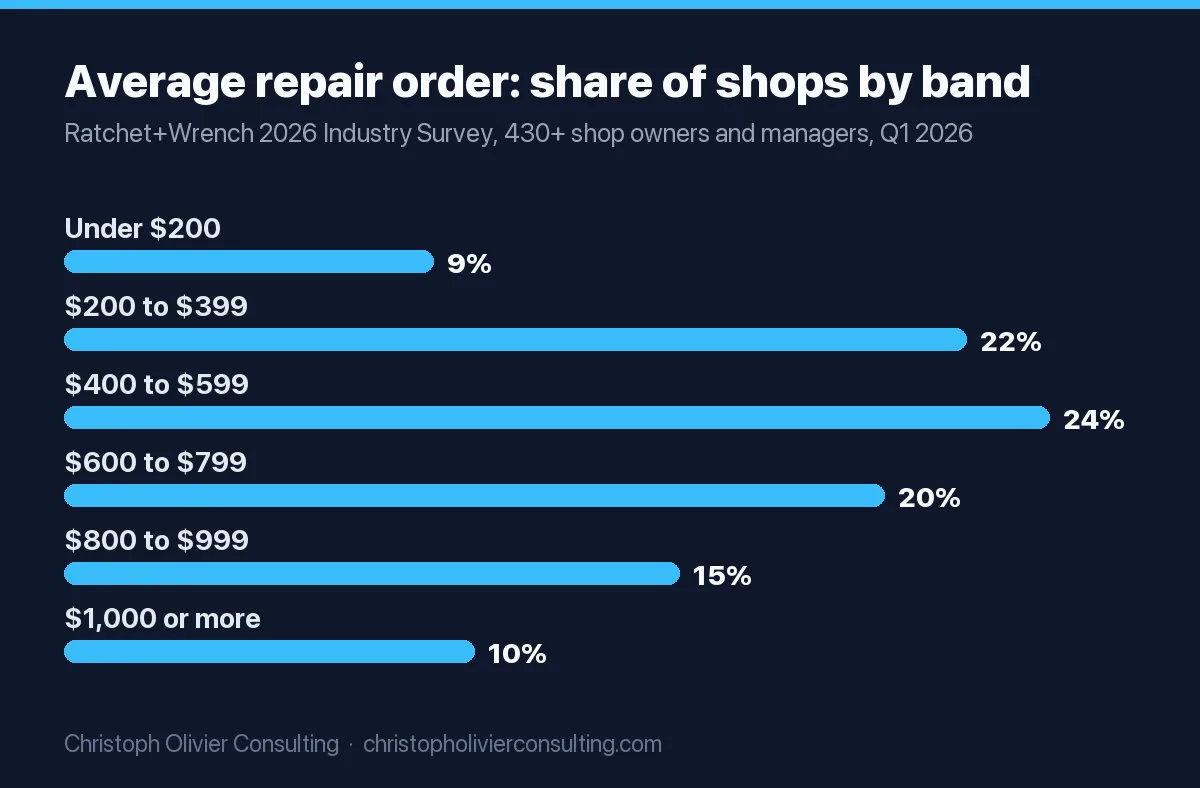
| ARO, survey bands | Most common band $400 to $599 (24% of shops); 45% above $600 | 2026 Ratchet+Wrench Industry Survey, 430+ owners and managers, mostly independents, Q1 2026 | Same report |
| Spend per customer, consumer side | $275 at general repair shops, $261 at dealers | 2025 Cox Automotive Service Industry Study, as published in the Cox 2026 Fixed Ops and Ownership Study deck | Not comparable with your ARO: it is what consumers report spending, every quick oil change included |
| Visits per year | 2.4 (an assumption Cox uses, dealer data) | Cox 2026 deck, footnote to its $12,398 estimate. No independent shop figure is published. | Repair orders divided by unique vehicles, last 12 months |
| Gross margin | Most common band 50% to 59% (28% of shops); 22% at 40% to 49%; 13% at 60% or more; 9% do not track it | 2026 Ratchet+Wrench Industry Survey. Tekmetric reports a separate 58% average parts margin. | Profit and loss: (sales minus parts cost minus tech labor) divided by sales |
| Years retained | No methodology-backed benchmark for independents. Ceiling for one vehicle: 8.4 years average ownership | Cox 2026 deck (footnote assumption). Years retained = 1 divided by annual churn rate. | Customers active 13 to 24 months ago who came back in the last 12 months |
Two sanity checks keep the inputs honest. First, the wallet: AAA’s 2026 Your Driving Costs puts maintenance, repair and tires at a weighted 11.73 cents a mile for new 2026 models, or $1,759.50 a year at 15,000 miles. If your formula says one vehicle spends far more than that with you every year, an input is off (older cars do spend more, so treat it as a floor, not a cap). Second, the fleet is old: S&P Global Mobility put the average US light vehicle at 12.8 years in May 2025, passenger cars at 14.5 years, across 289 million vehicles. Its release expects “stronger opportunity for maintenance and repair” as 2015 to 2019 model years roll off warranty. I found no 2026 update from S&P.
One trap in the Ratchet+Wrench report: its text says more than half of shops have an ARO above $600, but its own table (20% at $600 to $799, 15% at $800 to $999, 10% at $1,000 or more) adds up to 45%. Quote the table.
Customer lifetime value worked for three auto repair shops
Each row says where the number comes from. Visits per year and years retained are assumptions because no one publishes them for independent shops; swap in yours.
| Step | A. Quick-service heavy shop | B. Median general repair shop | C. Top-quartile shop |
|---|---|---|---|
| Average repair order | $275 (Cox, general repair customer spend) | $649.88 (Tekmetric median) | $879.38 (Tekmetric top 25%) |
| Visits per year | 3 (assumption: oil, tires, small repairs) | 2 (assumption) | 2 (assumption) |
| Revenue per vehicle per year | $825 | $1,299.76 | $1,758.76 |
| Wallet check vs AAA $1,759.50 | 47% of the vehicle’s yearly spend | 74% | 100%: you are getting all of it |
| Gross margin | 45% (assumption, middle of the 40% to 49% band) | 55% (middle of the most common 50% to 59% band) | 60% (floor of the top band) |
| Gross profit per year | $371.25 | $714.87 | $1,055.26 |
| Annual churn and years retained | 33.3% churn = 3 years (assumption) | 20% churn = 5 years (assumption) | 11.9% churn = 8.4 years (Cox ownership length as the cap) |
| CLV, revenue | $2,475 | $6,498.80 | $14,773.58 |
| CLV, gross profit | $1,113.75 | $3,574.34 | $8,864.15 |
The math for shop B in full: $649.88 x 2 = $1,299.76 a year; x 55% = $714.87 gross profit a year; x 5 years = $3,574.34. Cox’s dealer number checks out the same way: 2.4 visits x 8.4 years x $615 average dealer repair order (Xtime data) = $12,398.
What the table tells you:
- Years retained is the biggest lever you control. Shop B at 15% churn instead of 20% keeps a customer 6.7 years instead of 5 (1 divided by 0.15), and CLV rises from $3,574.34 to $4,765.79, plus $1,191.45 per customer, with no price change. Our customer retention statistics page has the retention and churn formulas to measure your own rate.
- Households multiply it. The table is per vehicle. If a customer brings two cars, double the row, which is why the vehicle count on each customer record matters.
- Shop C has no wallet left to win. At 100% of AAA’s yearly spend, growth comes from more customers and longer retention, not more visits. Shop A is the opposite: 53% of what its customers’ vehicles need is going to someone else, so declined-work follow-up and maintenance reminders pay first.
This is the auto repair version of the general method in our customer lifetime value guide. The figures here are not discounted for the time value of money, so treat the longer retention periods as optimistic.
What CLV lets you pay for a new repair customer
The ceiling comes from the same formula we use on our average cost per lead by industry page:
Max cost per lead = gross profit per new customer x lead-to-customer rate x acquisition share
I use one third as the acquisition share. It is a rule of thumb, not a published benchmark. I also use first-year gross profit, not lifetime, so the spend pays back inside 12 months; lifetime value is the upper limit you should never bid to. The 60% lead-to-customer rate is illustrative: the share of calls and booking requests that turn into a repair order. Pull yours from call tracking.
| Step | Shop A | Shop B | Shop C |
|---|---|---|---|
| First-year gross profit | $371.25 | $714.87 | $1,055.26 |
| Max acquisition cost (x 1/3) | $123.75 | $238.29 | $351.75 |
| Max cost per lead (x 60% close) | $74.25 | $142.97 | $211.05 |
| Google search benchmark CPL, auto repair 2026 | $29.96 | $29.96 | $29.96 |
| Close rate needed at the benchmark ($29.96 / max acquisition cost) | 24.2% | 12.6% | 8.5% |
| Break-even max CPC (max CPL x 15.51% conversion rate) | $11.52 | $22.17 | $32.73 |
The honest reading: at the published benchmark, paid search pays for all three shops, even the quick-service shop, as long as about one lead in four becomes a repair order. The risk is not the click price. It is that a new customer’s first visit is often a small ticket, so your first-year gross profit for search-acquired customers may sit well below the shop average. Run the table with first-year gross profit from customers tagged by source, not your shop-wide ARO.
For context on what peers spend: in the 2026 Ratchet+Wrench survey, 7% of shops put 0% of sales into marketing, 20% put 1% to 2%, 21% put 3% to 4%, 13% put 5% to 6%, 17% put 7% to 8%, 16% put 9% to 10% and 6% put 11% or more. A budget built from lead targets and allowable cost, the method in our small business lead generation plan, beats picking a percentage.
Google Business Profile for auto repair shops: categories, services, booking
The profile is free, and it is where a driver with a warning light compares you with the shop down the road. In the same Ratchet+Wrench survey, 13% of shops have no website and 23% use none of the listed marketing strategies, so a complete profile still stands out. The settings that matter for a repair shop:
| Setting | What to enter | The rule behind it |
|---|---|---|
| Primary category | Auto repair shop, unless one service is most of your sales (then Brake shop, Transmission shop or Tire shop) | Google says to pick the most specific category that describes the whole business, and that custom categories are not allowed (Business Profile Help) |
| Additional categories | Only departments you really run: Oil change service, Brake shop, Wheel alignment service, Auto electrical service, Muffler shop, Car inspection station or Smog inspection station | Google: add categories for departments, not one per service. Names from the 2026 auto category list compiled by Dalton Luka, which says one primary plus nine additional are allowed (Google’s page gives no number) |
| Services | Each job customers search for: brake pad replacement, check engine light diagnosis, AC recharge, timing belt, state inspection. Add a price or “from” price in the price field | Edit services, then Add custom service. Google rejects custom names that contain prices or phone numbers (Business Profile Help) |
| Booking button | The online scheduler URL from your shop software, set as the preferred link | Booking, Add link, Save. Up to 10 links per type; “Set preferred link” puts yours on top (Business Profile Help) |
| Review link | The short link and QR code for every invoice, text and counter card | Reviews, Get more reviews, copy icon. QR codes generate only in a computer browser (Business Profile Help) |
Then mirror the services list on your website with one page per high-value job, each naming the vehicles you see most. A “brake repair” page that says which makes you work on and what a typical pad and rotor job includes gives Google and the customer something the profile alone cannot.
Google Ads for auto repair: 2026 CPC, conversion rate and cost per lead
The closest benchmark is the “Automotive, Repair, Service and Parts” category in the 2026 LocaliQ and WordStream Search Advertising Benchmarks: 13,474 US campaigns on Google Ads and Microsoft Ads, April 1, 2025 to March 31, 2026. WordStream notes the “averages” are medians.
| Metric, 2026 edition | Automotive Repair, Service and Parts | Where it ranks of 23 industries |
|---|---|---|
| Average CPC | $4.35 | Below the $5.42 all-industry figure |
| Click-through rate | 5.56% | Lowest of all industries |
| Conversion rate | 15.51% | Second highest, after Animals and Pets (16.22%) |
| Cost per lead | $29.96 | Second lowest, after Arts and Entertainment ($26.84); up 5.12% year over year |
My read of low click-through plus high conversion: people scan several shops, then call the one that answers the immediate question. Write ads that answer it: the service in the headline, “same-day diagnosis” only if you offer it, and a call asset during open hours. Only 30% of shops in the Ratchet+Wrench survey run Google Ads, so in many towns the auction is thinner than in home services. Every other category, with year-over-year change, is in our Google Ads CPC by industry breakdown. Check whether Local Services Ads are open for your category and city in Google’s eligibility tool; Google’s help page says its “Google Verified badge is currently unavailable for verticals in the auto, beauty, and dining categories.”
Reviews: what Google and the FTC allow a repair shop to do
Two rulebooks apply and they are not the same. Google’s prohibited and restricted content policy covers your profile; the FTC’s Consumer Reviews and Testimonials Rule, 16 CFR Part 465, in force since October 21, 2024, covers your business everywhere. Knowing violations can cost up to $53,088 per violation, and an FTC notice for publication September 15, 2026 says the 2025 levels stay unchanged during 2026.
| Shop practice | FTC | Verdict | |
|---|---|---|---|
| Text the Google review link to every customer after pickup | Allowed: you may solicit reviews of genuine experiences | Allowed | Do it |
| “$10 off your next oil change for a review” | Banned: no payment, discounts or free services for reviews | Not banned by Part 465 if there is no sentiment condition (FTC Q&A) | Fail on Google |
| “$10 off for a 5-star review” | Banned | Violates § 465.4: incentives conditioned on a particular sentiment | Fail on both |
| Ask “how did we do?” and send only happy customers to Google | Banned: no selectively soliciting positive reviews | No specific ban, but the FTC says it “could violate the FTC Act” | Fail |
| Tablet at the counter: “leave your review before you go” | Banned: do not require or pressure reviews on the premises | Not addressed | Fail |
| Advisors must get 10 reviews a week | Banned: staff quotas for a number of reviews | Not addressed | Fail; track request rate instead |
| Owner’s spouse or a tech posts a review | Conflict of interest | Insider review rules under § 465.5 require clear disclosure | Fail |
The practical system: one review request text to every closed repair order, sent automatically by your shop software, and a reply to every review within a business day. The full response playbook and policy template are in our reputation management guide.
Shop management software with marketing built in: 2026 prices
Reminders, review requests and declined-work follow-up live in your shop software, because that is where the vehicle, mileage and repair history sit. Prices below are from each vendor’s US pricing page on November 1, 2026, per shop per month.
| Software | Plans: monthly billing (annual billing) | Retention features in the plan | Marketing add-on |
|---|---|---|---|
| Tekmetric | Start $199 ($179), Grow $349 ($309), Scale $439 ($409), Enterprise custom | Two-way texting named on Scale | Marketing, $345 a month per shop: online booking, reminders, reviews, campaigns, follow-ups |
| Shopmonkey | Basic $239 ($215), Clever $399 ($359), Genius $499 ($449), Multi-Shop custom; one-time $500 data migration fee | All plans: two-way SMS and email, automated appointment reminders. Genius adds Google Reviews Manager, automated estimate follow-ups, inactive work orders, coupons | Reviews Manager $99 ($89); CRM Essentials $349 ($314), the only way to get Campaigns |
| Shop-Ware | Startup $279 ($251), Pro $389 ($350), Master $499 ($449), Ultimate+ $999 ($899) | Startup has limited two-way texting, Pro unlimited. Ultimate+ adds website, SEO, call tracking, CRM, online scheduler and Google Ads enablement (ad budget and management fee extra) | CRM + Online Service Scheduler, $249 a month: service reminders, thank-you messages, offers |
| AutoLeap | Essentials $199 ($179), Pro $349 ($309), Elite $449 ($409), Enterprise custom; one-time setup fee, amount not listed | Appointment reminders on all plans; two-way texting from Pro; integrated Google Reviews on Elite | Marketing Suite (email and SMS campaigns, automated reminders, CRM dashboard, website), no price listed |
| Mitchell 1 Manager SE with SocialCRM | Quote only | SocialCRM: service reminder emails, appointment reminder texts, automated review requests | Quote only |
Price the stack against shop B’s $714.87 of gross profit per customer per year. Tekmetric Grow plus Marketing is $694 a month on monthly billing, or $8,328 a year, which 11.6 retained customer-years pay for. Shopmonkey Basic plus CRM Essentials ($588 a month) needs 9.9; Shop-Ware Pro plus the CRM add-on ($638) needs 10.7. If the reminders keep even a few dozen extra customers coming back, the software is the cheapest acquisition you will buy.
Oil change and maintenance reminders that follow SMS rules
Customers want these texts. In SimpleTexting’s January 2026 survey of 1,000 US consumers, 85.6% said they are opted in to texts from businesses, and appointment and reservation reminders were the top reason (76%). The rules that apply to a shop’s texts, current as of November 2026:
- Consent for promotional texts. The TCPA rule for autodialed advertising and telemarketing requires prior express written consent, and the safe course is to treat promotional texts the same way: a signed (electronic is fine) agreement naming the number, with a disclosure that consent is not a condition of purchase (47 CFR 64.1200(a)(2) and (f)(9)). Capture it on the check-in form or digital authorization.
- Opt-outs. Replies of “stop,” “quit,” “end,” “revoke,” “opt out,” “cancel” or “unsubscribe” count, and you have at most ten business days to honor them (64.1200(a)(10)). An FCC rule effective November 25, 2026 (91 FR 67214) lets senders treat a revocation as applying only to the category of informational messages it targeted. Ask counsel before you narrow how you handle STOP on promotional texts.
- Hours. Telephone solicitations to residential subscribers are barred before 8 a.m. and after 9 p.m. in the recipient’s time zone (64.1200(c)(1)). Schedule promotions inside that window.
- Exposure. The statute allows $500 per violation, and a court may triple it for willful or knowing violations (47 U.S.C. 227(b)(3)).
- Carrier registration. Business texting on local numbers needs A2P 10DLC registration; Twilio lists a $15 one-time campaign vetting fee and $1.50 to $10 per campaign per month (Twilio 10DLC overview). Ask your shop software vendor whether it registers for you and who pays the fees.
More opt-in and click data by industry is in our SMS marketing statistics. This is general information, not legal advice.
Copy-ready reminder texts for a repair shop
The timing below is my rule of thumb, not a published standard. Set the due date from the mileage interval in your shop software, not the calendar.
- Consent line on the check-in form: “Yes, text me service reminders and offers from [Shop Name] at [number]. Consent is not a condition of purchase. Msg and data rates may apply. Reply STOP to cancel, HELP for help.”
- Review request, same day as pickup, every customer: “[Shop Name]: Thanks for trusting us with your [2018 Honda CR-V] today, [First name]. If you have a minute, tell others how it went: [Google review link]”
- Declined work, 14 days after the visit: “[Shop Name]: The [rear brake pads] we measured on [June 2] are still on your [CR-V]’s list. Your quote [#4471] is good until [July 2]. Book a time: [booking link]. Reply STOP to opt out.”
- Maintenance due, 7 days before the estimated due date: “[Shop Name]: Your [CR-V] is due for [oil service and tire rotation] at about [52,000] miles. Pick a time: [booking link]. Reply STOP to opt out.”
- Lapsed customer, 9 months after the last visit: “[Shop Name]: It’s been 9 months since we saw your [CR-V]. If [your state inspection or oil service] is coming up, book here: [booking link]. Reply STOP to opt out.”
A 90-day auto repair marketing plan built on CLV
| Days | Work | Pass when |
|---|---|---|
| 1 to 10 | Pull 12 months from your shop software: ARO, repair orders per vehicle, gross margin, customers active 13 to 24 months ago who returned. Fill in the CLV table with your numbers. | You have a written CLV, a first-year gross profit and a max cost per lead |
| 11 to 25 | Fix the Google Business Profile: category, services with prices, preferred booking link, review link and QR code on invoices. Add the consent line to check-in. | Every service you sell is listed; consent is captured on new repair orders |
| 26 to 45 | Turn on the review request, declined-work, due and lapsed texts in your software. Finish 10DLC registration. | 100% of closed repair orders get a review request; reminders fire on schedule |
| 46 to 60 | Launch Google search ads on your top three services plus “near me” terms, call tracking on, bids under your break-even max CPC. | Calls and bookings are tracked by source |
| 61 to 90 | Compare cost per new customer by source against your max acquisition cost. Move budget toward the source with the most first-year gross profit per dollar. | Every channel is under your max acquisition cost, or paused |
The number to watch after day 90 is 12-month retention, because it moves CLV more than any ad. If you want a second set of eyes on your inputs before you set a budget, you can book a consultation.
Work with CO Consulting
Want this done for your business?
- A diagnostic call and an audit of your current marketing and numbers
- A prioritized 90-day plan built for your market
- Execution across SEO and AI search, paid ads, content, funnels and automation
- Weekly check-ins and monthly reporting, led by a fractional CMO
Frequently asked questions
What is the customer lifetime value of an auto repair shop customer?
Using 2026 published inputs, one customer vehicle is worth about $1,114 in gross profit at a quick-service shop ($275 spend, 3 visits, 45% margin, 3 years), $3,574 at a median shop (Tekmetric's $649.88 median ARO, 2 visits, 55%, 5 years) and $8,864 at a top-quartile shop. Visits and years are assumptions. Cox Automotive's dealer estimate is $12,398 of service revenue over ownership.
How do you calculate auto repair shop customer lifetime value?
Multiply average repair order by visits per year, gross margin and years retained. Pull ARO and visits from 12 months of repair orders in your shop software, gross margin from your profit and loss, and years retained as 1 divided by your annual churn rate. Use gross profit, not revenue, because only the profit can pay for acquiring the customer.
What is the average repair order for an auto repair shop in 2026?
Tekmetric's Shop Index, built from more than 10,000 shops on its software with data through June 2026, puts the national average ARO at $704.25, the median at $649.88 and the top 25% at $879.38. In the 2026 Ratchet+Wrench survey the most common band was $400 to $599, reported by 24% of shops, and 45% reported more than $600.
How much can an auto repair shop afford to pay for a new customer?
A practical ceiling is one third of the customer's first-year gross profit. For a shop with a $649.88 ARO, 2 visits a year and a 55% margin, that is $714.87 x 1/3 = $238.29 per new customer. At a 60% lead-to-customer rate, the most you can pay per lead is $142.97. The one-third share is a rule of thumb, not a published standard.
How much do Google Ads cost for auto repair shops?
In the 2026 LocaliQ and WordStream benchmarks (13,474 US campaigns, April 2025 to March 2026, medians), Automotive Repair, Service and Parts had a $4.35 average CPC, a 5.56% click-through rate, a 15.51% conversion rate and a $29.96 cost per lead. That cost per lead was the second lowest of 23 industries. Your local auction can differ, so check Keyword Planner for your area.
Can an auto repair shop offer a discount for a Google review?
Not on Google. Its policy bans payment, discounts or free services in exchange for reviews, even with no condition on the rating. The FTC's 16 CFR 465.4 bans incentives tied to a particular sentiment, such as a discount for a 5-star review. The safe approach is to text the same review link to every customer after pickup, with no reward attached.
What is a good customer retention rate for an auto repair shop?
No trade body publishes a 12-month retention benchmark for independent shops with a stated sample and method, so treat any single number you see with caution. Measure your own: of the customers who visited 13 to 24 months ago, what share came back in the last 12 months. Every point of churn you remove adds years to customer lifetime, since years retained equals 1 divided by churn.
More Growth, Strategy & Sales guides
- Coffee Shop Marketing: The Frequency Economics That Beat One-Time Discounts
- Daycare Marketing: A Funnel That Fills Your Enrollment
- Email List Building: A Practical Guide With Real Benchmarks
- How to Improve Free Trial Conversion: A Metrics-Backed Framework
- Guest Posting: How to Earn Links and Authority Without Breaking Google's Rules
- House Cleaning Marketing: The Recurring-Revenue Playbook
- All Growth, Strategy & Sales guides →