
Hair restoration marketing works when it is built around one number: cost per booked consult measured against your average case value and close rate. A follicular unit extraction case often lands in five figures, so a clinic can afford a cost per consult that would sink a low ticket business. The channels that win are high intent local search, a strong Google Business Profile, patient reviews, and consent based before and after content kept inside advertising policy.
Last reviewed: September 2026
What hair restoration marketing has to solve in 2026
Hair restoration is a high consideration, cash pay decision. Prospects research for weeks, compare surgeons, and want proof before they book. Marketing has to educate first, build trust with real results and reviews, then convert an inquiry into a scheduled consult fast. The job is not raw lead volume. It is qualified consults at a cost your case economics can support.
Most clinics spend somewhere between $3,000 and $25,000 per month across channels depending on market size and growth goals. A single channel approach usually pays a higher blended cost per patient than a coordinated funnel that combines search, local, and social. If you want the underlying framework, see our guide to SEO for professional services.
Cost Per Consult by Channel
Cost per consult is the cost to produce one scheduled, qualified consultation, not a raw form fill. The estimates below are midpoints of ranges reported across aesthetic and hair restoration campaigns in the United States for 2026. Your real numbers will vary with city, competition, offer, and how well your intake converts inquiries into kept appointments.
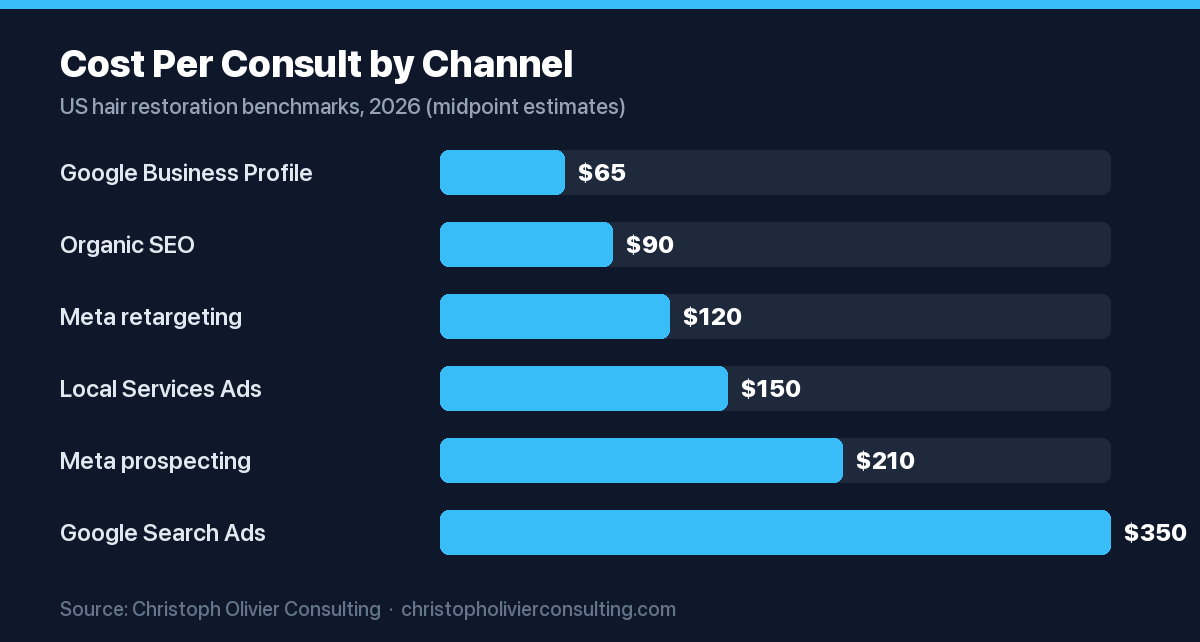
| Channel | Est. cost per consult (midpoint) | Why it lands there |
|---|---|---|
| Google Business Profile / local map pack | $65 | Free placement that captures a large share of local clicks; cost is content and review effort |
| Organic SEO | $90 | High marginal efficiency once ranked; a clinic ranking for 3 to 5 local terms can see 15 to 30 consult requests per month |
| Meta retargeting (warm) | $120 | Re engages site visitors and video viewers; consistently the lowest paid social cost |
| Local Services Ads | $150 | Pay per lead placement at the top of results; needs screening to protect quality |
| Meta prospecting (cold) | $210 | Builds demand with education and testimonials; higher cost, needs strong retargeting behind it |
| Google Search Ads | $350 | Highest intent but among the most expensive healthcare keywords; poorly built accounts default to $300 or more per lead |
Read this against your own case value. If a typical case is worth five figures and roughly one in five consults closes, a consult cost that looks high in another vertical can still return strongly here.
Which channels move a hair restoration clinic
The clinics that scale predictably run three engines together: earned local visibility, paid high intent search, and social proof. Each covers a different stage, from first research to the moment a prospect is ready to book. Below is the order most clinics should build them in.
- Google Business Profile and reviews first, because the local map pack captures a large share of local search clicks at no media cost.
- Organic SEO on high intent local and procedure terms, which compounds and reduces reliance on paid media over time.
- Google Search Ads for the ready to book searches you cannot yet rank for organically.
- Meta retargeting to recover the many researchers who visit once and leave.
- Meta prospecting and video only after the first four are producing, to widen the top of the funnel.
For clinics still building their first predictable pipeline, our small business lead generation guide covers the foundations, and our social media lead generation guide details the paid social side.
Before and after photos within Meta policy
Before and after images are the most persuasive asset in hair restoration, and also the most likely to get an ad account restricted. Meta limits before and after visuals in paid ads and rejects exaggerated or guarantee based copy. The safe pattern is to keep transformation galleries on channels you own, use documented patient consent, and keep paid ad creative educational.
Practical guardrails that tend to keep accounts healthy:
| Placement | Before and after use | Note |
|---|---|---|
| Your website and blog (owned) | Generally allowed with consent | Label results as individual and not typical; store signed consent |
| Organic social posts (owned) | Usually acceptable | Avoid guarantee language; results vary by patient |
| Meta paid ads | Restricted | Keep creative educational; direct clicks to owned galleries instead |
| Google Search Ads | Text focused | Match claims to landing page evidence |
Policies change, so confirm the current advertising rules for each platform before you launch, and have a compliance reviewer sign off on creative.
Compliant claims and how to phrase results
Hair restoration marketing sits under healthcare advertising standards, which means claims should be truthful, evidence backed, and free of guarantees. You can describe typical experiences and show consented results. You should avoid promising a specific outcome, a guaranteed graft survival rate, or a fixed timeline that you cannot substantiate for every patient.
Use conditional, verifiable language. Say that many patients see visible density over 9 to 12 months, that results depend on individual factors, and that a surgeon consult determines candidacy. Keep any statistic tied to a source you can produce on request. This protects the clinic and reads as more credible to a cautious buyer.
A speed to consult intake system
The intake system is where most hair restoration budgets leak. Inquiries arrive with high intent, then wait hours for a reply and go cold. A fast, structured intake converts far more of the traffic you already pay for. Top clinics report lead to consult conversion in the 10 to 15 percent range against a common average near 3 percent, and speed is a large part of that gap.
- Respond to every inquiry within five minutes during business hours, by call and text.
- Qualify against candidacy basics before booking, so consults are worth a surgeon’s time.
- Offer a specific consult slot in the first message rather than asking the prospect to pick later.
- Send a confirmation plus a short education asset that sets expectations.
- Run reminder touches by text and email to protect the show rate.
- Follow up unbooked inquiries for at least 30 days, since this is a long consideration purchase.
How to lower your cost per consult
You lower cost per consult by improving conversion and shifting spend toward the channels that book, not by cutting media blindly. Small gains in landing page conversion and show rate move blended cost more than a lower bid ever will. Track cost per booked consult by channel every month and reallocate toward the winners.
- Add negative keywords and tight match types to search campaigns so you stop paying for non buyers.
- Build channel specific landing pages with clear proof, consented results, and one primary action.
- Grow reviews on Google steadily, since review count and rating lift both map pack visibility and conversion.
- Weight budget toward retargeting and organic, which carry the lowest cost per consult.
- Fix the intake speed and follow up before spending more on traffic.
If you want an outside operator to build this system with your team, review our consulting services.
Frequently asked questions
How much does hair transplant marketing cost per month?
Most hair restoration clinics invest between $3,000 and $25,000 per month across channels, depending on market size, competition, and growth goals. Smaller single location clinics often start near the lower end with local SEO and Google Business Profile, then add paid search and social as booked consults justify it. The right number is the one your case economics and close rate can support profitably.
What is a good cost per consult for a hair restoration clinic?
There is no single figure, because it depends on your average case value and close rate. Since a follicular unit extraction case often reaches five figures, many clinics can profitably pay well over one hundred dollars per booked consult. Organic and retargeting tend to produce the lowest cost per consult, while high intent Google Search Ads sit at the top of the range.
Can hair transplant clinics run before and after ads?
Before and after images are restricted in paid ads on Meta and should be handled carefully everywhere. The safer approach is to keep transformation galleries on channels you own, use documented patient consent, and keep paid creative educational. Confirm the current advertising policy on each platform before launch, since these rules change and violations can restrict your ad account.
Which channel brings the best hair restoration leads?
High intent Google Search captures ready to book prospects, and the Google Business Profile map pack captures a large share of local clicks at no media cost. Most clinics get the best blended result by combining local SEO, paid search, and social proof rather than relying on one channel. Retargeting warm visitors usually delivers the lowest cost per lead.
How long does SEO take for a hair restoration clinic?
Local SEO usually takes several months to move, and results depend on your market, current site, and review profile. A clinic that ranks for three to five high intent local terms can generate a meaningful stream of consult requests each month without ongoing ad spend. Treat SEO as a compounding asset that reduces paid reliance over time rather than a quick fix.
What claims can a hair restoration clinic legally make?
Claims should be truthful, evidence backed, and free of guarantees under healthcare advertising standards. You can describe typical patient experiences and show consented results, but you should avoid promising a specific outcome, a guaranteed graft survival rate, or a fixed timeline you cannot substantiate. Use conditional language, note that results vary by individual, and keep any statistic tied to a source you can produce.
More marketing guides for rank on ai: get cited by ai search
- Kitchen Remodeling Marketing: A Channel Plan That Books High-Ticket Projects
- Locksmith Marketing: A 2026 Playbook for Booked Jobs and Beating Lead-Gen Spam
- Logo Design Cost in 2026: What You Pay by Source
- Water Damage Restoration Marketing: The 2026 Playbook for More Booked Jobs
- Weight Loss Clinic Marketing: A Compliant Playbook for GLP-1 Growth
- Average Cost Per Lead by Industry (2026 Benchmarks)
- Rank on AI: Get Cited by AI Search