
Last reviewed: September 2026
A client management app is the daily workspace where a service business runs live client work: projects, tasks, messages, files, approvals, invoices, and a client-facing portal, on desktop and phone. This is a hands-on roundup for solo operators and small agencies, built from testing how these tools handle the work after the deal is signed, not how they store contact records.
What a client management app actually does
A client management app coordinates the delivery side of client relationships: it moves a project from kickoff to paid invoice while keeping the client in the loop. Think task boards, shared timelines, threaded messaging, file review, proposals, contracts, and billing in one login. It is where work happens, not just where names are filed.
That is the line worth drawing early. If your main need is storing, tagging, and segmenting who your clients are, that is a records problem best solved by client database software and a clear CRM strategy. A client management app assumes those records exist and focuses on the active jobs attached to them: what is due, who owns it, and what the client sees.
For a service business, the practical test is simple. Can one person open the app on a Monday and see every open project, the next three deadlines, unread client messages, and which invoices are overdue, without switching to four other tools? Apps that pass that test earn their monthly fee. Apps that only hold contact details do not belong in this category.
The best client management apps for service businesses
The best client management app depends on what kind of client work you sell. A booking-based studio needs proposals and payments up front; a retainer agency needs recurring tasks and time tracking; a solo consultant needs the whole lifecycle in one cheap tool. The table below maps common service business types to the app that fits their workflow, with the feature that makes it fit.
| Business type | Best-fit app | Why it fits the work | Client portal |
|---|---|---|---|
| Solo consultant / coach | Moxie | Full lifecycle (proposals, contracts, time, invoicing, projects) at the lowest entry price | Yes |
| Creative studio (photo, events, design) | HoneyBook | Styled proposals, contracts, and payment in one interactive smart file for booking-based work | Yes |
| Intake-heavy service (legal, accounting, therapy) | Dubsado | Deep form and questionnaire customization plus workflow automation for onboarding | Limited |
| Freelancer wanting one tidy system | Bonsai | Clean, integrated contracts, invoicing, and tax tracking for the financial side of client work | Yes |
| Multi-client freelancer / small team | Plutio | Unlimited projects and clients with tasks, messaging, and a branded portal in one place | Yes |
| Delivery-focused agency | Teamwork | Tasks, time tracking, budgets, and invoicing tied to profitability reporting | Yes |
Names here are described, not endorsed by any commercial arrangement. Pricing and features shift, so confirm current plans before you commit. What holds steady is the pattern: pick the app whose default workflow already looks like how you deliver, so you configure less and adopt faster.
Entry prices compared
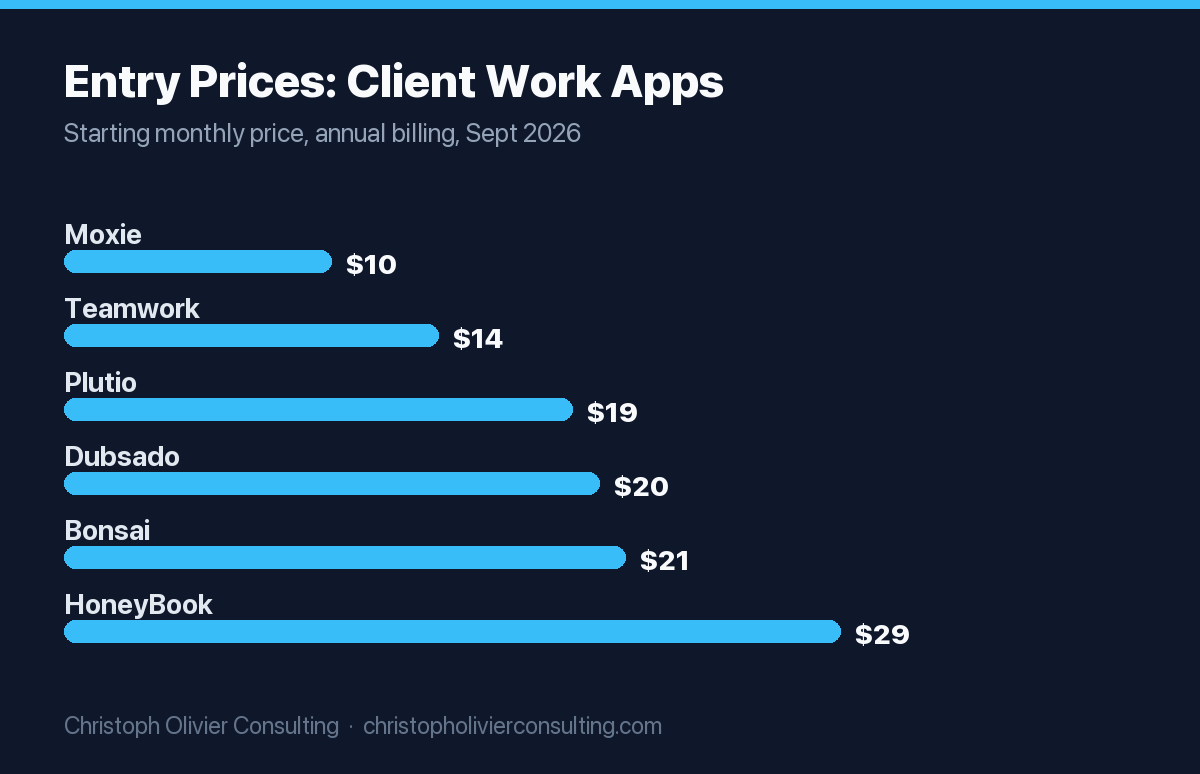
Entry prices for client work apps sit mostly between $10 and $30 per month per user on annual billing, with cheaper tools covering the full freelance lifecycle and pricier tools adding polish and automation depth. The figures below are starting-tier prices found in September 2026 recon; monthly billing runs higher, and several tools raise prices over time, so treat these as a planning baseline.
| App | Entry price (annual billing) | Free tier |
|---|---|---|
| Moxie | ~$10 / month | Trial |
| Teamwork | ~$14 / month per user | Free forever (limited) |
| Plutio | ~$19 / month | Trial |
| Dubsado | ~$20 / month | 3-client cap (not truly free) |
| Bonsai | ~$21 / month | Trial |
| HoneyBook | ~$29 / month | Trial |
Price alone is a weak signal. A $10 tool you fully use beats a $29 tool you half configure. Weigh the entry fee against how many separate subscriptions the app lets you cancel: if it replaces a separate invoicing tool and a separate scheduling tool, the real cost is lower than the sticker.
How to choose a client management app
Choose a client management app by mapping your actual delivery steps first, then matching a tool to that map rather than to a feature list. The goal is fewer apps and fewer handoffs, not the longest checklist. Work through these steps in order.
- Write down your real client journey, from first yes to final payment, as five to eight concrete steps.
- Mark which steps currently live in email, spreadsheets, or your head. Those are the gaps a single app should close.
- Decide whether clients need a portal to see progress and pay, or whether email updates are enough for your market.
- Shortlist two apps whose built-in workflow already resembles your journey, using the fit table above.
- Run one real, small project through each during a trial. Judge speed of daily use, not the demo.
- Check the mobile app does the three things you do most on the go, before you pay for the year.
- Confirm the app either sends invoices itself or connects cleanly to your billing, so paid work does not stall.
Most switching regret comes from choosing on features instead of fit. An app that matches your sequence gets adopted; one that forces a new sequence gets abandoned inside a quarter.
Client management app vs client database software
A client management app runs the work; client database software stores the records. The app answers “what is happening on this project and what does the client owe,” while a database answers “who are our clients, how are they segmented, and what is each one worth.” Service businesses usually need both, but they solve different problems and should not be confused at buying time.
If you find yourself wanting custom fields, list segments, lifecycle stages, and reporting across your whole client base, that is a records and pipeline job. Sort that with a deliberate CRM strategy before layering a work app on top. Buy the workflow app to run jobs, and keep the system of record separate and clean, so neither tool is asked to do the other’s job badly.
Mobile: managing client work on the go
The mobile app is where a client management app is won or lost for service businesses, because most owners approve work, reply to clients, and check deadlines away from a desk. A strong mobile app lets you read and answer client messages, update or complete a task, log time, and see what is due today, all without opening a laptop.
Before you commit to an annual plan, install the iOS or Android app and run your three most frequent actions through it. Many tools that look complete on desktop lose invoicing, file review, or portal access on phone. Teamwork, Zoho Projects, and HubSpot ship full-featured mobile apps; several freelance-focused tools are lighter on phone, which is fine if your on-the-go needs are just messaging and task updates. Match the mobile depth to how you actually work between meetings.
Making the app earn its keep
A client management app pays back when its automation removes repetitive admin, not when it simply stores your projects. Auto-sent intake forms, reminder sequences, recurring invoices, and status updates to the portal are where hours come back. The tool is a platform; the returns come from the workflows you build on it.
That is the work I do with clients as a fractional CMO: mapping the client journey, then wiring the app so follow-ups, reminders, and billing run without a human touching them. If you want that built for you, see how I approach business automation and the broader fractional CMO services I offer. And because buyers increasingly find tools through AI answers, it is worth understanding how to rank on AI so your own service shows up when clients ask an engine for recommendations.
Frequently asked questions
What is the difference between a client management app and a CRM?
A client management app runs the delivery side of client work: projects, tasks, messages, files, and invoices from kickoff to payment. A CRM focuses on the sales pipeline and the records of who your clients are and where deals stand. Service businesses often use both, with the app running active jobs and the CRM holding the system of record.
What is the cheapest client management app for a solo service business?
In September 2026 recon, Moxie starts around $10 per month on annual billing and still covers the full freelance lifecycle, including proposals, contracts, time tracking, and invoicing. Teamwork offers a limited free-forever tier at roughly $14 per month for its first paid plan. Confirm current pricing before you buy, since these tools change plans regularly.
Do client management apps include a client portal?
Many do. A client portal lets clients see project progress, review files, approve work, read updates, and pay invoices in one branded space instead of long email chains. Moxie, HoneyBook, Bonsai, Plutio, and Teamwork offer portals, while some intake-heavy tools are lighter here. If your clients expect self-serve visibility, treat the portal as a must-have when shortlisting.
Which client management app is best for creative studios?
Creative studios that book projects, such as photographers, event planners, and designers, tend to fit HoneyBook well. It combines styled proposals, contracts, and payment in one interactive smart file, which suits booking-based work. Studios that need deeper questionnaires and onboarding automation sometimes prefer Dubsado. Run a real project through a trial before committing to a year.
Can I manage clients from my phone?
Yes, most client management apps ship iOS and Android apps, but depth varies. Strong mobile apps let you answer client messages, update tasks, log time, and see deadlines away from a desk. Some tools lose invoicing, file review, or portal features on phone. Before paying annually, install the app and test your three most frequent actions on it.
How much should a service business budget for a client management app?
Most solo and small-team service businesses land between $10 and $30 per month per user on annual billing. The better question is how many separate subscriptions the app replaces. A tool that absorbs your invoicing, scheduling, and proposals can cost less overall than a cheaper app that leaves those as extra paid services.
More marketing guides for rank on ai: get cited by ai search
- Customer Relationships: Stages, Strategy, and How to Build Them
- How to Create Instagram Stories Ads: A Step-by-Step Guide
- How to Rank Higher on Google: A Prioritized 2026 Playbook
- The Best HubSpot Alternatives in 2026 (by Use Case)
- 20 Personal Brand Statement Examples (and How to Write Yours)
- Sales Representative Job Description (Template + Skills)
- Rank on AI: Get Cited by AI Search