
Last reviewed: October 2026
The best email marketing ideas are tied to one goal each: welcome new subscribers, nurture them with useful content, promote an offer, win back quiet readers, keep clients, or earn referrals and reviews. Below are 46 ideas grouped by those goals, each with a sample subject line and the reason it works, plus a 30-day calendar and the sender rules you must meet first.
Most idea lists stop at “send a newsletter.” This page is built for owners and marketing leads at service businesses and professional firms who need a plan they can run next month. Pick the goal that matters most, choose three or four ideas from that section, and slot them into the calendar.
How to choose the right email marketing ideas
Choose email marketing ideas by matching them to a single business goal and to where the reader is in their relationship with you. A new subscriber needs orientation, a long-time reader needs fresh value, and a past client needs a reason to come back. An idea with no goal attached is just content, and it rarely gets measured.
Use this quick filter before you write anything:
- Name the goal. Booked calls, repeat purchases, referrals, reviews, or event signups. One per email.
- Name the segment. New subscribers, active prospects, current clients, past clients, or inactive readers.
- Decide automated or scheduled. Anything triggered by a behavior (a signup, a purchase, a missed renewal) should be automated once and left running.
- Write one call to action. If you cannot say what the reader should do next in one sentence, the idea is not ready.
- Pick the metric. Clicks and replies tell you more than opens, which privacy features now inflate.
The automated versus scheduled decision matters more than most teams expect. In Omnisend’s 2026 Ecommerce Marketing Report, based on 27 billion emails sent by 150,000 brands in 2025, automations were just 2% of email sends but generated 30% of email-driven revenue, at $2.87 per send versus $0.18 for scheduled campaigns. That data is from ecommerce, so treat it as directional for service firms, but the pattern is consistent: triggered emails reach people at the moment they care. If you want a deeper primer on that category, start with our guide to triggered emails and when to use them.
Welcome email ideas for new subscribers
Welcome emails are the highest-attention moment in your list. Someone just raised their hand, so the first three to five emails should confirm the signup, set expectations, deliver what was promised, and start a two-way conversation. In Omnisend’s 2025 data, welcome and abandoned cart flows together drove 76% of all automation-generated orders.
| # | Idea | Example subject line | Why it works |
|---|---|---|---|
| 1 | Thank you and what to expect | You’re in. Here’s what lands in your inbox next | Sets frequency and topics, which lowers early unsubscribes and spam complaints. |
| 2 | Founder or firm story | Why we started doing this differently | Gives the reader a reason to trust a person, not a logo. |
| 3 | Best-of roundup | Our 5 most-read guides, in one place | Delivers instant value and shows the depth of what you publish. |
| 4 | One quick win | A 10-minute fix most owners skip | A small result early builds the habit of opening your emails. |
| 5 | The reply question | Quick question: what are you working on this quarter? | Replies teach you what to write and start a real two-way conversation. |
Spread these over one to two weeks rather than one day. We break down timing, length and sequence order in our full guide to building a welcome email sequence.
Newsletter ideas and nurture emails
Good newsletter ideas answer a question your readers already have, in less time than a search would take. Nurture emails work best when they follow a repeatable format the reader recognizes, such as one tip, one explainer, or one curated link with your take. A consistent format makes each issue fast to read and fast to produce.
| # | Idea | Example subject line | Why it works |
|---|---|---|---|
| 6 | Monthly digest | October: 3 changes worth knowing about | Low effort, predictable, and easy to skim. |
| 7 | Reader Q&A | “Should I hire or outsource this?” (a reader asked) | Real questions feel personal and show you listen. |
| 8 | Myth vs fact | The pricing myth that costs firms clients | Contrarian framing earns the open, and the correction earns trust. |
| 9 | Behind the process | How we scope a project before quoting | Demystifies your service and pre-answers sales objections. |
| 10 | Rule or market change explainer | What the new rule means for you (plain English) | Timely, high-utility, and hard for generic content to match. |
| 11 | Curated links with commentary | 3 things I read this week, and what I’d do | Your opinion is the value, not the links. |
| 12 | Checklist or template | Steal our year-end planning checklist | A downloadable tool gets saved, forwarded and remembered. |
| 13 | Anonymized lesson from real work | What one stalled project taught us about scope | Story plus lesson, without client names, shows expertise safely. |
A newsletter is a commitment, not a campaign. Before you launch one, decide its cadence, format and owner. Our email newsletter strategy guide walks through those decisions, and if you would rather drip education automatically, these email drip campaign examples show how firms sequence it.
Promotional email marketing campaign ideas
Promotional email marketing campaign ideas work when the offer is specific, the reason for sending now is real, and the email goes to the segment most likely to care. Discounts are only one option. For service firms, capacity windows, packages, early access and genuine deadlines usually perform better and protect your pricing.
| # | Idea | Example subject line | Why it works |
|---|---|---|---|
| 14 | New service launch | New: a fixed-fee version of our audit | News is a natural reason to email, and existing readers are the warmest buyers. |
| 15 | Real capacity window | We’re opening 4 onboarding slots for January | True scarcity is honest urgency. Only use it if the limit is real. |
| 16 | Package or bundle | The setup + 90-day support package | Makes buying simpler by removing decisions. |
| 17 | Subscriber early access | Before we announce it publicly | Rewards the list and makes being subscribed feel worth it. |
| 18 | Seasonal or deadline offer | Book before the year-end rush | Ties the offer to a date the reader already has in mind. |
| 19 | Price change notice | Our rates change on February 1 | Transparent and fair, and it gives fence-sitters a clear reason to act. |
Keep promotions to a minority of your sends. A list that only hears from you when you want money learns to ignore you. A simple rule many teams use is several value emails for every promotional one, then adjust based on unsubscribes and replies.
Re-engagement and retention email ideas
Re-engagement emails ask inactive subscribers whether they still want your mail, while retention emails keep current clients informed and satisfied. Both protect revenue you already earned. Re-engagement also protects deliverability, because sending to people who never open can increase spam complaints, which mailbox providers watch closely.
Re-engagement ideas
| # | Idea | Example subject line | Why it works |
|---|---|---|---|
| 20 | Simple check-in | Still want these emails? | Direct and respectful. A yes click is a strong engagement signal. |
| 21 | Preference update | Want fewer emails? Pick what you get | Turns a likely unsubscribe into a lighter subscription. |
| 22 | Best of the year | The 5 issues readers saved most this year | Reminds quiet readers why they signed up. |
| 23 | What’s changed | A lot has changed since you last heard from us | Gives lapsed contacts a fresh reason to look again. |
| 24 | Sunset email | We’ll stop emailing you on Friday | Cleans the list and often prompts a final click from people who do care. |
Retention ideas for current clients
| # | Idea | Example subject line | Why it works |
|---|---|---|---|
| 25 | Next steps after signing | Your first 30 days with us | Reduces buyer’s remorse and support questions. |
| 26 | Client anniversary | One year in: a quick look back | Recognition plus a natural moment to plan what’s next. |
| 27 | Results or activity recap | Your quarter in review | Makes your work visible, which makes renewal an easier decision. |
| 28 | Renewal reminder | Your plan renews on March 1 | No surprises, fewer disputes, more time to upsell. |
| 29 | Get more from the service | 3 things clients often forget they can ask us for | Increases usage and surfaces add-on needs. |
Most of these can be automated off dates already in your CRM: sign date, renewal date, last open, or last purchase.
Referral, review and event email ideas
Referral, review and event emails turn satisfied readers into visible proof and new pipeline. They work best right after a positive moment, such as a finished project, a compliment, or a strong result, and when the ask is small and specific. One clear request with one link usually beats a long email with three asks.
Referrals and reviews
| # | Idea | Example subject line | Why it works |
|---|---|---|---|
| 30 | Review request after a milestone | Would you share how this went? | Timing the ask to a win makes a positive review more likely. |
| 31 | Referral ask | Know one owner who’d find this useful? | Narrow asks (“one owner”) are easier to act on than “anyone.” |
| 32 | Client spotlight (with permission) | How a local firm rebuilt its intake process | Social proof that also flatters the featured client. |
| 33 | Partner introduction | Meet the bookkeeper we send clients to | Adds value and tends to earn reciprocal referrals. |
| 34 | Referral thank-you | Thank you for sending Sarah our way | Rewards the behavior you want repeated. |
Events and webinars
| # | Idea | Example subject line | Why it works |
|---|---|---|---|
| 35 | Webinar or workshop invite | Live on the 14th: planning next year’s budget | A date and a topic give two reasons to register. |
| 36 | Reminder series | Starts in 1 hour (link inside) | Reminders often decide whether registrants actually show up. |
| 37 | Replay and slides | Missed it? The replay and slides | Reaches the many who register but cannot attend live. |
| 38 | Open office hours | Bring your questions: open office hours Thursday | Low-commitment access to an expert often turns into booked calls. |
Email ideas for small business and professional services firms
The best email ideas for small business and professional services firms are built around the deadlines, rules and decisions your clients face. Accountants, attorneys, consultants and home-service owners all have calendar moments when clients need guidance. Emailing ahead of those moments positions you as the advisor, not the vendor.
| # | Idea | Example subject line | Why it works |
|---|---|---|---|
| 39 | Deadline reminder | 3 weeks until the filing deadline: your checklist | Useful, timely, and directly tied to work you sell. |
| 40 | Regulatory or policy update | The rule change affecting contractors this year | Shows you track what clients don’t have time to. |
| 41 | Quarterly planning checklist | Q1 planning: 7 questions to answer now | Positions you inside the client’s planning cycle. |
| 42 | Client-only briefing | For clients: what we’re seeing this quarter | Exclusivity rewards clients and supports retention. |
| 43 | Pricing and scope FAQ | What our engagements actually include | Answers the questions prospects hesitate to ask on a call. |
| 44 | Meet the team | Who answers when you call us | Puts faces to the firm, which matters in trust-based services. |
| 45 | “Signs it’s time” diagnostic | 5 signs you’ve outgrown doing your own books | Helps readers self-qualify, so the leads you get are ready. |
| 46 | Year-end review invite | Book your year-end review before December fills up | A recurring, expected touchpoint that drives booked meetings. |
In my experience, firms get the most from this group when one person owns the deadline calendar and the emails are drafted a month ahead. The ideas are simple. The discipline of sending them on time is what most firms lack.
Email marketing benchmarks: what results to expect
Recent benchmarks put average open rates around 36% to 43% and click rates around 2% to 2.6%, depending on the platform and the year measured. Open rates are inflated by Apple’s Mail Privacy Protection, so judge your email ideas mainly on clicks, replies and booked calls rather than opens.
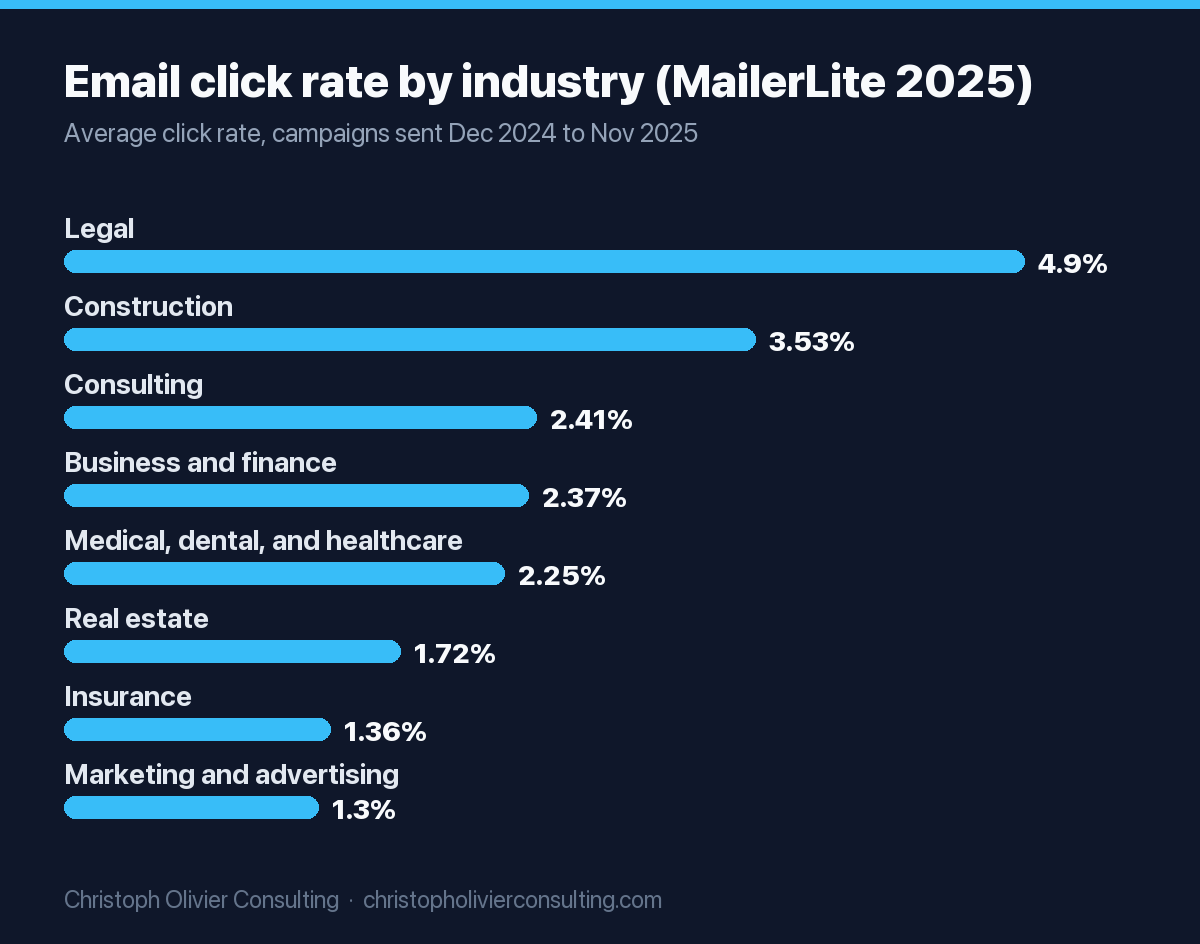
MailerLite’s 2025 benchmarks, covering more than 3.6 million campaigns from 181,000 accounts between December 2024 and November 2025, report a 43.46% average open rate, 2.09% click rate, 6.81% click-to-open rate and 0.22% unsubscribe rate. The unsubscribe rate was 0.08% the year before, a jump MailerLite links to easier one-click unsubscribes. Mailchimp’s benchmarks, last updated December 2023 and limited to campaigns sent to 1,000 or more subscribers, show a 35.63% open rate and 2.62% click rate across all users, with Mailchimp itself warning that Mail Privacy Protection can affect open-rate accuracy.
| Industry (MailerLite 2025) | Open rate | Click rate |
|---|---|---|
| Legal | 42.58% | 4.90% |
| Construction | 39.95% | 3.53% |
| Consulting | 45.96% | 2.41% |
| Business and finance | 43.34% | 2.37% |
| Medical, dental, and healthcare | 43.75% | 2.25% |
| Real estate | 40.37% | 1.72% |
| Insurance | 44.40% | 1.36% |
| Marketing and advertising | 37.23% | 1.30% |
| e-commerce | 32.67% | 1.07% |
Two caveats. First, platform averages mix tiny lists with large ones and are not a target, only a sanity check. Second, the comparison that matters is your own list over time. MailerLite also found that emails sent between 3 PM and 7 PM got the most opens in its data, which is worth testing but not worth treating as a rule. For a fuller breakdown of what good looks like by metric, see our email marketing benchmarks page.
A 30-day email marketing calendar you can copy
A 30-day email calendar turns a list of ideas into a schedule. The template below assumes a service business sending two scheduled emails a week, with welcome and retention automations running in the background. It balances value, proof and offers so the single promotional send has earned attention by the time it lands.
| Day | Idea # | Goal | Segment | |
|---|---|---|---|---|
| Ongoing | Welcome series (5 emails over 10 days) | 1 to 5 | Orientation, trust | New subscribers |
| Day 2 | Monthly digest | 6 | Nurture | Full list |
| Day 5 | Rule or market change explainer | 10 | Authority | Full list |
| Day 9 | Reader Q&A | 7 | Engagement, replies | Full list |
| Day 12 | Webinar invite | 35 | Event signups | Prospects and clients |
| Day 16 | Checklist or template | 12 | Lead capture, saves | Full list |
| Day 19 | Webinar reminder, then replay | 36, 37 | Attendance | Registrants |
| Day 23 | Client spotlight (with permission) | 32 | Social proof | Prospects |
| Day 26 | Real capacity window offer | 15 | Booked calls | Engaged prospects |
| Day 28 | Review request | 30 | Reviews | Recently finished clients |
| Day 30 | “Still want these?” check-in | 20 | List hygiene | No opens or clicks in 6+ months |
To run it, follow the same order each month:
- In week four of the prior month, pick the one offer and one event for next month.
- Choose value emails that lead naturally toward that offer.
- Draft everything in one sitting and schedule it.
- Review clicks, replies, unsubscribes and booked calls on day 30.
- Keep the two best formats, replace the weakest, and repeat.
Deliverability and compliance rules to check before you send
Before any of these ideas can work, your email has to reach the inbox and comply with the law. Gmail and Yahoo require authentication and low spam complaint rates, bulk senders must offer one-click unsubscribe, and US commercial email must follow the CAN-SPAM Act. Missing these basics can sink a good campaign before anyone reads it.
According to Google’s email sender guidelines, effective February 1, 2024, all senders to personal Gmail accounts need SPF or DKIM, valid forward and reverse DNS, a TLS connection, and spam rates in Postmaster Tools below 0.3%. Senders of 5,000 or more messages a day to Gmail must also set up SPF, DKIM and DMARC (a policy of none is acceptable), align the From domain, and support one-click unsubscribe plus a visible unsubscribe link. Yahoo’s sender best practices set the same 0.3% spam rate ceiling and require bulk senders to honor unsubscribes within 2 days.
The FTC’s CAN-SPAM compliance guide adds the legal floor: accurate header information, subject lines that reflect the content, a valid physical postal address, a clear way to opt out, and opt-outs honored within 10 business days. Each violating email can carry penalties of up to $53,088.
- Authenticate: SPF, DKIM and DMARC on your sending domain, set up through your email platform.
- Watch complaints: register in Google Postmaster Tools and keep the spam rate well under 0.3%.
- Make leaving easy: one-click unsubscribe in the header and a visible link in the footer.
- Stay honest: no fake “Re:” or “Fwd:” subject lines, and no urgency you cannot back up.
- Prune quietly: run the re-engagement and sunset ideas above at least twice a year.
If you want a second set of eyes on which of these ideas fit your list, your offers and your capacity, you can book a consultation and we can map out your next 90 days of email together.
Frequently asked questions
What are some good email marketing ideas?
Good email marketing ideas are tied to one goal each. Strong options include a welcome series that sets expectations, a monthly digest, a plain-English explainer on a rule change, a downloadable checklist, a webinar invite, a review request after a project milestone, a referral ask, and a re-engagement email that asks inactive readers whether they still want your mail.
How often should a small business send marketing emails?
Most small businesses do well with one to two scheduled emails a week, plus automated emails such as a welcome series and renewal reminders running in the background. The right cadence is the one you can sustain with useful content. Watch unsubscribes and spam complaints after each send, and slow down if either climbs.
What should I put in a business newsletter?
Pick a repeatable format readers recognize: one useful tip, one explainer on a change affecting your clients, a short reader question with your answer, or a few curated links with your take. Add one clear call to action, such as booking a call or downloading a checklist. Keep promotions to a small share of issues.
What is a good open rate for email marketing in 2026?
MailerLite's 2025 benchmarks report a 43.46% average open rate and a 2.09% click rate, while Mailchimp's benchmarks, last updated December 2023, show 35.63% and 2.62%. Apple's Mail Privacy Protection inflates opens, so compare your own list over time and judge results mainly on clicks, replies and booked calls.
How do I re-engage inactive email subscribers?
Segment people with no opens or clicks in roughly six months, then send a short sequence: a direct check-in asking if they still want your emails, a preference option for fewer emails, a best-of roundup, and finally a sunset email saying you will stop mailing them. Remove anyone who does not respond to protect deliverability.
Do I need one-click unsubscribe in my marketing emails?
If you send 5,000 or more messages a day to Gmail or Yahoo users, yes. Both providers require one-click unsubscribe for marketing mail plus a visible unsubscribe link, and Yahoo asks bulk senders to honor unsubscribes within 2 days. Smaller senders still need a clear opt-out under CAN-SPAM, honored within 10 business days.
More Funnels & Email guides
- Welcome Email Sequence: The 5-Email Series You Can Copy
- Email Newsletter Strategy: How to Grow an Audience and Pipeline
- Conversion Funnel Optimization Audit
- Landing Pages That Convert: 11 Patterns
- Product Funnel: How to Sequence Your Offers From Lead Magnet to Premium
- Abandoned Cart Email: The 3-Email Sequence That Recovers Revenue
- All Funnels & Email guides →