
Last reviewed: October 2026
Direct mail marketing best practices come down to five decisions made in order: mail the right list, make one clear offer, pick the format that fits the job, give every piece a trackable response path, and test one variable at a time. Get the list and the offer right and design matters less; get them wrong and no design will save the campaign.
This guide is written for owners and marketing leads at service businesses and professional firms. It uses current USPS prices and rules (checked October 2026), a format and cost comparison table, a tracking setup, a testing plan and a break-even worked example, so you can plan a direct mail campaign that pays for itself before you print a single piece.
Direct mail marketing best practices at a glance
The core direct mail marketing best practices are: mail a clean, targeted list, lead with a single offer, choose the cheapest format that can carry your message, put a trackable call to action on every piece, follow up across channels, and test before you scale. Each rule below links to a section with the detail and the numbers.
- Define one goal and one audience. Booked consultations from homeowners in three ZIP codes is a goal.
- Start with your house list. Past clients and warm prospects usually respond better than strangers, so mail them first.
- Clean the list before every drop. Run it through a USPS-approved change-of-address process and remove duplicates and opt-outs.
- Match the list method to the job. Use Every Door Direct Mail for saturation in a neighborhood, a targeted list for specific people.
- Make one offer. A specific, time-bound reason to respond beats a list of services.
- Choose format by message, not by habit. Postcards for simple offers, letters for considered decisions, dimensional mail for a short list of high-value targets.
- Write a headline that names the reader’s problem.
- Give every piece a unique response path. A QR code, a short URL, a dedicated phone number or a promo code.
- Plan the follow-up before the mail drops. Email, retargeting ads and a second mailing lift results more often than a single drop.
- Test one variable at a time, with a holdout group so you can measure true lift.
- Do the break-even math first. Know how many clients you need to cover the cost before you approve the print run.
- Stay compliant. Bill-like mailers need a federal disclaimer, discounted postage needs Move Update compliance, and regulated professions have their own advertising rules.
Start with the list: who gets the piece
The mailing list is the single biggest driver of direct mail results. Mail your house list first (past clients, current clients, inquiries that did not convert), then add prospect lists that match the profile of your best clients. A brilliant postcard sent to the wrong households will lose money every time.
Think of lists in three tiers:
- House list. People who already know you. Use it for reactivation, cross-sell and referrals.
- Targeted prospect list. Names and addresses bought or rented from a list broker, filtered by attributes such as home value, business type, revenue band or recent move. Good for professional services where the buyer is a specific person.
- Saturation (EDDM). Every address on a postal carrier route, no names required. Good for local consumer services where nearly every household is a possible buyer.
Keep the list clean
List hygiene saves postage and protects deliverability. If you claim presorted or automation First-Class Mail prices or USPS Marketing Mail prices, USPS requires you to update addresses within 95 days before the mailing date using an approved method such as NCOALink, Address Change Service (ACS) or ancillary service endorsements. Most mail houses and print vendors run NCOALink for you; ask for the processing report. Also remove duplicates, deceased records and anyone who asked not to be mailed.
EDDM vs targeted lists: which direct mail campaign type fits
Use Every Door Direct Mail when your buyers are concentrated in specific neighborhoods and nearly every household could need you. Use a targeted list when your buyer is a specific person or business, such as a business owner or a recent home buyer. EDDM is cheaper per piece; targeted lists waste fewer pieces.
USPS describes two EDDM options on its Every Door Direct Mail page. EDDM Retail needs no permit, is limited to between 200 and 5,000 pieces per day per ZIP Code, and costs $0.26 per piece. EDDM BMEU requires a bulk mailing permit, has no volume cap and is listed at “as low as $0.259” per piece. Both use flat-size pieces up to 3.3 ounces, and you can filter routes by Census-based age, income and household size.
| Factor | EDDM Retail | EDDM BMEU | Targeted (named) list |
|---|---|---|---|
| Who receives it | Every address on chosen carrier routes | Every address on chosen carrier routes | Only the names you select |
| Permit needed | No | Yes, bulk mailing permit | Yes for presort prices (or use a mail house) |
| Volume limit | 200 to 5,000 per day per ZIP Code | None stated | None |
| Postage (USPS, Oct 2026) | $0.26 per piece | As low as $0.259 per piece | Varies by class, shape and sort level (see cost table) |
| Personalization | None (addressed to “Postal Customer”) | None | Full: name, offer, PURL, variable copy |
| Best for | Small local drops, testing a neighborhood | Larger saturation campaigns | Professional services, B2B, reactivation |
For a law firm, an accounting practice or a B2B service, a targeted list is usually the better fit because the buyer is a defined person. The playbook for direct mail marketing for accounting firms shows how that works when the audience is business owners and households with specific tax needs.
Choose the format: postcard vs letter vs dimensional mail
Choose the simplest format that can carry your message. Postcards suit a single, easy offer because there is no envelope to open. Letters suit considered purchases that need explanation, proof and a personal tone. Dimensional mail (boxes, lumpy envelopes, kits) suits a short list of high-value targets where one reply can justify a high cost per piece.
Postcards
Postcards need no opening, which makes them strong for local offers, event invites and review requests. To qualify for First-Class postcard prices, USPS standards in its Quick Service Guide 201a require a card between 3.5 and 4.25 inches high, 5 and 6 inches long, and 0.007 to 0.016 inch thick. Go larger and you pay letter or flat prices. Oversized “jumbo” postcards are often mailed as Marketing Mail flats, including through EDDM.
Letters
A letter looks personal and gives you room to explain. It works for professional services and high-ticket offers that need proof. The tradeoff is that the envelope must be opened, so the outer envelope (a real return address, a stamp or a short teaser line) matters.
Dimensional mail
Dimensional pieces have bulk or an object inside. They cost far more to produce and mail, so reserve them for account-based campaigns to a few dozen or a few hundred decision makers where one new client is worth thousands. USPS also runs a Tactile, Sensory and Interactive promotion that discounts qualifying commercial mail with special textures, finishes or interactive elements.
What direct mail costs in 2026
Postage is the one cost you can check exactly. As of the USPS Notice 123 price list fetched in October 2026, EDDM Retail is $0.26 per piece, an automation 5-digit Marketing Mail letter is $0.395, a presorted automation First-Class postcard is $0.453, and a stamped one-ounce First-Class letter is $0.82. Printing, design, list rental and mail-house fees come on top.
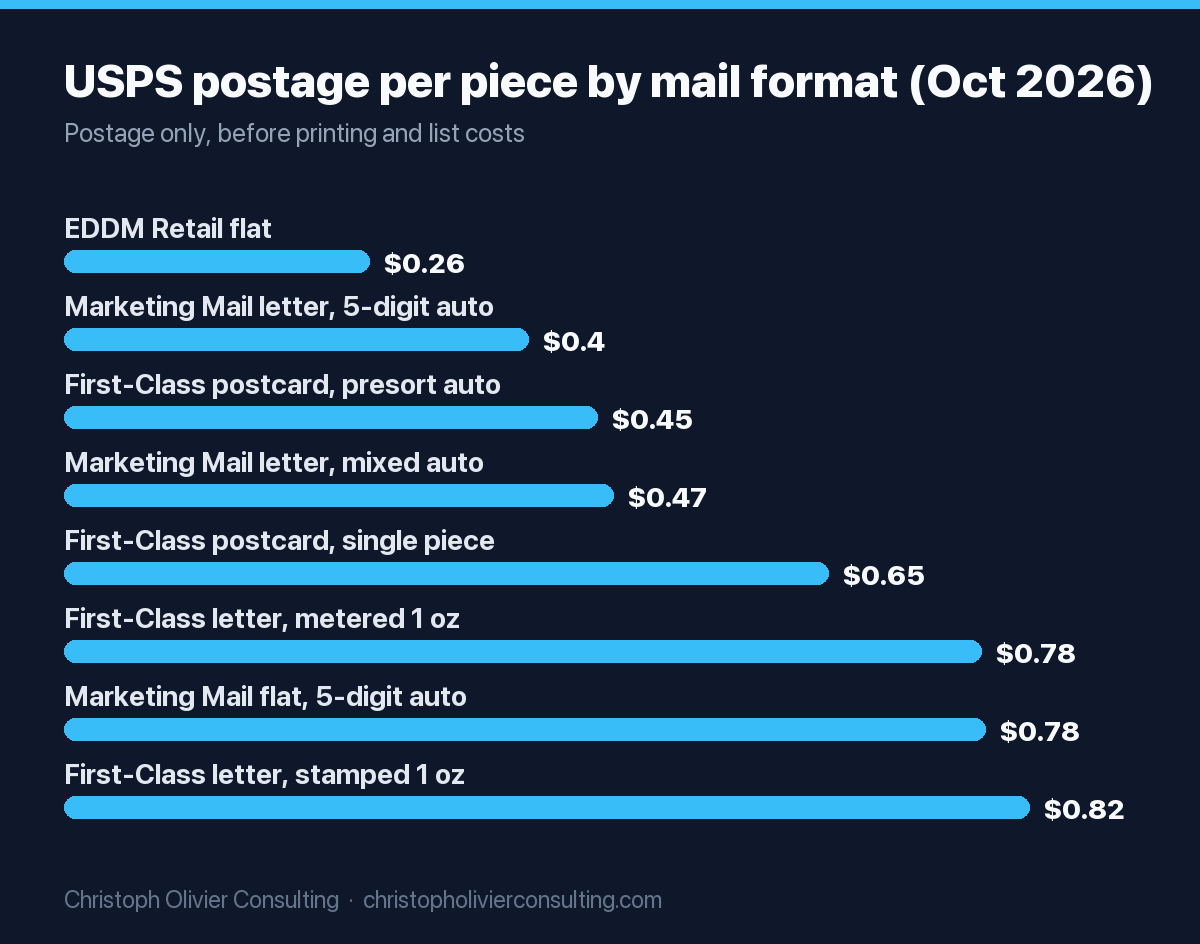
All postage figures below come from USPS Notice 123. Marketing Mail is cheaper but slower and needs a permit and minimum volumes; First-Class is faster, is forwarded and returned, and is the default for smaller or time-sensitive mailings.
| Format and class | USPS postage per piece | Typical use case | Watch out for |
|---|---|---|---|
| EDDM Retail flat (up to 3.3 oz) | $0.260 | Neighborhood saturation, local services | No names, no personalization, 5,000 per day per ZIP cap |
| Marketing Mail letter, automation 5-digit | $0.395 | Targeted letters at volume | Permit, minimum volume, Move Update, slower delivery |
| Marketing Mail letter, automation mixed | $0.467 | Targeted letters to a spread-out list | Less sorting density means higher price |
| First-Class postcard, presort automation | $0.453 | Reminders, reactivation, review requests | Must stay within postcard dimensions |
| First-Class postcard, single piece | $0.65 | Small runs mailed with stamps | Highest per-card cost |
| First-Class letter, metered 1 oz | $0.78 | Personal letters to prospects and clients | Envelope must earn the open |
| First-Class letter, stamped 1 oz | $0.82 | Hand-addressed, high-touch letters | Labor time for small batches |
| Marketing Mail flat, automation 5-digit | $0.783 | Brochures, catalogs, larger self-mailers | Costs climb fast at mixed sort levels ($1.260) |
USPS promotions that cut postage
The 2026 USPS Mailing Promotions technical guide lists a 5% postage discount for Integrated Technology (for example, mail that links to digital content), a 5% discount for Tactile, Sensory and Interactive mail from January 1 to June 30, a 5% Continuous Contact discount from April 1 to December 31, and a 5% First-Class Mail Advertising discount from September 1 to December 31. A Sustainability add-on gives a further 1%. Promotions apply to qualifying commercial mailings and require registration, so ask your mail house which ones your job can claim.
Offer, copy and design that get a response
The offer does most of the work. A strong direct mail piece makes one specific, believable, time-bound offer to one audience, explains the benefit in the reader’s words, and tells them exactly what to do next. Design exists to get that offer read in a few seconds, not to win awards.
Build the offer
- Specific. “Free 20-minute retirement tax review” beats “Contact us for tax help.”
- Low friction. For professional services, the first step should feel small: a checklist, an assessment, a short call.
- Time-bound. A real deadline gives people a reason to act now. Never invent fake scarcity.
Write the copy
- Lead with a headline that names the reader’s problem or outcome, not your firm’s name.
- Use short sentences, plain words and benefits before features.
- Add one proof point you can verify, such as credentials or years in practice.
- Repeat the call to action at least twice on a letter and once prominently on a postcard.
- On letters, use a P.S. line. Many readers skim to the end before deciding to read the body.
Design for a three-second scan
- One dominant visual and one dominant headline. Clutter kills response.
- High contrast, legible type, and enough white space around the call to action.
- Put the QR code and phone number where the eye lands last, next to the offer.
Direct mail campaign tracking: QR codes, PURLs and call tracking
Track a direct mail campaign by giving every piece, or every version, a response path you can count: a unique QR code, a personalized or campaign-specific URL, a dedicated call-tracking number or a promo code. Then compare responses against a holdout group that did not get the mail, because some of those people would have contacted you anyway.
- QR codes. Point to a dedicated landing page with UTM parameters, never your home page.
- PURLs and short URLs. A personalized URL (yourfirm.com/jsmith) identifies the individual responder. A short campaign URL is simpler and still separates mail traffic from other sources.
- Call tracking. A unique number per version or per list tells you which piece made the phone ring. For many service firms, calls are the main response.
- Matchback. After 60 to 90 days, match new clients against the mailing file. This catches people who responded without using the tracked path.
Add Informed Delivery
USPS Informed Delivery sends subscribers a daily email preview of their incoming mail. Businesses can run Informed Delivery campaigns that add a clickable “ride-along” image and link to that preview. USPS reports a 63.4% average daily open rate for Informed Delivery notifications and 37.4 billion campaign impressions in the past year. It can also help you qualify for the Integrated Technology discount.
Integrate direct mail with digital retargeting and follow-up
Direct mail works best as one touch in a short, planned sequence. Mail creates attention; email, retargeting ads, a second mailing and a phone call for high-value prospects convert that attention into booked meetings. Plan the sequence, the dates and the messages before the first piece drops, not after responses come in.
A simple 30-day sequence for a targeted list:
- Day 0: Upload the mailing list to your ad platforms as a customer match audience (where match rates allow) and start a light retargeting campaign with the same offer and visuals.
- Day 1 to 5: Mail drops. Informed Delivery preview reaches subscribers on delivery day.
- Day 7: Email to anyone on the list you already have consent to email, referencing the mailer.
- Day 14: Second mailing to non-responders with a different headline, same offer.
- Day 21: Phone or LinkedIn follow-up for your top-tier prospects only.
- Day 30: Deadline reminder, then close the campaign and run the numbers.
Direct mail should sit inside your wider pipeline plan, not beside it. If you are building that plan from scratch, the guide to small business lead generation shows where mail fits next to referrals, search and email. Seasonal moments also help: a year-end mailer can carry one of the Christmas marketing campaign ideas as a client thank-you that doubles as a referral request.
Direct mail marketing tips for testing: a simple plan
Test direct mail by changing one variable at a time, mailing each version to a random slice of the same list, and keeping a holdout group that gets nothing. Test the list first, then the offer, the format and the creative, since that is usually the order of impact. Scale what wins on cost per client.
- Write the hypothesis. “A free assessment offer will beat a 10% discount on cost per booked call.”
- Split the list randomly. Use a random split, not “first half of the alphabet,” which can skew by geography or age.
- Keep a holdout. A slice that receives no mail shows the baseline you would have had anyway.
- Change one thing. List, offer, format or headline. Two changes at once tell you nothing about which mattered.
- Size the test honestly. Small cells produce noise. Run larger cells, or repeat a test before you trust it.
- Judge on cost per acquired client. A cheaper postcard with a lower response rate can still win.
Response rate benchmarks and break-even math
Treat published response-rate benchmarks as a rough range, not a target. Your own break-even point matters more: divide total campaign cost by the profit from one new client to find how many clients you need, then judge whether that is realistic for your list. House lists usually outperform prospect lists.
The benchmark most articles quote is the ANA Response Rate Report, which sits behind a membership paywall, so I could not verify it at the source. Public summaries also disagree. A Printing Impressions summary of the 2024 ANA report puts house-list response at 5% to 9% and prospect lists at 4% to 5%, while other secondary sources cite different prospect figures. For the numbers we have checked, see our roundup of direct mail statistics, and treat any single benchmark with caution.
Worked example: break-even for a 2,000-piece letter campaign
The numbers below are hypothetical, chosen to show the method. Replace them with your own quotes and client values.
- Pieces: 2,000 targeted letters, Marketing Mail automation 5-digit at $0.395 postage = $790.
- Printing, envelopes and mail-house fees (your quote): say $1,400.
- List rental (your quote): say $300.
- Total campaign cost: $2,490, or about $1.25 per piece.
- Gross profit from one new client in year one: say $1,800.
- Break-even: $2,490 divided by $1,800 = 1.4, so you need 2 new clients.
- If about one in four booked consultations becomes a client in your practice, you need roughly 8 consultations from 2,000 letters, a booking rate of 0.4%.
That last line is the useful one. A 0.4% booking rate from a well-chosen list is a modest bar; a requirement of 3% would tell you to fix the list, the offer or the economics before mailing. To work backwards from revenue goals to the number of leads and calls you need, use the method in how many leads do I need.
Direct mail compliance basics
Most direct mail compliance comes down to three things: never make a solicitation look like a bill without the required federal disclaimer, keep addresses current if you claim discounted postage, and follow any advertising rules specific to your profession. Truthful, substantiated claims and honoring do-not-mail requests cover most of the rest.
- Bill-like mailers. Under 39 U.S.C. 3001(d), a solicitation that looks like a bill, invoice or statement of account must carry a conspicuous notice that it “is a solicitation for the order of goods or services, or both, and not a bill, invoice, or statement of account due.”
- Move Update. Discounted First-Class presort and automation mail, and Marketing Mail, require address updating within 95 days, as covered above.
- Profession-specific rules. Lawyers, financial advisers, CPAs and health providers often face extra rules on targeted solicitation, testimonials and required disclosures. Check your state bar, regulator or compliance team before you mail, and keep a copy of every piece and its list source.
- Claims and offers. State only what you can prove, disclose offer terms and expiry dates clearly, and avoid promising outcomes.
- Opt-outs. Keep a suppression file and apply it to every list, including rented ones.
Direct mail rewards discipline more than creativity: a clean list, one clear offer, a tracked response path and honest break-even math. If you want a second pair of eyes on a campaign plan before you commit the print budget, you can book a consultation and we can walk through it together.
Frequently asked questions
What are the most important direct mail best practices?
Mail a clean, targeted list, make one specific and time-bound offer, choose the cheapest format that can carry your message, and give every piece a trackable response path such as a QR code, short URL or call-tracking number. Then follow up across email and ads, test one variable at a time, and judge results on cost per new client.
Is a postcard or a letter better for direct mail?
A postcard is better for simple offers because there is nothing to open, and First-Class presort automation postcards cost $0.453 in postage per USPS Notice 123. A letter is better for considered purchases such as professional services, where you need room for explanation and proof. Many firms test both on the same list before committing.
How much does Every Door Direct Mail cost in 2026?
USPS lists EDDM Retail postage at $0.26 per piece and EDDM BMEU at as low as $0.259 per piece, for flat-size pieces up to 3.3 ounces. EDDM Retail needs no permit but is limited to 200 to 5,000 pieces per day per ZIP Code. Printing and design costs are extra and vary by vendor.
What is a good response rate for a direct mail campaign?
There is no single reliable figure. The ANA benchmark most sites quote is paywalled, and public summaries disagree, though they agree house lists respond better than prospect lists. A more useful test is break-even: divide total campaign cost by the profit from one client to see how many clients, and how many responses, you need.
How do you track direct mail marketing results?
Give each piece or version a unique response path: a QR code to a dedicated landing page with UTM tags, a short or personalized URL, a call-tracking number or a promo code. Keep a holdout group that receives no mail to measure true lift, and match new clients against the mailing file after 60 to 90 days.
Do I need to clean my mailing list before every mailing?
If you claim presorted or automation First-Class Mail prices or USPS Marketing Mail prices, USPS requires you to update addresses within 95 days before the mailing date using an approved method such as NCOALink or Address Change Service. Even when not required, cleaning removes duplicates and bad addresses, which saves postage.
What are good direct mail marketing tips for professional service firms?
Use a targeted list rather than saturation mail, lead with a low-friction offer such as an assessment or checklist, send a personal letter rather than a flashy postcard to high-value prospects, and follow up by email and phone. Check your profession's advertising rules, such as state bar or regulator requirements, before you mail.
More Growth Consulting guides
- Press Release Distribution in 2026
- What Is Inbound Marketing? Modern Playbook
- Online Course Marketing: A Funnel-First Playbook
- Catering Business Marketing: The Channels That Actually Book Events
- Nonprofit Marketing: A Small-Budget Playbook That Wins Donors
- Water Damage Restoration Marketing: The 2026 Playbook for More Booked Jobs
- All Growth Consulting guides →