
Last reviewed: October 2026
A paid media agency plans, buys and optimizes the advertising you pay for across search, social, programmatic display, video and CTV, and retail or commerce media, then reports results against your revenue goals. Most charge a percentage of ad spend, a flat monthly retainer or a hybrid of both, and published market ranges for percentage fees run from about 10% to 30% of spend, falling as budgets grow. The right agency leaves you owning every ad account and shows media cost and its own fees as separate lines.
This guide is for owners, partners and marketing leads at service businesses who are deciding between a paid media agency, a freelancer, an in-house hire or a fractional lead. It covers what agencies do, verified price ranges, a worked cost example, red flags, a 90-day plan and a hiring scorecard.
If you would rather have an expert run your ads, see how CO Consulting manages paid advertising for service businesses.
What does a paid media agency do?
A paid media agency runs the advertising you pay for. It sets the strategy and budget split, builds campaigns, writes or produces ads, manages bids and audiences, tracks conversions and reports results. Unlike a single-channel shop, a paid media agency usually manages several platforms at once and decides where your next dollar should go.
The channels a full paid media team typically covers:
- Paid search: Google Ads and Microsoft Advertising, the core of most PPC management engagements.
- Paid social: Meta, LinkedIn, TikTok, YouTube and Reddit.
- Programmatic display and video: open-web impressions bought through demand-side platforms (DSPs).
- CTV and streaming audio: ads on connected TV apps and podcasts, bought programmatically or direct.
- Retail and commerce media: ads sold by retailers and marketplaces, mostly relevant if you sell products.
Around the media itself, a good agency also handles conversion tracking, landing page testing, creative production or briefs, audience and CRM data uploads, and a reporting cadence tied to pipeline rather than clicks. If you want the mechanics of how inventory is bought and priced, the media buying guide goes deeper.
Paid media management vs paid media agency services
“Paid media management” usually means the ongoing account work: bids, budgets, keywords, audiences, ad rotation and weekly optimization. “Paid media agency services” is the broader menu, which can add strategy, creative, landing pages, analytics and incrementality testing. Check which one each quote covers.
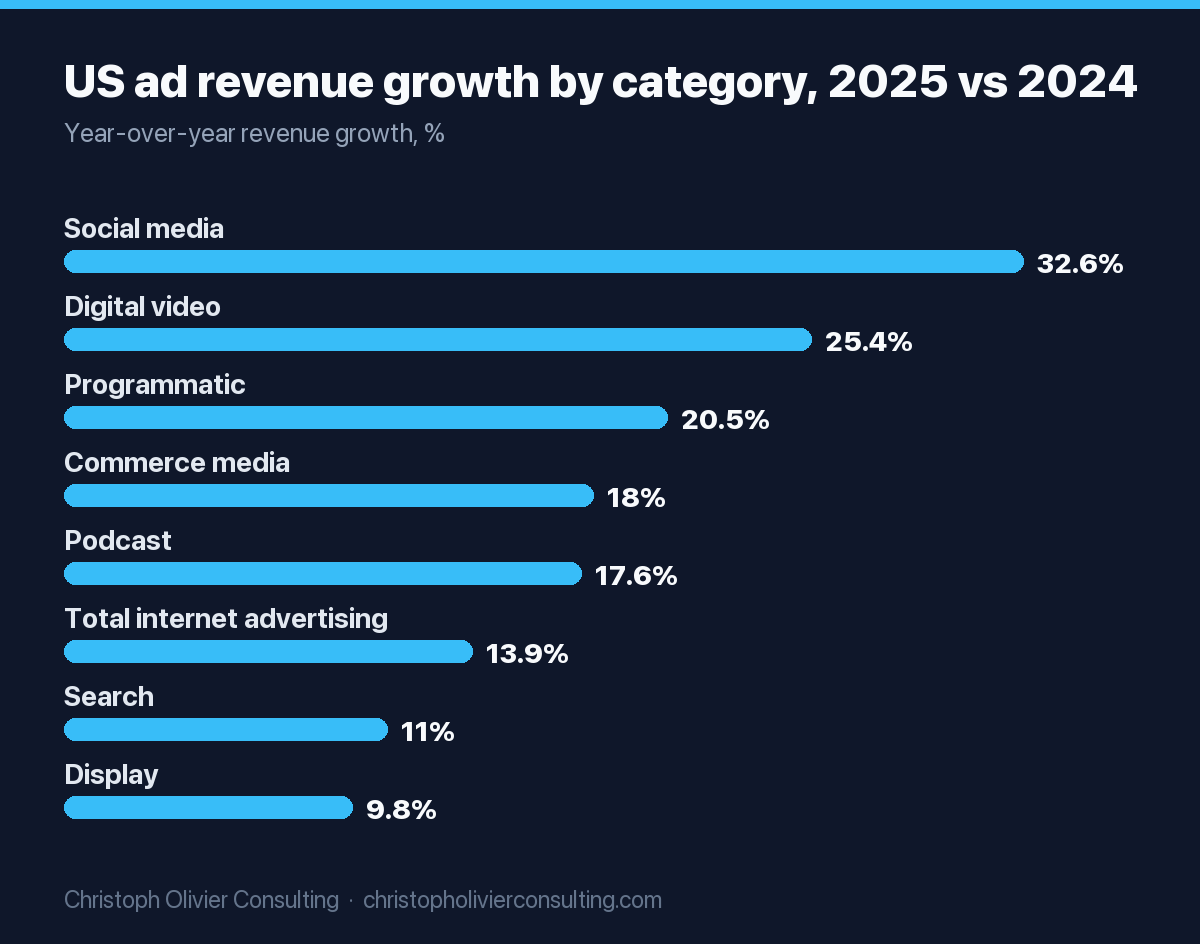
The channels also grow at very different speeds. In 2025, according to the IAB/PwC Internet Advertising Revenue Report, US social ad revenue rose 32.6% and digital video 25.4%, while search grew 11% and display 9.8%. An agency with depth in only one of those is working with part of the picture.
Where paid media budgets went in 2025
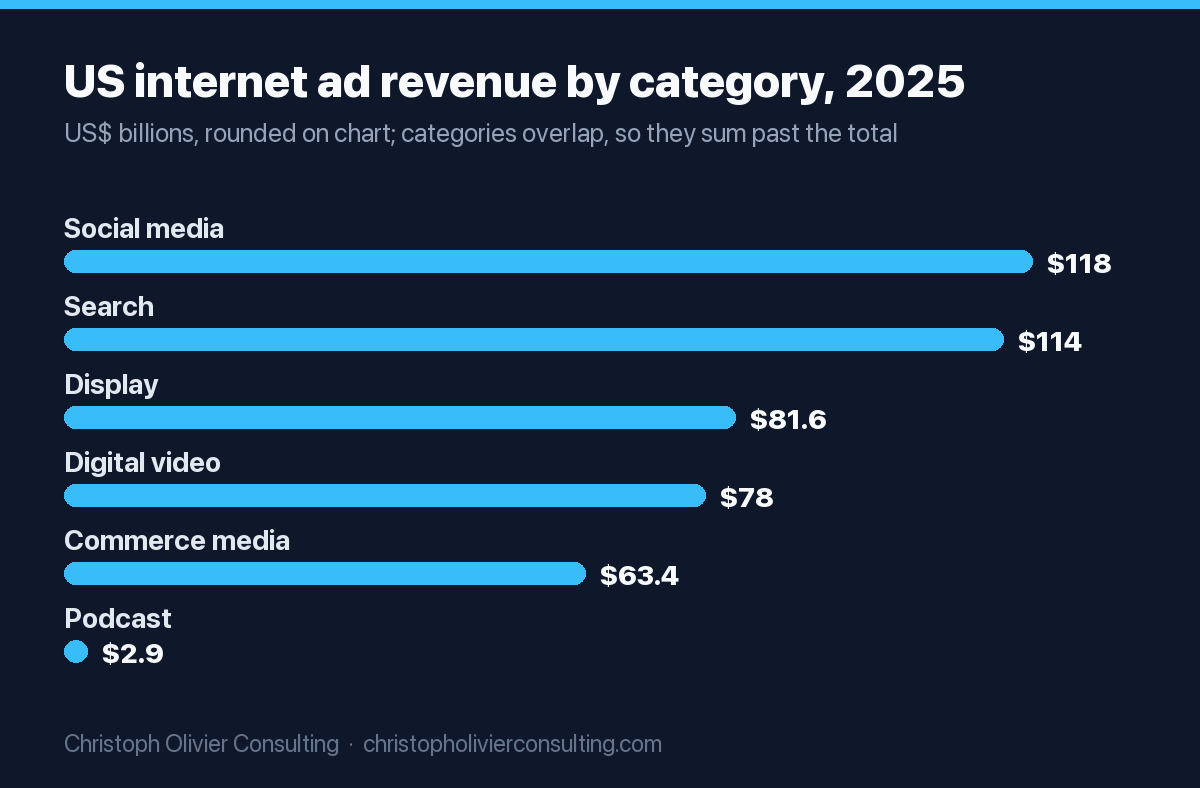
US internet advertising revenue reached $294.6 billion in 2025, up 13.9% year over year, according to the IAB/PwC report released April 16, 2026. Social ($117.7 billion) passed search ($114.2 billion) as the largest category, and programmatic transactions reached $162.4 billion. That mix is what a modern paid media agency is buying into.
| Category (US, 2025) | Revenue | Growth vs 2024 | Share of total |
|---|---|---|---|
| Social media | $117.7B | 32.6% | 40.0% |
| Search | $114.2B | 11.0% | 38.8% |
| Display | $81.6B | 9.8% | 27.7% |
| Digital video | $78.0B | 25.4% | 26.5% |
| Commerce media | $63.4B | 18.0% | 21.5% |
| Podcast | $2.9B | 17.6% | 1.0% |
| Programmatic (transaction method) | $162.4B | 20.5% | n/a |
| Total internet advertising | $294.6B | 13.9% | 100% |
Source: IAB/PwC Internet Advertising Revenue Report, Full Year 2025. The categories overlap (a social video ad can count in both social and video, and programmatic is a buying method rather than a channel), so the shares add up to more than 100%.
Two practical readings for a buyer:
- Programmatic is where fee and quality questions concentrate. More than half of internet ad revenue moved through programmatic pipes, which is why the transparency section below matters.
- Creator advertising is now its own line item. The same IAB release puts creator advertising at $37 billion in 2025 and projects $44 billion for 2026.
More channel data is in the US digital ad spend statistics roundup.
Paid media agency vs freelancer vs in-house vs fractional
You have four realistic ways to run paid media: hire an agency, contract a freelancer, build an in-house role, or bring in a fractional marketing lead who sets strategy and manages whoever executes. The right choice depends on budget, how many channels you need, and whether you have someone senior who can judge the work.
| Option | Typical cost basis | Best fit | Main strength | Main trade-off |
|---|---|---|---|---|
| Paid media agency | % of spend, flat retainer or hybrid (ranges below) | Multi-channel budgets that need a team: strategist, buyer, creative, analyst | Breadth of skills and tools, coverage when people are out | Your account can get junior attention; fees scale with spend |
| Freelancer | Hourly or monthly; 85% of PPC firms in Credo’s pricing survey charged $50 to $200 an hour | One or two channels, smaller budgets, a clear brief | Senior hands on the account, lower overhead | Single point of failure; limited creative and analytics depth |
| In-house hire | Salary plus benefits and tools; median pay for advertising and promotions managers was $133,660 in May 2025 (BLS) | Large, steady spend where institutional knowledge compounds | Full focus and fast iteration with sales | Hard to hire for every channel; one person rarely covers all of them |
| Fractional CMO or consultant | Monthly retainer scoped by time | Firms that need strategy, vendor selection and oversight more than hands-on buying | Independent judgment of agency work and spend | Still needs an executor (agency, freelancer or staff) |
When a specialist agency beats a full-service one
A specialist paid media agency tends to have deeper platform skills and sharper testing habits. A full-service marketing agency makes more sense when you also need brand, web and content from one vendor and value one point of accountability over channel depth.
How much does a paid media agency cost in 2026?
Paid media agencies charge in four main ways: a percentage of ad spend, a flat monthly retainer, a hybrid of base fee plus a smaller percentage, or performance-based pricing. Published market ranges put percentage fees at roughly 10% to 30% of spend, with retainer minimums commonly between $1,000 and $5,000 a month.
| Pricing model | How it works | Published market range | Works best when | Watch for |
|---|---|---|---|---|
| Percentage of ad spend | Fee equals a share of monthly media | 20% to 30% under $5K/mo spend; 15% to 20% at $5K to $25K; 12% to 18% at $25K to $50K; 10% to 15% above $50K (Swydo, 2026) | Spend is growing and the work grows with it | An incentive to raise spend whether or not returns hold |
| Flat retainer | Fixed monthly fee for a defined scope | 51% of PPC firms reported retainer minimums of $1,000 to $3,000 a month; typical pricing of $1,000 to $2,000 for one channel plus $500 to $750 per extra channel (Credo survey) | Spend is stable and scope is clear | Scope creep, or effort quietly dropping when the fee is fixed |
| Hybrid | Base fee plus a lower percentage above a spend threshold | Example structure: $8,000/mo base plus 8% of spend above $50,000 (Swydo, 2026) | Larger multi-channel programs | Thresholds that are set low so the percentage kicks in early |
| Performance-based | Fee per lead, per sale, or a bonus on targets | No reliable published range; terms are negotiated case by case | Clean, closed-loop tracking from ad to revenue | Cheap, low-quality leads that hit the metric but not revenue |
| Hourly | Billed time, often for audits or freelancers | 60% of PPC firms in the Credo survey charged $100 to $200 an hour | Audits, setup, short projects | Open-ended bills without a cap |
Other line items to expect:
- Setup or onboarding fees: commonly $500 to $3,500 one time, per Swydo’s 2026 pricing analysis, which also notes that most agencies keep monthly minimums of $1,000 to $5,000 regardless of spend.
- Contract length: in the Credo survey, 30.52% of PPC providers required a minimum of 6 to 12 months and 26.3% had no minimum at all.
- Creative and tools: production, dashboards and call tracking are often billed separately.
Treat all of these as market ranges, not quotes. The Credo figures come from older survey data and act more like a floor than a 2026 benchmark, and agencies with senior strategists on your account often price above them.
Worked example: a $20,000 monthly budget under each model
At $20,000 a month in media across search and paid social, agency fees under the published ranges land roughly between $1,500 and $4,000 a month depending on model, plus a one-time setup fee. An in-house manager at the BLS median salary costs about $11,140 a month in pay alone, before benefits and tools.
| Model | Assumption used | Monthly fee | Year-one fee (excl. setup) |
|---|---|---|---|
| % of spend | 15% to 20% (Swydo tier for $5K to $25K spend) | $3,000 to $4,000 | $36,000 to $48,000 |
| Flat retainer | One channel at $1,000 to $2,000 plus one extra channel at $500 to $750 (Credo) | $1,500 to $2,750 | $18,000 to $33,000 |
| Hybrid (illustrative) | $2,000 base plus 10% of spend above $10,000 | $3,000 | $36,000 |
| In-house manager | $133,660 BLS median, salary only | About $11,140 | $133,660 |
| One-time setup | $500 to $3,500 (Swydo) | Added once in month one | |
The hybrid row is my own illustrative structure, not a market benchmark. Three lessons come out of the math:
- The fee gap is smaller than the performance gap. On $20,000 of media, a 10% better cost per qualified lead is worth $2,000 a month, which is about the difference between the cheapest and most expensive agency model.
- Price the scope, not the label. A $1,500 bids-only retainer and a $4,000 fee that includes creative and testing are different products.
- Check what happens at $40,000. Under a pure percentage, your fee doubles when spend doubles. Ask each agency to quote both your current and your target budget.
How to evaluate a performance marketing agency
Judge a performance marketing agency on three things before creative or case studies: whether you own every account and data source, whether media cost and agency fees are fully transparent, and whether they measure incremental results rather than platform-claimed conversions. An agency that is weak on any of the three is hard to hold accountable.
Account ownership
Google’s own advertiser guide to working with third parties says the agency “must set up a separate Ads account for you,” and its transparency requirements oblige third parties to give you your customer IDs when requested. Your company should own or administer every ad platform, GA4, Tag Manager and pixel, with the agency as a user, so the history and audiences stay with you if you part ways.
Transparency on media versus fees
Under Google’s transparency requirements, third parties must disclose management fees in writing before the first purchase and on every invoice, and report cost, clicks and impressions at the account level, with cost shown as the exact amount Google charged, excluding fees. Use that as your standard on every platform.
The reason it matters: an ANA-commissioned K2 Intelligence investigation (fieldwork 2015 to 2016) found agency rebates ranging from 1.67% to about 20% of aggregate media spending, and markups on media sold through principal transactions of roughly 30% to 90%. Practices have shifted since, but the contract lesson holds at any size: require written disclosure of rebates, principal-based buying and tech fees. In programmatic, the ANA’s 2024 Programmatic Benchmark found that 43.9% of dollars entering a DSP reached consumers, so ask for placement-level and fee-level reporting.
Measurement: attribution vs incrementality
Platform dashboards count conversions they touched, and several platforms can claim the same sale. Incrementality asks a harder question: what would have happened without the ads? A strong agency uses holdout tests, conversion lift studies, geo experiments or marketing mix modeling to answer it, and reports blended cost per acquisition from your CRM alongside platform numbers.
What the Google Partner badge does and does not tell you
To earn the Google Partner badge, an agency needs a 70% minimum optimization score, $10,000 in ad spend over 90 days across managed accounts, and at least 50% of account strategists certified. Premier Partners rank in the top 3% of participating companies in their country, evaluated annually. The badge is a useful floor. It is not proof of profit, because optimization score tracks adoption of Google’s recommendations, not your margin.
Questions to ask a paid media agency before you sign
The best questions force specifics: who works on your account, who owns what, how fees are calculated and how success is measured. Ask every shortlisted paid media agency the same list, in writing, so you can compare answers side by side instead of comparing pitch decks.
- Who exactly will run my account day to day, and how many other accounts do they manage?
- Will every ad account, pixel and analytics property be created in my company’s name with me as owner or admin?
- How is your fee calculated at my current budget and at double that budget?
- Do you receive rebates, volume bonuses or markups from any platform, DSP or vendor you would use for us? Will you put the answer in the contract?
- Will invoices show media cost and your fees as separate lines that match the platform bills?
- What is your primary success metric, and how do you connect ad data to our CRM or revenue?
- How do you test incrementality, and how often?
- What does the first 90 days look like, week by week?
- What are the notice period and exit terms, and what do we receive on exit?
Red flags when hiring a paid media agency
The clearest red flags are agency-owned ad accounts, guaranteed rankings or results, blended invoices that hide the fee, and reporting that stops at clicks or platform ROAS. Google itself lists hiding cost and performance data and guaranteeing ad placement as warning signs when you work with a third party.
- They own the accounts. Leaving can then mean losing years of data.
- Guaranteed positions or outcomes. Google’s advertiser guide flags “guaranteeing ad placement, either on a specific advertising channel or in a specific position” as a red flag.
- Claims that ads boost organic rankings. The same guide lists this claim as a warning sign.
- One blended number on the invoice. If you cannot reconcile media cost to the platform bill, you cannot see the fee.
- Bait and switch staffing. Seniors pitch, juniors execute.
- Long lock-ins with no performance exit. A 12-month term needs clear service levels and an exit if they are missed.
The first 90 days with a paid media agency
A well-run paid media onboarding moves in four stages: access and audit, tracking repair and baseline, restructure and test, then scale what proves incremental. Expect month one to produce findings and fixes more than results. Judge the agency on the quality of its audit and its test plan.
- Days 1 to 14: access and audit. Confirm account ownership, pull 12 months of history, audit tracking, targeting and landing pages, and agree on one primary metric (for most service firms, cost per qualified opportunity).
- Days 15 to 30: fix tracking and set the baseline. Repair conversion tags, import offline conversions from the CRM, cut wasted spend and document the baseline.
- Days 31 to 60: restructure and test. Rebuild campaign structure where needed, launch new creative and landing page tests, and shift budget toward the channels with the best qualified cost per lead.
- Days 61 to 90: scale and prove incrementality. Run a lift test or geo holdout on the biggest channel, scale the winners, and deliver a 90-day review with a plan for the next quarter.
Lift studies are one of the most practical ways to separate real impact from credit-claiming, and Google documents how its own Conversion Lift tool works.
Paid media agency hiring checklist (template)
Use this scorecard to compare two or three shortlisted agencies on the same criteria. Weight the criteria to your situation, score each agency from 1 to 5 based on written answers and references, and multiply. The highest total is your starting point for negotiation, not an automatic winner.
| Criterion | Suggested weight | What a 5 looks like | Agency A (1 to 5) | Agency B (1 to 5) |
|---|---|---|---|---|
| Account and data ownership | 20% | All accounts in your name, written into the contract | ||
| Fee transparency | 15% | Separate media and fee lines; rebates and markups disclosed in writing | ||
| Measurement | 20% | CRM-connected reporting plus a regular incrementality test | ||
| Team and seniority | 15% | Named strategist with a sensible account load | ||
| Channel fit | 10% | Proven depth in the 2 or 3 channels you need | ||
| Industry and sales-cycle fit | 10% | References with a similar deal size and cycle | ||
| Commercial terms | 10% | Clear scope, reasonable notice period, clean exit |
Before signing, confirm each item on this checklist:
- [ ] Owner or admin access confirmed on every ad platform, GA4, GTM and pixel
- [ ] Fee model quoted at current and target budget
- [ ] Rebate, markup and principal-buying disclosure written into the contract
- [ ] Primary KPI agreed and tied to CRM data
- [ ] 90-day plan delivered in writing
- [ ] Exit terms and data handover spelled out
- [ ] Two references called
Do you need a paid media agency? How to decide
You likely need a paid media agency when you are spending across three or more platforms, nobody internal has time to test weekly, and you have working tracking from ad to revenue. You likely do not yet if spend is small, one channel drives most leads, or tracking and sales follow-up are still broken.
If you want an independent read before you hire, CO Consulting offers an audit-first approach to paid advertising: I review your accounts and tracking, build a 90-day plan, and can match you with an agency or freelancer that fits your budget and channels. I have managed millions of dollars in ad spend and built content systems that have earned 200M+ organic views. There are no guaranteed outcomes, only a clear plan and honest measurement. If that sounds useful, you can book a consultation and walk through your current setup.
Work with CO Consulting
Want ads that book qualified calls?
- Google, Meta, LinkedIn and YouTube campaigns built around qualified pipeline, not clicks
- Run by Christoph Olivier, who has managed millions of dollars in ad spend
- Tracking and follow-up fixed before budget is scaled
- No guaranteed leads, costs or revenue; we report what the auctions actually deliver
Frequently asked questions
How much does a paid media agency cost?
Most paid media agencies charge a percentage of ad spend, a flat monthly retainer or a hybrid. Published 2026 market ranges put percentage fees around 20% to 30% for budgets under $5,000 a month, falling to about 10% to 15% above $50,000. Many agencies also keep monthly minimums of $1,000 to $5,000 and charge a one-time setup fee. Treat these as ranges, not quotes.
What is the difference between a paid media agency and a PPC agency?
A PPC agency usually focuses on pay-per-click search ads such as Google Ads and Microsoft Advertising. A paid media agency covers a wider mix: paid search plus paid social, programmatic display and video, CTV, audio and sometimes retail media. It also decides how budget should be split across those channels, not just how to run one of them.
Is a performance marketing agency the same as a paid media agency?
They overlap heavily. Performance marketing agency usually signals a focus on measurable outcomes such as leads, sales or cost per acquisition, and sometimes performance-based pricing. Paid media agency describes the channels being bought. Many firms use both labels, so judge them on how they measure results and connect ad data to revenue rather than on the name.
Should my paid media agency own my ad accounts?
No. Your company should be the owner or admin of every ad account, pixel and analytics property, and the agency should have user access. Google's advertiser guide says a third-party agency must set up a separate Ads account for you, and its transparency rules require agencies to give you your customer IDs on request. Ownership protects your data if you change agencies.
What does paid media management include?
Paid media management usually covers ongoing account work: budget pacing, bidding, keywords and audiences, ad testing, placement and search term cleanup, conversion tracking checks and regular reporting. Broader paid media agency services can add strategy, creative production, landing pages, CRM integration and incrementality testing. Always confirm the scope in writing, because two quotes at the same price can include very different work.
How do I know if a paid media agency is actually driving results?
Compare blended cost per qualified lead or sale from your CRM before and after, not just platform-reported conversions, which can double count. Ask the agency to run holdout tests, conversion lift studies or geo experiments on your largest channel. A good agency welcomes this, because incrementality evidence is the clearest proof that the spend, and its fee, are earning their keep.
More Paid Advertising guides
- PPC Management: What It Is, How It Works, and What It Costs
- How to Create Instagram Stories Ads: A Step-by-Step Guide
- Different Types of Ads: 7 Ad Formats and When to Use Each
- Instagram Ads: Performance Playbook 2026
- Retargeting Ads: A 2026 Playbook
- Business Advertising Online: The Channels, How They Work, and How to Start
- All Paid Advertising guides →