
Last reviewed: October 2026

Higher education digital marketing is the use of search, paid social, video, email and a CRM to move prospective students from first inquiry to enrolled student, measured by cost per enrolled student rather than clicks. In 2026 it has to work against a shrinking pool of high school graduates, so the institutions that win usually segment by audience, respond to inquiries fast and track spend all the way to enrollment.
This guide is for presidents, enrollment VPs and marketing leads at colleges and universities. It covers the enrollment funnel, a strategy for each audience, the channels that matter, real budget benchmarks from published reports, the compliance rules that trip up marketers, and a 90-day plan you can adapt.
What higher education digital marketing means in 2026
Higher education digital marketing is every paid, owned and earned digital touchpoint a college uses to generate inquiries, applications and deposits. It includes the .edu website, organic and AI search, paid search, paid social, YouTube and streaming video, email and text nurture from a CRM, and chat. The goal is enrolled students, not traffic.
Two things changed the job. First, the money moved online. In EAB’s 2026 Higher Ed Marketing Outlook, based on a survey of more than 120 marketing leaders and published in July 2026, 61% of enrollment marketing dollars now support digital efforts, while budgets are flat and teams are smaller. Second, discovery is fragmenting across Google, school websites, social feeds and AI answer engines, so a single “brand campaign” rarely carries an enrollment class on its own.
That means the core skill is no longer making ads. It is running a measured system: the right message for each audience, delivered on the channel that audience actually uses, tied back to an enrolled student in your CRM.
The enrollment cliff: why digital marketing for higher education got harder
The number of US high school graduates peaked in 2025 and is projected to decline steadily through 2041, according to WICHE’s Knocking at the College Door (11th edition). WICHE projects a 13% decline from the peak by the end of the projection period, with 38 states graduating fewer students in 2041 than in 2023.
The decline is not even. WICHE reports that the Midwest and Northeast have already seen declines, the South grows before dipping slightly late in the period, and the West mirrors the national trend. WICHE’s own researchers describe it as a slower, steadier decline than the phrase “demographic cliff” suggests, as K-12 Dive reported at the December 2024 release.
Recent enrollment data shows who is winning so far. The National Student Clearinghouse final fall 2025 estimates (January 2026) put total enrollment at more than 19.4 million, up 1.0%. Undergraduate enrollment rose 1.2% and graduate enrollment slipped 0.3%. The gains were uneven:
- Community colleges: undergraduate enrollment up 3.0%
- Public four-year: up 1.4%
- Private nonprofit four-year: down 1.6%
- For-profit: down 2.0%
- By credential: certificates up 1.9% and associate degrees up 2.2%, against 0.9% for bachelor’s programs
The marketing takeaway: if you are a tuition-dependent private college in the Midwest or Northeast, the traditional first-year pool alone will not hold your class. Most institutions now need a real plan for transfer, adult, online and graduate audiences, each of which buys differently.
The enrollment funnel: from inquiry to enrolled student
The college enrollment funnel runs from awareness to prospect, inquiry, application, admit, deposit and enrolled student. Each stage has its own conversion rate and its own marketing job. Digital marketing feeds the top, but the biggest wins usually come from fixing leaks in the middle, especially slow inquiry follow-up and weak application nurture.
Here is the funnel in order, with the job marketing does at each stage:
- Awareness. Search, YouTube, paid social and streaming put your programs in front of people who do not know you yet.
- Prospect. Someone visits a program page, watches a video or follows you. You can retarget them, but you do not have their contact details.
- Inquiry. They fill out a request-for-information form, start chat or register for an event. They are now a CRM record.
- Application. Nurture email, text, counselor outreach and clear deadline content move them to apply.
- Admit. Admissions decides. Marketing supports with financial aid explainers and outcome content.
- Deposit. Yield campaigns, admitted-student events and peer content push the commitment.
- Enrolled. The student starts classes. This is the number your marketing should be judged on, with melt (deposits who never show) tracked separately.
| Funnel stage | Main digital channels | Metric to watch |
|---|---|---|
| Awareness | YouTube, streaming/CTV, paid social, SEO | Reach in target markets, branded search lift |
| Prospect | Program pages, retargeting, organic social | Program page visits, engaged sessions |
| Inquiry | Paid search, lead forms, chat, events | Cost per inquiry, speed to first contact |
| Application | CRM email and text, counselor outreach | Inquiry to application rate |
| Admit to deposit | Yield email, admitted-student events, aid content | Yield rate, cost per deposit |
| Enrolled | Onboarding communications | Cost per enrolled student, summer melt |
University marketing strategy by audience
A university marketing strategy works best when it treats each audience as a separate market with its own funnel, message and channel mix. A 17-year-old, their parents, a 34-year-old working nurse and an international graduate applicant search differently, decide on different timelines and respond to different proof. One generic campaign for all of them usually underperforms.
Adult and online learners deserve special attention because they decide fast. In EducationDynamics’ Online College Students Report 2024 (3,011 respondents), about 67% inquired with only one or two institutions, 45% applied to only one school, and 80% enrolled at the school that admitted them first. More than 40% began their search on Google and nearly 40% went straight to school websites. Most worked full time (58%) or part time (21%), and nearly 60% preferred asynchronous study.
| Audience | What they care about | Best digital channels | Decision speed |
|---|---|---|---|
| Traditional first-year (16 to 18) | Campus life, peers, majors, cost after aid | YouTube, Instagram, TikTok, student search lists, email | Long: junior year to May 1 |
| Parents and families | Net price, outcomes, safety | Search, email, Facebook, aid calculators | Tied to the student’s cycle |
| Transfer students | Credit transfer, time to degree | Search, partner pages at community colleges, email | Medium, term-based |
| Adult and online learners | Flexibility, career payoff, total cost, start dates | Paid search, SEO program pages, YouTube, chat, fast follow-up | Short: weeks, not months |
| Graduate and professional | Career outcomes, faculty, format, employer support | Search, LinkedIn, webinars, email nurture | Medium |
| International | Rankings, visas, cost, outcomes | Search, agents where permitted, virtual events | Long, visa-driven |
The practical move is to build separate program pages, ad groups and nurture tracks for at least your top three audiences, and to report results by audience rather than as one blended number.
The channels that drive college enrollment marketing
The channels that drive college enrollment marketing in 2026 are search (organic, AI and paid), video (YouTube and ad-supported streaming), paid social, and CRM-driven email and text. Programmatic display and chat play supporting roles. The right mix depends on the audience: adult learners lean on search, while first-year prospects live on video and social.
Search: SEO, AI answers and paid search
Search is where intent shows up. Build one strong page per academic program with cost, format, start dates, outcomes and admission requirements in plain text, because EducationDynamics found that only 44% of online students could easily find programs and only 36% could easily find tuition on school websites. Those same structured, factual pages are what AI answer engines tend to quote. Paid search then covers high-intent program queries where you cannot rank yet.
Paid social and YouTube
Paid social builds awareness and retargets program-page visitors. Short video featuring real students, faculty and graduates usually beats polished brand spots for first-year audiences. If you are building this function, our guide to paid social media advertising covers targeting, creative testing and budgeting. EducationDynamics also found that about 70% of online college students primarily use ad-supported streaming services, which makes YouTube and connected TV worth testing for adult programs.
Email, text and the CRM
Your CRM (Slate, Salesforce Education Cloud or similar) is the engine that turns inquiries into applicants. Every inquiry should trigger an immediate, personal response and a nurture track matched to audience and program. Fast follow-up matters most for adult learners who apply to one school and enroll where they are admitted first. For sequence ideas you can adapt, see these email marketing ideas.
Content that proves outcomes
Outcome content does the persuading: graduate employers, salary ranges where you can verify them, student stories and faculty profiles. Look at strong content marketing examples for formats, then anchor every claim in your own institutional data.
| Channel | Best for | Primary KPI | Common mistake |
|---|---|---|---|
| SEO and AI search | All audiences, especially adult and graduate | Organic inquiries by program | Thin program pages with no cost or start dates |
| Paid search | High-intent program queries | Cost per inquiry, cost per application | One campaign for every program |
| Paid social | First-year awareness, retargeting | Cost per qualified inquiry | Optimizing for clicks or cheap leads |
| YouTube and streaming | Awareness, adult learners | Branded search lift, view-through inquiries | No tracking plan before launch |
| Programmatic display | Geo and retargeting reach | Assisted applications | Judging it on last-click alone |
| CRM email and text | Inquiry to application, yield | Stage conversion rates | Batch sends with no segmentation |
| Chat | After-hours questions | Chats that become inquiries | No escalation to a human |
Budget benchmarks: what colleges spend to recruit a student
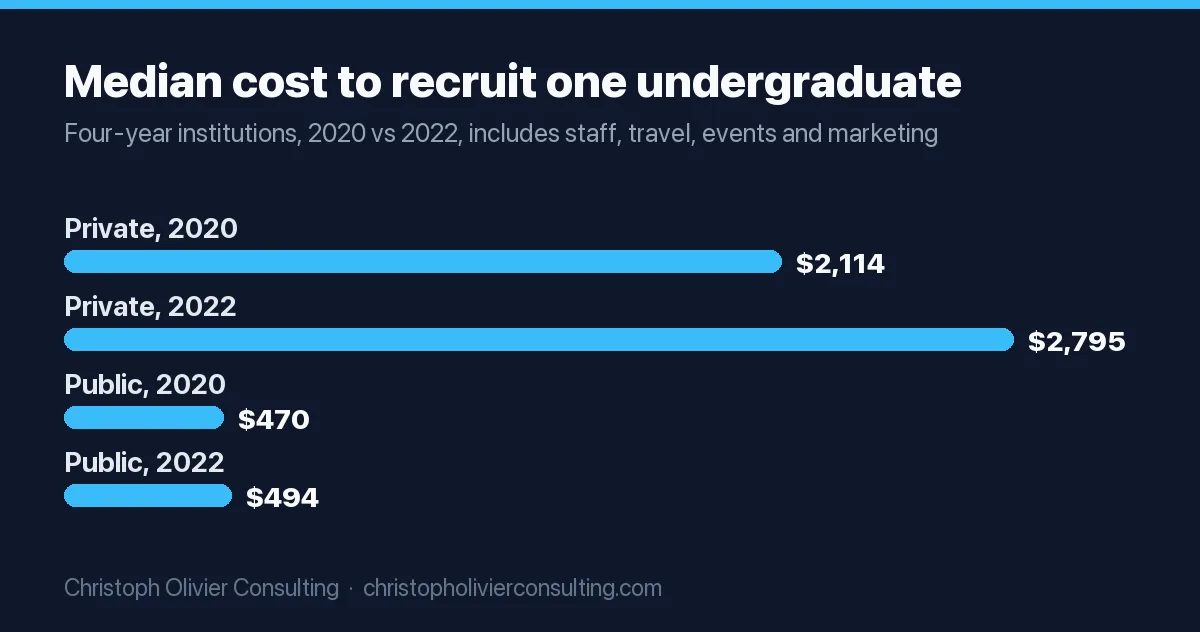
The most cited public benchmark is RNL’s Cost of Recruiting an Undergraduate Student report. In its 2022 edition, the median cost to recruit one undergraduate was $2,795 at four-year private institutions and $494 at four-year publics. That figure includes salaries, travel, events and marketing, not just ad spend.
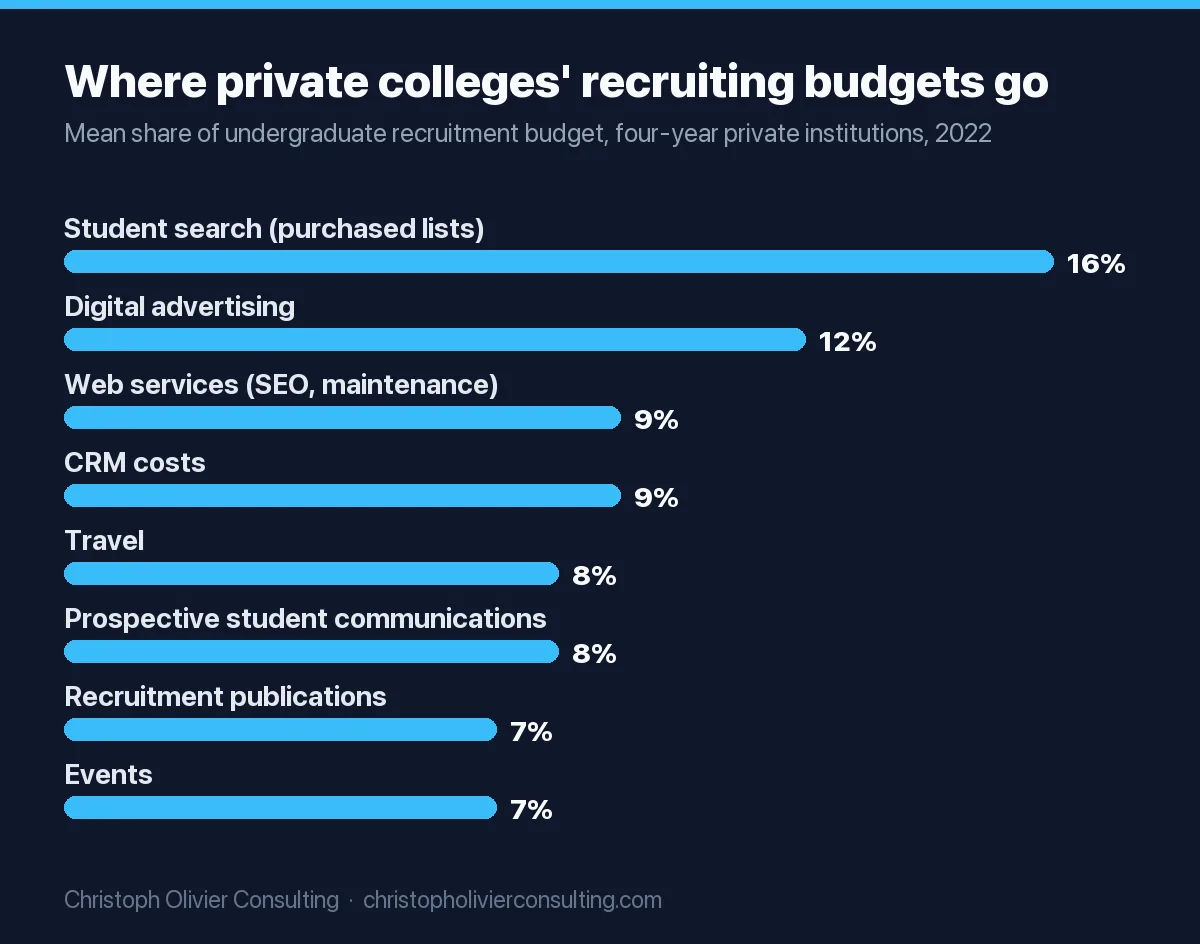
According to RNL’s 2022 report, that private median rose about 32% from $2,114 in 2020, and the public median rose about 5% from $470. The 2022 survey also showed how private institutions split their recruitment budgets: student search (purchased lists) took the largest share at 16%, followed by digital advertising at 12%, and web services and CRM costs at 9% each.
For professional, continuing and online units, the 2024 UPCEA and Search Influence marketing metrics study found an average cost per inquiry of $140 (range $29.03 to $450) and an average cost per enrolled student of $2,849 among units that tracked it: $1,505 for undergraduate, $3,804 for graduate and $599 for non-credit programs. The sample was small (44 completed surveys), so treat it as directional.
| Benchmark | Figure | Source and caveat |
|---|---|---|
| Median cost to recruit an undergraduate, private four-year | $2,795 | RNL 2022; includes staff, travel and events |
| Median cost to recruit an undergraduate, public four-year | $494 | RNL 2022; same definition |
| Share of enrollment marketing dollars on digital | 61% | EAB 2026 outlook, 120+ marketing leaders |
| Average cost per inquiry (PCO units) | $140 | UPCEA and Search Influence 2024; 44 respondents |
| Average cost per enrolled graduate student (PCO units) | $3,804 | UPCEA and Search Influence 2024; trackers only |
Use these as sanity checks, not targets. Your cost per enrolled student depends on selectivity, tuition, brand awareness and program mix. The more useful benchmark is your own number, tracked consistently every term. Early childhood programs face the same per-enrollment math, and our daycare enrollment funnel guide breaks down marketing cost per enrolled child.
Compliance: FERPA, incentive compensation and misrepresentation
Higher education marketers work under rules most commercial marketers never see. The big three are FERPA for student records, the federal ban on incentive compensation for recruiters at Title IV institutions, and the Department of Education’s misrepresentation rules, which also cover what outside vendors say on your behalf. This is an overview, not legal advice.
FERPA basics for marketers
FERPA protects student education records. Under the Department of Education’s FERPA regulations (34 CFR Part 99), schools generally need signed, dated written consent before disclosing personally identifiable information from education records. “Directory information” such as name, address, enrollment status and degrees can be disclosed after public notice, but students can opt out. In practice: do not upload current-student or alumni records to ad platforms or vendors without checking with your registrar and counsel.
The incentive compensation ban
Under 20 U.S.C. 1094(a)(20), institutions in federal student aid programs may not pay any commission, bonus or other incentive payment based on success in securing enrollments or financial aid to anyone engaged in recruiting or admissions. The main exception covers recruiting foreign students living abroad who are not eligible for federal aid. This affects how you pay agencies, lead vendors and online program managers.
The Department’s 2011 “bundled services” guidance (GEN-11-05) allows tuition-share arrangements when the vendor provides a bundle of services and the institution controls admission decisions. A January 2025 Dear Colleague Letter restated that view in a footnote, as summarized by law firm HMBR. Advocacy groups have pushed to rescind that guidance, so confirm its current status with counsel before signing a revenue-share contract.
Misrepresentation by vendors
The same January 2025 letter, per HMBR’s summary, warned that vendor staff presenting themselves as institutional “admissions counselors” or “academic counselors,” or marketing an online program as equivalent to a campus program without evidence, can count as misrepresentation by the institution. Audit vendor scripts, email signatures and ad copy. Separately, check consent rules for text messaging and calls with counsel before launching SMS nurture.
Measurement and attribution in higher education digital marketing
Measure higher education digital marketing on cost per enrolled student and stage conversion rates, not clicks or raw lead volume. That requires capturing the source of every inquiry in the CRM, carrying it through application and enrollment, and reporting by program and audience every month. Without that chain, budget decisions are guesses.
Many teams are not there yet. In the UPCEA and Search Influence study, only 46% of marketers tracked cost per inquiry, 43% tracked cost per enrolled student, and 17% said they did not track key marketing metrics. Among those who tracked both, 92% were satisfied with campaign performance, compared with 47% satisfaction across all respondents.
A workable setup for most institutions:
- Capture source at inquiry. UTM parameters and hidden form fields write channel, campaign and program into the CRM record.
- Keep first and last touch. Store both. Multi-touch models are useful, but only once the basics are clean.
- Join spend to outcomes. Pull ad spend by campaign and divide by inquiries, applications and enrolled students from the CRM.
- Report by audience and program. A blended cost per enrolled student hides which programs lose money.
- Tag AI and referral traffic. Track visits from AI assistants as their own source so you can see whether that channel produces inquiries.
For dashboards, data plumbing and reporting cadence, our guide to digital marketing analytics walks through the setup in more detail.
Worked example: back-solving an inquiry target from an enrollment goal
Start from the enrollment goal and work backward through your own funnel rates to find how many inquiries, and how much budget, you need. The numbers below are illustrative placeholders to show the math, not benchmarks. Replace every rate with your institution’s last three cycles of data from the CRM.
Suppose a private college wants 300 new first-year students and its historical rates are: 25% of admitted students enroll, 70% of completed applications are admitted, and 12% of inquiries complete an application.
- Admits needed: 300 divided by 0.25 = 1,200 admitted students.
- Applications needed: 1,200 divided by 0.70 = about 1,714 completed applications.
- Inquiries needed: 1,714 divided by 0.12 = about 14,286 inquiries.
- Sanity-check total cost: at RNL’s 2022 private median of $2,795 per recruited undergraduate, 300 students implies roughly $838,500 in total recruitment cost, including staff and travel. If your budget is far below that, either your brand already does heavy lifting or the goal needs a second look.
- Find the lever: raising inquiry-to-application conversion from 12% to 14% would cut the inquiries needed to about 12,245. Improving nurture is often cheaper than buying 2,000 more inquiries.
Run the same math separately for transfer, adult and graduate audiences, because their conversion rates differ.
A 90-day higher education digital marketing plan (template)
A 90-day plan should fix measurement first, then repair the funnel’s biggest leak, then scale the channels that prove they produce enrolled students. Trying to launch new channels before tracking works usually wastes the first term’s budget. Use this checklist as a starting template and assign an owner to each line.
Days 1 to 30: foundation
- Set enrollment goals by audience and program for the next two terms.
- Audit CRM source capture. Confirm every form writes channel, campaign and program.
- Measure speed to first contact on inquiries. Set a same-business-day standard.
- Pull last cycle’s cost per inquiry, application and enrolled student by channel.
- Review vendor contracts and scripts for incentive compensation and misrepresentation risk.
Days 31 to 60: fix the funnel
- Rebuild your top five program pages with cost, format, start dates, outcomes and a clear call to action.
- Launch or rewrite nurture tracks for your top three audiences.
- Split paid search into program-level campaigns with matching landing pages.
- Add chat with a defined handoff to a counselor.
Days 61 to 90: scale what works
- Shift budget toward channels with the lowest cost per application, not per lead.
- Test one video or streaming campaign for an adult or graduate program with a tracking plan.
- Publish a monthly one-page report: goal, pipeline by stage, cost per enrolled student, next actions.
When to bring in outside marketing leadership
Bring in outside leadership when enrollment is slipping, marketing and admissions report different numbers, or nobody owns the full funnel from ad spend to enrolled student. Smaller institutions often cannot justify a full-time vice president of marketing but still need senior strategy, vendor oversight and a measurement system.
That is the gap a fractional CMO can fill: setting the strategy, holding agencies accountable to cost per enrolled student, and building reporting your cabinet trusts. In my experience the first win is rarely a new channel. It is usually clean data and faster follow-up on the inquiries you already have.
If you want a second set of eyes on your enrollment funnel or marketing budget, you can book a consultation and we can walk through your numbers together.
Frequently asked questions
What is higher education digital marketing?
Higher education digital marketing is the use of search, paid social, video, email, text and a CRM to attract prospective students and move them from inquiry to application, deposit and enrollment. It covers the college website, SEO and AI search visibility, paid ads, nurture campaigns and chat. The strongest programs judge success on cost per enrolled student rather than clicks or lead volume.
How much do colleges spend to recruit a student?
RNL's 2022 Cost of Recruiting an Undergraduate Student report put the median cost at $2,795 per recruited undergraduate at four-year private institutions and $494 at four-year publics. Those figures include staff salaries, travel, events and marketing, not only advertising. Costs vary widely with selectivity, brand awareness and program mix, so track your own number each term.
What is the enrollment cliff and when does it start?
The enrollment cliff refers to the projected decline in US high school graduates. WICHE's Knocking at the College Door projects graduates peaked in 2025 and will decline about 13% from that peak through 2041, with 38 states graduating fewer students in 2041 than in 2023. The Midwest and Northeast are already seeing declines, while the South grows before dipping.
Which digital marketing channels work best for colleges?
It depends on the audience. Adult and online learners often start on Google or a school website, so search and strong program pages matter most. First-year prospects respond to YouTube, short video and social. Across audiences, CRM-driven email and text nurture plus fast inquiry follow-up usually have the biggest effect on converting inquiries into applications.
Does FERPA limit college marketing?
Yes, in specific ways. FERPA generally requires written consent before a school discloses personally identifiable information from student education records. Directory information such as name and enrollment status can be shared after public notice, but students can opt out. Marketers should check with the registrar and counsel before uploading current student or alumni records to ad platforms or vendors.
Can a college pay a marketing agency per enrolled student?
Usually not for recruiting services. Federal law bars institutions in Title IV aid programs from paying commissions or bonuses based on securing enrollments to anyone engaged in recruiting. Department of Education guidance from 2011 allows some tuition-share deals when the vendor provides a bundle of services and the school controls admissions, but advocates have pushed to rescind it, so confirm the current status with counsel.
How should a university measure marketing ROI?
Capture the source of every inquiry in the CRM, carry it through application and enrollment, and divide spend by enrolled students for each channel, program and audience. A 2024 UPCEA and Search Influence study found only 43% of surveyed marketers tracked cost per enrolled student, yet 92% of those tracking it alongside cost per inquiry were satisfied with campaign performance.
More Growth Consulting guides
- Locksmith Marketing: A 2026 Playbook for Booked Jobs and Beating Lead-Gen Spam
- How to Design a Customer Loyalty Program That Protects Margin
- How Much Does Digital Marketing Cost?
- Marketing OKRs: How to Write Objectives and Key Results That Move Revenue
- What Is Inbound Marketing? Modern Playbook
- How to Promote Your Business: The Order That Actually Works
- All Growth Consulting guides →