
Last reviewed: October 2026

Public health campaigns are planned, time-bound efforts by health agencies, nonprofits or coalitions to change what a defined group of people believes or does about a health risk. The campaigns with the strongest evidence, such as CDC’s Tips From Former Smokers and the truth campaign, paired one clear behavioral ask with sustained exposure, supporting services and independent evaluation.
Below: nine public health campaign examples with documented results from the agencies and studies that evaluated them, the frameworks they share, how they measure success, a planning process, a brief template and what a professional-service firm can borrow.
What are public health campaigns?
A public health campaign is a planned communication program that aims to change a health behavior or belief across a population rather than in one patient. It names an audience, a single action, a time window and a way to measure change. The stronger ones pair advertising with services, policy or enforcement that make the action easier to take.
The discipline behind most of them is social marketing. Philip Kotler and Gerald Zaltman coined the term in a July 1971 Journal of Marketing article, defining it as “the design, implementation, and control of programs calculated to influence the acceptability of social ideas” (summary and citation). In plain terms: apply the commercial marketing toolkit to a behavior instead of a product.
You will see four broad types in the wild:
- Health awareness campaigns: raise knowledge of a risk or symptom, like the UK’s Act F.A.S.T. stroke campaign.
- Behavior change campaigns: ask for one action, such as quitting smoking or placing a baby on its back to sleep.
- Enforcement-linked campaigns: combine advertising with visible enforcement, such as Click It or Ticket.
- Fundraising and advocacy campaigns: raise money or attention, such as the ALS Ice Bucket Challenge.
9 public health campaign examples with documented results
The public health campaign examples below were chosen because each has a published evaluation or an official results page, not just awards or view counts. They span tobacco, road safety, infant sleep, physical activity, wildfires, vaccination and research funding. Read each result with its caveat: most are modeled estimates or associations, not randomized proof.
| Campaign | Sponsor | Launched | Main lever | Documented result |
|---|---|---|---|---|
| Tips From Former Smokers | CDC | 2012 | Personal-testimony TV ads from former smokers | More than 16.4 million quit attempts and about 1 million successful quits, 2012 to 2018 (CDC estimate) |
| truth | Truth Initiative | 2000 | Youth-focused national ads | About 450,000 fewer adolescents started smoking, 2000 to 2004 (peer-reviewed model) |
| The Real Cost | FDA | 2014 | Youth-targeted TV and digital ads on costs of tobacco | Up to 587,000 youth prevented from starting to smoke, Feb 2014 to Nov 2016 (FDA) |
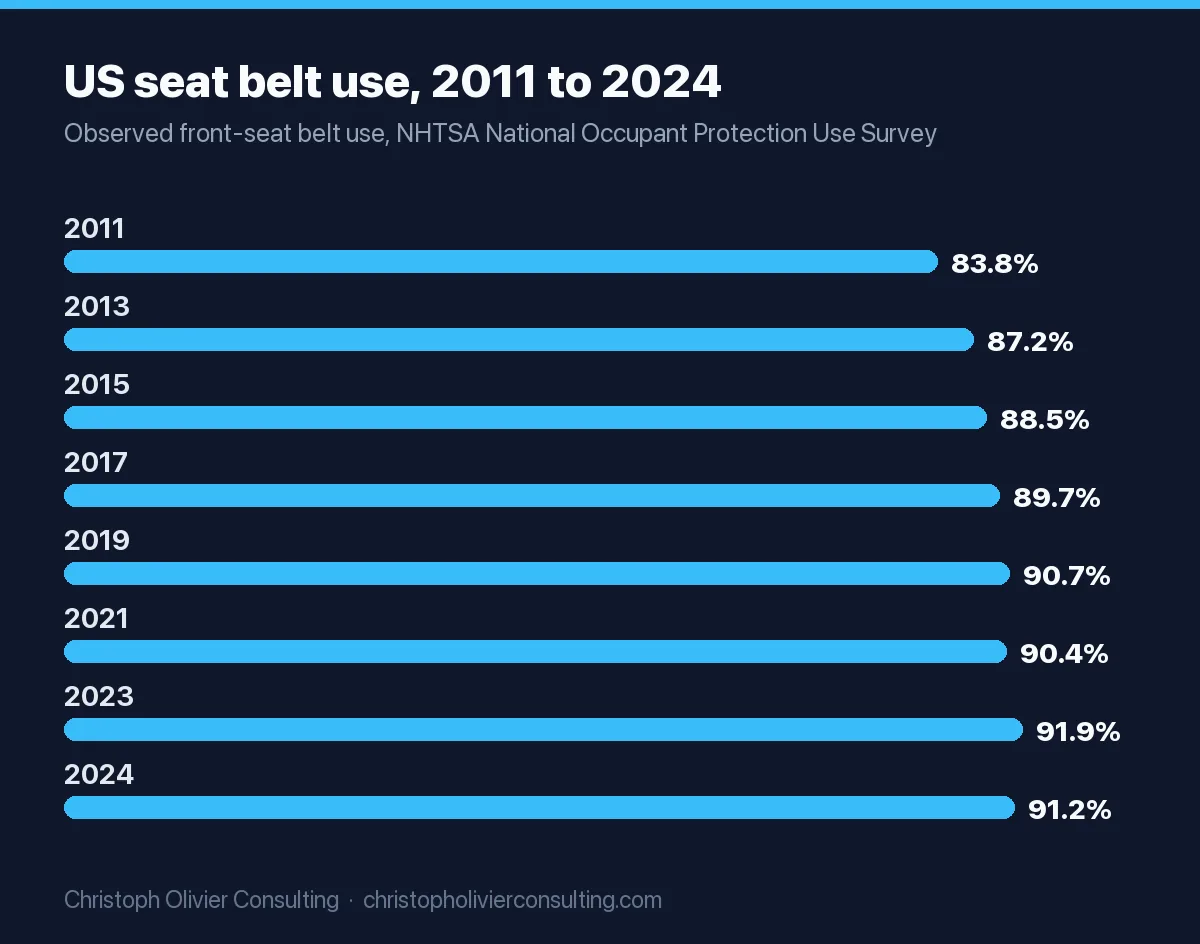
| Click It or Ticket | NHTSA | National in 2003 | Paid ads plus high-visibility enforcement | Belt use up 9 points in the 2001 regional pilot; national use 91.2% in 2024 |
| Smokey Bear | Ad Council | 1944 | Mascot plus a single personal-responsibility line | Longest-running campaign in Ad Council history; acreage claim below |
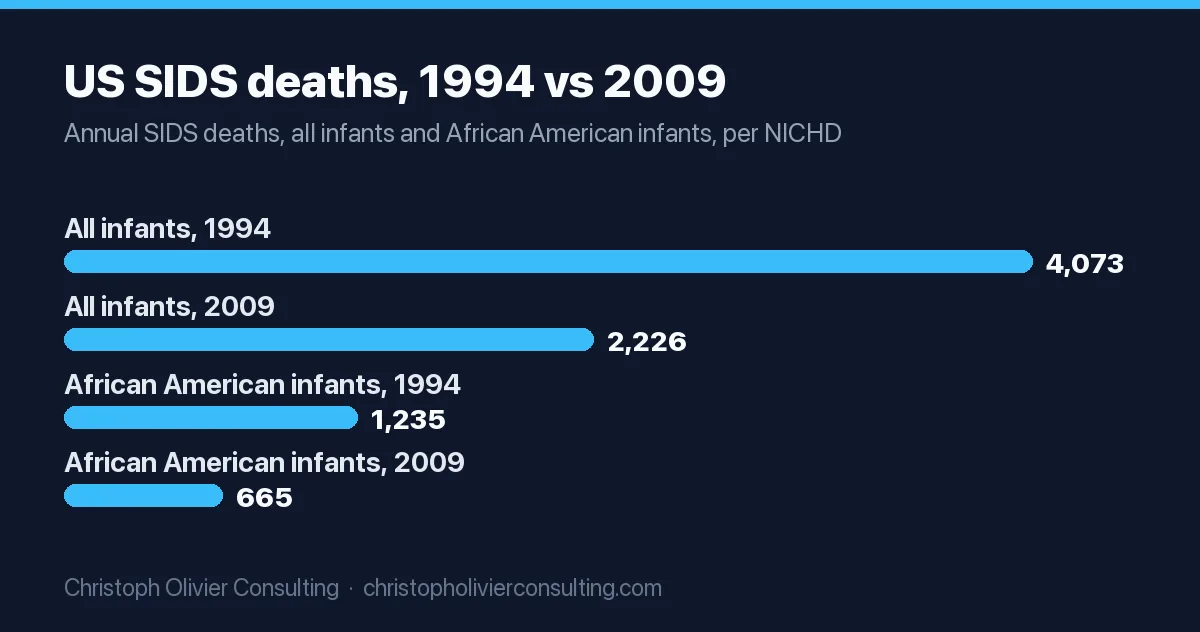
| Back to Sleep / Safe to Sleep | NICHD (NIH) | 1994 | One instruction for parents, delivered through clinicians | Back sleeping rose from under 30% to 74%; SIDS rate fell more than 50%, 1994 to 1999 |
| VERB | CDC | 2002 | Branded physical activity messaging for tweens | 75% awareness by 2006; dose-response link to daily activity |
| ALS Ice Bucket Challenge | Grassroots, ALS Association | 2014 | Peer-nominated social video | $115 million to the ALS Association; five new ALS genes found by funded researchers |
| We Can Do This | HHS | 2021 | Paid digital and TV for COVID-19 vaccination | Higher weekly digital impressions associated with a 125% higher likelihood of a first dose |
Tips From Former Smokers (CDC)
Tips uses real people living with smoking-related disease to tell smokers what they wish they had known. The ads are blunt and short, and the ask is one action: try to quit.
CDC’s impact page estimates that from 2012 to 2018 more than 16.4 million people who smoke attempted to quit and about one million quit successfully, with 129,000 early deaths prevented and $7.3 billion in healthcare costs saved, or one early death prevented per $3,800 spent. A peer-reviewed evaluation of the 9-week 2014 flight followed 4,248 smokers and found exposure raised the odds of a quit attempt (odds ratio 1.17), about 1.83 million additional quit attempts nationally.
truth (Truth Initiative)
truth is a national youth smoking prevention brand that has spoken to young people since 2000. Rather than lecturing teens about their health, its ads point attention at the tobacco industry, which makes not smoking feel like independence.
An RTI International study in the American Journal of Preventive Medicine (Farrelly and colleagues, 2009) followed 8,904 adolescents and estimated about 450,000 fewer young people started smoking from 2000 through 2004 because of the campaign. A later Truth Initiative study estimated 301,930 young people aged 15 to 21 did not become smokers over 2015 to 2016. That figure comes from the sponsor, so weigh it accordingly.
The Real Cost (FDA)
The Real Cost was FDA’s first tobacco prevention campaign, aimed at youth aged 12 to 17 at risk of smoking. Its newer vaping ads, like the one below, frame nicotine as a loss of control: a threat that feels immediate rather than decades away.
According to FDA, the campaign prevented up to 587,000 youth aged 11 to 19 from starting to smoke between February 2014 and November 2016, with more than $53 billion in projected savings. Its latest outcome evaluation (late 2023) found about 42% of youth aware of at least one ad. Note “up to”: it is the top of an estimated range.
Click It or Ticket (NHTSA)
Click It or Ticket is the textbook high-visibility enforcement model: tell people police are watching, then make sure they are. The ad is credible because the ticket is real. NHTSA made it a national program in 2003.
After the first region-wide run in May 2001, across eight southeastern states, observed belt use rose nine percentage points across the region. Nationally, belt use reached 84% in 2009 and 91.2% in 2024, per NHTSA’s National Occupant Protection Use Survey, which is fielded in early June, immediately after the campaign.
Smokey Bear (Ad Council)
Smokey shows that a simple character and one personal line can carry a message for generations. The first poster was prepared on August 9, 1944, the longest running campaign in Ad Council history, and the line became “Only You Can Prevent Wildfires” in April 2001.
The same source says annual acres lost fell from 22 million to 4 million since the campaign began. Treat that as context, not proof: firefighting, land management and weather all drive acreage, and no isolated campaign effect is published with the claim.
Back to Sleep / Safe to Sleep (NICHD)
Back to Sleep reduced a complex research finding to one instruction any parent can follow at 2 a.m.: put the baby on its back. It carried the authority of the NIH and pediatric guidance.
When it launched in 1994, fewer than 30% of babies slept on their backs; by 2010, 74% did, and the US SIDS rate fell by more than 50% between 1994 and 1999, according to NICHD. The rate then plateaued while other sleep-related deaths rose, so the campaign was broadened as Safe to Sleep in 2012. CDC still counted about 3,400 sudden unexpected infant deaths in 2024.
VERB (CDC)
VERB tried to make physical activity a brand tweens wanted to belong to. It ran from June 2002 to September 2006 for children aged 9 to 13, on a cumulative $339 million appropriation, and ended when funding stopped.
A 2010 American Journal of Public Health evaluation found 75% awareness in 2006. Among children aged 10 to 13, the share active the previous day rose from 62.4% with no exposure to 68.4% with daily exposure, but there was no link to organized sports. Awareness and a real dose-response effect still vanished with the budget.
ALS Ice Bucket Challenge
The Ice Bucket Challenge was a peer-nominated fundraising mechanic, not a behavior change campaign: short video, public challenge, named friends, a deadline. It reads best as a cause marketing case.
The ALS Association received $115 million from the 2014 challenge. An RTI International report (2019) found it awarded 322 grants to 237 scientists from 2014 to 2018, and its funded researchers identified five new ALS-linked genes.
We Can Do This (HHS)
HHS launched We Can Do This in April 2021 to raise COVID-19 vaccine confidence and uptake. Its evaluation linked paid media weight in each market to individual vaccination behavior.
A 2023 Journal of Medical Internet Research study of 3,642 US adults found that moving weekly paid digital impressions in a market from minus 30,000 to 30,000 on the study’s scale was associated with a 125% higher likelihood of a first dose (1.2% to 2.6% predicted). The authors flag self-reported dates and mandates as possible confounders.
What made these successful public health campaigns work
Successful public health campaigns share five traits: one specific action, an audience defined by a barrier rather than a demographic, an emotional frame that fits that audience, exposure sustained for years rather than weeks, and something real behind the message, such as a quitline, enforcement or a clinician. Messaging alone rarely carries the whole result.
- One action, stated plainly. “Back to sleep.” “Click it or ticket.” Tips asks for one thing: a quit attempt. If you cannot state the action in under five words, the audience will not repeat it.
- A frame chosen for the audience. truth gave teens an enemy; The Real Cost gave them an immediate loss of control; Tips gave adult smokers a mirror. Same product category, three different psychological levers.
- Something real behind the ad. Click It or Ticket has visible enforcement. Tips points smokers to quit support. Back to Sleep had pediatric guidance behind it. The ad creates intent; the service converts it.
- Sustained exposure. Tips has run in repeated flights since 2012, and the 2014 evaluation covers its third year. VERB shows the opposite: when funding ended, the brand ended.
- Measurement designed in. The campaigns with the strongest claims had cohort, survey or observation studies running alongside the media. That is why we can discuss their results now.
UK examples tell the same story. A 2025 PLMR review credits Act F.A.S.T. and Five a Day with turning complex advice into a memorable, measurable instruction, This Girl Can with audience insight, Dry January with timing, and Every Mind Matters with partnerships.
The seat belt chart in this section shows what sustained effort looks like on a mature behavior: steady gains, then a plateau in the low 90s where further gains get harder. Commercial campaigns often follow the same curve.
The behavior-change frameworks behind health awareness campaigns
Most health awareness campaigns are built on two frameworks. The Health Belief Model explains why a person acts: they must feel at risk, see the risk as serious, believe the action helps, find the barriers low and feel capable. Social marketing supplies the planning toolkit: research, segmentation and the marketing mix of product, price, place and promotion.
The Health Belief Model was developed in the 1950s by social psychologists Hochbaum, Rosenstock and others in the US Public Health Service (Health Behavior and Health Education). Its six constructs map onto the campaigns above, and onto a B2B sales conversation.
| HBM construct | Campaign that used it | Business translation |
|---|---|---|
| Perceived susceptibility | Tips: “this happened to someone like me” | Show the buyer the problem already affects firms like theirs |
| Perceived severity | Tips: the long-term reality of smoking-related disease | Quantify the cost of doing nothing |
| Perceived benefits | Back to Sleep: lower SIDS risk | State the outcome of acting in the buyer’s terms |
| Perceived barriers | Tips: pointing smokers to quit support removes “I don’t know how” | Remove the switching cost, effort or risk |
| Cues to action | Click It or Ticket: May enforcement window | Deadlines, renewals, regulatory dates |
| Self-efficacy | VERB: everyday activity framed as doable | A small first step, such as an audit or pilot |
Social marketing and the 4Ps
Social marketing treats the behavior as the product. Lefebvre and Flora’s 1988 essential components include formative research, segmentation, pretesting and the marketing mix (overview). Applied to a campaign, the 4Ps become:
- Product: the behavior and its benefit (a smoke-free life, a safer crib).
- Price: what the person gives up: money, time, effort, social standing, pleasure.
- Place: where the action happens and how easy it is there (quitline, pediatrician’s office, the car).
- Promotion: the messages and channels, the only P most people picture.
The common failure is spending nearly all the effort on promotion. The campaigns above also lowered the price of acting.
How public health campaigns measure results
Public health campaigns measure results on a ladder: exposure and awareness first, then beliefs and intentions, then reported or observed behavior, then health outcomes. Each rung is harder to move and harder to attribute. The best evaluations use cohorts or market-level variation in ad weight so they can compare exposed and unexposed people over time.
| Rung | What it measures | Example from this list | Attribution difficulty |
|---|---|---|---|
| 1. Exposure and awareness | Did the audience see and recall it? | VERB: 75% total awareness in 2006 | Low |
| 2. Beliefs and intentions | Did attitudes or plans shift? | Tips 2014: 1.73 million more smokers intending to quit within 6 months | Moderate |
| 3. Behavior | Did people act? | Click It or Ticket: observed belt use; Tips: quit attempts | High |
| 4. Health and economic outcomes | Did disease, deaths or costs change? | Tips: 129,000 early deaths prevented (CDC estimate) | Very high, usually modeled |
Back to Sleep shows why the top rung is tricky. NICHD’s own data show SIDS deaths falling from 4,073 in 1994 to 2,226 in 2009, but the agency also notes that some deaths once labeled SIDS may now be classified under other causes, which may explain part of the decline. Good evaluators say this out loud. You should too, whenever you report a campaign’s results to a board or a client.
How to plan a public health campaign: step by step
Plan a public health campaign backward from the behavior you want to change, not forward from the creative idea. Define the action, find the barrier, choose the frame, build the service that removes the barrier, then buy enough media for long enough to move a measurable number. Write the evaluation plan before the first ad runs.
- Pick one behavior. Write it as a verb a person can do this week: call the quitline, buckle up, book a screening.
- Define the audience by barrier. “Smokers who have tried to quit and failed” is more useful than “adults 35 to 54.”
- Run formative research. Find which Health Belief Model construct is weakest for this audience.
- Choose the frame. Fear with a clear way out (Tips), rebellion (truth), identity (VERB), simplicity (Back to Sleep), social challenge (Ice Bucket).
- Build the “place.” Quitline, booking link, clinic partner or enforcement window: every ad needs a next step.
- Pretest the creative. Test with the audience for comprehension and unintended effects before you buy media.
- Plan sustained exposure. Budget for repeated flights over several years, not one burst.
- Design the evaluation. Baseline survey, comparison markets or a cohort, and the rung of the ladder you will report on.
- Report honestly and adjust. Publish what worked and what did not, and refresh tired creative.
Public health campaign brief template
A one-page campaign brief keeps everyone honest about the single action, the audience barrier and the measurement plan before money is spent. Copy the checklist into your planning doc and do not approve creative until every line has a specific answer. It works for agencies, nonprofits and commercial firms alike.
Campaign brief: checklist
- [ ] Behavior: the one action, in under 10 words.
- [ ] Audience: who, defined by the barrier they face.
- [ ] Insight: the belief that currently stops them (name the HBM construct).
- [ ] Frame: the emotional angle and why it fits this audience.
- [ ] Offer and place: the service, link or partner that makes acting easy.
- [ ] Price reduction: what effort, cost or risk you are removing.
- [ ] Channels: where this audience actually spends attention.
- [ ] Duration and weight: flights per year, years committed, budget.
- [ ] Baseline: today’s awareness, intention and behavior numbers.
- [ ] Evaluation design: cohort, comparison markets or pre/post, and who runs it.
- [ ] Success threshold: the change on a named rung that means “keep funding.”
- [ ] Risks: backlash, stigma or unintended effects found in pretesting.
What businesses can borrow from public health campaigns
Businesses can borrow three things from public health campaigns: a single behavioral ask instead of a list of features, a frame chosen from audience research rather than internal preference, and a measurement ladder that separates awareness from action. Professional-service firms in particular sell behavior change, because the buyer has to stop doing something the old way.
Take a hypothetical law firm promoting estate planning. The behavior is “book a 30-minute review.” The barrier is usually not awareness; it is perceived severity (“nothing will happen soon”) and price (“this will be expensive and awkward”). A Tips-style approach would use consented client stories of what went wrong without a plan, then remove the price barrier with a fixed-fee first meeting.
The same logic shows up in commercial work. Many famous ads work because they make one action feel normal, and many innovative marketing campaigns succeed by copying public health’s habit of attaching a real service to the message. If you run a mission-driven organization, the planning steps above sit comfortably inside a broader nonprofit marketing plan, and the Ice Bucket mechanic is a reminder that social media campaigns spread fastest when participation itself is the message.
Common mistakes and honest caveats
The most common public health campaign mistakes are awareness-only goals, one short burst of media, no service behind the message, and claiming credit for trends that were already moving. Even the strongest evaluations in this guide report modeled associations, and several headline numbers come from the sponsoring organization, so treat every result as an estimate.
- Stopping at awareness. VERB reached 75% awareness yet found no link to organized activity. Awareness is a means, not the goal.
- Over-attribution. Smokey’s acreage numbers and the SIDS decline both include factors beyond the campaign. Say so.
- Sponsor-reported results. Several Truth Initiative and FDA figures come from the organizations running the campaigns.
- Plateaus. Belt use and SIDS both flattened after big early gains. The holdouts often need a new frame or a policy change, not more of the same ad.
In my experience, the firms that get the most from these lessons are the ones that write the measurement plan first and the headline last. If you want a second pair of eyes on a campaign brief built this way, you can book a consultation and we can walk through it together.
Frequently asked questions
What is a public health campaign?
A public health campaign is a planned program, usually run by a health agency, nonprofit or coalition, that tries to change a health belief or behavior across a population. It defines an audience, one action, a time window and a way to measure change. The stronger campaigns pair advertising with a service, policy or enforcement that makes the action easier.
What are some examples of successful public health campaigns?
Well documented examples include CDC's Tips From Former Smokers, the truth youth smoking campaign, FDA's The Real Cost, NHTSA's Click It or Ticket, NICHD's Back to Sleep (now Safe to Sleep), CDC's VERB physical activity campaign, Smokey Bear, the ALS Ice Bucket Challenge and HHS's We Can Do This vaccination campaign. Each has an official results page or published evaluation.
What makes a public health campaign effective?
Effective campaigns ask for one specific action, define the audience by the barrier that stops them, choose an emotional frame that fits that audience, and run long enough to build exposure. They also put something real behind the message, such as a quitline, visible enforcement or clinician advice, and plan their evaluation before the first ad runs.
How do you measure the success of a health awareness campaign?
Measure on a ladder. Start with exposure and awareness, then beliefs and intentions, then reported or observed behavior, then health and cost outcomes. Higher rungs are harder to attribute, so strong evaluations use a baseline, a cohort that is followed over time, or comparison markets with different ad weight. Report which rung your result sits on.
What is the difference between social marketing and a public health campaign?
Social marketing is the planning discipline; a public health campaign is one way it gets delivered. Social marketing, a term coined by Kotler and Zaltman in 1971, applies research, segmentation and the product, price, place and promotion mix to a behavior. A campaign is the time-bound program, often mostly promotion, that results from that planning.
What is the Health Belief Model in public health campaigns?
The Health Belief Model, developed in the 1950s by researchers in the US Public Health Service, says people act on a health threat when they feel susceptible, see it as severe, believe the action helps, find the barriers low, get a cue to act and feel able to do it. Campaign planners use it to find the weakest belief and target it.
Can businesses use public health campaign tactics?
Yes. The transferable parts are one clear behavioral ask, audience research that finds the real barrier, a service that removes that barrier, sustained exposure rather than a single burst, and honest measurement that separates awareness from action. Professional-service firms often benefit most, because their buyers have to change an existing habit before they hire.
More Growth Consulting guides
- Nonprofit Marketing: A Small-Budget Playbook That Wins Donors
- Optometry Marketing: A Practice Owner’s Guide to Lower Cost Per New Patient
- The Best Client Management Apps for Service Businesses (2026)
- Pricing Strategy: A Founder’s Guide to Setting the Right Price
- Med Spa Marketing: How to Attract and Keep Clients in 2026
- How to Create a Marketing Plan (Step by Step, With Template and Example)
- All Growth Consulting guides →