

Church marketing is the work of helping someone who has never walked into your building find you, show up once, and come back a second time. For most congregations the limit is not money. It is hours: one staff member or volunteer who also runs the bulletin, the slides and the kids check-in. So this plan is built around the time you actually have, not the budget a vendor wishes you had.
The context matters. In the Pew Research Center’s 2023-24 study of more than 36,000 US adults, 33% attend services in person at least monthly, 23% watch online at least monthly, and 8% participate online only. That means your Sunday livestream and your Google listing are often seen by more people than your foyer. And Barna’s 2025 State of the Church data shows the typical churched adult attends 1.6 weekends a month, with Gen Z at 1.9. A “regular” attender is often a twice-a-month attender, which changes how you plan follow-up and how you measure growth.
Want a specialist to build this for your business? See how CO Consulting’s marketing services work, starting with a diagnostic and audit.
The three moments your church marketing has to win
Almost every church marketing strategy worth doing serves one of three moments. If a task does not help with one of them, it can usually wait.
- The search. Someone types “church near me,” “Christmas Eve service” or your church’s name into Google or Maps. They decide in seconds whether you look alive, safe and clear about what happens on Sunday.
- The first visit. They need to know where to park, which door to use, what to do with their kids, how long the service runs and what people wear. Every unanswered question is one more reason to stay home.
- The second visit. One visit is curiosity. The second is a decision. What you do in the 7 days after a first visit (a personal note, an easy next step, an invitation to something smaller than Sunday) matters more than any ad.
Most church marketing advice focuses on moment one. In my experience, growth is usually won or lost in moments two and three.
Fix the free listings before you spend a dollar
Your Google Business Profile is often the first thing a searcher sees about your church, and it costs nothing. A few rules from Google’s own Business Profile guidelines trip churches up:
- Use your real-world name. Google says your name should match how it appears “on your storefront, website, stationery.” “Grace Community Church” is fine. “Grace Community Church Best Family Church Springfield” risks a suspension.
- Be careful with hours. Google’s guidelines say certain businesses “shouldn’t provide hours, including those with varied hours (like schedules for different types of activities, including showtimes, worship services, or classes).” If your office has staffed hours, list those. Put service times in your description, your posts and, most importantly, your website, where you control the wording.
- Pick the fewest categories that describe you. Google asks you to complete “This business IS a,” not “this business HAS a.” Your church is a church. It is not also a “preschool” unless that preschool has its own profile.
- Post photos of the outside and the entrance. The single most useful photo for a first-time guest is the door they should walk through.
Then build one page on your website called “Plan Your Visit” and make every other channel point to it. It should answer, in plain words: service times, address and parking, the door to use, what happens with kids (including check-in and safety), how long the service lasts, what people wear, and one human name with a photo who will say hello. If you only do one thing from this article, do this page.
Church marketing strategies by the hours you have each week
Here is the core of the plan. Find the row that matches your real capacity, not your aspirational one. Each tier assumes you have finished the tier above it.
| Weekly capacity | Do this | Stop or skip this | Number to watch |
|---|---|---|---|
| About 2 hours (one volunteer or the pastor) | Keep the Google profile and Plan Your Visit page accurate. Post one photo or short update a week. Send a personal email or text to every first-time guest within 48 hours. Print invite cards for Christmas and Easter. | Daily social posting, a church app, paid ads, a weekly designed newsletter. | First-time guests per month, and how many came back within 6 weeks. |
| About 8 hours (part-time communications lead) | Everything above, plus: a simple livestream or recorded sermon on YouTube, a 3-email guest sequence, a monthly newsletter, and one community event per quarter promoted 6 weeks out. Apply for Google Ad Grants if you qualify. | Being on every platform. Pick the one or two your community actually uses. | Plan Your Visit page views, guest form submissions, second visits. |
| 20+ hours (staff role or small team) | Everything above, plus: a managed Ad Grants account with conversion tracking, short sermon clips each week, segmented email (guests, parents, volunteers), seasonal campaigns for Advent and Easter, and a quarterly report to leadership. | Vanity metrics like page likes. Reporting attendance alone without guest retention. | Cost per first visit (if paying), guest-to-member rate, volunteer sign-ups. |
The right column is the point. A church that sees 10 first-time guests a month and keeps 4 is doing better marketing than one that sees 30 and keeps 2. If you are a larger or multi-site church and want an outside view of where your hours are going, that is the kind of question I take on in a consultation call.
When people go looking: the church marketing calendar
Search interest in churches is not flat across the year. I pulled US Google Trends data for “church near me” from October 2021 to October 2026. In 2025 the week of December 21 hit an index of 81, roughly double the 40 to 45 range of most November weeks. In 2026, the weeks starting March 29 (Palm Sunday week) and April 5 (Easter week) scored 67 and 66, against 40 to 44 for the weeks earlier in March. Several of the year’s highest weeks also landed in February and June 2026, for reasons the data alone cannot explain, which is a good argument for checking your own Search Console instead of trusting any national calendar.
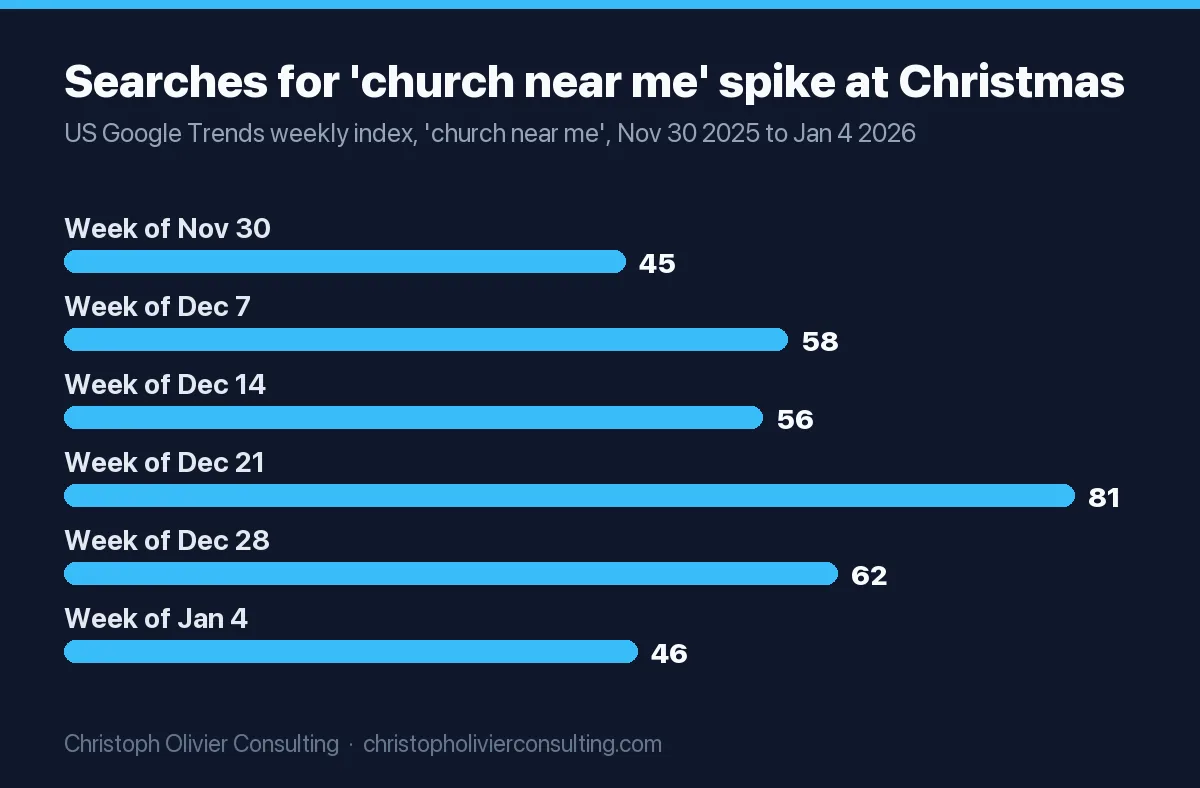
The practical lesson: your Christmas Eve and Easter pages need to be live, indexed and linked from your Google profile about 4 to 6 weeks before the date, not the Monday before. Use the calendar below as a starting frame.
| Window | What people are looking for | What to publish or do |
|---|---|---|
| Mid-November | Christmas Eve service times, kids programs | Publish a Christmas Eve page with every service time, length and kids option. Hand invite cards to members on the last Sunday in November. |
| December | “Christmas Eve service near me,” candlelight services | Add a Google post and update your description. Christmas Eve 2026 falls on a Thursday, so say clearly whether there is also a Sunday service that week. |
| January | New-year resolutions, groups, recovery | Launch a short sermon series and a 4 to 6 week group that a guest can join without commitment. |
| 4 to 6 weeks before Easter | Easter service times, egg hunts | Easter Sunday is March 28 in 2027. Publish the Easter page in mid-February and plan one community event that gives guests a reason to come back the following Sunday. |
| Summer | VBS, kids camps, local events | Promote VBS registration in spring. Treat VBS families as warm guests and follow up personally. |
| Late August to September | Back-to-school routines, families new to the area | Run a “new to town” or fall kickoff Sunday. Refresh photos on your profile. |
Every one of these is an event, and events need their own promotion timeline. The structure in our event marketing plan guide (when to announce, when to remind, how to follow up) maps neatly onto a Christmas Eve or Easter push.
Church outreach ideas people outside the church say they would attend
Here is the uncomfortable data point for anyone planning a big ad campaign. When Lifeway Research surveyed 2,000 unchurched Americans, 51% said a personal invitation from a friend or family member might get them to attend, compared with 18% for a Facebook ad and 23% for a postcard. Only 35% said they would attend a worship service if a friend invited them, but interest in community events ran much higher. The survey is from 2016, so treat the exact figures as directional, but the pattern lines up with what most pastors see.
| Church-hosted event | Unchurched adults likely to attend |
|---|---|
| Meeting about neighborhood safety | 62% |
| Community service event | 51% |
| Sports or exercise program | 46% |
| Concert | 45% |
| Neighborhood get-together | 45% |
| Worship service, if invited by a friend | 35% |
| Recovery group | 25% |
| Seminar on a spiritual topic | 24% |
Two takeaways shape a church marketing plan. First, your members are your highest-converting channel, so equip them: printed invite cards, a shareable link to the Plan Your Visit page, and a specific ask (“invite one person to Christmas Eve”). Second, the outreach ideas that draw neighbors are useful to the neighborhood first. A safety meeting with the local police, a free sports clinic, a back-to-school supply giveaway or a concert gives people a low-stakes way to meet you. Collect an email at the door (with permission) so the event leads somewhere.
Funerals and memorial services belong on this list too. They are often the first time a non-member sits in your sanctuary, and they reach the same families that funeral homes market to. A printed welcome card in the pew and a warm, no-pressure invitation to a grief group can matter more than any ad.
Google Ad Grants for churches: who qualifies and what gets accounts paused
Google Ad Grants gives each qualifying nonprofit up to $10,000 per month in search ads shown on Google.com. Churches are not on Google’s list of excluded organization types, but US eligibility has a catch that many church guides skip.
Google’s US requirement is that organizations “must be registered with the IRS as exempt from federal income tax under Section 501(c)(3)… or a group exempt organization with proven affiliation to a central nonprofit that has 501c3 status.” Meanwhile, the IRS says in Publication 1828 that churches meeting 501(c)(3) requirements “are automatically considered tax exempt and are not required to apply.” So a church can be fully tax exempt and still have no determination letter for Google’s partner to verify. Before you apply, check whether you have your own IRS letter or appear on your denomination’s group ruling. If you are unsure, your denomination’s office is usually the fastest place to ask.
Once approved, the Ad Grants account management policy has rules that volunteer-run accounts often miss:
- Local targeting. Google names “houses of worship” as an example of organizations whose ads “should be shown only in your town or local area.”
- A 5% click-through rate each month at the account level. Miss it for 2 consecutive months and the account is temporarily deactivated.
- Conversion tracking with at least 1 meaningful conversion a month (a Plan Your Visit form, a newsletter sign-up, a call). Homepage visits do not count as conversions.
- Smart bidding. Accounts created on or after April 22, 2019 must use Maximize conversions, Maximize conversion value, Target CPA or Target ROAS.
- At least 2 sitelinks.
Here is sample copy for a church search ad pointed at a Plan Your Visit page. Adjust the names and times to your church.
- Headline options: “Church in Springfield” / “Sunday Services 9 and 11” / “Kids Check-In Made Easy” / “Plan Your First Visit”
- Description: “Casual dress, great kids program, 70-minute service. Tell us you’re coming and we’ll save you a parking spot.”
- Sitelinks: “Plan Your Visit,” “Kids Ministry,” “Christmas Eve Services,” “Watch Online”
Our full guide to Google Ad Grants for nonprofits covers application steps and account structure in more depth.
Livestream and YouTube: the account rules and the music license
Pew’s numbers make the case: 16% of US adults participate both in person and online at least monthly. For many guests, your stream is the first visit. Two things need to be in order.
The account. YouTube requires that you verify your channel, have no live streaming restrictions in the past 90 days, and be at least 16 years old to stream. Set this up weeks before Easter, not on Saturday night.
The music. Leading congregational songs in the building is one thing. Streaming them is another. CCLI offers a Streaming License, and its Streaming Plus License “permits the inclusion of authorized Master Recordings (such as artist tracks) and Multitracks” in online services. If your band plays along to tracks, check which tier you hold. Not every publisher participates, so confirm coverage for songs you use often.
For volunteer-run churches, a fixed camera, a clean audio feed from the soundboard and a consistent start time beat a multi-camera setup that breaks every other week. Put your Plan Your Visit link in the stream description and say it out loud once per service.
What a 501(c)(3) church can say in an election year
This is the one area where a marketing mistake can become a legal problem. The IRS says 501(c)(3) organizations are “absolutely prohibited from directly or indirectly participating in, or intervening in, any political campaign” for or against a candidate. Non-partisan voter registration drives and genuinely non-partisan forums or voter guides can be allowed, depending on the facts.
Your website and social channels count. Publication 1828 says that if an organization posts something on its website that favors or opposes a candidate, it is treated the same as distributing printed material, and that the church is responsible for the links it chooses to keep on its site.
You may have heard the rule changed. In July 2025 the IRS and a group of plaintiffs, including the National Religious Broadcasters and two Texas churches, asked a federal court to approve a consent judgment that would have let churches address candidates from the pulpit. On March 31, 2026, Judge J. Campbell Barker ruled the court lacked jurisdiction to approve it and dismissed the case, leaving the provision in place for now. NRB said it plans to appeal to the Fifth Circuit. Until a court or Congress says otherwise, keep candidate endorsements out of sermons streamed online, newsletters, social posts and ads, and ask your attorney or denomination before election season.
Follow-up that turns a first visit into a second
If Barna is right that the typical churched adult attends 1.6 weekends a month, a guest who misses the next Sunday has not necessarily left. Your follow-up should run across about 6 weeks, not 6 days. A simple three-email sequence works for most churches:
- Within 48 hours, from the pastor or a named greeter. Subject: “Thanks for joining us Sunday.” Body: “It was good to meet you. If you have any questions about the church, kids ministry or anything you heard Sunday, just hit reply. It comes straight to me.”
- Around day 7. Subject: “Your next step (it’s a small one).” Invite them to one specific, low-commitment thing: a newcomers’ lunch, a group, a serve day. One link, one date.
- Around day 21. Subject: “What’s coming up at [church].” Share the next seasonal event and a short story about the people they would meet. Then add them to your regular newsletter.
Your regular newsletter does a different job: it keeps occasional attenders connected between visits. If yours reads like a bulletin, the patterns in these email newsletter examples can help you lead with one story and one clear ask. Many of the same donor-and-volunteer habits covered in our nonprofit marketing guide apply here too, with one difference: for a church, the goal is belonging, not a transaction.
A one-page church marketing plan you can fill in this week
If you need something to bring to your elders or staff meeting, this is enough:
- Capacity: Who owns communications, and how many hours a week do they really have? Pick your row from the capacity table.
- Front door: Google profile accurate, Plan Your Visit page live, both checked by someone who has never been to your church.
- Next two seasonal moments: Dates, pages, invite cards and one community event for each.
- Follow-up: Who contacts every first-time guest, by when, and with what words.
- Guardrails: Ad Grants eligibility checked, streaming license confirmed, election-season policy written down.
- Two numbers: First-time guests per month and second visits within 6 weeks, reviewed monthly.
Most churches that do these six things well will not need an elaborate marketing program. They will need patience, consistency, and members willing to say, “Come with me this Sunday.”
Work with CO Consulting
Want this done for your business?
- A diagnostic call and an audit of your current marketing and numbers
- A prioritized 90-day plan built for your market
- Execution across SEO and AI search, paid ads, content, funnels and automation
- Weekly check-ins and monthly reporting, led by a fractional CMO
Frequently asked questions
What is church marketing?
Church marketing is the work of helping people who do not attend your church find it, visit once, and return. In practice it means an accurate Google Business Profile, a clear Plan Your Visit page, member invitations, seasonal pushes around Christmas and Easter, and personal follow-up with first-time guests. It is outreach and hospitality, not selling.
How much should a small church spend on marketing?
Many small churches can start with almost nothing. A Google Business Profile, a simple website page for first-time guests, printed invite cards and a free email tool cover the essentials. Time is usually the real constraint. If your church qualifies for Google Ad Grants, search ads can be added without ad spend, though the account still needs regular management.
Can churches get Google Ad Grants?
Churches are not on Google's list of excluded organization types. In the US, Google requires IRS registration as a 501(c)(3) or proven affiliation with a central organization that holds a group exemption. Because the IRS treats qualifying churches as automatically exempt without applying, some churches lack a determination letter, so check your status or your denomination's group ruling before applying.
What are good church outreach ideas for people who don't attend?
Events that help the neighborhood tend to draw the most interest. In a 2016 Lifeway Research survey of unchurched Americans, 62% said they would likely attend a church meeting about neighborhood safety and 51% a community service event, compared with 35% for a worship service if a friend invited them. Sports programs, concerts and neighborhood get-togethers also scored well.
Can a church endorse political candidates on its website or social media?
Not without risking its tax-exempt status. The IRS prohibits 501(c)(3) organizations, including churches, from participating in political campaigns for or against candidates, and treats website posts like printed material. A 2025 proposed consent judgment that would have loosened this for some churches was not approved; the court dismissed the case on March 31, 2026. Ask your attorney before election season.
Do churches need a license to livestream worship music?
Usually yes, if you stream copyrighted songs. Licenses for congregational singing in the building generally do not cover streaming. In the US, CCLI offers a Streaming License, and its Streaming Plus License adds authorized master recordings and multitracks. Coverage depends on which publishers participate, so confirm the songs you use most often are included.
When should a church start promoting Christmas and Easter services?
About 4 to 6 weeks ahead. Google Trends data for US searches of 'church near me' roughly doubled in the week before Christmas 2025 compared with November, and rose sharply in Palm Sunday and Easter weeks in 2026. Pages need time to be indexed, and members need invite cards before the final Sunday rush.
More Growth Consulting guides
- Nonprofit Marketing: A Small-Budget Playbook That Wins Donors
- Weight Loss Clinic Marketing: A Compliant Playbook for GLP-1 Growth
- How to Choose a Business-to-Business Marketing Agency (B2B Marketing Agency Guide)
- How Much Does Digital Marketing Cost?
- Marketing Services for Small Businesses: What They Include and How to Prioritize Them
- Marketing Strategy Consultant: What They Do, Cost, and How to Hire One
- All Growth Consulting guides →