

An ecommerce marketing agency earns its fee only when the contribution margin it adds is bigger than what you pay it, and most brands never check that math before they sign. The pitch deck shows ROAS screenshots. Your bank account cares about revenue after product cost, shipping, returns, ad spend and the retainer. This guide is for the founder or marketing lead of an online store, usually on Shopify, who is deciding whether to hire an agency, which one, and on what terms.
The stakes are rising. The US Census Bureau puts e-commerce at $340.2 billion in Q2 2026, or 17.1% of total retail sales (seasonally adjusted). More stores are bidding for the same shoppers on the same few platforms, so the gap between an agency that understands your unit economics and one that just runs campaigns shows up fast in your P&L.
If you would rather have an expert run your ads, see how CO Consulting manages paid advertising for service businesses.
Below: when an agency makes sense at all, what the services really are, what agencies charge in 2026 and what each fee model quietly rewards, a worked margin calculation you can copy, a 100-point pitch scorecard, the contract terms that protect you, and what a good first 90 days looks like.
Do you need an ecommerce marketing agency yet?
Agencies sell expertise and capacity. If your problem is neither, an agency will not fix it. A store with a weak product page, thin margins or no repeat buyers can burn a retainer proving that more traffic does not help. Before you take calls, write down which of these you are actually short on:
- Skill: nobody on your team can build a Performance Max structure, a Meta testing plan or a Klaviyo flow set properly.
- Capacity: you know what to do but cannot produce 20 new ad variations a month or rebuild your flows while also running operations.
- Judgment: spend is going up, results are flat, and nobody can tell you why.
Skill and capacity gaps are what agencies are built for. A judgment gap usually calls for a strategist or a fractional CMO first, then an agency to execute. If you have not yet settled who your best customers are and which products carry your margin, start with your ecommerce marketing strategy before you outsource the channels.
Here is a practical way to match the setup to the size of the business. These are rules of thumb, not industry statistics, and the right answer shifts with your margin and team.
| Where you are | Typical bottleneck | Setup that usually fits | What to avoid |
|---|---|---|---|
| Under about $1M a year in revenue | Product-market fit, offer, site conversion | Founder runs strategy; a freelancer or small specialist handles one channel; email flows built once and maintained | Full-service retainers that eat most of your contribution margin |
| About $1M to $10M a year | Creative volume, paid scaling, retention | A paid media specialist agency plus a retention (email and SMS) specialist, managed by one internal owner | Letting each agency grade its own homework with platform-reported numbers |
| Above about $10M a year | Measurement, channel mix, team depth | In-house marketing leadership with specialist agencies for paid, retention, marketplaces or creative | Handing strategy to whichever vendor has the biggest budget line |
| Any size, no marketing lead | Nobody owns the numbers | One accountable partner, either a fractional leader or a full-service marketing agency with a named strategist | Three disconnected vendors and no one deciding between them |
What ecommerce marketing services actually cover
“Ecommerce marketing services” is a menu, not a single job. Almost every agency lists the same items. The difference is in how each one is done, so judge each service by the outcome you should see, not the activity.
Paid acquisition: Google Shopping, Performance Max, Meta, TikTok
For most stores, Google is the first or second biggest line. Google describes Performance Max as a goal-based campaign that reaches all Google Ads inventory from one campaign, across YouTube, Display, Search, Discover, Gmail and Maps, and positions it as a complement to keyword Search campaigns, not a replacement. For retailers with a Merchant Center feed, Google even offers an experiment to measure the uplift of switching from Standard Shopping to Performance Max. A good agency proposes that test; a weak one just tells you PMax is better. Our Performance Max guide covers the feed, asset group and brand-exclusion details to ask about.
On Meta and TikTok, the platforms now automate most targeting, so the agency’s real job is creative: how many new concepts it ships, how fast it kills losers, and whether it can tell a winning hook from a winning offer. Ask how many new ads per month are included and who makes them.
Retention: email and SMS flows
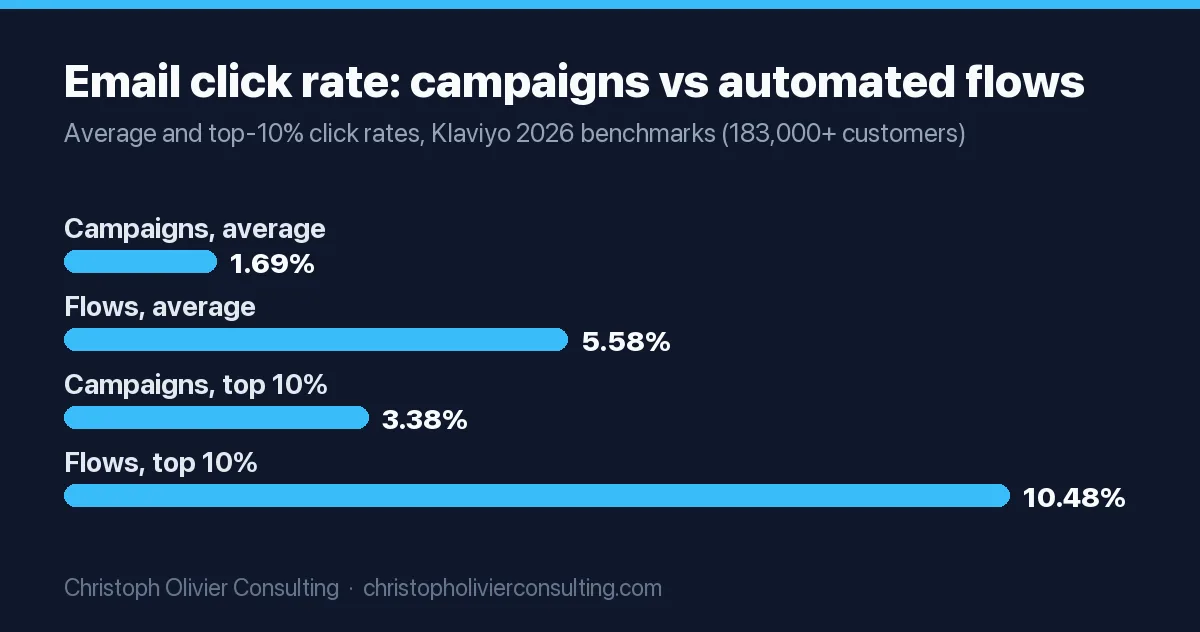
Retention is where many stores leave the easiest money. Klaviyo’s 2026 benchmarks, drawn from more than 183,000 customers, show that automated flows made up 5.3% of email sends but nearly 41% of email revenue, with flow revenue per recipient nearly 18 times that of campaigns. So the first question for any retention agency is not “how many campaigns a week?” but “which flows will you audit and rebuild first?” Welcome, abandoned checkout, browse abandonment, post-purchase and win-back are the usual core. Our guide to ecommerce email marketing walks through the order to build them.
Conversion rate optimization
CRO done well is a testing program with a hypothesis, a sample size and a decision rule. CRO done badly is a designer changing button colors. Ask to see a past test log, including the tests that lost.
Marketplaces and social commerce
Amazon and TikTok Shop are their own disciplines, with separate ad systems, fee structures and catalog rules. Agencies often price them separately and sometimes add a commission on sales (see the pricing table below). If an agency says it “does Amazon too,” ask who on the team has run a catalog your size.
Measurement and reporting
This is the service most agencies undersell and the one that matters most. Every ad platform reports its own attributed revenue, and the platforms routinely claim credit for the same order. Your agency’s reporting should start from what Shopify (or your store platform) recorded, then explain how each channel contributed. If the monthly report leads with platform ROAS and never mentions blended revenue, new-customer counts or margin, you are reading the agency’s marketing, not yours.
Ecommerce marketing agency pricing in 2026, and what each fee model rewards
There is no audited price index for agency fees, so treat every range you see, including the ones below, as what agencies publish about themselves. Two published 2026 pricing guides line up reasonably well. Darkroom’s guide lists paid media management at $8,000 to $25,000 a month, email and SMS retention at $3,000 to $10,000, Amazon at $5,000 to $20,000 and full-stack partnerships at $30,000 to $75,000. LimeLight’s guide puts percent-of-spend paid media fees at 10% to 20% of ad spend with monthly minimums, and full-service partnerships at $8,000 to $50,000 or more a month. On Clutch’s ecommerce marketing category, the first agency profiles listed showed minimum projects of $1,000 to $5,000 and average hourly rates of $100 to $199.
The fee level matters less than the fee structure, because each structure pays the agency for a different behavior.
| Fee model | How it works | What it quietly rewards | When it fits | What to negotiate |
|---|---|---|---|---|
| Percent of ad spend | Commonly 10% to 20% of monthly media, with a minimum | Spending more, whether or not the extra spend is profitable | Stable accounts where spend tracks a profit target you set | A cap, or a lower rate above a spend threshold |
| Flat retainer | Fixed monthly fee for a defined scope | Doing the defined scope; little upside for the agency if you grow | Most stores, because your cost is predictable and spend decisions stay neutral | A written scope: channels, number of new ads, reporting cadence |
| Hybrid | Base fee plus a smaller percentage above a threshold (Darkroom’s example: $8,000 a month plus 8% of spend above $50,000) | Scaling, but with less pressure to inflate small budgets | Brands planning to scale spend within the year | Where the threshold sits, and whether the percentage applies to all channels |
| Revenue share or GMV commission | A percentage of sales, often on top of a retainer (Darkroom cites 5% to 10% of incremental GMV for some TikTok Shop agencies) | Revenue, including orders you would have won anyway, and discount-heavy sales | Marketplaces where the agency controls most of the levers | A clear, testable definition of “incremental,” and a margin floor |
| Per asset (creative) | Priced per static image or video | Volume of assets | Brands that already have a media buyer and only need creative | Usage rights and how many revision rounds are included |
If you are comparing paid specialists specifically, our breakdown of how a paid media agency structures fees goes deeper on spend tiers and minimums.
The margin math: what fee can your store afford?
This is the part the “top agencies” lists skip. You need three numbers before you compare proposals: your monthly revenue, your contribution margin before marketing (revenue minus product cost, shipping, fulfillment, payment fees and returns), and the profit you want left after marketing. From those, you can work out the most you can spend on marketing in total, including the agency.
Two definitions first. MER (marketing efficiency ratio) is total store revenue divided by total marketing spend. Break-even MER is 1 divided by your contribution margin rate. At a 45% contribution margin, break-even MER is 1 / 0.45 = 2.22. Below that, every dollar of marketing loses money even before the agency fee.
Worked example, a hypothetical store with illustrative numbers:
- Revenue: $200,000 a month ($2.4M a year).
- Contribution margin before marketing: 45%, so $90,000.
- Profit target after marketing: 10% of revenue, so $20,000.
- All-in marketing budget: $90,000 minus $20,000 = $70,000. That covers ad spend, the agency fee and marketing tools. Required blended MER: $200,000 / $70,000 = 2.86.
- Subtract the agency and tools: with a $9,000 retainer and $1,000 of tools, $60,000 is left for ads. Ad spend now has to return $200,000 / $60,000 = 3.33 times in total store revenue.
- Price the fee in revenue: $9,000 / 0.45 = $20,000. The agency has to add $20,000 a month in revenue that would not have happened otherwise just to pay for itself, before any extra ad spend.
Now watch what the fee model does as spend grows. At $60,000 of ad spend, a 15% fee is also $9,000, so the two proposals look identical. Push spend to $100,000 and they split:
| At $100,000 ad spend | Flat $9,000 retainer | 15% of ad spend |
|---|---|---|
| Agency fee | $9,000 | $15,000 |
| Total marketing cost (with $1,000 tools) | $110,000 | $116,000 |
| Monthly revenue needed to keep a 10% profit | $314,286 | $331,429 |
| Required MER on ad spend | 3.14 | 3.31 |
The formula behind the revenue line: revenue needed = total marketing cost / (contribution margin rate minus profit target rate), here divided by 0.35. Under the percentage model, the same store needs about $17,000 more revenue every month to land the same profit. That is not a reason to refuse percentage pricing. It is a reason to cap it, or to tie spend increases to a blended MER you set, not the agency.
Two refinements make this sharper. First, split revenue into new and returning customers, because returning buyers often come back through email no matter what the ads do; an agency hired for acquisition should be judged mostly on new-customer revenue per ad dollar. Second, run the numbers by product line if margins differ a lot, since a 4.0 ROAS on a 25% margin product loses money while a 2.5 on a 60% margin product does not.
Ecommerce digital marketing agency vs in-house vs freelancers
The honest comparison is cost against what you get for it. The Bureau of Labor Statistics reports a median annual wage of $166,790 for marketing managers in May 2025, before benefits and before the specialists that one manager still needs. A paid media retainer in the published ranges above runs roughly $96,000 to $300,000 a year and comes with a team, but a shared one.
| Specialist agency | In-house hire | Freelancers | |
|---|---|---|---|
| Speed to start | Weeks | Months to recruit and ramp | Days to weeks |
| Breadth of skills | Several specialists on one invoice | One person’s strengths | Exactly the skill you hire for |
| Knowledge of your business | Shallow at first; depends on account team turnover | Deepest over time | Varies by engagement length |
| Who owns the strategy | Risk: the agency, by default | You | You, which means you must have one |
| Main risk | Junior team after the sale; misaligned fees | Single point of failure; slow to add skills | Coordination falls on you |
Many brands in the $2M to $20M range land on a hybrid: one internal owner who holds the numbers and the strategy, plus one or two specialist agencies or freelancers for execution. The internal owner is what keeps any outside partner honest.
Hiring a Shopify marketing agency: what to check
“Shopify agency” covers two different businesses. Some build and maintain stores (themes, apps, migrations). Others drive demand (ads, email, SEO). Many do a little of both and are strong at one. Ask which side most of their revenue comes from.
Shopify’s own Partner Directory lets you browse partners under categories such as “Marketing and sales” and shows partner tiers (Select, Plus, Premier and Platinum), which Shopify says are based on factors including “history of experience and proven success on Shopify.” A tier is a useful filter for platform competence. It does not tell you whether an agency can grow your margin, so it belongs in the first screen, not the final decision.
Shopify-specific questions worth asking:
- Which data will you use for reporting: Shopify orders, GA4, or the ad platforms? How do you reconcile them?
- Who maintains the Merchant Center feed, and how often do you check for disapproved products?
- What will you change on the theme or checkout, and who approves it before it goes live?
- Which apps will you add, and what do they cost each month?
Run the pitch with a 100-point scorecard
Most agencies pitch well. The scorecard below is my own model for separating the ones that understand ecommerce economics from the ones that understand pitching. Score each line during or right after the call, and score every agency on the same sheet.
| Area (points) | Question to ask | Strong answer sounds like | Weak answer sounds like |
|---|---|---|---|
| Economics (25) | “What MER do we need to stay profitable?” | They ask for your contribution margin before answering, then talk about break-even MER and new-customer acquisition cost | A target ROAS number given before they have seen your margins |
| Measurement (20) | “How will we know your work caused the growth?” | Blended store revenue as the base, plus holdout, geo or platform experiments (such as Google’s Standard Shopping vs PMax test) | “Our dashboard tracks everything” with platform-attributed revenue only |
| Team and access (15) | “Who works on our account each week, and who owns the ad accounts?” | Named people with their seniority; your business holds Admin on every account | The founder pitches, an unnamed “team” delivers; accounts opened under the agency |
| Creative (15) | “How many new ads a month, and who makes them?” | A number, a testing cadence and a rule for killing ads | “As many as needed,” with no figure in the proposal |
| Commercial terms (15) | “What happens if we want to leave?” | 30 to 60 days’ notice, a handover checklist, you keep creative and data | A long minimum term with exit fees, or ownership of creative held back |
| Retention (10) | “What would you fix first in our email and SMS?” | A flow audit before more campaigns, plus how they handle consent | A higher campaign send schedule |
Give full points for a strong answer, half for a partly strong one, and zero otherwise. As a working threshold: 80 or more goes on the shortlist, 60 to 79 needs a second call on the weak areas, and under 60 is a pass. Then ask the shortlisted agencies for two current clients you can call yourself, at a revenue size close to yours.
Contract terms that protect your store
Most painful agency breakups come down to access, not performance. Get these written into the agreement before work starts.
- You own the accounts. In Google Ads, control sits with whoever holds Admin access; Google’s own ownership transfer instructions work by adding a new Admin user and then removing the old one, and the same pattern applies to Google Analytics and Merchant Center. Your business should hold Admin on Google Ads, GA4, Merchant Center, Meta Business, TikTok, Klaviyo and Shopify. The agency gets user or partner access, never sole ownership.
- You own the work. Ad creative, copy, audiences, email templates and test results transfer to you on exit, including raw files.
- Scope is specific. Channels, number of new ads, report frequency and meeting cadence are in writing, so a “full-service” retainer cannot quietly shrink.
- Exit is short and clean. A notice period you can live with, plus a handover list.
- Compliance is the agency’s job too. The FTC’s final rule on reviews bans buying fake reviews, paying for reviews of a particular sentiment and buying fake followers or views, and lets the FTC seek civil penalties against knowing violators. Influencer posts need a clear disclosure of any material connection, and the FTC says free products count. Marketing texts fall under the TCPA, where consent rules are in flux: in March 2026 the Fifth Circuit held in Bradford v. Sovereign Pest Control that the statute requires only prior express consent, but the FCC’s written-consent rule was not struck down and still applies elsewhere. Ask how the agency captures and stores SMS consent, and have your counsel set the standard.
Walk away if you see two of these
- A ROAS or revenue figure promised before they have seen your margins or accounts.
- Ad accounts that would be opened in the agency’s name.
- Monthly reports built on impressions, clicks and platform ROAS, with no store revenue or margin.
- Case studies with big percentages and no baseline, timeframe or client you can contact.
- Offers to “boost” reviews or social proof with paid or incentivized content.
What the first 90 days with a good agency look like
A strong partner spends the first month learning your business before it spends more of your money. If the proposal starts with “launch new campaigns in week one,” ask what they plan to measure them against.
- Days 1 to 14, access and audit. Admin access confirmed on your side, tracking checked against Shopify orders, Merchant Center feed health reviewed, email flows audited, contribution margin agreed by product line, break-even and target MER written down.
- Days 15 to 45, fix leaks and start tests. Tracking gaps and feed errors fixed, the most valuable missing flows rebuilt, a first creative sprint launched, and at least one controlled experiment set up (for example, Standard Shopping vs Performance Max, or a geographic holdout).
- Days 46 to 90, scale what clears the bar. Budget moves toward campaigns that beat your target MER on new-customer revenue, losing tests are cut, and the first experiment is read out with a decision.
At day 90 you should be able to answer one question: is blended contribution margin after marketing better than before, and can the agency show why? If it is not, a good agency will say so and tell you what it would change. In most cases, three months is enough to judge the process even if it is too early to judge the full results.
CO Consulting engagements follow the same shape: after managing millions of dollars in ad spend, I start every account with an audit and a written 90-day plan built on the margin math above, with no performance guarantees, because nobody can honestly promise a ROAS before seeing your numbers. If you want a second opinion on an agency proposal or your current setup, you can book a consultation and bring your margins.
Work with CO Consulting
Want ads that book qualified calls?
- Google, Meta, LinkedIn and YouTube campaigns built around qualified pipeline, not clicks
- Run by Christoph Olivier, who has managed millions of dollars in ad spend
- Tracking and follow-up fixed before budget is scaled
- No guaranteed leads, costs or revenue; we report what the auctions actually deliver
Frequently asked questions
How much does an ecommerce marketing agency cost?
Published 2026 agency pricing guides put paid media management at roughly $8,000 to $25,000 a month, email and SMS retention at $3,000 to $10,000, and full-stack partnerships from about $30,000 upward. Percent-of-spend models commonly run 10% to 20% of ad spend with a monthly minimum. These are agency-published ranges, so compare scopes line by line rather than headline prices.
Is percent of ad spend or a flat retainer better for an online store?
A flat retainer usually suits most stores because your cost stays predictable and the agency gains nothing from spending more. Percent of spend can work if it is capped or tiered and spend increases are tied to a blended MER target you set. Without that guardrail, percentage pricing rewards the agency for spend growth even when the extra spend is unprofitable.
What is a good MER for an ecommerce brand?
It depends on your contribution margin. Break-even MER equals 1 divided by your contribution margin rate, so a 45% margin store breaks even at about 2.22 and a 30% margin store at about 3.33. A good target sits above break-even by enough to cover the agency fee, tools and the profit you want, which you can calculate before talking to any agency.
Should I hire a Shopify-specific marketing agency?
Platform experience helps with feeds, checkout, apps and reporting, and Shopify's Partner Directory shows tiers based on experience on the platform. But a tier measures platform skill, not your margin. Confirm whether the agency mainly builds stores or drives demand, then judge it on economics, measurement and team, the same as any other ecommerce marketing agency.
How long should I give an agency before judging results?
About 90 days is usually enough to judge the process: access and audit in the first two weeks, fixes and first experiments next, then scaling what clears your target MER. Full results on new channels or creative can take longer, but by day 90 the agency should show whether blended contribution margin after marketing has moved and explain why.
Who should own my Google Ads and Meta ad accounts?
Your business should. Keep Admin access on Google Ads, GA4, Merchant Center, Meta Business, TikTok, Klaviyo and Shopify, and give the agency user or partner access. Google's own ownership transfer process works through Admin users, so an agency that holds the only Admin login controls your account history and can make switching agencies slow and costly.
More Paid Advertising guides