

The typical real estate agent closes about 9 to 10 transactions a year, which works out to about 3 clients who will close being worked at any one time, plus prospects who are still deciding. The 2026 NAR Member Profile reports that the typical REALTOR® completed nine individual transaction sides in 2025, down from ten in 2024. New agents with two years or less closed a median of two. Agents on teams closed far more, because the team shares the load.
No survey measures “clients at one time” directly. So this page does three things. It shows the published numbers with their source and year. It turns them into an at-one-time estimate with the math visible. And it gives you a pipeline worksheet to run your own numbers, whether you are an agent planning a year or a seller asking a listing agent how busy they are.
Short answer: A typical NAR member closed 9 transaction sides in 2025 (NAR 2026 Member Profile), so they serve about 9 closing clients a year. Because a buyer search runs a median of 10 weeks before the contract-to-close period, that agent has only about 3 closing clients active at once, plus prospects who never buy. Team-based agents report a median of 31 to 32 sides per team. A 2014 MLS study found sale outcomes worsened when a listing agent carried 15 or more other listings.
How many clients do real estate agents have? The published numbers
Every figure below comes from the original publisher. Note what each one measures: NAR counts transaction sides from a member survey, the Consumer Federation of America counted sales shown on agent profiles, and the Bureau of Labor Statistics counts jobs and wages, not deals.
| Measure | Figure | Period | Source |
|---|---|---|---|
| Typical REALTOR®, individual transaction sides | 9 (median) | 2025 | NAR 2026 Member Profile, Feature Sheet |
| Typical REALTOR®, transaction sides | 10 (median) | 2024 | NAR 2025 Member Profile coverage |
| Agents with 2 years or less, individual sides | 2 (median), $330,000 volume | 2025 | HousingWire on the 2026 Member Profile |
| REALTOR® teams, transaction sides per team | 31 (Feature Sheet) or 32 (press release) | 2025 | NAR Feature Sheet; NAR press release |
| Share of REALTORS® on a team; typical team size | 21%; 4 members | 2025 | NAR press release |
| Median sales volume, individual brokerage specialists | $2.7 million | 2025 | NAR press release |
| Median hours worked per week | 35 | 2025 | HousingWire on the 2026 Member Profile |
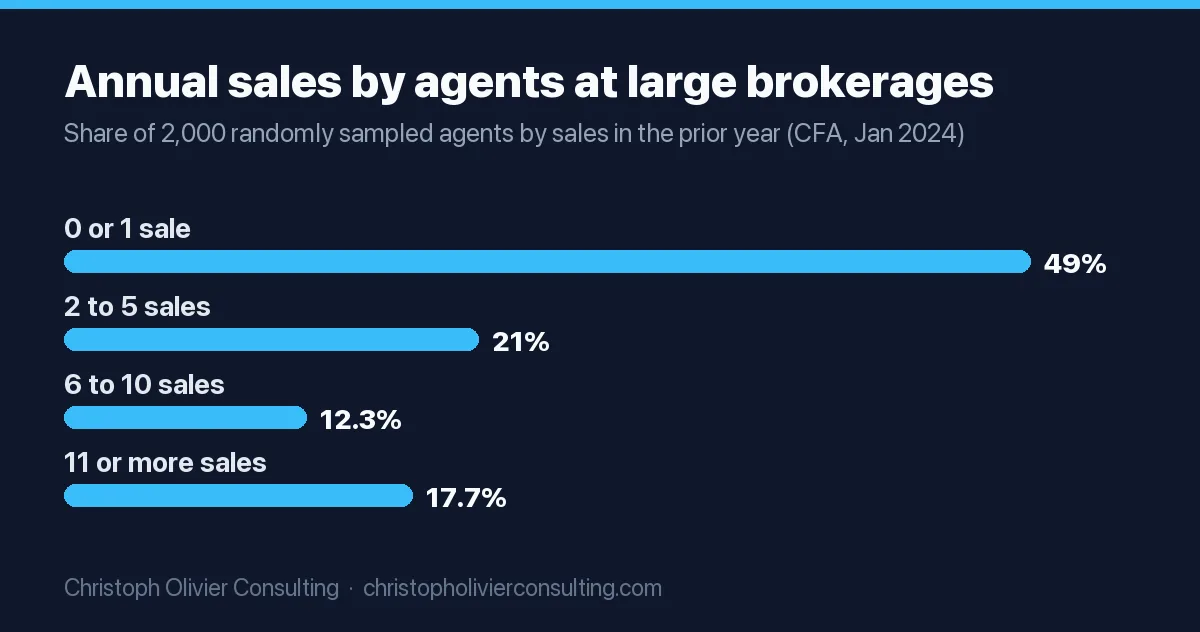
| Agents at large brokerages with 0 or 1 sale in the prior year | 49% of 2,000 sampled | Prior 12 months, report dated Jan 2024 | CFA, A Surfeit of Real Estate Agents 3 |
| Agents with 5 or fewer sales | 70% of 2,000 sampled; median “barely two” | Same | CFA report |
| NAR membership | 1,438,569 | June 2026 | NAR press release |
| Existing-home sales, US | 4,060,000 | 2025 | NAR existing-home sales table |
| Real estate sales agent jobs (BLS) | About 427,000; 54% self-employed | 2025 | BLS Occupational Outlook Handbook |
The gap between NAR’s median of 9 and CFA’s median of about 2 is not a contradiction. NAR surveys its own members, and the people who answer tend to be the more active ones. CFA picked agents at random from the rosters of 20 large firms in Central Pennsylvania, Orlando, Tucson and Minneapolis and counted their listed sales. If you want “what does a working, full-time agent do,” use NAR. If you want “what does a random licensed agent at a big brokerage do,” the CFA sample is closer.
Transaction sides are not the same as clients
Every sale has two sides: the seller’s side and the buyer’s side. An agent who represents only the buyer gets one side. An agent who represents both buyer and seller on the same home (double-ending) gets two sides, as the CFA report explains. So 9 sides usually means about 9 clients who closed, with two exceptions to keep in mind:
- A household that sells one home and buys another with the same agent counts as two sides but one relationship.
- Sides only count clients who closed. Buyers who toured for months and gave up, and listings that expired, do not show up anywhere in the median.
How many clients does a realtor have at one time?
For most agents, the honest answer is a small number: roughly 1 to 4 clients who will actually close, plus a longer list of prospects and buyers who are still deciding. You can estimate it with one formula, borrowed from queueing math (Little’s Law):
Clients active at once = closings per year × months each client stays active ÷ 12
The inputs you can source: in NAR’s 2025 Profile of Home Buyers and Sellers, the median buyer searched for 10 weeks, and recently sold homes sat on the market for a median of four weeks. The contract-to-close period depends on the loan and local practice, so the table below uses an assumed 6 weeks. Replace it with your own escrow average. That puts a typical closing client at about 16 weeks of active work, or 3.7 months.
| Agent profile | Closed sides per year | Months active per client (assumed 3.7) | Closing clients active at once |
|---|---|---|---|
| New agent, 2 years or less (NAR median) | 2 | 3.7 | 0.6, so often zero or one |
| Typical REALTOR®, individual (NAR median) | 9 | 3.7 | 2.8 |
| High-producing solo agent (example, not a benchmark) | 24 | 3.7 | 7.4 |
| Typical team, whole team (NAR median, about 4 members) | 32 | 3.7 | 9.9 across the team, about 2.5 per member |
Method: sides × 3.7 ÷ 12, my arithmetic. Buyers and listings that never close sit on top of these numbers, and no public source measures that fall-out rate.
Two practical readings of this table. First, an agent juggling 10 closing clients alone is producing at roughly three times the national median, and usually has help. Second, if you are hiring an agent, “how many clients are you working with right now?” is a fair question. Two to five is normal for a solo full-time agent. Double digits on your own deserves a follow-up about who will actually return your calls.
How many listings is too many for one agent?
The best published evidence is a study by Bian, Waller, Turnbull and Wentland, “How Many Listings is too Many? Agent Listing Inventory and Sales Performance”. It analyzed 12,388 sold homes from a Virginia MLS listed between 1999 and 2009. The findings:
- About half of listings were held by agents carrying 2 to 7 other listings. The researchers used this as the “typical” reference group.
- When the listing agent had 15 or more other listings, the home sold for about 3% less and stayed on the market 129% longer, about 160 extra days against a 124-day average for the reference group.
- Agents with 8 to 14 other listings showed no clear penalty in price or time on market against the reference group, as Inman’s write-up reports.
The data is old and from one market, so treat it as a warning threshold, not a rule. It still matches the table above: a seller’s listing agent with 15 or more active listings is carrying several times the typical load.
Real estate agent average sales per year
“Average” is the wrong word for most published figures, which are medians. Here is what each source says about a year of sales:
- NAR members: median 9 individual sides in 2025, 10 in 2024 and 10 in 2023, per the 2025 and 2026 Member Profiles. The 2026 edition was the first to split individual from team production, so part of the drop from 10 to 9 may reflect that change in method.
- Random agents at large firms: median “barely two” sales, with 12.3% of the 2,000 sampled agents selling 6 to 10 properties, per the CFA.
- A top-down check: NAR counted 4,060,000 existing-home sales in 2025. Two sides each gives 8.12 million sides. Divided by 1,438,569 NAR members, that is about 5.6 sides per member. This is my rough arithmetic: it ignores new-construction sales, unrepresented buyers, for-sale-by-owner deals and licensees who are not NAR members, so read it as a ceiling-check, not a statistic.
The distribution is the real story. Half of the CFA sample did almost nothing, while a minority did most of the deals.
What is the 80/20 rule for REALTORS®?
The 80/20 rule is the Pareto principle applied to real estate. It is used two ways. At industry level, it is the claim that about 20% of agents close about 80% of transactions. At the agent level, it means about 80% of your income comes from about 20% of your contacts, usually past clients and the people who refer them.
Neither version is an official statistic. No public dataset we found measures the exact split of all US transactions by agent. The evidence that exists points in the same direction. In the CFA sample, 70% of agents had five or fewer sales, and by subtraction about 18% had more than ten. At the agent level, NAR’s 2026 Member Profile found the typical REALTOR® got 28% of business from repeat clients and 22% from referrals from past clients, half of all business from an existing network. For agents with 16 or more years in the business, repeat business was a median 49%, against 0% for agents with two years or less.
That is why the most useful version of the 80/20 rule is about your database, not the industry. Your past clients are the cheapest source of your next ones. A structured referral program and a CRM you actually keep up to date are what turn that 20% into a predictable pipeline.
What is the 3-3-3 rule in real estate?
The phrase has no single official definition. The version agents most often mean is a relationship-marketing habit popularized by real estate coach Darryl Davis, as described in RISMedia: each month, call three people, send three personal handwritten notes, and share three pieces of useful content (a market snapshot, a maintenance checklist, a list of local events) with past clients, prospects and your sphere.
You will also see “3-3-3” used on consumer sites as a buyer-readiness checklist about savings and property evaluations. That version is informal advice, not a lender requirement. If someone uses the term with you, ask which one they mean.
The agent version matters for client count because of the numbers above: with half of a typical agent’s business coming from repeat and referral clients, a few personal touches each month are what keep next year’s pipeline from starting at zero. Treat 3-3-3 as a minimum. Nine touches a month adds up to only 108 touches a year.
Are real estate agents struggling in 2026?
Many are, and the data shows it clearly:
- Volume is near a 30-year low. Existing-home sales have hovered just above 4 million a year for about three and a half years, the lowest level since 1995, per the NAR Feature Sheet. 2025 finished at 4.06 million, flat on 2024.
- Too many agents for the deals. NAR has 1,438,569 members for about 8 million sides a year, before counting licensees who are not members.
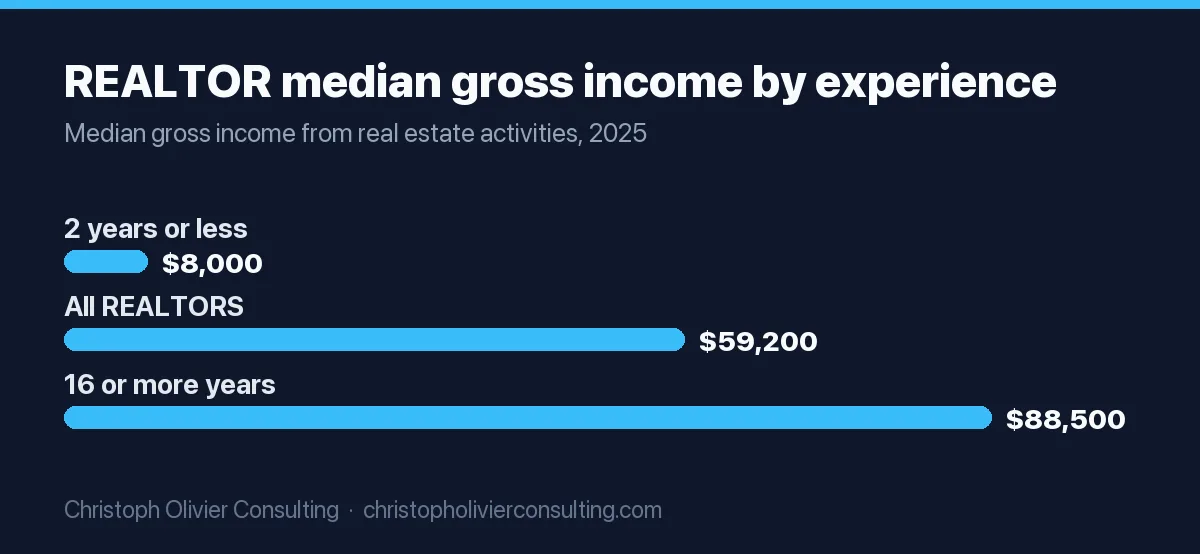
- New agents earn very little from real estate. Median gross income was $8,000 in 2025 for REALTORS® with two years or less, against $59,200 for all members and $88,500 for those with 16 or more years, per NAR.
- Costs are rising. Median business expenses rose to $9,530 in 2025 from $8,010 in 2024, per the NAR press release.
- Yet most plan to stay. 75% of members said they are very certain they will remain active for at least two more years, and the typical member now has 13 years of experience.
The BLS reports a median annual wage of $52,830 for real estate sales agents and $73,220 for brokers in May 2025, with employment projected to grow 2% from 2025 to 2035. The BLS also notes that 54% of sales agents are self-employed, which matters because self-employed income is not a salary: it arrives one closing at a time.
How much does a real estate agent make on a $300,000 house?
Commission is a negotiated percentage of the sale price, paid to the agent’s brokerage, which then pays the agent their split. Redfin’s analysis of its own closed sales found the average US buyer’s agent commission was 2.43% in the second quarter of 2025, up from 2.38% a year earlier and from a low of 2.36% in the third quarter of 2024. Listing-side rates vary by market and contract and are not in that dataset.
| Commission rate on one side | Gross commission on $300,000 | What happens next |
|---|---|---|
| 2.00% (example rate) | $6,000 | Paid to the brokerage. The agent receives their split, minus any desk, franchise, MLS or team fees. Business expenses (median $9,530 a year per NAR) come out of what is left. |
| 2.43% (Redfin buyer’s agent average, Q2 2025) | $7,290 | |
| 2.50% (example rate) | $7,500 | |
| 3.00% (example rate) | $9,000 |
What changed after the NAR settlement. NAR’s new practice rules took effect in August 2024. As NAR describes them, quoted by Redfin: buyers and their agents must agree in writing on how the agent will be paid before touring a home, and offers of compensation from the seller side can no longer be shared on the MLS, though they can still be made off-MLS. In practice, Redfin’s data shows rates dipped right after the settlement and had climbed back to pre-settlement levels by mid-2025. For client counts, the written buyer agreement matters more than the rate: an agent now knows exactly how many buyers they have signed, which makes the at-one-time math above easy to track.
Income math: sides × price × commission
You can rebuild an agent’s gross commission income from three numbers. Using NAR’s 2025 medians: 9 sides with a median sales volume of $2.7 million means about $300,000 per side. At Redfin’s 2.43%, that is $2.7 million × 2.43% = $65,610 in gross commission before the brokerage split. NAR’s reported median gross income for all members was $59,200. The two are not directly comparable (medians do not multiply cleanly, and rates differ by side and market), but they land in the same range, which is a useful sanity check on the method.
Pipeline math worksheet: leads to clients to closings
The fastest way to answer “how many clients do I need?” is to work backward from income. Copy this into a spreadsheet and replace every example input with your own numbers from your CRM and your brokerage agreement. The example rates below are placeholders, not industry benchmarks; no reliable public benchmark for agent lead conversion exists.
| Step | Formula | Example input | Example result |
|---|---|---|---|
| 1. Target take-home from real estate | Your number | $75,000 | $75,000 |
| 2. Add business expenses | Step 1 + your expenses | $9,530 (NAR 2025 median) | $84,530 |
| 3. Gross commission needed before split | Step 2 ÷ your split % | 70% split (example) | $120,757 |
| 4. Commission per closed side | Average price × rate | $300,000 × 2.43% | $7,290 |
| 5. Closed sides needed per year | Step 3 ÷ Step 4 | 16.6, round up to 17 | |
| 6. Signed clients needed | Step 5 ÷ your signed-to-closed rate | 75% (example) | 23 |
| 7. Consultations or listing appointments needed | Step 6 ÷ your appointment-to-signed rate | 40% (example) | 58 |
| 8. Clients active at once | Step 5 × months active ÷ 12 | 3.7 months | 5.2 |
Read the result against the published data. Seventeen sides is nearly double the NAR median of 9, so the plan needs a real lead source behind step 7, not hope. Where those appointments come from is the hard part: in NAR’s 2025 buyer and seller survey, 43% of buyers used an agent found through a referral, and 66% of sellers found their agent through a referral or had used them before. That leaves a minority of clients to win from cold channels. The channel mix that produces those is covered in lead generation for real estate agents, and you can turn this worksheet into a full year plan with the real estate marketing plan template.
A few rules of thumb from the numbers on this page:
- Count signed agreements, not leads. Since August 2024, a written buyer agreement exists for every buyer you tour with, so “clients” now has a clean definition.
- Track months active per client. If your buyers average five months instead of 3.7, the same 17 closings means about 7 active clients at once, not 5.
- Set a ceiling before you hit it. The listing study above saw outcomes drop at 15 or more other listings. Pick your own ceiling, then add a showing assistant, a transaction coordinator or a team partner before you reach it.
- Grow the referral share. Experienced agents get a median 49% of business from repeat clients. The cost of a past client’s next deal is far lower than a new lead’s, which is the core idea behind customer lifetime value.
What this means if you are choosing an agent
Ask three questions, and compare the answers to the numbers here:
- “How many transactions did you close last year, and how many were yours versus your team’s?” Nine individual sides is the NAR median. The CFA advises checking an agent’s recent sales and reviews, naming Zillow and Realtor.com as the most useful places to look.
- “How many clients are you working with right now?” Two to five is typical for a solo agent. Higher is fine if a team or assistant is named.
- “If you have 15 or more listings, who will handle my showings and calls?” That is the level where the Virginia MLS study found homes sat much longer.
For more benchmarks on how buyers and sellers find and hire agents, see the sourced figures in our real estate marketing statistics. If you run a brokerage or team and want help turning these numbers into a lead and referral plan, you can book a consultation.
Ready to scale your revenue?
Book a free 30-min consultation. We’ll diagnose your growth bottleneck and map out the 3 highest-leverage moves for your business.
Frequently asked questions
How many clients do real estate agents have a year?
The typical NAR member closed 9 individual transaction sides in 2025, according to the 2026 NAR Member Profile, down from 10 in 2024. Each side is roughly one client who closed. New agents with two years or less closed a median of 2, and a random sample of 2,000 agents at large firms studied by the Consumer Federation of America found a median of barely two sales.
How many clients does a realtor have at one time?
No survey measures it directly, but the math is simple: closings per year times months each client stays active, divided by 12. With NAR's median of 9 sides and about 3.7 months per client (a 10-week median buyer search plus an assumed six-week closing), a typical agent has about 3 closing clients active at once, plus prospects who have not decided.
How many listings can a real estate agent handle?
A study of 12,388 sales from a Virginia MLS found that about half of listings were held by agents with 2 to 7 other listings. When the agent had 15 or more other listings, homes sold for about 3% less and stayed on the market 129% longer. Agents with 8 to 14 other listings showed no clear penalty. The data covers 1999 to 2009 in one market.
What is the average number of homes a real estate agent sells per year?
Published figures are medians, not averages. NAR members reported a median of 9 individual transaction sides in 2025, with a median sales volume of $2.7 million. A rough top-down check, 4.06 million existing-home sales times two sides divided by 1,438,569 NAR members, gives about 5.6 sides per member, but that ignores new homes, non-members and unrepresented deals.
How much does a real estate agent make on a $300,000 house?
At the 2.43% average buyer's agent commission Redfin measured in the second quarter of 2025, one side of a $300,000 sale pays $7,290 in gross commission. That money goes to the brokerage first. The agent then receives their negotiated split, minus any desk, franchise or MLS fees, and pays business expenses, which NAR put at a median $9,530 for 2025.
How many clients do new real estate agents get?
Very few in year one or two. NAR's 2026 Member Profile reports that REALTORS with two years or less of experience closed a median of 2 individual transaction sides in 2025, with $330,000 in sales volume, and earned a median gross income of $8,000. Repeat and referral business, which is half of a typical member's business, was a median 0% for these new agents.
How many clients: caseload research