
A dental office referral program can thank patients and colleagues, but in most of the US it cannot pay them. Cash, gift cards, discounts or prize entries handed out per referred patient run into the ADA Code of Ethics, state dental and patient-brokering laws that apply to every payer, and, for Medicaid, CHIP or Medicare patients, the federal Anti-Kickback Statute. The programs that hold up reward nobody per head: they make referring easy, say thank you without money attached, and treat every patient the same.
Short answer: Do not tie anything of value to a referral. California makes a referral “rebate, refund, commission, preference, patronage dividend, discount, or other consideration” unlawful for any licensee, Florida treats a kickback for referring patients as patient brokering (a felony with a $50,000 fine at the lowest tier), and the 2026 ADA Code says a patient paid “a specific amount or percentage of professional fees” for marketing “is engaged in fee splitting.” A handwritten thank-you, a referral card and a practice-wide appreciation event that does not depend on referrals are the safe core of a program.
Below: the federal rules, the ADA Code, six state rules quoted with links, a risk matrix for 14 common reward ideas, survey data on the gifts orthodontists send to general dentists, copy-ready thank-you templates and a pass/fail checklist. This is a marketing guide, not legal advice. Run your final program past a health care attorney in your state.
Can dentists give referral rewards? The three layers of rules
Three separate rule sets apply, and the strictest one that reaches your patient wins. Federal law reaches patients in government programs. The ADA Code reaches ADA members. State law reaches every licensed dentist in that state, whatever the patient’s insurance.
| Rule | Who it reaches | What the text says | Maximum penalty |
|---|---|---|---|
| Federal Anti-Kickback Statute, 42 U.S.C. 1320a-7b(b)(2) | Any referral for an item or service payable by a federal health care program (Medicaid, CHIP, Medicare) | Bars anyone who “knowingly and willfully offers or pays any remuneration (including any kickback, bribe, or rebate)… in cash or in kind to any person to induce such person… to refer an individual” | Felony: fine up to $100,000, up to 10 years in prison, or both. Civil penalty up to $127,973 per act (2025 adjusted figure in 45 CFR 102.3) |
| Beneficiary inducement CMP, Social Security Act 1128A(a)(5) | Gifts to Medicare or Medicaid beneficiaries themselves | Penalizes remuneration “likely to influence the beneficiary’s selection of a particular provider”; OIG reads “nominal value” as up to $15 per item or $75 per patient per year, never cash or cash equivalents | Up to $25,595 per act (2025 adjusted figure, 45 CFR 102.3) |
| ADA Code of Ethics 4.E and 4.E.1 (2026 edition) | ADA members, and the ethics standard many state boards echo | “Dentists shall not accept or tender ‘rebates’ or ‘split fees.'” The rule “applies to business dealings between dentists and any third party, not just other dentists” | Membership discipline by the ADA |
| State dental practice acts and anti-kickback laws | Every licensee in the state, all payers including cash and private insurance | Varies; six states quoted in the next section | License discipline; in some states criminal penalties |
The federal layer: when a Medicaid, CHIP or Medicare patient is involved
Federal fraud and abuse law only bites when the referred care can be paid by a government program. For dentists that mostly means children: Medicaid.gov states that “Medicaid covers dental services for all child enrollees,” while adult dental coverage is optional by state and has “no minimum requirements.” Original Medicare is narrower. Medicare.gov says it “doesn’t cover dental services like routine cleanings, fillings, tooth extractions,” with exceptions tied to hospital stays and certain medical treatments.
If you see any of those patients, a reward to a parent for referring another Medicaid family is remuneration “to induce such person… to refer an individual” under the Anti-Kickback Statute. The statute has no dollar floor. It says “any remuneration,” and it covers rewards “in cash or in kind.”
The $15 / $75 nominal value rule, and what it does not cover
The number everyone quotes comes from the OIG policy statement of December 7, 2016: “we are interpreting ‘nominal value’ as having a retail value of no more than $15 per item or $75 in the aggregate per patient on an annual basis. As with our previous interpretation, the items may not be cash or cash equivalents.” It replaced the $10 / $50 limits from the OIG Special Advisory Bulletin of August 2002.
Three details trip up practices:
- It is a reading of the beneficiary inducement law, not an Anti-Kickback safe harbor. The policy statement is about section 1128A(a)(5), gifts that sway a beneficiary’s own choice of provider. A reward for bringing in someone else is a referral payment, which is the Anti-Kickback question.
- Retail value counts, not what you paid. A branded water bottle you bought for $6 that retails for $18 is over the per-item line.
- Existing patients count too. The 2002 bulletin says OIG “considers the provision of free goods or services to existing customers who have an ongoing relationship with a provider likely to influence those customers’ future purchases.”
Worked example for a Medicaid family member. Patient appreciation day tote ($12 retail), holiday treat box ($14), back-to-school kit ($15), birthday card with a $10 retail toothbrush, summer event snack bag ($8). Each item is at or under $15. Total: 12 + 14 + 15 + 10 + 8 = $59, under the $75 annual aggregate. Add a $20 retail electric toothbrush and you break both limits at once. Track it per patient in your practice software, not in someone’s head.
ADA Code of Ethics 4.E: why “rebates” covers patients in 2026
The 2026 ADA Principles of Ethics and Code of Professional Conduct (advisory opinions revised to October 2025) closed the gap that older referral guides relied on. Advisory Opinion 4.E.1 now reads: “If an influencer or a current, past, or prospective patient is providing advertising or marketing services and is paid a specific amount or percentage of professional fees collected for dental procedures from actual or prospective patients, that individual is engaged in fee splitting.”
Advisory Opinion 5.F.4 on referral services adds the general rule: a dentist “is generally not permitted to make payments to another person or entity for the referral of a patient for professional services.” Paying for advertising is fine; paying per patient is the problem.
State dental board rules on referral rewards: six states, quoted
State law is where most patient referral programs actually fail, because it applies to cash and privately insured patients too. Here is the operative text in six large states, read from the statute or regulation itself.
| State | Rule | Operative text | What it means for a patient referral reward | Penalty |
|---|---|---|---|---|
| California | Business and Professions Code 650(a) | “the offer, delivery, receipt, or acceptance by any person licensed under this division… of any rebate, refund, commission, preference, patronage dividend, discount, or other consideration, whether in the form of money or otherwise, as compensation or inducement for referring patients… is unlawful.” | Gift cards, discounts on the referrer’s next visit and free services per referral all fit the list. Applies to all payers. | Public offense: up to 1 year in county jail, a fine up to $50,000, or both (650(i)) |
| Texas | 22 Tex. Admin. Code 108.58; Occupations Code 102.001 | “A licensee shall not offer, give, dispense, distribute or make available to any third party… any cash, gift, premium, chance, reward, ticket, item, or thing of value for securing or soliciting patients.” | A referring patient is a third party, and “chance” covers raffle entries. Allowed: a non-cash gift of no more than $10 given directly to a potential patient, and rewards to patients of record “for the continuation of that relationship,” not for soliciting new patients. | Board discipline; 102.001 makes paying for patient solicitation a Class A misdemeanor |
| Florida | Statutes 456.054(2); 817.505 | “It is unlawful for any health care provider… to offer, pay, solicit, or receive a kickback, directly or indirectly, overtly or covertly, in cash or in kind, for referring or soliciting patients.” | “Kickback” is defined as payment “to any person as an incentive or inducement to refer patients.” Violations “shall be considered patient brokering.” | 817.505: third-degree felony and a $50,000 fine; $100,000 at 10 to 19 patients; $500,000 at 20 or more |
| New York | 8 NYCRR 29.1(b)(3) and (4), applied to dentistry by 29.5 | Unprofessional conduct includes “directly or indirectly offering, giving, soliciting, or receiving or agreeing to receive, any fee or other consideration to or from a third party for the referral of a patient.” | Any consideration to a referring patient or colleague is professional misconduct, regardless of payer. | License discipline |
| Illinois | 225 ILCS 25/23, item 5 | Grounds for discipline include “Division of fees or agreeing to split or divide the fees received for dental services with any person for bringing or referring a patient.” | Aimed at fee splitting; a per-referral payment funded from fees fits it. Licensed referral services under Section 45 are excepted. | License action and fines up to $10,000 per violation |
| Michigan | MCL 333.16221(d)(ii) | Unethical business practices include “Dividing fees for referral of patients or accepting kickbacks on medical or surgical services, appliances, or medications purchased by or in behalf of patients.” | Fee splitting for referrals is a listed ground for investigation and discipline. | License discipline |
Two state details worth knowing. Florida’s patient brokering statute excludes “any discount, payment, waiver of payment, or payment practice not prohibited by” the federal Anti-Kickback Statute (817.505(3)(a)); how far that reaches for cash-pay patients is a question for Florida counsel, and 456.054 has its own text. Texas 108.58(c) explicitly allows paying for advertising or marketing services when the fee “is set in advance, is consistent with the fair market value of the services, and is not based on the volume or value of any patient referrals.” California 650(g) says the same for third-party advertisers that do not “recommend, endorse, or otherwise select a licensee,” and requires discount ads to show the regular price.
Referral reward risk matrix: 14 ideas rated
This is the decision table built for this page. “Tied to a referral” is the question that matters most: if the item only arrives because someone sent you a patient, assume it is a referral payment.
| Idea | Tied to a referral? | Rule it runs into | Rating |
|---|---|---|---|
| $25 or $50 gift card per new patient | Yes | CA 650 “money or otherwise”; TX 108.58 “cash, gift”; FL 456.054; NY 29.1(b)(3); ADA 4.E.1; AKS for program patients; OIG bars cash equivalents outright | High risk |
| $X off the referrer’s next treatment | Yes | CA 650 names “discount” and “refund”; ADA 4.E “rebates” | High risk |
| Free whitening or cleaning per referral | Yes | In-kind remuneration under the AKS; “thing of value” in TX; “consideration” in CA and NY | High risk |
| Raffle entry per referral | Yes | TX 108.58 lists “chance” and “ticket”; still a thing of value elsewhere | High risk |
| Paying an influencer or patient per booked patient | Yes | ADA 4.E.1 names influencers and patients | High risk |
| Pay-per-patient lead service that picks one dentist | Yes | ADA 5.F.4; CA 650(g) and TX 108.58(c) only protect flat, fair market fees | High risk |
| Donation to a charity for each referred patient | Yes, but value goes to a charity | No money to the referrer, so it is far from the core kickback pattern; TX 108.58(a) still reaches value to “any third party” for securing patients | Gray: get a state opinion first |
| Specialist gifts to a GP office scaled to referral volume | Yes | AKS if Medicaid or CHIP patients are referred; ADA 4.E; state fee-splitting rules | High risk |
| Same modest holiday treat to every referring office | No (not scaled) | Still “remuneration” under the AKS if intended to induce referrals; keep it small and uniform | Gray, lower |
| Handwritten thank-you note, no item | Yes, but nothing of value | None | Low risk |
| Printed referral cards and a share link | No | Advertising rules only (truthful content) | Low risk |
| Patient appreciation event open to all patients | No | Keep per-person value within $15 / $75 for Medicare or Medicaid patients | Low risk |
| New-patient offer advertised to the public | No | TX allows a non-cash gift up to $10 to a potential patient; Medicare or Medicaid patients fall under the beneficiary inducement rules | Low to gray |
| Loyalty perk for staying a patient, unrelated to referrals | No | TX 108.58(b) allows it “for the continuation of that relationship”; check your state and program patients | Gray, state-specific |
Dental patient referral program ideas that stay on the right side of the rules
The useful question is not “what can we give?” but “why would a happy patient mention us, and how do we make that one step easier?” These ideas cost little and carry no per-referral reward.
- Ask at the moment of relief. The best time is right after a pain visit is solved or a smile is finished. One sentence at checkout (script below) does more than a lobby poster.
- Hand over two referral cards, not one. Put your phone number, booking link, insurance plans accepted and a QR code on them. No offer printed, no “you get” line.
- Make the booking page referral-friendly. Add “Who referred you?” as an optional field. It is the only way to know who to thank and whether the program works.
- Send a handwritten thank-you within a week. Template below. Nothing inside the envelope.
- Run one practice-wide appreciation event a year. Open to every patient, whether or not they ever referred anyone. Price favors for Medicare or Medicaid patients against the $15 / $75 limits.
- Treat the referred patient well and say so. Fast first appointment, a call from the dentist after a big procedure. Referrers hear about it from their friend.
- Give patients something worth forwarding. A clear one-page explainer on what a crown or aligner case costs, emailed after the consult, gets shared far more than a promo.
- Ask for a review in the same message. Reviews are referrals to strangers; use the request patterns in our guide on how to get more Google reviews, with no incentive attached.
- Build the professional side. Physicians, pediatricians, sleep clinics and specialists refer too. A quarterly lunch-and-learn with real clinical content beats gift baskets.
- Measure it as a channel. Count referred new patients per month and their accepted treatment, then compare with paid channels in your dental office marketing budget.
If you want the wider system behind this, the referral marketing guide covers program design across industries, and dental marketing costs per patient shows where referrals sit next to SEO and ads.
Dental office referral gifts: what specialists actually send
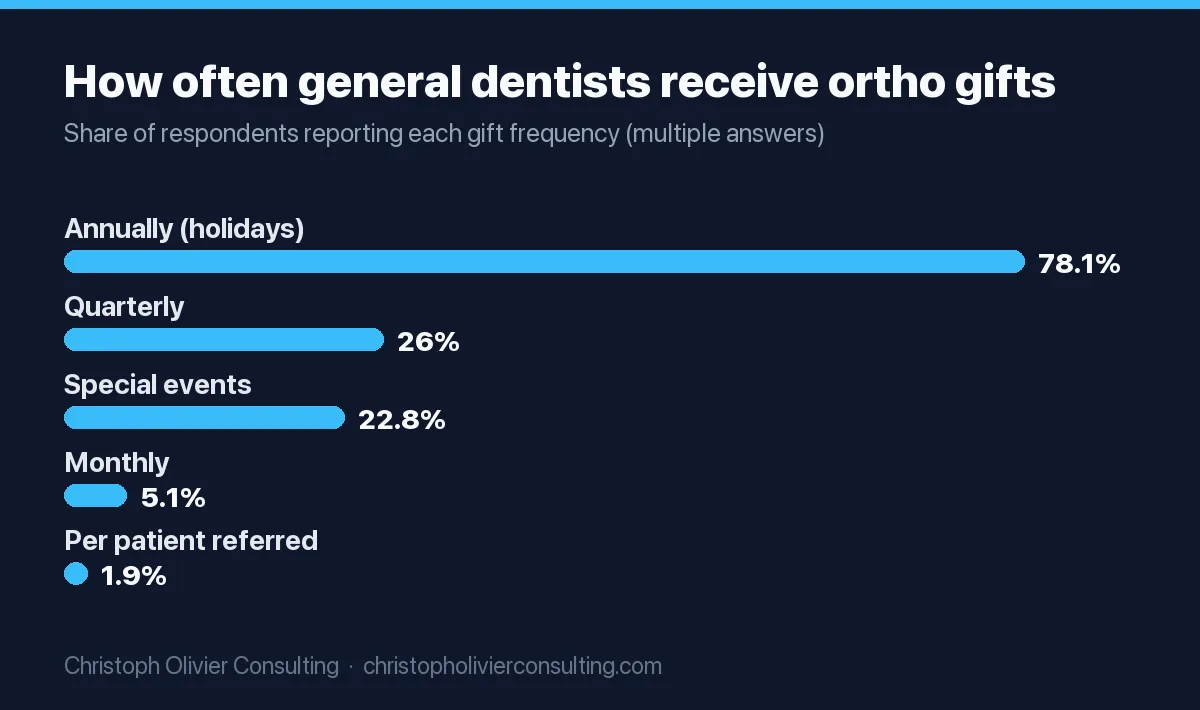
The “referral gifts” searches mostly come from the other direction: orthodontists, oral surgeons and endodontists thanking general dentists. The best data comes from a peer-reviewed survey, Al-Mahdi, Firestone, Beck and Fischbach, “Gifts from orthodontists to general dentists,” The Angle Orthodontist, 2017. It emailed 1,300 general dentists in Ohio (members of the Ohio State University alumni association) and analyzed 254 valid responses (about 20%). Eighty-five percent said they received gifts from an orthodontist, and 44% reported discounted orthodontic treatment.
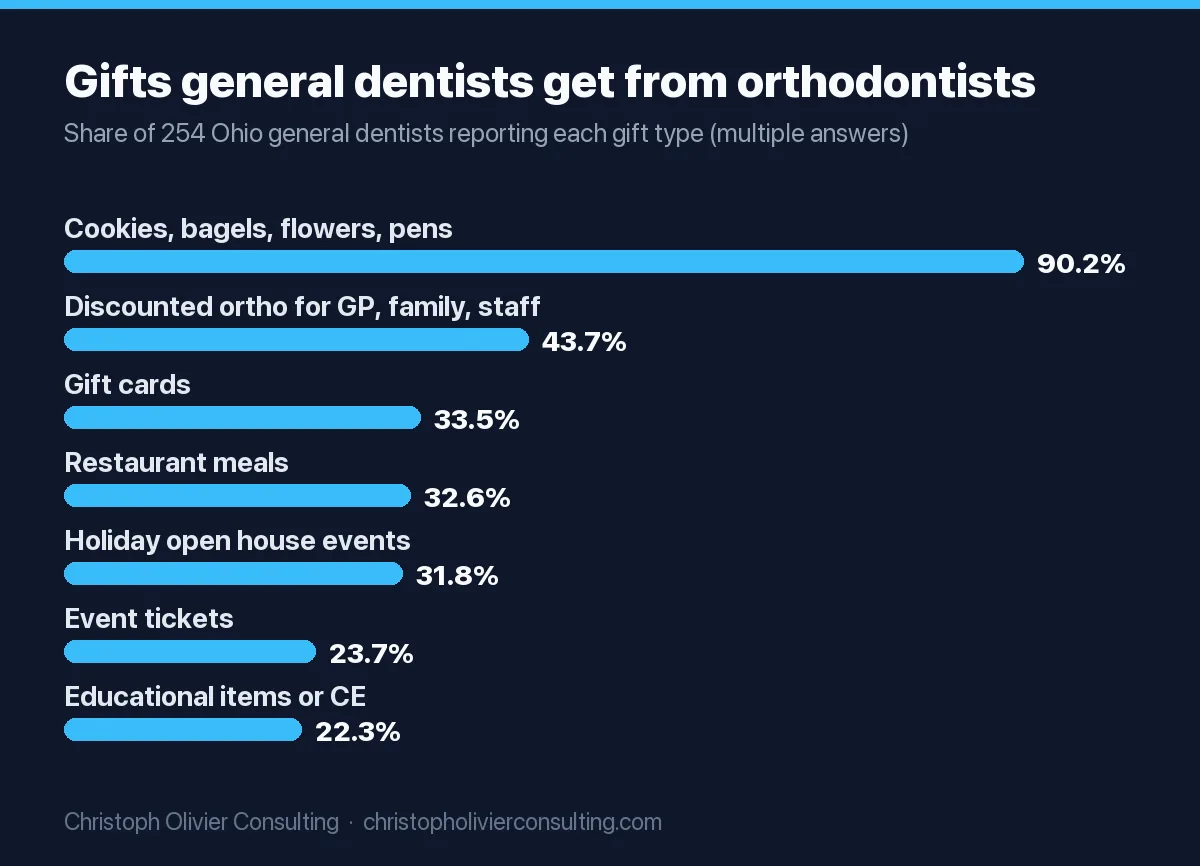
From the full text: the mean annual value of all gifts was $860.60, which falls to $320 once free or discounted orthodontic care is removed. Respondents averaged 6.4 gifts a year. 85.6% said gifts came “only [from] practices we refer patients to,” and the authors found a statistically significant correlation between referrals made and the number and value of gifts received. Asked why they refer, 83% ranked “high-quality orthodontic outcome and patient’s satisfaction” first.
| Gift type general dentists reported receiving | Share of respondents |
|---|---|
| Cookies, bagels, flowers, pens and similar | 90.2% |
| Discounted orthodontic treatment for the dentist, family or staff | 43.7% |
| Gift cards | 33.5% |
| Meals at restaurants | 32.6% |
| Holiday open house receptions or events | 31.8% |
| Tickets (sporting events, movies) | 23.7% |
| Educational items such as seminars or CE | 22.3% |
| Jewelry / vacations / electronics | 2.3% / 0.9% / 0.5% |
Source: Al-Mahdi et al., Table 6. Multiple answers allowed. One state, low response rate, so read it as a pattern, not a national norm.
What is a good referral gift for a dental office?
The data points to the answer. Gifts that went to the whole team (88.4% said the “entire office” received them) and consumables like food and flowers were the norm. Gift cards, tickets and discounted treatment are the categories that look most like payment. A defensible gift to a referring office is:
- sent on a calendar (holidays, the office’s anniversary), not per referral;
- the same for every referring office, not scaled to volume;
- consumable and shared by the team, such as a lunch delivery or fruit basket;
- never cash, gift cards or free treatment for the dentist or family.
The same logic answers “what is a good gift for a dental clinic” from a patient: a card or homemade treat for the team is a kind gesture, not a referral payment, because the dentist is receiving, not paying.
Do dentists get paid for referrals to other dentists?
They should not. The ADA Code’s “rebates” and “split fees” rule in 4.E is aimed squarely at money moving between the referring and receiving dentist, and California, New York, Illinois and Michigan all prohibit paying for referrals or splitting fees for them in the text quoted above. Only 1.9% of dentists in the Ohio survey reported gifts “per patient referred,” which is the pattern that looks most like a payment. Legitimate money between offices comes from documented services at fair market value, such as a consulting or employment arrangement, not from the referral itself.
Copy-ready referral thank-you templates
1. Patient thank-you card (handwritten, nothing enclosed)
Dear [first name],
Thank you for recommending us to someone you care about. It means a lot that you trusted us with that. We will take good care of them.
If you ever have a question about your own care, call me directly at [number].
With thanks,
[Dentist first name] and the team at [Practice]
Do not name the referred patient or mention their treatment in the card. A card can be seen by anyone in the house.
2. Thank-you note to a referring office (from a specialist)
Dear Dr. [name] and team,
Thank you for the trust you place in us with your patients. Our goal is to return each one to you with a clear report and a finished result, and to keep you informed at each step.
If anything about our communication could be faster or clearer for your front desk, tell me and we will fix it.
Warm regards,
Dr. [name], [Practice]
3. Checkout script for asking
“We are glad today went well. Most of our new patients come from people like you telling a friend. If someone asks you about a dentist, here are two cards with our booking link. We would be glad to take care of them.”
Compliance checklist: pass/fail before you launch
| Check | Pass | Fail |
|---|---|---|
| 1. Does anything of value reach a person because they referred a patient? | No: only notes and thanks | Yes: gift card, discount, free service, prize entry |
| 2. Is any amount calculated from fees collected from the referred patient? | No | Yes (fee splitting under ADA 4.E.1) |
| 3. Do you treat Medicaid, CHIP or Medicare patients? | No, or every gift is under $15 retail per item and $75 per patient per year, never cash or cash equivalents | Gifts above the limits, or any referral-linked item for these patients |
| 4. Have you read your own state’s rule on paying for referrals or soliciting patients? | Yes, text saved in the program file | Relying on a vendor blog |
| 5. Are marketing vendors paid a fixed, fair market fee? | Yes, set in advance, not per patient | Per booked patient or percentage of production |
| 6. Are gifts to referring offices uniform and calendar-based? | Yes | Scaled to referral volume, or per referral |
| 7. Is every appreciation event open to all patients? | Yes | Invitation only for referrers |
| 8. Does your promotional copy avoid promising rewards? | Yes: “Thank you for trusting us” | “Refer a friend, get $50” |
| 9. Has a health care attorney in your state reviewed it? | Yes, dated sign-off | No review |
If you also run cosmetic campaigns, the same per-patient payment problem shows up with social coupons and influencers; our cosmetic dentist marketing playbook covers those channels. And if you want help building a referral system that fits your state’s rules, you can book a consultation.
How does a dental referral work?
What is a dental referral?
A dental referral is when your dentist sends you to another dentist, usually a specialist, for care they do not provide: an orthodontist, oral surgeon, endodontist or periodontist. Some plans require it before they will pay. Delta Dental notes that “pre-authorizations or referrals are required for certain benefit plans and certain dental care providers,” so check your plan document.
How does a dental referral work after the specialist visit?
The ADA Code (section 2.B) sets the expectation: the specialist “upon completion of their care shall return the patient, unless the patient expressly reveals a different preference, to the referring dentist.” The specialist treats the problem and you go back to your regular dentist for ongoing care.
Where can I get a dental referral?
From your current general dentist, which is the usual route. If you have no dentist, call the member services number on your dental plan for an in-network specialist list, or use HRSA’s Find a Health Center tool to locate a community health center near you. For children in Medicaid, Medicaid.gov states that “a referral to a dentist is required for every child in accordance with the periodicity schedule set by a state.”
Can a dentist refuse to give a referral?
The ADA Code points the other way: dentists “shall be obliged to seek consultation, if possible, whenever the welfare of patients will be safeguarded or advanced by utilizing those who have special skills, knowledge, and experience.” If a dentist will not refer, you can ask for a second opinion or a copy of your records and see a specialist directly, unless your plan requires a referral to pay.
Two other questions people ask alongside this one
What is the dentist 2 year rule?
There is no federal or ADA rule by that name in the sources reviewed for this page. People usually mean a plan’s frequency limit or an office’s own policy on when a lapsed patient is booked as new. Check the plan document or ask the office.
What is the 50-40-30 rule in dentistry?
It is a cosmetic guideline, not a business or referral rule. It describes the ideal “apparent contact dimension” between upper front teeth, shrinking in a 50:40:30 ratio from the midline toward the canine. Real teeth often do not follow it: a 2018 study of 150 dental students in the Journal of Prosthetic Dentistry found their proportions “did not fit the 50:40:30 ratio.”
Ready to scale your revenue?
Book a free 30-min consultation. We’ll diagnose your growth bottleneck and map out the 3 highest-leverage moves for your business.
Frequently asked questions
Can dentists give referral rewards to patients?
Generally not if the reward depends on the referral. California Business and Professions Code 650 bans any rebate, discount or other consideration for referring patients, Texas rule 108.58 bars cash, gifts or chances to third parties for securing patients, and the 2026 ADA Code treats paying a patient per referred case as fee splitting. A thank-you note with nothing of value enclosed is the safe option.
Is a dental referral program legal?
A referral program is legal when it makes referring easy and thanks people without paying them per patient: referral cards, a booking link, a handwritten note and appreciation events open to every patient. It becomes a problem when a gift card, discount, free service or prize entry is tied to each referral, which state laws, the ADA Code and, for Medicaid or Medicare patients, the federal Anti-Kickback Statute restrict.
What are good dental office referral gifts?
For a referring office, the lowest-risk gifts are uniform, calendar-based and shared by the whole team, such as a holiday lunch or fruit basket, never scaled to referral volume. In an Ohio survey of general dentists, 90.2% reported receiving cookies, flowers or similar items from orthodontists, while gift cards, tickets and discounted treatment were less common and look more like payment.
Do dentists get money for referrals?
They should not. ADA Code section 4.E says dentists shall not accept or tender rebates or split fees, and states such as New York, Illinois and Michigan list fee splitting or paying for referrals as misconduct. Florida treats kickbacks for referring patients as patient brokering, a felony. Money between practices should only pay for documented services at fair market value.
What is the OIG nominal value limit for gifts to patients?
In its December 2016 policy statement, the HHS Office of Inspector General said it reads nominal value as a retail value of no more than $15 per item or $75 per patient per year, and never cash or cash equivalents. It applies to gifts to Medicare and Medicaid beneficiaries under the beneficiary inducement law. It is not a safe harbor for paying referral rewards.
Can a dental office donate to charity for each referral?
It is a gray area. No money reaches the referrer, which keeps it far from a classic kickback, but some state rules reach value given to any third party for securing patients. Texas rule 108.58(a) is written that broadly. Get a written opinion from a health care attorney in your state or your dental board before launching a per-referral donation.
Referral fee rules by profession