

A bookkeeper costs most small businesses between about $200 and $750 a month when you outsource, or about $24 an hour in wages when you hire one as an employee. Online services published starting prices from $99 to $1,250 a month when we read their pricing pages on November 16, 2026, and the most common fee independent bookkeepers report charging is $300 to $500 a month. A full-time in-house bookkeeper at the median wage costs roughly $74,000 a year once benefits are included.
Short answer: Employed bookkeepers earned a median $24.36 an hour ($50,670 a year) in May 2025, according to the Bureau of Labor Statistics. Outsourced plans start around $200 to $400 a month for a small business with simple books, and 40% of independent bookkeepers in one 2025 survey said their typical client pays $300 to $500 a month. Your price rises with transaction volume, accounts, payroll and how far behind the books are.
Below you get the actual numbers behind those ranges: wage percentiles from the federal government, published plan prices from each vendor’s own page, a fee survey of independent bookkeepers, and a calculator you can fill in with your own figures.
Bookkeeper cost per month: 2026 published prices
These are list prices from each provider’s own pricing page, read on November 16, 2026. They change often, so check the page before you sign. “Quote only” means the provider does not publish a number.
| Provider and plan | Monthly price | What sets the price | Catch-up / cleanup |
|---|---|---|---|
| Bench Bookkeeping Light | $199/mo, or $1,910/yr billed annually | Only for businesses with $250K or less in yearly revenue | Current year caught up free on an annual plan; prior years quoted |
| Bench Bookkeeping | $399/mo, or $3,830/yr | Flat | Same as above |
| Bench Bookkeeping + Tax | $649/mo, or $6,230/yr | Adds business income tax filing and up to four advisory calls a year | Same as above |
| Bench QBO Bookkeeping (in your QuickBooks file) | $399 / $699 / from $999 a month | Up to 500 transactions a month, up to 2,000, or unlimited | Same as above |
| Pilot Essentials | $99/mo | Up to $100,000 in monthly expenses; AI categorizes and reconciles, cash basis, support by in-app message | Not published |
| Pilot Core | From $299/mo billed annually ($399 month to month) | Monthly expenses: up to $15,000 is $299; up to $30,000 is $499; rising to about $559 near $60,000; custom above that. Adds a US-based bookkeeper, accrual option, reports by the 10th business day | Not published |
| Pilot Custom | Quote only | AR, AP, payroll admin, existing QuickBooks file | Quote only |
| Merritt Bookkeeping | $250/mo | Flat, “no pricing tiers,” no contract | $200 for each month you are behind; $100 for months needing fewer than 20 entries |
| inDinero Essential | From $750/mo | Simple financial structures; outsourced accounting team | Quote only |
| inDinero Growth | From $1,250/mo | Accrual accounting managed by controllers, QuickBooks Online or NetSuite | Quote only |
Two things stand out. First, the cheapest plans are cheap because software does most of the work: Pilot’s $99 Essentials tier describes AI categorizing and reconciling, while the human bookkeeper arrives at the Core tier. Second, the published tiers are keyed to your volume, either monthly expenses (Pilot) or monthly transactions (Bench’s QBO plans), so the honest answer to “how much are bookkeepers” depends on how many transactions you push through each month.
A word on Bench, because many older articles still list it: the platform shut down abruptly on December 27, 2024 and Employer.com agreed to acquire it three days later, per TechCrunch. Its pricing page is live again with the plans above. That episode is the strongest argument for keeping your books in a file you own and can export.
How much does a bookkeeper charge per hour?
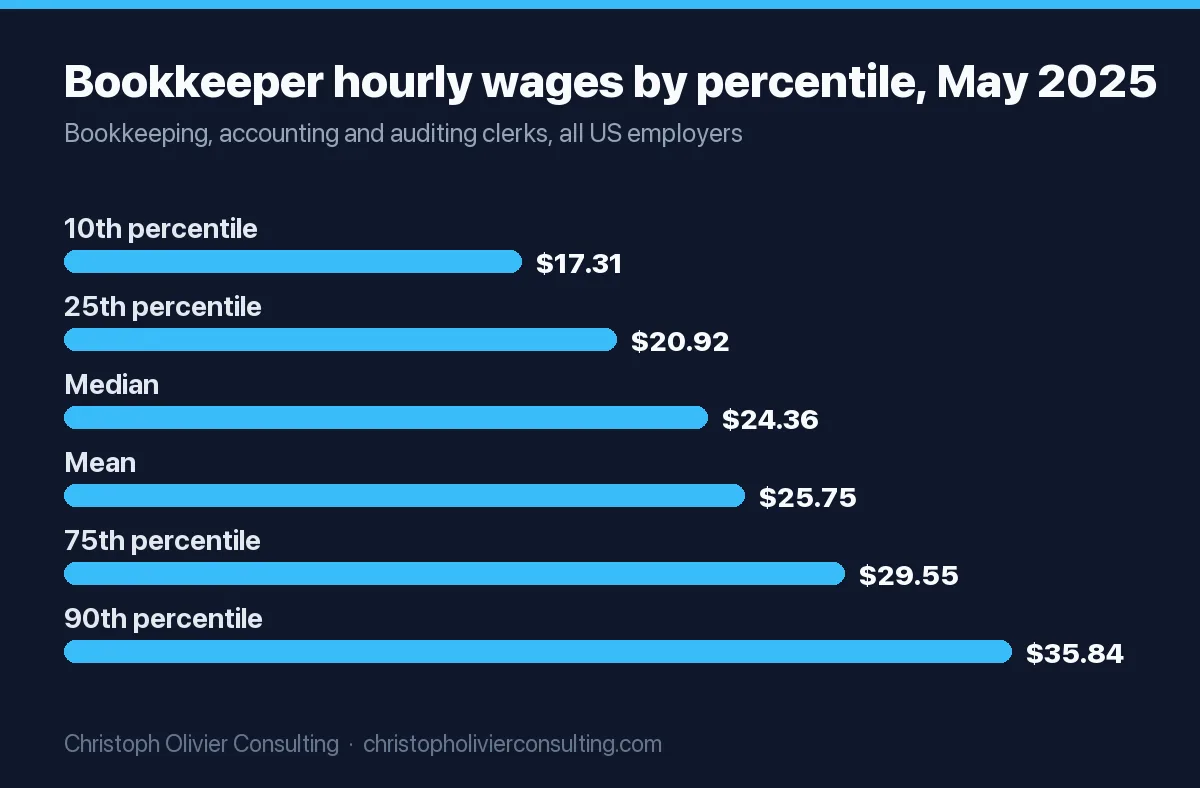
For employees, the best number is the federal one. The Bureau of Labor Statistics Occupational Employment and Wage Statistics for bookkeeping, accounting and auditing clerks (May 2025, 1,373,680 jobs) shows this spread:
| Percentile (May 2025) | Hourly wage | Annual wage | Hourly cost with benefits (our calculation) |
|---|---|---|---|
| 10th | $17.31 | $36,000 | $25.20 |
| 25th | $20.92 | $43,520 | $30.45 |
| Median | $24.36 | $50,670 | $35.46 |
| Mean | $25.75 | $53,560 | $37.48 |
| 75th | $29.55 | $61,470 | $43.01 |
| 90th | $35.84 | $74,550 | $52.17 |
The last column is our own calculation. The BLS Employer Costs for Employee Compensation survey (June 2026) found that for private-industry office and administrative support workers, wages are 68.7% of total compensation and benefits are 31.3% ($25.22 in wages and $11.51 in benefits per hour worked). Dividing each wage by 0.687 gives the employer’s approximate all-in hourly cost. Treat it as an average: a part-time bookkeeper with no health plan costs you less, a senior full-charge bookkeeper with a rich benefits package costs more.
What hourly rate should a bookkeeper charge as a freelancer?
A freelancer or firm has to cover what an employer normally pays: the benefits, payroll taxes, software, unbilled admin time and marketing. That is why an independent bookkeeper charging the same hourly figure as the median employee wage would be underpricing. A practical floor is the loaded employee cost in the table above, roughly $35 an hour at the median, and anything specialized (job costing, inventory, multi-entity, cleanup) sits above it.
In practice, most independent bookkeepers no longer quote by the hour at all. In the 2025 State of Virtual Bookkeeping and Accounting Industry Report discussed on The Ambitious Bookkeeper Podcast (644 responses, per the hosts), about 50% of respondents said they charge a fixed monthly fee, 17% use tiered packages, 13% value-based pricing and only 12% bill hourly.
What is the going rate for a bookkeeper?
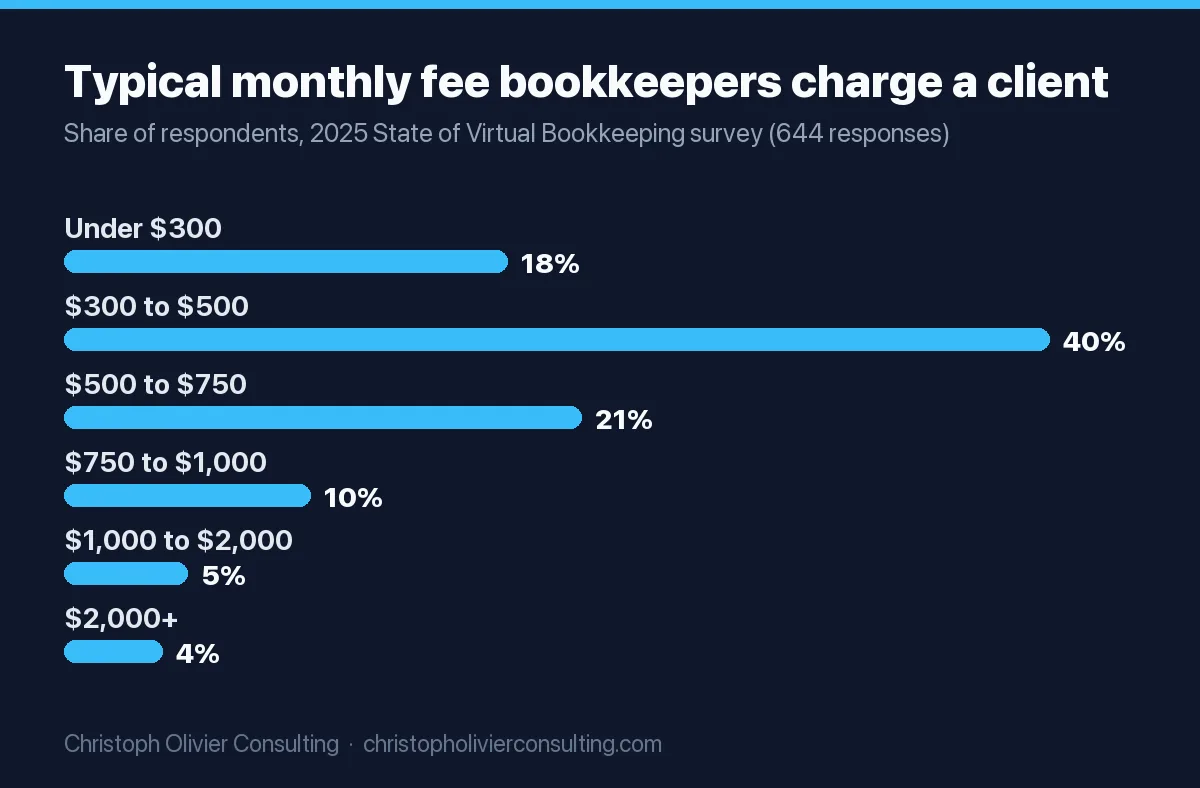
For an outsourced bookkeeper on a monthly retainer, the most useful public figure comes from bookkeepers themselves. When the same 2025 survey asked “What is the average monthly fee of your clients, or typical monthly fee you charge your clients?”, the answers were:
| Typical monthly fee per client | Share of respondents |
|---|---|
| Under $300 | 18% |
| $300 to $500 | 40% |
| $500 to $750 | 21% |
| $750 to $1,000 | 10% |
| $1,000 to $2,000 | 5% |
| $2,000 or more | 4% |
Source: The Ambitious Bookkeeper Podcast, episode 206, figures as read out by the hosts. The hosts flag two limits: respondents may have read the question as average or as minimum fee, and most respondents said the majority of their clients earn under $100,000 a year. So this is the going rate for small, simple clients. If your business does seven figures in revenue, expect to be in the top three rows.
Employee vs freelancer vs firm vs online service: cost side by side
The four ways to buy bookkeeping price very differently. This table puts them on one monthly basis. Employee rows are our calculations from the BLS figures above; outsourced rows are the published prices and survey ranges already cited.
| Option | Typical monthly cost | How it is calculated | Best fit | Main risk |
|---|---|---|---|---|
| Full-time employee | About $4,220 in wages, about $6,150 all in | Median $50,670 a year divided by 12; all-in divides by 0.687 (ECEC benefits share) | Hundreds of transactions a week, daily AP/AR, payroll in house | One person holds all the knowledge; fraud controls need a second set of eyes |
| Part-time employee, 10 hours a week | About $1,056 in wages to $1,537 all in | $24.36 x 10 hours x 52 weeks / 12; all-in uses $35.46 | You want someone on site a day or two a week | Hiring, training and covering vacations |
| Independent bookkeeper (retainer) | $300 to $750 for most clients | 79% of survey respondents’ typical fees fall under $750 | Owner-led firms that want a named person who knows the business | Capacity: one person, many clients |
| Online service | $99 to $1,250+ | Published plans from Bench, Pilot, Merritt, inDinero | Standard books, bank-fed transactions, few exceptions | Less judgment on odd items; you depend on the platform |
| CPA or accounting firm doing the books | Usually quote only | Firms rarely publish bookkeeping fees | When you want books and tax under one roof | Highest rate per hour of work |
On capacity, the number of clients a solo bookkeeper can serve well is limited, which is one reason good ones raise prices or close their books to new clients. We break down that math in how many clients a bookkeeper can handle.
Bookkeeper cost calculator (fill in your numbers)
Copy this into a spreadsheet. It compares an employee against an outsourced plan on the same basis, using your own transaction count and the published rates above.
- Count your monthly transactions. Export last quarter’s bank and card activity, add the lines, divide by 3. Call it T.
- Estimate hours an employee would need. Hours per month = T divided by your entry rate, plus fixed time for reconciliations and close. Write your own assumption down; there is no official benchmark.
- Employee cost. Hours per month x hourly wage / 0.687. Use $24.36 for a median bookkeeper, $29.55 for the 75th percentile.
- Outsourced cost. Pick the published tier that matches T or your monthly expenses (for example, Bench QBO: up to 500 transactions is $399; Pilot Core: up to $15,000 in expenses is $299 billed annually).
- Add one-time costs. Catch-up months x the provider’s catch-up rate (Merritt publishes $200 per month behind).
- Add your own time. Hours you spend each month on bookkeeping x what an hour of your time is worth. This is the cost most owners leave out.
- Compare year one and year two. Year one includes catch-up; year two shows the steady-state price.
Worked example (our calculation)
A consulting firm runs about 400 transactions a month, is four months behind, and the owner spends 8 hours a month on the books.
| Line | Part-time employee (10 hrs/week, median wage) | Bench QBO, Complexity 1, annual | Merritt Bookkeeping |
|---|---|---|---|
| Monthly fee or wages | $1,537 all in | $319 ($3,830 / 12) | $250 |
| Catch-up, 4 months | Employee time (included above) | $0 for current-year months on an annual plan | $800 (4 x $200) |
| Year-one total | $18,444 | $3,830 | $3,800 |
| Year-two total | $18,444 | $3,830 | $3,000 |
At 400 transactions a month, outsourcing costs roughly a fifth of a part-time hire. The employee only wins once the role grows into AP, AR, payroll and daily office work that a monthly-close service does not do. The example leaves out software: most services require or include an accounting subscription, so check what each plan bundles.
What you will pay by transaction volume
Use this as a decision table. The price bands come from the published tiers cited above; the volume bands are how those vendors draw their own lines.
| Your situation | Published price band | Sensible option |
|---|---|---|
| Under $250K revenue, one bank account, a few dozen transactions | $99 to $250 a month | Pilot Essentials, Bench Light, or a flat-fee bookkeeper |
| Up to about 500 transactions or $15,000 in monthly expenses | $250 to $400 a month | Pilot Core, Bench Bookkeeping or QBO Complexity 1, independent bookkeeper |
| 500 to 2,000 transactions or $15,000 to $60,000 in monthly expenses | $500 to $700 a month | Bench QBO Complexity 2, Pilot Core upper tiers, a firm on retainer |
| Unlimited transactions, inventory, multiple entities, AP/AR | From $750 to $1,250+ a month, often quote only | Bench QBO Complexity 3 (from $999), inDinero, Pilot Custom, or a part-time employee |
Is $300 a month reasonable for monthly bookkeeping?
Yes, for a small business with simple books, $300 a month sits right in the middle of the market. It is inside the $300 to $500 band that 40% of bookkeepers in the 2025 survey named as their typical fee, and it is close to Bench’s $399 Bookkeeping plan and Pilot’s $299 Core entry price billed annually. It is high if you only have a handful of transactions (Bench Light is $199, Pilot Essentials is $99) and low if you have payroll, inventory, several accounts or more than a few hundred transactions a month.
The question to ask is what $300 buys: monthly reconciliation of every account, a closed month with a profit and loss statement and balance sheet, and a named person who answers questions. If it buys categorization only, it is a software fee with a human attached.
Is a bookkeeper cheaper than an accountant?
Yes, per hour. Employed accountants and auditors earned a median $40.23 an hour ($83,680 a year) in May 2025, according to the BLS Occupational Outlook Handbook, about 65% more than the $24.36 median for bookkeeping clerks (our calculation). On the outsourced side, the same pattern shows up in published prices: Pilot lists tax consulting from $250 an hour for single-member LLCs and from $400 an hour for partnerships, S-corps and C-corps, while its full bookkeeping tier starts at $299 a month. A bookkeeper records and reconciles; an accountant or CPA interprets, files and advises. Paying accountant rates for data entry is the expensive mistake, and paying bookkeeper rates for tax strategy is the risky one. If you are weighing finance leadership on top of the books, our comparison of fractional CFO and fractional CMO roles covers where that line sits.
Is it worth getting a bookkeeper?
Run step 6 of the calculator. If you spend 8 hours a month on bookkeeping and an hour of your time is worth more than about $40, a $300 plan pays for itself in hours alone, before counting cleaner tax filing and faster month-end numbers. It also tends to be worth it when:
- You are behind by more than a quarter. Catch-up only gets more expensive; Merritt charges $200 for every month behind.
- A lender, investor or buyer will look at your books. Pilot sells its Core plan on exactly that: “reporting your partners, lenders, and investors trust.”
- You make pricing or hiring decisions monthly and need a closed month by a fixed date. Pilot Core promises reports by the 10th business day; Custom by the 6th.
For a professional-service firm, the same monthly numbers tell you what your marketing actually returns. If you are tracking customer acquisition cost or checking yourself against average accounting firm revenue, you need books closed on time first.
What are the downsides of hiring a bookkeeper?
- Platform risk. Bench customers lost access with little warning in December 2024. Keep the ledger in a system you own and export it quarterly.
- Scope creep fees. Low tiers have ceilings: 500 transactions, $15,000 or $100,000 in expenses, $250K revenue. Cross one and the price changes.
- Cash vs accrual. Pilot Essentials is cash basis only; accrual starts at Core. If you need accrual reports for a lender, the cheapest tier will not do.
- Catch-up bills. Cleanup is often priced separately from the monthly plan, and prior years are commonly quote only.
- You still own the outcome. A bookkeeper does not replace review. Read your monthly profit and loss statement and ask about anything that surprises you.
How much should you pay someone to do your bookkeeping?
Match the price to your volume, not to a headline average. In my view the cleanest way to decide is this:
- Under a few hundred transactions a month: pay $200 to $400 for an online plan or flat-fee bookkeeper.
- A few hundred to 2,000 transactions, payroll or accrual needs: budget $500 to $1,000 a month.
- Daily AP/AR, inventory, multiple entities: price a part-time employee at $1,050 to $1,550 a month for 10 hours a week, and compare it with a custom quote.
If you are a bookkeeper reading this to set your own prices, the survey numbers above are your market. Our guide to how to get clients as a bookkeeper covers how to fill the calendar once you have set them. And if your firm is growing faster than its back office and marketing can keep up, you can book a consultation to talk through the plan.
Ready to scale your revenue?
Book a free 30-min consultation. We’ll diagnose your growth bottleneck and map out the 3 highest-leverage moves for your business.
Frequently asked questions
How much does a bookkeeper cost per month?
Most small businesses pay about $200 to $750 a month for an outsourced bookkeeper. Published plans read on November 16, 2026 started at $99 (Pilot Essentials), $199 to $399 (Bench), $250 (Merritt) and $750 to $1,250 (inDinero). In a 2025 survey of independent bookkeepers, 40% said their typical client pays $300 to $500 a month.
How much does a bookkeeper charge per hour?
Employed bookkeeping clerks earned a median $24.36 an hour in May 2025, with the 10th to 90th percentile running from $17.31 to $35.84, according to BLS wage data. Adding benefits at the BLS average share for office and administrative support workers lifts the median employer cost to about $35.46 an hour. Freelancers usually price above that because they cover their own overhead.
What is the going rate for a bookkeeper?
For an employee, the going rate is the BLS median of $24.36 an hour or $50,670 a year (May 2025). For an outsourced monthly retainer, the most common answer in the 2025 State of Virtual Bookkeeping survey was $300 to $500 a month (40% of respondents), followed by $500 to $750 (21%) and under $300 (18%).
Is $300 a month reasonable for bookkeeping?
Yes, for a small business with simple books. $300 falls inside the $300 to $500 band that 40% of surveyed bookkeepers named as typical, and near Pilot Core's $299 entry price billed annually and Bench's $399 plan. It is generous for a handful of transactions and too low for payroll, inventory or several hundred transactions a month.
Is a bookkeeper cheaper than an accountant?
Yes. BLS data for May 2025 puts the median accountant and auditor wage at $40.23 an hour versus $24.36 for bookkeeping clerks, about 65% higher. Outsourced pricing follows the same pattern: Pilot lists tax consulting from $250 to $400 an hour, while its bookkeeping tier starts at $299 a month billed annually.
How much does a full-time bookkeeper cost a year?
The median wage is $50,670 a year (BLS, May 2025). Using the BLS finding that wages are 68.7% of total compensation for private-industry office and administrative support workers, the all-in employer cost is roughly $73,755 a year, or about $6,150 a month. That is our calculation; your actual benefits package will move it up or down.
Practice economics benchmarks