
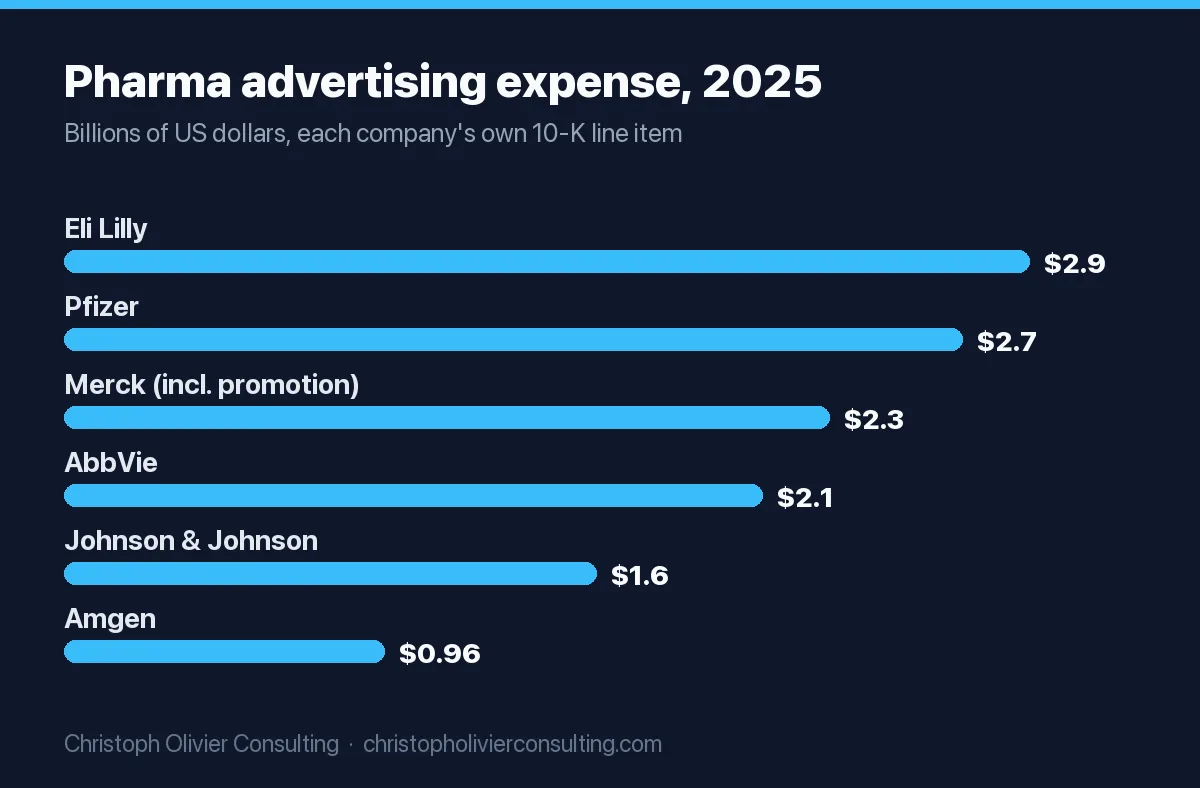
The biggest US-listed drugmakers reported between $1 billion and $3 billion each of advertising expense in 2025. Eli Lilly disclosed $2.9 billion, Pfizer $2.7 billion, Merck $2.3 billion of advertising and promotion, AbbVie $2.1 billion, Johnson & Johnson $1.6 billion and Amgen $963 million, all in their 2025 10-K filings. Bristol Myers Squibb and Novo Nordisk, the maker of Ozempic, publish no advertising figure at all.
Short answer: Six large drugmakers that disclose the number reported a combined $12.6 billion of advertising expense in 2025 (our sum of their 10-K figures), about 1.7% to 4.4% of each company’s revenue. Pfizer spent $2.7 billion, down from a peak of $3.7 billion in 2023. On national TV, iSpot.TV estimates the ten biggest drug brands spent $2.67 billion in 2025, led by AbbVie’s Skyrizi at $439.6 million.
Every company figure below comes from the company’s own annual filing on SEC EDGAR, read in November 2026. Each row keeps the filing’s exact wording, because “advertising” means something slightly different in every 10-K. TV figures are third-party estimates from iSpot.TV and are labelled that way. Industry totals come from a peer-reviewed JAMA study and the US Government Accountability Office.
Big pharma advertising spend by company (2025 10-K figures)
The percentage column is our calculation, with one formula for every company: advertising ÷ total revenue in the same filing × 100. Worked example, Pfizer 2025: $2,700 million ÷ $62,579 million × 100 = 4.3%.
| Company | Exact line in the filing | Fiscal year end | Advertising (reported) | Revenue (same filing) | % of revenue (calculated) | Source |
|---|---|---|---|---|---|---|
| Eli Lilly | “Global advertising expenses, comprised primarily of online marketing and television advertising” | Dec 31, 2025 | $2.9 billion | $65,179 million | 4.4% | Lilly 10-K, 2025 |
| Pfizer | “Advertising expenses” | Dec 31, 2025 | $2.7 billion | $62,579 million | 4.3% | Pfizer 10-K, 2025 |
| Merck | “Advertising and promotion expenses” | Dec 31, 2025 | $2.3 billion | $65,011 million | 3.5% | Merck 10-K, 2025 |
| AbbVie | “Advertising expenses” | Dec 31, 2025 | $2.1 billion | $61,160 million | 3.4% | AbbVie 10-K, 2025 |
| Johnson & Johnson | “Advertising expenses worldwide, which comprised television, radio, print media and Internet advertising” | Dec 28, 2025 | $1.6 billion | $94,193 million | 1.7% | J&J 10-K, 2025 |
| Amgen | “Advertising costs” | Dec 31, 2025 | $963 million | $36,751 million | 2.6% | Amgen 10-K, 2025 |
| Bristol Myers Squibb | No amount disclosed; advertising sits inside “Selling, general and administrative” | Dec 31, 2025 | Not disclosed | $48,194 million | n/a | BMS 10-K, 2025 |
| Novo Nordisk (Ozempic, Wegovy) | No advertising line; “Sales and distribution costs” of DKK 64,310 million | Dec 31, 2025 | Not disclosed | DKK 309,064 million | 20.8% for all sales and distribution costs (company-stated, not advertising) | Novo Nordisk Annual Report 2025 (filed with 20-F) |
Three things to know before you quote these numbers. First, the 10-K figures are worldwide, not US-only, and they cover all advertising, not only consumer TV ads. Second, they exclude the much larger cost of sales reps, free samples and medical education, which sit elsewhere in selling expenses. Third, Merck’s line includes “promotion”, so it is not strictly comparable with the others. If you want the full marketing picture for the sector, our guide to pharmaceutical marketing breaks down where the rest of the money goes.
How much does Pfizer spend on advertising? $2.7 billion in 2025
Pfizer’s 2025 10-K says: “Advertising expenses totaled approximately $2.7 billion in 2025, $3.3 billion in 2024 and $3.7 billion in 2023.” The figure sits inside “Selling, informational and administrative expenses” of $13,794 million, which also covers “the internal and external costs of marketing, advertising, shipping and handling, digital and legal defense.” Pfizer says it markets “directly to consumers through direct-to-consumer advertising” in “the U.S. and select international markets.”
| Year | Pfizer advertising expense (reported) | Where it was reported |
|---|---|---|
| 2020 | $1.8 billion | 10-K for 2022 |
| 2021 | $2.0 billion | 10-K for 2023 |
| 2022 | $2.8 billion | 10-K for 2023 |
| 2023 | $3.7 billion | 10-K for 2025 |
| 2024 | $3.3 billion | 10-K for 2025 |
| 2025 | $2.7 billion | 10-K for 2025 |
So Pfizer’s advertising roughly doubled from 2020 to the 2023 peak, then fell 27% by 2025 (our calculation: 2.7 ÷ 3.7 = 0.73). For scale, Pfizer spent $10,437 million on research and development in 2025, almost four times its advertising.
A related question people ask: Pfizer CEO Albert Bourla’s total pay for 2025 was $27,585,301 in the Summary Compensation Table basis, according to Pfizer’s 2026 proxy statement. Most of it is stock awards, with a salary of $1.8 million.
Eli Lilly: $2.9 billion in 2025, more than double 2024
Lilly had the biggest jump of any company here. Its 2025 10-K reports global advertising of $2.9 billion in 2025, $1.4 billion in 2024 and $1.1 billion in 2023, “comprised primarily of online marketing and television advertising,” and adds that it was “less than 5 percent of revenue each year.” The timing lines up with Zepbound: iSpot.TV’s estimate of Zepbound’s national TV spend went from $11.5 million in 2024 to $160.1 million in 2025, per Fierce Pharma. Lilly also warns investors that “U.S. government authorities have taken and may continue to take actions intended to restrict direct-to-patient advertising.”
Merck: $2.3 billion in advertising and promotion (2025)
Merck’s 2025 10-K records “advertising and promotion expenses of $2.3 billion in 2025, $2.4 billion in 2024 and $2.3 billion in 2023.” That is the flattest trend in the group. Merck also spent $15,789 million on research and development in 2025, the most of any company in this table.
AbbVie: $2.1 billion (2025), and the biggest TV spender
AbbVie’s 2025 10-K reports advertising expenses of $2.1 billion in 2025, $2.1 billion in 2024 and $2.2 billion in 2023. AbbVie’s reported total is mid-pack, but its brands dominate TV. Three of the ten biggest TV drug advertisers of 2025 were AbbVie’s: Skyrizi ($439.6 million), Rinvoq ($376.4 million) and Vraylar ($128.9 million), all iSpot.TV estimates. Together that is $944.9 million (our sum), or close to half of AbbVie’s reported $2.1 billion worldwide advertising. Treat that comparison loosely, since the TV figures are estimates and the 10-K figure is booked differently.
Johnson & Johnson: $1.6 billion (2025)
J&J’s 2025 10-K reports worldwide advertising, “which comprised television, radio, print media and Internet advertising,” of $1.6 billion in fiscal 2025, $0.6 billion in 2024 and $0.5 billion in 2023. The near tripling matches its TV push: iSpot.TV estimates Tremfya’s national TV spend rose from $160.1 million in 2024 to $431 million in 2025, and Caplyta added $185.7 million. J&J’s 1.7% of revenue is the lowest ratio here because its $94.2 billion revenue includes a large MedTech business.
Amgen: $963 million (2025)
Amgen’s 2025 10-K says advertising costs “were $963 million, $987 million and $647 million during the years ended December 31, 2025, 2024 and 2023.”
Bristol Myers Squibb: no advertising figure disclosed
BMS confirms it advertises to US consumers “through direct-to-consumer print, radio, television and digital advertising and promotion,” and lists “advertising and product promotion costs” inside selling, general and administrative expense ($7,267 million in 2025). Its 2025 10-K gives no separate advertising amount, so any BMS figure you see elsewhere is an estimate.
Ozempic marketing budget: Novo Nordisk does not disclose one
Novo Nordisk does not publish an advertising figure for the company, let alone for Ozempic. Here is what its Annual Report 2025 does say:
- Sales and distribution costs were DKK 64,310 million in 2025, 20.8% of sales. That is a much broader line than advertising: DKK 23,757 million of it was employee costs.
- In US Operations, “the cost increase is mainly driven by promotional activities related to Wegovy.”
- Ozempic sales were DKK 127,089 million in 2025.
The only Ozempic-specific numbers are third-party TV estimates. iSpot.TV estimated Ozempic’s national TV spend at $46.9 million in Q1 2025 and $43.3 million in Q2 2025 (Fierce Pharma, April 2025; Fierce Pharma, July 2025). That is about $90.2 million for the first half (our sum of two estimates). Ozempic did not make iSpot’s full-year 2025 top 10, where the cut-off was $128.9 million. Wegovy did: an estimated $298.1 million on national TV in 2025. None of these figures include digital, social, print or HCP marketing, so the real Ozempic budget is higher and unknown.
How much does big pharma spend on TV advertising?
No company reports TV spend separately, so TV numbers are estimates from ad-measurement firms. iSpot.TV, compiling for Fierce Pharma (January 16, 2026), estimates the ten biggest drug brands spent a combined $2.67 billion on national TV in 2025, up from $2.13 billion in 2024. Eight of the ten listed the NFL as their top program by spend.
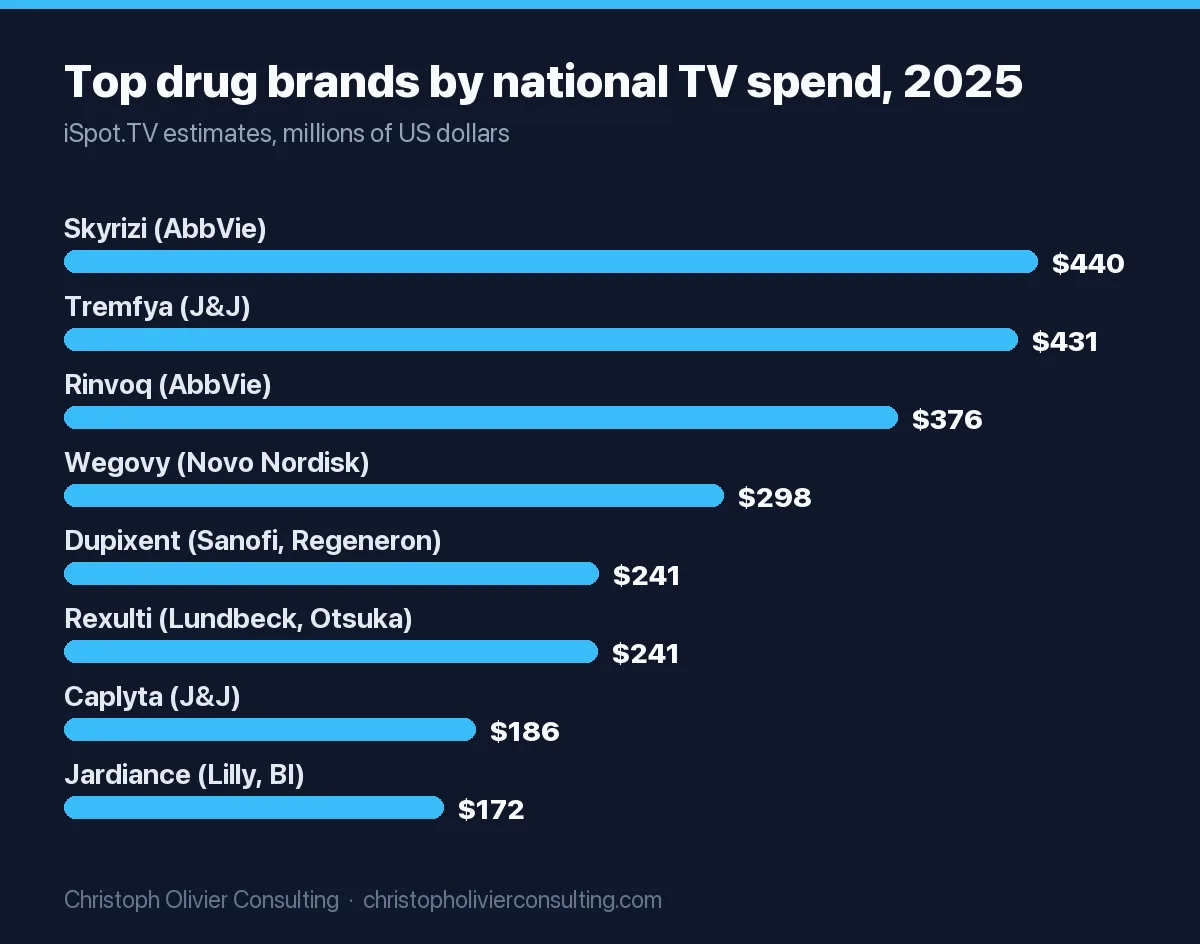
| Rank | Brand (company) | Est. national TV spend, 2025 | 2024 |
|---|---|---|---|
| 1 | Skyrizi (AbbVie) | $439.6M | $377.3M |
| 2 | Tremfya (J&J) | $431.0M | $160.1M |
| 3 | Rinvoq (AbbVie) | $376.4M | $338.1M |
| 4 | Wegovy (Novo Nordisk) | $298.1M | $263.2M |
| 5 | Dupixent (Sanofi, Regeneron) | $241.3M | $279.2M |
| 6 | Rexulti (Lundbeck, Otsuka) | $241.1M | $223.8M |
| 7 | Caplyta (J&J) | $185.7M | $83.1M |
| 8 | Jardiance (Lilly, Boehringer Ingelheim) | $171.5M | $134.5M |
| 9 | Zepbound (Lilly) | $160.1M | $11.5M |
| 10 | Vraylar (AbbVie) | $128.9M | $117.7M |
Source: iSpot.TV estimates as published by Fierce Pharma, January 16, 2026. Estimates cover national TV airings only.
For a longer view, the GAO (report GAO-21-380, 2021) found drugmakers spent $17.8 billion on direct-to-consumer advertising for 553 drugs from 2016 through 2018, “relatively stable at about $6 billion each year.” If you are weighing TV against streaming for your own brand, our connected TV advertising statistics cover CTV prices and reach.
Pharma ad spend for the whole industry: what the research says
There is no official annual total. These are the most credible numbers, each measuring something different:
| Measure | Figure | Year | Source and type |
|---|---|---|---|
| All US medical marketing (drugs, disease awareness, health services, lab tests) | $29.9 billion | 2016 (2016 dollars) | Schwartz & Woloshin, JAMA 2019; peer-reviewed |
| Pharma marketing to health professionals | $20.3 billion, incl. $13.5 billion free samples and $5.6 billion detailing | 2016 | Same JAMA study |
| US DTC prescription drug advertising | $6 billion (4.6 million ads, incl. 663,000 TV commercials) | 2016 | Same JAMA study |
| US DTC drug advertising, 553 drugs | $17.8 billion total, about $6 billion a year | 2016 to 2018 | GAO-21-380; government audit |
| Ten large drugmakers’ advertising | About $13.8 billion | 2023 | Campaign for Sustainable Rx Pricing analysis, as reported by TechTarget (March 19, 2025); advocacy group compilation |
| Six drugmakers’ reported advertising (this page) | $12.6 billion | 2025 | Our sum of the 10-K figures above |
| Top 10 drug brands, national TV | $2.67 billion | 2025 | iSpot.TV via Fierce Pharma; estimate |
The JAMA study is the key context: in 2016, consumer advertising was only about a third of medical marketing ($9.6 billion of $29.9 billion), and most of the money went to doctors, not TV. The TV ads are the visible part.
Does pharma spend more on advertising than research?
On advertising alone, no. Every company that discloses the number spent far more on R&D than on advertising in 2025. The claim that pharma spends more on “marketing” than research usually compares R&D with the whole selling and administrative line, which also includes sales reps, admin staff and legal costs. On that broader basis, Pfizer, J&J, AbbVie and Novo Nordisk did spend more on selling and admin than on R&D in 2025. This table, built from each 10-K, shows both views.
| Company (2025) | Advertising | Selling and admin line (exact name) | R&D expense | Advertising as % of R&D (calculated) | Selling and admin bigger than R&D? |
|---|---|---|---|---|---|
| Pfizer | $2,700M | $13,794M (Selling, informational and administrative) | $10,437M | 26% | Yes |
| AbbVie | $2,100M | $14,010M (SG&A) | $9,096M | 23% | Yes |
| Eli Lilly | $2,900M | $11,094M (Marketing, selling, and administrative) | $13,337M | 22% | No |
| Merck | $2,300M | $10,733M (SG&A) | $15,789M | 15% | No |
| Amgen | $963M | $7,050M (SG&A) | $7,272M | 13% | No |
| Johnson & Johnson | $1,600M | $23,676M (Selling, marketing and administrative) | $14,665M | 11% | Yes |
| Bristol Myers Squibb | Not disclosed | $7,267M (SG&A) | $9,951M | n/a | No |
| Novo Nordisk | Not disclosed | DKK 64,310M (Sales and distribution) | DKK 52,039M | n/a | Yes |
R&D figures are the R&D expense line as reported; several companies book acquired in-process R&D on a separate line that is not included here. The answer to “which pharma company spends the most on R&D” depends on the list, but among the US filers above it was Merck at $15,789 million in 2025.
Why you see these ads in the US, and what changed in 2025
Prescription drug ads aimed at consumers are rare worldwide. Researchers Menkes, Mintzes and Lexchin write that “New Zealand and the United States are the only high-income countries to allow unrestricted direct-to-consumer advertising of branded medicines” (New Zealand Doctor, August 9, 2024). That is why the 10-K figures above are driven mainly by US spending.
In the US, the rules sit in 21 CFR 202.1. TV and radio ads must state the drug’s “major side effects and contraindications” (the “major statement”) in the audio, and must either carry a brief summary of risks or make “adequate provision” for viewers to get the full labeling. That second option is why TV ads point you to a website or phone number instead of reading every risk.
On September 9, 2025, the FDA announced it was “sending thousands of letters” to drugmakers about misleading ads, issuing about 100 cease-and-desist letters, and starting rulemaking to close the “adequate provision” loophole created in 1997. The FDA said its warning letters to drug companies had dropped “to one in 2023 and zero in 2024.” Spending did not stop: Fierce Pharma reported TV drug ad spending rose in September 2025 despite the crackdown. Doctors and clinics face a different set of rules, covered in are doctors allowed to advertise.
Which company spends the most on advertising overall?
Not a drugmaker. Amazon reported $23.5 billion of “advertising and other promotional costs” in 2025 in its 10-K, nearly double the six drugmakers above combined. Pharma’s ratio of advertising to revenue (1.7% to 4.4% for the companies above) is modest next to many consumer brands, which you can compare in our big brand marketing budgets table and our advertising to sales ratio by industry guide.
How to find any drugmaker’s ad spend in its 10-K
You can check any number on this page, or find one we did not cover, in about three minutes:
- Go to SEC EDGAR full-text search or the company’s filing list and open the latest 10-K (foreign filers like Novo Nordisk file a 20-F with the annual report attached).
- Press Ctrl+F and search, in this order: “Advertising expenses”, “Advertising costs”, “advertising and promotion”. The figure is almost always in Note 1 or Note 2, the accounting policies note, not in the income statement.
- Copy the sentence word for word, including the years. Most give three years, so you get a trend for free.
- Find total revenue on the income statement of the same filing and calculate: advertising ÷ revenue × 100.
- If the search returns nothing (BMS, Novo Nordisk), write “not disclosed.” Do not substitute selling and admin expense, which is several times larger.
Pass/fail check before you publish a pharma ad figure: it names the filing and year, uses the filing’s own wording, says whether it is worldwide or US, and labels any TV or brand figure as a third-party estimate. If you are setting a budget for a regulated health brand and want a second opinion on the numbers, you can book a consultation.
Ready to scale your revenue?
Book a free 30-min consultation. We’ll diagnose your growth bottleneck and map out the 3 highest-leverage moves for your business.
Frequently asked questions
How much does big pharma spend on advertising?
Six large drugmakers that disclose the figure reported a combined $12.6 billion of advertising expense in 2025, according to their 10-K filings: Eli Lilly $2.9 billion, Pfizer $2.7 billion, Merck $2.3 billion (advertising and promotion), AbbVie $2.1 billion, Johnson & Johnson $1.6 billion and Amgen $963 million. That is 1.7% to 4.4% of each company's revenue. Bristol Myers Squibb and Novo Nordisk do not disclose an amount.
How much does Pfizer spend on advertising?
Pfizer reported advertising expenses of approximately $2.7 billion in 2025, $3.3 billion in 2024 and $3.7 billion in 2023, in its 2025 10-K. That was about 4.3% of its $62.6 billion revenue. The figure is worldwide and sits inside selling, informational and administrative expenses of $13.8 billion. Pfizer spent $10.4 billion on R&D in the same year.
How much does big pharma spend on TV advertising?
Companies do not report TV spend separately, so the numbers are estimates. iSpot.TV, compiling for Fierce Pharma, estimates the ten biggest drug brands spent $2.67 billion on national TV in 2025, up from $2.13 billion in 2024. AbbVie's Skyrizi led at $439.6 million. GAO found total direct-to-consumer drug advertising ran about $6 billion a year from 2016 to 2018.
What is the Ozempic marketing budget?
Novo Nordisk does not disclose an Ozempic marketing budget or any company-wide advertising figure. Its 2025 annual report shows sales and distribution costs of DKK 64,310 million, a much broader line. Third-party estimates from iSpot.TV put Ozempic's national TV spend at $46.9 million in Q1 2025 and $43.3 million in Q2 2025. Digital, print and doctor-facing marketing are not included in those estimates.
Does pharma spend more on advertising than research?
Not on advertising alone. Every drugmaker in our table that discloses advertising spent far more on R&D in 2025; Pfizer's $2.7 billion of advertising was about 26% of its $10.4 billion R&D. The claim usually compares R&D with the whole selling and administrative line. On that wider basis Pfizer, J&J, AbbVie and Novo Nordisk did spend more on selling and admin than on R&D.
Which pharma company spends the most on advertising?
Among companies that disclose the number, Eli Lilly reported the most advertising in 2025 at $2.9 billion, more than double its $1.4 billion in 2024. Pfizer was close behind at $2.7 billion and had the highest figure in 2023 at $3.7 billion. On national TV, AbbVie was the biggest spender, with Skyrizi, Rinvoq and Vraylar all in iSpot.TV's 2025 top 10.
Why do so few countries allow prescription drug ads on TV?
Very few countries allow them. Researchers writing in New Zealand Doctor in 2024 note that New Zealand and the United States are the only high-income countries that allow unrestricted direct-to-consumer advertising of branded medicines. In the US, 21 CFR 202.1 requires TV ads to state major side effects, and in September 2025 the FDA announced a crackdown on misleading drug ads.
What big companies spend on marketing