
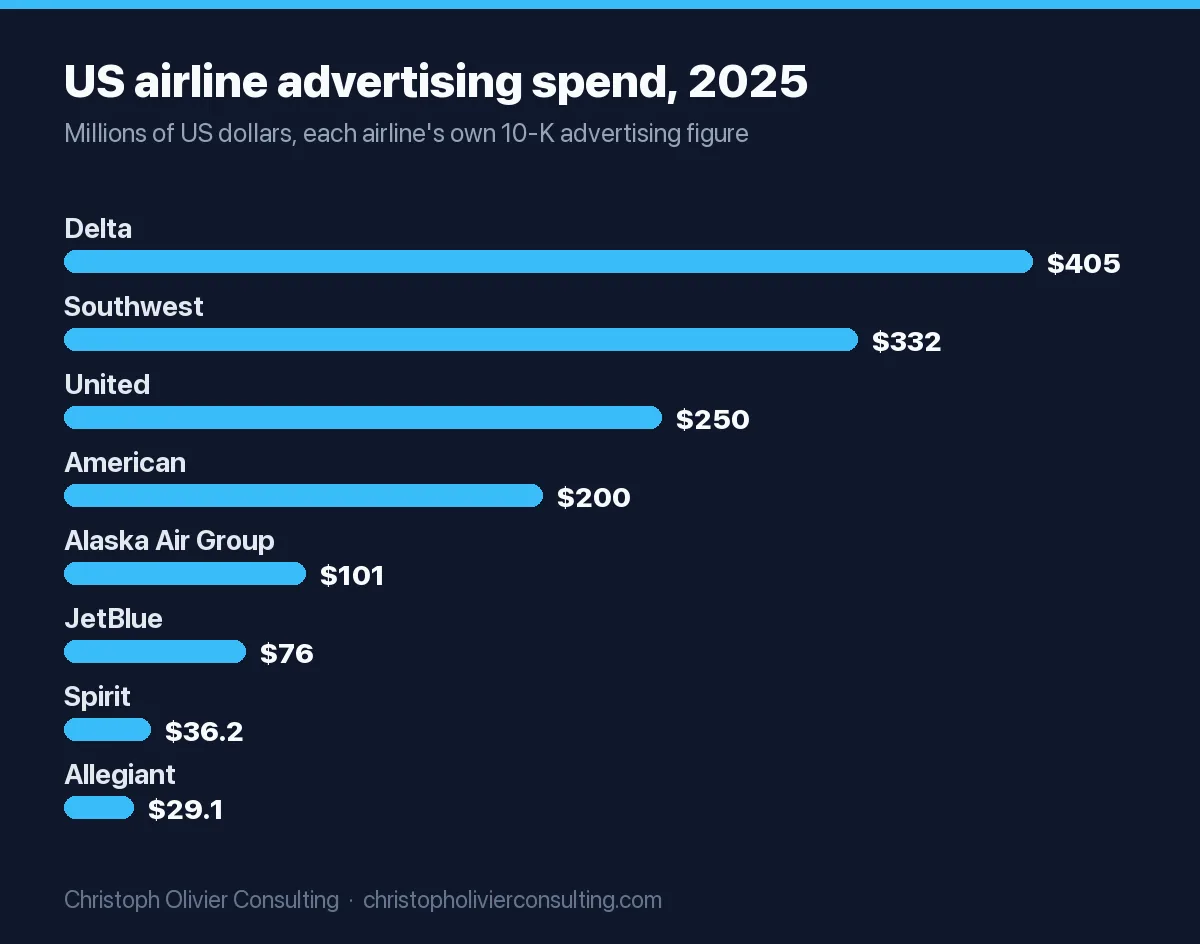
US airlines spend surprisingly little on advertising. In 2025, Delta reported $405 million of advertising expense, Southwest $332 million, United $250 million and American $200 million, according to each airline’s own 10-K. None of the nine US carriers on this page spent more than 1.2% of revenue on advertising, and the two biggest card-linked loyalty programs bring in far more marketing money than the airlines pay out: Delta received $8.2 billion from American Express in the same year.
Short answer: Delta: $405 million (2025, 0.64% of revenue). Southwest: $332 million advertising and promotions (2025, 1.18%). United: $250 million (2025, 0.42%). American: $200 million (2025, 0.37%). That is roughly $1 to $2 of advertising per passenger. The much bigger “selling” lines in the same filings ($2.5 billion at Delta, $2.0 billion at American) are mostly commissions, card fees and booking fees, not marketing budgets.
Every figure below is the advertising number the airline itself reports in its annual report for calendar 2025, filed with the SEC between February and March 2026. All nine airlines use a December 31 year end, so the years line up. Where I divide one number by another, I say so and show the math.
Airline advertising spend compared: 9 US airlines, 2025
The percentage column uses one formula for every airline: advertising as % of revenue = reported advertising expense ÷ total operating revenue × 100. Worked example, Delta: $405 million ÷ $63,364 million × 100 = 0.64%.
| Airline | What the 10-K calls it | 2025 advertising (reported) | 2025 operating revenue (same filing) | % of revenue (calculated) | Source |
|---|---|---|---|---|---|
| Delta Air Lines | “Advertising expense”, inside passenger commissions and other selling expenses | $405 million | $63,364 million | 0.64% | Delta 2025 10-K |
| Southwest Airlines | “Advertising and promotions expense”, inside other operating expenses | $332 million | $28,063 million | 1.18% | Southwest 2025 10-K |
| United Airlines | “Advertising expenses”, inside other operating expenses | $250 million | $59,070 million | 0.42% | United 2025 10-K |
| American Airlines | “Advertising expense”, inside selling expenses | $200 million | $54,633 million | 0.37% | American 2025 10-K |
| Alaska Air Group (incl. Hawaiian) | “Advertising expense”, including advertising, sponsorship and promotional costs | $101 million | $14,239 million | 0.71% | Alaska Air Group 2025 10-K |
| JetBlue | “Advertising expense”, inside sales and marketing | $76 million | $9,062 million | 0.84% | JetBlue 2025 10-K |
| Spirit Airlines | “Marketing and advertising expenses”, inside distribution | $36.2 million (two reporting periods added, see Spirit section) | $3,796.7 million | 0.95% | Spirit Aviation Holdings 2025 10-K |
| Allegiant | “Advertising expense”, inside sales and marketing | $29.1 million | $2,606.6 million | 1.12% | Allegiant Travel 2025 10-K |
| Frontier Airlines | Advertising and production costs, inside sales and marketing | $7 million | $3,724 million | 0.19% | Frontier Group 2025 10-K |
Two reading notes. First, the big four carriers report in round millions, so a percentage can move by a hundredth of a point. Second, each airline draws the line around “advertising” a little differently: Alaska says its figure includes sponsorship and promotions, Southwest says “advertising and promotions”, Spirit says “marketing and advertising”. Treat the table as each company’s own definition, not one audited industry standard.
Delta Air Lines marketing budget: $405 million in advertising (2025)
Delta’s 2025 10-K says: “Advertising expense was $405 million, $438 million and $347 million for the years ended December 31, 2025, 2024 and 2023.” That makes Delta the biggest advertiser among US airlines in 2025, even after a 7.5% cut from its 2024 peak (my calculation: $405M ÷ $438M).
The figure you will often see quoted for Delta’s “marketing budget” is about $2.5 billion. That is a different line. Delta’s income statement shows passenger commissions and other selling expenses of $2,485 million in both 2025 and 2024. The 10-K places advertising inside that line, but the rest is sales commissions, merchant (card processing) fees and other selling costs. Advertising is about 16% of it ($405M ÷ $2,485M). Data sites that label the $2.5 billion “selling and marketing expense” are reading the XBRL tag, not the line description.
Delta’s real marketing engine: $8.2 billion from American Express
The same filing reports that “remuneration from American Express totaled $8.2 billion” in 2025, up 11% from 2024, and that Delta expects it to grow to $10 billion “over the next few years”. American Express pays Delta to sell SkyMiles to cardholders. For every $1 Delta spent on advertising in 2025, Amex paid Delta about $20 (my ratio: $8.2B ÷ $405M). For context on how large the rest of Delta’s cost base is, salaries and related costs were $17,520 million and fuel was about 17% of total operating expense in 2025.
United Airlines advertising budget: $250 million (2025)
United’s 2025 10-K states: “Advertising expenses were $250 million, $235 million and $221 million for the years ended December 31, 2025, 2024 and 2023.” United booked the cost inside “other operating expenses”. United and American are the only two of the big four that raised ad spend in both 2024 and 2025; United’s rise in 2025 was 6.4%.
The larger commercial line is distribution expenses of $2,109 million in 2025, down $122 million (5.5%), which United attributes to a change in the mix of sales channels and to refined assumptions for credit card fees. That line is the cost of selling tickets, not brand marketing.
United’s co-brand deal with JPMorgan Chase also shows how marketing money flows the other way. The 10-K says the MileagePlus card agreement “provides for joint marketing and other support for the MileagePlus credit card and provides Chase with other benefits such as permission to market to the Company’s customer database.” United does not break out the dollar amount Chase pays in the text of the 10-K, so I do not quote one here.
American Airlines marketing budget: $200 million in advertising (2025)
American’s 2025 10-K reports: “Advertising expense was $200 million, $143 million and $114 million for the years ended December 31, 2025, 2024 and 2023.” That is the fastest increase among the big four: up 40% in one year and up 75% over two years (my calculations).
Advertising sits inside American’s selling expenses line, which the filing defines as “credit card fees, commissions, third party distribution channel fees and advertising”. Selling expenses were $1,997 million in 2025, up $185 million (10.2%), which American explains as higher commissions “resulting from renegotiated agency contracts, as well as an increase in advertising expenses.” Advertising is about 10% of that line.
How is American doing financially, and does the ad spend show up?
American grew revenue to $54,633 million in 2025 from $54,211 million, while operating income fell to $1,467 million from $2,614 million, per the same 10-K. The extra $57 million of advertising is small next to that $1.1 billion swing; salaries, wages and benefits ($17,566 million) were American’s largest expense at 38% of operating costs. The money that does move the needle is loyalty: “cash payments from co-branded credit card and other partners were $6.2 billion and $6.1 billion during 2025 and 2024.” Starting in 2026, Citi became the exclusive issuer of the AAdvantage card in the US. That $6.2 billion is 31 times American’s ad budget (my ratio).
Southwest Airlines marketing budget: $332 million advertising and promotions (2025)
Southwest’s 2025 10-K says: “Advertising and promotions expense for the years ended December 31, 2025, 2024, and 2023 was $332 million, $346 million, and $266 million, respectively.” Southwest spends the highest share of revenue on advertising of any airline here, 1.18%, because its revenue ($28,063 million) is less than half of Delta’s while its ad budget is 82% of Delta’s.
Southwest has no separate selling line on its income statement. Advertising, distribution costs and several other items are rolled into “other operating expenses” of $4,467 million. Its 2025 marketing news in the filing is product led: an amended co-brand agreement with Chase “including new benefits and improved economics”, free Wi-Fi for Rapid Rewards members sponsored by T-Mobile from October 2025, and new distribution through Expedia. The 10-K describes what Chase buys besides points: “the use of the Southwest Airlines brand and access to Rapid Rewards Member lists, licensing and advertising elements”.
Alaska, JetBlue, Spirit, Allegiant and Frontier advertising spend (2025)
Alaska Air Group: $101 million (2025)
Alaska’s 10-K reports advertising expense of $101 million in 2025, $97 million in 2024 and $78 million in 2023, and says the figure includes “advertising, sponsorship, and promotional costs.” Hawaiian Airlines is included from September 18, 2024, so 2025 is the first full year with both brands. Alaska carried 58.6 million revenue passengers in 2025 across the group.
JetBlue: $76 million (2025)
JetBlue’s 10-K reports advertising expense of $76 million in 2025, down from $79 million in 2024 ($66 million in 2023). It sits inside a $305 million “sales and marketing” line. Revenue fell 2.3% to $9,062 million and revenue passengers fell 2.9% to 39.3 million.
Spirit Airlines: $36.2 million (2025, two periods)
Spirit’s 10-K splits 2025 at March 12, 2025, the date it emerged from its 2024 Chapter 11 case: “Marketing and advertising expenses were $24.3 million for the Successor Period and $11.9 million for the Current Predecessor Period” (March 13 to December 31, and January 1 to March 12). I added the two to get $36.2 million for the calendar year. The filing gives $26.8 million for 2024 and $9.0 million for 2023, and says spending rose “related to our new travel options and transformed Guest experience.”
Allegiant: $29.1 million (2025)
Allegiant’s 10-K shows advertising expense of $29.1 million in 2025, down from $32.0 million in 2024 and $41.0 million in 2023: the only airline here that cut ad spend two years running. Allegiant flew 18.7 million passengers in 2025.
Frontier: $7 million (2025)
Frontier’s 10-K says advertising and production costs “represented $7 million, $7 million and $5 million” in 2025, 2024 and 2023. That is 0.19% of $3,724 million revenue, by far the lowest ratio here, for an airline that flew 33.2 million passengers.
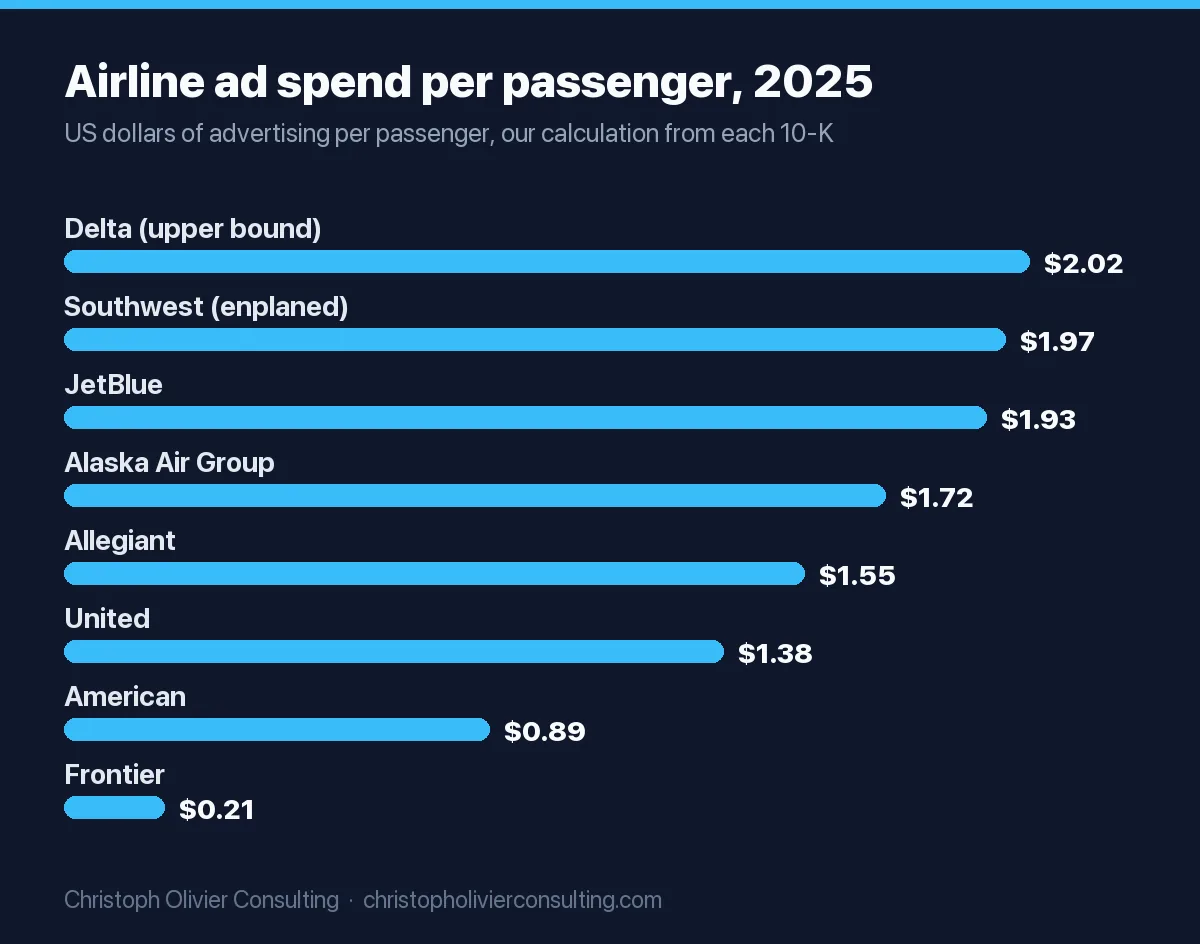
Airline ad spend per passenger: about $1 to $2
This is my own calculation, not a number any airline reports. Formula: advertising per passenger = 2025 advertising expense ÷ 2025 passengers, with both numbers taken from the same 10-K. Passenger definitions differ slightly, so read the “passenger count used” column before comparing two airlines closely.
| Airline | 2025 advertising | Passenger count used (from the 10-K) | Ad spend per passenger (calculated) |
|---|---|---|---|
| Delta | $405M | “over 200 million customers” (Delta gives no exact count) | about $2.02 or less |
| Southwest | $332M | 168.3 million enplaned passengers (134.1 million revenue passengers carried) | $1.97 ($2.48 per passenger carried) |
| JetBlue | $76M | 39.3 million revenue passengers | $1.93 |
| Alaska Air Group | $101M | 58.6 million revenue passengers | $1.72 |
| Allegiant | $29.1M | 18.7 million passengers (total system) | $1.55 |
| United | $250M | 181.1 million passengers, counted per flight segment | $1.38 |
| Spirit | $36.2M | 32.0 million passenger flight segments | $1.13 |
| American | $200M | “approximately 224 million passengers boarded our flights” | $0.89 |
| Frontier | $7M | 33.2 million passengers | $0.21 |
Worked example, United: $250,000,000 ÷ 181,053,000 passengers = $1.38. Compare that with the price of one ticket and the point is plain: airlines do not buy most of their customers with advertising. They buy them with network, schedule, loyalty status and distribution.
Airline ad spend trend, 2023 to 2025
All three years for each airline come from the same 2025 10-K, so each row is internally consistent. Change columns are my calculations.
| Airline | 2023 | 2024 | 2025 | Change 2024 to 2025 | Change 2023 to 2025 |
|---|---|---|---|---|---|
| Delta | $347M | $438M | $405M | −7.5% | +17% |
| Southwest | $266M | $346M | $332M | −4.0% | +25% |
| United | $221M | $235M | $250M | +6.4% | +13% |
| American | $114M | $143M | $200M | +39.9% | +75% |
| Alaska Air Group | $78M | $97M | $101M | +4.1% | +29% |
| JetBlue | $66M | $79M | $76M | −3.8% | +15% |
| Spirit | $9.0M | $26.8M | $36.2M | +35% | about 4x |
| Allegiant | $41.0M | $32.0M | $29.1M | −9.1% | −29% |
| Frontier | $5M | $7M | $7M | 0% | +40% |
The four largest carriers together spent $1,187 million on advertising in 2025, about flat on 2024’s $1,162 million. The mix shifted: Delta and Southwest trimmed, American and United added. Alaska’s 2024 and 2023 figures exclude most or all of Hawaiian, which joined in September 2024.
Why airlines spend so little on advertising
Coca-Cola reported $5.4 billion of advertising on $47,941 million of revenue in its 2025 10-K, about 11.3% (my calculation). No airline here reaches 1.2%. Our big brand marketing budgets page compares more consumer brands, and airlines look much more like the big-box chains on our retail advertising spend page. The airline filings point to three reasons.
- Banks pay them for marketing access. Co-brand card deals are partly marketing contracts. Frontier’s 10-K lists the performance obligations it sells to its card partner: miles, “licensing of brand and access to member lists”, “advertising and marketing efforts” and airline benefits. Southwest’s lists brand use, member lists, “licensing and advertising elements”. The airline is the one being paid.
- The cost of selling is booked elsewhere. Commissions, card fees and booking fees dwarf advertising: $2,485 million at Delta, $2,109 million at United, $1,997 million at American in 2025. If you want the full cost of getting a ticket sold, that is the number to look at, not the ad line.
- Labor and fuel take the money. Salaries are the largest cost at every major carrier: 46.9% of Southwest’s operating expenses and 38% of American’s in 2025, per their 10-Ks. United calls fuel “its second largest operating expense”, about $11.4 billion in 2025.
Co-brand card money vs. advertising, 2025
| Airline | Card or partner payments disclosed in the 10-K | 2025 advertising | Ratio (calculated) |
|---|---|---|---|
| Delta | $8.2 billion “remuneration from American Express” | $405 million | about 20 to 1 |
| American | $6.2 billion “cash payments from co-branded credit card and other partners” | $200 million | 31 to 1 |
| United | Chase agreement described, total not stated in the text | $250 million | n/a |
| Southwest | Chase agreement amended in 2025, total not stated in the text | $332 million | n/a |
What is an airline’s biggest expense?
Labor. In 2025, salaries and related costs were $17,520 million at Delta, $17,647 million at United, $17,566 million at American and $12,963 million at Southwest, each the largest line on its income statement. Fuel is usually second: $9,819 million at Delta, $11,396 million at United, $10,718 million at American and $5,240 million at Southwest. Advertising at these four equals between 0.7% (American) and 1.8% (Southwest) of labor plus fuel (my calculation).
How to find an airline’s advertising budget in its 10-K
Use this when a new 10-K comes out (the 2026 filings are due in February and March 2027) or when you want a carrier not listed here.
- Open the company’s filing list on SEC EDGAR and pick the latest Form 10-K.
- Search the document for “advertising expense”. In airline filings it sits in Note 1, the summary of significant accounting policies, usually one sentence giving three years.
- If that finds nothing, search “advertising costs”, “advertising and promotions” and “marketing and advertising”. Frontier’s figure only appears inside its sales and marketing definition.
- Note which line the cost is booked in (selling, distribution, sales and marketing, other operating). Do not quote that whole line as the ad budget.
- Take total operating revenue and passengers from the same filing, then apply the two formulas above.
| Airline | Search term that finds it | Bigger line it hides in | That line in 2025 | Quote the bigger line as “marketing budget”? |
|---|---|---|---|---|
| Delta | “Advertising expense was” | Passenger commissions and other selling expenses | $2,485M | No: mostly commissions and merchant fees |
| United | “Advertising expenses were” | Other operating expenses | $9,919M | No: catch-all line |
| American | “Advertising expense was” | Selling expenses | $1,997M | No: card fees, commissions, distribution |
| Southwest | “Advertising and promotions expense” | Other operating expenses | $4,467M | No: includes aircraft rentals, distribution |
| JetBlue | “Advertising expense was” | Sales and marketing | $305M | Only as “sales and marketing”, not advertising |
| Spirit | “Marketing and advertising expenses” | Distribution | Split across two periods | No |
| Frontier | “Advertising and the related production costs” | Sales and marketing | $159M | No: includes card processing and contact centers |
One more trap: tracking firms that estimate media buys from ad monitoring can land far from the filing. One free advertiser profile lists Delta’s media spend as “less than $750k”, against the $405 million Delta itself reports. Use the 10-K.
Which company spends the most on marketing?
Not an airline. Amazon reported $23.5 billion of advertising and other promotional costs in its 2025 10-K, about 58 times Delta’s $405 million. Delta’s ad budget, the largest of any US airline, is also less than a tenth of Coca-Cola’s $5.4 billion.
What a service business can take from airline budgets
Many firms set their budget with a “percent of revenue” rule. The airline filings show why that number alone misleads. The carriers with the most loyal customers spend under 1% on advertising because loyalty and partners carry the acquisition load. If you run a professional-service firm, check three numbers before raising your ad budget:
- Ad spend per new client, the same way you would calculate ad spend per passenger above. If it is rising while repeat and referral share is falling, the fix is retention, not more ads. Our loyalty program guide covers how to design that without giving away margin.
- Cost of selling vs. cost of advertising. Airlines book commissions separately. So should you: referral fees, platform fees and sales time belong in their own line.
- Who pays you for access to your clients. Banks pay airlines for member lists and brand rights. A firm with a trusted client base can often structure co-marketing with complementary firms on the same logic.
To turn that into a budget, use the method in how to set a marketing budget, and sanity-check the result against the survey data in our marketing budget benchmarks. If you want a second pair of eyes on the numbers, you can book a consultation.
Ready to scale your revenue?
Book a free 30-min consultation. We’ll diagnose your growth bottleneck and map out the 3 highest-leverage moves for your business.
Frequently asked questions
How much do airlines spend on marketing?
Far less than most people expect. In 2025, Delta reported $405 million of advertising expense, Southwest $332 million, United $250 million and American $200 million, according to their 10-K filings. That is between 0.37% and 1.18% of revenue, or roughly $1 to $2 of advertising per passenger. Their larger selling lines are mostly commissions, card fees and booking fees, not brand marketing.
What is Delta Airlines' marketing budget?
Delta's 2025 10-K reports advertising expense of $405 million, down from $438 million in 2024 and up from $347 million in 2023. That is 0.64% of its $63,364 million revenue. The often quoted $2.5 billion is Delta's passenger commissions and other selling expenses line ($2,485 million), which includes commissions and merchant fees as well as advertising.
What is American Airlines' marketing budget?
American Airlines reported advertising expense of $200 million in 2025, up from $143 million in 2024 and $114 million in 2023, per its 10-K. That is 0.37% of $54,633 million in revenue. Advertising is booked inside selling expenses of $1,997 million, which also cover credit card fees, commissions and third party distribution fees.
What is United Airlines' advertising budget?
United's 2025 10-K states advertising expenses of $250 million, up from $235 million in 2024 and $221 million in 2023. The cost is included in other operating expenses. On total operating revenue of $59,070 million, that is 0.42%. Divided by the 181.1 million passengers United reports, it works out to about $1.38 per passenger.
What is Southwest Airlines' marketing budget?
Southwest reported advertising and promotions expense of $332 million in 2025, $346 million in 2024 and $266 million in 2023, included in other operating expenses. At 1.18% of its $28,063 million revenue, Southwest spends the largest share of revenue on advertising among the nine US airlines compared here, about $1.97 per enplaned passenger.
What is an airline's biggest expense?
Labor. Salaries and related costs were the largest line on the 2025 income statements of Delta ($17,520 million), United ($17,647 million), American ($17,566 million) and Southwest ($12,963 million). They made up 46.9% of Southwest's operating expenses and 38% of American's. Fuel is usually second, for example about $11.4 billion at United.
Who has the biggest marketing budget?
Among US airlines, Delta, with $405 million of advertising in 2025. Across all companies, Amazon reported $23.5 billion of advertising and other promotional costs in its 2025 10-K, about 58 times Delta's figure. Coca-Cola reported $5.4 billion, roughly 11% of its revenue, against under 1.2% for every airline compared here.
What big companies spend on marketing