
Hims & Hers spent $919.3 million on marketing in 2025, 39% of its revenue. Duolingo spent $125.7 million on sales and marketing, 12% of revenue. Peloton spent $400.4 million in its fiscal year ended June 30, 2026, down from $1.02 billion four years earlier. Warby Parker reported $110.2 million of marketing in 2025. Every figure here comes from the company’s own 10-K or 10-Q on SEC EDGAR, read in November 2026.
Short answer: Hims & Hers: $919.3 million of marketing in 2025 (39.2% of revenue), of which $798.5 million was paid customer acquisition. Duolingo: $125.7 million of sales and marketing (12.1%), including $86.9 million of advertising. Peloton: $400.4 million in fiscal 2026 (16.4%). Warby Parker: $110.2 million of marketing (12.6%) and $113.9 million of advertising costs, which are two separately reported numbers.
Two things make these numbers hard to compare, and most pages that rank for them ignore both. First, the label differs: Hims and Warby Parker report a “marketing” line, Duolingo and Peloton report “sales and marketing,” and every company also states a separate advertising figure in its accounting notes. Second, the fiscal years differ: Peloton’s year ends June 30, the others end December 31. The tables below keep each company’s own wording and period.
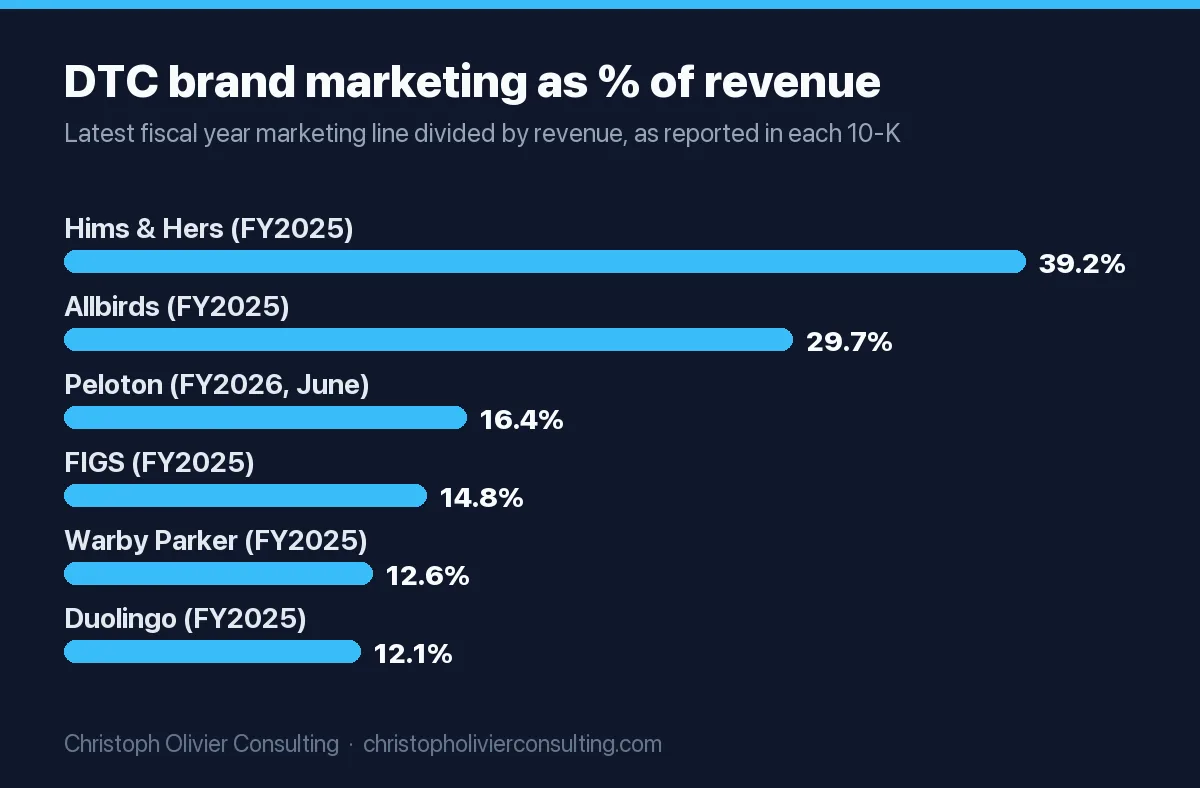
DTC brand marketing spend compared: latest fiscal year
| Company | Fiscal year | Marketing line (as reported) | Advertising stated in notes | Revenue | Marketing % of revenue (calc.) | Source |
|---|---|---|---|---|---|---|
| Hims & Hers | FY2025 (Dec) | Marketing: $919.3M | $814.9M (customer acquisition plus content production) | $2,347.6M | 39.2% | Hims & Hers 10-K, FY2025 |
| Duolingo | FY2025 (Dec) | Sales and marketing: $125.7M | $86.9M | $1,037.6M | 12.1% | Duolingo 10-K, FY2025 |
| Peloton | FY2026 (June) | Sales and marketing: $400.4M | $224.2M | $2,446.0M | 16.4% | Peloton 10-K, FY2026 |
| Warby Parker | FY2025 (Dec) | Marketing (segment line): $110.2M | $113.9M | $871.9M | 12.6% | Warby Parker 10-K, FY2025 |
| FIGS | FY2025 (Dec) | Marketing: $93.1M | Not stated separately | $631.1M | 14.8% | FIGS 10-K, FY2025 |
| Allbirds | FY2025 (Dec) | Marketing expense: $45.2M | Marketing expense is defined as advertising costs | $152.5M | 29.7% | Allbirds 10-K, FY2025 |
The percentages are my division of the reported marketing line by reported revenue; Duolingo’s and Peloton’s filings print the same rounded ratios (12% and 16.4%). For context on where these sit against other sectors, our advertising-to-sales ratio by industry table uses the same 10-K method, and the Uber, DoorDash and Airbnb marketing spend breakdown covers the app companies.
Hims & Hers marketing budget: $919.3 million in 2025 (39% of revenue)
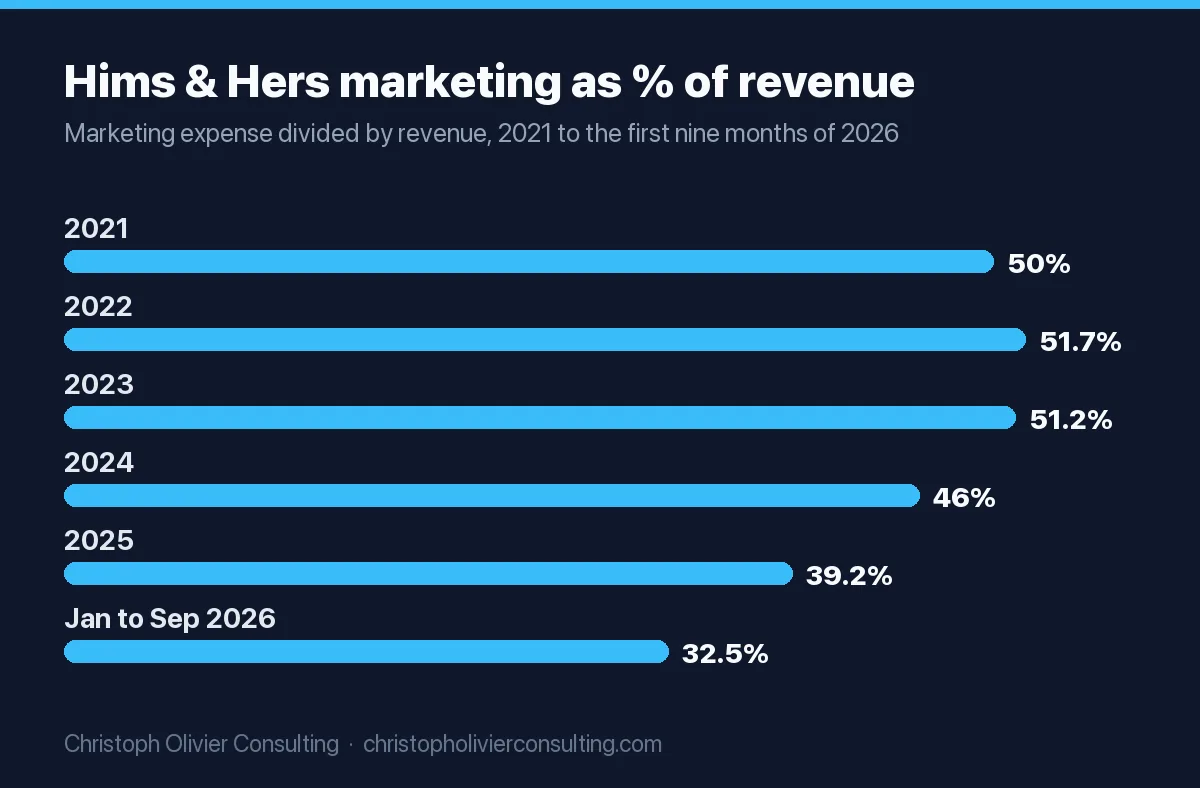
Hims & Hers is the outlier in this group. Its FY2025 10-K reports marketing expenses of $919.3 million for 2025, up 35% from $678.8 million in 2024, on revenue of $2,347.6 million. That is 39.2% of revenue, down from 46.0% in 2024.
The 10-K splits the number in a way that answers “what is the Hims marketing budget actually spent on”:
- Customer acquisition costs: $798.5 million in 2025, up from $594.5 million. Hims defines these as “paid marketing expense”: advertising and media costs in digital media, social media, television, radio, out-of-home and other outlets, excluding content production.
- Everything else in marketing: about $120.8 million (my subtraction): salaries and stock compensation for marketing staff, agencies and contractors, content production, software.
- Advertising costs for customer acquisition and content production: $814.9 million, stated separately in the accounting notes ($604.6 million in 2024, $390.3 million in 2023).
The filing names the channels that drove the increase: display, search, streaming and linear television (including the Super Bowl campaign in February 2025), affiliate, and radio and podcast marketing. So the “Hims spends half its revenue on marketing” line that circulates on social media was roughly true through 2023 and is no longer true.
Hims & Hers marketing spend as a share of revenue, 2021 to 2026
| Period | Marketing expense | Revenue | Marketing % of revenue (calc.) | Source |
|---|---|---|---|---|
| 2021 | $135.9M | $271.9M | 50.0% | 10-K FY2023 |
| 2022 | $272.6M | $526.9M | 51.7% | 10-K FY2023 |
| 2023 | $446.4M | $872.0M | 51.2% | 10-K FY2025 |
| 2024 | $678.8M | $1,476.5M | 46.0% | 10-K FY2025 |
| 2025 | $919.3M | $2,347.6M | 39.2% | 10-K FY2025 |
| Jan to Sep 2026 | $731.5M | $2,251.7M | 32.5% | 10-Q Q3 2026 |
Dollar spend kept rising every year. What fell is the ratio, because revenue grew faster: 59% in 2025 against 35% growth in marketing. The company says in its 10-K that it expects “total marketing expenses as a percentage of revenue to continue to decrease over the long term,” citing newer offerings and a maturing subscriber base.
Hims & Hers marketing spend in 2026 so far
The Q3 2026 10-Q reports marketing of $247.3 million for July to September 2026 (up 7% year on year) and $731.5 million for the first nine months, of which $636.5 million was customer acquisition. Third-quarter revenue was $890.4 million, so marketing ran at 27.8% of revenue in that quarter, the lowest ratio in the table. The filing attributes the increase in acquisition spend to international growth and more search and affiliate marketing. Subscribers reached about 2.8 million at September 30, 2026, up 13%.
How much does Duolingo spend on marketing? $125.7 million in 2025
Duolingo’s FY2025 10-K reports sales and marketing expense of $125.7 million in 2025, up 39% from $90.5 million in 2024, on revenue of $1,037.6 million. Both years come to 12% of revenue. Advertising costs inside that line were $86.9 million ($62.4 million in 2024, $53.0 million in 2023).
Of the $35.2 million increase, the 10-K attributes $25.8 million to “direct marketing and other expenses,” $6.8 million to personnel and $2.5 million to web services and technology. The line covers new user acquisition, brand marketing, digital and social media content and marketing staff.
The ratio is held down by revenue, not by a tiny budget. For 2026, the Q3 2026 10-Q shows $121.4 million of sales and marketing in the first nine months, up 33%, against $899.4 million of revenue: 13.5%. That matches what the CEO’s Q4 2025 shareholder letter said in February 2026: the company expected “slightly higher marketing spend” in 2026, including more dedicated marketing for Chess.
Why Duolingo’s marketing budget is so small: the company’s own explanation
The 10-K says the user base “has grown organically through word-of-mouth virality” for almost a decade, “supplemented by selective and targeted paid user acquisition.” It lists four elements: brand building on social media with “entertaining content, instead of promotional content,” owned media (personalized emails and push notifications), paid acquisition aimed at users “more likely to retain well,” and local marketing managers in markets where awareness is low.
The Q1 2025 shareholder letter gives the best-known example: the “Dead Duo” campaign, which the company says “generated 1.7 billion organic impressions” and on which it “spent practically nothing.” In a 2023 interview summarized by The Logan Bartlett Show, the summary put Duolingo’s spend at about $50 million a year at that time; the filings above are the better number to quote now.
How much money does Duolingo make from ads?
The 10-K states that about 7.7% of 2025 revenue came from advertising shown to free users. On $1,037.6 million of revenue that is roughly $80 million (my calculation). Duolingo’s own advertising cost was $86.9 million, so its ad income and its ad spend were close to even in 2025.
Peloton marketing budget: $400.4 million in fiscal 2026, down from $1.02 billion
Peloton’s fiscal year ends June 30. Its FY2026 10-K reports sales and marketing of $400.4 million (16.4% of $2,446.0 million revenue), down 5% from $421.6 million in fiscal 2025, “primarily driven by a decrease in acquisition marketing spend.” Advertising inside that line was $224.2 million, after $247.0 million in fiscal 2025 and $435.0 million in fiscal 2024.
The peak was fiscal 2022. The FY2023 10-K shows $1,018.9 million of sales and marketing in fiscal 2022, 28.4% of revenue, with $637.3 million of advertising. Fiscal 2023 fell to $648.2 million, driven by $287.6 million less spending on advertising and marketing programs.
| Peloton fiscal year (ends June 30) | Sales and marketing | Advertising | Revenue | S&M % of revenue |
|---|---|---|---|---|
| FY2022 | $1,018.9M | $637.3M | $3,582.1M | 28.4% |
| FY2023 | $648.2M | $362.6M | $2,800.2M | 23.1% |
| FY2024 | $658.9M | $435.0M | $2,700.5M | 24.4% (calc.) |
| FY2025 | $421.6M | $247.0M | $2,490.8M | 16.9% |
| FY2026 | $400.4M | $224.2M | $2,446.0M | 16.4% |
Sources: Peloton 10-K FY2023 (FY2022, FY2023) and 10-K FY2026 (FY2024 to FY2026).
The cut came with a shrinking base: ending paid Connected Fitness subscriptions fell from 2.976 million (FY2024) to 2.800 million to 2.553 million (FY2026), with average net monthly churn of 1.7% in fiscal 2026. The 10-K still says “maintaining an attractive LTV/CAC ratio is a primary goal” of its acquisition strategy. The direction turned in the first quarter of fiscal 2027: the Q1 FY2027 10-Q shows $76.6 million of sales and marketing for July to September 2026, up 14.8%, from “an increase in acquisition and brand marketing spend.”
Warby Parker marketing budget: $110.2 million in 2025
Warby Parker reports two different figures, and both are correct. Its FY2025 10-K shows a segment expense line called Marketing of $110.2 million (12.6% of $871.9 million revenue), up from $95.5 million. The accounting note separately says advertising costs, which include sponsored search, online advertising and Home Try-On program costs, were about $113.9 million ($95.8 million in 2024). Neither sits on the face of the income statement, which reports one combined selling, general and administrative line.
What the dollar figure leaves out is the stores. The 10-K describes retail stores as “efficient customer acquisition vehicles” that “drive brand awareness.” Warby opened 47 stores in 2025, ending with 323, and that rent and staff cost sits in other SG&A, not in marketing. Active customers rose 7.0% to 2.689 million and average revenue per customer reached $324.
FIGS and Allbirds marketing spend (2025)
FIGS reported marketing of $93.1 million in 2025, 14.8% of $631.1 million revenue, down from 15.9% in 2024, per its FY2025 10-K. The company credits the lower ratio to lapping its 2024 Olympics campaign, “greater efficiency in our marketing spend” and higher revenue. Its marketing line includes performance channels (retargeting, paid search, paid social, SEO, email, SMS, app push) and brand channels (billboards, podcasts, commercials, its Ambassador Program). Active customers: 2.921 million.
Allbirds spent $45.2 million on marketing in 2025, 29.7% of $152.5 million revenue, after $41.6 million (21.9%) in 2024, per its FY2025 10-K. Spend rose while revenue fell about 20%, which the filing ties to “upper funnel marketing initiatives in the first quarter.” The company has since sold the footwear business: its Q3 2026 10-Q, filed as Smartbird, Inc. (formerly Allbirds, Inc.), says the asset sale to an affiliate of American Exchange Group closed on June 9, 2026, for $40.7 million in cash. No public marketing figure exists for the brand after that date.
What these marketing budgets buy per customer (my calculations)
None of these companies discloses customer acquisition cost. They do disclose customer or subscriber counts, so you can build two rough proxies. Both are my calculations, not company figures, and both have known flaws: net additions hide churn (gross new customers are higher, so true CAC is lower than the first proxy), and the marketing line includes brand and retention spend, not only acquisition.
| Company (FY) | Customer metric (start to end) | Net change | Marketing per net new customer (calc.) | Marketing per end-of-year customer (calc.) |
|---|---|---|---|---|
| Hims & Hers (2025) | Subscribers 2.229M to 2.511M | +282k | $2,832 (customer acquisition costs only: $798.5M) | $366 |
| Duolingo (2025) | Paid subscribers 9.5M to 12.2M | +2.7M | $47 (sales and marketing) | $10 |
| Peloton (FY2026) | Paid Connected Fitness subs 2.800M to 2.553M | minus 247k | Not meaningful (base shrank) | $157 |
| Warby Parker (2025) | Active customers 2.514M to 2.689M | +175k | $630 | $41 |
| FIGS (2025) | Active customers 2.670M to 2.921M | +251k | $371 | $32 |
Customer counts come from each company’s 10-K linked above. Duolingo’s paid subscribers are rounded to 0.1 million in the filing, so its proxy is approximate. Duolingo counts paid subscribers but most users never pay, so its per-subscriber figure flatters it against Hims, whose subscribers pay every month (Hims reports $83 of monthly revenue per average subscriber in 2025). Read the column against revenue per customer, not against each other. Our customer acquisition cost benchmarks page explains why blended figures like these differ from channel-level CAC.
Three DTC marketing models, and which one fits a service business
The filings show three distinct ways to buy growth. The ratio a company can afford depends on which one it is running, not on an industry average.
| Model | Example in the filings | Marketing % of revenue | What has to be true for it to work | Warning sign in the numbers |
|---|---|---|---|---|
| Paid-media scale | Hims & Hers | 39% (2025), falling from 50%+ | Recurring revenue per customer rises over time; gross margin stays high (74% in 2025) | Ratio stops falling while customer growth slows |
| Product-led, organic first | Duolingo | 12% | The product itself creates sharing; a free tier feeds the paid tier | Paid acquisition growing faster than daily users |
| Retail plus performance | Warby Parker, FIGS | 13% to 15% | Stores or community programs do acquisition work that sits outside the marketing line | Marketing ratio flat while revenue per customer stalls |
| Cut to profit | Peloton | 28% (FY2022) to 16% (FY2026) | Existing subscribers carry the business while spend is rebuilt | Subscriber base shrinking year after year |
A professional-service firm or a 7-figure service business usually looks most like the retail-plus-performance row: referrals and relationships do the work stores do for Warby Parker. If you sell to both businesses and consumers, the trade-offs in our B2B vs DTC lead magnet comparison apply directly.
Copy-ready: the 10-K test for your own marketing budget
Run the same arithmetic on your business that this page ran on the filings. Use the last 12 months.
- Marketing ratio = total marketing spend (ads, agencies, marketing staff, software) ÷ revenue. Write down which of the four models above you are actually running.
- Marketing per net new customer = marketing spend ÷ (customers at end of period minus customers at start). This is a ceiling on CAC, like the Hims and Warby proxies above.
- Months to recover = result of step 2 ÷ (average monthly revenue per customer × gross margin %).
- Average customer life in months = 1 ÷ monthly churn rate (for example, 2% monthly churn means 50 months). See the customer lifetime value guide for the full method.
Pass: months to recover (step 3) is less than half of average customer life (step 4), and the marketing ratio is flat or falling while customer count grows. Fail: months to recover exceeds average customer life, or the ratio rises two years in a row while customer count is flat or shrinking, which is the Peloton FY2022 and Allbirds 2025 pattern. These thresholds are my rule of thumb for deciding where to look first, not a published standard.
Worked example, Hims & Hers 2025, using the ceiling proxy: $2,832 ÷ ($83 × 74%) = about 46 months to recover acquisition spend from gross profit, if every acquisition dollar produced only the net new subscribers. Because churn means gross additions were higher than 282,000, the real figure is lower; the filing does not disclose gross additions, so it cannot be computed exactly. If you want a second pair of eyes on these numbers for your own firm, you can book a consultation.
For how these DTC ratios compare with the largest advertisers, see our breakdown of big brand marketing budgets, and for setting your own number, how to set a marketing budget.
Ready to scale your revenue?
Book a free 30-min consultation. We’ll diagnose your growth bottleneck and map out the 3 highest-leverage moves for your business.
Frequently asked questions
What is the Hims and Hers marketing budget?
Hims & Hers reported marketing expenses of $919.3 million for 2025 in its 10-K, equal to 39.2% of its $2,347.6 million revenue. Of that, $798.5 million was customer acquisition costs: paid advertising and media across digital, social, TV, radio and out-of-home. For January to September 2026 the 10-Q shows $731.5 million of marketing, or 32.5% of revenue.
How much does Duolingo spend on marketing?
Duolingo's 2025 10-K reports sales and marketing expense of $125.7 million, about 12% of its $1,037.6 million revenue, up from $90.5 million in 2024. Advertising costs within that line were $86.9 million. In the first nine months of 2026 it spent $121.4 million, according to its Q3 2026 10-Q. The company says most growth comes from word of mouth and social content.
What is Peloton's marketing budget?
Peloton reported sales and marketing expense of $400.4 million in its fiscal year ended June 30, 2026, or 16.4% of revenue, including $224.2 million of advertising. That is down from a peak of $1,018.9 million in fiscal 2022. In the quarter ended September 30, 2026, spend rose 14.8% to $76.6 million as the company increased acquisition and brand marketing.
What is Warby Parker's marketing budget?
Warby Parker's 2025 10-K shows a marketing segment expense of $110.2 million, 12.6% of $871.9 million revenue, and separately states advertising costs of about $113.9 million, which include sponsored search, online ads and Home Try-On costs. Its 323 retail stores, which the company calls customer acquisition vehicles, are paid for outside the marketing line.
How much money does Duolingo make from ads?
Duolingo's 2025 10-K says about 7.7% of total revenue came from advertising shown to free users. On $1,037.6 million of revenue that works out to roughly $80 million, a calculation rather than a reported figure. That is close to the $86.9 million Duolingo itself spent on advertising in 2025.
Why does Hims spend so much on marketing?
Hims sells recurring subscriptions, so each new subscriber pays for months or years. Its 10-K calls marketing an important driver of growth and says it intends to keep investing in customer acquisition, while expecting marketing as a share of revenue to keep falling over time. The ratio has already dropped from about 51% in 2022 and 2023 to 39% in 2025.
What is the 70/20/10 rule for marketing budget?
The 70/20/10 rule splits a marketing budget by risk: about 70% to channels that already produce customers, 20% to promising channels that are not yet proven, and 10% to true experiments. As described in Entrepreneur in August 2026, the split is reviewed quarterly so winning experiments move into the bigger buckets. It is a rule of thumb, not a standard.
What big companies spend on marketing