

The best insurance advertising examples are easy to check: GEICO’s “Fifteen minutes could save you 15% or more on car insurance” (The Martin Agency, since 1994), the GEICO Gecko (1999) and Cavemen (2004), Aflac’s duck (January 1, 2000), Progressive’s Flo (January 14, 2008), Allstate’s Mayhem (June 2010), Liberty Mutual’s LiMu Emu and Doug (February 2019), and in health insurance, Cigna’s “TV Doctors of America” (2016) and Oscar’s New York subway ads (2014). Each one makes one simple promise, and a single agency can copy that idea without a TV budget.
Below are 16 examples. Each row gives the company, channel, year, core message and the lesson for an agency, and links to the press release, company history page, trade report or Google Ads Transparency Center record it comes from. After the examples come the rules that actually govern insurance ads (NAIC Models 570 and 40, the CMS Medicare Advantage marketing rules, and Texas as a state example), then 8 copy-ready ad templates, each with a rule check. I describe the ads rather than reproduce them. This page is general information, not legal advice. Your state insurance department’s rules decide what you can run.
Short answer: The famous insurance ads each own one idea: savings in 15 minutes (GEICO), a name you cannot forget (Aflac), a store that makes buying insurance easy (Progressive), the risk you are insured against (Allstate), and paying only for what you need (Liberty Mutual). Any insurance ad, an agent’s Google ad included, must be “truthful and not misleading in fact or by implication” (NAIC Model 570, Section 4). It must also name the insurer and give the source of any statistic it uses.
16 insurance advertising examples at a glance
Read across a row to see what each brand ran and what an agency can take from it. The national campaigns show positioning. The search ads at the bottom show the copy that brings in quotes. Ad records were viewed in the Google Ads Transparency Center (region: United States) on November 19, 2026.
| # | Company | Channel | Year | Core message | Lesson for an agency |
|---|---|---|---|---|---|
| 1 | GEICO | TV, radio, all media | Since 1994 | “Fifteen minutes could save you 15% or more on car insurance” (The Martin Agency) | Put a time and a number in the promise |
| 2 | GEICO | TV | 1999 | The Gecko debuts (GEICO history) | One recurring character carries every message |
| 3 | GEICO | TV | 2004 | Cavemen: buying on geico.com is “so easy a caveman can do it” (GEICO full history) | Sell how easy it is to buy, not the policy |
| 4 | State Farm | Jingle, TV and radio | 1971 | “Like a Good Neighbor,” written by Barry Manilow (Saturday Evening Post) | A local, human promise outlasts every price promise |
| 5 | State Farm | Super Bowl pregame TV | 2020 | Jake’s desk returns, “Back in the office 2/2/20” (WGLT) | Bring back what customers already remember |
| 6 | Aflac | TV | 2000 | The duck in “Park Bench” (Aflac) | Fix name recall before you sell features |
| 7 | Progressive | TV | 2008 | Flo in the insurance “superstore” (Fast Company) | Show the buying experience as a pleasant place |
| 8 | Allstate | TV | 2010 | Mayhem personifies everyday accidents (CBS News) | Show the specific risk, then the protection |
| 9 | Liberty Mutual | 30-second TV, social, digital | 2019 | LiMu Emu and Doug: “only pay for what they need” (Liberty Mutual release) | Customized coverage is a selling point; say it plainly |
| 10 | Cigna | TV, digital, social | 2016 | “Go. Know. Take Control.” with five TV doctors (Cigna release) | Health ads can sell a behavior (the check-up), not a plan |
| 11 | Oscar Health | NYC subway | 2014 | “Health insurance that won’t make your head explode” (Fortune) | Name the frustration your buyer already feels |
| 12 | Lemonade | Google search ads | Live Nov 2026 | “Starts at $5/mo,” “We’ll cancel your old policy for you” (Ads Transparency) | Remove the switching hassle in the ad itself |
| 13 | Policygenius | Google search ads | Live Nov 2026 | “Compare Life Insurance Quotes,” customer quote in the description (Ads Transparency) | Testimonials work, and they carry rules |
| 14 | SelectQuote | Google search ads | Live Nov 2026 | “Over 1.2 Million Families Trust SelectQuote” (Ads Transparency) | One specific, provable number |
| 15 | Goosehead Insurance and its franchise agents | Google search and local ads | Live Nov 2026 | “One agent, many options,” “compares 150+ carriers” (Ads Transparency) | An independent agency’s edge is choice; count it |
| 16 | eHealth | Google search ads | Live Nov 2026 | “Side-by-Side Plan Comparison: Dental Plans in California” (Ads Transparency) | Put the state and the plan type in the headline |
Famous insurance commercials: what they ran and why it works
GEICO: “15 minutes,” the Gecko and the Cavemen (1994 to today)
The Martin Agency won the GEICO account in 1994. The line it built the work around, “Fifteen minutes could save you 15% or more on car insurance,” has been GEICO’s message for more than 20 years, according to the agency’s own account of the partnership. The Gecko debuted in 1999, and the agency describes it as “the solution to a 1999 actors’ strike.” GEICO’s company history says the Gecko “made its first appearance during the 2000 television season.” In 2004 GEICO introduced the Cavemen to make the point that using geico.com was “so easy even a caveman can do it.” By 2008 the Caveman had been voted America’s favorite advertising icon of the year.
Why it works: the tagline holds still while the creative changes. Gecko, Cavemen and every later spot all end on the same promise of time and savings. Agency version: pick one claim you can back up, such as “a written comparison of [N] carriers within one business day,” and end every ad, email and video with it for a year.
State Farm: “Like a Good Neighbor” (1971) and Jake (relaunched 2020)
The State Farm jingle “was written by Barry Manilow at the start of his career in 1971,” and he was paid 500 dollars for it, per the Saturday Evening Post. Jake came later: the original “Uh, khakis” spot starred Jake Stone, a State Farm employee. For Super Bowl Sunday 2020, State Farm teased a new 30-second spot showing an empty desk with a “Jake from State Farm” nameplate and the line “Back in the office 2/2/20.” It was the first work from new creative lead agency The Marketing Arm, and it replaced the “Here to help life go right” campaign that started in 2016, WGLT reported. A State Farm spokesperson said “there are some key aspects of our brand that resonate across generations.”
Why it works: State Farm sells through local agents, and “neighbor” describes exactly that. Agency version: if you are the local office, say where you are and who answers the phone. Proximity is a claim national direct writers cannot make.
Aflac: the duck in “Park Bench” (2000)
“On January 1, 2000, Americans got their first glimpse of a new, innovative marketing campaign,” Aflac writes on its duck history page, which lists the TV commercial “Park Bench” as the debut. Aflac reports that its brand recognition “soared from 11% (2000) to 94%.” That is the company’s own figure.
Why it works: the duck turns the company name into a sound, and Aflac credits it with helping “catapult Aflac into a household name.” Agency version: if your agency name is long or easy to confuse with another, test a shorter name in ads before you spend on anything clever.
Progressive: Flo and the Superstore (2008)
Progressive needed an identity, and its agency Arnold Worldwide proposed a “superstore” with gleaming white shelves labeled by insurance type, showing insurance shopping as heaven rather than hell. The first ad aired January 14, 2008, Fast Company reported in 2018. Flo, the cashier, was not planned as the star. Progressive’s CMO Jeff Charney said the character “was completely unplanned, but we saw it and we jumped on it.” Progressive’s Superstore campaign page still says Flo has been selling insurance “since 2008.”
The video in this section is a current Superstore-campaign spot from Progressive’s official YouTube channel.
Why it works: it makes the purchase itself look easy. Agency version: show your actual process, such as a 90-second screen recording of a real (anonymized) quote comparison, instead of stock photos of families.
Allstate: Mayhem (2010)
Allstate made the switch “in June” 2010. Leo Burnett created Mayhem, played by Dean Winters, a character who personifies everyday disasters: distracted teen drivers, mischievous puppies, falling branches, CBS News reported. Mayhem followed Dennis Haysbert’s “in good hands” spots. An E-Poll analyst told CBS that “in terms of appeal, Mayhem is comparable to the Geico Gecko and Progressive’s Flo.”
Why it works: it shows the specific loss, so the viewer pictures their own claim. Agency version: a local hail, flood or theft story told plainly (“what a [city] hail claim covers, and what it does not”) does the same job, as long as it does not exaggerate the risk.
Liberty Mutual: LiMu Emu and Doug (2019)
Liberty Mutual’s release announced a “new national advertising campaign that launches today.” It also published a copy, dated February 25, 2019. Goodby Silverstein & Partners made a series of 30-second spots in which the duo are “guided by the notion that it’s a crime to pay for things you don’t need,” with the stated aim of “helping consumers only pay for what they need.” The spots ran on national network and cable alongside the 2014 “Truth Tellers” campaign. The in-house agency Copper Giants built the social and digital versions.
Why it works: it turns a dull product feature (customized coverage) into a buddy-cop joke. Agency version: a short “coverage audit” video that finds one thing a client was paying for and did not need. Keep the claim about savings to “may” and show the actual change.
Health insurance ads examples (Cigna, Oscar, eHealth)
Health insurance ads sell something people would rather not think about, so the best ones sell a behavior or a feeling rather than a benefit grid.
Cigna, “TV Doctors of America” (2016). On September 8, 2016 Cigna launched a TV, digital and social campaign in which Alan Alda, Patrick Dempsey, Lisa Edelstein, Donald Faison and Noah Wyle, actors known for playing doctors, urge viewers to get an annual check-up. The line: “We’ve saved hundreds of lives on TV. Now we’re helping to save lives for real.” The campaign was organized as “Go. Know. Take Control.” and the release notes that most health plans cover the annual check-up at 100 percent as a preventive service (Cigna release). The ad never asks you to buy a plan; it asks you to use one.
Oscar Health, New York subway (2014). Oscar’s colorful subway ads promised “Health insurance that won’t make your head explode,” with the punch line “And if it does, you’re covered” (Fortune, December 9, 2014). The ad is a joke built on the frustration every buyer already has. In the Ads Transparency Center, Oscar Management Corporation is the verified advertiser on about 200 Google ads pointing to hioscar.com.
eHealth, search (2026). eHealth’s search ad reads “Side-by-Side Plan Comparison: Dental Plans in California,” with “Compare dental plans by cost, carrier, and top-rated” underneath (Ads Transparency, 10 ads on file). The state and the plan type are in the headline, which is exactly what the searcher typed.
Health ads have the strictest wording rules of any line. Under the NAIC’s Accident and Sickness advertising model (Model 40), an ad may not word a limitation “in a positive manner to imply that it is a benefit, such as describing a waiting period as a ‘benefit builder’ or stating ‘even preexisting conditions are covered after two years'” (Section 6B(1)). It may not use “only,” “just,” “merely,” “minimum” or “necessary” to play down exclusions (6B(4)). Where a policy excludes preexisting conditions, it may not use “no medical examination required” or similar phrases.
Insurance ads examples from Google Ads Transparency Center
Search ads are where most agencies actually spend, and Google publishes them. Enter an insurer’s or agency’s domain in the Ads Transparency Center, set the region to United States, and you see the ads that advertiser has run with the verified advertiser name. Here is what six insurance advertisers had on file on November 19, 2026.
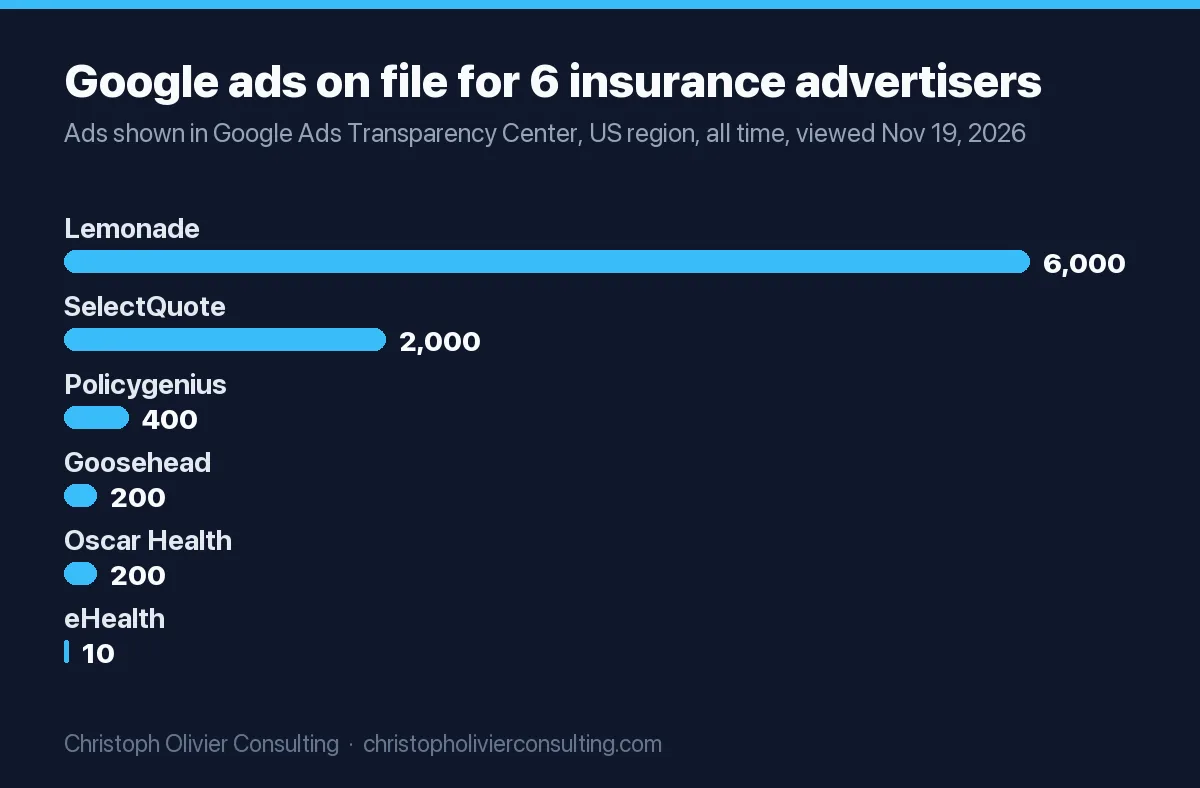
| Advertiser (domain) | Ads on file, US | Verified advertiser on the ads shown | Copy in visible ads | Rule note |
|---|---|---|---|---|
| Lemonade (lemonade.com) | ~6,000 | Lemonade INC | “Starts at $5/mo, Rated 4.9/5 Stars,” “We’ll cancel your old policy for you,” “#1 Renters Insurance, Starts at $5/mo,” sitelink “Car from $30/month” | A “from” price and a “#1” claim need a basis on file; the NAIC models require the source of any statistic to be identified |
| SelectQuote (selectquote.com) | ~2,000 | Selectquote Insurance Services | “Over 1.2 Million Families Trust SelectQuote To Find Their Life Insurance Policy,” “Substantial life insurance for less than $1/day? It could be possible” | Hedged price (“could be possible”) is safer than a flat price; the family count must be current |
| Policygenius (policygenius.com) | ~400 | Policygenius, Inc. | “Compare Life Insurance Quotes,” a customer quote about price in the description, sitelinks “Life Insurance Calculator,” “Top 7 Life Insurers” | Testimonials must be genuine and current (Model 570, Sec. 5Q) |
| Goosehead (goosehead.com) | ~200 | Goosehead Insurance, plus franchise agents verified under their own names | “Goosehead Insurance: Smarter Insurance Choices,” “One agent, many options,” a local ad with address and “compares 150+ carriers” | Carrier counts are statistics: keep the list that proves them |
| Oscar Health (hioscar.com) | ~200 | Oscar Management Corporation | Text not visible in the listing | Health plan ads fall under the stricter A&S rules |
| eHealth (ehealthinsurance.com) | 10 | Ehealthinsurance Services Inc | “Side-by-Side Plan Comparison: Dental Plans in California” | State in the headline also avoids implying licensing elsewhere |
Counts are as displayed by Google, which rounds larger totals, and cover all time, all platforms and all formats. Google notes that each of these domains has ads from more than one advertiser account. The Goosehead listing is the most useful for a small agency: individual franchise agents run their own verified ads that point to the brand’s domain. The chart shows the same counts.
Four copy patterns repeat across these ads, and each one works on a small budget:
- A price floor with “from” or “starts at.” Lemonade leads with “$5/mo.” If you quote a price, it has to be a rate a real customer can get.
- Remove the switching hassle. “We’ll cancel your old policy for you” answers the biggest objection to switching before the click.
- A specific, checkable number. “1.2 Million Families” and “150+ carriers” are believable because they are precise. Your version: “Comparing 14 carriers in [county] since 2011.”
- The state and the line in the headline. eHealth’s “Dental Plans in California” matches the search and limits the ad to where you are licensed.
The Google Ads cost per click by industry breakdown shows why insurance search ads need this precision: you pay for every click, so the copy should screen out people you cannot quote.
What the big insurance advertisers spend
The national campaigns above run on budgets no agency can match. These are advertising expense figures that companies report in their annual filings, pulled from the SEC’s XBRL data for calendar 2025. Allstate, State Farm, GEICO and Liberty Mutual are not in this dataset: Allstate reports advertising for one segment only, and the others do not file this figure with the SEC. Our insurance company marketing spend analysis covers those gaps and the third-party estimates.
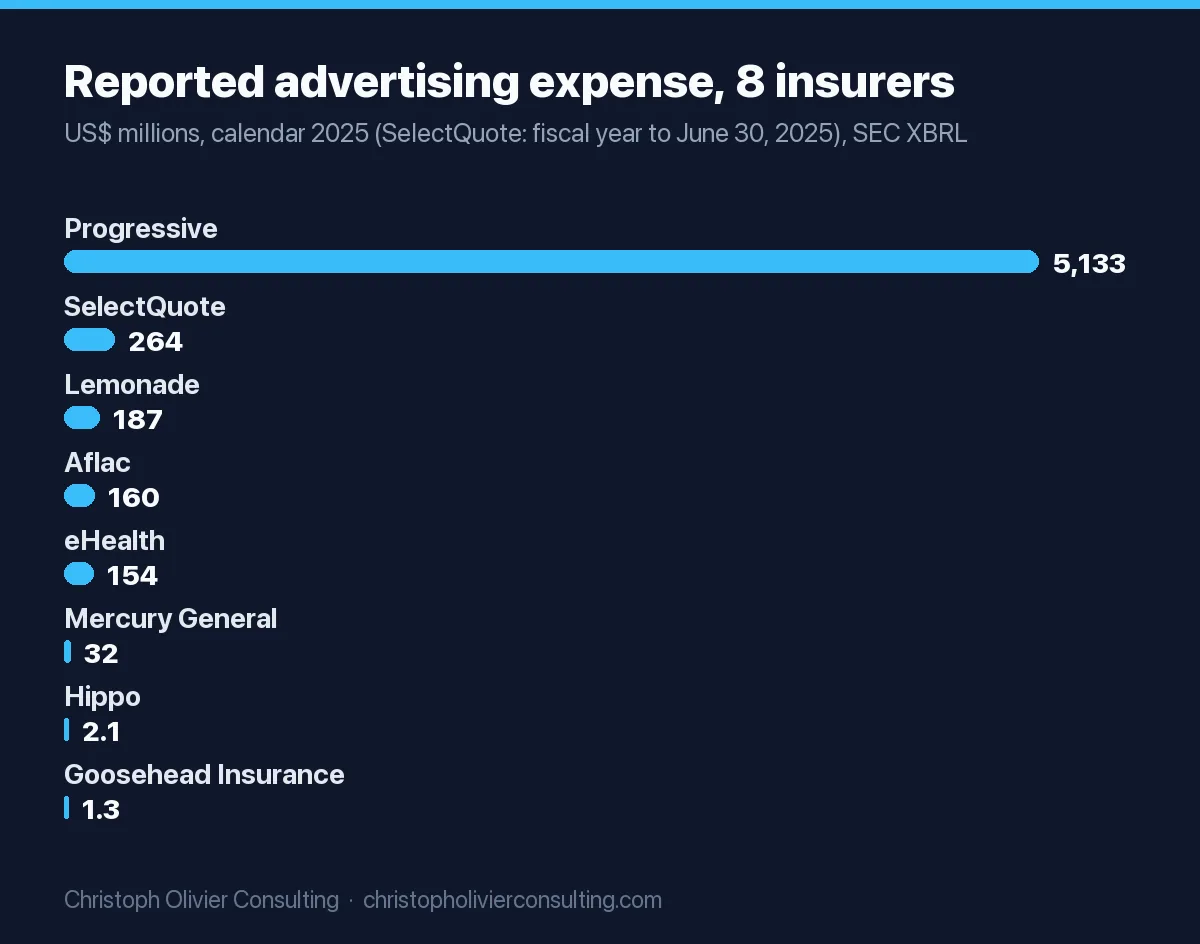
In calendar 2025, Progressive reported $5.133 billion of advertising expense. SelectQuote reported $263.7 million for its fiscal year ended June 30, 2025, followed by Lemonade at $187.3 million, Aflac at $160.0 million and eHealth at $153.5 million. Mercury General reported $32.0 million, Hippo $2.1 million and Goosehead Insurance $1.3 million. Companies define “advertising” differently, so compare orders of magnitude rather than exact amounts. The gap is the point for an agency: you cannot outspend Progressive, but you can be more specific about one city and one line.
What is considered advertising in insurance?
Far more than TV spots. The NAIC Advertisements of Life Insurance and Annuities Model Regulation (Model 570) defines an advertisement as “material designed to create public interest in life insurance or annuities or in an insurer, or in an insurance producer.” It lists printed and published material, “radio and television scripts, telemarketing scripts, billboards,” and “the Internet or any other mass communication media.” It also includes “web pages” and “prepared sales talks, presentations and materials for use by insurance producers.” Texas uses a similarly broad definition in 28 TAC 21.102, including “electronic media,” “lead solicitations” and “any other communication directly or indirectly related to a policy.” In Texas, “agent” includes every “solicitor, counselor, and soliciting representative of an insurer.”
So your Google ads, your Facebook posts that mention a product, your quote landing page and the script your producers read on the phone are all advertising. Brand ads are treated differently: Texas classes web pages “that do not refer to a specific insurance policy” as institutional advertisements, and the Model 570 drafting note suggests states exempt “generic or branding advertisements” from pre-approval.
Insurance advertising rules compared: NAIC, CMS and Texas
The NAIC models are templates that states adopt in their own versions, so check your state’s text. This table compiles what each primary source says on the issues that matter most when you write an ad.
| Issue | Life and annuities (NAIC Model 570) | Accident and sickness (NAIC Model 40) | Medicare Advantage (42 CFR 422.2262 and 422.2263) | Texas (28 TAC Ch. 21) |
|---|---|---|---|---|
| Core standard | “Truthful and not misleading in fact or by implication,” judged by the overall impression on “a person of average education or intelligence” (Sec. 4A) | “Truthful and not misleading in fact or in implication”; no words whose meaning is “clear only by implication or by familiarity with insurance terminology” (Sec. 5D) | May not “mislead, confuse, or provide materially inaccurate information” (422.2262) | Applies to agents as well as insurers (21.102) |
| “Free” and price words | “Free,” “no cost” and similar words only if true; if someone else pays, name the payer (Sec. 5M) | Limitations may not be played down with “only,” “just,” “merely” (Sec. 6B(4)) | May not call a $0 premium or reduced cost sharing “free” (422.2262(a)(1)(xi)) | Dividends may not be implied “guaranteed or certain to occur” (21.115) |
| Misleading product words | No “investment,” “savings plan,” “retirement plan” and similar terms that suggest something other than a policy (Sec. 4B) | No “no medical examination required” if preexisting conditions are excluded (Sec. 6C) | No implying the plan is a Medicare supplement or endorsed by CMS or Medicare (422.2262(a)(1)(ix), (xii)) | See the line-specific sections 21.113 to 21.116 |
| Testimonials | Must be genuine and current; disclose the endorser’s financial interest (Sec. 5Q) | Reconfirm after one year; a paid spokesperson needs “Paid Endorsement” disclosure (Sec. 9A, 9C) | Endorser must have been enrolled at the time; disclose payment; label “actor portrayal” (422.2262(b)) | Covered by the general rules |
| Statistics | “The source of any statistics used in advertisement shall be identified” (Sec. 5R) | Source must be identified in the ad (Sec. 10C) | Comparisons only if accurate and supportable (422.2263(b)(5)) | Covered by the general rules |
| Name the insurer | Insurer’s name “clearly identified in all advertisements”; no slogan or trade name that hides who carries the risk (Sec. 6A, 6B) | Identity of insurer required (Sec. 14) | On TV, online or social, the plan name must be read at the pace of the phone number or shown for the whole ad (422.2263(b)(9)) | Covered by the general rules |
| Look like the government | No words, symbols or colors that suggest a link to a government program (Sec. 6C) | Covered by the general standard | No misleading use of the Medicare name, CMS logo or Medicare card (422.2262(a)(1)(xvii)) | Covered by the general rules |
| Keep copies | Insurer keeps every ad for 5 years after last use (Sec. 9A) | 4 years, or until the next exam report if longer (Sec. 18A) | Material ID code (SMID) on most materials (422.2262(d)) | Check the department’s current rule |
Model 570’s penalty section allows “a fine up to $1000 for each violation and suspension or revocation” of the license, and it applies to producers as well as insurers. Your state’s adopted version sets the actual amount.
Medicare Advantage ads: the TPMO disclaimer and the TV ad rules
Medicare is the line where ad rules changed most recently. In its 2024 Medicare Advantage final rule (CMS-4201-F), CMS said “the proliferation of certain television advertisements generically promoting enrollment in MA plans” had drawn scrutiny, and it is “prohibiting ads that do not mention a specific plan name” as well as ads that “use language or Medicare logos in a way that is misleading, confusing, or misrepresents the plan” (CMS fact sheet, April 5, 2023).
If you sell plans from more than one Medicare Advantage organization, you are a third-party marketing organization (TPMO). Your ads must carry this standardized disclaimer, word for word, per 42 CFR 422.2267(e)(41):
“We do not offer every plan available in your area. Currently we represent [insert number of organizations] organizations which offer [insert number of plans] products in your area. Please contact Medicare.gov or 1-800-MEDICARE to get information on all of your options.”
If you sell for every MA organization in the service area, the second sentence stays and the ending becomes “You can always contact Medicare.gov or 1-800-MEDICARE for help with plan choices.” The disclaimer must be read on sales calls before benefits are discussed. It must appear in emails and chats, be shown prominently on TPMO websites, and be included in print materials and television ads.
Insurance agency advertising ideas: 8 copy-ready ad templates
These are templates, not real ads. Replace every [bracket] with your own facts. They are written as Google responsive search ad assets: Google allows up to 15 headlines of 30 characters and 4 descriptions of 90 characters (Google Ads Help), so count the characters again after you fill the brackets. The rule check column shows which provision each line is written to meet.
| # | Line | Headlines (30 chars or less when filled) | Description (90 chars or less when filled) | Rule check |
|---|---|---|---|---|
| 1 | Personal auto, independent agency | [City] Auto Insurance Quotes Compare [N] Carriers in [State] Licensed [State] Agency | We quote [N] insurers side by side. Your rate depends on drivers, vehicle and coverage. | [N] must match your current appointments (statistics rule, Model 570 Sec. 5R); [State] only where you are licensed (Model 570 Sec. 7A) |
| 2 | Homeowners | [City] Home Insurance Review Hail and Wind Coverage Check Talk to a Local Agent | We review your current policy and show deductibles and exclusions in writing. | The service is described, not a premium result; no “free” unless there is truly no charge (Model 570 Sec. 5M principle) |
| 3 | Term life | Term Life Quotes, [State] [Term]-Year Term From [Carrier] Compare Term Life Options | Premiums depend on age, health and term length. A medical exam may be required. | Names the insurer when a product is named (Sec. 6A); no “investment” or “savings plan” wording (Sec. 4B) |
| 4 | Hospital indemnity (accident and sickness) | Hospital Indemnity, [State] Pays $[X] Per Hospital Day | Benefits start after a [N]-day waiting period. Preexisting condition limits apply. | Waiting period disclosed in plain negative terms, not as a “benefit builder” (Model 40 Sec. 6B(1), 6B(3)) |
| 5 | Medicare (TPMO) | Medicare Plan Help, [County] Compare [N] Plan Options Licensed Medicare Agent | We do not offer every plan available in your area. Currently we represent [N] organizations… | Use the full 422.2267(e)(41) disclaimer on the landing page and ad extensions; never “free” for $0 premium (422.2262(a)(1)(xi)); name the MA organization if a benefit is mentioned (422.2263(b)(9)) |
| 6 | Small commercial | Contractor Insurance [City] GL and Workers Comp Quotes COIs Issued by [Time] | Quotes from [N] carriers for [trade] businesses. Certificates same day once bound. | Same-day COI is a service standard you control; no promise about premium outcome |
| 7 | Testimonial social post | “[Exact client words],” [First name], client since [year] | [Paid Endorsement, if the client got anything of value] | Genuine and current; reconfirm after one year; disclose compensation (Model 40 Sec. 9A, 9C; Model 570 Sec. 5Q) |
| 8 | Referral program post | Know Someone Shopping Rates? Introduce Them to [Agency] | Thank-you gift up to [state limit]. No purchase needed by you or them. | Check your state’s anti-rebating and gift limits first; see our guide to insurance agent referral fees |
Before any of these go live, put each asset through this check. One fail means rewrite.
- Proof on file: every number (carriers, years, clients, ratings, prices) has a record you could show the department. Pass or fail.
- Insurer named: any ad for a specific product names the carrier. Pass or fail.
- No outcome promise: no “guaranteed savings,” “lowest rate,” or a flat “save X%” you cannot back up for the reader. Pass or fail.
- Limits stated plainly: waiting periods, exclusions and medical exam requirements described as limits, not benefits. Pass or fail.
- No government look-alike: no seals, red-white-and-blue cards or “official Medicare” wording. Pass or fail.
- Testimonials authorized and current: real clients, written permission, reconfirmed within a year, paid ones labelled. Pass or fail.
- Copy archived: a dated copy of every version kept for at least 5 years, which covers both NAIC models. Pass or fail.
Catchy insurance slogans and what makes them stick
People searching for catchy insurance ads usually mean the slogans. The ones that last share three traits: they are short, they make one claim, and the claim is about the buyer, not the company.
| Slogan | Brand, year | Claim type | Source |
|---|---|---|---|
| “Fifteen minutes could save you 15% or more on car insurance” | GEICO, since the mid-1990s | Time plus savings, hedged with “could” | The Martin Agency |
| “Like a Good Neighbor” | State Farm, 1971 | Relationship | Saturday Evening Post |
| “So easy a caveman can do it” | GEICO, 2004 | Ease of buying | GEICO |
| “It’s a crime to pay for things you don’t need” | Liberty Mutual, 2019 | Fair price, customization | Liberty Mutual release |
| “Go. Know. Take Control.” | Cigna, 2016 | Health behavior | Cigna release |
| “Health insurance that won’t make your head explode” | Oscar, 2014 | Frustration relief | Fortune |
Note the hedge in GEICO’s line: “could save you.” A flat savings promise is the easiest way for a slogan to cross into “misleading by implication.” When an ad does get it wrong, the cost can be real, as the cases in our roundup of false advertising examples show.
How to turn these examples into an agency ad plan
None of this needs a national budget. The pattern across all 16 examples is the same: one promise (GEICO’s 15 minutes, Liberty Mutual’s “only pay for what you need”), one proof (SelectQuote’s 1.2 million, Goosehead’s 150+ carriers), and copy that names the reader’s line, state and situation. For which channels to fund first by line of business, start with our insurance agency marketing playbook. To set the budget, the insurance marketing spend benchmarks show what carriers and agencies actually report.
My view after putting these side by side: most agencies should copy the plain search ads before the mascots. A headline with your city, your line and one true number will do more for a three-person agency than any brand character. If you want a second pair of eyes on your ad copy and the compliance check, you can book a consultation.
Ready to scale your revenue?
Book a free 30-min consultation. We’ll diagnose your growth bottleneck and map out the 3 highest-leverage moves for your business.
Frequently asked questions
What are some popular insurance ads?
The best known are GEICO's Gecko (1999), Cavemen (2004) and its "15 minutes could save you 15% or more" line, State Farm's "Like a Good Neighbor" jingle (1971) and Jake, Aflac's duck (2000), Progressive's Flo (2008), Allstate's Mayhem (2010) and Liberty Mutual's LiMu Emu and Doug (2019). Each one repeats a single promise, such as speed, savings, recall, ease of buying, or coverage that fits.
What is considered advertising in insurance?
Almost any communication meant to sell a policy. NAIC Model 570 defines an advertisement as material designed to create public interest in insurance, an insurer or a producer, including TV and radio scripts, telemarketing scripts, billboards, web pages, internet media and the sales talks agents use. Texas adds electronic media and lead solicitations, and its rules cover agents as well as insurers.
What are some health insurance ads examples?
Cigna's 2016 "TV Doctors of America" campaign used five actors known for playing doctors to promote annual check-ups under the line "Go. Know. Take Control." Oscar Health's 2014 New York subway ads promised "Health insurance that won't make your head explode." eHealth runs search ads like "Side-by-Side Plan Comparison: Dental Plans in California." Health ads also face stricter wording rules than other lines.
What are some catchy slogans for insurance companies?
Lasting examples include GEICO's "Fifteen minutes could save you 15% or more on car insurance," State Farm's "Like a Good Neighbor" (1971), GEICO's "So easy a caveman can do it" (2004), Liberty Mutual's "It's a crime to pay for things you don't need" (2019) and Cigna's "Go. Know. Take Control." (2016). Each is short, makes one claim and is about the buyer, and GEICO's hedges with "could."
What insurance agency advertising ideas work for a small agency?
Copy the search ads before the mascots. Put your city, the line of insurance and one provable number in the headline, for example the number of carriers you quote. Name the insurer when you advertise a specific product, describe waiting periods and exclusions as limits, use real testimonials with written permission, and keep a dated copy of every ad for at least five years.
What disclaimer do Medicare insurance ads need?
An agency or marketer that sells plans from more than one Medicare Advantage organization must use the TPMO disclaimer in 42 CFR 422.2267(e)(41): "We do not offer every plan available in your area. Currently we represent [number] organizations which offer [number] products in your area. Please contact Medicare.gov or 1-800-MEDICARE to get information on all of your options." It must appear in TV ads, print, websites, emails and calls.
Can insurance ads use testimonials?
Yes, with conditions. NAIC Model 570 requires testimonials to be genuine, reflect the person's current opinion and be accurately reproduced, and any financial interest of the person giving one must be disclosed. Model 40 for health insurance adds that a testimonial used more than a year after it was given must be reconfirmed, and a paid spokesperson needs a "Paid Endorsement" disclosure.
Real advertising examples by industry