

Yes, dispensaries can advertise in every US state that licenses them, but only inside narrow lanes. State rules decide where an ad may run, who must be in the audience, and what text it must carry. Federal law and the big ad platforms then close most paid digital channels: Meta and TikTok refuse THC ads outright, and Google’s only US cannabinoid opening is certified topical hemp CBD.
Short answer: A licensed dispensary can advertise, but almost every legal state requires proof that most of the audience is 21 or older: at least 71.6% in California, Colorado and New Jersey, at least 70% in Michigan and at least 85% in Massachusetts. New York ties its threshold to the state’s census share of residents 21 and older, which works out to about 76.6% on 2025 Census estimates (our calculation). Billboards are banned outright in New York and Ohio, and Ohio requires state pre-approval of every ad. On Facebook and Instagram, THC ads are prohibited; dispensaries can only post organic business content, and Meta restricts it to adults.
Below: the federal position as of November 2026, each platform’s written policy, a 10-state rule table with section numbers, the math behind the audience thresholds and a pre-flight checklist. This summarizes published rules; it is not legal advice.
Why cannabis ads are legal in some places and banned on most platforms
Federal law is the reason the platforms say no. Adult-use marijuana is still a Schedule I controlled substance. On April 28, 2026, the Justice Department published a final rule (91 FR 22714) that moved only two categories to Schedule III: FDA-approved drug products containing marijuana, and marijuana “subject to a state-issued license to manufacture, distribute, and/or dispense marijuana or products containing marijuana for medical purposes.” A separate hearing on moving all marijuana to Schedule III was scheduled to start June 29, 2026 and to conclude “not later than July 15, 2026,” according to the DEA’s rescheduling page. As of November 20, 2026, that page lists no final order covering adult-use marijuana.
The federal statute that matters for advertising is 21 U.S.C. 843(c). Subsection (c)(1) makes it unlawful to place a written ad in a newspaper, magazine, handbill or other publication “knowing that it has the purpose of seeking or offering illegally to receive, buy, or distribute a Schedule I controlled substance.” The same subsection carves out material that “merely advocates” a position and does not “propose or facilitate an actual transaction.” Subsection (c)(2) separately bars using the internet to advertise the sale of a controlled substance where the sale “is not authorized” under federal law.
The platforms draw the same line: proposing a THC sale is out; education, advocacy and news are mostly in. Do not assume a future Schedule III move for adult-use products would lift platform bans on its own; each platform would have to change its written policy.
Can dispensaries advertise on Facebook and Instagram?
No, not with paid ads for THC. Meta’s Drugs and Pharmaceuticals advertising standard says advertisers “can’t run ads that promote THC products or cannabis products containing related psychoactive components,” which “includes both ingestible and non-ingestible products.” It also bans ads that “promote the sale of drug-related paraphernalia, such as bongs, rolling papers and vaporizers.”
What Meta does allow, under the same page:
- CBD with 0.3% THC or less, only for advertisers “actively certified with LegitScript” who also hold written authorization from Meta, only targeting the United States and only people aged 18 or older. No health or medical claims.
- Hemp products in Canada, Mexico and the United States.
- Advocacy, news and awareness about prohibited drugs, “as long as they don’t promote the sale or consumption of those substances.”
Organic posting is different from ads. Meta’s Community Standards on restricted goods list “business related content posted by marijuana dispensaries where there are no attempts to buy, sell or trade marijuana” as content Meta keeps visible but restricts to adults 18 and older. Any post that attempts to buy or sell marijuana or THC products is removed. So a dispensary Page can post hours, location, events and education, but not a priced menu with an order button.
So which cannabis ads are not allowed on Facebook? THC in any form, paraphernalia, uncertified CBD and anything that encourages consumption.
Can dispensaries advertise on Google?
Not in the United States. Google’s Recreational drugs policy names marijuana as an example of “substances that alter mental state for the purpose of recreation” and also bars ads for products or services “marketed as facilitating recreational drug use.” The one US opening is CBD: “topical, hemp-derived cannabidiol (CBD) products with THC content of 0.3% or less,” such as creams and lotions, with LegitScript certification for retailers and Google’s CBD Ads Certification form for all advertisers. FDA-approved pharmaceutical CBD advertisers may target only California, Colorado and Puerto Rico.
Canada is the exception. Google’s Cannabis-Related Content policy update describes a Canada-only pilot of Search ads that runs through December 31, 2026, now open to holders of federal Health Canada licenses and provincially authorized retailers.
Google Maps is the free channel that does work. Google’s Business Profile guidelines allow profiles for businesses selling products that “require the customer to be a certain minimum age, like alcohol, cannabis, or weapons,” but say they “aren’t permitted as service-area businesses without a storefront.” A walk-in dispensary qualifies; a delivery-only operation does not. Our local SEO statistics page has the data on how map results drive store visits.
TikTok, X and the other platforms
X is the only major US social platform with a written path for licensed cannabis advertisers. TikTok bans the category. The table below quotes each policy as read in this session.
| Platform | THC / dispensary ads in the US | CBD / hemp | Conditions that apply |
|---|---|---|---|
| Meta (Facebook, Instagram) | Prohibited | CBD (0.3% THC or less) with LegitScript certification and Meta authorization; hemp in US, Canada, Mexico | 18+ targeting; no health claims. Organic dispensary business posts allowed, shown to 18+ only. |
| Google Ads | Prohibited | Topical hemp CBD (0.3% THC or less) with LegitScript and Google certification | Canada-only cannabis Search pilot through Dec. 31, 2026. |
| X | Allowed for approved, licensed advertisers, but no sale offers | Topical hemp CBD at 0.3% THC or less may be sold | Pre-approval; target only states where licensed; no one under 21; age-gated landing pages; no depiction of use; no health claims; no encouraging transport across state lines. |
| TikTok | Prohibited, including “unauthorized drugstores, pharmacies, or dispensaries” | Not covered by the drugs exception | Bans “depiction of drug-related words, symbols, or images” in ad content and landing pages. |
| US SMS (10DLC, via carriers) | Rejected | Rejected | Twilio rejects campaigns that “promote, advertise, or facilitate the sale of cannabis, CBD products, marijuana, or controlled substances,” “regardless of state-level legality.” Not eligible for resubmission. |
X’s US terms come from its Drugs and drug paraphernalia policy: advertisers “must be licensed by the appropriate authorities,” “may only target jurisdictions in which they are licensed,” “may not promote or offer the sale of Cannabis,” and landing pages “must be age gated and sales must be age verified.” That makes X a brand-awareness channel, not a menu channel.
Cannabis advertising rules by state: 10 states compared
This is the core of compliance. Every state below requires that ads avoid appeal to minors and avoid false or health claims; the table shows what is different. Read the cited section before you buy media, because these rules are amended often (Ohio’s current version took effect October 5, 2026).
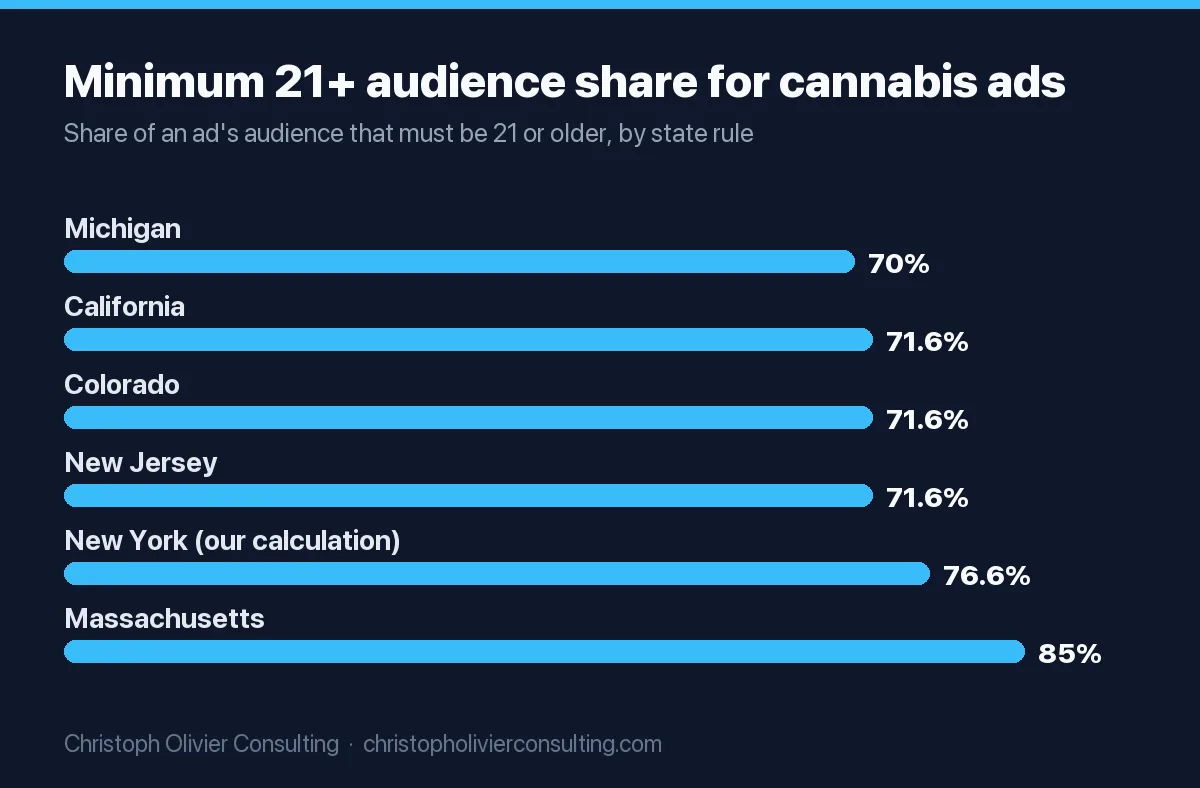
| State | Audience rule for paid media | Billboards and outdoor | Required text on ads | Rules that catch people out |
|---|---|---|---|---|
| California 4 CCR 15040, B&P 26151, 26152 | At least 71.6% reasonably expected to be 21+, shown by “reliable up-to-date audience composition data” (census data does not count) | No billboard on an interstate highway or a state highway that crosses the California border; no sign within 1,000 feet of a daycare, K to 12 school, playground or youth center | License number on every ad; platforms may not show an ad without it | No “free” cannabis goods, BOGO, contests, sweepstakes or raffles in ads (15040(a)(4)); no word “candy” or “kandy” |
| Colorado 1 CCR 212-3, Rules 3-720, 3-735 | At least 71.6% reasonably expected to be 21+ for TV, radio, print and internet (medical and retail) | No outdoor sign within 500 feet of schools, places of worship or public playgrounds | Not set in these rules | No unsolicited pop-up ads (3-750); location-based mobile marketing only via an app the 21+ owner installed, with opt-out (3-745) |
| New York 9 NYCRR Part 129 | 21+ share must meet or exceed the state’s 21+ share in the latest Census Bureau resident population estimates; licensee carries the burden of proof | No billboards at all (129.2(b)(11), 129.4(a)(1)); outdoor signs limited to name, address, contact, directions and licensed activity; nothing within 500 feet of a school ground, playground, child day care provider, public park or library | Standard 21+ / Poison Center warning plus one rotating health warning in a bright yellow box, 6-point minimum; HOPEline number, text and website or QR code; licensee name and license number | No depiction of consumption; no ads on public transit or public property; no promoting potency; social ads only where users verify 21+; mail only to verified 21+ addressees in a plain opaque envelope |
| Illinois 410 ILCS 705/55-20 | Section 55-20 sets no audience percentage | No ad within 1,000 feet of school grounds, playgrounds, recreation centers, child care centers, public parks or libraries, or arcades open to under-21s | Not set in 55-20 | No image of a cannabis leaf or bud; no transit vehicles or shelters; no publicly owned property; no giveaways of cannabis |
| Michigan Mich. Admin. Code R 420.507 | No more than 30% of the audience reasonably expected to be under 21 (adult-use), so at least 70% 21+ | Must follow municipal sign ordinances | Warnings listed in R 420.504, including “It is illegal to drive a motor vehicle while under the influence of marihuana” and the Poison Control number | No health claims unless FDA has accepted a qualified health claim; adult-use products must be marketed as “marihuana” for 21+ only |
| Massachusetts 935 CMR 500.105(4) | At least 85% reasonably expected to be 21+, for TV, radio, internet, apps, social media, billboards and print | Billboards must meet all state and local rules; bans “any illuminated or external signage beyond the period of 30 minutes before sundown until closing”; no product ads on the exterior of the premises | Long FDA disclaimer required on all advertising, plus “Please Consume Responsibly” and at least two listed warnings on public ads | No price advertising outside the store; no giveaways, coupons, loyalty programs or “free” marijuana; no vehicle or transit-venue ads; website must verify 21+ |
| New Jersey N.J.A.C. 17:30-17.2 | At least 71.6% reasonably expected to be 21+; event ads need 80% or more 21+ | No billboard off the business’s own property; nothing within 200 feet of elementary or secondary school grounds | Full warning starting “This product contains cannabis. For use only by adults 21 years of age or older”; disclosure that the facility is licensed by New Jersey | No TV, streaming or radio ads between 6:00 A.M. and 10:00 P.M. (online has no hour limit); prices may be listed on the business’s own or a third-party website, not in other ads |
| Washington RCW 69.50.369, WAC 314-55-155 | RCW 69.50.369 sets no audience percentage | Outdoor signs and billboards limited to business name, location and type of business; no plant or product images; nothing within 1,000 feet of schools, playgrounds, rec centers, child care, parks, libraries or open arcades | Four warnings in type at least 10% of the largest type, plus text that only people 21+ may buy or possess | Max four signs of 1,600 square inches each on the entrance side; no transit ads; no marketing aimed at people outside Washington |
| Ohio OAC 1301:18-4-22 (eff. Oct. 5, 2026) | No ads on “a medium with a high likelihood of reaching persons under the age of twenty-one” | No billboards; nothing within 500 feet of a prohibited facility (on-site signage excepted) | Universal THC symbol where the rule requires it; Division of Cannabis Control seal on websites | Every ad must be submitted to and approved in writing by the Division before use; no radio, TV broadcast or “internet programming”; contests, raffles and drawings banned; no slang names |
| Florida (medical only) Fla. Stat. 381.986(8)(h) | Not set by percentage | No advertising visible from any street, sidewalk, park or public place, except one dispensary sign with the business name, approved trade name or approved logo | Not set in (8)(h) | Internet ads allowed only if “approved by the department”; no unsolicited pop-ups; opt-in marketing needs an easy, permanent opt-out; nothing promoting recreational use |
Two patterns stand out. First, the 71.6% number is a standard, not a coincidence: Colorado’s rule explains that it mirrors the alcohol industry’s voluntary code, which tells brewers and distillers “to refrain from advertising where more than 28.4 percent of the audience is reasonably expected to be under the legal age of purchase” (Rule 3-720, Basis and Purpose). One hundred minus 28.4 is 71.6. Second, the agent is not a shield. California’s rule says any act or omission of “an advertising agent, representative, or contractor retained by the licensee shall in every case be deemed the act, omission, or failure of the licensee” (15040(f)), and New York makes the licensee responsible for third parties using its marks (129.2(o) and 129.5(b)).
What the audience thresholds mean in practice
None of the current top results do this math, so here it is. The question a media buyer has to answer is simple: if a channel’s audience looked like the state’s general population, would it pass? We calculated each state’s share of residents aged 21 and older from the Census Bureau’s Vintage 2025 state population estimates by single year of age (July 1, 2025), and set it against the state’s legal threshold.
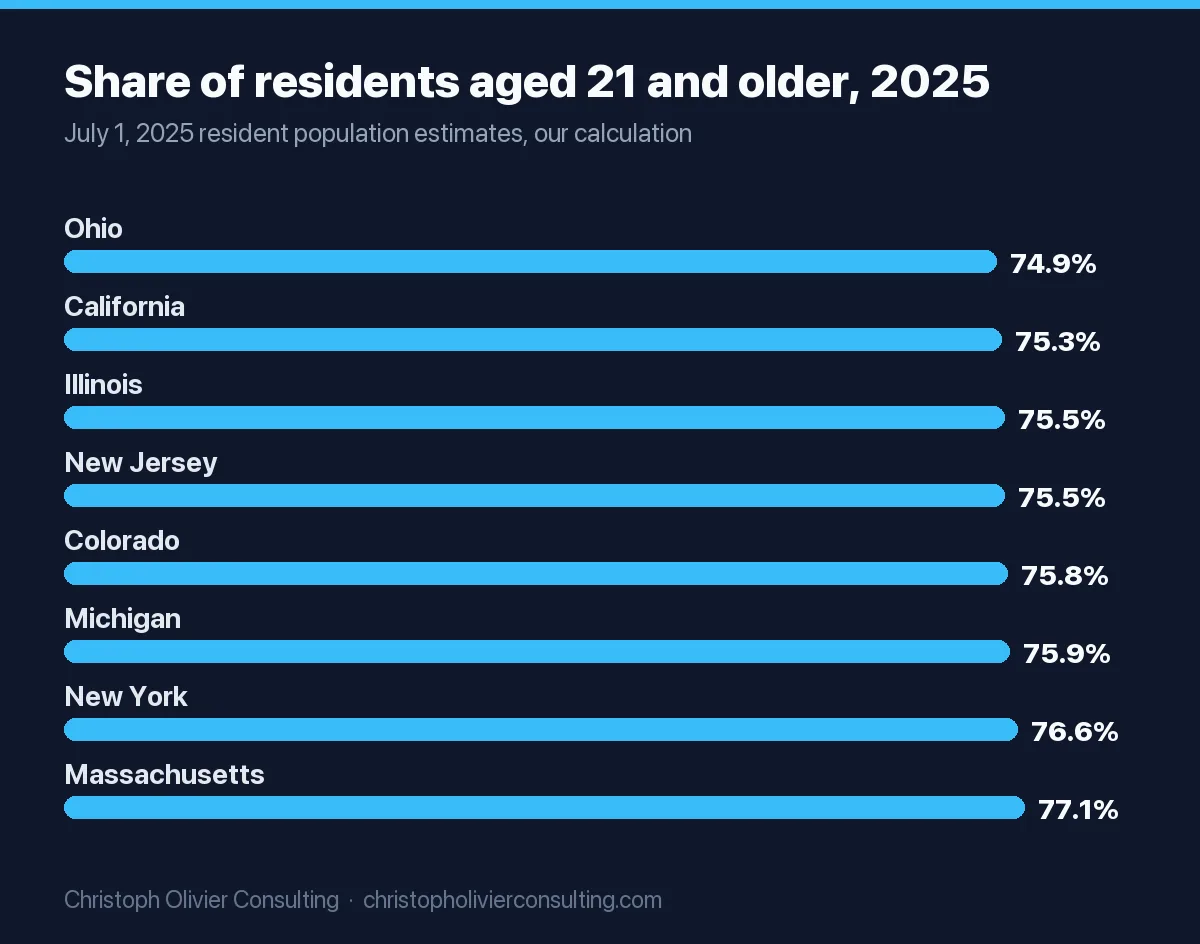
| State | Residents 21+ (July 1, 2025) | Share 21+ (our calculation) | Legal minimum 21+ share | Does a population-average audience pass? |
|---|---|---|---|---|
| California | 29,640,497 of 39,355,309 | 75.3% | 71.6% | Yes, with 3.7 points of margin |
| Colorado | 4,558,553 of 6,012,561 | 75.8% | 71.6% | Yes, 4.2 points of margin |
| New Jersey | 7,208,470 of 9,548,215 | 75.5% | 71.6% | Yes, 3.9 points of margin |
| Michigan | 7,685,852 of 10,127,884 | 75.9% | 70.0% (30% under-21 cap) | Yes, 5.9 points of margin |
| New York | 15,322,090 of 20,002,427 | 76.6% | Equal to the state share, about 76.6% | Only just: zero margin by design |
| Massachusetts | 5,518,928 of 7,154,084 | 77.1% | 85% | No, short by 7.9 points |
Method and assumptions: we summed the Census estimates for all sexes, all origins and all races, ages 21 and up, divided by the total, and rounded to one decimal. The New York Office of Cannabis Management may publish its own figure and may use a different vintage; its number controls. Audience composition data from a publisher, not census data, is what regulators ask for, and California’s rule explicitly says census and state population estimates do not count as “reliable up-to-date audience composition data.”
The takeaway: in California, Colorado, New Jersey and Michigan, a channel whose audience mirrors the adult population usually passes. In New York, it must skew older than the state. In Massachusetts, only strongly adult audiences pass: age-verified platforms, adult-only venues and your own opt-in lists.
Worked example: one podcast buy, four states
Assume a hypothetical podcast network gives you a demographic report showing 80% of its listeners are 21 or older. These are the results, based only on the audience test:
- California: 80% is above 71.6%. Passes, provided the ad carries the license number and has no free-product offer. Keep the report: California can demand it “immediately upon request” and order removal if you cannot produce it (15040(d), (e)).
- New York: 80% is above the roughly 76.6% state share. Passes the audience test. As audio-only, the ad must read aloud: “For persons 21 and older. Keep away from children and pets. If cannabis is accidentally consumed, contact the Poison Center.” The HOPEline requirement in 129.2(f) applies to “any advertising” unless the office exempts it, so check how to deliver it in audio.
- Massachusetts: 80% is below 85%. Fails. Do not run it.
- Ohio: The audience number is irrelevant. Internet programming is a barred medium under 1301:18-4-22(C)(5), and nothing runs without written Division approval.
One audience, four answers. A multi-state brand needs a media plan per state.
Compliant vs noncompliant cannabis ad copy
Each row ties to a specific rule.
| Noncompliant | Why | Compliant alternative |
|---|---|---|
| “Free pre-roll with every purchase this weekend” | CA 15040(a)(4) bans advertising free cannabis goods; NY 129.3 bans “free” or “donated” product giveaways; MA bans giveaways and coupons | “New flower drop Friday. Open 9 to 9.” (In NY, a disclosed discount is allowed in email, mail or your website to a 21+ audience under 129.3.) |
| “Our gummies help you sleep and ease anxiety” | Health claims barred: IL 55-20(a)(5), NY 129.2(b)(9), OH (B)(9), MI R 420.507(3) | “Gummies in 5 mg servings. Ask our staff about onset times.” |
| Photo of a person exhaling smoke | Depicting consumption barred in IL 55-20(a)(3), NY 129.2(b)(5) and (12), OH (B)(6); X bans depicting use | Product-free storefront or staff photo, or packaged product that complies with labeling rules |
| “Strongest THC in the city, 35%” | NY 129.2(b)(13) bans promoting potency; NY 129.2(b)(4) bans promoting overconsumption | State the THC content factually on the product page, without comparative superlatives |
| Cartoon mascot, candy colors, the word “kandy” | CA 15040(a)(3) bans cartoons and “candy” or “kandy”; NJ, MA, WA ban content appealing to under-21s | Plain adult design with no characters |
Marketing channels that stay open to dispensaries
With paid social and search closed, owned channels carry the load. Each still has rules.
- Your website and SEO. NY 129.2(l) requires a mechanism to verify visitors are 21 or older; Massachusetts bars operating a website “that fails to verify that the entrant is 21 years of age or older”; Ohio requires age affirmation and the Division seal. Menu, education and location pages are what rank.
- Google Business Profile. Allowed for storefront dispensaries, not for delivery-only operators (see the Google section above).
- Email. The workhorse for dispensaries. Build it from in-store opt-ins with age verified at the counter. Florida requires opt-in marketing to carry “an easy and permanent opt-out feature.” In New York, emailed discounts are allowed to a 21+ audience under 129.3(a)(3). Our email marketing best practices cover consent.
- SMS. Mostly closed. Even with opt-in, US carriers through providers such as Twilio reject cannabis campaigns “regardless of state-level legality.” Plan around email; our SMS marketing platforms comparison is relevant only to non-cannabis lines of business.
- Third-party menu sites. Listing marketplaces such as Weedmaps and Leafly are where many shoppers compare menus. New Jersey explicitly allows price lists “on its website or a third-party website” (17:30-17.2(e)4.ii), and New York allows discount offers via a third-party website “where the audience is intended to be individuals 21 years of age and over.” Your state’s audience rule still applies to any paid placement there.
Billboards are the channel with the widest spread: banned in New York and Ohio, banned off-premises in New Jersey, text-only in Washington, banned on border-crossing highways in California. Our out-of-home advertising statistics cover pricing and reach if your state allows them.
Canada, in one paragraph
Canada is federally legal but stricter on creative. Section 17(1) of the Cannabis Act bans promoting cannabis “by communicating information about its price or distribution,” by testimonial or endorsement, by depicting “a person, character or animal,” or by associating it with “glamour, recreation, excitement, vitality, risk or daring.” Licensed sellers may use informational or brand-preference promotion only in narrow settings, such as addressed communications to named adults or age-restricted channels (s. 17(2)).
Cannabis ad pre-flight checklist
Run every ad through these checks before it goes live. Any “fail” means stop.
- Licensed and current? Pass: your license is active and not suspended (CA 26152(h) bars ads during a suspension). Fail: suspended, pending or out-of-state.
- Medium allowed? Pass: the medium is not on your state’s banned list (billboard, transit, public property, broadcast in Ohio, daytime TV and radio in New Jersey). Fail: any banned medium.
- Audience data on file? Pass: a written, current audience report from the publisher shows a 21+ share at or above your state’s minimum (71.6%, 70%, about 76.6% or 85%). Fail: no report, census data only, or below the threshold.
- Distance check done? Pass: any physical placement is outside the buffer (200 feet NJ, 500 feet CO, NY and OH, 1,000 feet CA signs, IL and WA). Fail: inside it, or not measured.
- Required text present? Pass: license number (CA, NY), state warnings in the required wording, size and color (NY yellow box, 6-point; WA 10% of the largest type), HOPEline in NY, licensed-by-New-Jersey disclosure in NJ. Fail: any missing item.
- Creative clean? Pass: no consumption, no under-21 models, no cartoons or candy cues, no leaf image (Illinois), no potency boasts (New York), no health or safety claims. Fail: any one.
- Offer legal? Pass: no free product, contests or raffles; discounts only where and how your state allows. Fail: BOGO, giveaways, or a price ad in Massachusetts outside the store.
- Platform policy cleared? Pass: the platform allows this ad type (X approval, LegitScript for CBD on Meta or Google). Fail: THC ad on Meta, Google or TikTok.
- Pre-approval where required? Pass: written Division approval in Ohio, Department approval for Florida internet ads. Fail: running before approval.
- Records kept? Pass: the ad, placement list and audience data saved (New Jersey requires “a precise description of the audience” and a list of all publications and venues; Massachusetts requires sponsorship audience data to be kept for one year). Fail: nothing on file.
False-claim enforcement is not unique to cannabis. Our roundup of false advertising examples shows what unsupported claims cost in other regulated categories. If you want a second pair of eyes on a multi-state cannabis media plan before you commit spend, you can book a consultation.
Ready to scale your revenue?
Book a free 30-min consultation. We’ll diagnose your growth bottleneck and map out the 3 highest-leverage moves for your business.
Frequently asked questions
Can dispensaries advertise?
Yes, in states that license them, but within strict limits. Most states require reliable data showing a mostly adult audience: at least 71.6% aged 21+ in California, Colorado and New Jersey, 70% in Michigan and 85% in Massachusetts. Ads cannot appeal to minors, depict consumption or make health claims, and New York and Ohio ban billboards entirely. Ohio also requires state approval of every ad before it runs.
Can dispensaries advertise on Facebook?
Not with paid ads. Meta's advertising standards prohibit ads that promote THC products or cannabis products with psychoactive components, ingestible or not, and ads for paraphernalia. Dispensaries can keep a Page or Instagram profile and post business content such as hours, location and events, which Meta restricts to adults 18 and older, as long as the posts do not try to buy or sell marijuana.
Can dispensaries advertise on Google?
Not in the United States. Google's Recreational drugs policy lists marijuana as prohibited and bars ads for businesses that facilitate recreational drug use. The US exception is topical, hemp-derived CBD with 0.3% THC or less, with LegitScript certification and Google's CBD certification. Google runs a separate Canada-only cannabis Search ads pilot through December 31, 2026. Storefront dispensaries can still use a free Google Business Profile.
Are cannabis companies allowed to advertise on social media?
On X, approved and licensed cannabis advertisers can run US brand ads targeted to states where they are licensed and to users 21 and older, but cannot offer products for sale or show consumption. TikTok bans drug ads, including unauthorized dispensaries. New York also requires that social ads reach only users who verify they are 21 or older and that the profile shows the license number.
What is the 71.6% rule in cannabis advertising?
It is the minimum share of an ad's audience that must be reasonably expected to be 21 or older in states such as California, Colorado and New Jersey. Colorado's rule explains it mirrors the alcohol industry's voluntary code, which avoids audiences more than 28.4% under the legal purchase age. Licensees need reliable audience composition data from the publisher; California says census data does not qualify.
Can cannabis dispensaries use billboards?
It depends on the state. New York and Ohio ban cannabis billboards outright. New Jersey bans billboards that are not on the business's own property. California bans them on interstate highways and state highways that cross the state border and within 1,000 feet of schools and similar sites. Washington limits billboards to the business name, location and type of business, with no plant or product images.
Can dispensaries send text message marketing?
In practice, rarely. US carriers reject cannabis SMS campaigns: Twilio's error 30940 says campaigns that promote, advertise or facilitate the sale of cannabis, CBD or marijuana are rejected regardless of state legality and cannot be resubmitted. Most dispensaries rely on opt-in email instead, which states such as Florida require to include an easy, permanent opt-out.
Professional advertising rules