

Yes. Pharmacies in the United States can advertise, including their prescription prices, in print, on the radio, on TV, in search and on social media. The question was settled in 1976, when the Supreme Court struck down a Virginia law that made it “unprofessional conduct” for a pharmacist to advertise “any amount, price, fee, premium, discount, rebate or credit terms” for prescription drugs (Virginia State Board of Pharmacy v. Virginia Citizens Consumer Council, 425 U.S. 748). What remains are rules on how you advertise: an FDA rule for prescription price ads, state board of pharmacy rules, a federal ban on advertising controlled substances online, the HIPAA marketing rule, and the certification gates at Google and Meta.
Short answer: A pharmacy can advertise its services, hours, delivery, vaccinations and prescription prices. A prescription price ad escapes the FDA’s full brief summary rule only if it meets the four conditions in 21 CFR 200.200: price only, no safety or effectiveness claims, name plus strength plus dosage form plus quantity, and one all-in price. Advertising controlled substances online for unauthorized sale is a federal crime under 21 U.S.C. 843(c), and online pharmacies need LegitScript certification or NABP accreditation before Google or Meta will run their prescription drug ads.
The 1976 case that made pharmacy advertising legal
Before 1976, several states treated price advertising by pharmacists as professional misconduct. Virginia’s statute, section 54-524.35(3), banned a pharmacist from publishing, advertising or promoting “directly or indirectly, in any manner whatsoever” any price for “any drugs which may be dispensed only by prescription.” A consumer group sued, arguing that the people harmed were not the pharmacists but the patients who could not compare prices.
The Supreme Court agreed on May 24, 1976. Justice Blackmun’s opinion held that commercial speech is protected by the First Amendment and that “the free flow of commercial information is indispensable.” The record showed why it mattered: in Richmond, “the cost of 40 Achromycin tablets ranges from $2.59 to $6.00,” and in the Newport News and Hampton area tetracycline ranged from $1.20 to $9.00, a 650% spread (425 U.S. 748). The Court left room for rules against false or misleading ads and for reasonable time, place and manner limits, which is exactly the space today’s pharmacy advertising rules occupy.
The same First Amendment line later opened advertising to lawyers, dentists and physicians. The parallel stories are in our guides on whether doctors are allowed to advertise and whether dentists are allowed to advertise.
Who regulates a pharmacy ad: the six rulebooks
A single pharmacy ad can fall under several regulators at once. Which ones apply depends on what you advertise (a prescription price, an OTC product, a compounded drug, a controlled substance) and where it runs.
| Rulebook | What it covers in a pharmacy ad | Citation |
|---|---|---|
| FDA, prescription drug advertising | Any ad for a prescription drug must carry a “brief summary” of side effects, contraindications and effectiveness, unless it is an exempt reminder ad or a price-only ad meeting 21 CFR 200.200. | 21 U.S.C. 352(n), added in 1962; 21 CFR 202.1; 21 CFR 200.200 |
| FTC | Ads for over-the-counter drugs, vitamins, services and anything else that is not a prescription drug: no false advertisement likely to induce the purchase of “food, drugs, devices, services, or cosmetics.” | 15 U.S.C. 52 |
| DEA statute (Ryan Haight Act provisions) | Using the Internet “to advertise the sale of, or to offer to sell, distribute, or dispense, a controlled substance” in a manner not authorized by the Controlled Substances Act. Up to 4 years in prison per violation. | 21 U.S.C. 843(c)(2) and (d) |
| State board of pharmacy | Truthfulness, price ad contents, controlled substance ads, kickbacks, comparative claims. Violations are license discipline. | See the state table below |
| HHS Office for Civil Rights, HIPAA | Using patient information to send marketing (texts, emails, mailers) requires written authorization, with exceptions for refill reminders. | 45 CFR 164.501, 164.508(a)(3) |
| Ad platforms (Google, Meta) | Online pharmacies need LegitScript certification or NABP accreditation, plus platform approval, to advertise prescription drugs. | Google Healthcare and medicines policy; Meta Drugs and Pharmaceuticals policy |
The FDA states the split plainly: “while the FDA oversees ads for prescription drugs, the Federal Trade Commission (FTC) oversees ads for over-the-counter (non-prescription) drugs” (FDA, Basics of Drug Ads). For a typical community pharmacy, that means your OTC circular is an FTC matter and your prescription price list is an FDA matter.
Pharmacy price advertising rules under 21 CFR 200.200
This is the rule most pharmacies actually need, and almost nobody explains it. Under 21 CFR 202.1(e), every prescription drug ad must include a brief summary of side effects, contraindications and effectiveness. That would make a simple price list impossible. The FDA solved it in 1975 with a carve-out: prescription drug “reminder advertisements and reminder labeling intended to provide price information to consumers” are exempt “if all of the following conditions are met” (21 CFR 200.200(a), 40 FR 58799, December 18, 1975):
- Price is the only purpose. The ad provides “information concerning the price charged for a prescription for a particular drug product” and contains “no representation or suggestion concerning the drug product’s safety, effectiveness, or indications for use.”
- Required identifiers. The proprietary name (if any), the established (generic) name (if any), the strength, the dosage form, and “the price charged for a prescription for a specific quantity of the drug product.”
- Pharmacy information is allowed. You may add “identification of professional or convenience services provided by the pharmacy,” as long as it is not false or misleading and says nothing about the drug’s safety, effectiveness or uses.
- One all-in price. The price “shall include all charges to the consumer including, but not limited to, the cost of the drug product, professional fees, and handling fees, if any. Mailing fees and delivery fees, if any, may be stated separately.”
Subsection (b) applies the exemption to “price lists, catalogs, and other promotional material, whether mailed, posted in a pharmacy, placed in a newspaper, or aired on radio or television.” Subsection (c) warns that a price ad that misses any condition “shall be the subject of appropriate regulatory action” against the product or “the responsible person.”
Two traps in the parent rule. First, the moment your price ad says what the drug treats (“Metformin for diabetes, $4”), it stops being price-only and needs a full brief summary. Second, ordinary reminder ads are not permitted for drugs with a boxed warning, but 21 CFR 202.1(e)(2)(i) expressly preserves price-only ads that meet 200.200 (21 CFR 202.1(e)(2)(i)).
Copy-ready prescription price ad template
Built line by line from 21 CFR 200.200 and the New Jersey rule below, which is stricter than most states. Fill in the brackets; do not add words about what the drug does.
| Line | Template text | Rule it satisfies |
|---|---|---|
| 1 | [Proprietary name, if any] ([established name]) [strength] [dosage form] | 200.200(a)(2) |
| 2 | [Quantity], $[price] | 200.200(a)(2); N.J.A.C. 13:39-7.14(b) |
| 3 | Price includes all pharmacy charges, including professional and handling fees. | 200.200(a)(4) |
| 4 | Delivery: $[fee] (optional). [Any other added service charge] | 200.200(a)(4); N.J.A.C. 13:39-7.14(b) |
| 5 | Prices valid [start date] through [end date]. | N.J.A.C. 13:39-7.14(d) |
| 6 | [Pharmacy name, address, hours, services such as delivery or immunizations] | 200.200(a)(3) |
Example, filled in: “Atorvastatin calcium 20 mg tablets, 30 tablets, $[price]. Price includes all pharmacy charges, including professional and handling fees. Local delivery $[fee]. Prices valid January 1 through January 31, 2027.” Notice what is missing: “lowers cholesterol,” “safe,” “same as the brand.” Each of those would pull the ad out of the exemption.
State board of pharmacy advertising rules, compared
Every state board can discipline a license for misleading advertising, but the specific rules differ. These are the operative texts from four states, quoted from the codes themselves.
| State and rule | What it says | What it means for your ads |
|---|---|---|
| Florida, Fla. Admin. Code 64B16-27.104(1) and (3) | “A pharmacist or pharmacy shall be permitted to advertise medicinal drugs other than those controlled substances specified in Chapter 893, F.S., and patent and proprietary preparations so long as such advertising is not false, misleading or deceptive.” Subsection (3) bars rebate or percentage rental agreements with prescribers or facilities that limit “a patient’s free choice of a pharmacist or pharmacy.” | Controlled substances are off the table in Florida pharmacy ads. Everything else is allowed if it is truthful. |
| New Jersey, N.J.A.C. 13:39-7.14 | Price quotes must “stipulate the strength and quantity,” include “the usual and customary prescription cost,” list added charges such as delivery, and “stipulate the effective period of price quotation.” “Any reference in any form of advertisement to the quality of a drug or its beneficial use is prohibited.” Ads must be “predominantly informational,” and ads “demeaning the quality of professional services rendered by another licensee” are banned. | The strictest of the four. No quality claims, no “works just as well,” no knocking the competitor down the street, and every price needs an end date. |
| California, 16 CCR 1766 and Bus. & Prof. Code 4122 | “No pharmacist or permit holder shall violate Section 17500 of the Business and Professions Code” (the state false advertising statute). Section 4122 requires a posted board notice on price information and says a pharmacist “shall give the current retail price for any drug sold at the pharmacy upon request from a consumer.” | California pushes price transparency. If a caller asks for prices on more than five drugs without prescriptions, you may require a written request and answer within 10 days, and you need not quote controlled substance prices by phone or answer competitors (4122(c) and (e)). |
| Georgia, Ga. Comp. R. & Regs. 480-5-.03(g) | “No pharmacist or licensed pharmacy shall disseminate through any communication media any false, misleading or fraudulent advertising.” Subsection (j) bars “a rebate or percentage rental agreement” with physicians. | A general truthfulness standard, enforced through license discipline, plus a ban on referral rebates. |
Rules change. Iowa’s dedicated pharmacy advertising rule, 657-8.12, is shown on Cornell’s copy of the Iowa code as rescinded effective July 16, 2025. Check your own board’s current code before a campaign launches, not after a complaint.
What a pharmacy cannot advertise
Controlled substances online
Federal law makes it unlawful “to knowingly or intentionally use the Internet, or cause the Internet to be used, to advertise the sale of, or to offer to sell, distribute, or dispense, a controlled substance” except as the Controlled Substances Act authorizes. It also covers ads that refer buyers “to Internet sellers of controlled substances who are not registered.” The penalty is up to 4 years in prison, and up to 8 years after a prior conviction (21 U.S.C. 843(c)(2) and (d)). Separately, Google’s policy says “Offering prescription drugs without a prescription is not allowed” (Google Ads policy). Florida goes further and keeps controlled substances out of pharmacy advertising entirely.
Compounded drugs with misleading claims
Compounding pharmacies can advertise. In 1997 Congress conditioned the compounding exemption on a pharmacy agreeing to “not advertise or promote the compounding of any particular drug, class of drug, or type of drug.” The Supreme Court struck that down 5 to 4 on April 29, 2002, as an unconstitutional restriction on commercial speech (Thompson v. Western States Medical Center, 535 U.S. 357), and Congress removed the provision from the statute in 2013 through Pub. L. 113-54 (21 U.S.C. 353a, editorial notes).
What compounders cannot do is make false or misleading claims. A compounded drug is misbranded if its advertising or promotion is “false or misleading in any particular” under section 502(bb) of the FD&C Act. In an FDA warning letter dated June 8, 2026, the agency flagged the claims “The same active ingredient in Mounjaro® and Zepbound™” and an “FDA licensed compounding facility,” and stated: “Compounding facilities, including pharmacies and outsourcing facilities, are not ‘FDA-approved’ or ‘FDA-licensed’ entities” (FDA warning letter, MARCS-CMS 730317). Recipients get 15 business days to respond. If you market compounded GLP-1s, our weight loss clinic marketing playbook covers compliant GLP-1 promotion more broadly.
Patient data used for marketing without authorization
Under HIPAA, marketing means “a communication about a product or service that encourages recipients of the communication to purchase or use the product or service.” Two pharmacy exceptions matter. Refill reminders and messages “about a drug or biologic that is currently being prescribed for the individual” are not marketing, but “only if any financial remuneration received by the covered entity in exchange for making the communication is reasonably related to the covered entity’s cost of making the communication” (45 CFR 164.501). Everything else that uses patient information for marketing needs a signed authorization, and if a third party such as a manufacturer pays you, “the authorization must state that such remuneration is involved” (45 CFR 164.508(a)(3)). Face-to-face conversations and “a promotional gift of nominal value” are exempt.
Can a pharmacy advertise on Google, Facebook or TV?
Yes, with gates that depend on whether you sell prescription drugs online. A pharmacy promoting its location, hours, flu shots or OTC products runs under the general policies. A pharmacy that wants to promote prescription drugs online needs third-party verification first.
- Google (United States): online pharmacies must be “Certified by LegitScript through its Healthcare Merchant Certification Program” or accredited by NABP through its “Digital Pharmacy Accreditation Program or Healthcare Merchant Accreditation Program,” and must also be certified with Google (Google Healthcare and medicines policy). Telemedicine providers face the same two options.
- Meta (Facebook and Instagram): “Meta requires online pharmacies and telehealth providers to be actively certified with LegitScript,” then to request Meta authorization. Prescription drug ads may only target “eligible countries (United States, Canada or New Zealand)” and “people 18 years or older.” OTC medicine ads may not target anyone under 18 either (Meta Drugs and Pharmaceuticals policy).
- TV and radio: no certification gate. The FDA rule still applies: a broadcast price ad that meets 21 CFR 200.200 is exempt “whether mailed, posted in a pharmacy, placed in a newspaper, or aired on radio or television.”
What certification costs: 3-year own calculation
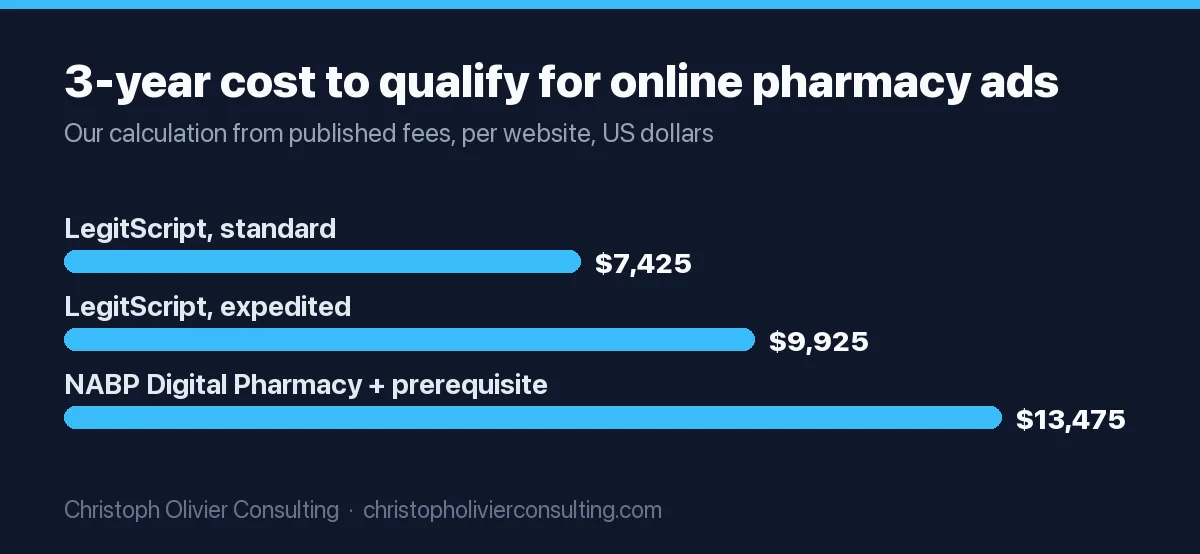
Our calculation from each body’s published fee page, per website, fetched November 2026. Assumptions: three years of operation; LegitScript’s annual fee is charged in each of the three years starting at approval; no expedite unless stated; domain registration and any additional surveys excluded because their prices are not published.
| Path | Published fees | 3-year cost (our calculation) | Gaps |
|---|---|---|---|
| LegitScript Healthcare Merchant Certification | $975 application (nonrefundable); $2,150 annual fee after approval; $2,500 optional expedite | $975 + (3 x $2,150) = $7,425; $9,925 with expedite | Per website; $3,995 annual fee instead if placed on probationary monitoring |
| NABP Healthcare Merchant Accreditation | $1,075 per website, covers year 1 | $1,075 plus annual fees for years 2 and 3: not disclosed on the fee page | Requires a .pharmacy domain, priced by the registrar |
| NABP Digital Pharmacy Accreditation (single location) | $3,974 application; $3,500 survey; $1,642 annual participation, years 1 to 3 (NABP estimate $12,400) | $12,400 + $1,075 Healthcare Merchant prerequisite = $13,475 minimum | Healthcare Merchant fees after year 1 not disclosed; extra surveys extra |
For most independents selling online for the first time, LegitScript is the cheaper documented route, and it is the only one Meta accepts for pharmacies. NABP Digital Pharmacy Accreditation is the heavier, inspection-based credential. If you are weighing whether the ad spend behind it pays back, the income figures in our analysis of how much a pharmacy owner makes are a useful sanity check.
Compliant vs noncompliant pharmacy ads
Each row applies a specific rule quoted above. The noncompliant versions are illustrative wording, not real ads.
| Situation | Noncompliant | Compliant | Rule |
|---|---|---|---|
| Generic price ad | “Generic Lipitor, just $9! Lowers cholesterol.” | “Atorvastatin calcium 20 mg tablets, 30 tablets, $9. All pharmacy fees included.” | 21 CFR 200.200(a)(1), (a)(2) |
| Fees | “$4 prescriptions” with a $2 dispensing fee added at the counter | “$6 for 30 tablets, all fees included. Delivery $3.” | 21 CFR 200.200(a)(4) |
| New Jersey price ad | Price with no end date | “Prices valid through March 31, 2027.” | N.J.A.C. 13:39-7.14(d) |
| Quality claims (New Jersey) | “Our generics work just as well as the big chains’ brands.” | “Generic and brand-name prescriptions filled. Ask for today’s price.” | N.J.A.C. 13:39-7.14(c), (f) |
| Compounded GLP-1 | “Same active ingredient as Ozempic, from an FDA-licensed compounding pharmacy” | Describe the compounded product and the prescription requirement without implying FDA approval or licensing | FD&C Act 502(bb); FDA warning letter, June 8, 2026 |
| Controlled substances online | Search ad: “Order ADHD meds online, no visit needed” | No ad for the controlled substance; advertise the pharmacy’s general services | 21 U.S.C. 843(c)(2); Fla. Admin. Code 64B16-27.104(1) |
| Text messages | Manufacturer-paid text to patients on a competing drug, sent without authorization | Refill reminder for a drug currently prescribed, with no payment beyond the cost of sending | 45 CFR 164.501; 164.508(a)(3) |
| Instagram OTC promo | Allergy medicine ad targeted to ages 13 and up | Same ad targeted to 18 and up, compliant with state law | Meta Drugs and Pharmaceuticals policy |
Most of these failures are the same failure the FTC punishes in other industries. Our roundup of false advertising examples and what they cost shows the pattern.
Why is it legal to advertise prescription drugs?
Because no law forbids it, and Congress chose disclosure over a ban. In the FDA’s words: “No federal law has ever banned DTC advertising. Until the mid-1980s, drug companies gave information about prescription drugs only to doctors and pharmacists” (FDA, Background on Drug Advertising). The legal frame dates from 1962, when Pub. L. 87-781 added section 502(n) to the Federal Food, Drug, and Cosmetic Act, requiring the established name, the formula and a “brief summary relating to side effects, contraindications, and effectiveness” in prescription drug ads. The same section says that “except in extraordinary circumstances, no regulation issued under this paragraph shall require prior approval” of ad content (21 U.S.C. 352(n)). The FDA reviews ads after they run, not before.
TV ads took off after the FDA’s approach to broadcast risk information, first floated in 1997 and finalized in its August 1999 guidance on consumer-directed broadcast ads. A broadcast ad must state the “major statement” of risks and either a full brief summary or “adequate provision” for viewers to find the full labeling, such as a website or phone number (21 CFR 202.1(e)(1)(i)). The FDA itself now calls that option “the ‘adequate provision’ loophole created in 1997” (FDA press announcement, September 9, 2025).
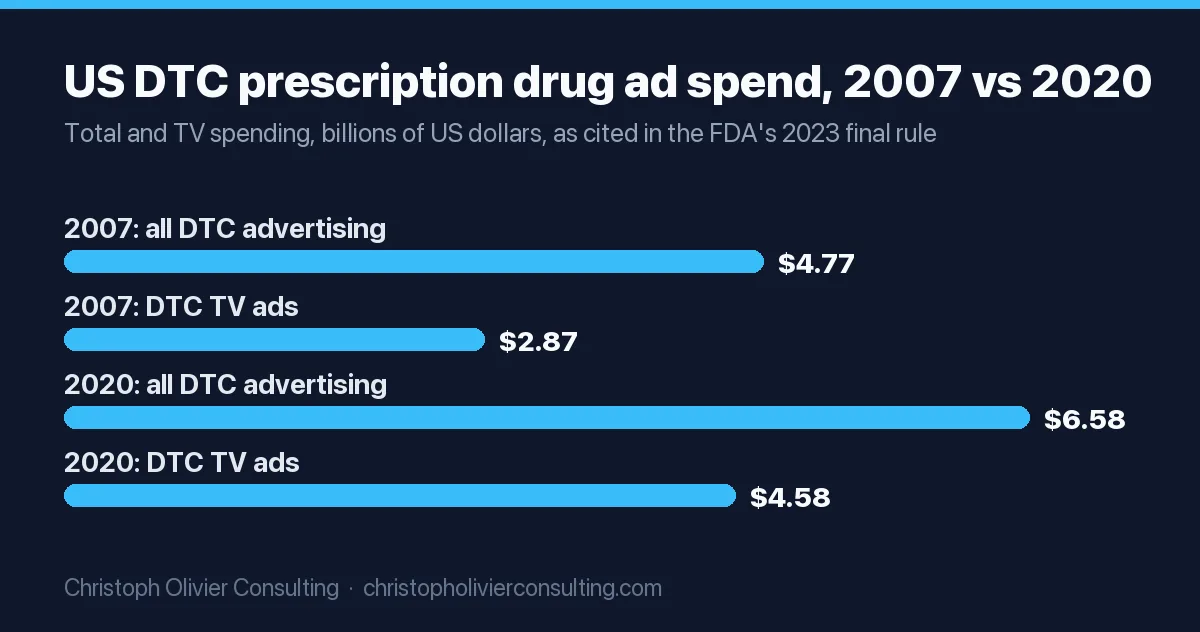
The result is a very large market. The FDA’s 2023 final rule reports $4.77 billion of DTC spending in 2007, $2.87 billion of it on TV, and $6.58 billion in 2020, with $4.58 billion on TV (88 FR 80958, November 21, 2023). For what individual manufacturers report in their filings, see how much Big Pharma spends on advertising.
Outside the US, the default is the opposite. New Zealand “is one of only two developed countries, along with the US, that permits direct-to-consumer advertising” (University of Auckland, 2019). In the UK, regulation 284(1) of the Human Medicines Regulations 2012 says “A person may not publish an advertisement that is likely to lead to the use of a prescription only medicine” (legislation.gov.uk).
The 2023 “clear, conspicuous and neutral” rule
Since November 20, 2024 (the compliance date; the rule took effect May 20, 2024), the major statement in a DTC TV or radio ad must be “presented in a clear, conspicuous, and neutral manner,” which 21 CFR 202.1(e)(1)(ii) defines with five tests:
- “consumer-friendly language and terminology that is readily understandable”;
- audio “at least as understandable as the audio information presented in the rest of the advertisement” in volume, articulation and pacing;
- on TV, “dual modality”: audio and on-screen text together, with the text starting at the same time and ending “at approximately the same time as the corresponding audio”;
- on TV, font size, style, contrast and placement that “allow the information to be read easily”;
- no “audio or visual elements, alone or in combination, that are likely to interfere with comprehension of the major statement.”
This rule binds manufacturers running product claim ads, not a pharmacy running a price-only spot under 200.200. It matters to a pharmacy only if you co-produce a branded drug ad.
Are pharmaceutical ads going to be banned?
Not by any law on the books as of November 2026. On September 9, 2025, the FDA announced it was “sending thousands of letters warning pharmaceutical companies to remove misleading ads,” “issuing approximately 100 cease-and-desist letters,” and “initiating rulemaking to close the ‘adequate provision’ loophole.” It also noted that its enforcement letters had “dropped to one in 2023 and zero in 2024” (FDA, 2025). The rule, “Transparency in Direct-to-Consumer Advertising” (RIN 0910-AJ14), would require broadcast ads to carry the full brief summary in the ad itself; as reported by Foley Hoag on July 7, 2026, it appears only in the 2026 Unified Agenda, with a proposed rule expected in December 2026. That would make TV drug ads far longer, not illegal, and it would not touch pharmacy price ads under 200.200.
Pharmacy advertising checklist
Run every ad through these ten checks. Any “fail” means fix before it runs.
| # | Check | Pass | Fail |
|---|---|---|---|
| 1 | Does a prescription price ad name the drug, strength, dosage form and quantity? | All four present | Any missing |
| 2 | Is the price all-in? | Includes professional and handling fees; delivery listed separately | Fees added at the counter |
| 3 | Does the price ad mention what the drug treats, how well it works or how safe it is? | No | Yes, unless you add a full brief summary |
| 4 | Does the ad show an end date for prices? | Yes (required in New Jersey) | No date in a state that requires one |
| 5 | Does any ad, post or keyword offer a controlled substance online? | No | Yes |
| 6 | Do compounded drug ads avoid “same as,” “generic,” “FDA-approved” or “FDA-licensed”? | Avoided | Any of them used |
| 7 | Are marketing texts or emails built from patient records covered by an exception or a signed authorization? | Refill reminder at cost, or authorization on file (stating any third-party payment) | Neither |
| 8 | If you sell prescription drugs online, are you LegitScript certified or NABP accredited before launching Google or Meta ads? | Certified and platform-approved | Ads submitted first |
| 9 | Are medicine ads on Meta targeted to 18 and over? | Yes | Under-18 audiences included |
| 10 | Have you read your own state board’s current advertising rule this year? | Yes, with the section number saved in the campaign file | Relying on another state’s rule or an old copy |
The rules are narrower than most owners assume, which leaves plenty of room to compete on price, convenience and services. For the channel side, our pharmacy marketing guide for independent owners covers which channels to use. If you want a second set of eyes on a campaign before it launches, you can book a consultation.
Ready to scale your revenue?
Book a free 30-min consultation. We’ll diagnose your growth bottleneck and map out the 3 highest-leverage moves for your business.
Frequently asked questions
Can pharmacies advertise?
Yes. The Supreme Court struck down state bans on pharmacy price advertising in Virginia State Board of Pharmacy v. Virginia Citizens Consumer Council (1976). Pharmacies can advertise services and prescription prices, but price ads must meet 21 CFR 200.200, ads must not be false or misleading under state board rules, and controlled substances cannot be advertised online for unauthorized sale.
Why is it legal to advertise prescription drugs?
No federal law has ever banned direct-to-consumer drug advertising, as the FDA itself states. Since 1962, section 502(n) of the FD&C Act has regulated drug ads through disclosure instead: the established name, formula and a brief summary of side effects, contraindications and effectiveness. The law bars the FDA from requiring prior approval of ads except in extraordinary circumstances.
When did it become legal to advertise prescription drugs on TV?
It was never illegal, but broadcast ads were impractical until the FDA accepted the 'adequate provision' approach, first floated in 1997 and finalized in its August 1999 guidance. That let TV ads state the major risks and point viewers to a website or phone number for full labeling, instead of reading the entire brief summary on air.
What are the rules for pharmacy price advertising?
Under 21 CFR 200.200, a prescription price ad is exempt from the FDA brief summary only if price is its sole purpose, it makes no safety, effectiveness or indication claims, it names the drug, strength, dosage form and quantity, and the price includes all professional and handling fees. Delivery fees may be listed separately. Some states, such as New Jersey, also require an end date for quoted prices.
Can a pharmacy advertise on social media or TV?
Yes. A price-only ad meeting 21 CFR 200.200 can run on radio or TV. On Meta, online pharmacies must be certified by LegitScript and authorized by Meta, and drug ads may only target people 18 or older. Google requires online pharmacies in the US to hold LegitScript certification or NABP accreditation and to be certified with Google.
Are pharmaceutical ads going to be banned?
No ban is in law as of November 2026. In September 2025 the FDA sent thousands of warning letters and announced rulemaking to end the 'adequate provision' option. The planned rule, RIN 0910-AJ14, would force broadcast ads to include the full brief summary, which would make TV ads longer. A proposed rule was reported as expected in December 2026.
Where is prescription drug advertising illegal?
Most countries bar advertising prescription medicines to the public. New Zealand and the United States are described as the only two developed countries that permit it. In the UK, regulation 284 of the Human Medicines Regulations 2012 says a person may not publish an advertisement likely to lead to the use of a prescription only medicine.
Professional advertising rules