

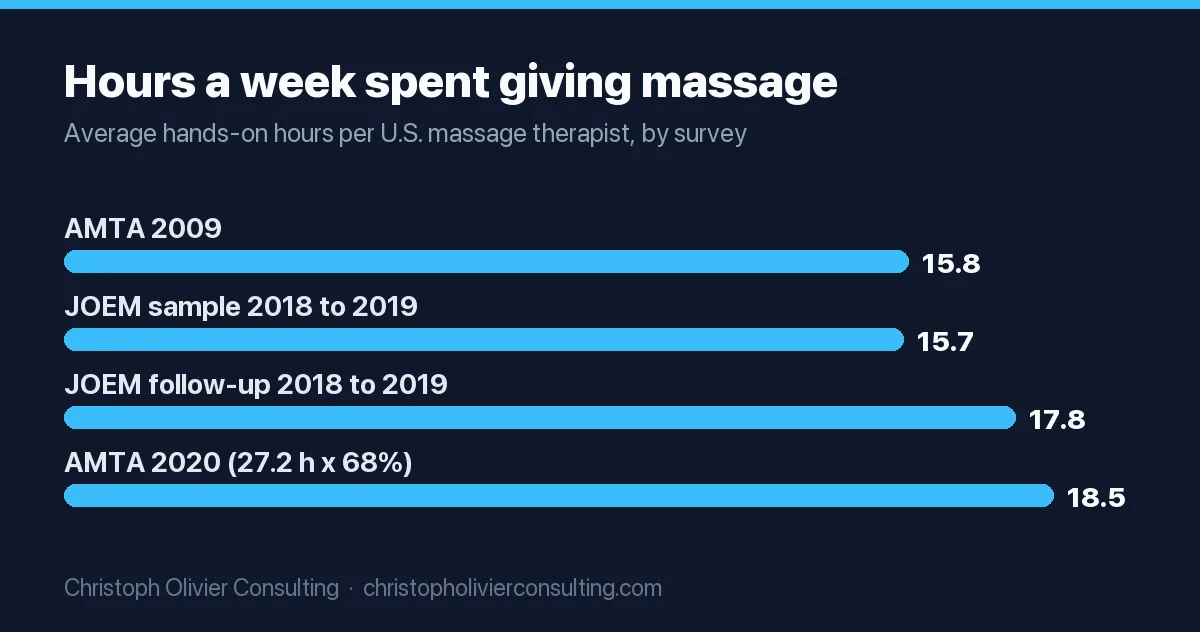
The typical U.S. massage therapist gives about 16 to 19 hours of hands-on massage a week, which works out to roughly 15 to 20 one-hour clients a week, or 3 to 4 a day across a five-day week. That is not a guess: an AMTA-hosted survey of 8,305 working therapists in 2018 and 2019 found a mean of 15.7 hours a week giving massages, and AMTA’s own 2021 research report puts the 2020 work week at 27.2 hours, 68% of it spent massaging. Busy full-time therapists run higher: about one in four gives 21 to 30 hours of massage a week.
Short answer: Most massage therapists see 15 to 20 clients a week (3 to 4 a day), and a heavy full-time book is 25 to 30 a week (5 to 6 a day). Measured in people rather than appointments, a therapist doing 16 one-hour sessions a week has somewhere between about 64 and 220 different clients a year, depending on whether those clients come monthly or the national average of 3.5 times a year (our calculation from AMTA data).
How many clients does a massage therapist have? What the data actually says
No regulator counts massage clients. What does exist is survey data on hands-on hours, and for one-hour sessions an hour of massage is one client. Here is every benchmark we could verify, with what each one actually measures.
| Benchmark | Figure | What it measures | Source |
|---|---|---|---|
| Hours giving massage, large U.S. sample | 15.7 hours a week | Mean, 8,305 therapists in AMTA continuing education courses, 2018 to 2019 | Friedman, Cambron and Madigan, JOEM, 2022 |
| Hours giving massage, follow-up group | 17.8 hours a week | Mean, 209 therapists who were at least 5 hours a week hands-on | JOEM, 2022, Table 1 |
| Total hours in the massage business | 27.9 hours a week | Mean for the same 8,305 therapists, including admin, laundry and marketing | JOEM, 2022 |
| Average work week, 2020 | 27.2 hours, 68% massaging | About 18.5 hands-on hours (our calculation: 27.2 x 0.68) | AMTA 2021 Massage Profession Research Report |
| Share giving 21 to 30 hours of massage | 24.4% | Share of surveyed therapists, 2024 to 2025 | NCBTMB Job Task Analysis, as reported by AMTA |
| Hours giving massage, 2009 | 15.8 hours a week | Average, up from 15 hours in 2008 | AMTA Massage Therapy Journal |
| Massages per consumer | 3.5 a year | Average for adults who got a massage in the 12 months ending June 2020 | AMTA 2021 report |
| Client counts per therapist | Not published | No national survey reports distinct clients per therapist | None found |
Two things stand out. First, the hands-on number has barely moved in 15 years: 15.8 hours in 2009, 15.7 in 2018 to 2019, roughly 18.5 in 2020. Second, therapists work far more hours than they bill. In the JOEM sample, about 12 of every 28 working hours went to something other than massage. AMTA’s breakdown of that unpaid time: cleaning and sanitizing, marketing, general business tasks and insurance paperwork.
For scale, the Bureau of Labor Statistics counts 155,400 massage therapist jobs in 2025, 36% of them self-employed, and says part-time work is common. AMTA’s broader estimate, which includes part-timers and therapists in licensing databases, was 363,155 therapists in 2020.
How many massages can a therapist do a day?
The BLS answer is blunt: “many therapists cannot perform massage services 8 hours per day, 5 days per week,” because the work requires strength and endurance (Occupational Outlook Handbook). The survey averages above translate to 3 to 4 one-hour massages on a five-day week. Going beyond that to 5 or 6 a day puts you in the top quarter of the profession, and the ceiling is set by your hands and back, not the clock.
The body cost is documented. In a survey of 1,103 Ontario massage therapists, 85% had experienced work-related pain, most often in the hand and wrist (65.5%) and fingers and thumb (60.3%); 31% reported lost income and 30.5% had considered changing, or had changed, profession (Barraclough et al., 2022). The Massage Therapy Foundation’s ergonomic job task analysis found long effleurage strokes put mild biomechanical stress on the shoulders 90% of the time and recommends more time between sessions (Resnick, 2024). A 2,079-person U.S. study found physical exhaustion was the strongest correlate of injury-forced work reduction and advised spacing massages and varying technique (Blau et al., 2013).
Session length changes the count more than anything else. A table massage typically runs 30 to 90 minutes and a chair massage 5 to 10 minutes, per the BLS. Here is what fits in one day at the same hands-on load.
| Session length | Turnover gap (assumed) | Massages in a 5-hour hands-on day | Clock time on site |
|---|---|---|---|
| 30 minutes | 10 minutes | 10 | About 6 hours 30 minutes |
| 60 minutes | 15 minutes | 5 | About 6 hours |
| 90 minutes | 15 minutes | 3 (4.5 hours hands-on) | About 5 hours 15 minutes |
| Mixed: two 90s, two 60s | 15 minutes | 4 (5 hours hands-on) | About 5 hours 45 minutes |
Our illustration. The 5-hour hands-on day and the turnover gaps are assumptions, not survey figures; a lunch break is not included. Five hours is above the survey average and suits a therapist working four days a week.
How many clients do massage therapists see a week?
Taking one-hour sessions as the unit, the averages say 15 to 19 clients a week. The distribution is wide. The 2024 to 2025 NCBTMB job task analysis found 24.4% of therapists give 21 to 30 hours of massage a week, and nearly 70% of respondents were self-employed. In the JOEM data the standard deviation was 10.3 hours around the 15.7 mean, so plenty of therapists sit at 5 to 10 and plenty at 25 or more.
Weekly counts also swing with the economy. During COVID, AMTA found therapists were seeing only about 65% of the clients a week they had seen before the pandemic, and 53% were deliberately accepting fewer clients per day.
One practitioner example worth knowing, because it starts from income rather than stamina: writing in MASSAGE Magazine in 2022, a licensed therapist showed that a $4,500 monthly target at $75 per hour equals 60 massages a month, or 15 a week, then laid that out as three a day five days a week, four a day four days a week, or five a day on fewer days. Work backward from the number you need, then pick the daily shape your body tolerates.
Clients per week vs clients you actually have
“How many clients does a massage therapist have” usually means the size of the book, not the weekly schedule. Those are different numbers, linked by how often each client comes back. AMTA’s consumer survey found people who got a massage averaged 3.5 massages in the year. Members and regulars come more often.
The formula: distinct clients a year = weekly sessions x working weeks / visits per client a year.
- A therapist doing 16 sessions a week for 48 weeks delivers 768 massages a year.
- If clients visit at the national average of 3.5 times a year, that is about 219 different people.
- If the book is mostly monthly regulars (12 visits a year), the same schedule needs only 64 clients.
That gap is why rebooking matters more than lead volume. A monthly-regular book of 64 is a marketing problem you solve once; a 219-person book of occasional visitors is one you solve every month. The same logic drives personal trainer caseloads and hair stylist client books, and it is a different question from how many clients a psychotherapist sees per week, where sessions are weekly and caseloads are small.
Capacity table: hands-on hours, clients and gross income
This is our own calculation, built so you can find your row. Assumptions: one-hour sessions, 48 working weeks, five working days. Income uses two AMTA figures for 2019, reported in the 2021 research report: the $76.48 average price clients paid for an hour of massage, and the $22.48 average hourly pay plus $16.97 average tip ($39.45) for therapists in franchises and chains. Prices have risen since 2019, so treat the dollar columns as conservative.
| Hands-on hours a week | Clients a day (5 days) | Massages a year | Distinct clients at 3.5 visits a year | Distinct clients at 12 visits a year | Gross at $76.48 (independent, before expenses) | Pay at $39.45 (franchise, incl. tips) |
|---|---|---|---|---|---|---|
| 10 | 2 | 480 | 137 | 40 | $36,710 | $18,936 |
| 15 | 3 | 720 | 206 | 60 | $55,066 | $28,404 |
| 20 | 4 | 960 | 274 | 80 | $73,421 | $37,872 |
| 25 | 5 | 1,200 | 343 | 100 | $91,776 | $47,340 |
| 30 | 6 | 1,440 | 411 | 120 | $110,131 | $56,808 |
Our calculations. Independent gross is revenue, not take-home: rent, linens, oil, booking software, insurance and self-employment tax come out of it. Franchise pay assumes every hands-on hour is paid at the AMTA average for that setting, which overstates pay for therapists paid per service with unpaid gaps.
Read the table against the survey averages. The typical therapist sits on the 15 to 20 hour rows. AMTA reported average gross income from massage of $29,439 in 2019 for therapists earning at least $100 from massage, which is consistent with many therapists working fewer, lower-priced hours than the 15-hour row implies.
How many clients should a massage therapist see a day?
There is no licensing rule that caps it. The evidence points to the same practical range: 4 to 6 one-hour clients on a working day, with fewer working days if you go to the top of that range. Use this worksheet to test your own schedule. The thresholds are our rules of thumb, grounded in the sources above, not a professional standard.
| Check | Pass | Fail: cut volume or restructure |
|---|---|---|
| Hand, wrist or thumb pain at the end of a day | Gone by next morning | Still there next morning, or numbness or tingling (hand and wrist is the most common pain site, 65.5% in the Ontario survey) |
| Gap between clients | At least 15 minutes, including reset | Back-to-back, or gaps eaten by laundry and payment (time was the barrier to self-care for 57.9% of therapists in the JOEM follow-up) |
| Deep or sports work in a row | No more than 2 in a row, then a lighter session or break | 3 or more deep sessions back to back on most days |
| Weekly hands-on hours vs your sustainable level | Within 5 hours of the level you held for the last 3 months without pain | Jumped more than 5 hours in a month (for example, a new spa shift on top of private clients) |
| Income math | Your target divided by your rate fits inside your pass-level hours | Target only works at 30+ hours: raise price or rebook rate instead of adding hours |
| Admin and marketing time | Scheduled, about 30% to 40% of the week | Done after the last client every night (AMTA found only 68% of the 2020 work week was massage) |
If you fail the income row, the fix is usually price and retention rather than volume. Our pricing strategy guide covers how to raise rates without losing your best clients, and customer retention statistics show why a rebooked client is worth more than a new one.
Is 25 clients a week a lot for a massage therapist?
Yes, for one-hour sessions. Twenty-five hours of hands-on massage is about 60% above the 15.7-hour mean in the large JOEM sample and in the top band of the NCBTMB data, where 24.4% work 21 to 30 hours. Spread over five days it is 5 clients a day, which is workable for some therapists, but it leaves little room for deep-tissue-heavy days. Over four days it is 6 or 7 a day, which is where the injury research says spacing and technique variation matter most. Twenty-five 30-minute clients, by contrast, is only 12.5 hands-on hours, a light week.
Can a massage therapist make $100,000 a year?
Some do, but it is rare for employees. The BLS reports a median of $58,450 a year ($28.10 an hour) in May 2025, with the top 10% earning more than $100,200. Those wage figures exclude the 36% of therapists who are self-employed. By industry, median pay was highest in offices of chiropractors ($72,800) and lowest in accommodation ($43,840).
For an independent therapist, the math is straightforward. At AMTA’s 2019 average price of $76.48, $100,000 in gross revenue takes 1,308 one-hour massages, or about 27 a week over 48 weeks (our calculation). At an assumed $100 an hour, it takes about 21 a week. Either way that is revenue, not profit. After rent and costs, a six-figure take-home generally needs higher prices, longer sessions, or the high-paying settings below rather than more bodies on the table.
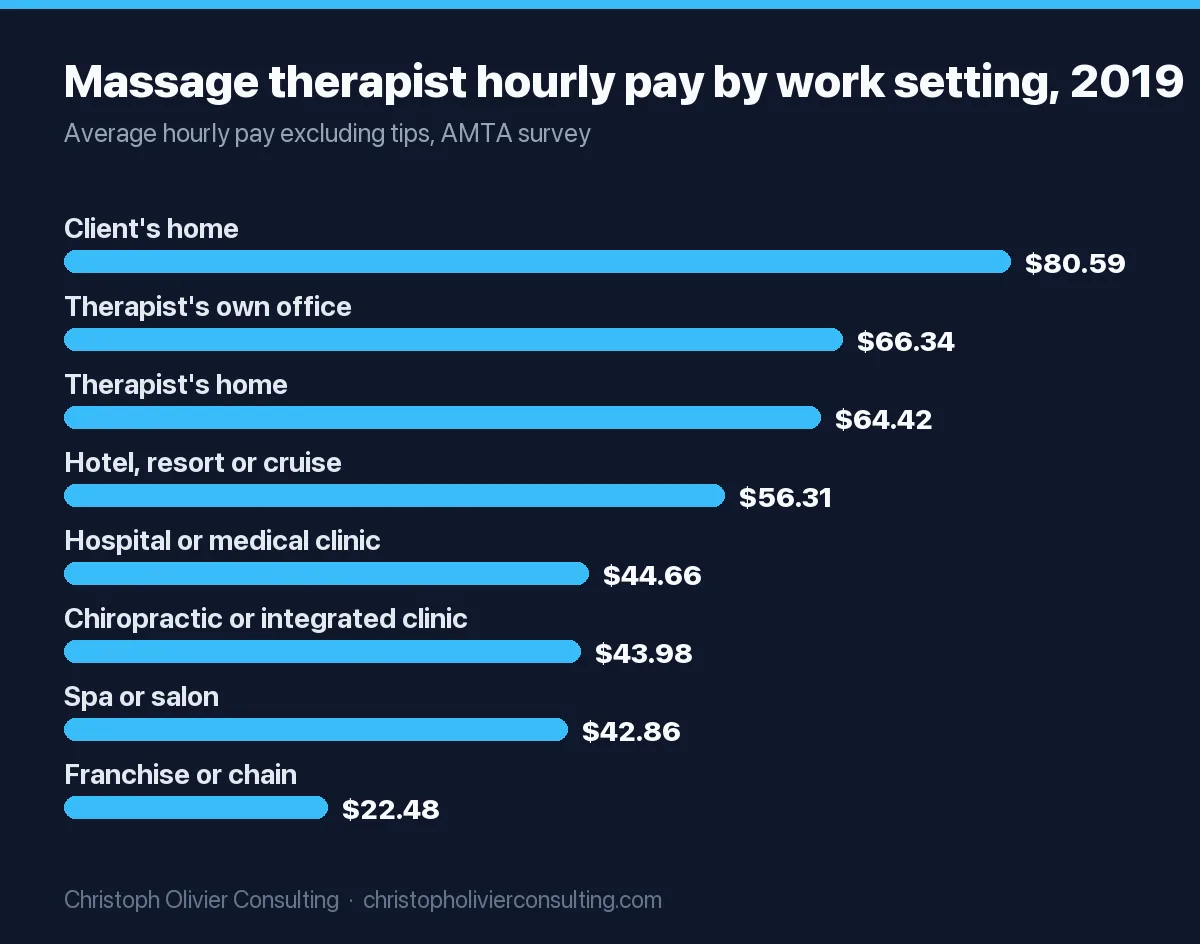
Setting matters as much as volume. In AMTA’s data, therapists who traveled to clients’ homes earned the most per hour and franchise and chain therapists the least, with a difference of more than three to one.
| Work setting | Average hourly pay, 2019 | Average tip, 2019 |
|---|---|---|
| Client’s home | $80.59 | $12.69 |
| Client’s workplace | $70.41 | $8.99 |
| Therapist’s own office | $66.34 | $11.46 |
| Therapist’s home | $64.42 | $10.45 |
| Hotel, resort or cruise | $56.31 | $22.40 |
| Health club or athletic facility | $47.06 | $9.03 |
| Hospital, medical office or clinic | $44.66 | $3.31 |
| Chiropractic office or integrated clinic | $43.98 | $7.81 |
| Spa or salon | $42.86 | $16.66 |
| Massage franchise or chain | $22.48 | $16.97 |
Source: AMTA 2021 Massage Profession Research Report, Figure 15, 2019 data reported in 2020. Self-employed settings are before expenses.
What franchise volume tells you about clients per therapist
The two largest chains publish system numbers but not clients per therapist, so any per-therapist figure you see for them is an estimate. What is public:
- Massage Envy is privately held and does not file public financials. Its March 2025 release says franchised locations have delivered 207 million massages since 2002 across more than 1,000 locations in 49 states, and its careers page lists 1.2 million-plus members. Therapist headcount and per-therapist volume are not disclosed in either.
- Hand & Stone states, citing Item 19 of its franchise disclosure document, average annual massage sales of $807K per spa and average annual gross sales of $1.35M, with 650+ locations. The page does not give the FDD year, unit count, therapist count or price per massage, so clients per therapist cannot be derived. For scale only: $807K is about $15,500 of massage sales a week per spa (our division).
The franchise model is built on memberships, which is the 12-visits-a-year column in the capacity table. That is why a chain therapist can fill 25 hours a week from a small number of regulars, and why turnover is high: in the JOEM follow-up, 25% of therapists in spas, salons and franchises changed their primary setting within roughly three to six months, against 11.6% in private practice.
How long do massage therapists stay in the career?
No national study tracks career length from start to exit, so the often-repeated “5 to 7 year” career figure is not something we could source. What the data shows: active therapists in the large JOEM sample averaged 7.0 years in practice (8.2 years in the follow-up group), and AMTA found 83% had a different profession before massage, so many enter mid-life. AMTA also notes that up to 12% of licensed therapists may be inactive while still appearing on state lists. In Ontario, 30.5% of surveyed therapists had considered leaving or had left because of work-related pain. The practical reading: your client count should be set for a 10 or 20 year career, not a strong first year.
Filling the book without overfilling your hands
Most therapists hit the stamina ceiling long before the demand ceiling, so marketing for a massage practice is really about the mix: more rebooked regulars, more premium sessions, fewer one-off discount clients. AMTA’s data shows 90% of consumers found therapists through client referrals, yet only 38% of therapists actively promoted that channel. Our list of marketing ideas for massage therapists and the referral marketing guide go through how to build that channel. If you run a multi-therapist practice and want a second opinion on capacity and pricing, you can book a consultation.
Ready to scale your revenue?
Book a free 30-min consultation. We’ll diagnose your growth bottleneck and map out the 3 highest-leverage moves for your business.
Frequently asked questions
How many clients does a massage therapist have?
Most see 15 to 20 one-hour clients a week. An AMTA-hosted survey of 8,305 therapists (2018 to 2019) found a mean of 15.7 hours a week giving massage, and AMTA's 2020 data implies about 18.5. In distinct people, a therapist doing 16 sessions a week has roughly 64 to 220 clients a year, depending on whether clients come monthly or about 3.5 times a year.
How many massages can a therapist do a day?
The survey averages work out to 3 to 4 one-hour massages a day over five days, and a heavy schedule is 5 to 6. The BLS notes many therapists cannot massage 8 hours a day, 5 days a week. Shorter sessions raise the count: a 5-hour hands-on day is about 10 thirty-minute or 3 ninety-minute massages.
How many clients do massage therapists see a week?
Averages point to 15 to 19 one-hour clients a week, with wide spread. The 2024 to 2025 NCBTMB job task analysis found 24.4% of therapists give 21 to 30 hours of massage a week. During COVID, AMTA found therapists were seeing only about 65% of their pre-pandemic weekly clients.
How many clients should a massage therapist see a day?
No rule caps it. A practical range is 4 to 6 one-hour clients on a working day, with at least 15 minutes between sessions and fewer working days at the top of that range. Research on Ontario therapists found 85% had work-related pain, most often in the hand and wrist, so cut volume if pain lingers into the next morning.
Is 25 clients a week a lot for a massage therapist?
Yes, for one-hour sessions. Twenty-five hands-on hours is about 60% above the 15.7-hour average in a large AMTA-hosted survey and in the top band of NCBTMB data, where 24.4% work 21 to 30 hours. Over five days it is 5 clients a day. Twenty-five 30-minute clients is only 12.5 hands-on hours.
Can a massage therapist make $100,000 a year?
Some do. The BLS reports a May 2025 median of $58,450, with the top 10% of employees above $100,200. An independent therapist charging AMTA's 2019 average of $76.48 an hour needs about 27 one-hour clients a week for 48 weeks to gross $100,000, before rent, supplies and taxes (our calculation).
How many clients: caseload research