

No government agency or certifying body publishes an official average client count for personal trainers. The best direct measurement is a survey of 596 trainers published in Orthopedic Reviews in 2016: they taught an average of 50.6 people a week, but that figure is inflated by group classes (7.8 people per session on average). For one-on-one training, the math that matters is sessions per week divided by sessions per client: a full-time trainer delivering 20 to 30 paid sessions a week has 10 to 15 clients who train twice a week, or 20 to 30 who train once a week.
Short answer: A full-time one-on-one trainer typically carries 10 to 15 active clients at two sessions a week (20 to 30 sessions), which is our capacity calculation, not a survey average. Because the average gym member who uses a trainer buys only 21 sessions a year (Health & Fitness Association, 2024 data), that same trainer works with roughly 45 to 70 different people over a year. Wage and salary trainers earned a median $47,160 in May 2025 (BLS OEWS).
How many clients does a personal trainer have? What the data actually says
Every number in the current search results (“15 to 25 clients”, “about 20 is a full load”) traces back to opinion or to one 2014 survey. Here is everything that is measured, with what each figure really counts.
| Measure | Figure | What it counts | Source |
|---|---|---|---|
| People taught per week | 50.6 (standard deviation 210.9) | All people a trainer taught weekly, group classes included; 596 respondents, surveyed February to May 2014 | Waryasz et al., Orthopedic Reviews, 2016 |
| People per session or class | 7.8 | Average members per class or session, 552 respondents | Waryasz et al., 2016 |
| Hours of exercise work per week | 32.4 | Self-reported hours in exercise-related work | Waryasz et al., 2016 |
| Gym members who used a trainer | 23% | Share of U.S. fitness facility members who used a personal trainer in 2024 | HFA, released Oct 30, 2025 |
| Sessions per trainer user per year | 21 (down from 28 in 2019) | Average personal training sessions per member who trains | HFA, 2024 data |
| Life Time personal training sessions | Over 220,000 per month | Dynamic Personal Training sessions across the chain in 2025, up 18% on 2024 | Life Time 10-K, FY2025 |
| Fitness trainer jobs | 388,400 | All jobs, including self-employed, 2025 | BLS Occupational Outlook Handbook |
| Active client roster per trainer | Not published | No federal survey, certifier or trade association publishes it | None found |
Two warnings about the 50.6 number that ranks in search today. First, the standard deviation (210.9) is four times the mean, which tells you a few respondents teaching huge classes pull the average up. Second, the sample was recruited through gym websites, forums and social media, and the authors could not tell how many people saw the invitation. Treat it as the best available snapshot, not a census.
A top-down cross-check (our calculation)
You can sanity check the per-trainer workload from the national totals. The Health & Fitness Association counted 77 million U.S. facility members in 2024. If 23% used a trainer, that is about 17.7 million people. At 21 sessions each, members bought roughly 372 million sessions. Spread across BLS’s 388,400 trainer and instructor jobs, that is about 960 sessions per job per year, or about 20 per week over 48 weeks. This is rough: the BLS count includes group fitness instructors who teach no one-on-one sessions, and HFA’s figure covers members only. But it lands right where capacity math does, around 20 sessions a week per job.
How many clients does a personal trainer have per day?
Most full-time trainers deliver 4 to 6 one-on-one sessions a day. That range is our arithmetic, not a survey: 20 to 30 weekly sessions over a 5-day week. The 2016 survey’s 32.4 average weekly hours of exercise work fits that range once you add travel between clients, program writing, check-ins and selling. Hours cluster early morning and evening, because most clients train before or after their own jobs, which is why a 6-session day often spans 12 hours.
For scale on the employer side, Life Time ran over 220,000 personal training sessions a month in 2025 across 189 centers at year end, according to its FY2025 10-K. That works out to roughly 1,160 sessions per center per month, or about 270 a week (our division, using the year-end center count). The filing does not disclose how many trainers deliver them, only that the company employs over 11,100 certified fitness professionals “ranging from personal trainers to studio performers”.
Capacity table: sessions per week to clients to income
This is the original asset for this page. It converts a weekly session load into active clients, total different clients per year and gross revenue. Assumptions (ours, change them to fit you): 48 working weeks a year, one-hour sessions, clients either at 2 sessions a week or at the HFA national average of 21 sessions a year. Session prices of $60, $80 and $100 are inputs, not survey averages: an American Council on Exercise article (2014) put suburban and rural rates at $40 to $60 a session and experienced metro trainers at $100 to $200 an hour.
| Paid sessions per week | Sessions per day (5-day week) | Active clients at 2x per week | Sessions per year (48 weeks) | Different clients per year at 21 sessions each | Gross at $60 | Gross at $80 | Gross at $100 |
|---|---|---|---|---|---|---|---|
| 15 (part-time) | 3 | 7 to 8 | 720 | 34 | $43,200 | $57,600 | $72,000 |
| 20 | 4 | 10 | 960 | 46 | $57,600 | $76,800 | $96,000 |
| 25 | 5 | 12 to 13 | 1,200 | 57 | $72,000 | $96,000 | $120,000 |
| 30 | 6 | 15 | 1,440 | 69 | $86,400 | $115,200 | $144,000 |
| 35 (very heavy) | 7 | 17 to 18 | 1,680 | 80 | $100,800 | $134,400 | $168,000 |
Our calculation. Gross is what clients pay, before any gym split, space rent, insurance, software, marketing or tax. A gym-employed trainer keeps only part of it; independent trainers keep it all but pay every cost.
The column most trainers ignore is “different clients per year”. If your clients behave like the national average and buy 21 sessions a year, a 25-session week needs about 57 different people over 12 months to stay full. That is a sales and retention problem, not a scheduling one, and it is why the marketing side of personal training decides income more than the hourly rate does.
How many clients should a personal trainer have?
Enough to fill your target session count with clients who stay. Work it backward in this order:
- Pick your weekly session ceiling. 20 to 30 one-hour sessions is the full-time band in the table above. Above 30, you are past 6 sessions a day on a 5-day week.
- Set your average frequency. At 2 sessions per client per week, divide sessions by 2. At 1 per week, clients equal sessions.
- Add a churn buffer. The HFA drop from 28 to 21 sessions per user between 2019 and 2024 means clients buy fewer sessions than they used to. Keep 2 to 3 leads in conversation for every open slot (our rule of thumb, not a measured ratio).
- Check the income line. Multiply sessions by your take-home per session and by 48. If the result misses your target, change price or format before adding more hours.
Client load worksheet (pass or fail)
Run this every quarter. Each line is our rule of thumb, built from the numbers on this page.
| Check | Pass | Fail and what to do |
|---|---|---|
| Weekly paid sessions | Within 10% of your target (for example 23 to 27 against 25) | Under: more lead flow. Over by 5+: raise price or move clients to small group |
| Sessions per day | 6 or fewer one-on-one hours | 7+: quality and injury risk rise; cap new sign-ups |
| Average client frequency | 1.5 or more sessions a week | Below 1: you need far more people to fill the week, see “different clients per year” |
| Prepaid sessions left at month end | Covers at least the next 4 weeks for most clients | Most clients near zero: renewal conversations now, not after the last session |
| Take-home per hour (all hours, including admin and travel) | Above the BLS median of $22.67 | Below: raise price, cut travel, or bundle sessions |
| New clients needed per month | Different clients per year divided by 12 is a number you have hit before | Above your best month: retention fix first, then marketing |
How many clients do personal trainers need to make $100k?
Between about 9 and 18 clients at twice a week, depending on price and whether $100,000 means revenue or take-home pay. Our calculation, 48 weeks a year:
| Price per session | Sessions per week for $100k revenue | Clients at 2x per week | Sessions per week for $100k pre-tax profit (25% overhead assumed) | Clients at 2x per week |
|---|---|---|---|---|
| $60 | 35 | 17 to 18 | 46 | 23 |
| $80 | 26 | 13 | 35 | 17 to 18 |
| $100 | 21 | 10 to 11 | 28 | 14 |
| $120 | 17 to 18 | 9 | 23 | 11 to 12 |
Our calculation. Revenue needed = $100,000. Profit case: revenue needed = $100,000 divided by 0.75, about $133,333, assuming 25% of revenue goes to space rent, insurance, software, equipment and marketing (an assumption: measure your own). Independent trainers also owe the 15.3% self-employment tax on net earnings, which an employee splits with the employer, plus income tax.
Two conclusions fall out. At $60 a session, $100k of profit needs 46 sessions a week, which is not realistic for one person. And at $100 or more, the same income needs about 28 sessions, inside the full-time band. Price, not hours, is the lever. Pricing models like good, better, best packages are how most trainers move the average up without losing the entry-level client.
Why $100k is rare for gym employees
BLS reports that 90% of wage and salary fitness trainers earned less than $39.95 an hour in May 2025, equal to $83,100 a year at 2,080 hours (OEWS 39-9031). $100,000 at 2,080 hours is $48.08 an hour. If a gym pays a trainer a flat amount per session delivered, sessions needed per week = $100,000 divided by (48 weeks times pay per session): 69 a week at $30, 52 at $40, 42 at $50 (illustrative pay rates, our calculation). No national survey we could access publishes typical gym commission splits, so check your own contract. This is the main reason experienced trainers go independent or add small group and online clients.
How much do personal trainers make? BLS 2025 data
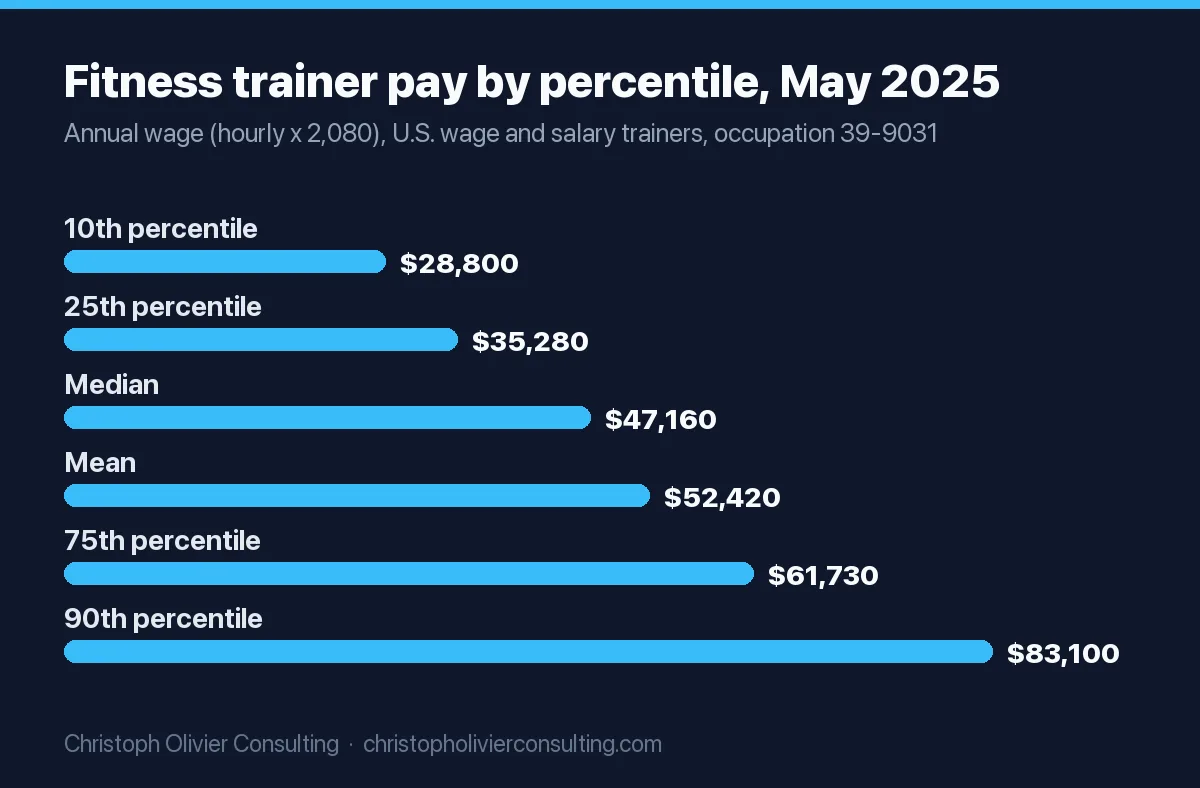
The Bureau of Labor Statistics May 2025 Occupational Employment and Wage Statistics cover 322,930 wage and salary fitness trainers and aerobics instructors. They exclude the self-employed, who hold 15% of the occupation’s jobs. BLS also computes annual figures as hourly wage times 2,080 hours, so they describe a full-time equivalent, not what a part-time trainer actually takes home.
| Percentile | Hourly | Annual (hourly x 2,080) |
|---|---|---|
| 10th | $13.85 | $28,800 |
| 25th | $16.96 | $35,280 |
| Median | $22.67 | $47,160 |
| Mean | $25.20 | $52,420 |
| 75th | $29.68 | $61,730 |
| 90th | $39.95 | $83,100 |
Source: BLS OEWS time series, May 2025, occupation 39-9031, cross-industry. The occupation includes group fitness instructors.
Where trainers work and what each setting pays
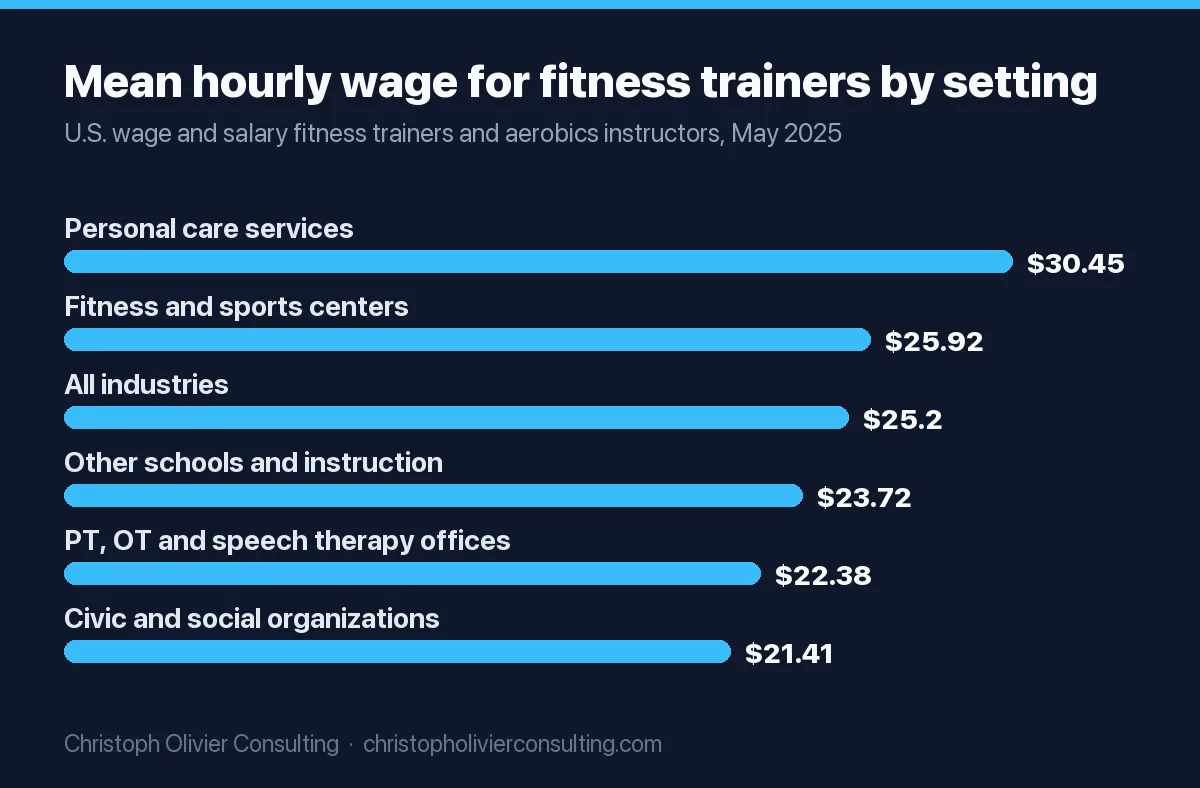
Fitness and recreational sports centers employ 55% of the occupation, the self-employed 15%, civic and social organizations 8%, and educational services 7% (BLS OOH). Mean wages differ by setting:
| Industry (NAICS) | Wage and salary jobs | Mean hourly | Median annual |
|---|---|---|---|
| Fitness and recreational sports centers (713940) | 210,830 | $25.92 | $48,140 |
| Civic and social organizations (813400) | 31,360 | $21.41 | $38,640 |
| Other schools and instruction (611600) | 23,200 | $23.72 | $45,350 |
| Offices of physical, occupational and speech therapists (621340) | 2,480 | $22.38 | $44,820 |
| Personal care services (812100) | 2,180 | $30.45 | $55,400 |
Source: BLS OEWS, May 2025. Self-employed trainers are not in these figures. If you are weighing whether to open your own facility instead, our breakdown of what gym owners make by gym type covers the margin side.
How much do personal trainers make per client?
Per client revenue is price times frequency. Our calculation, using 4.33 weeks per month:
| Frequency | Per month at $60 | Per month at $80 | Per month at $100 |
|---|---|---|---|
| 1 session a week | $260 | $346 | $433 |
| 2 sessions a week | $520 | $693 | $866 |
| 3 sessions a week | $779 | $1,039 | $1,299 |
| National average buyer (21 sessions a year) | $1,260 a year | $1,680 a year | $2,100 a year |
The last row is the sobering one. If the typical member buys 21 sessions a year, average annual revenue per client is closer to one month of a committed twice-weekly client than to twelve. Retention is where income lives, which matches the wider service data in our customer retention statistics.
Is $300 a month a lot for a personal trainer?
For one-on-one training, $300 a month buys about one session a week at roughly $69 each, or two a week at about $35 each (our division by 4.33 weeks). Against the ACE ranges of $40 to $60 per session in suburban and rural areas and $100 to $200 an hour for experienced metro trainers, $300 is ordinary for weekly one-on-one work, low for twice-weekly, and generous for small group, which ACE priced at about $12 to $25 per person per workout. For comparison, Life Time’s average center revenue per membership was $3,531 in 2025, about $294 a month, and that covers dues plus every in-center purchase (Life Time 10-K). Note the ACE figures date from 2014; current local prices are usually higher.
Is personal training declining?
No, participation is growing, but each client buys fewer sessions. The evidence points both ways:
- Growing: women’s personal training participation rose 16% in 2024 to 7.3 million (HFA). Life Time’s sessions grew 18% in 2024 (over 180,000 a month, per its FY2024 10-K) and another 18% in 2025. U.S. facility membership hit 81 million in 2025 (HFA, April 2026). BLS projects trainer employment to grow 7% from 2025 to 2035, to 416,900 jobs.
- Thinning: sessions per trainer user fell from 28 in 2019 to 21 in 2024, and 32% of members took small group training in 2024, a cheaper format that competes for the same client.
For a trainer, that means more potential clients per session slot and more selling to keep a roster full.
What percentage of personal trainers quit?
There is no official quit rate, and the “80% quit in the first year” figure that circulates online has no published source we could find. The closest official number is BLS’s projection that 16.2% of workers in the occupation will leave it each year from 2025 to 2035: 10.1% moving to another occupation and 6.1% leaving the labor force (BLS occupational separations table). That turnover, not growth, drives most of the 68,000 openings projected each year.
How old is the average personal trainer?
The median age of employed exercise trainers and group fitness instructors was 39.6 in 2025 (BLS Current Population Survey, table 11b), slightly above the 38.4 median for all personal care and service occupations. The 2016 survey of 596 trainers found a mean age of 39.8 and 13.4 years in the exercise field on average.
Online coaching changes the math
Everything above assumes one-hour, in-person sessions. Remote coaching replaces hours per client with check-ins per client, so a coach can carry more people, but no public dataset reports typical online roster sizes, and the claims in current search results are vendor estimates. If you add online clients, track your actual minutes per client per week for a month and plug that into the same capacity math. The same applies to massage, where we ran the numbers in how many clients a massage therapist has, and to counseling in how many clients a therapist sees per week.
If you run a studio or training business and want help building the lead flow that keeps 50 or more different clients coming through each year, you can book a consultation.
Ready to scale your revenue?
Book a free 30-min consultation. We’ll diagnose your growth bottleneck and map out the 3 highest-leverage moves for your business.
Frequently asked questions
How many clients does the average personal trainer have?
No official average exists. A 2016 survey of 596 trainers found they taught 50.6 people a week, but that includes group classes averaging 7.8 people. For one-on-one work, a full-time load of 20 to 30 sessions a week equals 10 to 15 clients training twice weekly, or 20 to 30 training once weekly. That is capacity math, not a survey figure.
How many clients should a personal trainer have?
Enough to fill your target weekly sessions with clients who renew. Start from a ceiling of 20 to 30 one-hour sessions, divide by average sessions per client per week, then keep two to three leads in conversation per open slot. If the income line still misses your goal, raise price or add small group sessions before adding hours past six a day.
How many clients does a personal trainer have per day?
Most full-time trainers deliver four to six one-on-one sessions a day, which is 20 to 30 sessions over a five-day week. Surveyed trainers reported 32.4 hours a week of exercise-related work, which also covers travel, programming and selling. Sessions bunch in early mornings and evenings, so a six-session day can span twelve hours.
How many clients do personal trainers need to make 100k?
At $100 a session and 48 weeks, $100,000 in revenue takes about 21 sessions a week, roughly 10 to 11 clients training twice weekly. At $60 a session it takes 35 sessions, or 17 to 18 clients. For $100,000 of pre-tax profit after an assumed 25% overhead, you need about 28 sessions a week at $100. These are our calculations.
How much do personal trainers make per client?
Per-client revenue is price times frequency. At $80 a session, a once-weekly client brings about $346 a month and a twice-weekly client about $693. But Health and Fitness Association data shows the average member who uses a trainer buys only 21 sessions a year, about $1,680 a year at $80, so retention drives income more than price alone.
Is $300 a month a lot for a personal trainer?
It buys about one one-on-one session a week at roughly $69 each, or two a week at about $35 each. Against American Council on Exercise ranges of $40 to $60 per session in suburban and rural areas and $100 to $200 an hour for experienced metro trainers, it is normal for weekly training and low for twice weekly. Those ACE figures date from 2014.
Is personal training declining?
No. Women's personal training participation rose 16% in 2024 to 7.3 million, Life Time's personal training sessions grew 18% in both 2024 and 2025, and BLS projects 7% job growth from 2025 to 2035. What is shrinking is volume per client: sessions per trainer user fell from 28 in 2019 to 21 in 2024.
How many clients: caseload research