
A jewelry store owner in the US typically earns between nothing and about $100,000 a year from a single independent store, and a minority with $1.5 million or more in sales earn well above that. No government survey measures jewelry owner pay directly. What the public data does show: the typical jewelry store company with employees takes in $500,000 to $999,999 a year (Census SUSB, 2022, my calculation). Salaried first-line supervisors in jewelry stores earned a median of $57,760 in May 2025 (BLS OEWS). In INSTORE magazine’s 2024 Big Survey of more than 700 owners and managers, 53% said they earned more than $100,000 in 2023 (INSTORE, Nov. 5, 2024).
Short answer: In my worked model built from Census, BLS and 10-K data, an owner who works the counter full time keeps about $28,000 a year before income tax from a $750,000 store and about $100,000 from a $1.5 million store. A $350,000 store roughly breaks even with the owner unpaid. The two numbers that move the result most are gross margin and how fast inventory sells: five points of gross margin on $1.5 million in sales is $75,000 of gross profit.
Below: what each data source actually measures, how much jewelry stores take in by size, the margins the two largest public US jewelers report, a three-size P&L with every assumption labeled, what it costs to stock a store, how sales split by month, and a pass/fail worksheet for your own numbers.
Jewelry store owner salary: what each source measures
Salary sites that show a single “jewelry store owner salary” are built from job ads and self-reports. Tax data does not help either: the IRS publishes sole proprietor and corporation results for “clothing and accessories retailers” as one group and does not break out jewelry stores (IRS SOI Table 1, tax year 2023; corporation Table 5.1). So you have to assemble the answer from revenue, payroll, public company margins and one trade survey. Check the “what it measures” column before comparing two numbers.
| Source and year | What it measures | Figure | How it was calculated |
|---|---|---|---|
| Census SUSB 2022, NAICS 448310 | Revenue per jewelry store location with employees | $2,164,465 | $41.88 billion receipts ÷ 19,348 locations (my calculation) |
| Census SUSB 2022 | Median jewelry store company with employees, by revenue | $500,000 to $999,999 | 43.1% of 13,668 firms are under $500,000, 65.0% under $1 million (my calculation) |
| Census Nonemployer Statistics 2022, NAICS 45831 | Revenue per jewelry business with no paid employees | $58,159 | $3.61 billion ÷ 62,040 businesses (my calculation) |
| BLS OEWS, May 2025, NAICS 458300 | Median pay of salaried first-line supervisors in jewelry, luggage and leather goods stores | $57,760 | Published. General and operations managers in the same stores: $77,490 |
| INSTORE Big Survey 2024 | Self-reported 2023 earnings of owners and managers (salary plus share of profit) | 53% above $100,000 | Published; more than 700 responses, anonymous online form, self-selected |
| INSTORE Big Survey 2025 | Self-reported earnings at the top of the range | 4% earned $500,000 to $1 million; about 1% over $1 million | Published Nov. 5, 2025; “more than one in five” reported over $250,000 |
| Signet Jewelers 10-K, fiscal 2026 | Net income as a share of sales for the largest US jewelry retailer | 4.3% | $294.4 million ÷ $6,813.6 million, as published |
How to read these together:
- The INSTORE sample skews large. 58% of its 2025 respondents reported 2024 sales above $1 million. In the Census count, only 35.0% of jewelry companies with employees are that big. A survey of mostly $1 million-plus stores will show higher owner pay than the typical store earns.
- Most jewelry “businesses” are side incomes. 68.1% of the 62,040 nonemployer jewelry businesses took in under $25,000 in 2022, and only 4.7% reached $250,000 (my calculation from the Census file). These are home sellers, market stalls and one-person repair benches, not stores.
- The supervisor wage is your floor. If you run the floor and buy the stock, $57,760 is roughly what you would pay someone else to do it. Owner income above that is the return on the money you have in the cases.
Owner pay is salary plus profit, not a salary
A jewelry store owner is paid in two layers. The first is pay for the work: store manager, salesperson, buyer and often bench jeweler. The second is whatever profit is left after inventory, staff, rent and loan payments. BLS publishes what jewelry stores pay the people you would otherwise hire (OEWS May 2025, NAICS 458300):
| Role you might fill yourself | Employed in these stores | 10th percentile | Median | 90th percentile |
|---|---|---|---|---|
| General and operations manager (11-1021) | 8,860 | $47,170 | $77,490 | $162,120 |
| First-line supervisor of retail sales (41-1011) | 10,230 | $38,290 | $57,760 | $95,030 |
| Jeweler, precious stone and metal worker (51-9071) | 11,740 | $36,360 | $53,990 | $85,460 |
| Retail salesperson (41-2031) | 66,170 | $29,130 | $37,270 | $60,410 |
| All occupations in these stores | 129,210 | $30,780 | $45,350 | $85,460 |
Source: BLS Occupational Employment and Wage Statistics, May 2025, national industry-specific estimates for NAICS 458300 (jewelry, luggage and leather goods retailers), from the official OEWS industry data file. Annual wages. Self-employed owners are not included.
The second layer depends on the P&L. If your store clears $40,000 after paying a supervisor, and you are the supervisor, you made $97,760. If you are also the bench jeweler, the store saves a second wage, which is one reason owner-jewelers often out-earn owners who only buy and sell.
How much revenue does a jewelry store make? Census data by size
The $2.16 million per-location average is pulled up by chains. The 50 jewelry companies with $100 million or more in receipts ran 4,497 locations, 23.2% of all jewelry store locations, and took 44.6% of all jewelry store revenue in 2022 (my calculation from SUSB). The size bands show the independent picture.
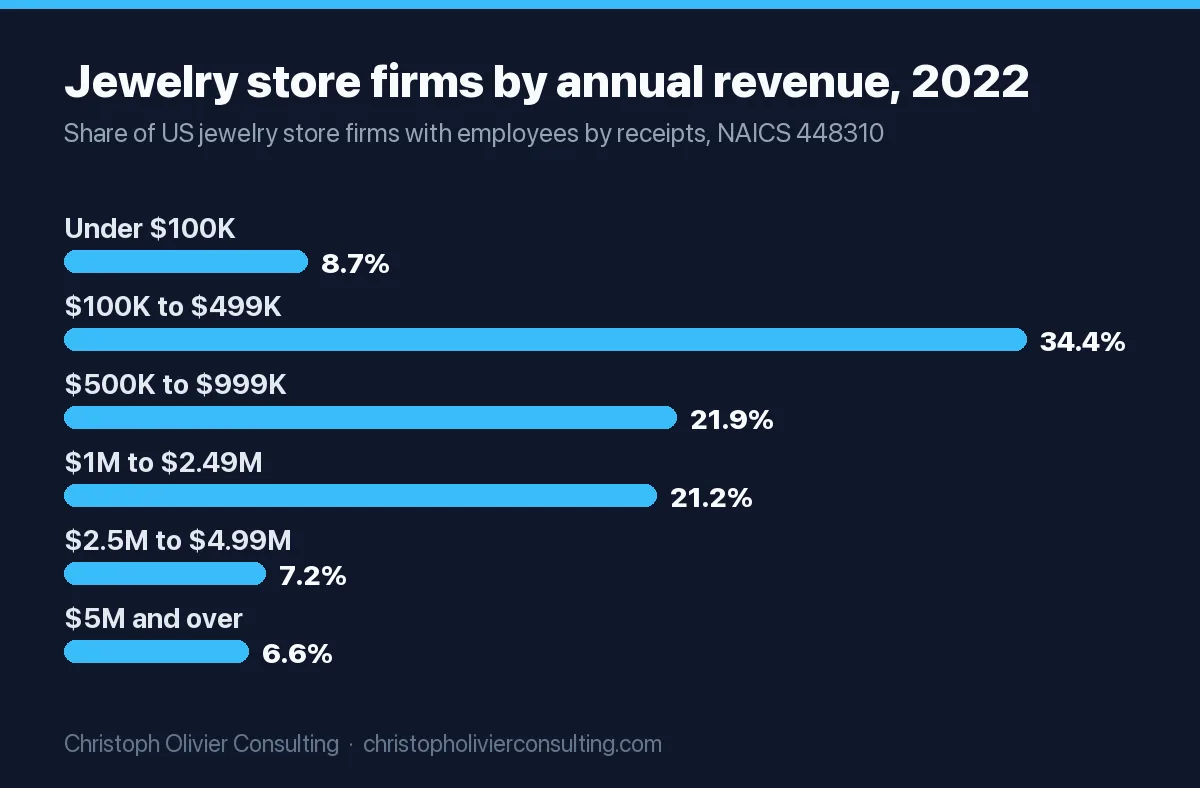
| Annual receipts of the firm | Jewelry store firms | Share | Cumulative | Avg receipts per firm | Employees per firm | Payroll as % of receipts |
|---|---|---|---|---|---|---|
| Under $100,000 | 1,189 | 8.7% | 8.7% | $54,613 | 1.0 | 24.8% |
| $100,000 to $499,999 | 4,704 | 34.4% | 43.1% | $280,256 | 2.0 | 18.1% |
| $500,000 to $999,999 | 2,997 | 21.9% | 65.0% | $720,528 | 3.4 | 16.4% |
| $1 million to $2.49 million | 2,894 | 21.2% | 86.2% | $1,555,087 | 5.4 | 15.6% |
| $2.5 million to $4.99 million | 988 | 7.2% | 93.4% | $3,424,756 | 8.2 | 13.5% |
| $5 million and over | 896 | 6.6% | 100% | $33,985,818 | 63.6 | 11.6% |
Source: U.S. Census Bureau, SUSB 2022, U.S. 6-digit NAICS by enterprise receipts size, NAICS 448310 jewelry stores (NAICS 2017 code; 458310 in NAICS 2022), released April 10, 2025. Employer firms only. The $5 million-plus row is the total minus the smaller bands. Shares, averages and ratios are my calculations. Payroll is wages only, before payroll taxes and benefits.
What the table tells you:
- The median independent sells $500,000 to $999,999 a year with about 3.4 employees. A third of employer firms sell less than $500,000.
- Payroll share falls as stores grow, from 18.1% of sales in the $100,000 to $499,999 band to 15.6% at $1 million to $2.49 million. Bigger stores sell more dollars per salesperson hour, so staff cost is spread over more sales.
- Payroll is a much smaller share than in services. The big cost in jewelry is not labor. It is the inventory sitting in the cases, which never shows up as an expense line until you add up what it costs to finance it.
For the full retail sector, Census estimated jewelry store sales at $41.16 billion in 2022 (Annual Retail Trade Survey, 2022 benchmarked). Operating expenses for jewelry, luggage and leather goods stores ran $15.08 billion, 32.4% of that group’s $46.57 billion in sales (ARTS expenses table, my calculation). ARTS does not publish a gross margin for jewelry stores on their own.
Jewelry store profit margin: what the public jewelers disclose
The only audited jewelry margins come from public companies. They define cost of sales differently, so read the notes before comparing.
| Line | Signet Jewelers, FY ended Jan. 31, 2026 | Brilliant Earth, 2025 |
|---|---|---|
| Sales | $6,813.6 million (services 11.8%) | $437.5 million |
| Gross margin | 39.5% (cost of sales includes store rent, utilities and depreciation) | 57.5% (mostly online, made-to-order) |
| Selling, general and administrative | 31.9% | 58.7% (marketing 24.2%, G&A 34.5%) |
| Advertising | 8.1% of sales, gross | 24.2% marketing and advertising |
| Operating margin | 5.8% | Loss of 1.2% |
| Net margin | 4.3% | Loss of 1.5% |
| Year-end inventory as % of sales | 28.5% ($1,940.1 million) | 12.2% ($53.2 million) |
| Cost of sales ÷ average inventory | 2.1 times (my calculation) | 4.1 times (my calculation) |
| Stores at year-end | 2,582 (2,329 in North America) | Online plus showrooms (count not used here) |
Percentages as published in each 10-K except inventory ratios and turns, which are my calculations from the balance sheets. Signet states its gross margin “may not be directly comparable to other retailers” because occupancy sits in cost of sales; its turn figure is therefore higher than a pure merchandise turn.
Three takeaways for an independent:
- Net margins are thin even at scale. The largest US jeweler kept 4.3 cents per dollar of sales. An independent has no national ad fund or credit card program, but also no head office.
- Old trade benchmarks point the same way. Industry analyst Ken Gassman put pretax margins “below 5 percent for most independent and some chain jewelers” and inventory turns at “about 1.1 times per year,” citing company reports and Jewelers of America data (IDEX Online, March 2008). It is an old figure, and I use it only as the turn assumption in the model below.
- Inventory is the swing factor. Brilliant Earth holds a third as much inventory per sales dollar as Signet because it makes rings to order. Memo goods and custom work are the independent’s version of that.
For margins in other retail categories, see profit margins across 94 industries.
Worked P&L: what an owner keeps at $350K, $750K and $1.5M in sales
This is my own model, not survey data. Each size sits inside a Census band so I can use that band’s actual payroll share. The owner works full time in the store and takes no wage. What is left is owner pay before income tax.
| Line (own calculation) | $350K store | $750K store | $1.5M store | Basis |
|---|---|---|---|---|
| Annual sales, including repair and custom work | $350,000 | $750,000 | $1,500,000 | Sizes inside Census bands |
| Gross profit at 46% | $161,000 | $345,000 | $690,000 | Assumption: Signet 39.5% includes occupancy; Brilliant Earth 57.5% |
| Staff wages | $63,350 (18.1%) | $123,000 (16.4%) | $234,000 (15.6%) | Census SUSB 2022 payroll share for the band |
| Payroll taxes, workers’ comp, benefits | $6,335 | $12,300 | $23,400 | Assumption: 10% of wages. Employer Social Security and Medicare alone are 7.65% (IRS Topic 751) |
| Rent and occupancy | $36,000 | $54,000 | $84,000 | Assumption |
| Advertising (5%) | $17,500 | $37,500 | $75,000 | Assumption; Signet spends 8.1% gross |
| Card processing (2.5%) | $8,750 | $18,750 | $37,500 | Assumption |
| Jewelers block insurance, alarm, monitoring | $9,000 | $14,000 | $22,000 | Assumption |
| Other operating: utilities, POS, accounting, bench supplies (4%) | $14,000 | $30,000 | $60,000 | Assumption |
| Inventory at cost (cost of goods ÷ 1.2 turns) | $157,500 | $337,500 | $675,000 | Assumption near the 1.1 trade turn |
| Interest on inventory financing at 8% | $12,600 | $27,000 | $54,000 | Assumption; zero if stock is fully paid for |
| Owner pay before income tax | loss of $6,535 | $28,450 (3.8%) | $100,100 (6.7%) | Gross profit minus all lines |
| Versus hiring a supervisor at the $57,760 median | $64,295 short | $29,310 short | $42,340 ahead | BLS OEWS May 2025 |
Operating costs before inventory interest come to 44.3%, 38.6% and 35.7% of sales in the three cases. Census’s industry-wide figure is 32.4%, which is pulled down by chains with low payroll shares. If you own your inventory outright, add the interest line back: the $750,000 store then pays the owner $55,450.
How sensitive owner pay is to margin and turns
| Sales (own calculation) | Gross margin 40% | Base 46% | Gross margin 50% | Turns 0.8 | Turns 2.0 |
|---|---|---|---|---|---|
| $350,000 | loss of $28,935 | loss of $6,535 | $8,398 | loss of $12,835 | loss of $1,495 |
| $750,000 | loss of $19,550 | $28,450 | $60,450 | $14,950 | $39,250 |
| $1,500,000 | $4,100 | $100,100 | $164,100 | $73,100 | $121,700 |
Same model as above, changing one input at a time. Turn changes affect only the inventory interest line. The margin changes also change the inventory needed.
Margin matters more than any cost line. Moving from 40% to 50% gross margin swings owner pay by $80,000 at $750,000 in sales and by $160,000 at $1.5 million. That is the math behind the trade advice to push repair, custom design and higher-margin fashion lines rather than discount bridal.
How much does a jewelry store make a month?
Jewelry sales are lumpy. The last full year Census published monthly jewelry store sales without suppression was 2019; from 2021 the series is marked “(S),” not published (Census Monthly Retail Trade Survey). In 2019, December alone was 18.8% of annual jewelry store sales, May (Mother’s Day) 8.9% and February (Valentine’s Day) 7.7%. January was the low at 5.6%.
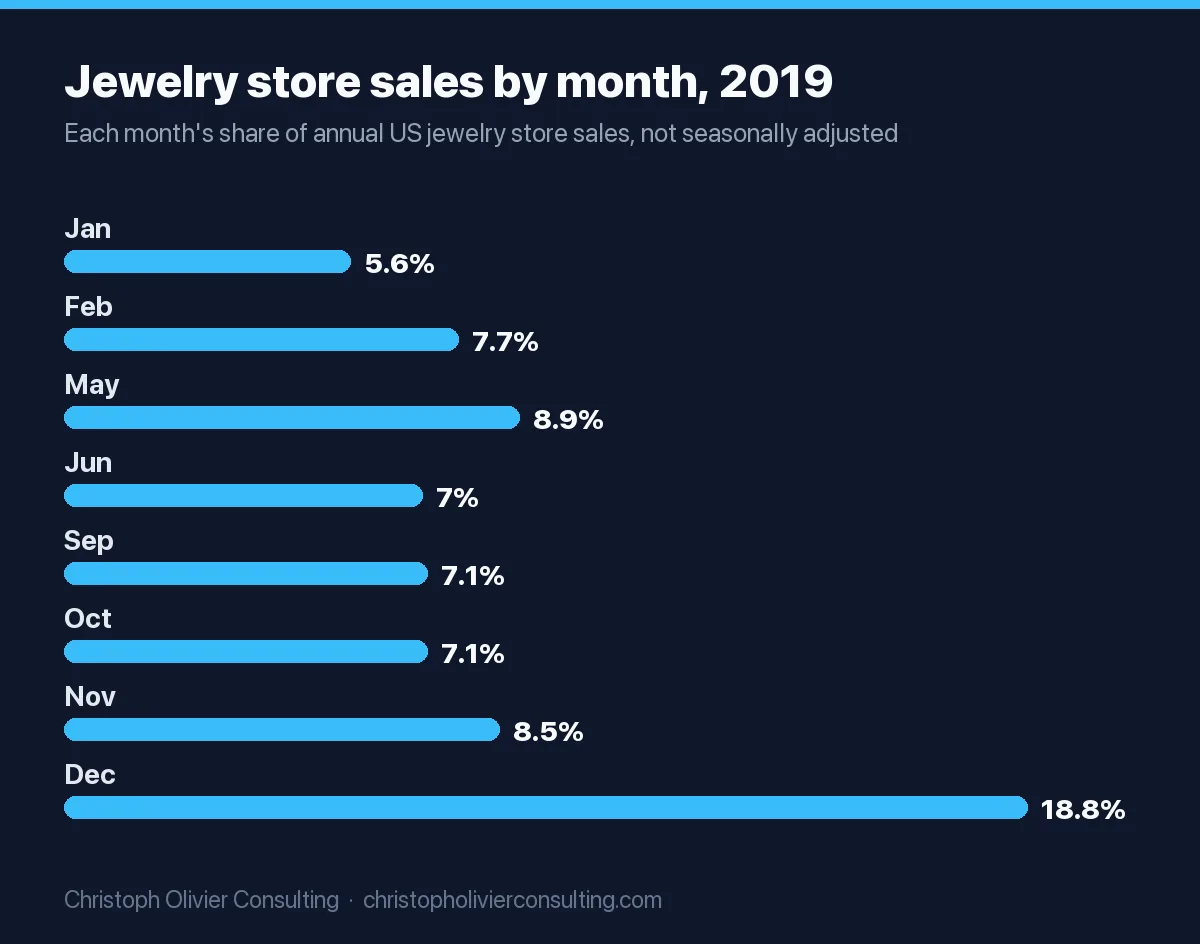
Applied to the $750,000 store (my calculation): an average month is $62,500, but December brings in about $141,000 and January about $42,000. Rent, payroll and loan payments do not shrink in January, so a store needs cash reserves or a credit line to carry it from February through November. If December is where you win or lose, the holiday retail marketing statistics are worth reading before you plan the season.
How much does a jewelry store need to sell to break even?
In the $750,000 model, cost of goods, advertising and card fees rise with each sale and total 61.5% of sales, so each dollar contributes 38.5 cents to fixed costs. Fixed costs (wages, payroll taxes, rent, insurance, other operating and inventory interest) are $260,300 a year.
- Break-even with the owner unpaid: $260,300 ÷ 0.385 = about $676,000 a year (my calculation).
- To also pay the owner the $57,760 supervisor median: $318,060 ÷ 0.385 = about $826,000 a year.
Use your own numbers: break-even sales = fixed costs ÷ (1 minus cost of goods share minus other variable costs).
Jewelry store start up cost: inventory is the biggest line
No federal agency or trade group publishes a verified start-up cost for an independent jewelry store, and figures on template and display vendor sites are not sourced. What you can calculate is the largest line: the stock you need in the cases to hit a sales target. Inventory at cost = target sales × (1 minus gross margin) ÷ turns per year.
| Target annual sales (own calculation, 46% margin) | 0.8 turns | 1.1 turns (trade figure) | 1.2 turns (model) | 2.0 turns |
|---|---|---|---|---|
| $350,000 | $236,250 | $171,818 | $157,500 | $94,500 |
| $750,000 | $506,250 | $368,182 | $337,500 | $202,500 |
| $1,500,000 | $1,012,500 | $736,364 | $675,000 | $405,000 |
Own calculation. Memo (consignment) goods from suppliers reduce what you must buy; Brilliant Earth’s made-to-order model holds 12.2% of sales in inventory, Signet 28.5%.
The rest of the opening budget is store-specific, so get written quotes for each line rather than trusting a national average:
- Inventory from the table above, plus loose stones if you sell bridal.
- Build-out and showcases for your lease (landlord allowance changes this a lot).
- Safe and vault rated to the level your insurer requires.
- Alarm, cameras and monitoring, and the first year of jewelers block insurance.
- Bench equipment if you will do repairs: about 1 in 10 sales dollars at Signet were services.
- POS and inventory software that tracks each piece by age and cost.
- Opening marketing and first months of advertising. The jewelry store marketing playbook covers which channels independents use.
- Working capital to carry rent and payroll through the January to April low months.
Jewelry store owner pay worksheet: pass/fail benchmarks
Run last year’s P&L through these lines. Two or more fails usually means owner pay below the supervisor median.
| Check | Pass | Fail | Where the line comes from |
|---|---|---|---|
| Gross margin, including repairs and custom | 46% or more | Below 40% | Model base and sensitivity; Signet 39.5% includes occupancy |
| Inventory turns (cost of goods ÷ average inventory at cost) | 1.2 or more | Below 0.8 | Trade figure 1.1 (IDEX 2008); Signet 2.1 on its broader cost basis |
| Staff wages as % of sales, owner excluded | At or below your Census band (18.1% under $500K, 16.4% at $500K to $999K, 15.6% at $1M to $2.49M) | 3+ points above your band | Census SUSB 2022, NAICS 448310 |
| Rent and occupancy as % of sales | 7% or less | Above 10% | Own model: $54,000 on $750,000 is 7.2% |
| Advertising as % of sales | 4% to 8% | Under 2% or over 12% | Signet 8.1%; own model 5% |
| Repair, custom and service revenue | 10% of sales or more | Under 5% | Signet services 11.8% of sales |
| Annual sales vs your break-even | At least 15% above | Within 5% | Own break-even formula above |
| Owner pay vs hiring a supervisor | Above $57,760 | Below $38,290 | BLS OEWS May 2025 median and 10th percentile, NAICS 458300 |
Do jewelry store owners make good money?
Owners of established $1 million-plus stores often do; owners of small stores usually do not. The Census count says 43.1% of employer jewelry companies sell under $500,000, where my model shows the owner close to unpaid. INSTORE’s mostly larger respondents report a midpoint “around the six-figure mark,” with 53% above $100,000. The ones who earn the most have high sales per square foot, a strong repair and custom business, and slow stock under control. In my view, if you cannot reach about $800,000 in sales within three years in your trade area, the numbers favor running a repair and custom studio with a small case line instead of a full store.
If you already own a store and want more of those December customers year round, the retail marketing strategy for independent stores lays out a plan by budget. To pressure-test your own P&L and marketing spend, you can book a consultation.
Ready to scale your revenue?
Book a free 30-min consultation. We’ll diagnose your growth bottleneck and map out the 3 highest-leverage moves for your business.
Frequently asked questions
How much does a jewelry store owner make a year?
No government survey measures it. In a worked model from Census, BLS and 10-K data, an owner who works full time keeps roughly nothing from a $350,000 store, about $28,000 from a $750,000 store and about $100,000 from a $1.5 million store, before income tax. In INSTORE's 2024 Big Survey, 53% of mostly larger store owners and managers reported earning more than $100,000 in 2023.
What is the profit margin of a jewelry store?
Signet Jewelers, the largest US jewelry retailer, reported a 39.5% gross margin and a 4.3% net margin for fiscal 2026, with store rent counted in cost of sales. Brilliant Earth reported a 57.5% gross margin but a 1.5% net loss for 2025. In the model on this page, an independent at $750,000 to $1.5 million in sales keeps 3.8% to 6.7% as owner pay.
How much does it cost to open a jewelry store?
No federal agency or trade group publishes a verified start-up figure. The largest line is inventory: at a 46% gross margin and 1.2 turns a year, stocking for $750,000 in annual sales takes about $337,500 at cost, and for $350,000 about $157,500 (my calculation). Build-out, safe, security, insurance and working capital come on top and need local quotes.
How much does a jewelry store make a month?
It depends heavily on the month. In 2019, the last full year Census published monthly jewelry store sales, December was 18.8% of annual sales and January only 5.6%. For a store selling $750,000 a year, that is about $141,000 in December, $42,000 in January and $62,500 in an average month.
How much revenue does a jewelry store make?
Jewelry store locations with employees averaged $2,164,465 in receipts in 2022, according to Census SUSB data (my calculation), but chains pull that up. The median jewelry store company sells between $500,000 and $999,999 a year, and 43.1% of employer firms sell under $500,000. Jewelry businesses with no employees averaged $58,159.
Do jewelry store owners make good money?
Owners of established stores above $1 million in sales often do; small store owners usually do not. Salaried first-line supervisors in jewelry stores earned a median of $57,760 in May 2025, and in the model on this page an owner needs about $826,000 in sales to pay themselves that much. Strong repair and custom revenue and faster inventory turns raise owner income most.
Small business owner income