
A fractional CMO for fintech is a part-time chief marketing officer who owns your growth plan, budget and marketing number, and who builds the compliance review into how marketing ships. Published 2026 rates for fintech specialists run from about $6,000 a month for 8 to 12 hours a week of advisory work to $18,000 to $25,000 a month for a senior operator at 20 to 25 hours a week. At the top of that range you are paying close to what a full-time marketing leader in finance costs once benefits are added, so the decision turns on how many hours of senior judgment you actually need, and whether the person has shipped regulated copy before.
Short answer: Fintech fractional CMOs publish rates of $6,000 to $25,000 a month (MarketerHire, July 2026), above the $3,000 to $12,000 general range, because vertical specialists price 20 to 30% higher. A full-time marketing manager in finance and insurance has a BLS median salary of $172,350 (May 2025), about $223,600 a year with benefits. Fractional fits best from seed to Series B, when you need senior direction and a compliance-ready process but not 40 hours a week of it.
Below: every published fintech rate with its source, the federal rules that change how a fintech CMO works (Reg Z, Reg DD, FDIC Part 328, FINRA 2210, UDAAP, Meta’s special ad category), what three public fintechs disclosed about acquisition spend in their 2025 10-Ks, a year-one cost model, an honest fit table, a 90-day plan and the questions to ask in an interview.
What a fractional CMO for fintech costs in 2026
All of these figures come from firms that sell fractional executives. None cites an independent survey, so treat them as asking prices and always ask for the hours behind a monthly number.
| Engagement | Published rate | Hours a week | Effective hourly (own calculation) | Source |
|---|---|---|---|---|
| Fintech fractional CMO, advisory | $6,000 to $10,000 a month | 8 to 12 | $173 to $192 | MarketerHire fintech guide, July 23, 2026 |
| Fintech fractional CMO, standard operator | $12,000 to $18,000 a month | 15 to 20 | $185 to $208 | MarketerHire, July 2026 |
| Fintech fractional CMO, senior operator with hiring accountability | $18,000 to $25,000 a month | 20 to 25 | $208 to $231 | MarketerHire, July 2026 |
| Fintech fractional CMO, US | $8,000 to $22,000 a month | 1 to 3 days | Not calculable | Fractionus, July 7, 2026 |
| Fintech fractional CMO | $6,000 to $20,000 a month | Not stated | Not calculable | GTM 8020, undated, fetched November 2026 |
| Any industry, strategy only | $3,000 to $6,000 a month | 5 to 10 | $138 (top of range) | MarketerHire cost guide, April 15, 2026 |
| Any industry, strategy plus execution oversight | $7,000 to $12,000 a month | 15 to 20 | $138 (top of range) | MarketerHire, April 2026 |
| Any industry, hourly | $150 to $350 an hour | 5 to 15 | As quoted | MarketerHire, April 2026 |
Effective hourly is the monthly fee divided by weekly hours times 52 over 12, at the bottom and top of each published range. Two things stand out. First, the fintech premium is real but modest per hour: $173 to $231 against the general market’s $150 to $350 hourly band. Most of the gap in monthly fees comes from fintech engagements being quoted at more hours. Second, MarketerHire’s general guide gives stage tiers that match fintech funding stages: $3,000 to $5,000 a month at pre-seed or seed, $5,000 to $10,000 at Series A, $10,000 to $15,000 at Series B and later. It also says a CMO with deep experience in one vertical prices 20 to 30% higher than a generalist. Our fractional CMO cost guide has the full cross-industry breakdown.
If you already have two or three proposals and they do not line up, book a free consultation and we will put your quotes, hours and scope next to this table, including telling you if the cheapest one is the right call.
Why fintech marketing needs a different kind of CMO
In most industries a CMO can approve an ad on taste. In fintech, a single phrase in a headline can trigger a federal disclosure requirement, and the rules differ by product. A fintech CMO does not need to be a lawyer, but they need to know which words send copy to counsel, and they need a review process that does not stall every campaign for two weeks. These are the rules that most often shape day-to-day marketing work. Have your counsel confirm which apply to your licenses and bank partners.
| Rule | Who it hits | What it does to marketing copy | Primary source |
|---|---|---|---|
| Regulation Z, closed-end credit advertising (12 CFR 1026.24(d)) | Installment loans, BNPL structured as closed-end credit, auto and personal loans | Stating a down payment, the number of payments or repayment period, a payment amount or a finance charge is a “triggering term.” The ad must then also state the down payment, the full repayment terms and the “annual percentage rate,” using that term | 12 CFR 1026.24 |
| Regulation Z, open-end credit advertising (12 CFR 1026.16(b)) | Credit cards, credit lines | Naming a cost term triggers disclosure of any minimum, transaction or similar finance charge, the periodic rate as an APR (and whether it is variable), and any membership fee | 12 CFR 1026.16 |
| Regulation DD, deposit advertising (12 CFR 1030.8) | Neobanks, savings and cash-management products offered with a bank | A rate of return must be stated as “annual percentage yield” (APY allowed once the full term appears). Stating the APY triggers: variable-rate warning, the date the APY is accurate as of, minimum balance and a statement that fees could reduce earnings. “Free” is banned if any maintenance or activity fee can apply | 12 CFR 1030.8 |
| FDIC Part 328, misrepresentation of insured status (12 CFR 328.102) | Any non-bank that partners with a bank and mentions FDIC insurance | No implying an uninsured product is FDIC insured. If you say you are associated with an insured bank, the nature of that association must be described “clearly, conspicuously, prominently, and accurately,” on any media or platform | 12 CFR 328.102 |
| FINRA Rule 2210, communications with the public | Broker-dealers (trading apps, robo platforms with a BD) | A registered principal must approve each retail communication (anything going to more than 25 retail investors in 30 days) before use. New members file with FINRA at least 10 business days before first use for their first year. No predicting or projecting performance | FINRA Rule 2210 |
| UDAAP, Consumer Financial Protection Act (12 USC 5531, 5536) | Covered persons and their “service providers” | Bans unfair, deceptive or abusive acts. “Abusive” includes materially interfering with a consumer’s ability to understand a term. Section 5536 applies to service providers as well as the company itself | 12 USC 5531, 12 USC 5536 |
| FTC Act Section 5 | Most non-bank fintechs | “Unfair or deceptive acts or practices in or affecting commerce” are unlawful; banks are carved out of the FTC’s authority, non-bank fintechs are not | 15 USC 45 |
| Meta Special Ad Category: financial products and services | US-based advertisers, or ads shown to US audiences | Required since January 14, 2025. Age is fixed at 18 to 65+, gender at all, location must be at least a 15-mile radius (no ZIP code targeting), and lookalike audiences, demographic and behavior targeting are unavailable | Meta Marketing API documentation, read via an April 2026 archive snapshot |
The service-provider point matters when you hire outside help. The statute defines a service provider as anyone who provides “a material service” in connection with a consumer financial product, while excluding businesses that only sell ad time or space. Whether a particular marketing contractor falls inside that definition is a question for your counsel, but it is a reason to put compliance review and approval records into the contract, not just into a Slack thread. Our fintech marketing playbook covers the claim-to-evidence review process in more detail.
The Meta rules matter for channel planning. A fintech that grew on lookalike audiences and tight age targets will see paid social behave differently under the special ad category, and a CMO who has not run campaigns under it will forecast cost per funded account from the wrong history.
What public fintechs spend to win a customer
Acquisition cost is the number a fintech CMO is judged on, and it is defined differently at every company. Three public fintechs disclosed enough in their fiscal 2025 annual reports to show how wide the range is.
| Company (FY2025 10-K) | Marketing line reported | Revenue reported | Marketing as % of revenue (own calculation) | Acquisition figure |
|---|---|---|---|---|
| Dave Inc., filed March 2, 2026 | Advertising and activation: $66.0 million | $554.2 million | 11.9% | Reported: CAC “approximately $19,” payback “under four months” |
| Robinhood Markets, filed February 18, 2026 | Marketing: $399 million | $4,473 million | 8.9% | Own calculation: $222 of marketing per net new funded customer (1.8 million net adds, to 27.0 million) |
| SoFi Technologies, filed February 17, 2026 | Sales and marketing: $1,095.4 million | $3,613.4 million net revenue | 30.3% | Own calculation: $311 of sales and marketing per net new member (3,523,679 net adds, to 13,651,002) |
How to read this: the Robinhood and SoFi figures are not CAC. They divide total marketing (SoFi’s line also includes direct member incentives and lead generation) by net customer growth, which ignores churn and spend aimed at existing customers. They are rough ceilings, shown only to make one point. A cash-advance app reporting $19 and a multi-product lender spending about $311 per net new member are both “fintech.” A fractional CMO who quotes a benchmark CAC without asking your product, unit economics and definition first is guessing.
Fractional vs full-time fintech CMO: year-one cost
The full-time baseline uses BLS marketing manager pay (May 2025): median $166,790 overall, $172,350 in finance and insurance, top 10% above $293,610. BLS does not track CMO as a separate job, so the 90th percentile is the closer proxy for a CMO at a growth-stage company. Benefits come from the BLS Employer Costs for Employee Compensation, June 2026: private-industry management, business and financial jobs cost $59.85 an hour in wages, $8.47 in paid leave and $20.31 in other benefits. Since salary already covers paid leave, the load is 20.31 / (59.85 + 8.47) = 29.7%.
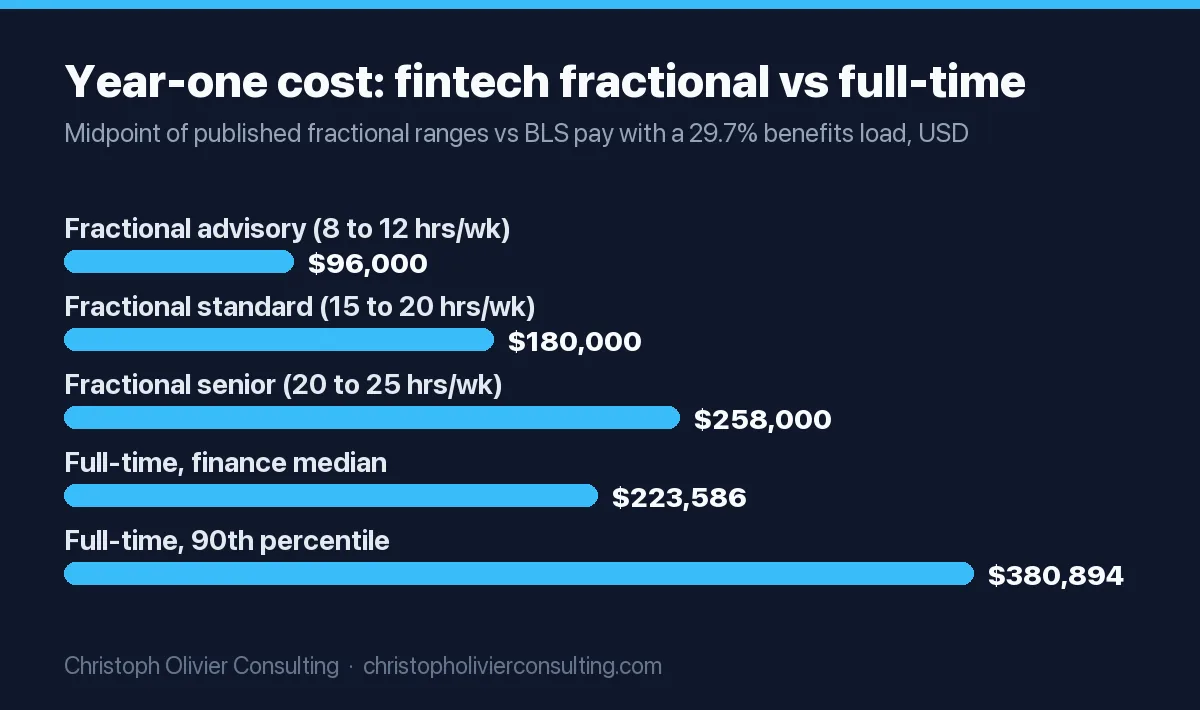
| Option | Math (own calculation) | Year-one cost | Senior hours a year |
|---|---|---|---|
| Fintech fractional, advisory | $6,000 to $10,000 x 12 | $72,000 to $120,000 | 416 to 624 |
| Fintech fractional, standard operator | $12,000 to $18,000 x 12 | $144,000 to $216,000 | 780 to 1,040 |
| Fintech fractional, senior operator | $18,000 to $25,000 x 12 | $216,000 to $300,000 | 1,040 to 1,300 |
| Full-time, finance and insurance median | $172,350 x 1.297 | $223,586 | 2,080 paid |
| Full-time, all-industry 90th percentile | $293,610 x 1.297 | $380,894 | 2,080 paid |
Assumptions: 52 weeks of fractional work, no equity, bonus, recruiting fee, ramp time or severance on the full-time side, and no ad spend or tools on either side. The honest reading is that a senior fintech fractional CMO at 25 hours a week costs about as much as a full-time median hire. Fractional wins on speed, on paying only for the hours you need and on access to someone more senior than the median salary buys. It stops winning once you need more than about 20 hours a week for more than a year.
Fintech marketing consultant, agency or fractional CMO?
The three searches people run (“fintech marketing consultant,” “marketing agency for fintech,” “fractional CMO for fintech”) describe three different jobs.
| Fintech marketing consultant | Fintech marketing agency | Fractional CMO | |
|---|---|---|---|
| What you buy | A defined answer: audit, positioning, launch plan | Production: ads, content, SEO, PR, design | Ongoing ownership of the plan, budget and marketing number |
| Typical pricing basis | Project or hourly ($150 to $350 an hour, MarketerHire) | Scope-based retainer; ask for a written scope and named team | Monthly retainer tied to weekly hours |
| Who signs off on copy | You | You or your compliance team; the agency drafts | The CMO runs the review workflow with compliance |
| Best when | You have a team and need one decision made well | Strategy is set and you need output | Nobody senior owns marketing and the board asks about CAC |
When a fractional fintech CMO makes sense, and when it does not
This is the table to be honest with yourself about. Several rows point away from hiring a fractional CMO.
| Your situation | Better option | Why |
|---|---|---|
| Pre-launch, no license or bank partner signed yet | Founder-led marketing plus a few hours of counsel | Your claims, disclosures and even product names can change with the partner bank’s review. A CMO plan written now gets rewritten |
| Product-market fit is unproven, under a few hundred active customers | A one-off consultant project on positioning and a waitlist test | You need learning, not a budget allocator. MarketerHire’s seed tier ($3,000 to $5,000) is light advisory for this reason |
| You only need paid acquisition run better | A paid media specialist who has run the Meta financial category | That is execution, not leadership, and the hourly rate should reflect it |
| Your problem is compliance itself (consent orders, open findings, no CCO) | Compliance counsel or a compliance hire first | Marketing should not design the control framework it will be judged by |
| Seed to Series B, one to five marketers or agencies, nobody senior setting direction | Fractional CMO, 8 to 20 hours a week | Enough team to execute a plan, not enough budget to justify $380,000 for a full-time 90th-percentile leader |
| Raising within 12 months and nobody can defend CAC, payback and channel mix | Fractional CMO for two to three quarters | Board-ready definitions and clean data are a leadership job |
| You need 25+ hours a week for more than a year, or the board wants a named executive | Full-time CMO or VP, with fractional as a bridge during the search | The senior fractional tier already costs as much as a loaded full-time median hire |
Not sure which row your fintech is in?
Bring your stage, team, current CAC definition and any fractional CMO or agency quotes to a free call. We will check them against the cost model and fit table above, and say so if a cheaper option fits better.
What a fintech fractional CMO should own in the first 90 days
Use this as the scope of work in the agreement. The pass criteria are my standard; adjust them, but write them down. Our fractional CMO contract template shows where they go.
| Days | Work | Deliverable | Pass if |
|---|---|---|---|
| 1 to 10 | Access to CRM, ad accounts, analytics, the bank partner’s marketing requirements and any existing approved-claims list | Access log and a list of every live ad, page and email | Every system sits under company-owned logins |
| 11 to 30 | Baseline: funded accounts or paying customers by source, CAC by channel under one written definition, activation and 90-day retention | Baseline sheet, with the source of every number | Finance and marketing agree on one CAC formula |
| 11 to 30 | Compliance inventory: which live assets use Reg Z or Reg DD triggering terms, FDIC references or performance language | Claims register: claim, evidence, required disclosure, approver | Every live claim has an approver and a stored version |
| 30 | Diagnosis and plan | Memo with three priorities, budget by channel with a CAC cap for each, owner and stop date | Each initiative has a dollar budget and a metric finance accepts |
| 31 to 60 | Review workflow with compliance and the partner bank; positioning by segment | Written review SLA, pre-approved disclosure blocks, message house | A standard ad clears review within the agreed SLA |
| 61 to 90 | Two or three channel tests; agency and team decisions | Test plan with hypothesis, budget cap and kill rule; keep, fix or cut call per vendor | Nothing launches without a stop rule and an approval record |
| 90 | Review with CEO, finance and compliance | Results against the day-30 plan | A clear call: continue, rescope hours, start a full-time search or end with a handover |
Interview questions for a fintech fractional CMO
These separate people who have shipped regulated marketing from people who have read about it.
- “Our ad says ‘pay in 4 installments.’ What has to appear with it?” Good answer: recognizes a Reg Z triggering term (number of payments) and asks whether the product is closed-end credit before naming the required APR and repayment disclosures. Weak answer: “legal handles that.”
- “How have you run Meta campaigns under the financial products special ad category?” Good answer: names what changed (no lookalikes, broad age and location) and how they rebuilt targeting around first-party lists and creative. Weak answer: no awareness of the category.
- “How do you define CAC, and what was it at your last fintech?” Good answer: a formula, a number, a segment and whether incentives were included. Weak answer: a blended number from ad platforms.
- “What is your review SLA with compliance, and who keeps the records?” Good answer: a turnaround in days, a claims register and version storage. For broker-dealers, mentions FINRA 2210 principal approval. Weak answer: “we just send it over.”
- “How do you describe our bank partner relationship in an ad?” Good answer: plain wording of who holds the deposits and what is FDIC insured, consistent with Part 328. Weak answer: puts the FDIC logo near the app name.
- “Which of your hours are leadership and which are execution?” Good answer: a weekly split. Weak answer: one monthly fee with no hours.
- “When would you tell us to stop working with you?” Good answer: a threshold, such as needing 25+ hours a week or a full-time hire becoming affordable. Weak answer: none.
If your company is closer to software than to a regulated financial product, our guide to a fractional CMO for SaaS uses ARR-based benchmarks instead. The general case for the model, with cross-industry math, is in what a fractional CMO does and costs.
Where CO Consulting fits for a fintech
To be plain: fintech is not one of the nine industries on our services page. Our financial-sector work is with financial advisors, tax planning firms, and capital raisers and fund managers, which means compliance-aware content and offering-rule limits are familiar, but we do not have a portfolio of neobank or lending launches to show you, and we are not compliance counsel. If you need someone who has taken three consumer fintechs through Series B, the specialist premium buys exactly that, and you should ask every provider, including us, for fintech references. Where we fit is a B2B or B2B2C fintech, or a financial-services firm with a fintech product, that needs senior direction over an existing team or agencies. Our fractional CMO services start with an audit and a prioritized 90-day plan, and run as a 20 to 40 hour a month retainer with a 3 to 6 month minimum, a fixed project such as a go-to-market plan, or a few hours a week of advisory. We own direction and accountability; copywriting, ad builds, design and video production are done by the team we direct. If that matches a row in the fit table, book a consultation and bring your stage, budget, CAC definition and any quotes you have.
Ready to scale your revenue?
Book a free 30-min consultation. We’ll diagnose your growth bottleneck and map out the 3 highest-leverage moves for your business.
Frequently asked questions
How much does a fractional CMO for fintech charge?
MarketerHire's July 2026 fintech guide lists $6,000 to $10,000 a month for 8 to 12 hours a week of advisory, $12,000 to $18,000 for a standard operator at 15 to 20 hours, and $18,000 to $25,000 for a senior operator at 20 to 25 hours. Fractionus lists $8,000 to $22,000 for the US. These are seller-published asking prices, not survey data.
What does a fintech marketing consultant do?
A fintech marketing consultant delivers a defined answer, such as a marketing audit, positioning work, a launch plan or a channel review, usually on a project or hourly fee. MarketerHire lists $150 to $350 an hour for fractional marketing leaders. A fractional CMO differs by owning the plan, budget and marketing number on an ongoing retainer and running the review workflow with compliance.
What is a typical fintech CMO salary?
There is no official CMO wage series. The closest is BLS marketing managers: a $172,350 median in finance and insurance in May 2025, and more than $293,610 for the top 10% across industries. With the 29.7% benefits load implied by BLS employer cost data for June 2026, that is about $223,600 to $380,900 a year before bonus, equity or a recruiting fee.
Should a fintech hire a marketing agency or a fractional CMO?
Hire an agency when strategy is set and you need production such as ads, content, SEO or design. Hire a fractional CMO when nobody senior owns marketing, CAC is undefined or disputed, and copy keeps stalling in compliance review. Many fintechs use both: the fractional CMO writes the agency scope, sets CAC caps and approves the plan, and the agency produces the work.
What compliance rules should a fintech CMO know?
At minimum: Regulation Z advertising triggering terms for credit (12 CFR 1026.16 and 1026.24), Regulation DD APY rules for deposit products (12 CFR 1030.8), FDIC Part 328 on describing insured status and bank partners, FINRA Rule 2210 if you are a broker-dealer, UDAAP under the Consumer Financial Protection Act, FTC Act Section 5, and Meta's financial products special ad category.
When should a fintech hire a full-time CMO instead?
When you need more than about 20 to 25 hours a week of senior marketing leadership for more than a year, or the board wants a named executive. At that point the senior fractional tier of $216,000 to $300,000 a year costs about as much as a loaded full-time finance-industry median hire of about $223,600. A fractional CMO can bridge the search.
Fractional CMO: cost, fit and industries