

Cold calling in 2026 works when seven things are right before anyone picks up the phone: your number shows up without a spam label, your list and calling hours are legal, you judge results against benchmarks with a named source, your dialer fits your volume, your opener states a reason, inbound callbacks happen within 5 minutes, and you track a handful of formulas. Most failed programs break on the first two, not on the script.
Below, each of the seven comes with the rule, the number or the price behind it, and the source. Two assets are built in: a pass/fail audit you can run on your own program this week, and a copy-ready opener with answers to the five objections reps hear most.
The 7 things, as a pass/fail audit
Score one point for each pass. Fix failures in this order, because a clean number and a legal list come before anything a script can do.
| # | What decides it | Pass | Fail |
|---|---|---|---|
| 1 | Caller ID reputation | Carrier confirms “A” attestation on your outbound calls; every outbound number registered with the Free Caller Registry; spam labels checked monthly | You do not know your attestation level, or reps call from numbers nobody has registered |
| 2 | Legal list and hours | Consumer numbers scrubbed against the National Do Not Call Registry within the last 31 days; internal do-not-call list shared by every rep; calls to Florida and Oklahoma stop at 8 p.m. local time | No scrub date on file, or opt-outs live in one rep’s notes |
| 3 | Honest benchmarks | Every target (connect rate, conversations, meetings) cites a source, sample and year | “Industry average is 10%” with no source |
| 4 | Dialer fit | Dialer mode matches list size and you know your abandoned-call rate | Parallel dialer on a 300-name list, or nobody can say how dropped connects are handled |
| 5 | Opener and objections | Written opener with a stated reason for the call, plus a written answer to each of the top five objections | Reps improvise, or open with “Did I catch you at a bad time?” |
| 6 | Speed to lead | Inbound callback and demo requests get a call within 5 minutes in business hours | Inbound leads wait in the same queue as cold lists |
| 7 | Metrics | Weekly connect rate, conversation rate, meeting rate and held rate, by rep and list | Only “dials made” is tracked |
Six or seven: scale what you have. Four or five: fix the failing items before adding reps. Three or fewer: more dials will make the numbers worse, not better.
1. Caller ID reputation: STIR/SHAKEN attestation and spam labels
If your number shows “Spam Likely,” nothing else on this page matters. Two separate systems decide what the prospect sees.
STIR/SHAKEN is the signature. The FCC describes STIR/SHAKEN as standards that let calls on IP networks “have their caller ID ‘signed’ as legitimate by originating carriers and validated by other carriers before reaching consumers.” The FCC required voice providers to implement it in the IP portions of their networks by June 30, 2021, and every provider must file in the Robocall Mitigation Database. The signature carries one of three attestation levels, which RFC 8588 names Full, Partial and Gateway:
| Level | What the signing carrier is saying | What it means for your team |
|---|---|---|
| A (Full) | “The service provider knows the caller and their association with the calling phone number” | The target. The carrier that originates your calls has to know the numbers are yours. |
| B (Partial) | “The service provider knows the caller, but not their relationship with the calling phone number” | Ask your carrier or dialer vendor why your calls are not getting A, and what it takes to fix it. |
| C (Gateway) | “The service provider is transiting the call but can’t authenticate the call source” | Worst case for answer rates: the network signing the call cannot vouch for who placed it. |
Definitions quoted from Bandwidth’s attestation explainer, which adds the point most teams miss: calls signed “A” “aren’t necessarily guaranteed to be delivered without a ‘spam’ label.” Labels come from analytics engines in the receiving network, not from the signature.
The analytics engines are the label. The Free Caller Registry is run by First Orion, Hiya and TNS, and it is free. You submit business name, address, website, a contact with a verified email, the call purpose and monthly outbound volume, then up to 20 numbers by hand or more as an .xlsx or .txt file under 100 KB. Each provider sends an acknowledgment. The registry is plain about its limits: registration “does not guarantee redress,” repeat submissions of the same number “provide no additional value,” it does not set your Caller ID Name, and it is only for businesses calling on their own behalf. If a number is still mislabeled, the registry lists a contact for each provider: FCRsupport@firstorion.com, freecallerregistry@hiya.com and communications@tnsi.com.
What you must display. Under 47 CFR 64.1601(e), anyone telemarketing must transmit caller ID and may not block it. You may show the seller’s name and customer service number instead, but that number “must permit any individual to make a do-not-call request during regular business hours.” Florida (Fla. Stat. 501.616(7)) and Oklahoma (HB 3168, Section 4) also bar technology that “deliberately displays a different caller identification number” to conceal the caller’s identity. For local-presence dialing, that means local numbers you actually own, which ring back to your team when the prospect returns the call.
Monthly routine: call each outbound number from a phone on each major carrier, note any label, re-register changed numbers, and retire a labeled number instead of dialing through the label.
2. Cold calling rules in 2026: B2B calls vs consumer calls
The rules split on who you are calling and how the call is placed. This is a summary of the federal rules and two strict states, not legal advice.
| Rule | Calls to businesses | Calls to consumers | Source |
|---|---|---|---|
| National Do Not Call Registry | The FTC says “most phone calls to a business made with the intent to solicit sales from that business are exempt” | Scrub against a copy of the registry no more than 31 days old and keep records of it | FTC Q&A; 47 CFR 64.1200(c)(2) |
| Exceptions to the B2B exemption | Calls to sell nondurable office or cleaning supplies are covered; calls to employees for personal purchases are “not business-to-business solicitations” | n/a | FTC TSR guide |
| Federal calling hours | The FCC rule is written for residential subscribers; use the same window anyway | No telephone solicitation before 8 a.m. or after 9 p.m., called party’s local time | 47 CFR 64.1200(c)(1) |
| Florida and Oklahoma hours | 8 a.m. to 8 p.m. in the called person’s time zone, and no more than three calls in 24 hours on the same subject, from any number | Fla. Stat. 501.616(6); Okla. HB 3168 (15 O.S. 775C.4) | |
| Your own do-not-call list | Keep one anyway, shared across phone, email and LinkedIn | Honor a request within a reasonable time, never more than 10 business days, and keep it for 5 years; give the caller’s name, the company’s name and a contact number | 47 CFR 64.1200(d)(3), (d)(4) and (d)(6) |
| Autodialer or artificial voice to a cell phone | Prior express consent; prior express written consent when the call is telemarketing. The rule has no exception for a mobile used for business | 47 CFR 64.1200(a)(1)(iii) and (a)(2) | |
| Damages | FTC: up to $53,088 per Do Not Call violation, and each call may count separately. Florida and Oklahoma: actual damages or $500, up to three times if willful | FTC Q&A; Fla. Stat. 501.059(10); HB 3168, Section 6 | |
What the Do Not Call Registry costs in fiscal year 2027
Fiscal year 2027 started October 1, 2026. Per the FTC’s August 26, 2026 announcement, the first five area codes are free, each additional area code costs $85 a year (up from $82), an additional area code for half a year costs $43, and the maximum for every area code nationwide is $23,425. A firm calling homeowners in 8 area codes pays 3 x $85 = $255 for the year. Under the FTC’s business exemption, a list of business lines may not need a subscription, but the moment a list mixes in sole proprietors on personal mobiles, scrub it.
Florida and Oklahoma: the state mini-TCPA laws that change the defaults
Florida’s Telephone Solicitation Act (501.059, last amended by ch. 2023-150) requires prior express written consent for unsolicited sales calls that involve “an automated system for the selection and dialing of telephone numbers” or a recorded message. It defines a telephonic sales call as one “to a consumer” about consumer goods or services, so most B2B calls fall outside it. The hours and three-calls rule in 501.616(6) is different: 501.604 keeps it in force even for sellers that are otherwise exempt.
Oklahoma’s Telephone Solicitation Act of 2022 (in effect since November 1, 2022) uses broader wording: an automated system for the selection or dialing of numbers. Under federal law the Supreme Court narrowed “autodialer” in Facebook v. Duguid (2021) to equipment that stores or produces numbers “using a random or sequential number generator,” which is why many power dialers are treated as outside the federal definition. State definitions like Oklahoma’s are why “our dialer is not an autodialer” is a question for counsel, not the vendor’s sales team.
AI voices and the November 25, 2026 revocation rule
On February 8, 2024, the FCC adopted a Declaratory Ruling that “calls made with AI-generated voices are ‘artificial'” under the TCPA, effective immediately. An AI voice agent placing outbound sales calls to mobiles therefore needs the same prior express written consent as a prerecorded robocall. A human rep who uses AI for notes or coaching is a different situation: the voice on the call is human.
For consent-based calls and texts, revocation rules change this month. The current text of 47 CFR 64.1200(a)(10) lets consumers revoke by any reasonable method, with “stop,” “quit,” “end,” “revoke,” “opt out,” “cancel” or “unsubscribe” counting per se, honored within ten business days. The new rule at 91 FR 67214 (published Oct 26, 2026; effective Nov 25, 2026) lets senders treat a revocation as applying only to the category of informational messages it was aimed at, and lets them designate an exclusive means to revoke consent. The full consent and fee table, with the vacated one-to-one rule, is on our SMS marketing statistics page.
3. Cold calling benchmarks for 2026, with who measured them
Most “average connect rate” figures online have no sample and no date. These do. Almost all come from vendors that sell calling software or services, so treat them as directional and compare definitions before you compare numbers.
| Benchmark | Figure | Source, sample, date |
|---|---|---|
| SDR daily activity | Median 112 activities a day: 44 phone, 41 email, 19 LinkedIn, 8 text or other; 4.1 quality conversations a day | Bridge Group, 351 B2B companies, February 6, 2025 (research firm) |
| Phone-centric vs email-centric teams | 56 dials and 4.6 quality conversations a day vs 28 dials and 3.4 | Bridge Group, same report |
| Monthly meeting quota | Median 10 held first meetings (Stage 0); 6 converted to Stage 1 | Bridge Group, same report |
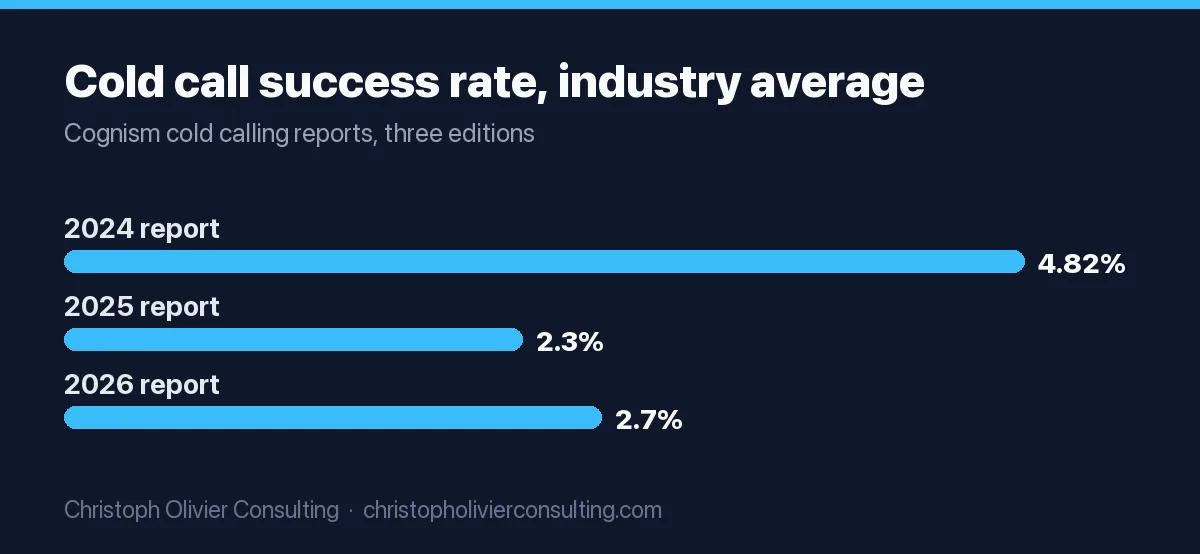
| Cold call success rate | 2.7% industry average, up from 2.3% in 2025 (4.82% in 2024); success is not defined on the report page | Cognism with WHAM, 200K+ calls of 2025 data (vendor) |
| Attempts to reach a prospect | 1.55 calls on average, down from 2.9 | Cognism, same report |
| Average call length | 82 seconds, down from 93 | Cognism, same report |
| Best windows | 10 to 11 a.m., then 2 to 3 p.m.; Thursday strongest, Friday weakest | Cognism, same report |
| Connect rate on known-pickup numbers | 24.2% vs a 6.6% baseline for Orum’s “Admin, C-suite” persona; a voicemail after the first attempt raised the next pickup rate by 25.8% | Orum blog, October 9, 2025, drawing on its 1B+ dial dataset (vendor; sample per figure not stated) |
| Openers that book meetings | “Heard the name tossed around?” 11.24%; permission-based 11.18%; “Did I catch you at a bad time?” 2.15% | Gong, 300M+ cold calls, July 24, 2024 (vendor; success not defined) |
| Stating a reason for the call | 2.1x the success rate; “How have you been?” 10.01% vs a 1.5% baseline | Gong Labs, 90,380 first-interaction calls, April 19, 2018 (vendor; old data) |
The SDR pay, ramp and attrition figures from the same Bridge Group edition, and what they mean for a first hire, are in our guide on when to hire an SDR.
4. Power dialer vs parallel dialer: what each costs in 2026
A power dialer calls one number after another from a list, so the rep is never typing numbers. A parallel (multi-line) dialer rings several numbers at once and connects the rep to whoever answers first. Parallel dialing raises conversations per hour on large lists, and it is also how calls get dropped: when two people answer, one of them hears silence.
That silence is regulated. 47 CFR 64.1200(a)(7) caps abandoned telemarketing calls at 3% of live-answered calls per 30-day campaign, and a call counts as abandoned if it “is not connected to a live sales representative within two (2) seconds of the called person’s completed greeting.” Ask any parallel-dialer vendor for its abandonment report before you sign.
| Tool | Dialer modes | Published price (USD) | Notes |
|---|---|---|---|
| Orum | AI dialer, power dialer, parallel dialer | Quote only (“based on package type and number of users”) | Minimum 9 seats |
| Nooks | Multi-line and power dialing | Quote only | No plan names or line counts published |
| Aircall | Power Dialer on Professional (imports up to 1,000 numbers) | Essentials $30, Professional $50 per license a month, billed annually; Enterprise custom | Minimum 3 licenses; Enterprise minimum 25 |
| JustCall | Power dialer from Pro; predictive (up to 10 lines), power and dynamic dialers on SalesPro | Team $29, Pro $49, Pro Plus $89 per user a month, billed annually; SalesPro quote only | Monthly prices not shown; page also lists a 2-license minimum |
| Kixie | Single-line PowerDialer, or Multi-Line PowerDialer up to 4 lines | Plan prices not published | Extra US/Canada numbers $5 a month; 7-day free trial |
Prices checked on the vendors’ US pricing pages on November 1, 2026. Worked example: three reps on Aircall Professional cost 3 x $50 = $150 a month, or $1,800 a year on annual billing, before any add-ons.
My rule of thumb for choosing: under about 1,000 fresh contacts per rep per month, a power dialer is enough and every connect gets a researched opener. Parallel dialing pays off when lists are large, numbers are mostly direct dials, and you have a manager watching the abandonment rate. If your list is 200 named accounts, the dialer is not your constraint.
5. A cold call opener and 30-second script you can copy
The structure follows the data above: a stated reason (Gong’s 2.1x finding), permission instead of “bad time” (11.18% vs 2.15% in Gong’s 2024 data), and a question the prospect can answer in one sentence. Cognism’s 82-second average call length means most calls end in under a minute and a half, so the script below runs about 30 seconds to the first question and leaves the rest of that time for the prospect.
Opener (first 10 seconds):
“Hi [first name], it’s [your name] from [company]. This is a cold call. Can I take 30 seconds to tell you why I called, and you tell me if it’s worth another minute?”
Reason and proof (next 20 seconds):
“I called because [trigger you verified: new office in Tampa, a job post for a controller, a partner who joined last month]. When [peer type, e.g. 20-person CPA firms] go through that, the problem we usually hear is [one specific problem]. We help them [one-line outcome, no numbers you cannot prove]. Is that on your list this quarter, or is it handled?”
If yes: “Then it’s worth 20 minutes with [closer’s name]. Does Tuesday at 10 or Thursday at 2 work better?” Offer two times in the prospect’s time zone, inside the 10 to 11 a.m. or 2 to 3 p.m. windows if you can.
The five common objections Cognism lists for 2026 (not ranked), with a reply for each:
| Objection | Reply | Goal |
|---|---|---|
| “I’m not interested.” | “Fair. Is that because [problem] isn’t an issue for you, or because it’s already handled?” | Find out which, then exit politely or continue |
| “We have other priorities at the moment.” | “Makes sense. When you plan next quarter, is [problem] on that list? If so, I’ll call back the week of [date].” | A dated callback, logged in the CRM |
| “I’m too busy to talk, send me an email.” | “Happy to. So it’s useful and not junk, which is the bigger headache right now: [A] or [B]?” | One qualifying answer before the email |
| “We’ve tried businesses like yours before.” | “What happened? I’d rather hear what went wrong than repeat it.” | Learn the failure; only continue if you solve it |
| “We already have a solution for this problem.” | “Good. If you could change one thing about how it works, what would it be?” | A gap, or a clean disqualification |
If the answer to “is it handled?” is yes, thank them and ask if you may check back in six months. If they ask not to be called again, say “Understood, I’ll take you off our list,” and do it the same day: under the rule in section 2 you have 10 business days at most for consumers, and there is no reason to use them for anyone.
6. Speed to lead: call inbound callbacks within 5 minutes
Every cold-calling team also gets warm calls: prospects who call back, fill in a form after a voicemail, or request a demo. These are the most valuable dials of the day, and they should never wait in the cold-list queue.
In the 2007 MIT and InsideSales.com Lead Response Management study, “the odds of contacting a lead if called in 5 minutes versus 30 minutes drop 100 times,” and the odds of qualifying it drop 21 times. The study “did not address close ratios,” so quote it as contact and qualification, not sales. Most companies still miss the window: in Clay’s September 2026 test of 6,346 demo and contact forms, two thirds of companies never replied, 96% never called, and only 5% of replies arrived within five minutes. And persistence matters as much as speed: in Velocify’s study of almost 3.5 million leads, as reported by The National Law Review in March 2016, “93% of all converted leads are reached by the 6th call.”
The operating rule: hand-raisers (callback, demo, quote or consultation request, or a missed inbound call) get an automated confirmation instantly and a human call within 5 minutes during business hours, with up to 6 call attempts before the lead is marked unresponsive. The full tiered SLA and the source behind each number are in our speed to lead statistics, and the routing setup in HubSpot and Salesforce is in our inbound sales process guide.
7. Cold calling metrics and the formulas behind them
Track five numbers weekly, by rep and by list. The definition matters more than the target, so write it down before anyone reports it.
| Metric | Formula | If it is low, fix |
|---|---|---|
| Connect rate | Connects with the intended person ÷ dials | Number reputation (section 1), list data, calling windows |
| Conversation rate | Connects lasting over 60 seconds ÷ connects (Orum’s definition; it flags reps under 20% and calls 60% or more exceptional) | Opener (section 5) |
| Meeting rate | Meetings booked ÷ conversations | Reason for the call, targeting, ask |
| Held rate | Meetings held ÷ meetings booked | Confirmation email, calendar invite, reminder |
| Accepted rate | Meetings the closer accepts ÷ meetings held | Qualification definition shared with the closer |
Worked example with Bridge Group medians. A phone-centric SDR makes 56 dials and has 4.6 quality conversations a day. That is 4.6 ÷ 56 = 8.2% of dials becoming a quality conversation. Over 21 calling days (my assumption), that is 1,176 dials and about 97 conversations. To hit the median quota of 10 held meetings a month, about 1 in 10 conversations (10 ÷ 96.6 = 10.4%) must turn into a meeting that actually happens. If your rep is at 4% of dials becoming conversations, the fix is the list or the number, not the script. If conversations are on target but meetings are not, the fix is the opener and the ask.
Two cautions when you compare with outside data. Bridge Group’s “quality conversation” and Orum’s “over 60 seconds” are not the same thing, and Cognism does not define “success” on its report page. And keep the channel in proportion: our B2B sales statistics trace how many buyers now prefer to research without a rep, which is why a cold call works best as one touch in a sequence with email, not as the whole program.
If you want a second pair of eyes on your audit score or your connect-rate numbers, you can book a consultation.
Ready to scale your revenue?
Book a free 30-min consultation. We’ll diagnose your growth bottleneck and map out the 3 highest-leverage moves for your business.
Frequently asked questions
Is cold calling still effective in 2026?
It can be, if the basics hold. Cognism's 2026 report, based on more than 200,000 calls of 2025 data, puts the industry average success rate at 2.7%, up from 2.3% the year before, and says it took 1.55 calls on average to reach a prospect. Results depend mostly on clean caller ID, a legal and accurate list, and a written opener with a stated reason for the call.
Is B2B cold calling legal without consent?
Live calls by a rep to business lines are generally allowed without consent. The FTC says most calls to a business to solicit sales from that business are exempt from the Do Not Call rules, except calls selling nondurable office or cleaning supplies. Autodialed or artificial-voice calls to cell phones still need prior express written consent for telemarketing, even if the mobile is used for business. This is not legal advice.
How much does the Do Not Call Registry cost in 2026?
For fiscal year 2027, which began October 1, 2026, the first five area codes are free, each additional area code costs $85 a year, an additional area code for half a year costs $43, and the maximum for all area codes nationwide is $23,425, per the FTC's August 26, 2026 announcement. You must scrub against a copy no more than 31 days old.
What is a good cold call connect rate?
There is no neutral industry figure; most published rates come from vendors. Orum reported a 6.6% baseline connect rate for its 'Admin, C-suite' persona and 24.2% on numbers with known pickups in October 2025. Measure your own connect rate as connects with the intended person divided by dials, by list and by rep, and compare week over week.
Can I use an AI voice to make cold calls?
Only with consent. On February 8, 2024, the FCC ruled that calls made with AI-generated voices are 'artificial' under the TCPA. That means an AI voice agent placing telemarketing calls to cell phones needs the same prior express written consent as a prerecorded robocall. Using AI to take notes or coach a human rep is different, because the voice on the call is human.
What is the best time to cold call?
Cognism's 2026 report found 10 to 11 a.m. the most effective window, with the longest conversations, followed by 2 to 3 p.m. Thursday was the strongest day and Friday the weakest. Stay inside legal hours too: 8 a.m. to 9 p.m. local time federally, and 8 a.m. to 8 p.m. with no more than three calls in 24 hours in Florida and Oklahoma.
What is the difference between a power dialer and a parallel dialer?
A power dialer calls numbers one after another from a list, so the rep never dials by hand. A parallel dialer rings several numbers at once and connects the rep to whoever answers first, which raises conversations per hour but can drop calls. The FCC caps abandoned telemarketing calls at 3% of live-answered calls per 30-day campaign, so ask vendors for their abandonment report.
More Growth, Strategy & Sales guides
- Product Market Fit: Find, Measure, Defend
- Product Marketing Strategy: How to Build One That Drives Pipeline
- Push Notification Marketing: A Playbook for Web and App Push
- Real Estate Marketing Plan Template
- Rebranding: How to Do It Right Without Losing Your SEO
- Recruitment Marketing: A Fractional CMO’s Field Guide
- All Sales Process & CRM guides →