

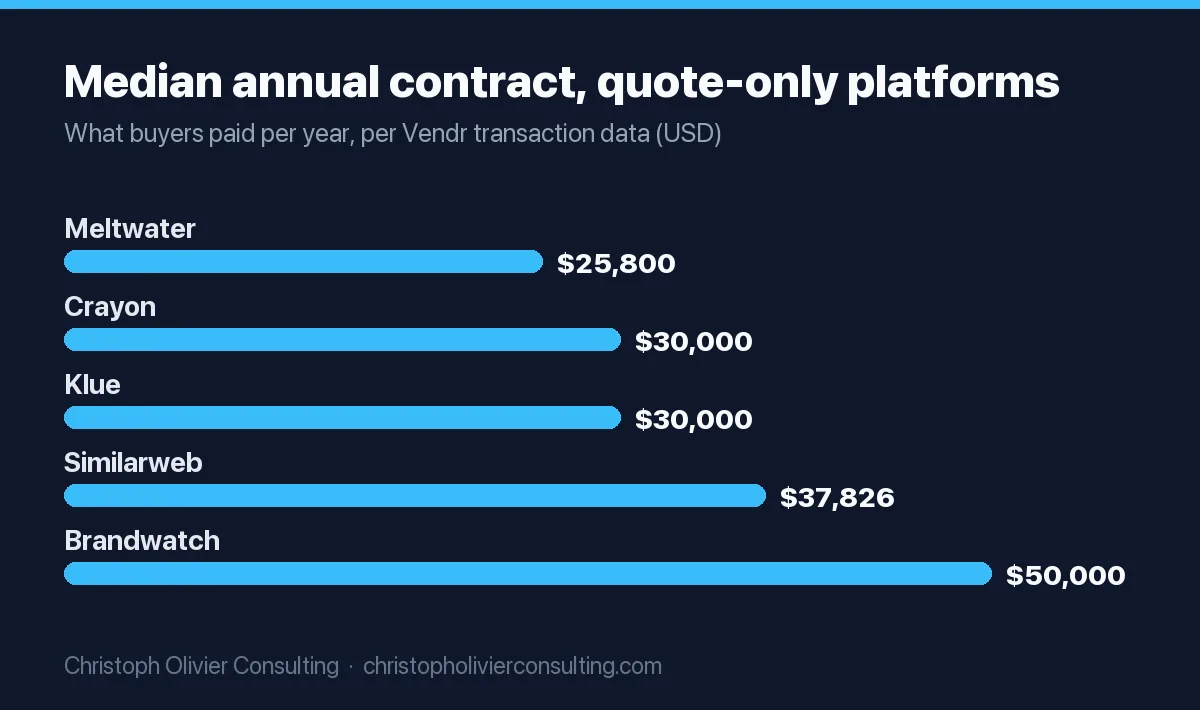
The best marketing intelligence software depends on which of four jobs you are buying it for: estimating competitors’ web traffic (Similarweb, Semrush Traffic & Market), tracking competitors’ search keywords and Google Ads (SpyFu), arming a sales team with competitor battlecards (Crayon, Klue, Kompyte), or listening to what people say about a brand (Brandwatch, Meltwater, Sprout Social, Brand24). Verified self-serve prices start at $39 a month for SpyFu Basic, $199 a month for Similarweb billed monthly and $289 a month for Semrush Traffic & Market. The enterprise platforms are quote only, and buyer data from Vendr puts their median contracts between $25,800 and $50,000 a year.
This page compares 11 tools by what they actually measure, lists every price we could confirm on the vendor’s own page, shows how far off the traffic numbers can be, and works through the ROI math so you can decide whether any of it is worth paying for.
Want a specialist to build this for your business? See how CO Consulting’s marketing services work, starting with a diagnostic and audit.
Best marketing intelligence software compared: what each tool actually measures
Most “best of” lists rank these tools against each other as if they did the same thing. They do not. A traffic estimator, a battlecard platform and a social listening tool answer different questions from different data. Pick the job first, then the tool.
| Tool | Job | What it actually measures | Verified starting price | Watch out for |
|---|---|---|---|---|
| Similarweb | Competitor traffic and market share | Estimated visits, traffic sources and audience for any domain, built on what Similarweb calls real user data | $199/month billed monthly (Competitive Intelligence, 1 user, 3 months of history); advertises plans “from $125/mo” | Entry plans are a worldwide view with no country filter; 37 months of history is an enterprise feature |
| Semrush Traffic & Market | Competitor traffic and market share | Traffic Analytics, channel split (including AI traffic, paid social, email, display), top pages, market overview, competitor monitoring | $289/month for Pro, 1 user seat, 3,000 requests a day | Sold separately from Semrush SEO plans; team seats and API access need a custom plan |
| SpyFu | Search keyword and ad intelligence | The keywords competitors rank for and buy on Google, for SEO and Google Ads research | Basic $39/month; SpyFu advertises membership from $33 a month | Built around Google search only; no social listening or sales enablement |
| Crayon | Competitive enablement for sales | Competitor monitoring with AI importance scoring, news summaries, battlecards inside Salesforce, Slack and Highspot, win/loss analysis | Quote only; Vendr median $30,000/year | Vendr reports pricing scales with the number of competitors you track and seats |
| Klue | Competitive enablement plus win-loss | Competitive intel and win-loss programs in one platform, with an AI assistant that cites its sources | Quote only; Vendr median $30,000/year | No public pricing page; the pricing URL lands on the homepage demo form |
| Kompyte | Competitive enablement for sales | Competitor updates across websites and other sources, battlecards, win/loss reporting; Essentials tracks 10 companies, Professional 20, Unlimited no cap | Quote only (plans page lists features, no prices) | Now a Semrush product; the site footer reads Semrush Inc |
| Brandwatch | Consumer intelligence and social listening | Online and social conversation, sold as Consumer Intelligence, Social Media Management and Influencer suites | Quote only (demo); Vendr median $50,000/year | Highest median contract of the tools here |
| Meltwater | Media monitoring and social listening | Media monitoring, social listening, GenAI Lens LLM tracking, influencer marketing | Quote only; Vendr median $25,800/year | No self-serve free trial, only a guided demo |
| Sprout Social Listening | Social listening as an add-on | Topics, sentiment scoring and spike alerts on social conversation, inside Sprout’s publishing platform | Base plans $199, $299 or $399 per seat/month billed annually; Listening is an add-on priced through a demo | You pay for a base seat before the listening add-on |
| Brand24 | Self-serve brand monitoring | Mentions of the keywords you track; sources it lists include news, blogs, reviews, newsletters and podcasts | $199/month billed annually (Individual: 3 keywords, 2,000 mentions a month) | Plans cap keywords and mentions; Individual updates every 12 hours |
| Supermetrics | Unifying your own marketing data | Pulls your ad, analytics and CRM data into Sheets, Data Studio (formerly Looker Studio), Power BI or a warehouse | From $39/month (Supermetrics’ own June 2026 comparison) | Tells you nothing about competitors; it is the reporting side of the category |
If your real question is how competitors win in Google, our comparison of SEO competitive analysis tools goes deeper on Ahrefs and Semrush for that one job.
Marketing intelligence software cost: published prices vs what buyers pay
There are two price worlds. Self-serve tools publish prices between $39 and $649 a month. The enterprise platforms publish nothing, so the best public evidence is Vendr, a software purchasing marketplace that shows what its buyers paid.
Published self-serve prices (October 2026)
| Plan | Billed monthly | Billed annually | What you get |
|---|---|---|---|
| SpyFu Basic | $39/month | Advertised from $33/month | Google keyword and ad research |
| Similarweb Competitive Intelligence | $199/month | Lower annual rate; site says “from $125/mo” | 1 user, 3 months of history |
| Similarweb Competitive Intelligence & SEO | $399/month | Lower annual rate, not shown in USD | 1 user, 6 months of history |
| Similarweb Competitive Intelligence, SEO & Ads | $649/month | Lower annual rate, not shown in USD | 1 user, 6 months of history |
| Semrush Traffic & Market Pro | $289/month | Shown only in EUR from our location | 1 seat, 3,000 requests a day |
| Brand24 Individual / Team / Pro / Business | $249 / $349 / $499 / $699 | $199 / $299 / $399 / $599 a month | 3 / 7 / 12 / 25 keywords; 2K / 10K / 40K / 100K mentions a month |
| Brand24 Enterprise | Not offered | From $1,499/month | Custom keyword and mention limits |
| Sprout Social Standard / Professional / Advanced | See vendor | $199 / $299 / $399 per seat a month | Listening is an extra add-on |
Annual billing matters more than most buyers expect. Brand24 Individual costs $249 billed monthly or $199 a month billed annually, a 20% cut for committing. Similarweb shows the same pattern: each self-serve plan is quoted as “per month billed annually or $199 per month.”
What buyers actually pay for quote-only platforms
| Platform | Median annual contract | Range Vendr shows | Purchases in Vendr’s data |
|---|---|---|---|
| Meltwater | $25,800 | $5,375 to $56,993 | 126 |
| Crayon | $30,000 | $12,700 to $46,000 | 93 |
| Klue | $30,000 | $16,000 to $60,000 | 108 |
| Similarweb | $37,826 | $14,340 to $94,500 | 158 |
| Brandwatch | $50,000 | $19,542 to $81,200 | 40 |
What moves the quote: Meltwater’s own pricing FAQ names the breadth of sources and regions, data volume, number of users, integrations, onboarding and contract terms. Vendr says Crayon prices on competitors tracked, seats, tier and term, and that tracking 5 to 10 competitors costs much less than 25 to 50. Buyers in Vendr’s data negotiated 12% to 20% off on average, so the first quote is rarely the last.
How accurate is marketing intelligence data?
Every traffic number in these tools is an estimate. The largest public test is SparkToro’s 2022 study, which compared 12 months of Google Analytics data (June 2020 to June 2021) from 641 websites against Semrush, Datos, Similarweb and Ahrefs. Its findings:
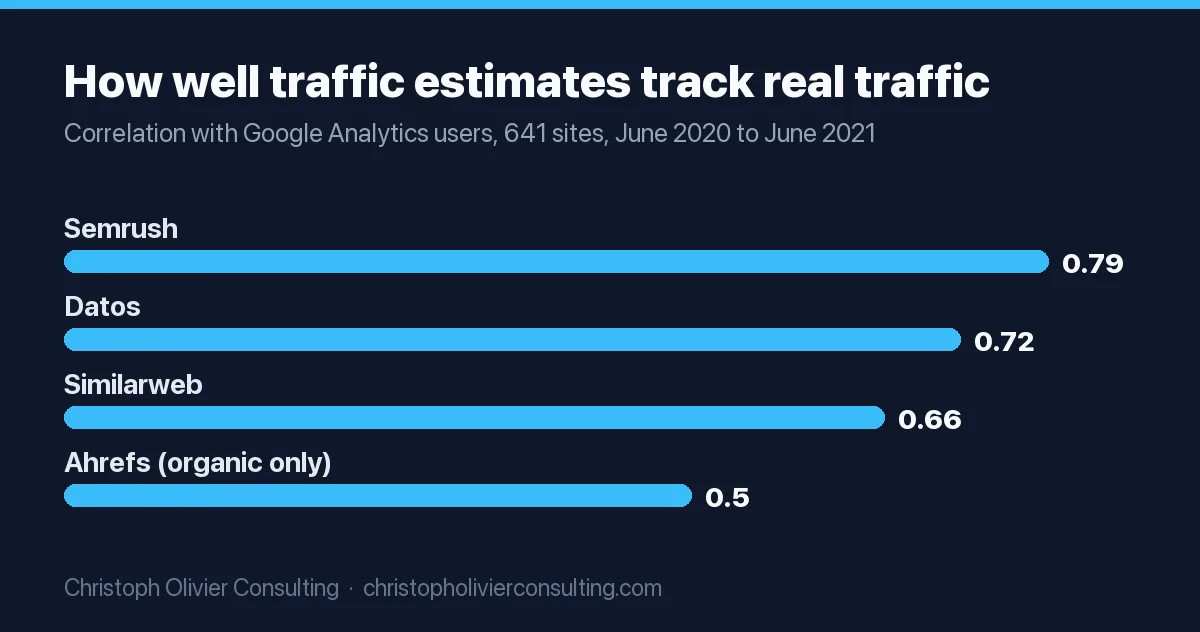
- Correlation with real traffic: Semrush 0.790, Datos 0.720, Similarweb 0.659 and Ahrefs 0.504. Ahrefs only estimates organic search traffic, so that comparison is unfair to it.
- Hit rate: for larger sites, Similarweb landed within plus or minus 30% of the real number about 63% of the time, the best of the group.
- Small sites are the weak spot: Similarweb’s estimates for sites under 5,000 monthly users were the worst of the four providers.
- Error size: maximum misses were often 100% or more, meaning a tool could report 50,000 visits for a site that really got 5,000 or 100,000.
- Google Trends is not a traffic proxy: branded search interest correlated poorly with actual traffic.
An older, smaller Screaming Frog test of 25 UK sites (2016 data) found the same small-site problem: for the three sites under 10,000 organic visits a month, almost every estimate from Similarweb, Ahrefs and Semrush was at least 40% wrong.
This matters for professional-service firms in particular. Your competitors are often local or niche firms with a few thousand visits a month, exactly the size where estimates are least reliable. Use traffic tools for direction and rank order (is this competitor growing, which channel do they lean on), not for budget math. When the decision depends on your own numbers, get them from your own analytics, set up properly. Our GA4 setup guide covers the mistakes that make internal data just as unreliable.
Is marketing intelligence software worth it? A worked ROI example
It is worth it when the time it saves plus the profit from decisions it changes is larger than its annual cost. Here is that math with real prices and labeled assumptions. Replace the assumptions with your own numbers.
| Line | Self-serve: Semrush Traffic & Market | Enterprise: Crayon at Vendr median |
|---|---|---|
| Annual tool cost | 12 x $289 = $3,468 | $30,000 |
| Manual research it replaces (assumption) | 3 hours a week x 48 weeks = 144 hours | 8 hours a week x 48 weeks = 384 hours |
| Share of that time the tool saves (assumption) | 50% = 72 hours | 50% = 192 hours |
| Value of time saved at $37.87/hour | 72 x $37.87 = $2,727 | 192 x $37.87 = $7,271 |
| Gap the tool must close with better decisions | $3,468 minus $2,727 = $741 | $30,000 minus $7,271 = $22,729 |
| Gross profit per new client (assumption: $15,000 fee at 40% margin) | $6,000 | $6,000 |
| Extra clients needed per year to break even | $741 / $6,000 = 0.12 (one client every 8 years) | $22,729 / $6,000 = 3.8, so 4 clients |
The hourly rate is the May 2025 median wage for market research analysts from the US Bureau of Labor Statistics: $78,760 a year, or $37.87 an hour, before benefits. Using your own loaded cost will push the time value up.
Read the result this way. The self-serve tool pays for itself if it changes one meaningful decision in several years, which is a low bar. The enterprise platform needs about four extra won clients a year that you can trace to competitor intel, and that is before counting the person who has to run it. My rule of thumb: if break-even needs more than one traceable extra client per quarter, start with a self-serve tool and upgrade only when your sales team is losing named deals to named competitors every month. If you want a second opinion on where your next dollar should go, that is a good use of a strategy consultation. For the wider method, see how to calculate and defend marketing ROI.
Which marketing intelligence software to buy, by use case and budget
| Your question | Budget | Start with | Why |
|---|---|---|---|
| What keywords and Google Ads are competitors paying for? | Under $50/month | SpyFu Basic plus the free Google Ads Transparency Center | Cheapest verified plan; covers Google search keywords and ads |
| Is this competitor growing, and from which channels? | $199 to $289/month | Semrush Traffic & Market or Similarweb Competitive Intelligence | Semrush correlated best with real traffic in SparkToro’s test; Similarweb was best within 30% on larger sites but cannot filter by country on entry plans |
| What are people saying about us online? | $199 to $599/month | Brand24 | Published prices, unlimited users from the Team plan up |
| We already publish with Sprout Social | Add-on quote | Sprout Social Listening | Sits on top of the seats you already pay for |
| Our PR team needs press and media coverage tracking | About $25,800/year median | Meltwater | Media monitoring is the first module it lists; also tracks LLM mentions with GenAI Lens |
| Our reps keep losing deals to the same competitors | About $30,000/year median | Klue, Crayon or Kompyte | Battlecards in the CRM and Slack, plus win/loss data; run each demo on your own competitor list |
| Enterprise consumer research across social conversation | About $50,000/year median | Brandwatch | Consumer Intelligence suite for large-scale social research; highest median contract here |
| We cannot tell which of our own channels produce clients | From $39/month | Not a market intelligence tool. Fix tracking, then unify data with a connector like Supermetrics | This is a reporting and attribution problem |
If that last row describes you, our guides to attribution models and marketing reporting tools will help more than any competitor feed.
What is a marketing intelligence platform, and how does it differ from a basic reporting tool?
Marketing intelligence software collects data about your market, not just about you: competitors’ traffic and channels, the keywords and ads they pay for, how they position against you in deals, and what customers say about everyone in public. A basic reporting tool only reorganizes data you already own, such as your ad accounts, analytics and CRM.
The simplest test: can the tool tell you something true about a company that is not yours? Similarweb, Semrush Traffic & Market, SpyFu, Crayon and Brandwatch can. Supermetrics feeding a Data Studio dashboard cannot, because it only moves your own numbers. Both are useful. They solve different problems, and vendors often sell one under the other’s name.
| Basic reporting tool | Marketing intelligence platform | |
|---|---|---|
| Whose data | Yours: ad platforms, GA4, CRM | The market’s: competitors, media, social conversation |
| Typical question | What did our campaigns produce last month? | Who is winning share, and how? |
| Data quality | Exact, if tracking is set up correctly | Modeled estimates, often off by 30% or more |
| Example | Supermetrics into Data Studio | Similarweb, Semrush Traffic & Market, Klue |
| Typical entry cost | From $39/month | $39/month to $50,000/year |
A “marketing intelligence suite” is simply several of these modules bundled. Similarweb, for example, packages its Web Intelligence product as a Competitive Intel Suite, a Strategic SEO Suite, an Ads Intel Suite and a Gen AI Intel Suite. Buy the module that answers your question, not the full suite.
Run the free version first
Before paying, spend one afternoon with the free sources. They cover more of the job than most buyers expect.
- Google Ads Transparency Center: launched March 29, 2023, it lets anyone search ads from verified advertisers on Search, YouTube and Display, by advertiser and region, with each ad’s format and the last date it ran.
- LinkedIn Ad Library: search by company or advertiser, payer, keyword and country. It only returns ads created in roughly the last 12 months (the date filter currently starts at October 30, 2025).
- Free trials: Semrush offers a 7-day Traffic & Market trial, Sprout Social a 30-day trial with no credit card, and Similarweb a free trial on its self-service plans.
Our list of online market research tools covers the survey and audience side of market research, which none of the tools above do well.
What to look for when choosing a marketing intelligence tool for your team: a pass/fail trial script
Run this during the free trial or the demo. Any fail on steps 1 to 3 means the data will not support your decisions.
- Calibration test. Enter your own domain and compare the tool’s monthly visits with your GA4 users for the same three months. Pass: within plus or minus 30%, the benchmark SparkToro used. Fail: off by more than that, because competitor numbers will be at least as wrong.
- Small competitor test. Enter your three closest competitors. Pass: the tool returns monthly data for all three. Fail: “no data” or flat lines, which is common for sites under 5,000 visits a month.
- Geography test. Filter to the country or region you sell in. Pass: the filter exists on the plan you will buy. Fail: worldwide view only, which is how Similarweb’s entry plans work.
- History test. Pass: at least 12 months of history so you can see seasonality. Similarweb self-serve plans include 3 or 6 months; 37 months is an enterprise feature.
- Seat test. Count who will log in weekly. Semrush Traffic & Market Pro includes 1 seat, Sprout Social bills per seat, and Brand24 includes unlimited users from the Team plan up. Price the plan for your real headcount.
- Decision test. Write down the one decision this tool will change in the next 90 days, such as “move $2,000 a month from LinkedIn to Google Ads if competitor X is winning there.” If you cannot write it, do not buy yet.
- Exit test. Ask for the term in writing. Enterprise deals are annual by default, and Vendr reports multi-year terms are often how buyers win lower prices, which also means more lock-in.
If the tool passes, document what you learn in a repeatable format. Our competitive analysis template turns raw competitor data into the positioning and channel decisions the software alone will not make for you.
Work with CO Consulting
Want this done for your business?
- A diagnostic call and an audit of your current marketing and numbers
- A prioritized 90-day plan built for your market
- Execution across SEO and AI search, paid ads, content, funnels and automation
- Weekly check-ins and monthly reporting, led by a fractional CMO
Frequently asked questions
What is the best marketing intelligence software?
It depends on the job. For competitor traffic, Semrush Traffic & Market ($289 a month) or Similarweb ($199 a month billed monthly). For Google keyword and ad intel, SpyFu from $39 a month. For sales battlecards, Klue, Crayon or Kompyte, quote only with Vendr medians near $30,000 a year. For social listening, Brand24 from $199 a month or Brandwatch and Meltwater on enterprise contracts.
How much does marketing intelligence software cost?
Self-serve plans run from $39 a month (SpyFu Basic) to $649 a month (Similarweb's top self-serve plan billed monthly). Quote-only platforms cost far more: Vendr buyer data shows median annual contracts of $25,800 for Meltwater, $30,000 for Crayon and Klue, $37,826 for Similarweb and $50,000 for Brandwatch. Annual billing usually lowers the monthly rate, by 20% on Brand24.
Is marketing intelligence software worth it?
It is worth it when the research time it saves plus the profit from decisions it changes exceeds its cost. A $289 a month tool that saves 72 hours a year covers about 79% of its cost on time alone. A $30,000 a year enterprise platform typically needs about four extra won clients a year that you can trace to its intel. Start self-serve unless you lose named deals to named competitors every month.
How accurate is marketing intelligence software?
Traffic figures are estimates. SparkToro's study of 641 sites found Similarweb within 30% of real traffic about 63% of the time for larger sites, and correlations with Google Analytics between 0.50 and 0.79 across four providers. Small sites under 5,000 monthly users were estimated worst. Use the numbers for trends and rank order, not exact budgets.
What is the difference between marketing intelligence and a reporting tool?
A reporting tool reorganizes data you own, such as ad accounts, GA4 and your CRM, into dashboards. Marketing intelligence adds data about the market you do not own: competitors' traffic, their ads and keywords, how they position in deals and what people say about them. A quick test is whether the tool can tell you something true about another company.
What should I look for when choosing a marketing intelligence tool for my team?
Check five things during the trial: the tool's estimate of your own traffic is within 30% of your GA4 numbers, it returns data for your smallest competitors, it filters to your country, it has at least 12 months of history, and its seat count fits the people who will use it. Then write down the one decision it will change in the next 90 days.
More Growth, Strategy & Sales guides
- 12 Marketing Strategy Frameworks Compared
- How to Build a Marketing Technology Stack
- Martial Arts School Marketing: A Playbook to Fill Mats and Keep Students
- Med Spa Marketing: How to Attract and Keep Clients in 2026
- Media Buying: A Practical Guide to Programmatic, Direct, Models, and Fraud
- Mortgage Marketing: A Loan Officer’s Playbook for Funded Loans
- All Growth, Strategy & Sales guides →