
Anheuser-Busch InBev spent $7,374 million on sales and marketing in 2025, about 12.4% of its $59,320 million revenue, according to its 2025 Form 20-F. Heineken reported €2,855 million of marketing and selling expenses for 2025, which it puts at 9.9% of net revenue. Molson Coors says its marketing and advertising ran at about $1.1 billion a year in 2023, 2024 and 2025. None of the three breaks spend out by brand, so there is no official Bud Light, Budweiser or Heineken-brand budget.
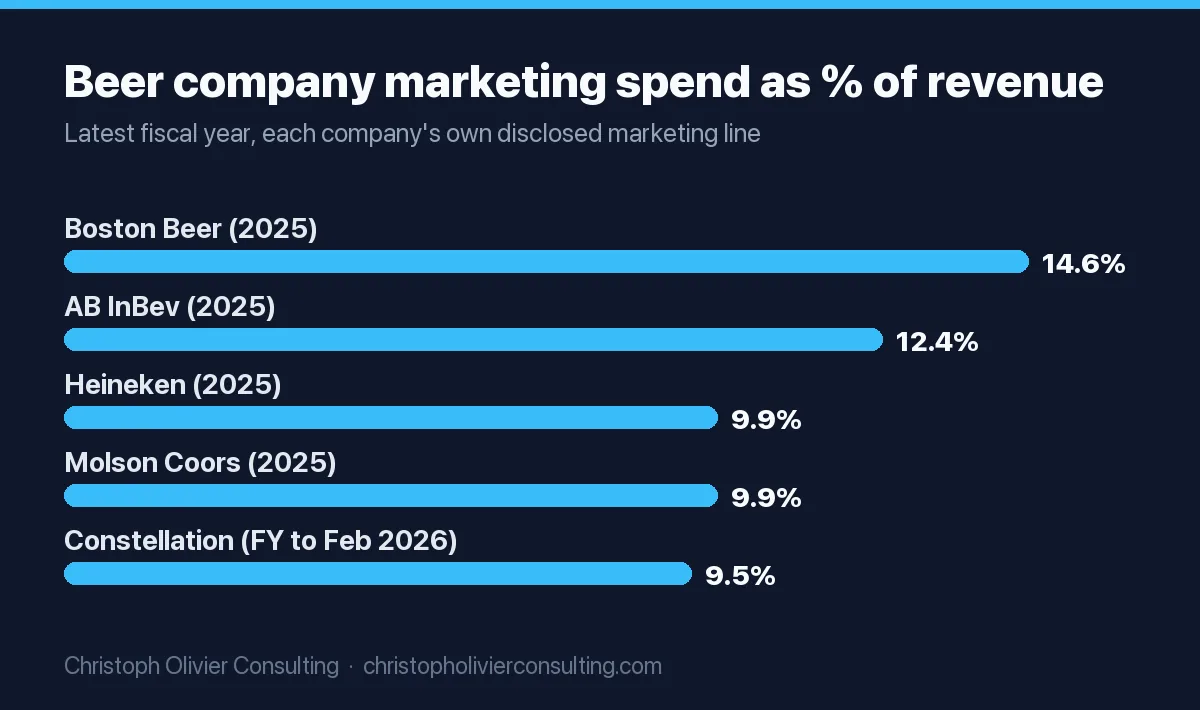
Short answer: AB InBev: $7.37 billion of sales and marketing expenses (2025, 12.4% of revenue). Heineken: €2.86 billion of marketing and selling expenses (2025, 9.9%). Molson Coors: about $1.1 billion (2025, about 9.9%). Constellation Brands (Modelo, Corona in the US): $867.4 million (fiscal year to February 2026, 9.5%). Boston Beer: $286.2 million of advertising and sales promotion (2025, 14.6%). Bud Light’s own budget is not disclosed.
Every figure below comes from the company’s own annual filing or results release, read in November 2026. Each row keeps the company’s exact line-item name, because “marketing budget” means something different in each filing. AB InBev’s line includes sales costs; Boston Beer’s narrower number is advertising and promotion only.
Beer marketing budgets compared (latest fiscal year)
Spend and revenue in each row come from the same filing. Percentages marked “calculated” are my own math with one formula: disclosed spend ÷ revenue in the same filing × 100. Worked example for AB InBev 2025: $7,374 million ÷ $59,320 million × 100 = 12.4%.
| Company (brands people search) | Exact line item | Fiscal year end | Spend (reported) | Revenue (same filing) | % of revenue | Source |
|---|---|---|---|---|---|---|
| Anheuser-Busch InBev (Budweiser, Bud Light, Michelob Ultra, Stella Artois, Corona outside the US) | “Sales and marketing expenses” | Dec 31, 2025 | $7,374 million | $59,320 million | 12.4% (calculated) | AB InBev 20-F, 2025 |
| Heineken (Heineken, Amstel, Birra Moretti, Tiger) | “Marketing and selling expenses” | Dec 31, 2025 | €2,855 million reported; €2,849 million on Heineken’s adjusted (beia) basis | €28,753 million net revenue | 9.9% (company-stated, beia) | Heineken FY2025 results |
| Molson Coors (Coors Light, Miller Lite, Blue Moon) | “Total marketing and advertising expenses, excluding depreciation and amortization” | Dec 31, 2025 | About $1.1 billion | $11,140.8 million net sales | About 9.9% (calculated from a rounded figure) | Molson Coors 10-K, 2025 |
| Constellation Brands (Modelo, Corona, Pacifico in the US) | “Marketing expense” (company-wide, beer plus wine and spirits) | Feb 28, 2026 | $867.4 million | $9,139.0 million net sales | 9.5% (calculated) | Constellation 10-K, FY2026 |
| Boston Beer (Samuel Adams, Twisted Tea, Truly) | “Total advertising and sales promotional expenditures” | Dec 27, 2025 | $286.2 million | $1,965.0 million net revenue | 14.6% (calculated) | Boston Beer 10-K, 2025 |
| Bud Light (brand only) | Not broken out | n/a | Not disclosed | n/a | n/a | AB InBev reports at company and region level only |
Two cautions before you compare rows. First, currencies differ: Heineken reports in euros, and I have not converted them. Second, the line items are not the same thing. AB InBev’s “sales and marketing” also carries amortization of multi-year sponsorship rights and distribution rights, per the accounting notes in its 20-F. Heineken’s figure includes selling costs. Boston Beer’s $286.2 million is the narrow advertising-and-promotion slice of a bigger $610.0 million line. The percentages are the fairest comparison you can make from public filings.
Anheuser-Busch marketing budget: $7.37 billion in sales and marketing (2025)
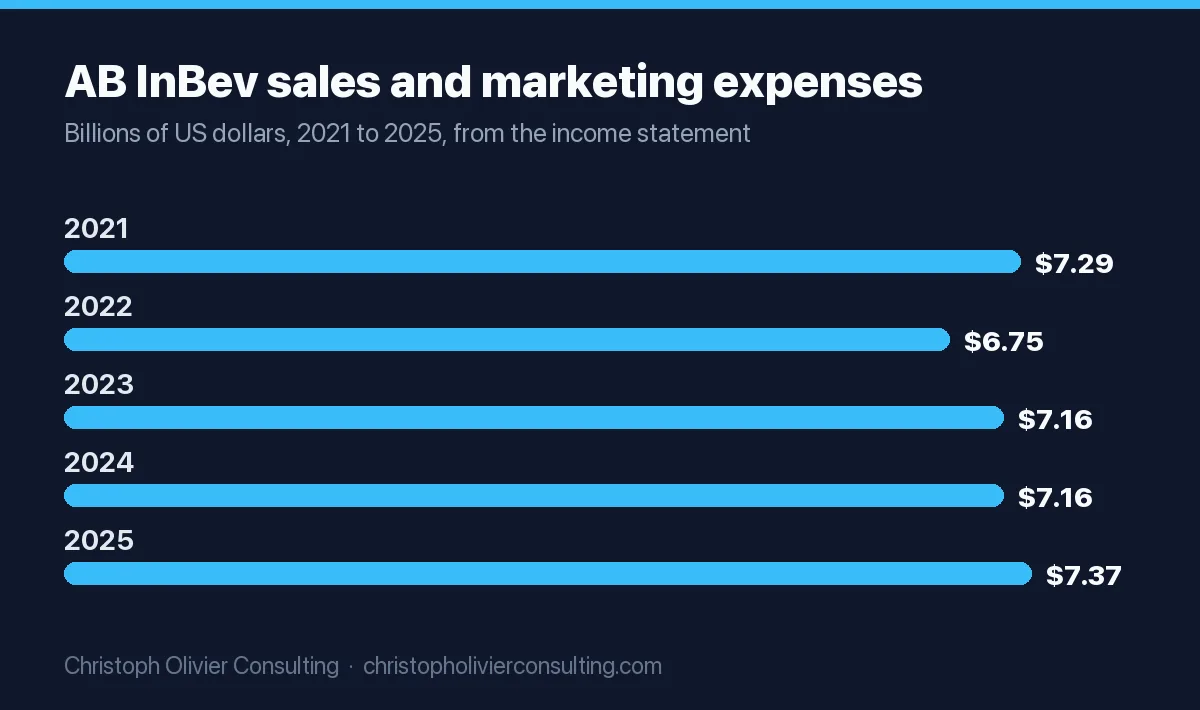
AB InBev is the parent of Anheuser-Busch. It files a 20-F with the SEC rather than a 10-K, and the income statement in its 2025 20-F shows sales and marketing expenses of $7,374 million in 2025, $7,156 million in 2024 and $7,158 million in 2023. That is a 3.0% rise in 2025 (calculated). The company says its selling, general and administrative costs rose 0.7% on an organic basis “as we increased our sales and marketing investments.”
The 20-F does not publish a separate “advertising” dollar figure. It only states the policy that “research, advertising and promotional costs are expensed in the year in which these costs are incurred.” So when someone asks for the Anheuser-Busch advertising budget, the closest official number is the $7.37 billion sales and marketing line, which is broader than advertising.
AB InBev sales and marketing spend, 2021 to 2025
| Year | Sales and marketing expenses | Revenue | % of revenue (calculated) | Source |
|---|---|---|---|---|
| 2025 | $7,374 million | $59,320 million | 12.4% | 20-F 2025 |
| 2024 | $7,156 million | $59,768 million | 12.0% | 20-F 2025 |
| 2023 | $7,158 million | $59,380 million | 12.1% | 20-F 2025 |
| 2022 | $6,752 million | $57,786 million | 11.7% | 20-F 2023 |
| 2021 | $7,292 million | $54,304 million | 13.4% | 20-F 2023 |
The pattern is steady: roughly 12 cents of every revenue dollar goes to sales and marketing, every year. The spend also follows the company’s brand bets. The 2025 20-F says it is “allocating increased sales and marketing investments” behind its “megabrands,” and that 20 of its brands each had an estimated turnover above $1 billion in 2025.
Why ad trackers show a much smaller Anheuser-Busch number
If you have seen a figure like “under $100 million,” it comes from a media tracker. MediaRadar’s profile says AB InBev “spent under $100 million on advertising in digital, print, and national TV in the last year.” That counts only the ads the tracker can see in those channels. It leaves out sponsorships, local and in-store marketing, sales teams and non-US markets, all of which sit inside the 20-F line. Neither number is wrong. They measure different things, and only the filing covers the whole company.
Where the US money sits
AB InBev does not split sales and marketing by country. The nearest view is its North America segment, which reported $4,407 million of combined distribution, sales and marketing, and administrative expenses in 2025, against $14,207 million of North America revenue (both from the 2025 20-F). That combined figure is not a marketing budget, so do not quote it as one.
Bud Light advertising budget: not disclosed, and what AB InBev did say
There is no official Bud Light advertising budget. AB InBev reports spend at the group level only, and its filings list Bud Light among its “local champions” without any brand-level spend. What the company has said on the record after the April 2023 backlash is below. Each line is from its own filings or results, apart from the May 2023 earnings-call remarks, which come from the Associated Press report of that call.
| Date | What the company said or reported | Source |
|---|---|---|
| May 4, 2023 (Q1 call) | CEO Michel Doukeris said the company would triple its US marketing spending that summer and that Bud Light’s US sales decline in the first three weeks of April was about 1% of global volumes. He did not say how much the company was spending to support wholesalers. | AP via SHOOT |
| Aug 3, 2023 (Q2 results) | US revenue fell 10.5%; sales to retailers fell 14.0%, “primarily due to the volume decline of Bud Light.” US EBITDA fell 28.2%, partly from “increased sales and marketing investments and support measures for our wholesaler partners.” Group-wide, AB InBev invested about $3.5 billion in sales and marketing in the first half, up 12.8%. | Q2 2023 release (6-K) |
| Full year 2023 | North America volumes fell 12.2% and revenue fell 9.0%, from $16,566 million to $15,072 million. The 20-F states that “in 2023, sales of Bud Light declined in the U.S. as a result of negative publicity.” | 20-F 2023 |
| Full year 2025 | North America revenue was $14,207 million, down 3.1% from $14,655 million in 2024. | 20-F 2025 |
| Q3 2026 | US revenue fell 1.2% in the quarter and rose 0.8% for the first nine months. US EBITDA fell 4.0%, “reflecting increased investment in sales and marketing.” Michelob Ultra and Busch Light were named the top two volume share gainers. | Q3 2026 release (6-K) |
How much money did Bud Light lose from the boycott?
AB InBev has never published a dollar loss for Bud Light. The closest official numbers are segment-level: North America revenue fell by $1,494 million in 2023 (calculated: $16,566 million minus $15,072 million), and second-quarter 2023 US revenue fell 10.5%. Those totals include every brand the company sells in the US and Canada, plus price and mix effects, so they are an upper boundary on the region, not a Bud Light figure. Bigger figures in headlines, such as “$27 billion,” are not company disclosures; check whether they describe lost sales or a fall in market value before you repeat them.
Is Bud Light still struggling in 2026, and did it recover?
The company does not report Bud Light sales on their own. What its Q3 2026 release shows is a US business that is roughly flat (revenue down 1.2% in the quarter, up 0.8% for nine months) and gaining total-alcohol share, with growth credited to Michelob Ultra, Busch Light, Cutwater and Nutrl. Bud Light is not named among the growth drivers. North America revenue in 2025 ($14,207 million) was still below 2022 ($16,566 million), though the two figures come from different annual filings and the segment is restated from time to time.
Heineken marketing budget: €2.86 billion, 9.9% of net revenue (2025)
Heineken N.V. reported marketing and selling expenses of €2,855 million in 2025, down from €2,940 million in 2024. The company says the reported drop was “due to the impact of currency translation.” On its adjusted (beia) basis, spend was €2,849 million and rose to 9.9% of net revenue from 9.8%, per its 2025 full-year results.
Three details from the same release tell you where the money goes:
- Investment was concentrated in priority markets: Brazil, Mexico, the USA, South Africa, Vietnam, the UK and India, with “a meaningful step up in sponsorships and in-trade execution.”
- Spend on 5 global brands and 25 local focus brands “accounted for over 80% of total spend.”
- Heineken is moving most markets onto Freddyai, its AI marketing platform, by the end of 2026, “covering about 80% of global marketing and selling investment.”
How much does Heineken spend on advertising?
Heineken does not publish an advertising-only figure. The €2,855 million marketing and selling line is the official answer, and it includes selling costs as well as media. US-only ad spend figures online come from third-party trackers and are estimates, not company disclosures. Heineken is also not an SEC registrant, so there is no 10-K to search; its numbers are in the annual report and results releases on its investor site.
Molson Coors marketing budget: about $1.1 billion a year (2023 to 2025)
The Molson Coors 2025 10-K states: “Total marketing and advertising expenses, excluding depreciation and amortization costs, were approximately $1.1 billion for each of the years ended December 31, 2025, 2024 and 2023.” On 2025 net sales of $11,140.8 million, that is about 9.9% (calculated from a figure the company rounds to $0.1 billion).
The flat headline hides a small cut. The 10-K explains that marketing, general and administrative expenses fell 2.7% to $2,643.9 million in 2025, “primarily due to lower short-term incentive compensation expense of approximately $70 million and lower marketing investment.” It also says Coors Light and Miller Lite made up about 55% of Americas segment net sales in 2025, so most of the US marketing weight sits behind two brands. The filing defines marketing to include media advertising (TV, radio, digital, print), tactical advertising such as point-of-sale materials, and promotions.
Constellation Brands (Modelo and Corona): $867.4 million in marketing (FY2026)
Constellation owns the US rights to Modelo, Corona and Pacifico. Its 10-K for the year ended February 28, 2026 reports marketing expense of $867.4 million, after $931.2 million the year before and $853.5 million two years before. That is 9.5% of $9,139.0 million net sales (calculated).
The company-wide figure mixes beer with wine and spirits. Constellation does not give a beer-only marketing total in dollars, but it does disclose the direction: beer marketing spend rose $5.9 million while wine and spirits marketing fell $69.7 million, and “marketing as a percent of net sales increased year-over-year to support our high-end imported beer brands.” Beer net sales were $8,315.2 million, so beer is about 91% of the company’s sales (calculated).
Boston Beer (Samuel Adams, Twisted Tea): $286.2 million in advertising and promotion (2025)
Boston Beer is the most transparent filer here. Its 2025 10-K reports total advertising and sales promotional expenditures of $286.2 million in 2025, up from $240.9 million in 2024 and $233.5 million in 2023. That is 14.6% of $1,965.0 million net revenue (calculated), the highest ratio among the US-listed brewers.
The wider “advertising, promotional and selling” line was $610.0 million, which the company puts at 31.0% of net revenue, or $85.43 per barrel. That line includes freight to distributors and sales salaries. The 10-K itemizes the 2025 increase: $27.0 million more media, $10.7 million more local marketing, $7.6 million more production and non-media costs and $5.9 million more point-of-sale. It also says the company “currently estimates it will further increase spending by between $20 million and $40 million” in 2026.
Beer brands vs the average company marketing budget
The big brewers sit above the cross-industry average. Gartner’s 2026 CMO Spend Survey of 401 marketing leaders, most at companies with more than $1 billion in revenue, found marketing budgets at 7.8% of company revenue in 2026, up from 7.7% in 2025. The brewers in the table run from 9.5% to 14.6%. You can see how other sectors compare in our marketing budget benchmarks and the advertising-to-sales ratio by industry data.
For scale outside beer: the highest disclosed figure among big brands is Amazon’s $23.5 billion of “advertising and other promotional costs” in 2025, per its 10-K. Coca-Cola’s annual advertising was $5.4 billion in 2025, per its 10-K. So AB InBev’s sales and marketing line is larger than Coca-Cola’s advertising line, though the two measure different things. The full list is in big brand marketing budgets.
What each beer company’s number actually includes
Use this decoder before you quote any of these figures in a deck. It shows what the official line covers and the right way to describe it.
| Company | Includes media advertising? | Includes sponsorships? | Includes sales teams or selling costs? | Brand-level split? | Say it like this |
|---|---|---|---|---|---|
| AB InBev | Yes | Yes (incl. amortized multi-year rights) | Yes | No | “$7.37B of sales and marketing expenses, 2025 20-F” |
| Heineken | Yes | Yes (named in release) | Yes | No (80%+ on 30 focus brands) | “€2.86B of marketing and selling expenses, 9.9% of net revenue, 2025” |
| Molson Coors | Yes | Not stated | Includes direct selling costs per policy note | No | “About $1.1B of marketing and advertising, excl. D&A, 2025 10-K” |
| Constellation | Yes | Not stated | Not stated | Segment direction only | “$867.4M marketing expense, all segments, FY ended Feb 2026” |
| Boston Beer | Yes | Not stated | Not stated for the $286.2M; yes in the $610.0M line | No | “$286.2M advertising and sales promotion, 2025 10-K” |
Sizing a beer or beverage marketing budget from these ratios
If you run a brewery or beverage brand, the ratios above give you a reality check, not a target. Large brewers spread fixed costs, such as national sponsorships, across billions in sales. A regional brand pays full price for every placement. Here is the math for a hypothetical brand with $5,000,000 in net revenue, using the published ratios:
| Benchmark ratio | Source of ratio | Annual budget on $5M revenue | Monthly |
|---|---|---|---|
| 7.8% | Gartner 2026 cross-industry average | $390,000 | $32,500 |
| 9.5% | Constellation, FY2026 (calculated) | $475,000 | $39,583 |
| 9.9% | Heineken 2025 (company-stated) | $495,000 | $41,250 |
| 12.4% | AB InBev 2025 (calculated) | $620,000 | $51,667 |
| 14.6% | Boston Beer 2025 (calculated) | $730,000 | $60,833 |
Formula: net revenue × ratio = annual budget, then ÷ 12 for monthly. Example: $5,000,000 × 0.124 = $620,000; $620,000 ÷ 12 = $51,667. In my view, a brand launching into new markets belongs nearer the top of that range, and a brand defending a stable local base nearer the bottom. Boston Beer’s own 10-K warns that spend “may not result in increased sales,” so tie each dollar to a measurable goal. The step-by-step method is in how to set a marketing budget, and sponsorship pricing context is in our sports sponsorship statistics.
The ad code every US beer budget has to clear
Beer marketing in the US runs under the Beer Institute’s voluntary Advertising and Marketing Code, last updated January 1, 2026. These rules decide where the money can go, so they shape the budget as much as any ratio. Use this as a pass/fail check on every placement:
- Audience test: pass only if audience data shows at least 73.8% adults of legal drinking age, or the placement is limited in advance to confirmed adults. This applies to TV, radio, print, digital and social media influencer placements.
- Talent test: pass only if models and actors are at least 25 years old with ID, and public figures and influencers are of legal drinking age and do not appeal primarily to people under it.
- Owned channels test: pass only if brand websites and social channels use available age-gating technology.
- Creative test: fail anything that depicts Santa Claus or suggests breaking the laws on sale and consumption.
- Campus test: pass college placements only where college policy allows them, and never portray beer as important to education or degrade studying.
Complaints go to the brewer first, then to an independent Code Compliance Review Board, which publishes its decisions. The full text is in the Code PDF. AB InBev’s 20-F also notes that in some countries television is a prohibited medium for beer advertising, which is one reason group-level spend varies by market. If you want a second opinion on where your own beverage or consumer budget should go, you can book a consultation.
Ready to scale your revenue?
Book a free 30-min consultation. We’ll diagnose your growth bottleneck and map out the 3 highest-leverage moves for your business.
Frequently asked questions
What is Anheuser-Busch's marketing budget?
AB InBev, the parent of Anheuser-Busch, reported sales and marketing expenses of $7,374 million in 2025 in its Form 20-F, up from $7,156 million in 2024. That is about 12.4% of its $59,320 million revenue. The company does not publish a separate advertising-only figure or a US-only marketing budget, so the 20-F line is the official answer.
What is Bud Light's advertising budget?
It is not disclosed. AB InBev reports marketing spend only for the whole group, not by brand. On its May 2023 earnings call the CEO said the company would triple US marketing spending that summer, and its Q2 2023 results cited increased sales and marketing investment and support for wholesalers, but no dollar amount for Bud Light was given.
How much money did Bud Light lose from the boycott?
AB InBev has not published a Bud Light loss figure. Its 2023 Form 20-F shows North America revenue falling 9.0%, from $16,566 million to $15,072 million, and volumes falling 12.2%, and states that Bud Light sales declined in the US because of negative publicity. Those are segment totals covering all brands, not a Bud Light number.
How much does Heineken spend on advertising?
Heineken does not publish an advertising-only number. Its 2025 results report marketing and selling expenses of EUR 2,855 million, or EUR 2,849 million on its adjusted basis, which it says equals 9.9% of net revenue. Over 80% of that spend went to 5 global and 25 local focus brands, with a step up in sponsorships and in-trade execution.
What is Molson Coors' marketing budget?
Molson Coors' 2025 10-K says total marketing and advertising expenses, excluding depreciation and amortization, were approximately $1.1 billion in each of 2025, 2024 and 2023. On 2025 net sales of $11,140.8 million that is about 9.9%. The filing also notes lower marketing investment in 2025 as one reason overhead costs fell 2.7%.
What company has the highest marketing budget?
Among companies that disclose a figure, Amazon is the largest: $23.5 billion of advertising and other promotional costs in 2025, per its 10-K. Coca-Cola reported $5.4 billion of advertising costs in 2025. In beer, AB InBev's $7.37 billion sales and marketing line is the largest, though it also includes sales costs, so it is not directly comparable.
What is the average marketing budget for a company?
Gartner's 2026 CMO Spend Survey of 401 marketing leaders, mostly at companies with over $1 billion in revenue, put average marketing budgets at 7.8% of company revenue, up from 7.7% in 2025. The large brewers sit above that: from about 9.5% at Constellation Brands to 14.6% at Boston Beer, based on their latest filings.
What big companies spend on marketing