
An advertising manager plans, directs, and controls the paid campaigns that put a company in front of buyers. The role owns campaign strategy, budgets, creative approval, media coordination, and the reporting that proves what the spend returned. This is a management job, not a software tool.
Last reviewed: September 2026
One quick clarification: “advertising manager” is a job title held by a person, while “Ads Manager” (or Meta Ads Manager) is Meta’s software for running Facebook and Instagram campaigns. This guide covers the human role, its responsibilities, skills, pay, and how it differs from adjacent titles.
What does an advertising manager do?
An advertising manager runs a company’s paid promotion end to end. They translate business goals into campaign objectives, set and pace budgets across channels, brief and approve creative, coordinate media placements, and measure results against targets. In smaller companies one person carries all of this; in larger ones the manager leads a team of specialists.
The output is a working advertising program: campaigns that launch on time, spend within budget, and report performance a leadership team can act on. The manager is accountable for the numbers, not just the ideas.
Advertising manager responsibilities day to day
The core responsibilities cluster around planning, spending, creative, and measurement. A typical week moves through most of the list below rather than a single lane, and the balance shifts with campaign timing.
- Campaign planning: turn a brief into objectives, audience definitions, channel mix, and a timeline.
- Budget management: allocate spend across channels, pace it through the flight, and reallocate toward what performs.
- Creative direction and approval: brief designers and copywriters, then review and sign off on ads before they run.
- Media coordination: work with media planners or buyers to secure placements, or negotiate contracts and rates directly.
- Market and competitor research: confirm who the audience is and how rivals are positioning their offers.
- Performance analysis: track cost per result, return on ad spend, and conversions, then report findings to stakeholders.
- Team and vendor management: supervise in-house staff and manage outside agencies or freelancers.
For a related management role and a reusable structure you can adapt, see this marketing manager job description template.
Skills an advertising manager needs
The job rewards people who pair creative judgment with numeric discipline. An advertising manager has to read a campaign report, decide what to cut, and defend the call, all while keeping creative quality high and deadlines intact.
The skills that matter most in practice:
- Channel fluency: working knowledge of Google Ads, Meta, and increasingly retail media and connected TV, plus how each measures results.
- Data analysis: comfort with metrics like cost per acquisition, click-through rate, and return on ad spend, and the judgment to act on them.
- Budgeting: allocating and pacing spend so money follows performance.
- Creative direction: giving briefs that produce on-message work and editing without micromanaging.
- Communication and negotiation: aligning stakeholders, briefing teams, and negotiating rates with vendors.
- Project management: keeping several campaigns moving without missing launch dates.
Search visibility now depends partly on how AI engines summarize a brand, so understanding how to rank on AI is becoming part of the modern advertising manager’s toolkit.
Advertising manager vs marketing manager vs media buyer
These three titles overlap, which is why job postings blur them. The clean distinction is scope: a marketing manager owns the whole marketing strategy, an advertising manager owns paid campaigns inside it, and a media buyer executes the purchasing of ad space. The table below sets them side by side.
| Dimension | Marketing manager | Advertising manager | Media buyer |
|---|---|---|---|
| Primary focus | Overall marketing strategy and brand | Paid advertising campaigns | Purchasing ad inventory and placements |
| Scope | Broadest: product, content, PR, ads | Advertising program specifically | Narrowest: placement and price |
| Owns the budget? | Total marketing budget | Advertising budget | Spends within the plan given |
| Key output | Strategy and departmental goals | Campaigns that hit targets | Cost-efficient placements |
| Reports to | CMO or founder | Marketing manager or CMO | Advertising or media manager |
In small businesses these roles often collapse into one hire or one contractor. For owners weighing where to spend limited budget first, this guide to the best advertising for small businesses covers the practical trade-offs.
How much does an advertising manager earn?
Pay for advertising managers is wide, and it depends on company size, city, and industry. The U.S. Bureau of Labor Statistics groups advertising and promotions managers together and reported a median annual wage of $133,660 in May 2025. The range around that median is what tells the real story.
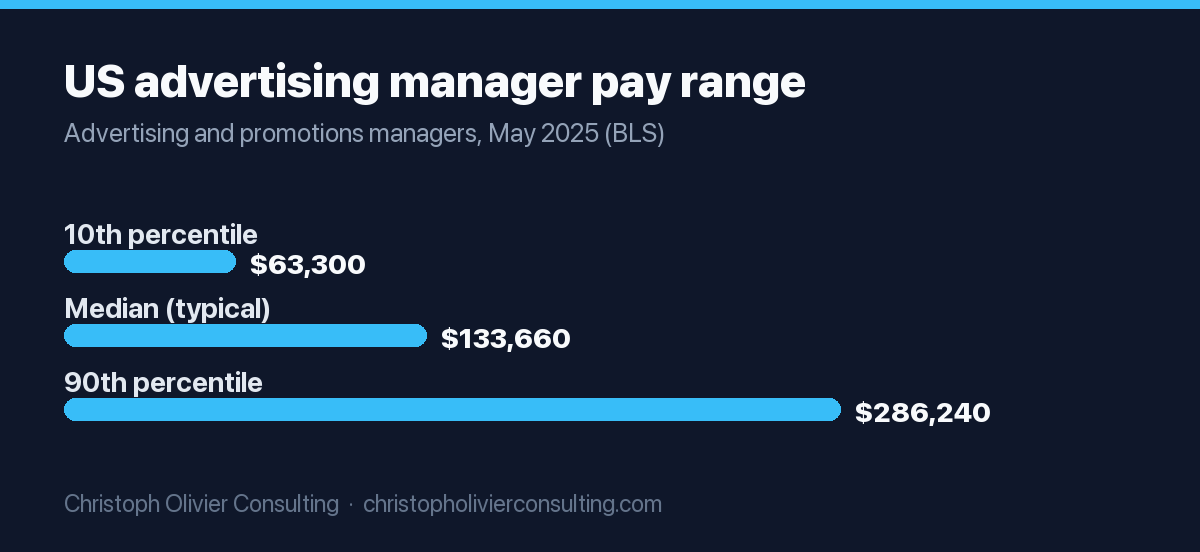
According to BLS, the lowest 10 percent of advertising and promotions managers earned less than $63,300, while the highest 10 percent earned more than $286,240 in May 2025. Private aggregators report lower averages for the narrower “advertising manager” title; Salary.com listed roughly $118,000 as of September 2026, reflecting different job-title definitions rather than a contradiction.
| Benchmark (May 2025, BLS) | Annual wage |
|---|---|
| Lowest 10 percent | Less than $63,300 |
| Median (typical) | $133,660 |
| Highest 10 percent | More than $286,240 |
These figures cover advertising and promotions managers as a group and are point-in-time estimates; actual offers vary with location and employer. Treat them as a starting reference, not a quote.
How to become an advertising manager
Advertising management is not an entry-level job. Most people reach it with a bachelor’s degree plus several years in a paid-media or marketing role, typically four to seven years from the start of a degree. The common path builds channel skills first, then adds budget and team ownership.
- Earn a bachelor’s degree in advertising, marketing, communications, or a related field.
- Take an entry role such as marketing assistant, junior copywriter, or ad operations coordinator.
- Run live campaigns and learn the platforms, metrics, and reporting hands on.
- Take ownership of a budget and, later, of other people’s work.
- Step into the manager title, and optionally add an MBA to move faster into senior roles.
Many companies, especially smaller ones, do not need this role full time. A fractional or outsourced arrangement can supply the same campaign ownership on a part-time basis; see the fractional CMO services overview for how that works in practice.
Frequently asked questions
Is an advertising manager the same as Meta Ads Manager?
No. An advertising manager is a person who runs a company’s paid campaigns, sets budgets, and reports on results. Meta Ads Manager is a software tool inside Facebook and Instagram used to build and manage ad campaigns. An advertising manager may use Ads Manager as one of several tools, but the title refers to the role, not the software.
What is the difference between an advertising manager and a marketing manager?
A marketing manager owns the full marketing strategy, including brand, content, public relations, and advertising. An advertising manager owns the paid advertising program specifically: campaign planning, ad budgets, creative approval, and performance. In large companies the advertising manager reports to the marketing manager or CMO. In small companies one person often covers both.
How much does an advertising manager make?
The U.S. Bureau of Labor Statistics reported a median annual wage of $133,660 for advertising and promotions managers in May 2025. The lowest 10 percent earned under $63,300 and the highest 10 percent earned over $286,240. Private sites list lower averages near $118,000 for the narrower title, reflecting different definitions. Pay varies with company size, city, and industry.
What qualifications do you need to be an advertising manager?
Most positions require a bachelor’s degree in advertising, marketing, communications, or a related field, plus several years of hands-on experience in paid media or marketing. It is not an entry-level role. An MBA is optional and can speed advancement, but proven campaign results and budget ownership usually matter more to employers than an advanced degree.
What skills does an advertising manager need?
Core skills include channel fluency across Google Ads and Meta, data analysis of metrics like cost per acquisition and return on ad spend, budgeting and pacing, creative direction, and project management across multiple campaigns. Strong communication and negotiation matter for aligning stakeholders and dealing with vendors. Increasingly, understanding how AI search engines summarize a brand is part of the job.
Does a small business need a full-time advertising manager?
Often no. Many small businesses cannot justify a full-time advertising manager salary and do better with a fractional, agency, or contractor arrangement that supplies campaign ownership part time. This keeps senior-level strategy and budget discipline in place while matching cost to the size of the advertising program. The right choice depends on ad spend and campaign complexity.
More marketing guides for rank on ai: get cited by ai search
- AI Marketing Agents: What They Are and How to Use Them
- Client Database Software: How to Store and Segment Client Records
- The Best Client Management Apps for Service Businesses (2026)
- Customer Relationships: Stages, Strategy, and How to Build Them
- How to Create Instagram Stories Ads: A Step-by-Step Guide
- How to Rank Higher on Google: A Prioritized 2026 Playbook
- Rank on AI: Get Cited by AI Search