

The dermatology marketing strategies that pay off in 2026 start with an uncomfortable fact: most practices do not have a demand problem. Medical patients already wait weeks to get in, so buying more general dermatology leads often lengthens the line without growing revenue. The real levers are which patients reach which provider, how fast the urgent and high-value cases get booked, and whether your cosmetic and procedural lines get the budget the medical side does not need.
So this guide does not treat “the practice” as one thing to promote. It splits a dermatology practice into its service lines, because a Mohs referral, a psoriasis patient starting a biologic and a first-time filler consult find you in different ways, pay you differently and trip different rules.
Want a specialist to build this for your business? See how CO Consulting’s marketing services work, starting with a diagnostic and audit.
Your schedule is already full. So what is marketing for?
Access is the starting point. In AMN Healthcare’s 2025 survey of 1,391 physician offices across 15 large metro areas, the average wait for a new dermatology appointment was 36.5 days, as reported by Medical Economics. The same coverage flags a caveat that matters to you: large groups usually book new patients with whichever physician has the most open schedule, so the wait to see an established dermatologist is often longer than the survey shows.
At the health-system level the gap is starker. Penn Medicine’s dermatology department told Healio that 40,000 to 50,000 new patients may contact it each year, while it has only 20,000 to 30,000 new patient visits available.
When demand outruns supply like that, marketing has three jobs, and “more leads” is only one of them:
- Route. Get the changing mole booked ahead of the routine skin check, and match patients to the provider who can see them soonest.
- Fill the right gaps. PAs, NPs and newer physicians often have open slots while senior physicians are booked for months. Promote those providers by name.
- Grow the elastic lines. Cosmetic injectables, lasers and procedures run on cash, and you can add capacity there with staffing and hours. That is where acquisition spend usually earns its keep.
Before you spend another dollar, pull three numbers: days to the third-next-available new-patient slot for each provider, your no-show rate, and the share of new patients by service line. Those three tell you which of the plays below to run first.
Dermatology marketing strategies for each service line
Here is the whole practice on one page. Each row is a separate business with its own payer, its own path to your door and its own compliance trap.
| Service line | Who pays | How patients find you | Channel that does the work | Stop doing | Rule to watch |
|---|---|---|---|---|---|
| General medical (acne, rashes, eczema, skin checks) | Insurance | PCP referral, insurer directory, “dermatologist near me” | Google Business Profile, online booking, triage scheduling | Paid search for broad “dermatologist” terms while you are booked out | HIPAA when replying to reviews |
| Chronic disease (psoriasis, atopic dermatitis, hidradenitis) | Insurance, specialty pharmacy | Referrals, condition searches, patient communities | Physician-written condition pages, referral letters | “Cure” and “clear for good” language | Meta’s ban on cure claims for psoriasis |
| Skin cancer: screening, biopsy, Mohs | Insurance | PCP and dermatologist referrals, annual recall | Referral relationships, recall reminders, community screenings | Fear-based creative | Meta’s ban on cancer cure claims, FTC substantiation |
| Cosmetic injectables and lasers | Cash | Instagram, Google, friends, comparison with med spas | Paid social, consult funnel, rebooking | Discount-only offers that attract one-time buyers | Meta 18+ targeting, Google drug terms, state photo law, Good Faith Estimates |
| Skincare retail | Cash | In-office recommendation, email | Post-visit email and SMS | Unsupported “clinically proven” claims | FTC health claim substantiation |
Notice that paid acquisition is the lead channel in only one row. For the insured lines, the work is access, referrals and reputation.
Medical dermatology: fix access before you buy clicks
Penn’s fix was not an ad campaign. It was a scheduling decision tree. Before the change, each provider’s appointments for the year were released at once and filled first come, first served. Now schedulers ask triage questions, such as a personal history of skin cancer, a family history of melanoma, and whether a lesion is growing or changing. Patients then go into acute (seen within 7 days), subacute (within 21 days) or routine (within 90 days) blocks, and unused slots open up two days ahead, according to Healio.
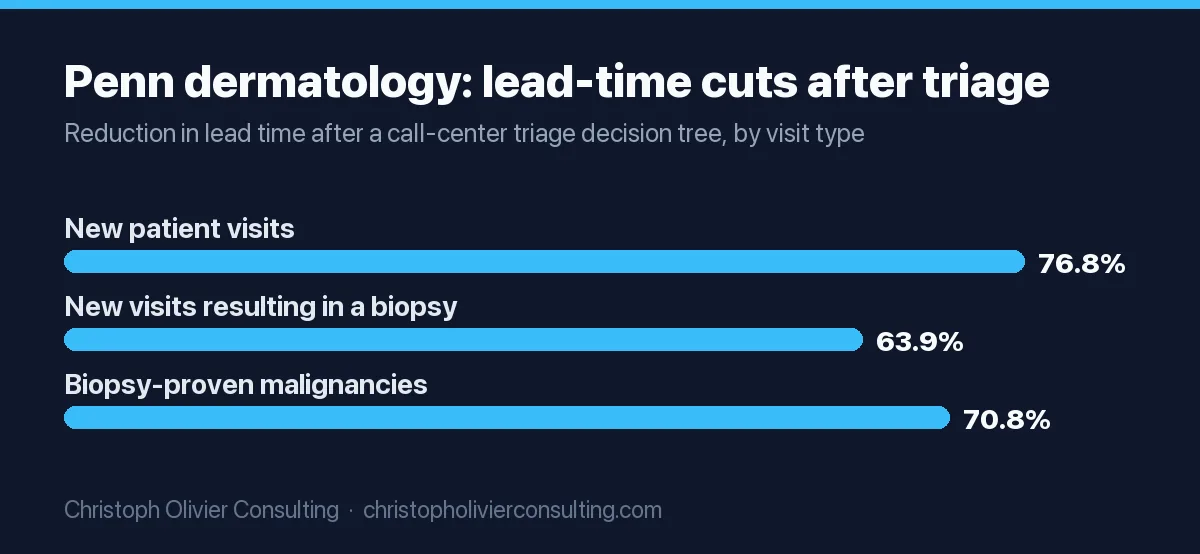
The reported results: new-patient lead times fell 76.8%, lead times for visits that ended in a biopsy fell 63.9%, and lead times for biopsy-proven malignancies fell 70.8%. No-shows dropped from 18.6% to 8.1%. About 30% of appointments across Penn’s sites are now self-scheduled online. That is one large health system, so treat it as direction, not a forecast for your practice.
Here is a front-desk script you can adapt. Your physicians should approve the triage criteria before anyone uses it.
“Thanks for calling [Practice]. So I can get you in at the right time, can I ask three quick questions? Have you ever been diagnosed with skin cancer? Has anyone in your family had melanoma? Is the spot you’re calling about new, growing, bleeding or changing?”
If yes to any: “Let’s get you in this week. Dr. [Name] or [PA Name], who works alongside our dermatologists, has an opening on [day].”
If no: “Our soonest routine visit is [date]. You can also grab a cancellation slot online at [link], since we release them two days ahead.”
The marketing benefit is quiet but real: patients who were seen fast leave better reviews, and fewer of the urgent ones end up booking with a competitor.
Google Business Profile for a multi-provider practice
Google lets public-facing professionals, including doctors, have their own Business Profiles. Its guidelines for representing your business say that when several practitioners work at one location, the practice gets its own profile and each practitioner’s profile title includes only the practitioner’s name, not the practice name. A solo practitioner at a branded practice shares one profile in the format “[brand]: [practitioner name]”. Titles like “Dr.” or “MD” are allowed. Keywords in the business name are not, and adding unnecessary information to the name can get the profile suspended.
For a dermatology group, that means a profile for each location plus a profile for each public-facing dermatologist, PA and NP. The provider profiles are where your open capacity gets found. A patient searching for a skin check this month does not care which name is on the door. They care who can see them.
Referring physicians are your best medical channel
For many medical patients, the path to your door starts with a primary care referral. What earns those referrals is service: a direct referral line, published triage criteria so their urgent lesions get urgent slots, and consult notes back on time. The broader physician-to-physician approach is covered in our guide to doctor marketing.
Keep the relationship about service, not gifts. The federal Anti-Kickback Statute makes it a felony to knowingly and willfully offer or pay anything of value to induce referrals for services payable by a Federal health care program. Run any perk, event or patient referral reward past healthcare counsel before launch.
Skin cancer and chronic disease: educate without promising
Skin cancer gives dermatology a public-health story few specialties can match. The American Academy of Dermatology estimates that one in five Americans will develop skin cancer in their lifetime and that about 9,500 people in the U.S. are diagnosed with it every day. The five-year survival rate for melanoma caught before it spreads to the lymph nodes is 99%. The AAD also notes that skin cancer in patients with darker skin tones is often diagnosed at later stages, when it is harder to treat.
That last point is a content gap in most local markets. Screening pages and social posts that show lesions on darker skin, and explain where to look (palms, soles, nails), serve patients who rarely see themselves in skin cancer content. The AAD’s SPOT Skin Cancer program gives you a ready-made reason to host or join community screenings.
The rule that catches dermatology practices out is on Meta. Its Health and Wellness ad policy bars claims to cure, heal or eliminate a closed list of conditions, and that list includes psoriasis, herpes and cancer. The policy says claims about treating or managing symptoms are not covered by the ban. So “manage psoriasis flares” can run. “Clear your psoriasis for good” invites a rejection. That list reads like part of a dermatology problem list, so audit old creative before you boost it.
For chronic-disease pages, write in the patient’s terms (what the flare feels like, what the treatment options are, how insurance approval usually works) and have the treating dermatologist review and sign each page. That is better for patients, and it is the kind of first-hand expertise search engines and AI answers tend to reward.
Cosmetic dermatology: where your digital marketing budget belongs
Cosmetic is where dermatology digital marketing behaves like ordinary performance marketing. Patients compare, research and pay cash, and you can add capacity. It is also where the rules stack up.
Meta. The July 2026 version of Meta’s Health and Wellness policy explicitly allows ads for dermal fillers, injectable treatments, chemical peels, micro-needling, non-ablative laser treatments and skin rejuvenation, as well as general cosmetic procedures shown as before-and-after transformations. Those ads must target people 18 or older. They cannot contain “statements of inferiority” about appearance, meaning negative language that attacks a person’s looks or body parts, and they cannot promise specific outcomes within a set time frame without qualifiers.
Google. Google’s healthcare and medicines policy restricts prescription drug terms in ads, landing pages and keywords, and the U.S. certification paths it describes are for online pharmacies and LegitScript-accredited telemedicine providers. Botulinum toxin neuromodulators are prescription drugs, so expect brand names in ad text to cause disapprovals. Build campaigns around the concern and the provider (“forehead lines,” “dermatologist-led injectables”) and check the policy status of every ad.
Your edge over med spas. Your strongest cosmetic message is who does the treatment. Say it accurately. California’s Business and Professions Code section 651, for example, bars a physician from using “board certified” unless the full name of the certifying board appears with comparable prominence. If you also compete with aesthetic clinics, our med spa marketing guide shows the playbook they run against you.
Prices. Publishing prices builds trust, but the same California section treats fee advertising as misleading unless it discloses all variables and material factors, other than a standard consultation fee or a range of fees for specific services. Separately, the No Surprises Act good faith estimate rules mean patients who are not using insurance are entitled to a written estimate of expected charges when they schedule at least three business days ahead or ask for one. Build the estimate into your cosmetic booking flow instead of treating it as paperwork.
The cosmetic funnel itself is consult-first: an ad or post sends people to a treatment page with real patient photos, the page books a consult, and the consult converts. Neuromodulator results wear off, so the rebooking reminder is likely the cheapest marketing you will ever run. The same consult-led structure works in cosmetic dentist marketing, and if your practice treats hair loss, Meta lists hair restoration surgery among allowed cosmetic categories too; our hair restoration marketing guide covers that line.
Before-and-after photos: clear three gates
- HIPAA authorization. Using a patient’s photo in marketing is a use of protected health information, and the HIPAA Privacy Rule requires a written authorization for marketing uses. Cropping out the face is not a safe workaround: the de-identification standard lists full-face photos and “any other unique identifying number, characteristic, or code” among the identifiers. Tattoos, birthmarks and distinctive lesions can identify a person.
- State advertising law. California’s section 651 is a useful benchmark even outside California. It requires before-and-after views to state which procedures were performed, to be comparable in poses and lighting, and to include a statement that the same results may not occur for all patients. Altered images and unlabeled model photos are treated as misleading. Check your own state medical board’s advertising rules.
- Platform and FTC. Meta allows cosmetic before-and-after ads for adults when they avoid negative self-perception. The FTC’s Health Products Compliance Guidance adds that testimonials reporting results more dramatic than people can generally expect are likely deceptive, and that a “results not typical” disclaimer does not cure that.
Practical rule: shoot every before and after in the same room, same light, same angle, and log the signed authorization next to the image file.
The rules a dermatology practice answers to
Most dermatology marketing guides mention “HIPAA compliance” and stop. Here is the actual list, with what each rule means for a practice that runs ads, posts photos and asks for reviews. This is a marketing map, not legal advice.
| Rule | What it covers | What it means for your marketing |
|---|---|---|
| HIPAA marketing authorization (45 CFR 164.508) | Using patient information for marketing | Signed authorization before any patient photo, story or video is used |
| OCR enforcement on review replies | Disclosing patient details in public responses | Manasa Health Center paid $30,000 to OCR after disclosing a patient’s information in a reply to a negative online review. Never confirm someone is a patient. |
| HHS online tracking guidance | Pixels and tags on your website and portal | A court vacated the part covering IP addresses on public pages in June 2024. The guidance still says tags on appointment-scheduling pages can collect PHI, such as an email address or reason for the visit, and treats logged-in pages like portals as covered. Keep ad pixels off booking flows and the portal. |
| FTC Consumer Reviews and Testimonials Rule (16 CFR 465) | Fake, bought, insider and suppressed reviews | No AI-written or staff reviews posing as patients, no incentives tied to positive sentiment, no suppressing negative reviews |
| FTC Health Products Compliance Guidance | Health claims and testimonials | Health claims need competent and reliable scientific evidence. Applies directly to your skincare retail line. |
| Meta Health and Wellness policy | Facebook and Instagram ads | 18+ for cosmetic, no appearance put-downs, no cure claims for psoriasis, herpes or cancer |
| Google healthcare and medicines policy | Search and display ads | Prescription drug terms restricted in ads, landing pages and keywords |
| FDA prescription drug advertising (21 CFR 202.1) | Ads issued by a drug’s manufacturer, packer or distributor | Mainly the manufacturer’s burden. Your service ads fall mostly under the FTC and your state board, so do not assume brand marketing claims transfer to you. |
| State advertising law (example: Cal. B&P 651) | Physician advertising | Photo presentation rules, fee disclosure, “board certified” naming, no unsubstantiated superiority claims |
| No Surprises Act good faith estimates | Uninsured and self-pay patients | Written estimates for cosmetic and self-pay bookings |
| Anti-Kickback Statute | Paying for referrals of federally payable care | Counsel review for referral rewards, perks and co-marketing |
If you want to see how ordinary-sounding claims turn into enforcement actions, these false advertising examples are a quick education.
Copy you can adapt, and the lines to retire
These are the lines that tend to cause trouble in dermatology, with a safer version of each. Only use a claim like “same-week appointments” if your schedule actually delivers it.
| Retire this | Why it is a problem | Try this instead |
|---|---|---|
| “Clear your psoriasis for good.” | Meta bans claims to cure or eliminate psoriasis | “Psoriasis flaring again? Our dermatologists build treatment plans to help manage it. New patients seen in [X] weeks.” |
| “Tired of looking old and worn out?” | A statement of inferiority about appearance under Meta policy | “Soften forehead and frown lines with a treatment plan from a board-certified dermatologist ([certifying board]).” |
| “Erase wrinkles in 7 days!” | A specific outcome in a set time frame without qualifiers | “Ask your dermatologist when results usually appear and how long they last for you.” |
| A brand-name injectable and a per-unit price in a Google ad | Prescription drug terms are restricted in Google ads | “Wrinkle treatment consults with a dermatologist. See pricing on our site.” |
| “Leave us a 5-star review and get $25 off your next peel.” | FTC rule bars incentives tied to positive reviews | “We’d value your honest feedback. Here’s the link: [link].” |
| Review reply: “Sorry your biopsy results upset you, but Dr. Lee explained them at your visit.” | Confirms the reviewer is a patient and discloses care details | “We take every concern seriously. Please call our practice manager at [number] so we can help.” |
Hiring a dermatology marketing agency: questions that sort them fast
Plenty of agencies sell marketing for dermatologists. Fewer understand that half your service lines do not need more leads. Ask these before you sign:
- Will you sign a business associate agreement, and which of your tools touch patient data?
- Where will your tracking tags fire? (The right answer excludes booking flows and the patient portal.)
- Will you report by service line: booked cosmetic consults, medical new patients by provider, referral volume? Or just “leads”?
- Who writes condition content, and which of our physicians reviews it before it goes live?
- How do you collect and store photo authorizations?
- What do you do when Meta or Google disapproves an ad, and how fast?
- How would you handle a month where our medical schedule is full?
An agency that answers the last question with “pause medical spend and push cosmetic” understands your business. If you would like a second opinion on a proposal before you commit, you can book a consultation and walk through it.
What to fund first, in order
- Measure access per provider. Third-next-available new-patient slot, no-show rate, new patients by service line.
- Install triage scheduling and online self-booking for routine visits, with cancellation slots released a couple of days ahead.
- Clean up Google Business Profiles: one per location, one per public-facing provider, names without keywords.
- Start a compliant review routine: ask every patient the same way, never filter by expected sentiment, and reply without confirming anyone is a patient.
- Build referral relationships with the 10 to 20 primary care practices nearest each location. Lead with triage criteria and fast consult notes.
- Publish physician-reviewed condition and screening pages, including skin cancer content that shows darker skin tones.
- Launch cosmetic paid social and search with policy-checked creative, authorized photos and a consult booking flow that includes good faith estimates.
- Automate rebooking and recall: injectable rebooking reminders, annual skin check recalls, chronic-disease follow-ups.
- Only then add paid search for medical services, and only for providers with open capacity.
My view: step 7 is where most owners want to start, and it is the most expensive place to start. The first six steps cost little and keep paying off.
Numbers to watch, by line
- Medical: days to third-next-available slot per provider, share of urgent triage patients seen within your target window, no-show rate.
- Skin cancer and Mohs: referrals per referring practice per quarter, days from referral to biopsy.
- Cosmetic: cost per booked consult, consult-to-treatment rate, rebooking rate within your treatment’s usual window, revenue per patient over 12 months.
- Retail: attach rate per visit and repeat purchase rate.
Review these monthly by service line, not as one blended “cost per lead”. A blended number hides the most common dermatology marketing mistake: paying to fill a schedule that was already full.
Work with CO Consulting
Want this done for your business?
- A diagnostic call and an audit of your current marketing and numbers
- A prioritized 90-day plan built for your market
- Execution across SEO and AI search, paid ads, content, funnels and automation
- Weekly check-ins and monthly reporting, led by a fractional CMO
Frequently asked questions
What are the best dermatology marketing strategies in 2026?
Plan by service line. For insured medical care, fix access first with triage scheduling, online booking, provider-level Google Business Profiles and referral relationships with primary care. For skin cancer and chronic disease, publish physician-reviewed education without cure claims. Put most paid acquisition budget into cosmetic services, where patients pay cash and you can add capacity, and automate rebooking and recall.
Can dermatologists use before-and-after photos in Facebook and Instagram ads?
Meta's Health and Wellness policy allows before-and-after transformations for cosmetic procedures such as fillers, injectables, peels and non-ablative lasers, if ads target people 18 or older and avoid negative statements about appearance. You also need a signed HIPAA marketing authorization from the patient and should follow your state's advertising rules on photo presentation and disclosures.
Is it a HIPAA violation to respond to a patient's online review?
Responding is allowed, but disclosing patient information in the reply is not. HHS's Office for Civil Rights settled with Manasa Health Center for $30,000 after it disclosed a patient's information in a response to a negative review. Use a neutral reply that does not confirm the person is a patient and invites them to call the practice directly.
Can a dermatology practice advertise Botox by name on Google Ads?
Google restricts prescription drug terms in ads, landing pages and keywords, and its U.S. certification paths cover online pharmacies and accredited telemedicine providers. Botulinum toxin products are prescription drugs, so brand names in ad text often trigger disapprovals. A safer approach is to write ads around the concern, such as forehead lines, and the provider's credentials, then check each ad's policy status.
Should I hire a dermatology marketing agency or keep marketing in-house?
Either can work. An agency is worth it if it signs a business associate agreement, keeps tracking tags off booking pages and the patient portal, reports results by service line, has physicians review clinical content and knows Meta and Google healthcare policies. In-house often works better for reviews, referral relationships and recall, which depend on your own staff and systems.
How should a dermatology practice market when the schedule is already booked out?
Shift from generating demand to routing it. Triage callers so changing lesions and skin cancer history get faster slots, promote providers with open capacity by name, release cancellations online, and move paid budget toward cosmetic services. Penn Medicine reported that a triage decision tree cut new-patient lead times by 76.8% and no-shows from 18.6% to 8.1%.
Do cosmetic dermatology patients need a good faith estimate?
Under the No Surprises Act rules described by CMS, patients who are not using insurance are entitled to a good faith estimate of expected charges when they schedule care at least three business days in advance or ask for one. Cosmetic patients usually pay cash, so build the estimate into your consult and booking workflow.
More Growth Consulting guides
- Med Spa Marketing: How to Attract and Keep Clients in 2026
- Cosmetic Dentist Marketing: A Cost-Per-Case Playbook for 2026
- Hair Restoration Marketing: A 2026 Cost Per Consult Playbook
- Garage Door Company Marketing: The 2026 Channel and Cost Guide
- Weight Loss Clinic Marketing: A Compliant Playbook for GLP-1 Growth
- What a Full-Service Website Actually Includes (2026 Buyer’s Guide)
- All Growth Consulting guides →