

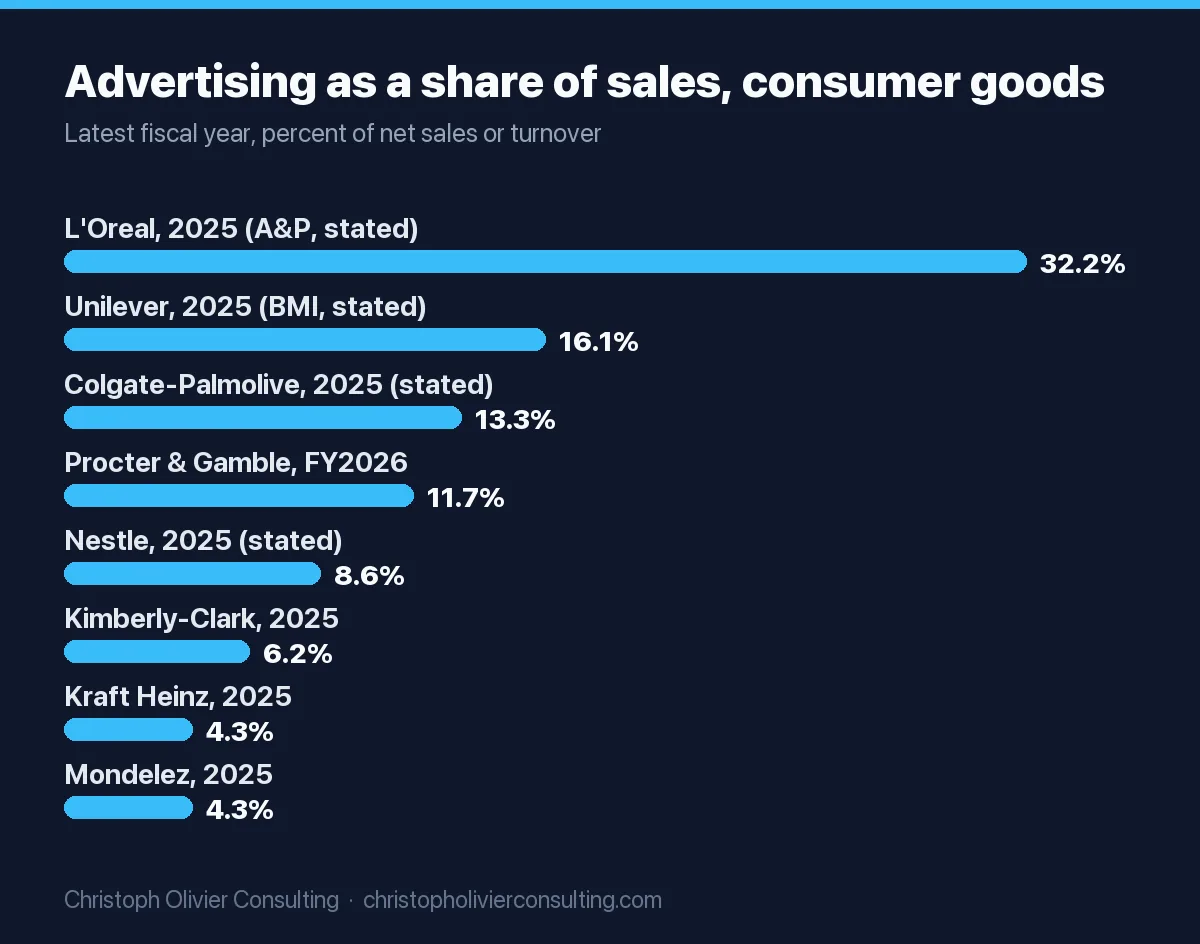
Procter & Gamble spent $10.2 billion on advertising in the fiscal year that ended June 30, 2026, the largest figure any consumer goods company reports in dollars. L’Oréal spent EUR 14.2 billion on advertising and promotion in 2025 (32.2% of sales), Unilever EUR 8.1 billion on brand and marketing investment (16.1% of turnover), and Nestlé put 8.6% of its CHF 89.5 billion in sales into advertising and marketing. Every figure below comes from the company’s own annual filing, with the fiscal year and the exact line item named, because the line items are not the same thing.
Short answer: P&G: $10.2 billion of advertising in FY2026 (11.7% of net sales). Unilever: EUR 8,142 million of brand and marketing investment in 2025 (16.1% of turnover, about $9.2 billion). Nestlé: 8.6% of sales on advertising and marketing in 2025 (about CHF 7.7 billion, our calculation). L’Oréal: EUR 14,178 million of advertising and promotion in 2025 (32.2% of sales, about $16.0 billion).
Consumer goods advertising spend compared (latest fiscal year)
The table uses each company’s most recent annual report as of November 2026. “Reported” means the number printed in the filing. The USD column for the European companies is our own conversion at the Federal Reserve’s 2025 annual average rates (Fed G.5A: $1.1306 per euro, CHF 0.8305 per dollar). Percent of sales is company-stated where marked, otherwise our calculation (spend divided by net sales).
| Company | Fiscal year | Line item, as reported | Reported amount | Approx. USD | % of sales |
|---|---|---|---|---|---|
| Procter & Gamble | FY ended Jun 30, 2026 | Advertising costs (10-K) | $10.2 billion | $10.2 billion | 11.7% (calc.) |
| L’Oréal | 2025 | Advertising and promotion expenses (URD) | EUR 14,177.8 million | $16.0 billion (calc.) | 32.2% (stated) |
| Unilever | 2025 | Brand and marketing investment (20-F) | EUR 8,142 million | $9.2 billion (calc.) | 16.1% (stated) |
| Nestlé | 2025 | Advertising and marketing expenses (Annual Review) | 8.6% of sales; CHF amount not published | about $9.3 billion (calc.) | 8.6% (stated) |
| Colgate-Palmolive | 2025 | Advertising (10-K) | $2,703 million | $2.7 billion | 13.3% (stated) |
| Mondelez | 2025 | Advertising expense (10-K) | $1,655 million | $1.7 billion | 4.3% (calc.) |
| Kraft Heinz | 2025 (to Dec 27) | Advertising expenses (10-K) | $1,073 million | $1.1 billion | 4.3% (calc.) |
| Kimberly-Clark | 2025, continuing ops | Advertising expense (10-K) | $1,020 million | $1.0 billion | 6.2% (calc.) |
| General Mills | FY ended May 31, 2026 | Advertising and media expense (10-K) | $873.6 million | $0.9 billion | 4.7% (calc.) |
Two warnings before you compare rows. First, the Nestlé amount is derived: Nestlé publishes the 8.6% ratio and CHF 89,490 million of sales, and 8.6% of that is about CHF 7.7 billion. Because the ratio is rounded to one decimal, the true figure could sit roughly CHF 45 million either side. Second, the line items measure different things, which is why L’Oréal looks three times as heavy as P&G. The decoder table further down shows what each one includes.
How much does P&G spend on advertising? $10.2 billion (FY2026)
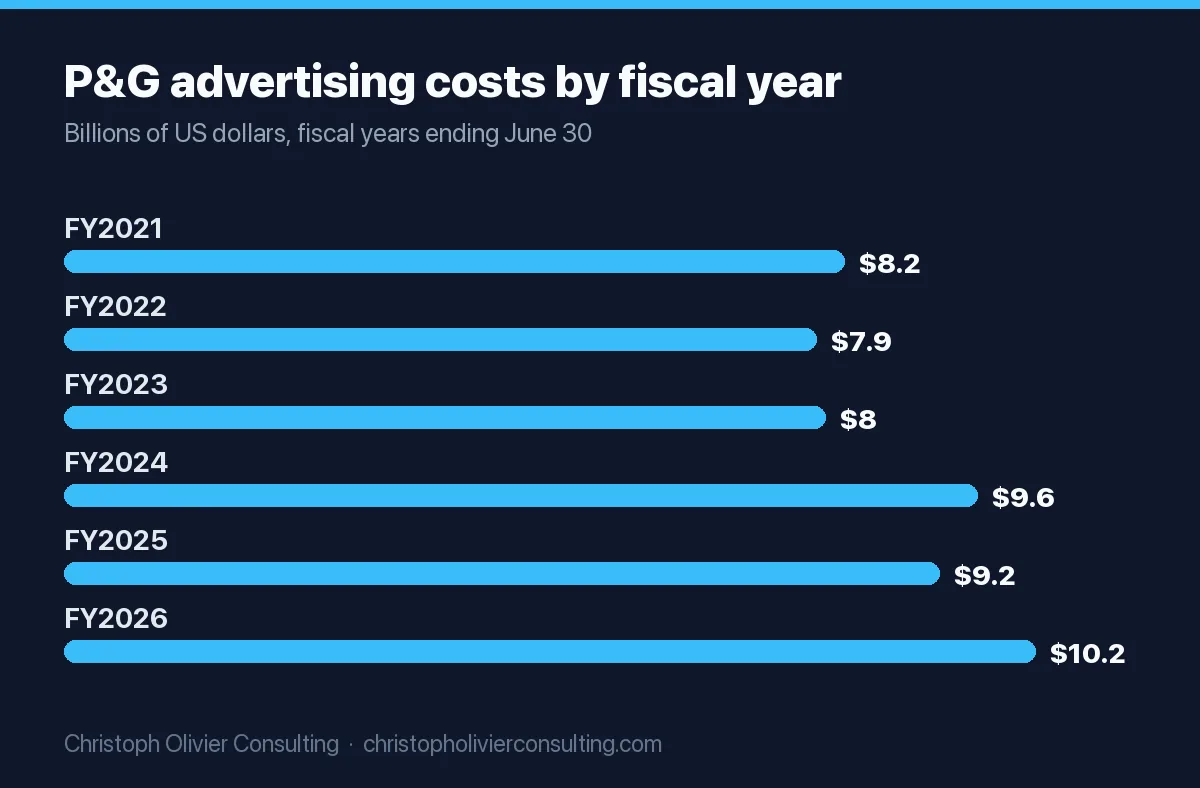
P&G’s fiscal 2026 10-K states that advertising costs, “charged to expense as incurred, include television, print, radio, digital and in-store advertising expenses and were $10.2 billion in 2026, $9.2 billion in 2025 and $9.6 billion in 2024.” Net sales were $87,032 million, so advertising ran at 11.7% of sales (our calculation). The same filing says marketing spending as a share of net sales rose 80 basis points in the year.
That $10.2 billion is not P&G’s whole marketing budget. The 10-K says the “non-advertising related components” of total marketing spending, namely consumer promotions, product sampling and sales aids, sit elsewhere in SG&A. Trade promotions (retailer pricing allowances, in-store merchandising funds, coupons) are not an expense line at all: P&G records them as a reduction of net sales. P&G does not publish a single “total marketing” dollar figure.
Procter and Gamble advertising budget by year
The figures below are the advertising costs printed in P&G’s fiscal 2023 10-K (FY2021 to FY2023) and fiscal 2026 10-K (FY2024 to FY2026). Percent of sales is our calculation against net sales in the same filings.
| P&G fiscal year (ends June 30) | Advertising costs | Net sales | Advertising % of sales |
|---|---|---|---|
| FY2021 | $8.2 billion | $76,118 million | 10.8% |
| FY2022 | $7.9 billion | $80,187 million | 9.9% |
| FY2023 | $8.0 billion | $82,006 million | 9.8% |
| FY2024 | $9.6 billion | $84,039 million | 11.4% |
| FY2025 | $9.2 billion | $84,284 million | 10.9% |
| FY2026 | $10.2 billion | $87,032 million | 11.7% |
The $200 million digital ad cut, in context
Much of what ranks for “P&G advertising budget” is about one event. In March 2018 P&G said it had cut digital advertising by $200 million in 2017 after viewability data showed its ads were not reaching the intended audience, Reuters reported. Chief brand officer Marc Pritchard said the average view time of a mobile newsfeed ad was 1.7 seconds, and P&G cut spend with several big media companies by 20% to 50%. The part most summaries drop: P&G told Reuters it did not cut overall media spending and reinvested the money in TV, audio and e-commerce media. Advertising costs were $7.1 billion that year per the same report. By our calculation the cut was about 3% of that year’s advertising, a reallocation rather than a retreat from advertising, and the table above shows spending has since climbed to $10.2 billion.
Unilever marketing budget: EUR 8.1 billion, 16.1% of turnover (2025)
Unilever reports a line called brand and marketing investment (BMI). Its 2025 Form 20-F shows BMI of EUR 8,142 million on turnover of EUR 50,503 million, down from EUR 8,378 million in 2024. At the Fed’s 2025 average rate that is about $9.2 billion (our conversion). Unilever defines BMI as “costs related to creating and maintaining brand equity and brand awareness”, including “media, advertising production, promotional materials and engagement with consumers.”
The ratio is the more useful number. The 20-F says BMI rose 10 basis points to 16.1% of turnover and calls this “a significant step-up in BMI over the last five years, up 300bps.” The euro amount fell only because currency moves cut turnover by 5.9%. One more catch when you compare years: the 2024 and 2023 figures were restated to remove the Ice Cream business, which was demerged in December 2025, so older articles quoting a larger Unilever budget are measuring a bigger company.
Is Unilever spending 50% of its budget on influencers?
Not as stated in most headlines. In a March 2025 fireside chat with a Barclays analyst, CEO Fernando Fernandez said, as quoted by FoodIngredientsFirst: “Our marketing spending has moved from 13% in 2022 to now close to 16%… Our spending on social [media] will move from 30% to 50% of our total spend. We will work with 20 times more influencers.” Social media is not the same as influencers: it includes paid social ads. Digiday later added an editor’s note clarifying that Unilever committed 50% of its digital budget, not its total media spend, to social, and reported that a year on the company had offered no public accounting of progress against the target. Unilever’s 20-F gives no social or influencer split.
What is Unilever’s marketing strategy?
In its own words, “social-first” marketing behind a short list of Power Brands. The 20-F describes a “Desire at Scale” approach led by Dove and Vaseline and cites the #VaselineVerified campaign, which took consumer-generated &
ldquo;hacks” shared on social channels, validated them through lab testing by Unilever scientists, and won a Titanium Lion at Cannes. Knorr ran what the report calls its biggest social-first campaign across 29 markets with a dating app and influencers. The spending pattern backs the words: BMI went up as a share of sales while overheads went down 50 basis points.
How much does Nestlé spend on advertising? 8.6% of sales, about CHF 7.7 billion (2025)
Nestlé does not print an advertising amount in Swiss francs. Its Annual Review 2025 says “advertising and marketing expenses as a percentage of sales” rose 50 basis points to 8.6% “as we stepped up growth investments”, while administration and other marketing expenses fell 30 basis points to 11.4%. Total reported sales were CHF 89,490 million per the 2025 consolidated financial statements. Multiply the two and you get about CHF 7.7 billion, or about $9.3 billion at the Fed’s 2025 average rate. Both are our calculations from a rounded ratio, so treat them as estimates.
The consolidated income statement folds advertising into “marketing and administration expenses” (20.0% of sales), which also covers sales teams, merchandising and head office costs. If you see a blog quote Nestlé’s total marketing and administration line as its ad budget, it is overstating ad spend by more than double. The Annual Review also says Europe’s margin fell partly because operational savings were “reinvested in growth through a step-up in advertising and marketing spend.”
How much does L’Oréal spend on advertising? EUR 14.2 billion, 32.2% of sales (2025)
L’Oréal’s 2025 Universal Registration Document reports advertising and promotion expenses of EUR 14,177.8 million on sales of EUR 44,052.0 million: 32.2% of sales, the same ratio as 2024 (EUR 14,008.9 million) and slightly below 2023 (32.4%). Converted at the 2025 average rate, that is about $16.0 billion (our calculation), which is more than P&G’s advertising line. The figure appears as its own line in the consolidated income statement, right after R&I.
Why so high? Two reasons. Beauty sells on image, and the line is broad: the accounting principles note says it consists mainly of the advertisement and promotion of products “to customers and consumers and beauty advisors”, so in-store beauty advisor costs land here rather than in SG&A. Meanwhile L’Oréal still deducts coupons, discounts and loyalty programmes from sales, so even the 32.2% understates total commercial spend. For a beauty company, 30%+ is normal; for a food company it would be ruinous.
Colgate-Palmolive: $2.7 billion, 13.3% of net sales (2025)
Colgate’s 2025 10-K reports advertising of $2,703 million on net sales of $20,382 million, and states that “advertising investment decreased as a percentage of Net sales to 13.3% from 13.5% in 2024.” In 2023 it was $2,371 million, so Colgate stepped up by about $350 million in 2024 and held there. Coupons and some trade programmes are booked as a reduction of sales, the same treatment P&G uses.
Kraft Heinz advertising: $1,073 million (2025), plus Mondelez, Kimberly-Clark and General Mills
Packaged food spends a far smaller share of sales on advertising than beauty or personal care. Retailer trade spend does much of the work, and it never shows up in these lines.
Kraft Heinz: $1,073 million, 4.3% of net sales
The Kraft Heinz 2025 10-K gives the broadest written definition of any company here: advertising production, in-store advertising, agency fees, brand promotions and events, sponsorships, and media across TV, radio, print, digital and social. The total was $1,073 million in 2025, $1,031 million in 2024 and $1,071 million in 2023, on 2025 net sales of $24,942 million. Market research is excluded.
Mondelez: $1,655 million, 4.3% of net revenues
Mondelez cut advertising expense to $1,655 million in 2025 from $2,112 million in 2024, a 22% drop (our calculation), while net revenues rose 5.8% to $38,537 million. The 10-K repeatedly cites “lower advertising and consumer promotion costs” as a profit offset in a year of higher raw material costs, and notes it has suspended advertising in Russia.
Kimberly-Clark: $1,020 million, 6.2% of net sales
Kimberly-Clark reported advertising expense of $1,020 million in 2025 against $16,447 million of net sales from continuing operations. Its segment table shows a wider “advertising and promotion expense” of $1,110 million. Figures exclude the international family care and professional business now reported as discontinued operations.
General Mills: $873.6 million, 4.7% of net sales
General Mills reported advertising and media expense, including production and communication costs, of $873.6 million for the fiscal year ended May 31, 2026, up from $847.5 million, on net sales of $18,424.6 million.
Why consumer goods companies spend 4% to 32% of sales on advertising
The spread looks random until you read the line-item definitions. Here is what each number actually captures, built from the filings above. Use it before you compare any two companies.
| Company | Line item | Includes | Excluded (booked elsewhere) | Comparable to P&G? |
|---|---|---|---|---|
| P&G | Advertising costs | TV, print, radio, digital, in-store advertising | Consumer promotions, sampling, sales aids (SG&A); trade promotions (cut from sales) | Baseline |
| Colgate | Advertising | Advertising in SG&A | Coupons and certain trade programmes (cut from sales) | Close |
| Kraft Heinz | Advertising expenses | Media, production, in-store, agency fees, events, sponsorships | Market research | Close, slightly broader |
| Unilever | Brand and marketing investment | Media, ad production, promotional materials, consumer engagement | Sales staff (overheads) | Broader: includes promotional materials |
| Nestlé | Advertising and marketing expenses (ratio only) | Advertising and marketing | Administration and other marketing (11.4% of sales) | Roughly, but only as a % |
| L’Oréal | Advertising and promotion expenses | Advertising and promotion of products to customers, consumers and beauty advisors | Coupons, discounts, loyalty (cut from sales) | No: much broader |
Beyond definitions, three forces set the ratio. Category: beauty and oral care sell on image and premium price, so they spend in the teens to 30s, while staples like cheese, crackers and cereal compete on shelf price and trade deals. Trade spend: food companies pour money into retailer allowances that are netted out of sales, so their visible advertising looks small. Strategy: Mondelez cut advertising 22% in a cost squeeze, while P&G and Unilever raised their ratios to defend volume. For cross-industry ratios beyond consumer goods, see our breakdown of advertising to sales ratio by industry.
Which companies spend the most on advertising?
There is no free, audited global ranking. Among companies that disclose a figure in their annual filings, these are the largest we could verify. Companies that publish no number, such as Apple, are left out rather than guessed.
| Rank (disclosed only) | Company | Fiscal year | Figure | Line item |
|---|---|---|---|---|
| 1 | Amazon | 2025 | $23.5 billion | Advertising and other promotional costs (10-K) |
| 2 | L’Oréal | 2025 | about $16.0 billion (EUR 14.2 billion) | Advertising and promotion |
| 3 | Procter & Gamble | FY2026 | $10.2 billion | Advertising costs |
| 4 | Alphabet | 2025 | about $9.9 billion | Advertising and promotional expenses (10-K) |
| 5 | Nestlé | 2025 | about $9.3 billion (derived) | Advertising and marketing, 8.6% of sales |
| 6 | Unilever | 2025 | about $9.2 billion (EUR 8.1 billion) | Brand and marketing investment |
| 7 | Comcast | 2025 | $8,862 million | Marketing and promotion (10-K) |
| 8 | Coca-Cola | 2025 | $5.4 billion | Advertising costs (10-K) |
| 9 | PepsiCo | 2025 | $5.4 billion, of which $3.4 billion advertising | Advertising and other marketing activities (10-K) |
| 10 | Colgate-Palmolive | 2025 | $2.7 billion | Advertising |
So the company with the highest disclosed advertising spend is Amazon, and the largest consumer goods advertiser is L’Oréal on a converted basis or P&G on a reported-in-dollars basis. The ranking is only as good as the line items, which differ, and currency conversions move it. For brand-by-brand detail on Nike, Coca-Cola, Amazon and others, see our guide to big brand marketing budgets.
What the 70/20/10 rule means for a marketing budget
The 70/20/10 rule comes from Coca-Cola’s “Content 2020” plan, which Social Media Today summarized as 70% low-risk content that has worked before, 20% content that builds on what worked, and 10% high-risk new ideas. It was a content mix, not a formula for sizing a budget, and none of the companies on this page disclose using it. Treated as an allocation rule, it is a sensible default for testing: protect the proven channels, keep a fifth for improving them, and ring-fence a tenth for experiments you expect to lose money on. Unilever’s move toward social is the same logic at scale: shift share from proven formats to a newer one in steps, then measure.
Copy-ready: look up any consumer goods company’s ad spend in 5 minutes
- Open the latest annual report: 10-K on SEC EDGAR for US companies, 20-F for Unilever, the Universal Registration Document for French companies, the Annual Review plus financial statements for Nestlé.
- Search the document for these phrases, in this order: “Advertising costs”, “Advertising expense”, “advertising and promotion”, “brand and marketing investment”, “advertising and marketing expenses as a percentage of sales”.
- Pass: you find a stated amount or ratio with a fiscal year. Fail: you only find “marketing and administration” or “SG&A”. Those include salaries and head office, so do not call them ad spend.
- Write down the definition sentence next to the number, and check whether coupons and trade promotions are deducted from sales.
- Calculate the ratio: advertising % of sales = advertising expense ÷ net sales × 100. Worked example, P&G FY2026: $10,200 million ÷ $87,032 million × 100 = 11.7%.
- Convert currencies last, with a named rate and date, and label the result as your own calculation.
If you run a service firm rather than a CPG brand, these ratios are not your benchmark. A 30% ad-to-sales ratio works for L’Oréal because its gross margin is about 74% of sales. Start from your own margin and customer value instead, as in how to set a marketing budget, and compare against the survey data in marketing budget benchmarks. If you want a second pair of eyes on your split, you can book a consultation.
How much do the CEOs of P&G and Unilever earn?
P&G’s 2026 proxy statement reports total compensation of $18,976,742 for Shailesh Jejurikar, who became President and CEO on January 1, 2026, for fiscal 2025/26. That includes $1,387,500 of salary and $11.0 million of stock awards. Jon Moeller, CEO until December 31, 2025 and then Executive Chairman, received $19,073,909 for the same year.
Unilever’s 20-F reports a single total figure of EUR 5,628,000 for Fernando Fernandez in 2025, covering two months as CFO and ten as CEO from March 1, 2025. His CEO base salary from January 1, 2026 is EUR 1,621,622. The CEO single figure for the year as a whole, combining Fernandez and his predecessor Hein Schumacher, was EUR 5,604,000.
Ready to scale your revenue?
Book a free 30-min consultation. We’ll diagnose your growth bottleneck and map out the 3 highest-leverage moves for your business.
Frequently asked questions
How much does P&G spend on advertising?
Procter & Gamble reported advertising costs of $10.2 billion for the fiscal year ended June 30, 2026, up from $9.2 billion in fiscal 2025 and $9.6 billion in fiscal 2024, per its 10-K. That is about 11.7% of its $87.0 billion in net sales. The figure covers TV, print, radio, digital and in-store advertising; consumer promotions, sampling and trade promotions are recorded elsewhere.
What is Unilever's marketing budget?
Unilever reported brand and marketing investment of EUR 8,142 million in 2025, 16.1% of its EUR 50.5 billion turnover, according to its 2025 Form 20-F. That is roughly $9.2 billion at the Federal Reserve's 2025 average exchange rate. The ratio has risen about 3 percentage points over five years. Figures exclude the Ice Cream business demerged in December 2025.
How much does Nestle spend on advertising?
Nestle does not publish a Swiss franc amount. Its Annual Review 2025 says advertising and marketing expenses were 8.6% of sales, up 50 basis points. Applied to CHF 89.5 billion of 2025 sales, that is about CHF 7.7 billion, or about $9.3 billion. Both amounts are calculations from a rounded ratio, not reported figures.
How much does L'Oreal spend on advertising?
L'Oreal reported advertising and promotion expenses of EUR 14,177.8 million in 2025, equal to 32.2% of its EUR 44.1 billion in sales, per its 2025 Universal Registration Document. That is about $16.0 billion at the 2025 average euro rate. The line is broad: it includes promotion to customers, consumers and beauty advisors, which is why the ratio is far higher than food companies report.
Which company spends the most on advertising?
Among companies that disclose a figure in their annual filings, Amazon is the largest, with $23.5 billion of advertising and other promotional costs in 2025. In consumer goods, L'Oreal is largest on a converted basis (about $16.0 billion of advertising and promotion) and Procter & Gamble is largest in reported dollars ($10.2 billion in FY2026). Apple and many private companies disclose no figure.
What is the 70/20/10 rule for marketing budget?
The 70/20/10 rule splits spend or content into 70% proven, low-risk activity, 20% improvements on what already works, and 10% high-risk experiments. It comes from Coca-Cola's Content 2020 plan, where it described a content mix rather than a budget formula. Used for budgets, it protects proven channels while funding tests you expect some to fail.
How much does the CEO of Procter & Gamble make per year?
P&G's 2026 proxy statement reports total compensation of $18,976,742 for CEO Shailesh Jejurikar for fiscal 2025/26, including $1,387,500 of salary and about $11.0 million of stock awards. He became CEO on January 1, 2026. Jon Moeller, CEO until December 31, 2025 and then Executive Chairman, received $19,073,909 for the same fiscal year.
What big companies spend on marketing