

Marriott International recognized $999 million of advertising costs in 2025, the largest disclosed hotel marketing number in the industry, and most of it was paid by hotel owners, not by Marriott. That is how every big hotel marketing budget works: owners pay a marketing or program fee of roughly 2% to 4% of room revenue into a brand fund, and the brand spends it. For your own hotel, the public benchmarks put total sales and marketing at about 9% of total revenue including staff and brand fees, and direct marketing spend at roughly 4% to 6% of revenue.
Short answer: Marriott: $999 million of advertising in 2025. IHG: $542 million of marketing from its System Fund in 2025. Choice Hotels: $207.8 million of advertising in 2025. Hilton does not disclose an advertising figure. A single hotel in CBRE’s sample spent 9.2% of total revenue on its sales and marketing department in 2019, and franchise-related fees made up 48.8% of that department’s cost.
Every chain figure below was read in November 2026 from the company’s fiscal 2025 annual report on SEC EDGAR or from a franchise disclosure document (FDD) filed with the Minnesota Department of Commerce. Where a number is my calculation, the text says so and shows the math. Where a company does not report a number, the table says “not disclosed”.
Hotel marketing budgets compared: Marriott, Hilton, IHG, Hyatt, Choice, Wyndham (2025)
Read the two right-hand columns separately. “Owner fee for marketing” is what a franchised hotel pays the brand. “Dollars disclosed” is the line item the company actually reports, under its own caption. The captions differ, so do not rank chains on the dollar column alone.
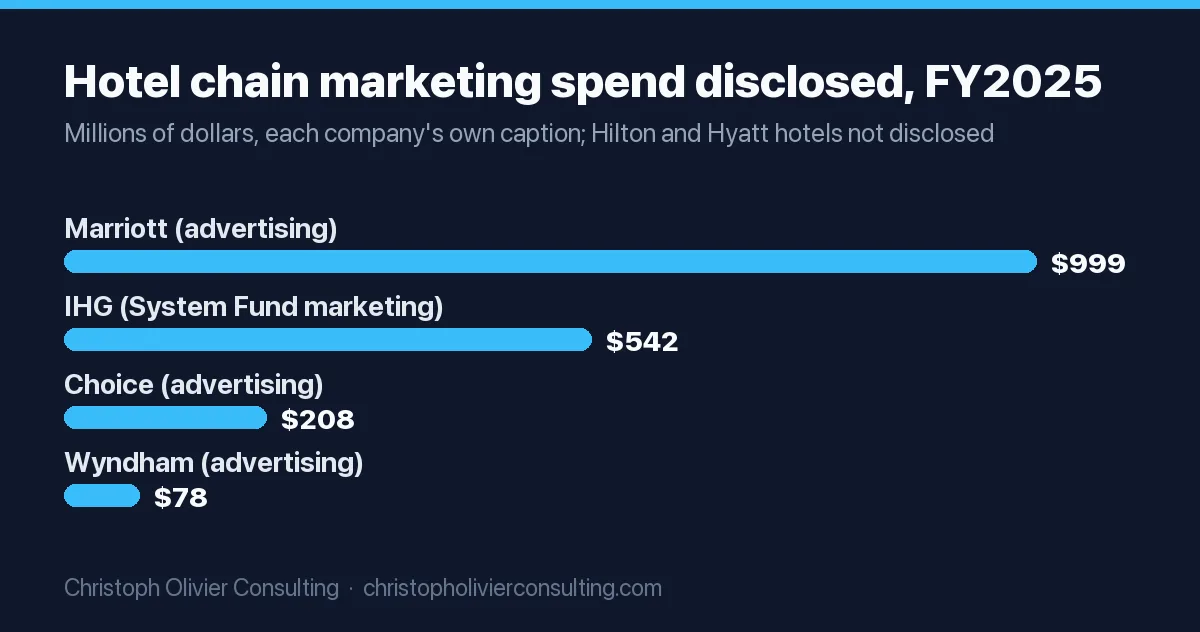
| Chain | Size, end of 2025 | Dollars disclosed, exact line item (FY2025) | Owner fee for marketing | Source |
|---|---|---|---|---|
| Marriott International | 9,805 properties, 1,779,936 rooms | $999 million “advertising costs” | Marriott Hotels FDD: Program Services Contribution of 1.62% of gross room sales (1% of it to the Marketing Fund) plus $50,000 a year plus $510 per room a year | 10-K, FDD 2025 |
| Hilton | 9,158 properties, 1,351,351 rooms | Not disclosed. Marketing sits inside $7,085 million of cost reimbursement revenues | “Monthly program fees” based on sales or usage; rate not stated in the 10-K. No current Hilton FDD on file in Minnesota | 10-K |
| IHG Hotels & Resorts | More than 6,900 hotels | $542 million “Marketing” expense of the System Fund; $1,717 million System Fund revenue | Marketing and reservation assessment plus loyalty assessment, generally a percentage of hotel revenue | Annual Report and Form 20-F |
| Hyatt | 1,528 hotels, 372,763 rooms | Hotel advertising not broken out. $58 million of advertising in the distribution segment only | Hyatt Place FDD: Commercial Services Fee of 3.5% of gross rooms revenue plus a 1.35% Digital Acquisition Fee on digital-channel room revenue | 10-K, FDD 2026 |
| Choice Hotels | 7,575 hotels, 656,825 rooms | $207.8 million “advertising expense” | Marketing and reservation fee “typically” 3% to 4% of gross room revenue; Quality Inn FDD: 3.5% | 10-K, FDD 2026 |
| Wyndham Hotels & Resorts | Over 8,300 hotels, about 869,000 rooms | $78 million “advertising expenses”; $565 million marketing, reservation and loyalty expense | Marketing and reservation fee of 2% to 4% of gross room revenue; Days Inn FDD: 3.8% System Assessment Fee | 10-K, FDD 2025 |
| Best Western (member association) | Not used here | Not disclosed in dollars | $16.86 per room per month Advertising Assessment plus 2.10% of room revenue Marketing and Technology Fees, plus a regional co-op fee | FDD 2026 |
One pattern stands out. The brands describe these funds as break-even pass-throughs. Marriott’s 10-K says the centralized marketing, sales and reservation programs are “not designed to impact our economics, either positively or negatively.” It is the same structure as the franchisee-funded ad funds behind the fast food marketing budgets of McDonald’s and Taco Bell: the parent company administers the money, the owners supply it.
How much does Marriott spend on marketing? $999 million in 2025
Marriott’s 2025 10-K states: “We recognized advertising costs of $999 million in 2025, $993 million in 2024, and $794 million in 2023.” It records them in “Reimbursed expenses” to the extent they are undertaken on behalf of hotel owners. That is 3.8% of Marriott’s $26,186 million of 2025 revenue, or about $561 per room in the system (my calculations: $999 million divided by $26,186 million and by 1,779,936 rooms).
The $999 million is advertising only. Marriott’s wider pool of owner-funded programs, which covers marketing, sales, reservations, insurance and the Marriott Bonvoy loyalty program, shows up as $19,204 million of cost reimbursement revenue against $19,503 million of reimbursed expenses in 2025. That pool also includes payroll at managed hotels, so it is not a marketing budget. Marriott reports that loyalty members booked about 75% of its U.S. room nights and 68% of global room nights in 2025.
What a Marriott franchisee pays toward marketing
The Marriott Hotels franchise disclosure document (issued March 31, 2025) sets the fees for full-service Marriott and JW Marriott hotels:
- Franchise fee: 6% of gross room sales plus 3% of food and beverage sales.
- Program Services Contribution: 1.62% of gross room sales, which includes a 1% Marketing Fund contribution, plus $50,000 a year plus $510 per guestroom a year. Large convention and resort hotels pay 1.42% plus $45,000 plus $480 per room.
- Loyalty Program: 4.2% of qualifying revenue from guests earning points or miles, reduced to 4.0% through December 2027.
The same FDD shows where the Marketing Fund went in 2024: 35% to awareness, trial and loyalty (28% of it to advertising, public relations, collateral and promotions), 7% to strategic planning and research, 44% to sales and channels, and 7% to distribution and revenue management. Administration was about 7% of the money spent.
Hilton marketing budget: not disclosed as a separate number (2025)
Hilton does not publish an advertising or marketing expense figure. Its 2025 10-K explains that franchised hotels pay “monthly program fees based on the underlying property’s sales or usage, as reimbursement for the costs related to our: (i) advertising and marketing programs; (ii) internet, technology and reservation systems; and (iii) quality assurance programs,” plus separate Hilton Honors payments. Hilton adds that it is “contractually required to use these fees that we collect solely for these programs.”
The closest disclosed totals are $7,085 million of cost reimbursement revenues and $7,550 million of reimbursed expenses in 2025, out of $12,039 million of total revenues. Those lines bundle marketing with managed-hotel payroll, shared services and Hilton Honors, so any “Hilton marketing budget” figure you see quoted as a single number is an estimate, not a disclosure. What Hilton does report: 243 million Hilton Honors members at year end 2025, up 15%. Hilton obtained a discretionary registration exemption in Minnesota in June 2020, so no current Hilton FDD is on that state’s database.
IHG marketing budget: $542 million from the System Fund (2025)
IHG is the most transparent of the large chains. Its 2025 Annual Report and Form 20-F breaks out System Fund expenses: Marketing $542 million in 2025, up from $520 million in 2024 and $498 million in 2023. The fund took in $1,717 million of revenue in 2025, of which $1,362 million was “marketing, reservation and other hotel fees” and $355 million was loyalty revenue net of point redemption costs. Marketing was 31.6% of System Fund revenue (my calculation). The fund is funded by owners through a marketing and reservation assessment and a loyalty assessment, “generally levied as a percentage of hotel revenues.”
Hyatt marketing budget: not broken out for hotels; $58 million in distribution (2025)
Hyatt’s 2025 10-K says advertising costs “are generally reimbursed by our third-party owners and franchisees” and sit inside $3,629 million of revenues for reimbursed costs. The only advertising figure it gives is $58 million in 2025 for the distribution segment (ALG Vacations and Mr & Mrs Smith), down from $67 million in 2024. On the owner side, the Hyatt Place FDD (issued March 27, 2026, amended August 5, 2026) charges a Commercial Services Fee of 3.5% of gross rooms revenue covering brand marketing, advertising, public relations, reservations and revenue management technology, plus a 1.35% Digital Acquisition Fee on rooms revenue booked through digital channels.
Choice Hotels marketing budget: $207.8 million of advertising (2025)
Choice’s 2025 10-K reports advertising expense of $207.8 million in 2025, $194.6 million in 2024 and $195.2 million in 2023. That is about $316 per room in its 656,825-room system (my calculation). Its marketing and reservation fees “typically range from 3% to 4% of gross room revenues,” and in 2025 reimbursable expenses exceeded reimbursable revenue by $47.1 million, a deficit franchisees must eventually make up under their agreements.
The Quality Inn FDD (issued April 1, 2026) sets the fee at 3.5% of gross room revenue and shows the 2025 split of all Marketing and Reservation Fees: 36.6% on media and other advertising, 3.5% on the Choice Privileges loyalty program, 51.6% on marketing and distribution such as reservations, global sales and research, and 8.3% on general and administrative costs.
Wyndham marketing budget: $78 million of advertising, $565 million of marketing, reservation and loyalty expense (2025)
Wyndham’s 2025 10-K reports advertising expenses of $78 million in 2025, down from $110 million in 2024 and $127 million in 2023. The broader “marketing, reservation and loyalty” expense was $565 million, matched by $562 million of marketing, reservation and loyalty revenue. Franchisees “generally pay us a royalty fee of approximately 5% of gross room revenue and a marketing and reservation fee of 2% to 4% of gross room revenue.” The Days Inn FDD (issued March 31, 2025) sets a 3.8% System Assessment Fee and reports that 17.3% of 2024 fund spending went to media placement and 21.6% to administration.
What hotel owners pay for brand marketing, side by side
To make the fee schedules comparable, here is what each structure would cost one example hotel: 120 rooms, 70% occupancy, $180 average daily rate. That gives 30,660 room nights and $5,518,800 of rooms revenue a year (my inputs and math, not a benchmark). Fees are applied exactly as written in each FDD.
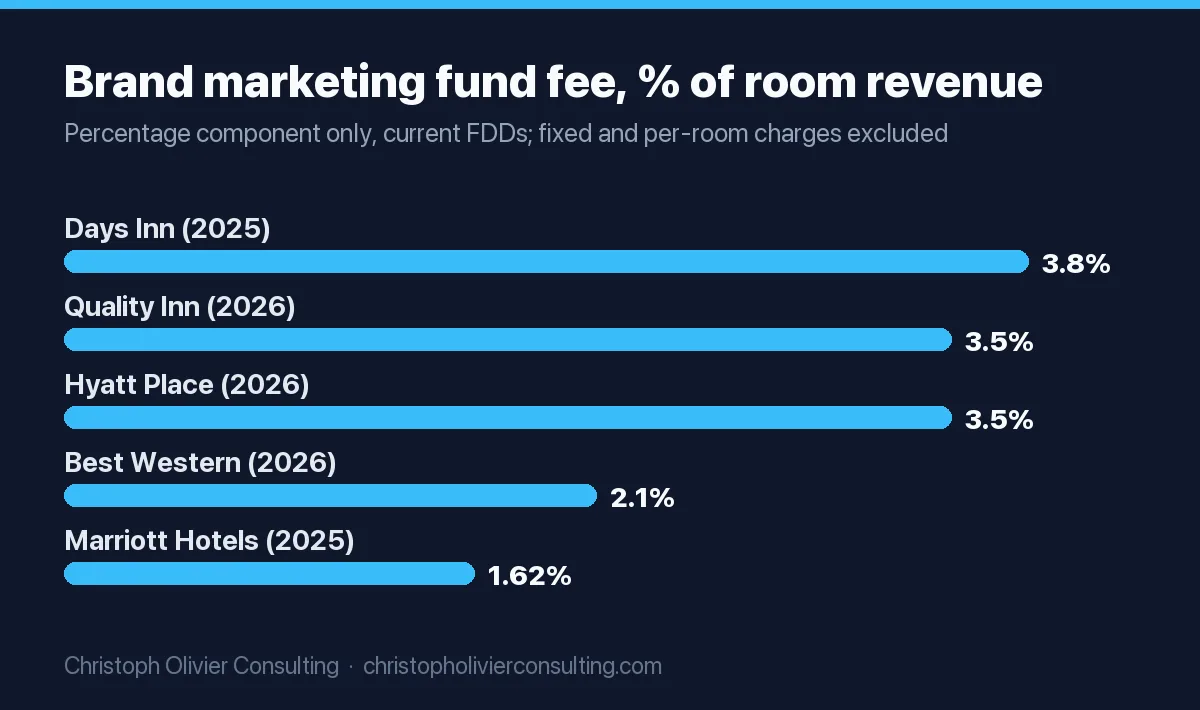
| Brand fee structure (FDD year) | Formula | Annual cost, example hotel | % of rooms revenue |
|---|---|---|---|
| Days Inn System Assessment Fee (2025) | 3.8% of gross room revenue | $209,714 | 3.8% |
| Marriott Hotels Program Services Contribution (2025) | 1.62% + $50,000 + $510 per room | $200,605 (of which Marketing Fund $55,188) | 3.6% |
| Quality Inn Marketing and Reservation Fee (2026) | 3.5% of gross room revenue | $193,158 | 3.5% |
| Hyatt Place Commercial Services Fee (2026) | 3.5% of gross rooms revenue, plus 1.35% of digital-channel rooms revenue | $193,158 plus the digital fee | 3.5% plus |
| Best Western Advertising Assessment plus Marketing and Technology Fees (2026) | $16.86 per room per month + 2.10% of room revenue + co-op (example: $100 a month + $1.50 per room a month) | $143,533 | 2.6% |
Two caveats. The Marriott Hotels FDD is for full-service hotels, which are usually larger than 120 rooms; the fixed $50,000 weighs less on a bigger hotel. And these are fund fees only. Loyalty charges come on top: Marriott’s is 4.0% of qualifying revenue through 2027, and CBRE found loyalty program fees averaged 2.2% of rooms revenue across 4,187 U.S. hotels in 2024. Fund fees also cover reservations and technology, not just advertising: Choice spent 36.6% of its fees on media, Days Inn 17.3%.
How much do hotels spend on marketing? The property-level benchmark
The best public benchmark for a single hotel comes from CBRE’s Trends in the Hotel Industry survey. In a same-store sample of 4,028 U.S. hotels with on-site sales and marketing staff, CBRE reported that “sales and marketing department expenses as a percent of total revenue increased from 9.2 percent in 2019 to 11.9 in 2020.” Use the 2019 figure: 2020 is distorted by a 64.1% revenue collapse. The same article breaks the department down: franchise-related fees were 48.8% of department costs in 2019, and salaries, wages and benefits were 28.5%.
| Piece of the sales and marketing department | Share of department cost, 2019 | As % of total hotel revenue |
|---|---|---|
| Total sales and marketing department | 100% | 9.2% (reported) |
| Franchise-related fees (marketing, reservation, loyalty) | 48.8% | About 4.5% (my calculation) |
| Sales and marketing payroll and benefits | 28.5% | About 2.6% (my calculation) |
| Everything else: advertising, website, PR, other | 22.7% | About 2.1% (my calculation) |
Source: CBRE Hotels Research, 2021, Trends in the Hotel Industry sample. Percent-of-revenue splits are derived by multiplying 9.2% by each share. They assume the shares apply to the average hotel, which is a simplification.
That split explains why opinions about hotel marketing budgets diverge so much. A branded hotel sends roughly half its marketing department budget to the brand, and the brand spends it. Park Hotels & Resorts, a REIT whose hotels are mostly brand-affiliated, shows the owner’s view: its 2025 10-K reports $41 million of marketing fees under its management and franchise agreements, on $1,505 million of rooms revenue. That is 2.7% of rooms revenue (my calculation), before any on-property sales team or local advertising.
Newer data shows the direction, not the level. CBRE reported in September 2025 that total franchise-related fees rose 3.5% from 2023 to 2024, with reservation and marketing assessments up 3.8% and loyalty costs up 3.9%, against rooms revenue growth of 2.7% in its loyalty sample. HotStats data for 2026 flags sales and marketing payroll as one of the cost lines running ahead of revenue in the Americas, up 5.7% year to date through July.
How much should a hotel spend on marketing?
There is no audited standard, so treat any single percentage as a starting point. Here is what the public sources say, with the revenue base each one uses:
| Benchmark | Base | Includes payroll? | Source |
|---|---|---|---|
| 9.2% (2019 average, reported) | Total revenue | Yes, plus franchise fees | CBRE Trends sample |
| Under 2.5% (commentator estimate, no data source named) | Room revenue | Yes | Max Starkov, Hospitality Net, 2024 |
| At least 4% to 6% (recommendation) | Total revenue | No | Starkov in Hospitality Net panel, 2025 |
| 4% to 6% established, up to 8% luxury, up to 10% new hotels (recommendation) | Actual or projected revenue | Not stated | Erik Muñoz, same panel |
| 15% to 25% for a new property or relaunch; 5% to 10% mature (recommendation) | Revenue | Not stated | Frédéric Gonzalo, same panel |
My read: for an independent hotel, 4% to 6% of total revenue for non-payroll marketing is a defensible default, because it roughly equals the 3.5% to 3.8% brand fund fee a franchised competitor pays plus a working budget for local and direct-booking marketing. Go higher in the first two years after opening or a repositioning. Keep OTA commissions out of this number; they are a distribution cost, and mixing them in makes the marketing line look larger than it is. The hotel marketing strategies guide covers where that money tends to work hardest.
Independent hotel marketing budget calculator
An independent hotel pays no brand fund, so it has to buy its own version of what the fund provides: search and metasearch visibility, a booking engine and website, email and CRM, PR and group sales. This calculator uses the brand fees above as the replacement benchmark. The example inputs are the same 120-room, 70% occupancy, $180 ADR hotel.
| Line | Formula | Worked example |
|---|---|---|
| A. Rooms revenue | Rooms × 365 × occupancy × ADR | 120 × 365 × 70% × $180 = $5,518,800 |
| B. Brand-fund replacement (website, search, metasearch, email, PR) | A × 3.5% (Quality Inn and Hyatt Place fund rate) | $193,158 |
| C. Direct-booking loyalty or CRM offers (optional) | A × up to 2.2% (CBRE 2024 average loyalty fee) | Up to $121,414 |
| D. Non-payroll marketing budget | B + C | $193,158 to $314,572 (3.5% to 5.7% of A) |
| E. Launch or repositioning uplift (years 1 and 2) | Raise D toward A × 10% | Up to $551,880 |
| F. Working media share | D × your target (Choice spent 36.6% on media; Best Western 52% on advertising and media) | At 40%: $77,263 to $125,829 |
| G. Sales and marketing payroll | Separate line; CBRE’s 2019 average was about 2.6% of total revenue | Your actual payroll |
| H. Monthly marketing spend | D ÷ 12 | $16,097 to $26,214 |
Line D lands inside the 4% to 6% band most commentators recommend, which is a useful cross-check. The 40% media share in line F is my illustrative assumption between Choice’s and Best Western’s disclosed splits, not a rule. Swap in your own revenue and rates. If you are setting budgets across several departments, how to set a marketing budget walks through the full method, and marketing budget benchmarks by industry shows how hotels compare with other sectors.
Copy-ready budget formula
Annual hotel marketing budget = rooms revenue × 3.5% (brand-fund equivalent) + rooms revenue × 0% to 2.2% (loyalty or CRM) + launch uplift, with OTA commissions and sales payroll tracked on separate lines.
What is the 70/20/10 rule for a marketing budget?
The 70/20/10 rule is a common allocation heuristic, not a hotel-industry standard: about 70% of the budget on proven channels, 20% on promising channels you are scaling, and 10% on experiments. For a hotel, the 70% is usually brand search, metasearch and email to past guests; the 20% might be group and wedding sales content or a new feeder market; the 10% tests something unproven. Choice’s 2025 fund split (36.6% media, 51.6% marketing and distribution, 8.3% admin) shows how a large brand actually divides money, which is by function rather than by risk.
What is the biggest expense for hotels?
Labor. HotStats data for the Americas, year to date through August 2025, shows that only 20 cents of each revenue dollar reached profit; of the remaining 80 cents of expenses, 53 went to payroll, 21 to other expenses and 6 to cost of sales. Sales and marketing is a smaller line, but its brand-fee portion grows with revenue automatically, while its discretionary portion is often the first cut in a downturn: CBRE found hotels cut sales and marketing department spending by 53.1% in 2020.
What the chain numbers mean for your hotel budget
- The big numbers are owner money. Marriott’s $999 million and IHG’s $542 million are funded by hotel owners through fees. A branded hotel’s “marketing budget” is mostly a fee it does not control.
- Fund fees buy more than ads. Only 17.3% of the Days Inn fund and 36.6% of Choice’s fees went to media. The rest pays for reservations, sales teams, technology and administration.
- Independents must replace the fund. Budget at least the 3.5% to 3.8% a franchised competitor pays, then add your own local and direct-booking spend.
- Loyalty is now a third of the bill at upscale brands. CBRE found loyalty payments exceed 33% of total franchise-related fees at luxury and upper-upscale hotels.
For context outside hospitality, big brand marketing budgets shows how hotel advertising compares with the largest advertisers, and advertising to sales ratio by industry puts the percentages in context. In my experience the hardest part is not picking the percentage but deciding which lines count as marketing. If you want a second opinion on that split for your property, you can book a consultation.
Ready to scale your revenue?
Book a free 30-min consultation. We’ll diagnose your growth bottleneck and map out the 3 highest-leverage moves for your business.
Frequently asked questions
How much do hotels spend on marketing?
In CBRE's sample of 4,028 U.S. hotels with on-site sales staff, the sales and marketing department cost 9.2% of total revenue in 2019. About 48.8% of that went to franchise-related fees and 28.5% to payroll, leaving roughly 2.1% of revenue for advertising, website, PR and other spending (our calculation). Franchised hotels also pay brand marketing fees of about 2% to 4% of room revenue.
How much should a hotel spend on marketing?
A defensible default for an independent hotel is 4% to 6% of total revenue for non-payroll marketing, which matches recommendations in a 2025 Hospitality Net expert panel and roughly equals a 3.5% brand fund fee plus a local budget. New or repositioned hotels often go toward 10%. Track OTA commissions and sales payroll on separate lines.
How much does Marriott spend on marketing?
Marriott recognized $999 million of advertising costs in 2025, $993 million in 2024 and $794 million in 2023, per its 2025 10-K. Most is funded by hotel owners through program fees. Under the 2025 Marriott Hotels FDD, franchisees pay a Program Services Contribution of 1.62% of gross room sales, including 1% to the Marketing Fund, plus $50,000 and $510 per room a year.
What is Hilton's marketing budget?
Hilton does not disclose a separate advertising or marketing figure. Its 2025 10-K says franchised hotels pay monthly program fees, based on sales or usage, that reimburse advertising and marketing, reservation systems and quality assurance. These sit inside $7,085 million of cost reimbursement revenues, which also include managed-hotel payroll and Hilton Honors, so any single Hilton marketing number is an estimate.
What is the 70/20/10 rule for a marketing budget?
It is a general allocation heuristic: roughly 70% of the budget on proven channels, 20% on channels you are scaling, and 10% on experiments. For a hotel, the 70% is often brand search, metasearch and past-guest email. It is not a hotel-industry standard, and large hotel brands divide their funds by function, such as media, distribution and administration.
What is the biggest expense for hotels?
Payroll. HotStats data for the Americas, year to date through August 2025, shows only 20 cents of each revenue dollar reached profit; of the 80 cents of expenses, 53 went to payroll, 21 to other expenses and 6 to cost of sales. Sales and marketing is a smaller undistributed line, around 9% of revenue in CBRE's 2019 sample.
What big companies spend on marketing