
McDonald’s U.S. franchise disclosure document requires every restaurant to spend at least 4% of gross sales on advertising. Applied to $55.1 billion of 2025 U.S. sales, that is a floor of about $2.2 billion a year, most of it paid by franchisees, not by McDonald’s Corporation. That split is the key to every fast food marketing budget: the parent company’s own advertising line is small, and the real budget sits in franchisee-funded ad funds and co-ops that some companies report and others do not.
Short answer: McDonald’s: at least 4% of U.S. sales, about $2.2 billion implied for 2025, plus $341 million of company-store co-op contributions. Taco Bell: 4.25% of sales, $754 million of franchisee contributions in 2025. Wendy’s: $422.6 million of ad fund spending in 2025. Chick-fil-A: $267.9 million of advertising expense in 2025, with operators paying 0% to a national fund. Measured media for all U.S. fast food was $5.0 billion in 2019.
Every figure below was read in November 2026 from the company’s own 10-K on SEC EDGAR or from its franchise disclosure document (FDD) filed with the Minnesota Department of Commerce. Where a number is my calculation, it says so and shows the math. Where a company does not disclose a number, the table says “not disclosed”.
Fast food marketing budgets compared (2025 filings)
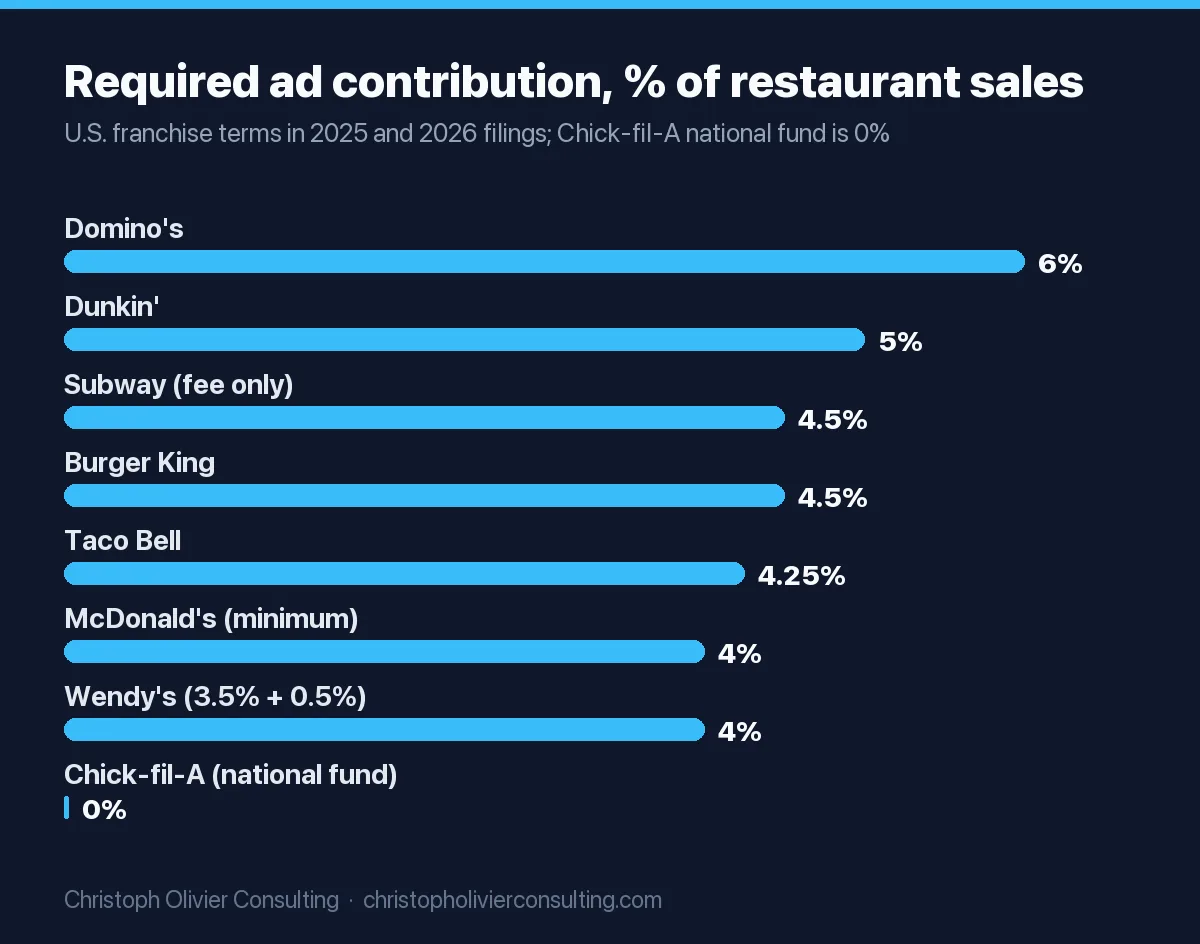
Two columns matter. “Required ad contribution” is the share of each restaurant’s sales that the franchise agreement sends to advertising. “Dollars disclosed” is what the filing actually reports, under the company’s own line-item name. They measure different things, so do not rank brands on the dollar column alone.
| Brand (owner) | Required ad contribution | Dollars disclosed, exact line item | Fiscal year | Source |
|---|---|---|---|---|
| McDonald’s | Not less than 4% of gross sales (U.S.); OPNAD national fund pledge currently 2.25% | $341 million company-store contributions to ad co-ops; $88 million production and other marketing in SG&A. Franchisee co-op spend: not disclosed | 2025 | 10-K, FDD |
| Taco Bell (Yum! Brands) | 4.25% of gross sales (U.S.) | $754 million “franchise contributions for advertising and other services” | 2025 | 10-K, FDD |
| Wendy’s | 3.5% national + 0.5% local = 4.0% (U.S.) | $422.6 million “advertising funds expense”; $40.3 million company-store advertising in cost of sales | 2025 | 10-K |
| Chick-fil-A (private) | 0% national fund since July 1, 1989 (FDD allows up to 3.25%) | $267.9 million “total advertising expenses” | 2025 | FDD, audited financials |
| Domino’s | 6.0% of sales (U.S.) | $559.5 million U.S. franchise advertising + $32.3 million other advertising = $591.8 million | 2025 | 10-K |
| Burger King (Restaurant Brands International) | 4.5% of gross sales since Jan 1, 2025 (4.0% legacy + 0.5%) | $567 million “advertising expenses and other services”, U.S. and Canada segment | 2025 | 10-K, FDD |
| Chipotle | No franchisees, no ad fund | $364.2 million “advertising, marketing and promotional costs” | 2025 | 10-K |
| Dunkin’ (private, Inspire Brands) | 5.0% of gross sales for new restaurants | $597.8 million “franchise contributions for advertising” | 2025 | FDD, audited financials |
| Subway (private) | 4.5% of gross sales, plus a recommended 2.5% local | Not disclosed in dollars | 2025 | FDD |
| Jack in the Box | About 5.0% of sales | $39.3 million company advertising costs; franchisee fund spend not broken out | FY ended Sep 28, 2025 | 10-K |
The pattern: the brands that consolidate their ad funds (Yum!, Wendy’s, Domino’s, Restaurant Brands) show the franchisee money as revenue and expense, so their dollar figures look large. McDonald’s does not consolidate its co-ops, so its reported figure looks small even though its system budget is the largest in the category.
McDonald’s marketing budget: at least 4% of U.S. sales, about $2.2 billion (2025)
McDonald’s does not publish a single “marketing budget”. Its 2025 10-K reports two pieces:
- $341 million of advertising in the operating costs of company-owned restaurants, “primarily” contributions to advertising cooperatives based on a percent of sales ($355 million in 2024, $347 million in 2023).
- $88 million of TV and radio production costs and other marketing expenses in SG&A ($90 million in 2024, $42 million in 2023).
The 10-K then says “significant advertising costs are incurred by conventional franchisees through contributions to advertising cooperatives”, and that McDonald’s does not consolidate those cooperatives because it does not control them. That franchisee money is the bulk of the budget, and it is not in the 10-K.
The McDonald’s USA franchise disclosure document (issued May 1, 2026, amended July 1, 2026) fills the gap. Item 6 sets “Advertising and Promotion” at “not less than 4% of Gross Sales”. Item 11 says each member of OPNAD, the franchisee-run national fund, pledges “currently 2.25% of sales”, and local co-ops set their own rates on top.
My calculation of the U.S. floor: 2025 U.S. franchised sales of $51,946 million plus U.S. company-operated sales of $3,115 million = $55,061 million. At 4%, that is about $2.2 billion. The OPNAD share at 2.25% is about $1.24 billion. Treat both as estimates: the FDD says “most” franchisees participate in the co-ops, and rates “may or may not exceed” 4%.
How much does McDonald’s spend on advertising? Why you see $445 million, $777 million and $2.2 billion
Each number counts something different:
- About $445 million (2024) is quoted by sites citing Statista. It equals the 10-K’s $355 million of company-store co-op contributions plus $90 million of production and marketing. Some pages describe the $355 million as franchisee money. The 10-K says it is the company’s own restaurants’ contribution.
- $776.8 million (2019) is McDonald’s measured U.S. media spend from Nielsen, published in the UConn Rudd Center’s Fast Food FACTS 2021. It counts ads seen in tracked media, not who paid for them. The same table shows $971.8 million in 2012, a 20% drop.
- About $2.2 billion (2025) is the U.S. minimum the franchise agreement requires, by my calculation above. It is the closest public number to a system-wide budget.
Taco Bell marketing budget: 4.25% of sales, $754 million from franchisees (2025)
The 2026 Taco Bell FDD (issued March 26, 2026) requires franchisees to pay a marketing fee of 4.25% of gross sales into the Taco Bell National Advertising Fund Administration (NAFA). Taco Bell says it “currently” contributes 4.25% of sales from its U.S. company-owned units too. New-unit incentive programs can waive the fee for one to four years or cut it to 2.25% for a year.
Yum! consolidates the cooperatives it controls, so the money shows up in its 2025 10-K. The Taco Bell Division recorded $754 million of “franchise contributions for advertising and other services” ($740 million of it in the U.S.) and $750 million of matching expense. “Other services” means the line is not pure advertising. On Taco Bell system sales of $18,361 million, $754 million is 4.1% (my calculation).
The FDD also shows how the fund was spent in fiscal 2025: 74.0% on media placement, 22.9% on producing ads and promotional materials, 3.0% on customer marketing and activation, 0.1% on general and administrative costs. For context, Nielsen measured $377.5 million of Taco Bell media in 2019, up 37% from 2012, per the Rudd Center report.
Across all of Yum! Brands (KFC, Taco Bell, Pizza Hut, Habit), consolidated cooperative advertising expense was $1,335 million in 2025, and company restaurants booked a further $134 million of advertising.
Wendy’s advertising budget: $422.6 million ad fund spend (2025)
The Wendy’s 2025 10-K states the rate directly: as of December 28, 2025, U.S. restaurants generally contribute 3.5% of sales to national advertising and 0.5% to local and regional advertising. Canada is about 3% national and 1% local, and Quebec is 4% local only.
- Advertising funds expense: $422.6 million in 2025, down from $478.1 million in 2024. Wendy’s says the drop came from lower franchise same-restaurant sales and less company funding of incremental breakfast advertising.
- Advertising funds revenue: $422.1 million (franchisee contributions), of which $384.5 million came from Wendy’s U.S.
- Company-store advertising: $40.3 million in cost of sales.
Global systemwide sales were $13.96 billion, of which $2.06 billion international, which leaves about $11.9 billion in the U.S. (my subtraction). At 4.0%, U.S. restaurants would owe about $476 million a year (my calculation), before incentive discounts. Nielsen measured $247.0 million of Wendy’s media in 2019.
Chick-fil-A marketing budget: $267.9 million of advertising (2025), 0% from operators
Chick-fil-A is private and files no 10-K, but its franchise disclosure document includes audited financial statements. The 2026 Chick-fil-A FDD (issued March 31, 2026, amended October 2, 2026) reports:
- Total advertising expenses of about $267.9 million in 2025, $254.0 million in 2024 and $209.8 million in 2023.
- Of the 2025 figure, about $46.3 million was national advertising that franchisees chose to reimburse.
- System-wide sales of about $23.9 billion across 2,920 restaurants in 2025, and total revenue and income of $10.34 billion.
My calculation: $267.9 million is 1.1% of system-wide sales and 2.6% of Chick-fil-A’s own revenue. Compare that with 4% to 6% required by the brands above.
The reason is in Item 6 and Item 11. Operators paid 3¼% of gross receipts to an advertising fund until June 30, 1989. Since July 1, 1989, the rate has been 0% “as a matter of policy”, though Chick-fil-A reserves the right to reinstate up to 3.25%. Operators in a market can vote in a local or regional advertising fund, and Chick-fil-A does not fund local advertising. Those local funds are not audited and their totals are not disclosed, so Chick-fil-A’s full system spend is higher than $267.9 million by an unknown amount. One more detail from the FDD: the national ad fund also receives contributions from designated suppliers, up to about 33% of operator purchases from those suppliers.
Domino’s advertising budget: $591.8 million (2025), the highest rate at 6%
Domino’s U.S. stores generally contribute 6.0% of sales to the Domino’s National Advertising Fund (DNAF), a consolidated not-for-profit subsidiary, per its 2025 10-K. Advertising expense in 2025 was $559.5 million of U.S. franchise advertising plus $32.3 million funded mostly by company-owned stores, a total of $591.8 million. That is 12.0% of Domino’s $4,940.0 million total revenue (my calculation), high because Domino’s revenue counts royalties and supply chain sales, not store sales. U.S. stores also spend extra on local store marketing on top of the 6%. In 2019 Nielsen ranked Domino’s second in fast food at $441.6 million of measured media, up 131% from 2012.
Burger King marketing budget: 4.5% of sales, $567 million (2025)
The Burger King FDD (issued March 26, 2026, amended September 2, 2026) sets the U.S. advertising contribution at 4.5% of gross sales as of January 1, 2025: the 4.0% legacy rate plus 0.5% under the “Fuel the Flame” program. The Franchise Agreement requires at least 65% of contributions to go to working media, and the fund actually spent 80.0% on working media in fiscal 2025.
In the Restaurant Brands International 2025 10-K, the BK segment (U.S. and Canada) recorded $567 million of “advertising expenses and other services” on $11,578 million of system-wide sales. 2024 included $61 million of extra advertising RBI put behind the program. Across all RBI brands, consolidated advertising expense was $1,292 million in 2025.
Chipotle marketing budget: $364.2 million, 3.1% of revenue (2025)
Chipotle owns its restaurants, so there is no ad fund to untangle. The 2025 10-K reports advertising, marketing and promotional costs of $364.2 million, up from $286.0 million in 2024, a 27% increase (my calculation). That is 3.1% of $11,925.6 million revenue. The line includes the cost of free food guests earn without a purchase, so promotions sit inside the marketing number.
Dunkin’, Subway and Jack in the Box: what the filings show
Dunkin’ is owned by private Inspire Brands, but its franchisor entity’s audited statements in the 2026 Dunkin’ FDD show $597.8 million of franchise contributions for advertising in 2025. New restaurants pay a 5.0% continuing advertising fee (2.5% at special distribution outlets).
Subway discloses no dollar figure. Its 2026 FDD sets the advertising fee at 4.5% of gross sales and recommends franchisees set aside at least another 2.5% for local marketing, 7.0% in total. Nielsen measured $250.5 million of Subway media in 2019, down 58% from $595.3 million in 2012.
Jack in the Box says in its fiscal 2025 10-K that marketing fund contributions were about 5.0% of sales (Del Taco about 4.0%). Jack in the Box systemwide sales were $4,209 million, so the fund is roughly $210 million a year (my calculation). Company advertising costs were $39.3 million.
How much do fast food companies spend on advertising in total?
The most complete independent count is the Rudd Center’s Fast Food FACTS 2021, built on 2019 Nielsen data. Fast-food restaurants spent $5.0 billion on advertising in 2019, up 9% from $4.6 billion in 2012. TV took 91% of it. 274 restaurants advertised, and the 27 biggest accounted for 92% of spending.
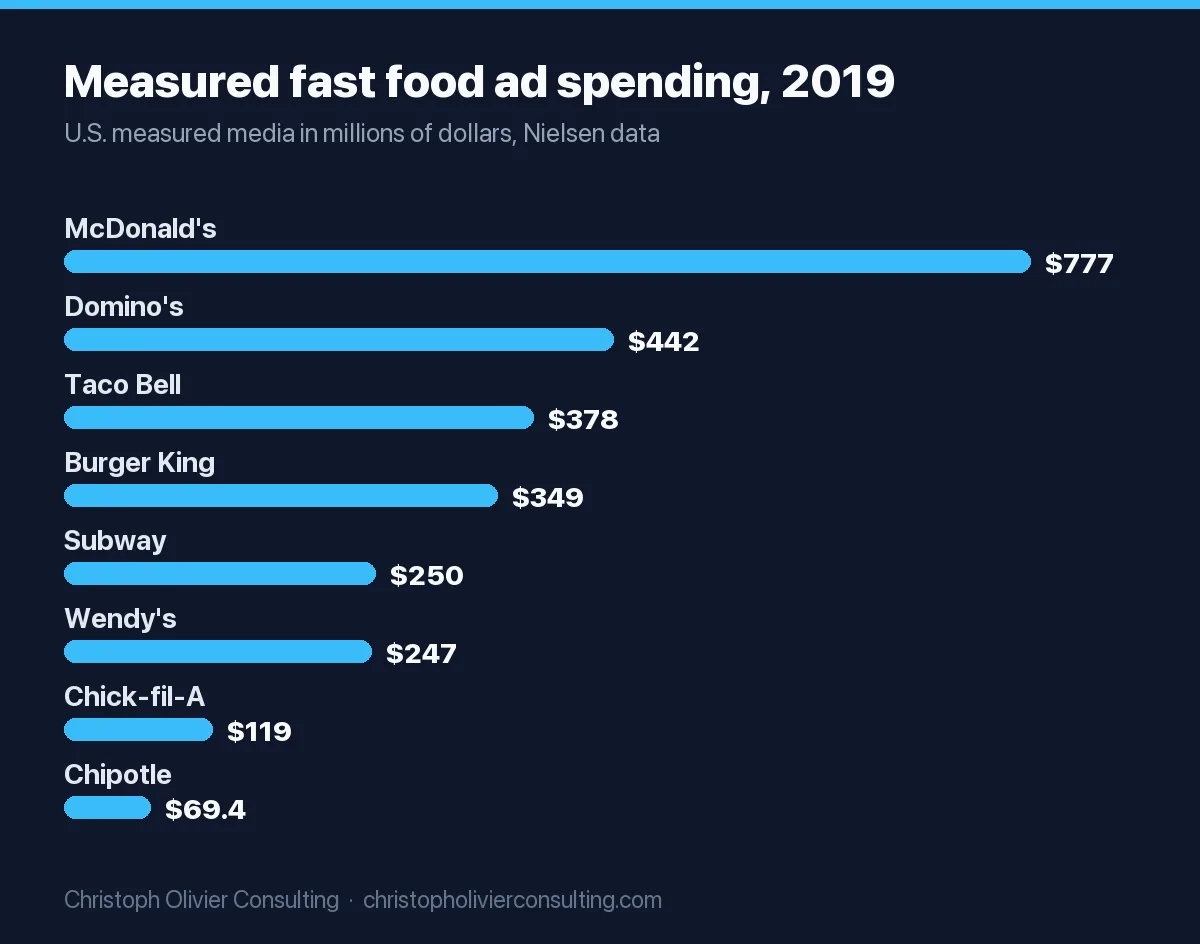
Two cautions. First, Nielsen measures media seen, so it misses most digital, social, loyalty and app spending, which is why its figures sit below the ad fund totals in the filings. Second, these are 2019 numbers. Use them to compare brands with each other, not as current budgets.
| Restaurant | Measured media 2012 | Measured media 2019 | Change |
|---|---|---|---|
| McDonald’s | $971.8M | $776.8M | -20% |
| Domino’s | $191.1M | $441.6M | +131% |
| Taco Bell | $274.7M | $377.5M | +37% |
| Burger King | $236.4M | $348.8M | +48% |
| Subway | $595.3M | $250.5M | -58% |
| Wendy’s | $274.5M | $247.0M | -10% |
| Chick-fil-A | $29.9M | $119.4M | +299% |
| Jack in the Box | $103.7M | $80.3M | -23% |
| Chipotle | $1.9M | $69.4M | +3,613% |
| All fast food (274 restaurants) | $4.6B | $5.0B | +9% |
Source: Nielsen data as published in Fast Food FACTS 2021, Ranking Table 1. Measured media in 18 media types, U.S. only.
Company spend vs franchisee ad funds: why the numbers disagree
When you see two very different numbers for the same chain, one of these four things is usually the cause:
- Who pays. Franchisees fund most fast food advertising through a percent of sales. The parent company pays only for its own restaurants plus extras such as production or one-off campaigns.
- Whether the fund is consolidated. Yum!, Wendy’s, Domino’s and Restaurant Brands control their funds and show franchisee contributions as revenue and expense. McDonald’s co-ops are franchisee-run, so they stay off its books.
- What the line includes. Yum! and RBI bundle technology fees into “other services”. Chipotle includes free food. Chick-fil-A’s figure includes $46.3 million that franchisees reimbursed.
- Measured media vs total spend. Nielsen counts ads seen in tracked media. Filings count everything the fund spends, including production, agency fees and research.
The same split explains why fast food looks cheap next to consumer brands in the big brand marketing budgets comparison: those companies pay for advertising themselves, while a restaurant franchisor passes most of the bill to operators. For how studios report their equivalent, see our breakdown of movie marketing budgets.
Where the ad fund money actually goes
Four FDDs publish how the fund was spent in fiscal 2025. This is the closest public view of a fast food media plan.
| Fund (FDD, fiscal 2025) | Media | Production | Admin | Everything else |
|---|---|---|---|---|
| Taco Bell NAFA | 74.0% | 22.9% | 0.1% | 3.0% customer marketing and activation |
| Burger King | 80.0% working media | 3.3% | Not split out | 6.9% agency fees; 9.8% research, PR, promotion development |
| Dunkin’ Advertising and Sales Promotion Fund | 35.5% | 11.5% | 17.8% | 2.6% point of purchase; 4.7% promotions; 27.9% research, sponsorships, PR, sports marketing, agency fees |
| Subway (SFAFT, U.S.) | 76% of revenue | 21% of revenue (incl. loyalty and tech) | 13% of revenue | Spent 110% of 2025 revenue using 2024 carryover |
Sources: Taco Bell, Burger King, Dunkin’ and Subway FDDs, Item 11. Categories are each company’s own and do not map one to one.
What a local restaurant or franchisee can learn from these budgets
The franchise systems above agree on a range: 4% to 6% of gross sales for brand advertising, with Subway recommending 7% once local spend is included. That is a useful benchmark for an independent restaurant too, because it is the share large chains write into their franchise agreements. Our restaurant marketing statistics and the advertising to sales ratio by industry give the wider context.
Three lessons from the filings:
- Most of the money goes to media. Taco Bell (74%) and Burger King (80%) put three quarters or more into placement. If production and agency fees eat more than a quarter of your budget, you are buying less reach than the chains do.
- Opening spend is separate. Taco Bell requires $5,000 of grand opening advertising within six months of opening, on top of the 4.25% fee. McDonald’s “strongly” recommends grand opening promotions.
- Local is on top of national. Wendy’s splits 3.5% national and 0.5% local. Domino’s stores spend on local store marketing beyond 6%. An independent has no national fund, so the whole percentage goes to the local market.
Copy-ready budget formula (fast food benchmark method)
| Line | Formula | Worked example: $1,874,000 sales |
|---|---|---|
| A. Annual gross sales | Last 12 months, excluding sales tax | $1,874,000 |
| B. Brand advertising (chain benchmark) | A × 4% to 6% | 5% = $93,700 |
| C. Working media | B × at least 65% (Burger King’s contract floor) | $60,905 minimum |
| D. Production and creative | B − C − E | Up to $28,110 |
| E. Admin and tools | B × 5% or less | $4,685 |
| F. Grand opening or relaunch (one time) | Fixed amount, separate from B | $5,000 (Taco Bell minimum) |
| G. Monthly media spend | C ÷ 12 | $5,075 |
The $1,874,000 example is the fiscal 2025 average unit volume of a franchised Jack in the Box, from its 10-K, and 5% is that brand’s fund rate. The 5% admin cap in line E is my assumption, not a chain rule. Swap in your own sales and rate. If your restaurant is not a franchise, the full B line is yours to spend locally, so read our guide to restaurant marketing strategies ranked by what you keep before splitting it across channels. Multi-unit operators balancing a national fund with local demand will find the trade-offs in franchise marketing.
In my view, the most useful number on this page is not McDonald’s $2.2 billion. It is Chick-fil-A’s 1.1% of system sales. It shows that a chain can reach $23.9 billion of system sales while its national advertising costs a fraction of the 4% to 6% its rivals require. If you want help setting your own percentage and media split, you can book a consultation.
Ready to scale your revenue?
Book a free 30-min consultation. We’ll diagnose your growth bottleneck and map out the 3 highest-leverage moves for your business.
Frequently asked questions
What is McDonald's advertising budget?
McDonald's USA requires each restaurant to spend not less than 4% of gross sales on advertising and promotion, per its 2026 franchise disclosure document. On 2025 U.S. sales of $55.1 billion, that implies at least about $2.2 billion a year (our calculation). The 2025 10-K reports only the company's share: $341 million of co-op contributions from company-owned restaurants plus $88 million of production and other marketing.
How much do fast food companies spend on advertising?
Fast-food restaurants spent $5.0 billion on measured U.S. advertising in 2019, up 9% from $4.6 billion in 2012, according to Nielsen data in the UConn Rudd Center's Fast Food FACTS 2021. TV took 91%. In franchise contracts, the major chains require 4% to 6% of each restaurant's gross sales for advertising, with Domino's highest at 6.0%.
What is Taco Bell's marketing budget?
Taco Bell franchisees pay a marketing fee of 4.25% of gross sales to its national advertising fund, per the 2026 Taco Bell FDD, and company-owned U.S. units currently contribute the same rate. Yum! Brands' 2025 10-K shows $754 million of Taco Bell franchise contributions for advertising and other services. In fiscal 2025 the fund spent 74.0% on media placement.
How much does Chick-fil-A spend on marketing?
Chick-fil-A's audited financial statements in its 2026 franchise disclosure document show total advertising expenses of about $267.9 million in 2025, up from $254.0 million in 2024. That is about 1.1% of $23.9 billion system-wide sales (our calculation). Operators have paid 0% to a national ad fund since July 1, 1989, though local operator-voted funds exist and are not disclosed.
What is Wendy's advertising budget?
Wendy's recorded $422.6 million of advertising funds expense in 2025, down from $478.1 million in 2024, plus $40.3 million of advertising at company-operated restaurants, per its 2025 10-K. U.S. restaurants generally contribute 3.5% of sales to national advertising and 0.5% to local and regional advertising, 4.0% in total.
What company has the biggest marketing budget?
Among fast food chains, McDonald's has the largest: its 4% U.S. minimum implies about $2.2 billion a year, and Nielsen ranked it first in 2019 measured media at $776.8 million. Across all industries, Amazon reported $23.5 billion of advertising and other promotional costs in 2025 in its 10-K, the largest disclosed figure we have checked.
What big companies spend on marketing