

A 30-second Super Bowl commercial for the 2027 game reportedly costs $8 million to $9 million, after Disney opened talks at $10 million and advertisers pushed back. That is airtime only. Add production, talent and the extra media networks expect you to buy, and a single spot usually lands well above $10 million all in. Below: the 2027 numbers, a year-by-year price table back to 1967, cost per second and per 1,000 viewers, and a budget worksheet you can fill in.
Short answer: Super Bowl LXI (February 14, 2027, on ESPN and ABC) is sold out, and many 30-second units reportedly sold for $8 million to $9 million each. Disney has not published a price. For the 2026 game, NBCUniversal reportedly averaged $8 million per 30 seconds, with a handful of spots above $10 million. Sources put the all-in cost of a Super Bowl commercial at $10 million to $12 million on the low end and $20 million plus on the high end.
Super Bowl commercial cost 2027: what Disney has reportedly charged
Super Bowl LXI is set for February 14, 2027 at SoFi Stadium in Inglewood, California. ESPN’s own press release (February 11, 2026) confirms the game airs on ESPN and ABC, the first Super Bowl ESPN has produced. The SoFi Stadium host committee release gives the same date and venue, and Disney+ says all its subscribers can stream it.
Disney never published a rate card. What we know comes from trade reporting, in this order:
| Date | What was reported | Price per 30 seconds | Source |
|---|---|---|---|
| April 17, 2026 | Disney asks $10 million per spot plus a $10 million “match” spent elsewhere in its portfolio; advertisers push back (four sources) | $10 million (asking, reported) | Variety |
| May 14, 2026 | Disney “backing off” the $10 million ask; more than ten 30-second units sold | Around $9 million each (reported) | ProFootballTalk, relaying Variety |
| August 5, 2026 | Disney says Super Bowl LXI is sold out: 58 brands, 34 categories, 9 first-time Super Bowl advertisers | Not disclosed by Disney | TheWrap, Marketing Brew |
| August 5, 2026 | “Many Super Bowl LXI units are thought to have instead sold in a range of $8 million to $9 million each” | $8 million to $9 million (reported) | Front Office Sports |
Two details matter if you are budgeting. First, Disney sold out about a month earlier than NBCUniversal did for the 2026 game, per Marketing Brew, so there is no 2027 inventory left to buy. Second, the “match” request means the real ask was never just the spot: Variety reported Disney wanted an equal amount spent across its other properties. ProFootballTalk’s summary says Disney was weighing counteroffers on that match, so the final terms per advertiser are not public.
How much does a 30-second Super Bowl ad cost? Prices by year
Networks rarely confirm prices, so every figure below is a reported or typical price from a named outlet. Where outlets disagree, the table shows the range. Viewer counts are Nielsen’s official totals from its Super Bowl LX release.
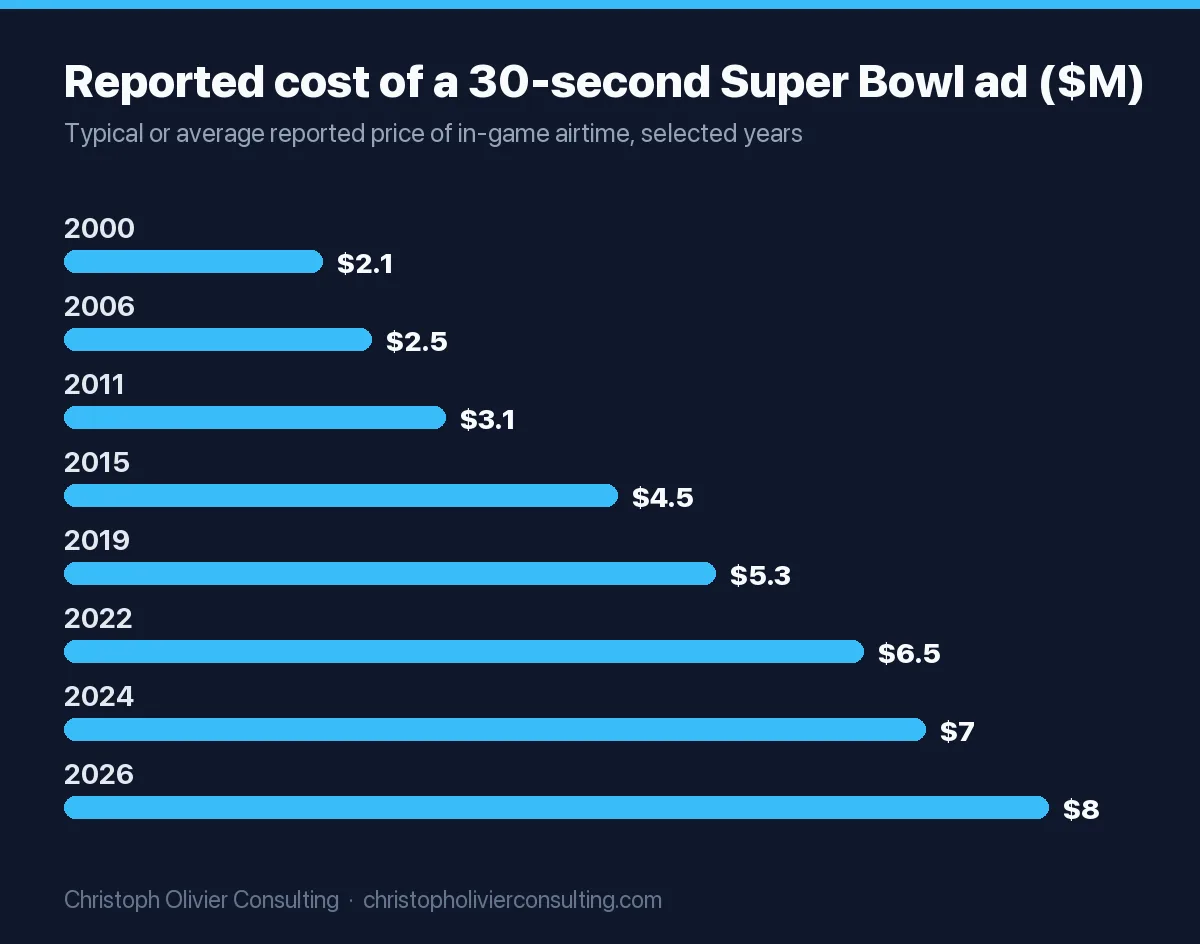
| Year | Game | Network | Reported cost of 30 seconds | Nielsen viewers | Price source |
|---|---|---|---|---|---|
| 2027 | LXI | ESPN, ABC | $8M to $9M for many units (asked $10M) | Not yet played | Front Office Sports, Variety |
| 2026 | LX | NBC | $8M average; bulk sold at $7M to $8M; a “handful” above $10M | 125.6M | TVLine, citing the Financial Times; Variety |
| 2025 | LIX | Fox | More than 10 spots at $8M; averages earlier reported above $7M | 127.7M | CNBC via NBC News |
| 2024 | LVIII | CBS | $7M average | 123.7M | CNBC, CBS News |
| 2023 | LVII | Fox | Most $6M to $7M; a few above $7M ($7M average per CNBC) | 115.1M | AP, CNBC |
| 2022 | LVI | NBC | $6.5M record; some late units at $7M | 101.5M | Reuters via Fox Business, AP |
| 2021 | LV | CBS | About $5.5M | 95.9M | Reuters via Fox Business |
| 2020 | LIV | Fox | $5.6M | 102.1M | Sports Illustrated (history table; 1967 figure credited to Ad Age) |
| 2019 | LIII | CBS | $5.3M (CBS News gives $4.5M) | 99.0M | |
| 2018 | LII | NBC | $5.0M | 104.0M | |
| 2017 | LI | Fox | $5.2M | 112.0M | |
| 2016 | 50 | CBS | $5.0M | 112.3M | |
| 2015 | XLIX | NBC | $4.5M | 114.8M | |
| 2011 | XLV | Fox | $3.1M | 111.0M | |
| 2006 | XL | ABC | $2.5M | 90.7M | |
| 2000 | XXXIV | ABC | $2.1M | 88.5M | |
| 1967 | I | CBS and NBC | $37,500 to $42,500 (sources differ) | 26.8M (CBS) + 24.4M (NBC) | Sports Illustrated, NBC Chicago |
Read the 2019 row with care: Sports Illustrated lists $5.3 million, while CBS News wrote that the price rose “from $4.5 million in 2019 to $7 million.” Both are reported figures, not network invoices. The 2006 ABC price matches Variety’s note that ABC sought about $2.5 million the last time it carried the game.
Super Bowl ad cost per second
Divide the 30-second price by 30. These are my calculations from the reported prices above, not rates any network sells.
| Price basis | Per second (own calc) | 15 seconds, pro rata | 60 seconds, pro rata | 90 seconds, pro rata |
|---|---|---|---|---|
| 2027 low end, $8M reported | $266,667 | $4.0M | $16.0M | $24.0M |
| 2027 high end, $9M reported | $300,000 | $4.5M | $18.0M | $27.0M |
| 2027 Disney ask, $10M | $333,333 | $5.0M | $20.0M | $30.0M |
| 2026 average, $8M reported | $266,667 | $4.0M | $16.0M | $24.0M |
| 2015, $4.5M | $150,000 | $2.25M | $9.0M | $13.5M |
How much does a 15-second Super Bowl commercial cost?
No network has published a 15-second Super Bowl price, and I found no credible report of one. The 30-second unit is the standard trade currency, so the pro rata column above is only a ceiling for planning, not a quote. If you are considering a shorter cut for the extended campaign, Kantar’s February 2026 study of Ritz’s 2025 Super Bowl ad found 15-second and 30-second versions produced comparable brand lift overall, with the 30-second cut doing better on linear TV and Prime Video.
Cost per 1,000 viewers: price vs audience
The fairer way to judge the price is cost per thousand viewers (CPM): the 30-second price divided by Nielsen’s audience in thousands. My calculation, using the reported prices and Nielsen totals:
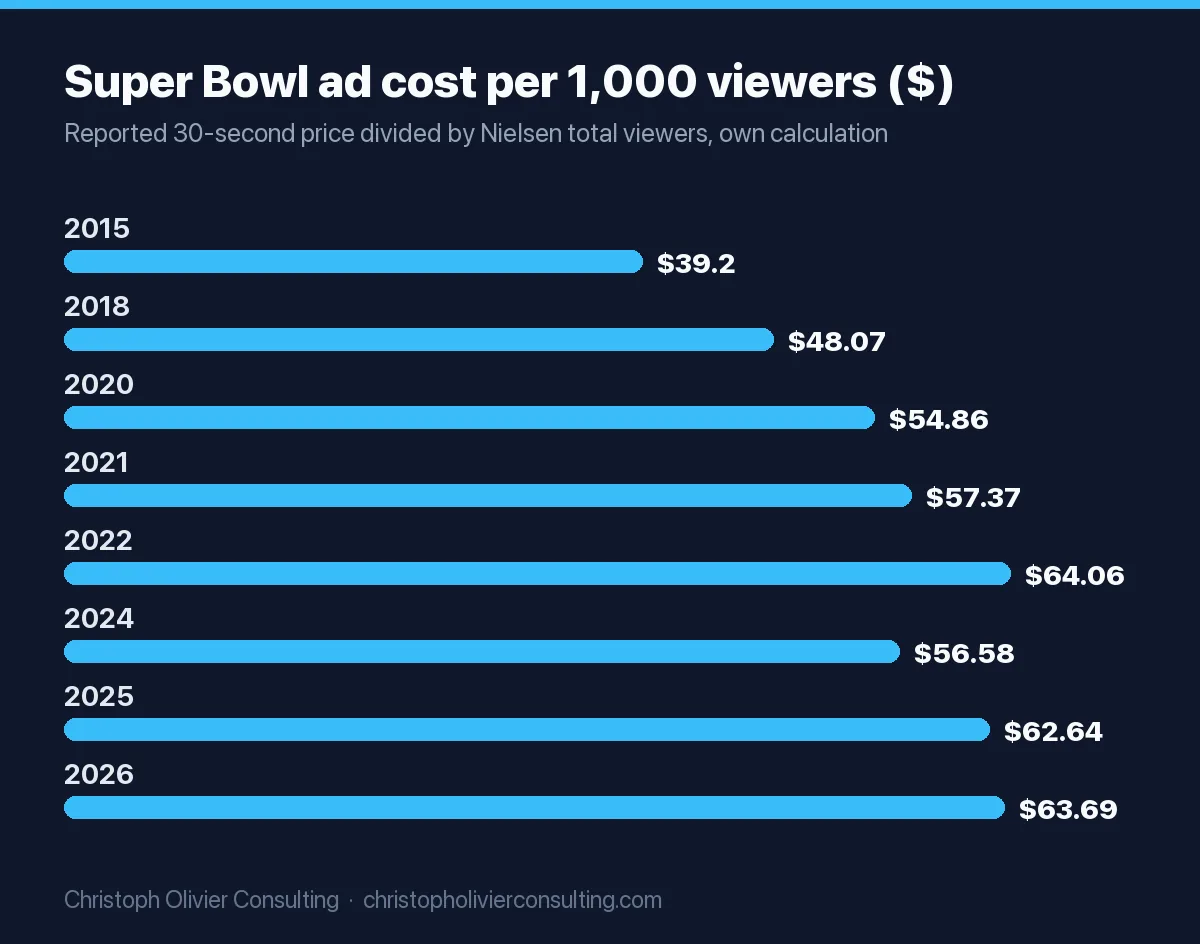
| Year | Reported price used | Nielsen viewers | Cost per 1,000 viewers (own calc) |
|---|---|---|---|
| 2015 | $4.5M | 114,810,000 | $39.20 |
| 2018 | $5.0M | 104,016,000 | $48.07 |
| 2020 | $5.6M | 102,086,000 | $54.86 |
| 2021 | $5.5M | 95,877,000 | $57.37 |
| 2022 | $6.5M | 101,470,000 | $64.06 |
| 2023 | $7.0M | 115,096,000 | $60.82 |
| 2024 | $7.0M | 123,714,000 | $56.58 |
| 2025 | $8.0M | 127,713,000 | $62.64 |
| 2026 | $8.0M | 125,603,000 | $63.69 |
| 2027 scenario | $8M to $9M | If equal to 2026 | $63.69 to $71.65 |
The pattern: the sticker price nearly doubled from 2015 to 2026, but audiences grew too, so cost per viewer rose far less. The 2022 game was the most expensive per viewer in this set because NBC raised the price while the audience was near 100 million. From 2023 through 2026, bigger audiences held CPM between about $56 and $64. Two caveats. Nielsen counts out-of-home viewing only from 2021 on and switched to Big Data plus Panel measurement for 2026, so years are not perfectly comparable. And a 2027 figure depends on an audience nobody has measured yet.
Average Super Bowl commercial budget: airtime is only part of it
When people search “Super Bowl ad budget,” they usually mean the airtime price. Brands budget for much more. The Hollywood Reporter (Alex Weprin, February 7, 2025) reported that sources put the all-in cost for a Big Game commercial at “$10 million to $12 million on the low end, and $20 million plus on the high end,” with A-list stars earning $3 million to $5 million and hit music usually adding six figures. Use this worksheet to build your own number:
| Line item | Lean scenario | Heavy scenario | Where the figure comes from |
|---|---|---|---|
| 30 seconds of in-game airtime (2027) | $8.0M | $9.0M | Reported range, Front Office Sports |
| Required spend on other network inventory (“match”) | Negotiated, not public | Up to $10.0M asked | Disney’s opening ask, Variety |
| Celebrity talent | $0 (no star) or a cameo | $3M to $5M per A-list star | The Hollywood Reporter |
| Music licensing | Original score | Six figures for a hit song | The Hollywood Reporter |
| High-end production (shoot, CGI, post) | Fill in from agency bid | $4M to $10M (commentary estimate) | Fortune op-ed, Richard Torrenzano |
| Teasers, social, PR, hospitality, staff time | Fill in | Fill in | Named as hidden costs in the same Fortune op-ed; no public benchmark |
| All-in, per reporting | $10M to $12M | $20M plus | The Hollywood Reporter (2025 game) |
Worked example, using only the figures above: one 2027 spot at $8.5 million (midpoint of the reported range, my assumption), one A-list star at $4 million (midpoint of THR’s range) and $4 million of production (low end of the Fortune estimate) totals $16.5 million before any required network match or launch campaign. That is consistent with THR’s $10 million to $20 million plus band. To see how that compares with what the biggest advertisers spend in a year, our breakdown of big brand marketing budgets puts a $16.5 million spot next to the annual ad totals Nike, Coca-Cola and Amazon report.
How much does the average Super Bowl commercial cost to make?
There is no audited average. The credible public range is the THR reporting above: talent at $3 million to $5 million for an A-list star, music in the six figures, plus production that a Fortune commentary put at $4 million to $10 million for a high-end ad. Brands that skip celebrities and big licensing can produce for far less, but no outlet has published a verified floor. Treat any single “average production cost” number online as an estimate unless it names who measured it.
What is the most expensive Super Bowl ad ever?
On a per-30-second basis, the record is the 2026 game: NBCUniversal’s Mark Marshall said the company sold a “handful” of spots for more than $10 million, per Variety and TVLine. NBC did not name the buyers. For a single long buy, CBS News cited a GoBankingRates estimate that Amazon’s and Google’s 90-second ads in 2020 cost about $16.8 million each; that is an estimate, not a disclosed price. Talent can be the biggest line: THR cited a reported $10 million payday for Larry David’s FTX ad.
For context on the first game: Nielsen shows Super Bowl I aired on both CBS (26.75 million viewers) and NBC (24.43 million), and 30 seconds cost $37,500 to $42,500 depending on the source. The 2026 average of $8 million is about 190 to 210 times that in nominal dollars (my calculation from $42,500 and $37,500).
Which companies disclose what they spent?
Almost none put a dollar figure in their filings. A full-text search of SEC filings since 2023 turns up mentions, not amounts:
- Coinbase: its Q1 2026 10-Q says offline advertising rose “primarily relating to our Super Bowl commercial,” without a figure.
- Hologic: its 10-Q for the quarter ended April 1, 2023 says selling and marketing fell partly because the prior year included “spend on our Super Bowl commercial.”
- Squarespace: its Q3 2023 10-Q mentions “amortization of the Super Bowl advertising” in prepaid expenses.
- Rocket Companies: its 2022 10-K notes its 2022 spot ranked first on USA Today’s Ad Meter.
Press estimates fill the gap for some brands. Temu, for example, reportedly spent about $14 million in 2023 and an estimated $21 million in 2024; our analysis of Temu’s advertising spend lays out those sources against its filings. For a brewer’s view, our comparison of Anheuser-Busch’s marketing budget shows the annual totals its game-day ads sit inside.
The cheaper way in: local Super Bowl spots
National units are sold out, but local affiliates sell their own breaks in the game. Gray Media, which owns stations across the country, discloses its take. Its Q1 2025 10-Q reports about $18 million of net Super Bowl revenue across 54 CBS stations in 2024 and about $9 million on its Fox stations in 2025. Its Q1 2026 10-Q reports about $10 million across 54 NBC and 47 Telemundo channels for 2026. Spread over 54 CBS stations, the 2024 figure averages about $333,000 per station for all local game inventory (my calculation), which shows local spots sell in a very different price tier from the national unit. Ask your local ABC affiliate for 2027 availability; Gray did not publish per-spot rates.
Do companies profit from Super Bowl commercials?
Some do, and the evidence is mixed. The most cited independent work is a Stanford GSB study by Wesley Hartmann and Daniel Klapper, summarized by Stanford in 2015. Using Nielsen sales data across 55 markets and six Super Bowls, it estimated Budweiser earned an extra $96 million in revenue from its ads, a 172% return, but found that when two major soda brands both advertise, “they receive no profit gain to offset their advertising investments.”
Vendor research is more upbeat. Kantar’s 2024 Creative Effectiveness Report says the previous year’s Super Bowl ads delivered an average ROI of $5.20 per dollar spent. Kantar sells creative testing, and the figure is modeled, so weigh it accordingly. Ad data firm EDO told CNBC the 2024 game was 224% more effective than average primetime, and GroupM estimated in-game ad revenue for that game at about $550 million.
My read: the spot pays when the brand already has national distribution, a reason to be remembered, and a follow-on budget to convert the attention. It rarely pays as a one-off stunt. The same logic applies to film launches, where the Super Bowl trailer is one line in a much larger plan; see how studios spread spend in our table of movie marketing budgets.
Should your brand buy one? A pass/fail check
These thresholds are my rules of thumb, not industry standards. Score each one honestly.
- Total budget test. Pass if the all-in number ($10M to $20M plus, per THR) is under roughly a quarter of your annual paid media. Fail if it would consume most of the year.
- Distribution test. Pass if a viewer anywhere in the US can buy from you within a week. Fail if you are regional or waitlisted.
- Category clash test. Pass if your direct rival is not also in the game. The Stanford soda finding is the warning.
- Follow-through test. Pass if you have funded search, social and retail support for at least four weeks after the game. Fail if the spot is the campaign.
- Timing test. Pass if you can commit during the spring upfront season. Disney sold 2027 out by August 2026, and Variety notes Fox and NBC typically sold 40% to 60% of their game inventory before the upfronts even started.
If you fail two or more, test cheaper ways to borrow the moment first, such as a local in-game spot on your ABC affiliate. To size that budget properly, start with our guide on how to set a marketing budget, or book a consultation if you want a second opinion on a big-event buy.
Ready to scale your revenue?
Book a free 30-min consultation. We’ll diagnose your growth bottleneck and map out the 3 highest-leverage moves for your business.
Frequently asked questions
How much does a 30-second Super Bowl ad cost in 2027?
Disney has not published a price. Front Office Sports reported that many Super Bowl LXI units sold for $8 million to $9 million each after Disney opened at $10 million plus a $10 million spending match, according to Variety. Disney said on August 5, 2026 that the game is sold out, with 58 brands across 34 categories.
How much was a 30-second commercial in Super Bowl 2026?
NBCUniversal reportedly sold Super Bowl LX spots at an average of $8 million per 30 seconds, according to TVLine citing the Financial Times. Variety reported the bulk sold for $7 million to $8 million, and NBCUniversal's ad chief said a handful went for more than $10 million, the highest reported 30-second prices so far.
What is the Super Bowl ad cost per second?
At the reported 2027 range of $8 million to $9 million for 30 seconds, airtime works out to about $266,667 to $300,000 per second. At Disney's $10 million opening ask it would be $333,333 per second. These are simple divisions of reported prices; networks do not sell airtime by the second.
What is the average Super Bowl commercial budget all in?
The Hollywood Reporter reported in February 2025 that sources put the all-in cost of a Big Game commercial at $10 million to $12 million on the low end and $20 million plus on the high end. That covers airtime and talent; A-list stars were reported at $3 million to $5 million, and hit music licenses usually add six figures.
Do companies profit from Super Bowl commercials?
Sometimes. A Stanford GSB study using Nielsen sales data estimated Budweiser earned a 172% return on its Super Bowl ads, but found competing soda brands that both advertised saw no profit gain. Kantar, which sells ad testing, reported an average modeled ROI of $5.20 per dollar for 2023 game ads. Results depend on category rivalry and follow-up spend.
Who is airing Super Bowl LXI in 2027?
ESPN and ABC will televise Super Bowl LXI on February 14, 2027 from SoFi Stadium in Inglewood, California, according to ESPN's press release. It is the first Super Bowl produced by ESPN and ABC's first since Super Bowl XL in 2006. Disney+ says all its subscribers can stream the game.
What big companies spend on marketing