

The most useful mortgage advertising examples come in two kinds: brand ads that worked (Rocket Mortgage’s Super Bowl spots, UWM’s broker campaigns, Better Mortgage’s train posters) and ads that drew CFPB penalties (“HUD-Approved” mailers, fake “Economic Stimulus Program” deadlines, ARMs sold as “fixed”). Side by side, they teach the rules: one clear promise, terms you will honor, and full disclosures the moment you mention a rate, payment, down payment or loan term.
Below: 16 real examples with sources, the rules section by section (Regulation Z 12 CFR 1026.24 and its official commentary, the MAP Rule in 12 CFR 1014, NMLS ID, fair housing and RESPA), a rewrite table and copy-ready templates. This is general information, not legal advice; have compliance or counsel review final copy for your state.
Short answer: A mortgage ad may only show terms the lender will actually offer, and any rate must be stated as an “annual percentage rate” (Reg Z 1026.24(a) and (c)). Four trigger terms (down payment, number of payments or loan term, payment amount, finance charge) require you to add the down payment, the full repayment terms and the APR (1026.24(d)). Regulation N bans 19 types of misrepresentation and requires you to keep copies of your ads for 24 months (12 CFR 1014.3 and 1014.5).
16 mortgage advertising examples at a glance
Rows 1 to 8 are brand campaigns you can learn from. Rows 9 to 16 are ads the CFPB found deceptive, which teach just as much. Penalties are civil money penalties as stated in each CFPB release.
| # | Lender | Channel | Year | Message | Lesson for your ads |
|---|---|---|---|---|---|
| 1 | Quicken Loans (Rocket Mortgage) | Super Bowl 50 TV spot | 2016 | “Push Button, Get Mortgage” (Money) | Speed claims invite a “too fast?” backlash; say what is fast |
| 2 | UWM | First Super Bowl spot, FindAMortgageBroker.com | 2020 | Brokers give a “faster, easier, more affordable” mortgage (HousingWire) | Comparative claims need proof on file |
| 3 | UWM | Super Bowl spot “The Perfect Match” | 2021 | Dating-app parody: find your broker match (HousingWire) | Borrow a format the viewer already knows |
| 4 | Rocket Mortgage | Two 60-second Super Bowl spots with Tracy Morgan | 2021 | Why it is smart to use Rocket when buying a home (HousingWire) | Brand ads can carry zero rate terms and zero triggers |
| 5 | Rocket | 60-second Super Bowl spot plus live stadium singalong | 2025 | “Own the Dream,” set to “Take Me Home, Country Roads” (NMP) | Sell the meaning of home, not the loan |
| 6 | Rocket and Redfin | 60-second Super Bowl LX spot, Lady Gaga | 2026 | A campaign “centered on home, community and connection” (Rocket Companies) | Tie the mortgage to the whole move: house, street, neighbors |
| 7 | UWM (Mortgage Matchup) | National TV, streaming, digital, social | 2026 | Borrowers have more options than 30 years and 20% down (NMP) | Bust a myth without quoting a single term |
| 8 | Better Mortgage | 840 posters on PATH trains, tracked URL | 2017 | better.com/PATH, aimed at New Jersey commuters (OAAA case study) | Advertise only where you are licensed, and track it |
| 9 | Flagship Financial Group | Direct mail, 1M+ pieces | 2011 to 2012 (order 2015) | Called itself “HUD-Approved”; $225,000 (CFPB) | Never imply a government tie you do not have |
| 10 | American Preferred Lending | Direct mail, 100,000+ pieces | 2011 to 2013 (order 2015) | “FHA-approved lending institution” logo, www.FHAdept.us; $85,000 (CFPB) | Your domain and logo are claims too |
| 11 | All Financial Services | Reverse mortgage mailer, ~200,000 recipients | 2011 to 2012 (suit 2015) | Eagle like the Great Seal, “GOVERNMENT LENDING DIVISION” (CFPB allegations, CFPB) | Design that mimics a notice is a misrepresentation |
| 12 | Sovereign Lending Group | VA direct mail | 2020 order | ARM called “fixed,” false prequalification; $460,000 (CFPB) | “Fixed” and “prequalified” are regulated words |
| 13 | Prime Choice Funding | VA direct mail | 2020 order | VA- or IRS-associated words and designs, misleading comparisons; $645,000 (CFPB) | Comparisons must use full-term terms |
| 14 | Service 1st Mortgage | Direct mail, millions of pieces | 2020 order | “Skip” two payments, “Economic Stimulus Program” deadline; $230,000 (CFPB) | Fake urgency is a misrepresentation |
| 15 | ClearPath Lending | VA direct mail | 2020 order | “Fixed” on ARMs, current lender’s name; $625,000 (CFPB) | Name the borrower’s lender only with a clear “not affiliated” line |
| 16 | Low VA Rates | VA direct mail | 2020 order | “Eliminate debt” claims, misstated APRs; $1,800,000 (CFPB) | Claims stack: this one order listed seven separate problems |
National mortgage brand ads: what they ran and why it works
The best brand ads leave out rates. A spot about home, speed or choice states no trigger term, so it needs no disclosure block. Copy that split in your own mortgage marketing: brand ads sell the idea, rate pages carry the terms.
Quicken Loans, “Push Button, Get Mortgage” (Super Bowl 50, 2016)
Quicken’s first Super Bowl ad launched Rocket Mortgage with the voiceover “What if we did for mortgages what the Internet did for buying music and plane tickets and shoes?” (Money, Feb. 8, 2016). Critics heard echoes of the pre-2008 boom, and the CFPB tweeted during the game that consumers should “take your time.” The fast part was the online application; closing still took weeks (Yahoo Finance).
Lesson: if you sell speed, name the step that is fast (“decision on your application in [X] hours”) so readers do not hear “no underwriting.”
UWM, FindAMortgageBroker.com (Super Bowl 2020) and “The Perfect Match” (2021)
UWM’s first Super Bowl spot opened with a dig at its rival (playing with rockets is fun as a kid, less so as an adult), then claimed brokers deliver a “faster, easier, more affordable” mortgage (HousingWire, Jan. 31, 2020). The 2021 follow-up parodied online dating to cast the broker as the borrower’s match (HousingWire, Feb. 1, 2021).
Lesson: “more affordable” is a claim about cost, and Regulation N bans material misrepresentations about rates and fees (1014.3(b) and (c)). Keep the data behind any comparison on file.
Rocket Mortgage, Tracy Morgan spots (Super Bowl 2021)
Two 60-second commercials featured Tracy Morgan, athletes and influencers on why it is smart to use Rocket when buying a home. HousingWire called it Rocket’s fourth Super Bowl and estimated the cost near $20 million (HousingWire).
Lesson: no rate, no payment, no term means no Reg Z trigger. Let landing pages do the disclosure work.
Rocket, “Own the Dream” (Super Bowl LIX, 2025)
Set to “Take Me Home, Country Roads,” the 60-second ad showed people returning home, then the broadcast cut to fans in the stadium still singing live (NMP, Feb. 10, 2025). Rocket says it won a Cannes Gold Lion and was “viewed nearly 250 million times on social media” (company figure, Rocket Companies).
Lesson: one shared moment beats a feature list. The local version is sponsoring the hometown event people already show up for.
Rocket and Redfin, “America Needs Neighbors Like You” (Super Bowl LX, 2026)
After buying Redfin, Rocket put both brands in one 60-second spot with Lady Gaga singing “Won’t You Be My Neighbor?”, Redfin’s first Super Bowl appearance in 20 years (Rocket Companies; GeekWire).
Lesson: a lender and a brokerage can advertise together; RESPA looks at who pays for what (see the broker rules below).
UWM Mortgage Matchup, “cookie-cutter mortgage” (2026)
In October 2026, UWM’s consumer brand launched a national TV, streaming, digital and social campaign against one myth: that 30 years and 20% down is the only path. An in-house “cookie-cutter mortgage” character carries it (NMP, Oct. 21, 2026).
Lesson: a myth-busting ad needs care. “30-year” is a payment-period trigger and “20% down” a down payment figure under the commentary to 1026.24(d)(1). Naming them as a myth to reject, not as an offer, is a judgment call worth running past compliance. Once you say “3% down available,” you are clearly stating a down payment term.
Better Mortgage, PATH train posters (2017)
Better Mortgage, based in New York City, could serve New Jersey homeowners but not New York City residents, so it bought PATH trains between the two: 840 commuter cards for four weeks from Aug. 28, each with the tracking address better.com/PATH. It renewed two weeks in, spent $23,000 in 2017 and committed $52,000 for 2018 (OAAA case study).
Lesson: media choice is a licensing decision. Advertising that you can take applications counts as engaging in the business of a loan originator (12 CFR 1008.103(b)(2)), so target only licensed states.
What a national mortgage lender spends on advertising
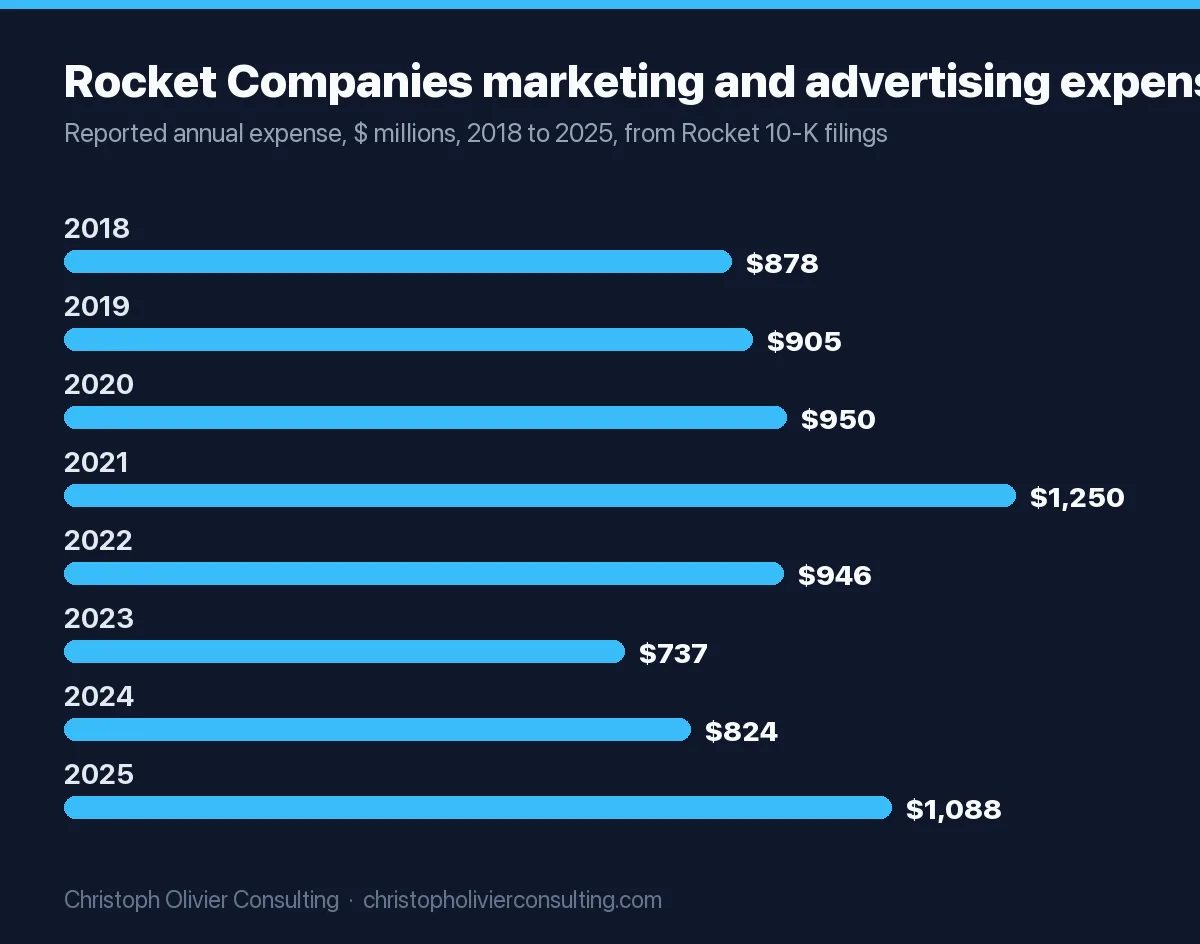
Rocket Companies reported $1.088 billion of marketing and advertising expense for 2025, up 32% from $824 million, “primarily driven by the launch of our unified Rocket brand restage, as well as an increase in performance marketing associated with higher origination volume” (Rocket 2025 Form 10-K). The line peaked at $1.25 billion in 2021 and bottomed at $737 million in 2023 (SEC EDGAR data). Spend tracks volume, which is why your cost per click matters more than a fixed annual budget.
Mortgage ads that drew CFPB penalties
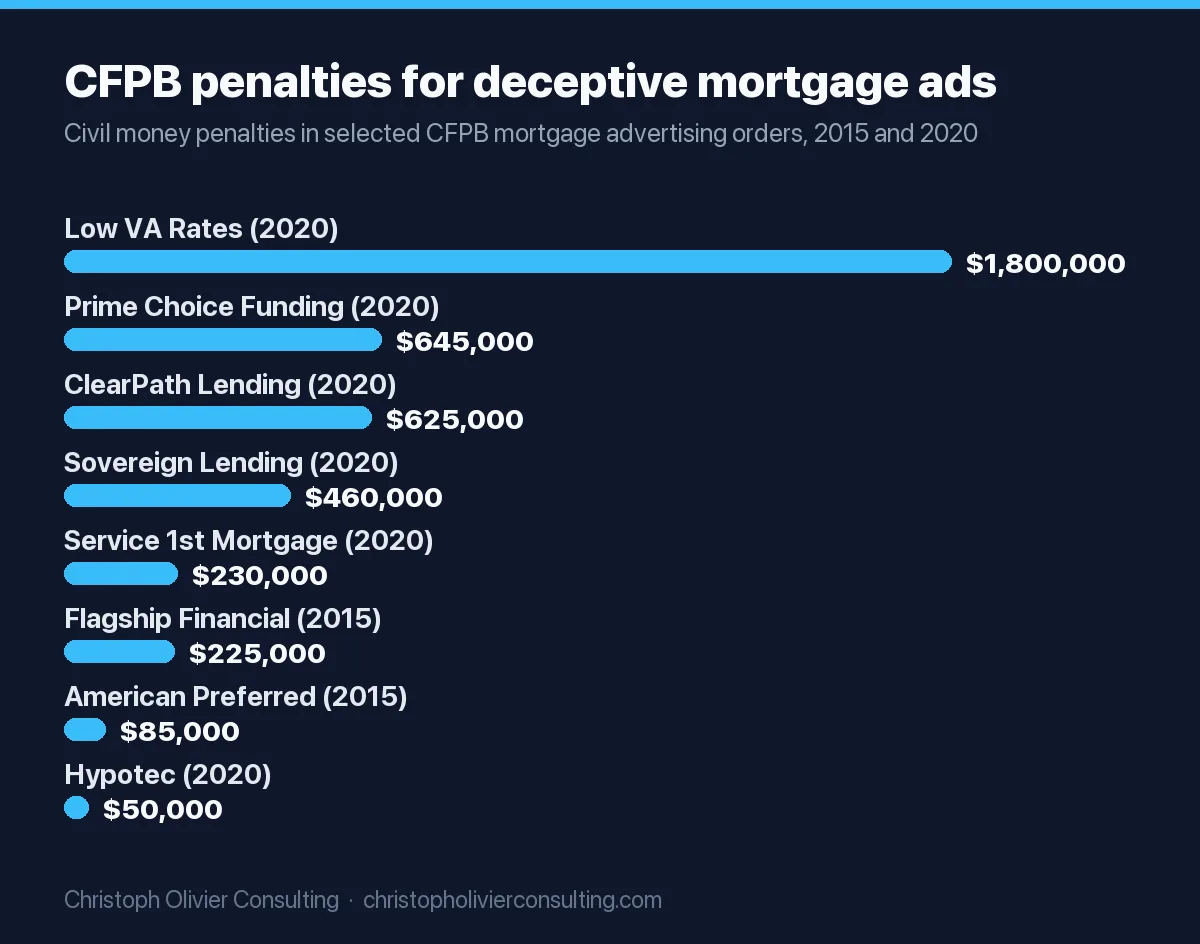
In 2015 the CFPB and FTC reviewed about 800 randomly selected mortgage ads across newspapers, the internet and mail, then brought three government-affiliation cases (CFPB, Feb. 12, 2015). Five years later a sweep of VA loan mailers produced nine orders and more than $4.4 million in penalties, ending with Low VA Rates in October 2020 (CFPB).
Government look-alike mailers (2015)
Flagship Financial Group called itself “HUD-Approved” in more than one million mailers and headed others “PURSUANT TO THE FEDERAL HOUSING ADMINISTRATION (FHA) HUD No. 12-045.” American Preferred Lending used an “FHA-approved lending institution” logo and www.FHAdept.us. All Financial Services was sued over an eagle resembling the Great Seal; that complaint was an allegation, not a finding (CFPB).
The 2020 VA mailer sweep
The orders repeat the same faults: terms the company “was not actually prepared to offer,” ARMs labeled “fixed,” VA or IRS style design, the current lender named without a disclaimer, and missing disclosures. Service 1st promised borrowers could “skip” two payments without saying they were added to principal, and it and Hypotec claimed an “Economic Stimulus Program” would end soon (Service 1st; Hypotec). Like most false advertising examples, the claim that sells hardest is the one a regulator reads first.
Mortgage advertising rules in Regulation Z (12 CFR 1026.24)
Section 1026.24 is the core of the CFPB mortgage advertising rules for closed-end loans. Home equity lines of credit fall under the open-end advertising section, 1026.16. The basics:
- Actually available terms, 1026.24(a). No “very low annual percentage rate that will not in fact be available at any time.” Limited-time offers are fine.
- Rates as APR, 1026.24(c). Any rate appears as an “annual percentage rate” or “APR,” plus the fact it can rise if it can. A simple interest rate may sit beside it, never more conspicuously.
- Clear and conspicuous, 1026.24(b). Same type size counts as “equally prominent”; immediately next to, above or below the triggering figure counts as “close proximity.” Unreadable TV fine print and rushed radio disclosures fail (comments 24(b)-2 to 24(b)-5).
Mortgage ad trigger terms and what each one requires
Under 1026.24(d), four terms trigger three extra disclosures: the down payment, the terms of repayment over the full term including any balloon, and the APR (plus the fact that it can rise). The trigger also fires when the term can be “readily determined,” so “80 percent financing available” signals a 20% down payment (comment 24(d)-1). Examples below are quoted from the official commentary.
| Trigger term, 1026.24(d)(1) | Triggers, per the commentary | Does not trigger | Extra rule for dwelling-secured loans |
|---|---|---|---|
| (i) Down payment amount or percentage | “Only 5% down,” “As low as $100 down” | “No downpayment” (the trigger needs a down payment to actually be required) | Commentary ties this trigger to credit sales; the cautious approach is to disclose anyway |
| (ii) Number of payments or repayment period | “30-year mortgage,” “48-month payment terms” | “Take years to repay,” “monthly payment terms arranged” | Repayment terms must cover the full term, not an intro period |
| (iii) Payment amount | “$500,000 loan for just $1,650 per month” | “Monthly payments to suit your needs” | Show each payment and its period with equal prominence, and say taxes and insurance are not included (1026.24(f)(3)) |
| (iv) Finance charge amount | “$50,000 mortgages, 2 points to the borrower” | An APR alone, or “no closing costs” | “No closing costs” is still a Reg N claim if fees exist (1014.3(c)) |
| Not a 24(d) trigger, but covered: a rate | “5.99%” | State the APR (24(c)); if more than one rate applies, list each rate, its period and the APR (1026.24(f)(2)) |
Worked example: disclosing a payment the compliant way
Advertising a payment on a $400,000, 30-year fixed loan at 6.50% interest? My calculation with the standard amortization formula gives $2,528.27 principal and interest, about $6.32 per $1,000 borrowed (the commentary allows that “unit-cost approach,” comment 24(d)(2)-2.i). A compliant version:
Illustrative template: “$2,528 a month principal and interest on a $400,000 30-year fixed loan: 360 payments of $2,528.27 at 6.50% interest, [X.XX]% APR, [X]% down. Payment does not include taxes and insurance; your actual payment will be higher. Example only, as of [date]; rates change daily.”
That covers 1026.24(d)(2) (down payment, full repayment terms, APR) and 1026.24(f)(3)(i)(C) (taxes and insurance). The commentary says examples “must be labeled as such and must reflect representative credit terms” you actually offer (comment 24(d)(2)-5).
The seven banned practices in 1026.24(i)
| Section | Prohibited in dwelling-secured loan ads | Who got caught |
|---|---|---|
| 24(i)(1) | “Fixed” on an ARM unless “Adjustable-Rate Mortgage,” “Variable-Rate Mortgage” or “ARM” appears first, at least as conspicuously, and each “fixed” states how long and that the rate may then change | Sovereign, ClearPath |
| 24(i)(2) | Comparing a current payment or rate with a teaser rate that lasts less than the full term, unless the full 24(f) disclosures are compared too | Prime Choice, Low VA Rates |
| 24(i)(3) | Calling a product a “government loan program” or “government-supported loan” unless it is FHA, VA or a similar real program | Flagship, American Preferred (2015 government-affiliation cases) |
| 24(i)(4) | Using the borrower’s current lender’s name without equally prominent own name and a clear “not associated with” statement | Sovereign, ClearPath |
| 24(i)(5) | Misleading claims that the loan will eliminate debt or get existing obligations waived or forgiven | Low VA Rates |
| 24(i)(6) | Calling a for-profit broker, lender or their staff a “counselor” | |
| 24(i)(7) | Giving teaser terms in a foreign language while the fully indexed rate or full payment appears only in English |
Format rules: TV and radio may state the APR and give a toll-free number for the rest (1026.24(g)). Websites may put full terms in one table if every trigger term elsewhere links to it (1026.24(e), comment 24(e)-4). Linked banner and pop-up ads skip the 24(f) detail (1026.24(f)(4)). Ads saying a loan can exceed the home’s value need a tax-deductibility warning (1026.24(h)).
CFPB mortgage advertising rules beyond Reg Z: the MAP Rule
Regulation N applies to any “commercial communication” about a consumer mortgage, including web pages, mailers, telemarketing scripts and “any other medium” (12 CFR 1014.2). Section 1014.3 bans material misrepresentation, “expressly or by implication,” on 19 subjects. The ones marketers trip over:
- (b) rates and (c) fees, “including but not limited to misrepresentations that no fees are charged”
- (g) variability, including misuse of the word “fixed”
- (m) claims a loan can “reduce, eliminate, or restructure debt”
- (n) government affiliation, including “formats, symbols, or logos” that resemble an agency’s
- (o) and (q) implying you are the current lender, or that the consumer is preapproved
How long do you have to keep mortgage advertisements? 24 months from the last date the ad ran, under 1014.5: copies of every materially different ad, scripts and training materials, and records of the products actually available. Failing to keep them is itself a violation. Reg Z’s two-year retention rule expressly excludes its advertising sections (1026.25(a)).
Mortgage broker advertising rules: NMLS ID, licensing, fair housing and RESPA
Licensing. Advertising that you can take applications or negotiate terms is itself engaging in the business of a loan originator (1008.103(b)(2)), so do not advertise loans in states where you are not licensed.
NMLS ID in ads. The federal rule (12 CFR 1026.36(g)) puts names and NMLSR IDs on the application, Loan Estimate, Closing Disclosure, note and security instrument, not on ads. The ad duty comes from state law. Minnesota’s is typical: the unique identifier “shall be clearly shown on all residential mortgage loan application forms, solicitations, or advertisements, including business cards or websites” (Minn. Stat. 58A.20; Iowa’s 535D.19 matches). Put company and individual NMLS IDs on every ad, profile and signature.
Equal Housing. HUD bars ads that indicate a preference based on race, color, religion, sex, handicap, familial status or national origin, including through “photographs, illustrations” and the choice of “media or locations” (24 CFR 100.75). FDIC-supervised banks must also show the Equal Housing Lender or Equal Housing Opportunity logotype in written mortgage ads, or say “Equal Housing Lender” in spoken ones (12 CFR 338.3). Agents face the same fair housing rules, covered in our real estate advertising rules guide.
Co-marketing with agents. RESPA Section 8 bars any “fee, kickback or other thing of value” for referrals, and “thing of value” includes paying another person’s expenses (12 CFR 1024.14(b) and (d)). A shared flyer is easier to defend when each party pays for its own share; a lender covering an agent’s marketing in return for referrals is the pattern Section 8 targets. More on what a mortgage broker referral fee can look like.
Compliant vs non-compliant mortgage ad rewrites
Each left-hand line is the kind of claim the rules above target. The right-hand rewrites are illustrative templates: replace every bracket with terms you actually offer on the date the ad runs.
| Non-compliant | Problem | Compliant rewrite (template) |
|---|---|---|
| “Rates from 5.25%!” | Rate without APR (24(c)); must be actually available (24(a)) | “[X.XX]% interest rate, [X.XX]% APR, 30-year fixed, [X]% down. Rate as of [date]; terms apply.” |
| “Only 3% down on your new home” | Down payment stated without repayment terms and APR (24(d)(2)) | “3% down: example $[price] home, $[loan] loan, 360 payments of $[X] at [X.XX]% interest, [X.XX]% APR. Taxes and insurance extra.” |
| “Own for $1,650/month” | Payment trigger; no full schedule; no taxes and insurance statement (24(f)(3)) | “$[X]/mo principal and interest for [term] on a $[loan] loan at [X.XX]% APR, [X]% down. Taxes and insurance not included; actual payment will be higher.” |
| “Lock a FIXED 5.5% today” on a 7/6 ARM | “Fixed” on an ARM (24(i)(1), 1014.3(g)) | “7/6 Adjustable-Rate Mortgage: rate fixed for 7 years at [X.XX]%, then may adjust every 6 months. [X.XX]% APR.” |
| “Pay $900 less than your current payment” | Comparison to a teaser rate (24(i)(2), 1014.3(h)) | “Compare your current $[X] payment with [X] years at $[X], then $[X] for the remaining [X] years, [X.XX]% APR.” Or drop the comparison. |
| “VA Benefit Notice: claim your entitlement” | Implies government source (24(i)(3), 1014.3(n)) | “[Company] offers VA-guaranteed home loans. We are a private lender, not the VA. NMLS #[ID].” |
| “Important update on your [Lender] loan” | Uses current lender’s name (24(i)(4), 1014.3(o)) | “From [Company], NMLS #[ID]. We are not associated with or acting for [Lender].” |
| “Refinance and eliminate your debt” | Debt elimination claim (24(i)(5), 1014.3(m)) | “A cash-out refinance can pay off other balances by rolling them into your mortgage. Your loan amount and total interest may increase.” |
| “You’re pre-approved!” | Approval likelihood (1014.3(q)) | “See if you prequalify in [X] minutes. Prequalification is not a commitment to lend.” |
| “No closing costs!” when costs are rolled into rate | Fee misrepresentation (1014.3(c)) | “No lender fees at closing; we offer a higher rate to cover them. Third-party costs may apply.” |
My own rule of thumb: if a line needs more than one bracket to be true, it belongs on a landing page, not in a 30-character headline.
Copy-ready mortgage ad templates
These are templates, not finished ads. Responsive search ads allow 15 headlines of 30 characters and 4 descriptions of 90 characters (Google Ads Help); recount after filling brackets. A search ad stating a rate carries the same Reg Z duties as print, so the safest ones point to landing pages with the full rate table.
| # | Use | Template copy | Rule check |
|---|---|---|---|
| 1 | Search ad, purchase (no terms) | Headlines: “[City] Home Loans” / “Talk to a Local Loan Officer” / “FHA, VA and Conventional” Description: “Licensed in [states]. Get a written Loan Estimate before you decide. NMLS #[ID].” | No trigger terms; NMLS ID per state law (e.g., Minn. 58A.20); government programs named accurately (24(i)(3)) |
| 2 | Search ad, rate (with terms) | Headlines: “30-Yr Fixed [X.XX]% APR” / “See Today’s Full Rate Table” Description: “[X.XX]% rate, [X.XX]% APR, [X]% down, 360 pmts. Taxes/ins. extra. As of [date].” | Rate as APR (24(c)); full term and down payment (24(d)(2)); taxes and insurance (24(f)(3)); must be available (24(a)) |
| 3 | Social post, myth-busting | “Think you need 20% down to buy? Many buyers put down less. Ask us which loan programs fit your budget. [Name], Loan Officer, NMLS #[ID]. [Company] NMLS #[ID]. Equal Housing Opportunity.” | Myth framing, no offered term; if you add “as little as 3% down,” add the full 24(d)(2) disclosures |
| 4 | Flyer or open house co-ad | Footer: “[Company], NMLS #[ID]. [LO name], NMLS #[ID]. Licensed in [states]. Not a commitment to lend. Equal Housing Opportunity. Ad costs shared by [Company] and [Brokerage] in proportion to space.” | NMLS ID; fair housing (24 CFR 100.75); RESPA cost share (1024.14) |
| 5 | Radio, 30 seconds | “…Our 30-year fixed starts at [X.XX] percent APR. For the full cost information, call toll free [number]. [Company], NMLS [ID], Equal Housing Lender.” | APR plus toll-free number satisfies 24(g)(2); read at a speed people can hear (comment 24(b)-5) |
| 6 | Veteran mailer | Header: “[Company] VA Home Loans.” Body: “We are a private lender approved to offer VA-guaranteed loans. We are not the Department of Veterans Affairs and not associated with your current lender.” | 24(i)(3) and (4); 1014.3(n) and (o); avoid seals, eagles and notice-style layouts |
Before any mortgage ad goes live: a pass/fail check
- Rate, payment, down payment, term or finance charge stated? Then APR, down payment and full repayment terms sit beside it at the same size, or it fails.
- Can a borrower get these terms today? Save the rate sheet with the ad, or it fails.
- Any “fixed,” “government,” “VA,” “counselor,” “pre-approved,” “no fees” or another lender’s name? Check each against 24(i) and 1014.3.
- NMLS IDs shown, and running only in licensed states?
- Copy, rate sheet and product list saved for 24 months (1014.5)?
If you want a second pair of eyes on a lender’s ad program before the next campaign goes out, you can book a consultation.
Ready to scale your revenue?
Book a free 30-min consultation. We’ll diagnose your growth bottleneck and map out the 3 highest-leverage moves for your business.
Frequently asked questions
What must be included in a mortgage advertisement?
Only terms you will actually offer, and any rate stated as an annual percentage rate (Reg Z 1026.24(a) and (c)). If the ad states a down payment, loan term, payment or finance charge, it must also show the down payment, full repayment terms and the APR. Most states also require the NMLS ID, and FDIC-supervised banks must show the Equal Housing Lender or Equal Housing Opportunity logo.
What are the trigger terms for mortgage advertising?
Under 12 CFR 1026.24(d)(1) the trigger terms are the amount or percentage of any down payment, the number of payments or period of repayment, the amount of any payment, and the amount of any finance charge. Examples from the official commentary include "30-year mortgage" and "$500,000 loan for just $1,650 per month." An APR alone or "no closing costs" is not a trigger.
How long do you have to keep your mortgage advertisements?
Regulation N (12 CFR 1014.5) requires 24 months from the last date the ad was run. Keep copies of every materially different ad, plus scripts, training and marketing materials, and records of the mortgage products and add-on products actually available while it ran. Failing to keep these records is itself a violation of the rule.
What is considered deceptive mortgage advertising?
Regulation N bans any material misrepresentation, express or implied, about 19 subjects, including rates, fees, whether taxes and insurance are included, the word fixed, debt elimination, government affiliation, the source of the ad and the chance of approval. CFPB orders have penalized HUD-Approved claims, VA look-alike mailers, ARMs called fixed and fake Economic Stimulus Program deadlines.
Do mortgage ads need an NMLS number?
Federal Regulation Z requires NMLSR IDs on loan documents, not ads, but state licensing laws based on the SAFE Act usually require it on ads. Minnesota Statutes 58A.20, for example, says the unique identifier must be clearly shown on all residential mortgage loan application forms, solicitations or advertisements, including business cards and websites. Show both the company and individual IDs.
What are the mortgage broker advertising rules?
Brokers follow the same Reg Z and Regulation N rules as lenders, plus a few broker-specific points. Advertising that you can take applications counts as acting as a loan originator, so advertise only where licensed. A for-profit broker may not call itself a counselor (1026.24(i)(6)). Co-marketing with real estate agents must not hide a referral payment, which RESPA Section 8 bans.
Real advertising examples by industry