

Most independent gym owners make between $33,600 and $78,000 a year. That is the “average” owner benefit band (profit plus owner pay, $2,800 to $6,499 a month) for class-based gyms in the Two-Brain Business 2025 State of the Industry report, as reported by Morning Chalk Up. Owners of big-box franchise clubs play a different game: Planet Fitness says its mature clubs average about $2.0 million in revenue with a 35.3% club-level margin after royalties, roughly $706,000 a club before debt and taxes, per its 2025 10-K.
Short answer: A typical small gym owner takes home about $34,000 to $78,000 a year, and above-average owners clear at least $78,000 to $102,000 a year depending on gym type (Two-Brain Business, 2025). The average US gym with employees took in $928,640 in 2022 (Census), but two in three gym companies had revenue under $500,000. Profitable small owners keep about 24% of revenue (IRS, broad recreation category), while mature Planet Fitness clubs run a 42.7% club-level margin before debt and taxes.
I pulled the numbers from primary sources: Census Bureau data for every US gym with a payroll, IRS tax returns, the Bureau of Labor Statistics wage survey, and the 10-K filings of Planet Fitness, Xponential Fitness and Life Time. Where a figure is my own calculation, the table says so. Three worked owner P&Ls (independent class gym, boutique franchise studio, big-box franchise club) and a copy-ready pay worksheet are further down.
How much does a gym owner make? The numbers by source
No government survey asks gym owners what they pay themselves. You have to triangulate from revenue data, tax data and industry benchmarks. Each row below measures something different, so read the “what it measures” column before you compare.
| Source and year | What it measures | Figure | Notes |
|---|---|---|---|
| Two-Brain Business 2025, reported by Morning Chalk Up | Monthly owner benefit, big group class gyms (CrossFit, bootcamp, HIIT) | $2,800 to $6,499 average; $6,500+ above average | About 7,000 gyms from two software platforms (Wodify, Kilo); not a random sample |
| Two-Brain Business 2025 | Monthly owner benefit, small group training gyms | $3,100 to $6,900 average; $7,000+ above average | Same dataset |
| Two-Brain Business 2025 | Monthly owner benefit, one-on-one personal training gyms | $4,000 to $8,499 average; $8,500+ above average | Same dataset |
| IRS SOI Table 1, tax year 2023 | Net profit per sole proprietor with a profit, amusement and recreation industries (includes fitness centers, golf, bowling) | $19,986 | $2.38 billion net income ÷ 119,272 returns (my calculation). Broad category, mostly side businesses |
| BLS Occupational Outlook Handbook, May 2025 | Median wage of employed fitness trainers and instructors | $47,160 | $48,140 inside fitness centers. Your opportunity cost if you work for someone else |
| Planet Fitness 10-K, 2025 | Club-level profit of a mature club after the 7% royalty | about $706,000 per club | $2.0M AUV × 35.3% (my calculation). Before debt service, taxes, owner overhead |
Two things jump out. First, a typical independent owner earns about what an employed trainer earns: the BLS median of $47,160 sits inside the Two-Brain average band. Second, the money in this industry concentrates in scale. A franchisee running ten big-box clubs and a solo studio owner are both “gym owners,” and their incomes differ by two orders of magnitude.
How much does a gym owner make a year after the first year?
Two-Brain’s 2025 report puts break-even before 50 members and says a gym at 100 members “should be profitable and earning a good wage,” per Morning Chalk Up’s summary. For big group gyms, the average member count band is 101 to 158. So the realistic year-one question is how fast you reach 100 paying members, not what your salary line says. Big operators ramp slowly too: Life Time says its new centers take three to four years on average to reach expected performance, per its 2025 10-K.
Average gym revenue: what the Census counts
The Census Bureau’s Statistics of U.S. Businesses (released April 2025) is the only full count of US gyms with employees. Under NAICS 713940, Fitness and Recreational Sports Centers, it reports for 2022:
- 40,786 locations owned by 33,232 companies, with $37.88 billion in receipts.
- Average revenue: $928,640 per location and $1,139,730 per company (my calculation).
- 649,964 employees, or 15.9 per location, paid $12.09 billion. That is $18,602 per employee, a sign of heavy part-time staffing, and payroll equals 31.9% of receipts (my calculation).
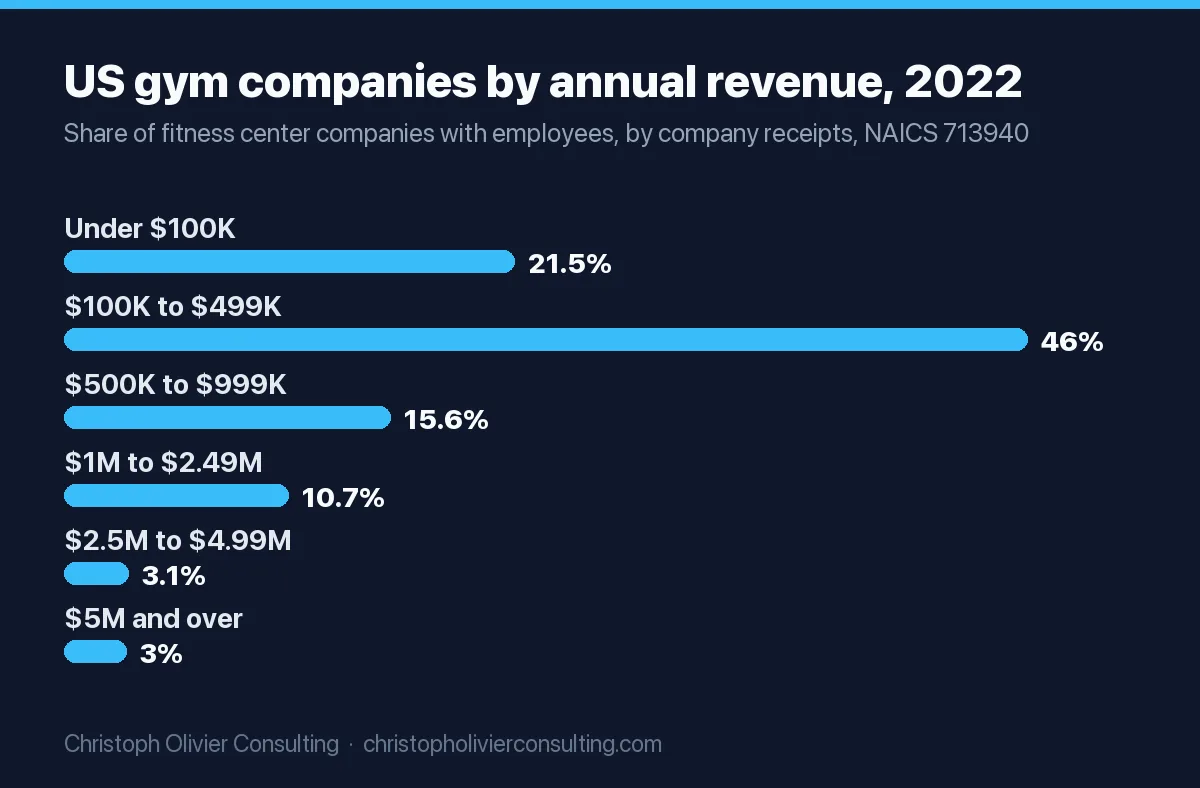
The average is pulled up by chains. Companies with $5 million or more in revenue were 3.0% of gym companies but took 56.2% of all receipts. The 135 companies above $100 million alone took 29.9% (my calculations from the same file).
The typical gym is much smaller than the average
| Company annual revenue | Gym companies | Share of companies | Cumulative share | Average revenue in band |
|---|---|---|---|---|
| Under $100,000 | 7,160 | 21.5% | 21.5% | $46,890 |
| $100,000 to $499,999 | 15,292 | 46.0% | 67.6% | $258,248 |
| $500,000 to $999,999 | 5,198 | 15.6% | 83.2% | $691,542 |
| $1M to $2.49M | 3,557 | 10.7% | 93.9% | $1,507,794 |
| $2.5M to $4.99M | 1,036 | 3.1% | 97.0% | $3,236,946 |
| $5M and over | 989 | 3.0% | 100% | n/a (chains) |
Source: Census SUSB 2022, NAICS 713940, employer firms only. Shares and band averages are my calculations.
The median gym company lands in the $100,000 to $499,999 band. That matches the Two-Brain revenue band for an average big group gym, $13,500 to $24,999 a month, or $162,000 to $300,000 a year. Gyms with no employees at all are not in this table. The Census Nonemployer Statistics file only breaks this out at the broader “other amusement and recreation” level (NAICS 7139): 140,432 one-person businesses averaging $45,661 in 2022 receipts (my calculation).
Average gym revenue by state
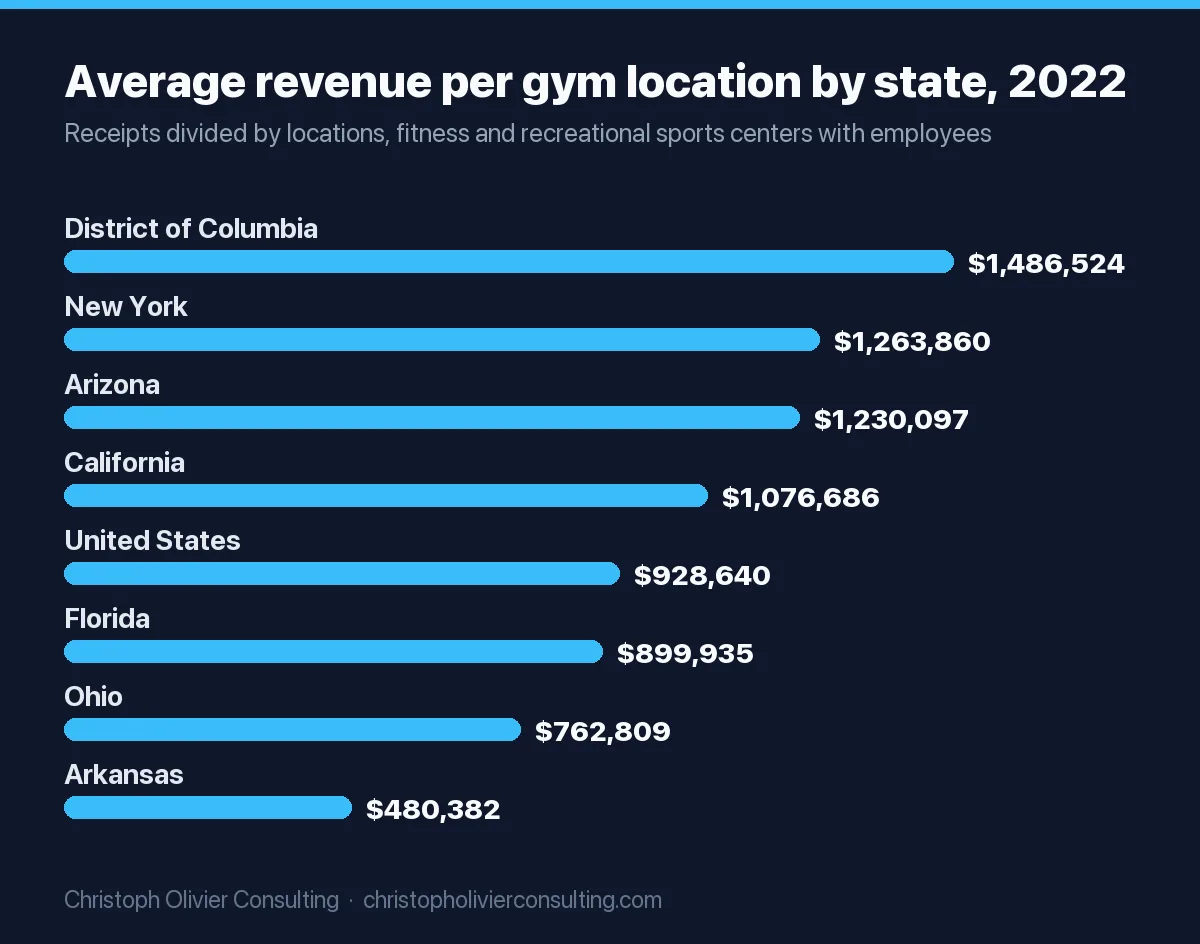
Revenue per location varies by a factor of three across states, mostly with local prices and the mix of large clubs. Selected states from the Census SUSB state file, 2022:
| State | Gym locations | Receipts | Revenue per location |
|---|---|---|---|
| District of Columbia | 143 | $212.6M | $1,486,524 |
| New York | 2,515 | $3,178.6M | $1,263,860 |
| Arizona | 797 | $980.4M | $1,230,097 |
| Illinois | 1,632 | $1,813.7M | $1,111,338 |
| California | 5,240 | $5,641.8M | $1,076,686 |
| United States | 40,786 | $37,875.5M | $928,640 |
| Texas | 3,294 | $3,058.7M | $928,555 |
| Florida | 2,753 | $2,477.5M | $899,935 |
| Ohio | 1,259 | $960.4M | $762,809 |
| North Carolina | 1,422 | $1,075.8M | $756,560 |
| Alabama | 484 | $299.0M | $617,694 |
| Wyoming | 90 | $44.7M | $496,811 |
| Arkansas | 249 | $119.6M | $480,382 |
Source: Census SUSB 2022, NAICS 713940, employer establishments. Revenue per location is my calculation. Receipts are assigned to the state where the location operates.
Gym profit margin: what the filings and tax data show
“Gym profit margin” means three different things depending on who reports it. Club-level (four-wall) margin counts the club’s own revenue and costs. Company net margin adds headquarters, debt, depreciation and taxes. Owner benefit is what a small owner keeps including their own pay. Here is each one from a source you can check:
| Operator and source | Margin type | Margin | Revenue base |
|---|---|---|---|
| Planet Fitness 10-K 2025, corporate clubs open 12+ months | Four-wall Adjusted EBITDA, includes local and national advertising | 42.7% | AUV about $2.0M per club |
| Same | Four-wall margin after the current 7% royalty (the franchisee view) | 35.3% | Same |
| Same | Corporate-owned clubs segment Adjusted EBITDA | 37.8% | $546.1M segment revenue, 292 clubs |
| Life Time 10-K 2025 | Company Adjusted EBITDA margin | 27.5% | $2.995B total revenue, 189 centers |
| Same | Company net income margin (adjusted net income margin) | 12.5% (10.9%) | Same |
| IRS SOI 2023, sole proprietors with a profit, amusement and recreation | Net profit before owner’s income tax (owner pay included) | 23.7% | $84,407 average receipts (my calculation) |
| IRS SOI 2023, all sole proprietors in the same group | Same, including those that lost money | 6.2% | 67.2% of returns showed a profit (my calculation) |
How profitable is owning a gym, really?
The 42.7% figure is real, but it describes a mature, standardized club with 20,000 square feet and, per the 10-K, over 90% recurring revenue. Planet Fitness also notes it “believes” franchisee clubs match that margin based on franchisee business reviews and management estimates, so treat it as the company’s estimate, not audited franchisee results. At the other end, one in three tax filers in the broad amusement and recreation category lost money in 2023. Profitable gyms exist at every size; the spread inside each size is the story.
Is a 30% profit margin too high for a gym?
Not at the club level. A 30% four-wall margin sits below Planet Fitness’s 35.3% after royalty. It is high as a net margin for a small owner, because owner benefit includes your own wage. If your books show 30% “profit” while you coach 40 hours a week unpaid, subtract a market wage first. The BLS median for an employed trainer, $47,160, is a fair floor for that adjustment. For margins in other industries, see our profit margin by industry table.
What type of gym makes the most money?
It depends on whether you mean revenue per location, margin, or owner pay for a given amount of capital. The disclosed numbers line up like this:
| Gym model | Revenue per location | Upfront investment | Source |
|---|---|---|---|
| Independent big group class gym | $162,000 to $300,000 a year (average band) | Not disclosed; CrossFit charges a $1,000 application fee plus $2,500 to $4,500 a year to affiliate | Two-Brain 2025; CrossFit |
| Boutique franchise studio (Xponential brands, 1,500 to 2,500 sq ft) | $695,000 AUV (trailing 12 months, North America) | About $554,000 weighted average initial investment, 2025 | Xponential 10-K 2025 |
| Average US gym with employees | $928,640 | Not measured | Census SUSB 2022 |
| High-volume, low-price franchise club (Planet Fitness, about 20,000 sq ft) | About $2.0M AUV | $1,282,500 to $5,386,000 (2026 FDD estimate, excludes real estate) | PLNT 10-K; FDD figures reported by Franchise Direct |
| Premium athletic club (Life Time) | $15.4M center revenue per center (my calculation: $2.909B ÷ 189) | $25M to $30M net invested capital per new location (company target) | Life Time 10-K 2025 |
Within small independent gyms, the Two-Brain data points to one-on-one personal training: its above-average owner benefit threshold ($8,500 a month) is the highest of the three coaching models, and its above-average revenue per member is $360 a month versus $187 for big group gyms. Fewer clients paying more is the pattern behind most high-earning small gym owners.
Three worked owner P&Ls (my calculations)
Each model below starts from disclosed numbers and adds as few assumptions as possible. Every assumption is labeled. Replace them with your own lease, staffing and pricing.
1. Independent class-based gym (CrossFit-style box)
Inputs sit in the middle of the Two-Brain 2025 average bands for big group gyms: 101 to 158 members, $126 to $186 average revenue per member, and a mean coach pay of $24.51 per class.
| Line (monthly) | Amount | Basis |
|---|---|---|
| Members × average revenue per member | 130 × $150 = $19,500 | Assumption inside Two-Brain average bands |
| Fixed costs: rent, utilities, insurance, software | −$8,775 | Assumption: 45% of revenue. Two-Brain flags 50% or more as below average |
| Coach pay: 80 classes taught by staff | −$1,961 | 80 × $24.51 (Two-Brain mean per class) |
| CrossFit affiliate fee | −$375 | $4,500 a year ÷ 12 (top of CrossFit’s range) |
| Marketing, card processing, equipment upkeep, other | −$2,340 | Assumption: 12% of revenue |
| Owner benefit (profit plus owner pay) | $6,049 a month, $72,588 a year | Lands at the top of the Two-Brain average band |
Now drop to 100 members at the same price and the same fixed dollar costs: revenue falls to $15,000, variable costs to $1,800, and owner benefit falls to $2,089 a month. Losing 30 members cut the owner’s income by about two thirds. That sensitivity to member count is why retention matters more than any other lever in a small gym; our gym marketing guide is built around it.
2. Boutique franchise studio (Xponential-style)
Xponential does not disclose studio-level profit margins in its 10-K, so this model shows what the franchisor’s fees take and what your remaining costs must stay under. It does not invent a margin.
| Line (annual) | Amount | Basis |
|---|---|---|
| Studio revenue | $695,000 | AUV, trailing 12 months, 2025 (10-K) |
| Royalty | −$51,430 | About 7.4%: $130.0M royalty revenue ÷ $1,746.1M North America system-wide sales (my rough calculation; your franchise agreement sets the actual rate) |
| Brand marketing fund | −$13,900 | 2% of gross sales (10-K) |
| Required local marketing | −$18,000 | At least $1,500 a month (10-K) |
| Left for rent, instructors, front desk, utilities and you | $611,670 | My calculation |
| Target: $100,000 owner pay plus recovering $554,000 over 5 years | −$210,800 | Assumption: your goal |
| Maximum for all other operating costs | $400,870 (57.7% of revenue) | If rent and labor run higher, the target fails |
One more data point before you sign: 92 Xponential studios in North America stopped operating in 2025, against 2,446 open at the start of the year, about 3.8% (my calculation from the 10-K).
3. Big-box franchise club (Planet Fitness)
| Line (annual) | Amount | Basis |
|---|---|---|
| Club revenue, mature club | $2,000,000 | AUV for clubs open 12+ months, 2025 (10-K) |
| Four-wall Adjusted EBITDA after 7% royalty | $706,000 | 35.3% (10-K); my multiplication |
| Simple payback on the low-end build | 1.8 years | $1,282,500 ÷ $706,000 (my calculation) |
| Simple payback on the high-end build | 7.6 years | $5,386,000 ÷ $706,000 (my calculation) |
| Not included | n/a | Loan interest, income tax, multi-club overhead, and equipment replacement every five to nine years (10-K) |
A single mature club can produce more owner cash than most independent gyms produce in revenue. The trade is capital: the 2026 FDD estimate starts at $1.28 million before real estate, and Planet Fitness says substantially all of its 2025 openings came from existing franchisees. In practice this is a multi-unit investor’s business, not a first gym.
Gym startup costs by model
Only franchisors are required to publish startup cost estimates (Item 7 of the Franchise Disclosure Document). Independent gym build-out costs are not tracked by any government source, so be wary of single averages you see quoted elsewhere.
| Planet Fitness 2026 FDD line item | Low | High |
|---|---|---|
| Initial franchise fee | $0 | $40,000 |
| Leasehold improvements | $1,000,000 | $2,167,000 |
| Fitness equipment | $33,300 | $995,000 |
| Non-fitness equipment | $89,200 | $1,315,000 |
| Pre-sale and grand opening marketing | $40,000 | $120,000 |
| Insurance | $25,000 | $45,000 |
| Additional funds, first 3 months | $68,000 | $459,000 |
| All other items (signs, deposits, fees, training, licenses) | $27,000 | $245,000 |
| Estimated total, excluding real estate | $1,282,500 | $5,386,000 |
Source: Planet Fitness 2026 FDD estimated initial investment, as reported by Franchise Direct. “All other items” is my sum of the remaining lines.
For a smaller format, Xponential reports a weighted average initial franchisee investment of about $554,000 in 2025 for studios of 1,500 to 2,500 square feet. For an unbranded or affiliate gym, the fixed fees are small (CrossFit: $1,000 to apply, $2,500 to $4,500 a year), and the real costs are your lease, build-out and equipment. Price those with actual landlord and vendor quotes, and budget for the months before you reach the 50-member break-even point.
How do gym owners make money?
Recurring dues carry the business, and add-ons lift revenue per member:
- Membership dues. At Life Time, dues and enrollment fees were 72.6% of 2025 center revenue. Planet Fitness says over 90% of its club and franchise revenue is recurring.
- Premium tiers. 66.5% of Planet Fitness members held the higher-priced Black Card at the end of 2025, and average monthly dues per member rose from $17.63 in 2021 to $19.51. A clear tiered offer, like the good, better, best pricing model, does the same job in a small gym.
- In-club services. Personal training, kids programs and other services were 27.4% of Life Time’s 2025 center revenue, and average revenue per center membership reached $3,531 for the year.
- Coaching price point. In small gyms the biggest lever is the program itself: Two-Brain’s above-average revenue per member is $187 a month for big group classes, $288 for small group and $360 for one-on-one.
Gym owner pay worksheet (copy and fill in)
Run your own numbers through this before you sign a lease or a franchise agreement. Each check uses a published benchmark.
- Monthly revenue = paying members × average revenue per member. Check: big group gyms below $13,500 a month are in Two-Brain’s below-average band.
- Average revenue per member = total monthly revenue ÷ paying members. Check: under $126 is below average for big group classes; under $189 for small group; under $209 for one-on-one.
- Fixed cost ratio = (rent + utilities + insurance + software + loan payments) ÷ revenue. Pass: under 50% for big group, under 40% for small group, under 35% for one-on-one (Two-Brain thresholds).
- Payroll ratio = all staff pay ÷ revenue. Reference: the average US gym with employees spent 31.9% of receipts on payroll in 2022 (Census, my calculation).
- Owner benefit = revenue − all costs except your own pay. Pass: at least $2,800 a month (bottom of the average band).
- Wage check = owner benefit − $47,160 (BLS median trainer wage). If negative, you are earning less than you would as an employee; the business has to make up the gap in equity value.
- Payback = total startup investment ÷ annual owner benefit above your wage. Compare with 1.8 to 7.6 years for a mature Planet Fitness club (my calculation from the 10-K and FDD).
Is owning a gym a good investment?
The data says it can be, under two conditions. First, enough members at a high enough price: the Two-Brain break-even sits near 50 members and a “good wage” near 100, and the worked example above shows how fast owner pay collapses when membership dips. Second, enough capital for the model you pick: the cheapest disclosed franchise route starts around $554,000 (boutique average) and big-box clubs start at $1.28 million before real estate.
In my view, the most useful number here is your fixed cost ratio, because it decides how many members you need before you get paid. If you are deciding between models, the franchise marketing guide covers what the brand fund and local spend requirements do for you, the marketing budget guide shows how to size spend against revenue, and our customer retention statistics put churn in context. Martial arts gyms follow the same membership math; see the martial arts school playbook. If you want a second set of eyes on your gym’s numbers and growth plan, you can book a consultation.
A note for readers outside the US: every figure on this page is for US businesses or US-listed companies.
How these figures were compiled
- Census SUSB 2022 (released April 10, 2025): US file by enterprise receipts size and state file, NAICS 713940. Employer businesses only. Averages and shares are my calculations from published totals.
- Census Nonemployer Statistics 2022: US file, available only at NAICS 7139 for national detail.
- IRS SOI: Nonfarm Sole Proprietorships, Table 1, tax year 2023, amusement, gambling and recreation industries (the finest level published; includes fitness centers). Sample-based estimates.
- BLS: Occupational Outlook Handbook, Fitness Trainers and Instructors, May 2025 wages. Excludes self-employed workers.
- Company filings: 10-K reports for fiscal 2025 from Planet Fitness, Xponential Fitness and Life Time. AUV and four-wall margins are company-defined non-GAAP measures.
- Two-Brain Business 2025 State of the Industry: figures as reported by Morning Chalk Up (November 11 and November 13, 2025). About 7,000 gyms on two software platforms; bands are relative to that dataset.
Ready to scale your revenue?
Book a free 30-min consultation. We’ll diagnose your growth bottleneck and map out the 3 highest-leverage moves for your business.
Frequently asked questions
How much does a gym owner make?
Most independent gym owners make about $33,600 to $78,000 a year, the average owner benefit band ($2,800 to $6,499 a month) for class-based gyms in the Two-Brain Business 2025 State of the Industry report. Above-average owners clear at least $78,000 to $102,000 depending on gym type. Big-box franchise owners earn far more per club but invest $1.28 million or more per location.
What is the average gym profit margin?
It depends on the margin you measure. Mature Planet Fitness clubs run a 42.7% four-wall Adjusted EBITDA margin, or 35.3% after the 7% royalty (2025 10-K). Life Time's company Adjusted EBITDA margin was 27.5% in 2025. Profitable sole proprietors in the broad amusement and recreation category kept 23.7% of receipts in tax year 2023 (IRS).
How much does a gym owner make a year with a franchise?
Planet Fitness says its mature clubs average about $2.0 million in annual revenue with a 35.3% club-level margin after royalty, which works out to roughly $706,000 per club before loan payments, taxes and overhead (my calculation from the 2025 10-K). Xponential boutique studios averaged $695,000 in revenue, but the company does not disclose studio profit margins.
What are typical gym startup costs?
Planet Fitness's 2026 franchise disclosure estimates $1,282,500 to $5,386,000 per club, excluding real estate, as reported by Franchise Direct. Xponential reported a weighted average initial franchisee investment of about $554,000 in 2025 for 1,500 to 2,500 square foot studios. A CrossFit affiliate pays a $1,000 application fee plus $2,500 to $4,500 a year, with build-out and equipment on top.
Is owning a gym profitable?
Often, but not reliably. In tax year 2023, 67.2% of sole proprietors in the amusement and recreation category, which includes fitness centers, reported a profit (IRS data, my calculation). Two-Brain's 2025 report puts break-even at under 50 members and says a gym with 100 members should be profitable and pay the owner a good wage.
What type of gym makes the most money?
Per location, premium athletic clubs lead: Life Time averaged about $15.4 million in center revenue per center in 2025. Planet Fitness clubs average about $2.0 million. Among small independent gyms, one-on-one personal training gyms have the highest owner benefit threshold in Two-Brain's 2025 data, at $8,500 a month for above-average owners.
How do gym owners make money?
Mainly from recurring membership dues, then premium tiers and in-club services. Dues and enrollment fees were 72.6% of Life Time's 2025 center revenue, and 66.5% of Planet Fitness members paid for the higher Black Card tier. Small gyms raise income mostly through price per member: Two-Brain's above-average mark is $187 a month for group classes and $360 for one-on-one training.
Practice economics benchmarks