

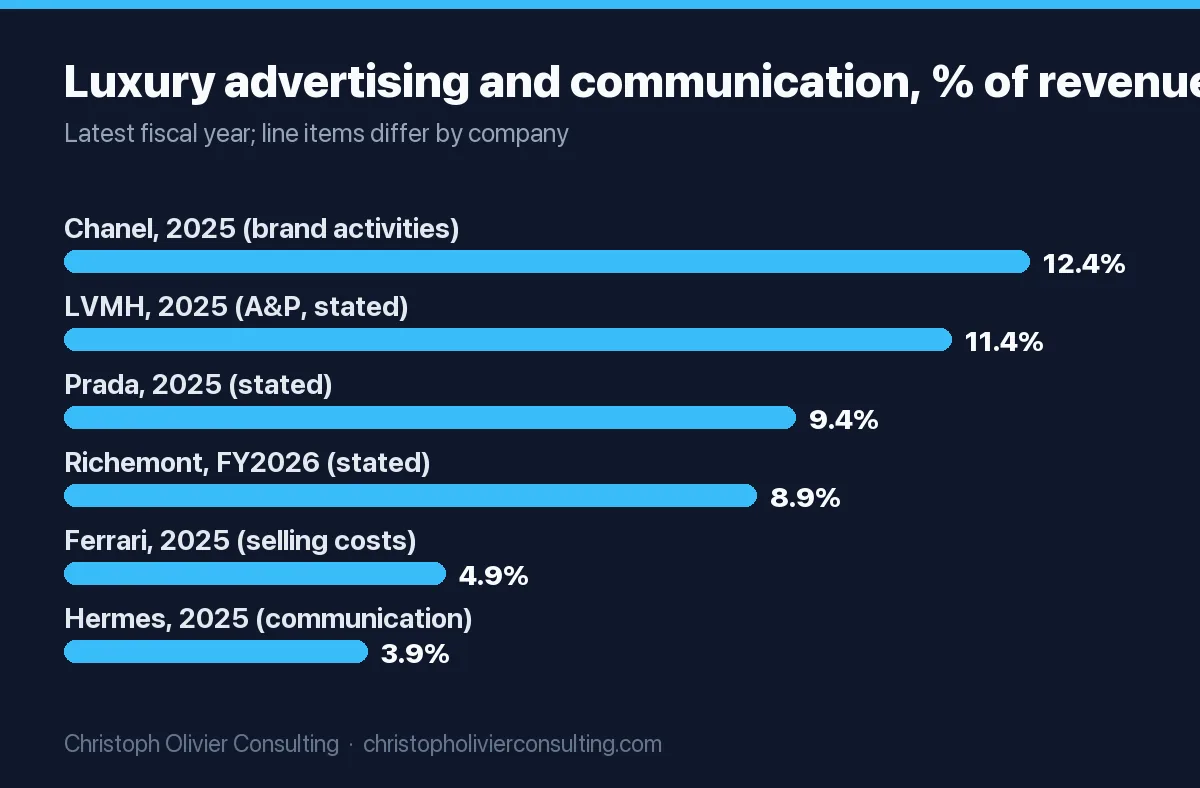
LVMH spent EUR 9,214 million on advertising and promotion in 2025, 11.4% of its EUR 80.8 billion revenue, which is about $10.4 billion and the largest figure any luxury group publishes. Chanel put $2,395 million into brand activities (12.4% of revenue, our calculation), Richemont EUR 1,996 million into communication (8.9% of sales), Prada EUR 537 million (9.4%), and Hermès only EUR 620 million (3.9%). Louis Vuitton, Gucci and Rolex do not publish a marketing budget at all. Every number below comes from the company’s own annual report or results release, with the fiscal year and the exact line item named.
Short answer: LVMH: EUR 9.2 billion of advertising and promotion in 2025 (11.4% of revenue, about $10.4 billion). Louis Vuitton: not disclosed, it sits inside that LVMH total. Gucci: not disclosed by Kering. Rolex: private and not disclosed. The luxury brands that do publish a figure spend between 3.9% (Hermès) and 12.4% (Chanel) of revenue on advertising and communication.
Luxury brand marketing budgets compared (latest fiscal year)
The table uses each company’s most recent annual filing or results release as of November 2026. “Stated” means the ratio is printed by the company; “calc.” means we divided the reported spend by reported revenue. The USD column is our own conversion at the Federal Reserve’s 2025 annual average rate of $1.1306 per euro (Fed G.5A, 2025). Richemont’s fiscal year runs to March 31, 2026, so its USD figure is an approximation.
| Company (brands) | Fiscal year | Line item, as reported | Reported amount | Approx. USD | % of revenue |
|---|---|---|---|---|---|
| LVMH (Louis Vuitton, Dior, Tiffany, Sephora, Moët Hennessy) | 2025 | Advertising and promotion expenses (LVMH 2025 URD, note 25.2) | EUR 9,214 million | $10.4 billion (calc.) | 11.4% (stated) |
| Chanel (private, publishes results) | 2025 | Investment to support brand activities including client engagement (FY25 results release) | $2,395 million | $2.4 billion | 12.4% (calc.) |
| Richemont (Cartier, Van Cleef & Arpels, IWC) | FY ended Mar 31, 2026 | Communication expenses (Annual Report 2026) | EUR 1,996 million | about $2.3 billion (calc.) | 8.9% (stated) |
| Prada Group (Prada, Miu Miu) | 2025 | Advertising and communications costs (Annual Report 2025) | EUR 537.2 million | $607 million (calc.) | 9.4% (stated) |
| Hermès | 2025 | Communication expenses (2025 URD) | EUR 620 million | $701 million (calc.) | 3.9% (calc.) |
| Ferrari | 2025 | Selling costs, which include marketing and events (Form 20-F) | EUR 349.4 million | $395 million (calc.) | 4.9% (calc.), broader line |
| Kering (Gucci, Saint Laurent, Bottega Veneta) | 2025 | No advertising line (2025 URD) | Not disclosed | Not disclosed | Not disclosed |
| Rolex (private) | None | Publishes no financial statements | Not disclosed | Not disclosed | Not disclosed |
Two warnings before you rank these. First, the line items are not the same thing: LVMH counts samples, catalogs and the staff who run promotion, Chanel counts client events, and Ferrari’s line also holds sales staff and store costs. The decoder table below shows what each includes. Second, a brand’s “marketing budget” in the broad sense is much larger than its advertising line. LVMH’s total marketing and selling expenses were EUR 29,914 million in 2025, 37.0% of revenue, because they include running 6,283 stores.
What each company’s line item actually includes
This decoder is built from the accounting definitions in each filing. Use it before you compare any two rows, or before you quote a luxury “marketing budget” in a board deck.
| Company | Line item | What the filing says it includes | What it leaves out |
|---|---|---|---|
| LVMH | Advertising and promotion | Producing advertising media, buying media space, manufacturing samples, publishing catalogs, “the cost of all activities designed to promote the Group’s brands and products”, plus personnel dedicated to the function | Store network costs, sales staff (these sit in the wider EUR 29.9 billion marketing and selling line) |
| Hermès | Communication | “Expenses designed to promote brands and products to customers”, expensed in the year incurred | Sales staff salaries and variable rents (EUR 3.1 billion of other sales and administrative expenses) |
| Richemont | Communication expenses | Shown as its own line on the income statement, separate from selling and distribution | Selling and distribution (EUR 5,731 million, 25.6% of sales) |
| Prada | Advertising and communications | No line-by-line definition; the report names fashion shows, advertising campaigns and media coverage as the main brand platforms. From 2025, campaign and show costs are expensed when incurred rather than partly held as prepayments | Selling costs (EUR 2,206 million, 38.6% of revenue) |
| Chanel | Brand activities including client engagement | Brand support and client events, as described in the release; no accounting definition published | Capital investment ($1,449 million in 2025) |
| Ferrari | Selling costs | Sales personnel, marketing and events, retail stores; corporate and launch events; “indirect marketing and brand-promotion activities” through Scuderia Ferrari | The cost of the Formula 1 team itself is not broken out here |
LVMH marketing budget: EUR 9.2 billion, 11.4% of revenue (2025)
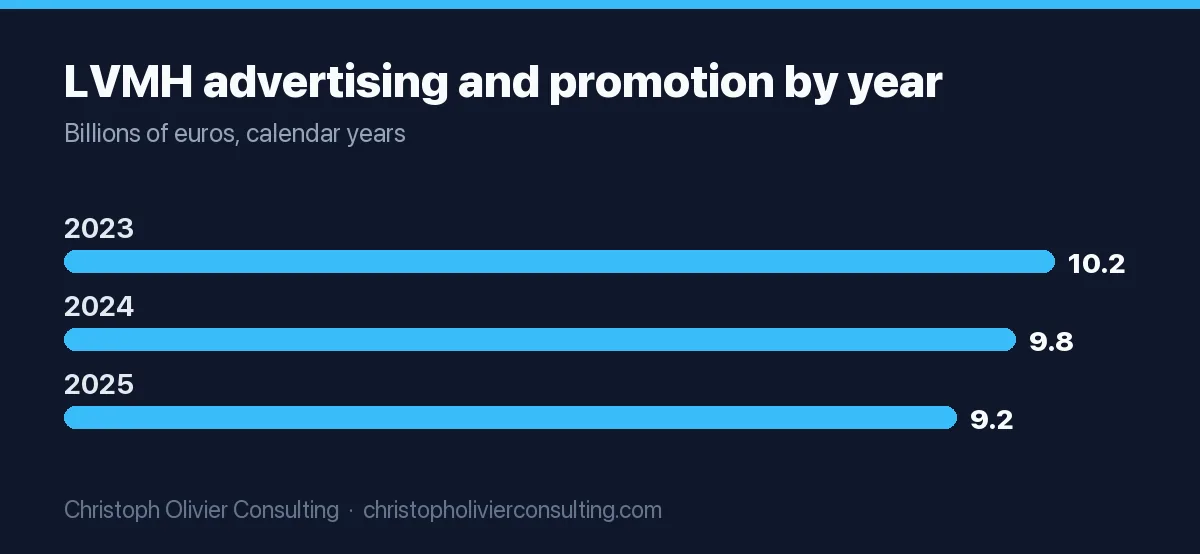
Note 25.2 of the LVMH 2025 Universal Registration Document lists advertising and promotion expenses of EUR 9,214 million in 2025, EUR 9,762 million in 2024 and EUR 10,221 million in 2023. The management report says they “amounted to 11.4% of revenue, were down 3% on a constant consolidation scope and currency basis.” At the Fed’s 2025 average rate that is about $10.4 billion.
LVMH also reports a much larger line. Marketing and selling expenses were EUR 29,914 million in 2025 (EUR 31,002 million in 2024), “37.0%, remaining stable” as a share of revenue. That figure adds the cost of the retail network: 6,283 stores at the end of 2025, 1,232 of them in the United States. When an article quotes LVMH’s marketing spend at EUR 20 to 30 billion, it is quoting this wider line, not advertising.
LVMH advertising and promotion by year
| Year | Advertising and promotion | Revenue | A&P % of revenue | Marketing and selling expenses |
|---|---|---|---|---|
| 2023 | EUR 10,221 million | EUR 86,153 million | 11.9% (calc.) | EUR 30,768 million |
| 2024 | EUR 9,762 million | EUR 84,683 million | 11.5% (calc.) | EUR 31,002 million |
| 2025 | EUR 9,214 million | EUR 80,807 million | 11.4% (stated) | EUR 29,914 million |
Source: LVMH 2025 URD, consolidated income statement and note 25.2. Several pages ranking for this query say LVMH spent “EUR 9.5 billion in 2023 and 2024”. The filing shows two different numbers for those years, EUR 10.2 billion and EUR 9.8 billion, and a third, lower one for 2025.
A big share of LVMH’s brand money now goes to sport. Formula 1 says LVMH became a Global Partner from 2025 on a 10-year deal involving Louis Vuitton, Moët Hennessy and TAG Heuer, with no financial terms disclosed. Bloomberg, citing people familiar with the negotiations, reported the deal “could be worth more than $1 billion with annual sponsorship fees topping $100 million” (as republished by Fortune). The URD also notes that 2024 included costs for the Paris 2024 Olympics partnership, booked under other activities. Our breakdown of what F1 sponsorship costs puts that $100 million a year next to team title deals.
Louis Vuitton marketing budget: not disclosed (inside LVMH’s EUR 9.2 billion)
LVMH does not publish revenue, profit or advertising for any single Maison, including Louis Vuitton. The closest disclosed figure is the Fashion and Leather Goods business group, which includes Louis Vuitton, Dior and other fashion houses: revenue of EUR 37,770 million in 2025, down from EUR 41,060 million in 2024, per the 2025 URD. LVMH does not split advertising and promotion by business group either.
So any precise “Louis Vuitton marketing budget” you see online is an estimate. Ad-tracking estimates, such as the MediaRadar profiles that rank for this query, cover only the paid media a tracker can observe, which misses fashion shows, store windows, client events and the F1 partnership. Treat those tracked figures as a floor, not the budget.
What LVMH does say about Louis Vuitton is qualitative. In 2025 the Maison “embarked on a new adventure in high-performance sports, becoming an Official Partner of Formula 1®” and created 24 trophy cases, one per Grand Prix, and it ran an installation at the France Pavilion at the World Expo in Osaka. How much Louis Vuitton pays its ambassadors is not disclosed anywhere in LVMH’s filings.
Gucci marketing budget: not disclosed by Kering (Gucci revenue EUR 6.0 billion, 2025)
Kering does not present advertising or communication as a separate line. Its 2025 Universal Registration Document groups costs by nature: cost of sales EUR 4,015 million, personnel EUR 2,777 million, and “other recurring operating income and expenses” of EUR 6,252 million, which mixes communication with rent, fees and everything else. Nothing in the document isolates Gucci’s marketing spend.
What Kering does disclose about Gucci in 2025:
- Revenue of EUR 5,992 million, down 22% as reported and 19% at comparable exchange rates (EUR 7,650 million in 2024).
- Recurring operating income of EUR 966 million, a 16.1% margin, down from EUR 1,605 million.
- 497 directly operated stores at year end, after a net 32 closures, and operating investments of EUR 165 million (2.7% of revenue).
- Group operating expenses fell 9%, while “the Houses continued to make substantial investments in design, the development of collections and communication campaigns.”
A figure that circulates on social media says Gucci’s annual advertising budget is “under $100 million”. We found no filing that supports or contradicts it. Like the Louis Vuitton numbers, it most likely reflects tracked paid media only.
Rolex marketing budget: not disclosed (Rolex is private)
Rolex is privately held and publishes no revenue, profit or marketing figures. Any number you read is an outside estimate. For scale, Morgan Stanley and LuxeConsult estimate Rolex’s 2025 turnover at roughly CHF 11 billion, about one third of the Swiss watch market by value, as reported by The Peak; a Vontobel estimate cited by Monochrome Watches says sales “still exceed CHF 10 billion”. Rolex has not confirmed either.
The visible part of Rolex’s marketing is sponsorship of sport and culture. One shift is on the record: Rolex had been Formula 1’s official timekeeping sponsor since 2013, and LVMH took over that role from 2025, Bloomberg reported via Fortune. If you need a working number for Rolex, do not apply a peer’s ratio to an estimated revenue and present it as fact. Say “not disclosed”.
Chanel marketing budget: $2.4 billion, about 12.4% of revenue (2025)
Chanel is privately owned but publishes audited headline results each year. Its 2025 results release reports “Investment of $2,395 million in 2025 to support Brand activities including client engagement”, on revenue of $19,269 million and operating profit of $4,712 million. That is 12.4% of revenue (our calculation), the highest ratio in our table.
In 2024, Chanel’s results release reported $2,445 million of brand support on revenue of $18,699 million (13.1%, our calculation), in a year when operating profit fell 30%. Chanel kept brand spending above $2.4 billion through that drop.
Richemont (Cartier) marketing budget: EUR 2.0 billion, 8.9% of sales (FY2026)
Richemont reports communication expenses as a separate income statement line. In the year ended March 31, 2026 they were EUR 1,996 million, against EUR 2,093 million the year before, per the Richemont Annual Report 2026. The report says they “were down by 5%, amounting to 8.9% of sales compared to 9.8% in the prior year”, which it attributes to the Maisons allocating spend more efficiently and the phasing of certain events. Group revenue was EUR 22,420 million.
Cartier itself is not broken out. It reports inside the Jewellery Maisons segment (with Van Cleef & Arpels and Buccellati), which had sales of EUR 16,539 million in FY2026.
Prada marketing budget: EUR 537 million, 9.4% of revenue (2025)
The Prada Group Annual Report 2025 lists advertising and communications costs of EUR 537.2 million in 2025, 9.4% of net revenues of EUR 5,717.5 million, up 13.5% from EUR 473.1 million (8.7%) in 2024. Advertising grew more than twice as fast as revenue (up 5.3%). The report names fashion shows, advertising campaigns and media coverage as “the main platforms for presenting the brands”. Prada and Miu Miu are not split.
Hermès marketing budget: EUR 620 million, 3.9% of revenue (2025)
Hermès is the clearest counterexample to the idea that luxury needs huge advertising. Its 2025 Universal Registration Document says sales and administrative expenses of EUR 3.7 billion “notably included €620 million in communication expenses (€637 million in 2024)”. Revenue was EUR 16,002 million, so communication ran at 3.9% of revenue, down from 4.2% in 2024 (our calculations). Recurring operating profitability was 41.0% of sales.
Hermès spent less on communication in 2025 than in 2024 while revenue grew 9% at constant exchange rates. Its spend is roughly one fifteenth of LVMH’s advertising line, on about one fifth of LVMH’s revenue.
Ferrari marketing budget: no general advertising, EUR 349 million of selling costs (2025)
Ferrari states its policy plainly in its 2025 Form 20-F: “We do not promote our brand or our cars through general advertising.” It says Formula 1 lets it market the brand “without resorting to traditional advertising activities, therefore preserving the aura of exclusivity around our brand and limiting the marketing costs”.
The closest disclosed line is selling costs: EUR 349.4 million in 2025 (EUR 288.5 million in 2024), which cover “sales personnel, marketing and events, and retail stores”, including model launch and client events. That is 4.9% of EUR 7,146 million of net revenues (our calculation), and it overstates pure marketing because it includes staff and stores. Ferrari also earns from its brand: sponsorship, commercial and brand revenues were EUR 820 million in 2025, 11.5% of net revenues.
Why luxury marketing budgets look so different
The filings show two models. Hermès and Ferrari restrict supply and spend under 5% of revenue on communication or selling. LVMH, Chanel, Prada and Richemont run large campaign and event programs at 9% to 12% of revenue. Neither is wrong; they fit different supply positions. The ratios also hide where the money goes: shows, client events, trophy trunks and F1 grids, not just media. If you want the same comparison for mass-market brands, our page on P&G, Unilever and L’Oréal advertising spend shows ratios from 4% to 32% of sales, and Estée Lauder and e.l.f. marketing budgets sit between the two worlds.
Scarcity model or visibility model: a checklist
This is our own decision tool, built from the patterns in the filings above. Answer each question for your business. Mostly “yes” points to a scarcity model with a low paid-media budget; mostly “no” points to a visibility model with a higher one.
- Demand exceeds capacity. Pass if you turn work away or run a waitlist for at least part of the year. Ferrari describes a “controlled volume” strategy in its 20-F.
- Most revenue comes from repeat clients. Pass if more than half of revenue is from existing clients. Low-spend luxury relies on clienteling, not acquisition.
- You control the sales channel. Pass if you sell direct. Gucci’s directly operated stores made 92% of its 2025 sales, which makes client data usable.
- You have one owned stage that earns attention. Pass if you own an event, a race team, a show or a flagship publication. Ferrari’s is Scuderia Ferrari; Prada’s is its fashion shows.
- You are not launching into a new category or market. Fail if you are. Entry needs paid reach that scarcity cannot provide.
- Your margin can absorb a down year without cutting brand spend. Pass only if yes. Chanel held brand support above $2.4 billion in 2024 while operating profit fell 30%.
Worked example: a luxury marketing ratio at your revenue
Owners often ask what a “luxury level” budget would mean for them. This table applies each company’s 2025 or FY2026 ratio to a business with $5 million in annual revenue. It is our own calculation: spend ratio multiplied by $5,000,000, with no adjustment for size, margins or industry. Treat it as a range to discuss, not a recommendation.
| Model | Ratio used | Annual budget at $5M revenue | Monthly | Per $100 of revenue |
|---|---|---|---|---|
| Hermès (communication) | 3.9% | $193,500 | $16,125 | $3.87 |
| Ferrari (selling costs, broader line) | 4.9% | $244,500 | $20,375 | $4.89 |
| Richemont (communication) | 8.9% | $445,000 | $37,083 | $8.90 |
| Prada (advertising and communications) | 9.4% | $470,000 | $39,167 | $9.40 |
| LVMH (advertising and promotion) | 11.4% | $570,000 | $47,500 | $11.40 |
| Chanel (brand activities) | 12.4% | $621,500 | $51,792 | $12.43 |
Two adjustments matter more than the ratio. First, these groups run gross margins of 66% (LVMH) to 80% (Prada), so a 10% ratio is affordable for them in a way it may not be for a business with 35% margins. Second, these are mature brands defending position. A newer firm usually needs more acquisition spend as a share of revenue, not less. In my view the useful lesson from Hermès and Ferrari is not “spend 4%”, it is to build the owned stage and the client relationships first, then decide how much paid reach to buy. Our guide on how to set a marketing budget walks through the full method, and marketing budget benchmarks show what companies outside luxury spend.
Which luxury company has the highest marketing budget?
In absolute terms, LVMH, by a wide margin: EUR 9,214 million of advertising and promotion in 2025, more than four times Chanel’s $2.4 billion and about 15 times Hermès. As a share of revenue, Chanel is highest among companies that disclose (12.4%), followed by LVMH (11.4%). Among all companies, not just luxury, the largest disclosed advertising budgets belong to consumer goods and tech groups; see big brand marketing budgets for the cross-industry list.
If you are weighing whether a sponsorship-led model like Ferrari’s or Rolex’s could fit a professional-services firm, that is a budget conversation worth having with numbers in front of you; you can book a consultation to work through it.
Ready to scale your revenue?
Book a free 30-min consultation. We’ll diagnose your growth bottleneck and map out the 3 highest-leverage moves for your business.
Frequently asked questions
What is LVMH's marketing budget?
LVMH reported advertising and promotion expenses of EUR 9,214 million in 2025, 11.4% of its EUR 80.8 billion revenue, or about $10.4 billion at the Federal Reserve's 2025 average rate. That is down from EUR 9,762 million in 2024 and EUR 10,221 million in 2023. Its broader marketing and selling expenses, which include running 6,283 stores, were EUR 29.9 billion, 37.0% of revenue.
What is Louis Vuitton's marketing budget?
Louis Vuitton's marketing budget is not disclosed. LVMH publishes no figures for individual Maisons and does not split advertising by business group. Louis Vuitton's spending sits inside LVMH's EUR 9.2 billion of 2025 advertising and promotion. The closest disclosed number is Fashion and Leather Goods revenue of EUR 37.8 billion in 2025. Tracked ad-spend estimates online cover paid media only.
What is Gucci's marketing budget?
Kering does not disclose Gucci's marketing or advertising budget, and its income statement has no separate advertising line. Kering's 2025 Universal Registration Document reports Gucci revenue of EUR 5,992 million, down 22%, and recurring operating income of EUR 966 million. It says the Houses kept making substantial investments in communication campaigns while cutting other operating costs.
How much does Rolex spend on marketing?
Rolex does not disclose its marketing budget because it is privately held and publishes no financial statements. Outside estimates cover revenue only: Morgan Stanley and LuxeConsult put Rolex's 2025 turnover at roughly CHF 11 billion. Its visible marketing is sponsorship of sport and culture. Rolex was Formula 1's timekeeping sponsor from 2013 until LVMH took over in 2025.
Which luxury company has the highest marketing budget?
LVMH has the largest disclosed luxury marketing budget: EUR 9,214 million of advertising and promotion in 2025, about $10.4 billion. As a share of revenue, Chanel is highest among companies that publish a figure, at about 12.4% ($2,395 million on $19.3 billion). Hermes is the lowest at 3.9%, and Ferrari says it does no general advertising.
What percentage of revenue do luxury brands spend on marketing?
Luxury companies that disclose a figure spend between about 3.9% and 12.4% of revenue on advertising and communication: Hermes 3.9%, Richemont 8.9%, Prada 9.4%, LVMH 11.4% and Chanel 12.4%, based on their 2025 or fiscal 2026 reports. Broader lines that include stores and sales staff run much higher, for example LVMH's 37.0% marketing and selling ratio.
How much does Chanel spend on marketing?
Chanel reported an investment of $2,395 million in 2025 to support brand activities including client engagement, on revenue of $19,269 million, according to its 2025 results release. That is about 12.4% of revenue. In 2024 it spent $2,445 million, about 13.1% of revenue, even though operating profit fell 30% that year.
What big companies spend on marketing