

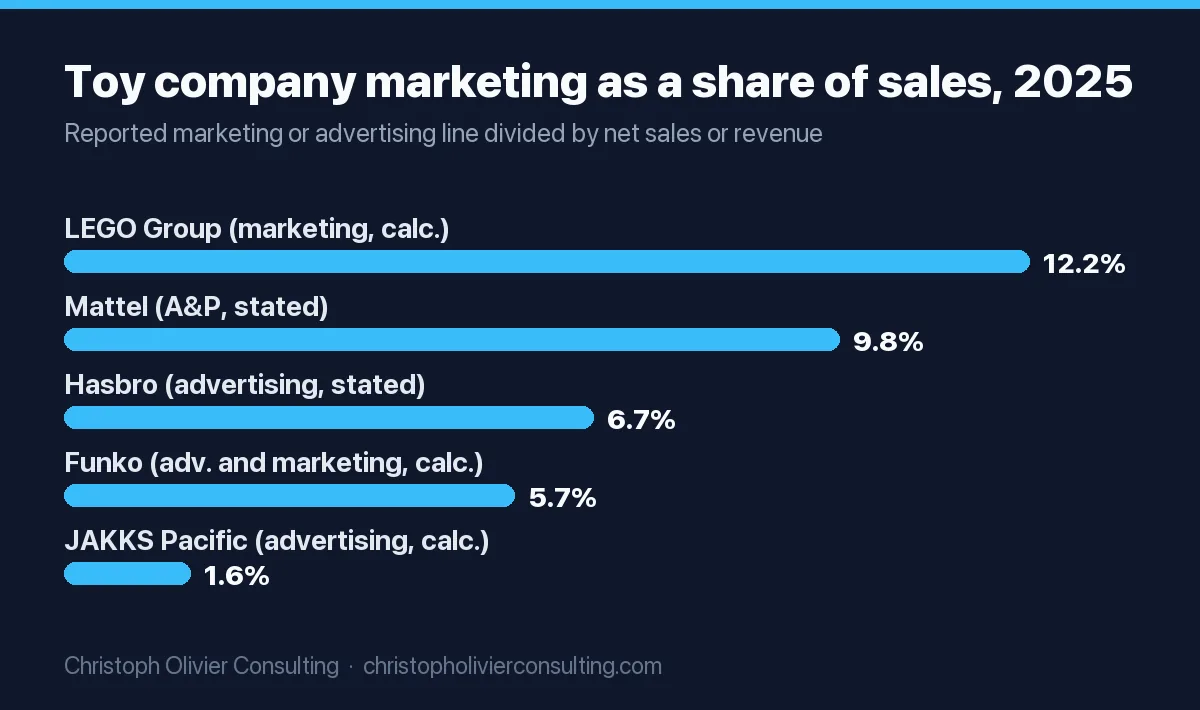
LEGO is the biggest marketer in toys: the LEGO Group booked DKK 10,151 million of marketing expenses in 2025, about $1.53 billion and 12.2% of revenue, in the first annual report where it shows marketing as its own line. Mattel spent $522.0 million on advertising and promotion in 2025 (9.8% of net sales) and Hasbro $316.9 million on advertising (6.7% of net revenues). Every figure below comes from the company’s own annual filing, with the fiscal year and the exact line item named, because the three companies do not measure the same thing.
Short answer: LEGO: DKK 10.2 billion of marketing in 2025 (about $1.53 billion, 12.2% of revenue, our conversion and calculation). Mattel: $522.0 million of advertising and promotion in 2025 (9.8% of net sales). Hasbro: $316.9 million of advertising in 2025 (6.7% of net revenues), down 37% from its 2021 peak of $506.6 million. LEGO’s marketing line alone is about 1.8 times Mattel and Hasbro combined.
Toy company marketing budgets compared (fiscal 2025)
The table uses each company’s most recent full-year report as of November 2026. “Stated” means the percentage is printed in the filing; “calc.” means we divided the spend line by net sales or revenue ourselves. LEGO reports in Danish kroner; the USD figure is our own conversion at the Federal Reserve’s 2025 annual average rate of DKK 6.6137 per dollar (Fed G.5A).
| Company | Fiscal year | Line item, as reported | Reported amount | Net sales or revenue | % of sales |
|---|---|---|---|---|---|
| LEGO Group | 2025 | Marketing, expenses by nature (Annual Report 2025, note 2.2) | DKK 10,151 million (about $1.53 billion, calc.) | DKK 83,530 million | 12.2% (calc.) |
| Mattel | 2025 | Advertising and promotion expenses (10-K) | $522.0 million | $5,347.6 million | 9.8% (stated) |
| Hasbro | 2025 (to Dec 28) | Advertising (10-K) | $316.9 million | $4,701.3 million | 6.7% (stated) |
| Funko | 2025 | Advertising and marketing, within SG&A (10-K) | $51.5 million | $908.2 million | 5.7% (calc.) |
| JAKKS Pacific | 2025 | Advertising expense (10-K) | about $9.4 million | $570.7 million | 1.6% (calc.) |
| Spin Master | 2025 | Not broken out in the year-end release; SG&A shown instead (Q4 2025 release) | Not disclosed in release (SG&A $908.6 million) | $2,112.9 million | SG&A 43.0% (calc.) |
Two things to read before you compare rows. First, the line items differ: Mattel’s figure includes promotions and retail displays, Hasbro’s is advertising only, and LEGO’s is a nature-of-expense line that sits inside its “sales and distribution expenses” of DKK 25,709 million. Second, retailer co-op advertising often never appears in these lines at all. JAKKS says its cooperative advertising allowances “range from 1% to 30% of gross sales” and are recorded as a reduction to revenue unless they buy a distinct benefit at fair value (JAKKS 10-K, 2025). That is why a 1.6% advertising line can coexist with a heavy retail marketing program.
How much does LEGO spend on marketing? DKK 10.2 billion (2025)
The LEGO Group’s 2025 Annual Report lists “Marketing” at DKK 10,151 million in 2025 and DKK 9,372 million in 2024 in note 2.2, Expenses by nature. At the Fed’s annual average rates (DKK 6.6137 per dollar in 2025, 6.8955 in 2024) that is about $1.53 billion in 2025 and $1.36 billion in 2024, our conversion. Marketing grew 8.3% in kroner while revenue grew 12.4% to DKK 83,530 million, so the marketing share slipped from 12.6% to 12.2% of revenue.
This is new disclosure. The 2024 Annual Report did not show marketing separately: its expenses-by-nature note folded it into “Other external expenses” of DKK 20,216 million. So any LEGO marketing number you see for 2023 or earlier is an estimate, not a company figure. Third-party trackers measure something narrower still: MediaRadar’s LEGO profile shows “over $100 million” of estimated spend on the digital, print and national TV campaigns it detects, which is a fraction of the reported total because it excludes in-store, owned retail, events and most non-US media.
The money supports a business that does not need to buy growth. LEGO’s 2025 results release reports revenue up 12%, consumer sales up 16% against a toy market that grew 7%, and operating profit of DKK 22.0 billion. The LEGO Group is privately held (its annual report names KIRKBI A/S as the ultimate parent), so there is no 10-K and no segment split of marketing by country.
Mattel advertising budget: $522.0 million, 9.8% of net sales (2025)
Mattel reports “advertising and promotion expenses” as a separate line on its income statement. Its 2025 10-K defines the line as (i) media costs for TV, print and digital, including planning and buying fees, (ii) non-media costs such as commercial and website production, merchandising and promotions, (iii) retail advertising such as consumer catalogs, and (iv) general costs including trade shows. Advertising production is expensed when the ad first airs.
The budget has been remarkably stable: between $507 million and $546 million every year from 2021 to 2025, while net sales stayed near $5.4 billion. The 2025 segment table lets you split it, which no ranking page does:
| Mattel segment, 2025 | Net sales | Advertising and promotion | A&P as % of segment sales (calc.) |
|---|---|---|---|
| North America | $3,001.1 million | $245.0 million | 8.2% |
| International | $2,346.6 million | $277.0 million | 11.8% |
| Total | $5,347.6 million | $522.0 million | 9.8% (stated) |
Source: segment table in Mattel’s 2025 10-K; percentages are our calculation. International markets get more than half of the A&P dollars on less than half of the sales, which is a useful benchmark if you are budgeting a launch outside your home market.
Did the Barbie movie raise Mattel’s ad budget?
No. In the film’s release year Mattel’s advertising and promotion fell to $524.8 million (9.6% of net sales) from $534.3 million (9.8%) in 2022, per its 2023 10-K. The 10-K credits the movie with higher Barbie billings “driven primarily by licensing revenues” and a gross-margin lift from favorable mix. The big campaign was the studio’s: rival studio executives estimated the Warner Bros. campaign at $150 million, not including the $145 million production budget, as reported by Variety in July 2023. Warner Bros. declined to comment on the budget, so treat that number as an estimate and do not add it to Mattel’s spend. Our movie marketing budgets breakdown covers how studio P&A is reported.
Hasbro advertising budget: $316.9 million, 6.7% of revenue (2025)
Hasbro’s 2025 10-K reports advertising of $316.9 million, or 6.7% of net revenues of $4,701.3 million, against $319.5 million (7.7%) in 2024. The filing explains the mix shift: Consumer Products advertising fell $30.3 million “to reduce variable expenses to offset the operating profit impact of tariffs,” while Wizards of the Coast and Digital Gaming advertising rose $28.8 million to support growth. Hasbro also says its advertising level depends on revenue mix and on “the amount and type of theatrical releases and television programming delivered.”
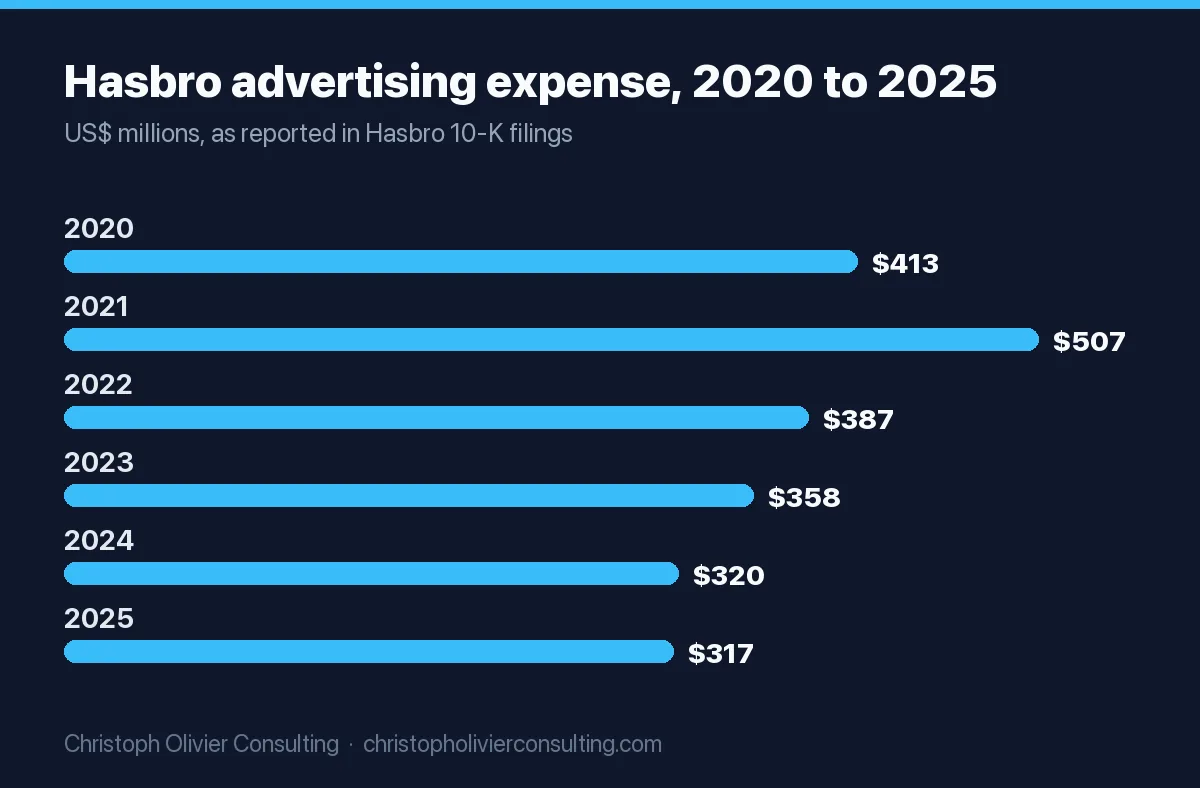
The longer trend is a deliberate cut. Hasbro spent $506.6 million (7.9% of revenue) in 2021 and $387.3 million (6.6%) in 2022 after what its 2022 10-K calls the Blueprint 2.0 shift. By 2025 the budget was 37% below the 2021 peak (our calculation), while revenue in 2025 rose 13.7% on the back of the games business. If you sell games and digital products, our video game marketing budgets page shows how publishers report the same line.
Mattel vs Hasbro advertising spend, 2020 to 2025
| Year | Mattel A&P | Mattel % of net sales | Hasbro advertising | Hasbro % of revenue |
|---|---|---|---|---|
| 2020 | $525.8M | 11.5% (stated) | $412.7M | 7.6% (stated) |
| 2021 | $545.7M | 10.0% (stated) | $506.6M | 7.9% (stated) |
| 2022 | $534.3M | 9.8% (stated) | $387.3M | 6.6% (stated) |
| 2023 | $524.8M | 9.6% (stated) | $358.4M | 7.2% (calc., on $5,003.3M) |
| 2024 | $507.3M | 9.4% (stated) | $319.5M | 7.7% (stated) |
| 2025 | $522.0M | 9.8% (stated) | $316.9M | 6.7% (stated) |
Sources: Mattel 10-Ks for 2022, 2023 and 2025; Hasbro 10-Ks for 2022 and 2025; cross-checked against SEC XBRL company facts for Mattel and Hasbro. Hasbro’s 2023 revenue of $5,003.3 million is the comparative shown in its 2025 10-K.
Funko, JAKKS Pacific and Spin Master
Funko: $51.5 million (2025)
Funko’s 2025 10-K lists advertising and marketing of $51.5 million in 2025, $51.6 million in 2024 and $31.3 million in 2023, inside selling, general and administrative expenses. The figure includes fees to exhibit at trade shows and Comic-Cons. Net sales fell 13.5% to $908.2 million in 2025, so the flat budget rose as a share of sales, to 5.7% by our math. Funko also discloses that its licenses can require it to “spend a certain percentage of our sales of the licensed product on marketing and advertising,” which puts a floor under the budget regardless of the year.
JAKKS Pacific: about $9.4 million (2025)
JAKKS reports advertising expense of about $9.4 million in 2025, down from $13.8 million in 2024 and $13.2 million in 2023, on net sales of $570.7 million (10-K). As noted above, most of its retail promotion runs through cooperative allowances of 1% to 30% of gross sales booked against revenue, so the advertising line badly understates its total marketing effort.
Spin Master: not broken out in the year-end release
Spin Master’s Q4 2025 results release reports revenue of $2,112.9 million and SG&A of $908.6 million for 2025, but gives no full-year advertising or marketing amount. It says only that fourth-quarter Toys results benefited from “lower marketing due to a shift in timing of marketing spend,” after “higher investments in the first half of the year to support key brand initiatives and retailer programs.” The full MD&A is filed on SEDAR+; we did not use a marketing figure we could not retrieve from it.
What a toy marketing budget looks like at your size (worked example)
The public ratios are useful because they bracket the range of strategies: a licensed, retailer-driven model near 2% of sales, a collectibles model near 6%, a TV and promotion model near 10%, and an owned-brand, owned-retail model above 12%. The table below applies each ratio to two hypothetical companies. It is our own calculation, not a recommendation, and it assumes the ratio transfers at your scale, which it often will not: smaller brands usually need a higher share to reach the same awareness.
| Benchmark ratio (2025) | Model it represents | On $5M net sales | On $20M net sales |
|---|---|---|---|
| JAKKS Pacific, 1.6% | Licensed products, retailer co-op carries the load | $80,000 | $320,000 |
| Funko, 5.7% | Collectibles, fan events, licensor minimums | $285,000 | $1,140,000 |
| Hasbro, 6.7% | Mixed toys and games, spend follows the growth segment | $335,000 | $1,340,000 |
| Mattel, 9.8% | Owned brands, TV, digital and in-store promotion | $490,000 | $1,960,000 |
| LEGO Group, 12.2% | Owned brand plus owned retail and direct channel | $610,000 | $2,440,000 |
Formula: annual marketing budget = forecast net sales × chosen ratio. Then add, outside the ratio, any co-op allowances your retailers will deduct from invoices, because the public companies book those against revenue. Our advertising-to-sales ratio by industry data shows where toys sit against other categories, and the product launch marketing budget guide covers how to front-load spend for a single new item.
Checklist: which benchmark fits your toy business
- Do you own the IP? If no, and a licensor sets a minimum marketing percentage, start from that contract floor (the Funko model). Pass: you know the floor in each license.
- Who buys the advertising? If big-box retailers run the ads through co-op deductions, your own media line can be small (the JAKKS model). Pass: you have a written co-op rate per account, so you can budget it as a sales deduction.
- Is the product advertised to children? Mattel’s 10-K notes its advertising is subject to the FTC Act and the Children’s Television Act of 1990. Pass: claims, disclosures and channel choices have had a compliance review before media is booked.
- Is demand seasonal? Spin Master describes moving marketing spend between quarters. Pass: at least half of the budget is scheduled against the weeks your retailers actually sell through.
- Do you sell direct? If you run your own store or site, budget toward the LEGO end. Pass: you can track direct revenue per marketing dollar.
If you want a second opinion on where your ratio should land, you can book a consultation. For the general method behind a percentage-of-sales budget, see how to set a marketing budget.
Is Mattel or Hasbro bigger, and are they making money?
By sales, Mattel is bigger: $5,347.6 million of net sales in 2025 against Hasbro’s $4,701.3 million of net revenues. Mattel earned net income of $397.6 million in 2025, down from $541.8 million in 2024 (10-K). Hasbro reported a net loss attributable to the company of $322.4 million in 2025 after a $1,021.9 million goodwill impairment, against earnings of $385.6 million in 2024 (10-K).
Hasbro’s most profitable business is Wizards of the Coast and Digital Gaming: segment operating profit of $1,006.8 million on $2,186.9 million of revenue in 2025, a 46.0% margin, while Consumer Products posted an operating loss of $942.6 million in a year in which Hasbro recorded a $1,021.9 million goodwill impairment. That gap explains the advertising shift described above.
How toy budgets compare with the biggest advertisers
Toy makers are mid-sized advertisers. Procter & Gamble reported $10.2 billion of advertising for the fiscal year ended June 30, 2026 (SEC XBRL company facts), roughly 20 times Mattel. Our consumer goods advertising spend and big brand marketing budgets pages rank the largest spenders. If you are pricing a single national TV spot, the Super Bowl commercial cost page shows what the most expensive 30 seconds costs.
Ready to scale your revenue?
Book a free 30-min consultation. We’ll diagnose your growth bottleneck and map out the 3 highest-leverage moves for your business.
Frequently asked questions
How much does LEGO spend on marketing?
The LEGO Group reported marketing expenses of DKK 10,151 million in 2025 and DKK 9,372 million in 2024 in its 2025 Annual Report. That is about $1.53 billion and $1.36 billion at Federal Reserve annual average exchange rates, our conversion, and about 12.2% of 2025 revenue of DKK 83,530 million. LEGO did not show marketing as a separate line before the 2025 report.
What is Mattel's advertising budget?
Mattel incurred advertising and promotion expenses of $522.0 million in 2025, 9.8% of net sales of $5,347.6 million, per its 10-K. The line covers media, commercial production, merchandising and promotions, retail catalogs and trade shows. North America received $245.0 million and International $277.0 million. Spend has stayed between $507 million and $546 million every year since 2021.
What is Hasbro's advertising budget?
Hasbro reported advertising expense of $316.9 million in 2025, 6.7% of net revenues of $4,701.3 million, per its 10-K. That compares with $319.5 million in 2024 and a peak of $506.6 million in 2021. In 2025 Consumer Products advertising fell $30.3 million to offset tariffs, while Wizards of the Coast and Digital Gaming advertising rose $28.8 million.
Who is bigger, Mattel or Hasbro?
By sales Mattel is bigger. Mattel reported net sales of $5,347.6 million in 2025, against Hasbro's net revenues of $4,701.3 million. Mattel also spends more on advertising: $522.0 million versus Hasbro's $316.9 million in 2025. Mattel earned net income of $397.6 million in 2025, while Hasbro reported a net loss after a goodwill impairment.
Did Mattel pay for the Barbie movie marketing?
Mattel's own advertising and promotion fell to $524.8 million in 2023, the film's release year, from $534.3 million in 2022, per its 10-K. The film campaign was run by Warner Bros.; rival studio executives estimated it at $150 million, as reported by Variety. Warner Bros. did not confirm the figure. Mattel gained mainly through Barbie licensing revenue.
What percentage of sales do toy companies spend on advertising?
Among companies that report it, 2025 ratios ranged from about 1.6% at JAKKS Pacific to 9.8% at Mattel and about 12.2% for LEGO's marketing line, our calculations except Mattel and Hasbro (6.7%), which state theirs. Retailer co-op allowances are often booked as a reduction of revenue, so true marketing effort is higher than the advertising line suggests.
What big companies spend on marketing