

Yes. Psychologists in the United States can advertise in any medium: search ads, social media, directories, radio, mailers and their own website. The APA Ethics Code treats “paid or unpaid advertising” as a public statement and asks only that it not be “false, deceptive, or fraudulent” (APA Ethical Principles of Psychologists and Code of Conduct, Standard 5.01, amended effective January 1, 2017). The real limits are narrower and sharper: who you may ask for testimonials, how you may approach prospective clients, what you may claim, and what your state board adds on top.
Short answer: Psychologists can advertise, including on social media and with fees, as long as every claim is true and provable. Under the APA code you may not solicit testimonials from current therapy clients (Standard 5.05), may not make uninvited in-person pitches to potential clients (5.06), and must label paid ads as ads (5.02c). States go further: New York lets you use a client testimonial only with the client’s written authorization, Texas bars “Board Certified” unless you name the board, and California makes false health advertising a misdemeanor.
This is general information, not legal advice. Your state board and a health care attorney licensed in your state have the final word.
Why psychologists are allowed to advertise at all
Older versions of the APA code restricted advertising. That changed through antitrust enforcement, not a change of heart. In fiscal year 1992 the Federal Trade Commission reported that the American Psychological Association “agreed not to restrict its members from using truthful advertising and participating in certain patient referral services” (FTC Annual Report 1992, page 25). The FTC’s complaint alleged the APA’s Ethical Principles had barred members “from advertising truthful claims about their professional services,” “from soliciting clients,” and from joining fee-per-referral services.
The same consent agreement explains why today’s testimonial rule looks the way it does. It let the APA keep policies “to detect deceptive representations, monitor the solicitation of testimonial endorsements from certain patients, and require consumer disclosure whenever a psychologist has paid a fee for the referral of business.” That is the origin of a testimonial ban that covers current clients and vulnerable people, not every client who ever worked with you. APA’s own practice organization puts the current position plainly: “In general, advertising is not prohibited, but psychologists may not make false, fraudulent or deceptive statements” (APA Services, “Have You Considered Advertising Your Services?”, created 2005).
The APA advertising rules, standard by standard
Section 5 of the APA code, “Advertising and Other Public Statements,” has six standards. Here is what each says and what it means for an ad.
| Standard | Exact rule text (excerpt) | What it means for your marketing |
|---|---|---|
| 5.01(a) Avoidance of False or Deceptive Statements | Public statements include “paid or unpaid advertising, product endorsements… brochures, printed matter, directory listings… or comments for use in media such as print or electronic transmission.” Psychologists “do not knowingly make public statements that are false, deceptive, or fraudulent.” | Your website, Psychology Today profile, Instagram captions, podcast guest spots and Google Ads all count. |
| 5.01(b) | No false, deceptive or fraudulent statements about “(1) their training, experience, or competence; (2) their academic degrees; (3) their credentials; (4) their institutional or association affiliations; (5) their services; (6) the scientific or clinical basis for, or results or degree of success of, their services; (7) their fees; or (8) their publications or research findings.” | Success rates, “evidence-based” labels, fee claims and affiliations must be accurate. An APA membership is not an APA endorsement. |
| 5.01(c) | Degrees may be claimed as credentials for health services only if “(1) earned from a regionally accredited educational institution or (2) were the basis for psychology licensure by the state in which they practice.” | Do not put an unaccredited or unrelated doctorate after your name in a therapy ad. |
| 5.02(a) Statements by Others | Psychologists “who engage others to create or place public statements that promote their professional practice… retain professional responsibility for such statements.” | If your agency writes a misleading ad, it is still your ethics problem. |
| 5.02(b) | Psychologists “do not compensate employees of press, radio, television, or other communication media in return for publicity in a news item.” | No paying a reporter or producer for coverage presented as news. |
| 5.02(c) | “A paid advertisement relating to psychologists’ activities must be identified or clearly recognizable as such.” | Sponsored posts, advertorials and paid podcast reads need a clear “ad” or “sponsored” label. |
| 5.04 Media Presentations | Public advice must be based on professional knowledge and literature, consistent with the code, and must “not indicate that a professional relationship has been established with the recipient.” | TikTok, YouTube and Instagram advice content needs a “this is not therapy” framing. |
| 5.05 Testimonials | “Psychologists do not solicit testimonials from current therapy clients/patients or other persons who because of their particular circumstances are vulnerable to undue influence.” | Never ask a current client for a review or quote. See the decision table below for everyone else. |
| 5.06 In-Person Solicitation | No “uninvited in-person solicitation of business from actual or potential therapy clients/patients or other persons who… are vulnerable to undue influence.” Exceptions: collateral contacts for an existing client, and “disaster or community outreach services.” | No working the room at a support group or approaching people after a crisis to sign them up. Talks, booths and outreach are fine. |
Two standards outside Section 5 also touch marketing. Standard 6.07 says fee splits with other professionals must be “based on the services provided” and “not based on the referral itself,” which rules out per-referral payments to other clinicians. Standard 3.05 on multiple relationships governs how you interact with clients you meet on social platforms.
Psychologist advertising rules by state: four examples
The APA code binds APA members and is often adopted by reference, but your license answers to your state. These four states show the range. Rule text is quoted from the current published versions.
| State and rule | What it says | Practical effect |
|---|---|---|
| California: 16 CCR 1397 and Business and Professions Code 651 | A psychologist “may advertise the provision of any services authorized… within the psychologist’s field of competence… so long as such advertising does not promote the excessive or unnecessary use of such services.” Section 651 bans claims that create “false or unjustified expectations of favorable results,” superiority claims unless “substantiated with objective scientific evidence,” scientific claims not backed by “reliable, peer reviewed, published scientific studies,” and testimonials that mislead “because of a failure to disclose material facts.” Price ads “shall be exact,” with no “as low as,” “and up” or “lowest prices.” | Violating 651 “is guilty of a misdemeanor” and is grounds for license suspension or revocation. “Most effective anxiety treatment in LA” fails unless you can prove it with objective evidence. |
| Texas: 22 TAC 465.6 | “Licensees do not solicit testimonials from current clients or patients or from other persons who are vulnerable to undue influence.” No “uninvited in-person solicitation.” A specialty title requires a doctorate in the area, APA retraining, a two-year postdoc, or a refereed board credential. “Board Certified” is “misleading or deceptive advertising, unless the licensee discloses the complete name of the specialty board.” | “Board Certified Child Psychologist” must read, for example, “Board Certified in Clinical Child and Adolescent Psychology, [full board name].” |
| New York: 8 NYCRR 29.1(b)(12), applied to psychology by 29.12 | Bans ads that are false or misleading, that “guarantee any service,” make cost or service claims that “cannot be substantiated,” or claim superiority without proof. Testimonials are allowed only if “the patient or client expressly authorizes the portrayal in writing,” identity is protected, disclaimers are included, and “fictional client testimonials are not permitted.” Price ads must state the period the prices are in effect. | You must keep “an exact copy of each advertisement” for one year after it last appears. |
| Florida: Florida Statutes 490.009 (2025) | Grounds for discipline include “False, deceptive, or misleading advertising or obtaining a fee… on the representation that beneficial results from any treatment will be guaranteed,” advertising “under a name other than one’s own,” soliciting through “undue influence,” and “entering into a reciprocal referral agreement.” | No outcome guarantees, no “you refer to me, I refer to you” deals, and no hidden practice names. |
If you see clients in more than one state, write your ads to the strictest state you serve.
Can psychologists use testimonials?
Sometimes, and far less often than other businesses. APA Standard 5.05 bans soliciting testimonials from current clients and from anyone vulnerable to undue influence. It does not ban former-client testimonials outright. But other mental health codes and some states are stricter, and confidentiality rules apply to everything. The table below is built for the question searchers actually have: “Can I ask this person?”
Testimonial decision table (who you may ask, by rulebook)
| Who you want a testimonial from | APA code (psychologists) | ACA code (counselors) | NASW code (social workers) | Texas psychology rule | New York rule |
|---|---|---|---|---|---|
| Current therapy client | No (5.05) | No (C.3.b) | No (4.07b) | No (465.6a1) | Only with written authorization, and APA 5.05 still bars you from asking |
| Former therapy client | Not banned, unless the person is vulnerable to undue influence | No: “current clients, former clients” | Not banned, unless vulnerable | Not banned, unless vulnerable | Written authorization, identity protection and disclaimers required |
| Client’s family member | Treat as vulnerable if their relative is in treatment with you | No if vulnerable | No if vulnerable | No if vulnerable | Same conditions as above |
| Workshop, speaking or consulting client (not a therapy client) | Allowed if truthful | Allowed if truthful | Allowed if not vulnerable | Allowed if not vulnerable | Allowed with the same conditions |
| Referring professional or colleague | Allowed if truthful | Allowed if truthful | Allowed | Allowed | Allowed |
| Made-up or composite client | No: deceptive under 5.01 | No | No | No | No: “fictional client testimonials are not permitted” |
Sources: APA Standard 5.05; 2014 ACA Code of Ethics, C.3.b (“Counselors who use testimonials do not solicit them from current clients, former clients, or any other persons who may be vulnerable to undue influence”); NASW Code of Ethics 4.07(b), which also covers asking for “consent to use a client’s prior statement”; 22 TAC 465.6; 8 NYCRR 29.1(b)(12)(iv). Cells marked “if vulnerable” are judgment calls.
My opinion: for a therapy practice, the safest testimonial program is none at all. Use credentials, a clear description of who you help, and educational content instead. Testimonials are fine for your speaking, supervision and consulting work, where buyers are not patients.
Online reviews: what you can and cannot do
Google and Yelp reviews written without your prompting are not solicited testimonials. Asking for them is where risk starts. The APA code does not define “solicit,” so a conservative reading treats any direct ask of a current client, including an automated post-session “review us” email, as solicitation. Federal rules apply on top:
- The FTC Consumer Reviews and Testimonials Rule, in effect since October 21, 2024, bans fake reviews, buying reviews, incentives “conditioned on the writing of consumer reviews expressing a particular sentiment,” undisclosed reviews by staff and managers, and suppressing negative reviews through “unfounded or groundless legal threats” (FTC, August 14, 2024). Knowing violations can draw civil penalties.
- The FTC Endorsement Guides add that advertisers should not edit, suppress or selectively publish reviews in a way that has “the effect of distorting or otherwise misrepresenting what consumers think” (16 CFR 255.2(d)). Under that guidance, “review gating,” where only happy clients get the review link, is a risk.
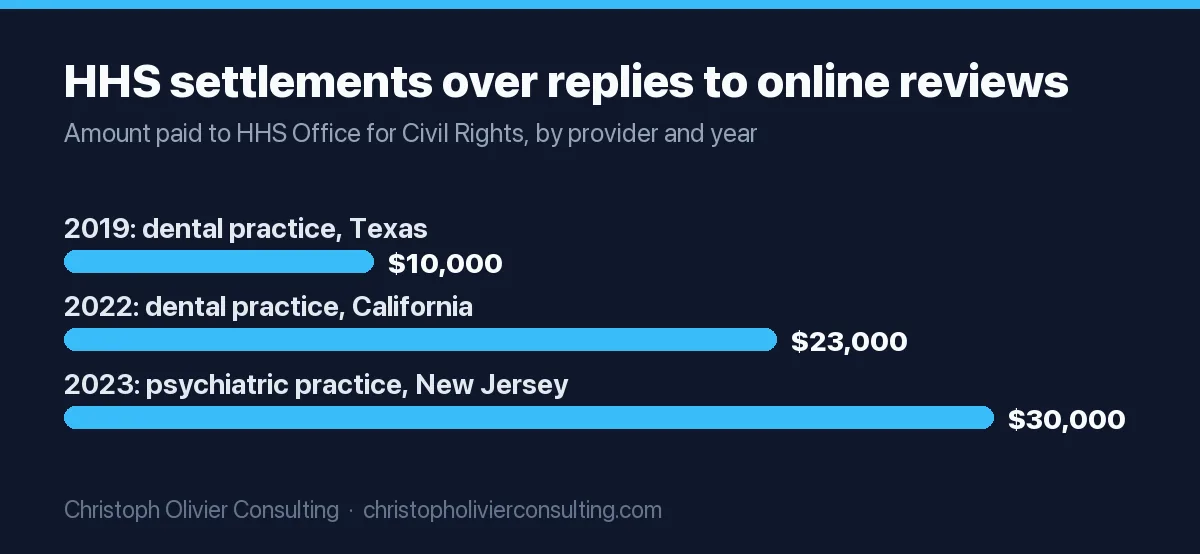
- HIPAA bars confirming that a reviewer is your client. In 2023 a New Jersey psychiatric practice paid $30,000 to the HHS Office for Civil Rights after it “impermissibly disclosed the protected health information of a patient when the entity posted a response to the patient’s negative online review” (HHS OCR, June 2023).
Three published HHS settlements over review replies are compiled below and charted. Two involved dental practices, but the HIPAA rule is the same for a psychologist, and the most recent and largest involved a psychiatric practice.
| Year | Provider type (location) | What was disclosed | Paid to HHS OCR | Source |
|---|---|---|---|---|
| 2019 | Dental practice (Dallas, Texas) | Patient information in replies to patient reviews | $10,000 | HHS OCR, Oct. 2, 2019 |
| 2022 | Dental practice (California) | Patient information in replies to online reviews | $23,000 | HHS OCR, Dec. 14, 2022 |
| 2023 | Adult and child psychiatric practice (New Jersey) | Patient information in a reply to a negative online review | $30,000 | HHS OCR, June 2023 |
A reply that works for any review, positive or negative, and confirms nothing:
“Thank you for taking the time to share feedback. Privacy laws and our professional ethics do not allow us to confirm whether anyone is or was a client, or to discuss care in a public forum. If you would like to talk about an experience with our practice, please call the office at [number] and ask for [role].”
For more ways to build reviews without crossing these lines, our guide on how to get more Google reviews covers the mechanics; apply the APA 5.05 filter before using any of them.
Can psychologists advertise on social media?
Yes. Social posts are public statements under 5.01, so the same truthfulness rules apply, and four specific points come up again and again.
- Say you are not their psychologist. According to the APA Monitor on Psychology (April 2024), “APA’s Ethics Committee recommends using a disclaimer on your social pages indicating that interacting with you online does not establish a professional relationship.” This is Standard 5.04 in practice.
- Label paid content. Boosted posts are labeled by the platform. Paid collaborations, sponsored podcast reads and affiliate links are not, so Standard 5.02(c) and the FTC rules require you to label them.
- Do not friend or follow clients back. Standard 3.05 says a multiple relationship is a problem when it “could reasonably be expected to impair the psychologist’s objectivity” or “risks exploitation or harm.” A social connection with a current client is a second relationship. Put your policy in your informed consent paperwork.
- Never post client stories, even “anonymized” ones a client could recognize. Florida treats “public statements which are derived from… client contacts… and which identify or damage… clients” as grounds for discipline (490.009(1)(v)).
Copy-ready bio disclaimer (fits Instagram, TikTok and LinkedIn):
“Licensed psychologist in [state(s)]. Posts are education, not therapy or advice, and following or messaging me does not create a therapist-client relationship. In crisis in the US? Call or text 988.”
The 988 Lifeline takes calls, texts and chats “anytime, day or night” (988lifeline.org).
If short video is your channel, our breakdown of whether therapists can advertise on TikTok covers the platform’s own health ad rules.
Paid search and social ads: platform rules psychologists hit
Platforms add rules on top of ethics codes. Two matter most for psychology practices on Google:
- No remarketing lists for therapy ads. Google lists “Counseling services for mental health issues like depression, anxiety, and addiction” as a sensitive health category (Google Ads, Health in personalized advertising). Advertisers in sensitive categories “are unable to use advertiser-curated audiences,” which includes Customer Match and your own data segments (Google Ads, Restricted targeting in personalized advertising). Plan on keyword and location targeting, not retargeting website visitors.
- Addiction treatment needs certification. Ads for “recovery-oriented drug and alcohol addiction services” in the United States require Google approval first (Google Ads, Addiction services). Services for “impulse control disorders, behavioral addiction, or nicotine addiction” are out of scope.
Dentists face a parallel set of rules, compared in are dentists allowed to advertise.
How do psychologists advertise? Channels and what each rule touches
Costs are listed only where the vendor publishes them.
| Channel | Published cost | Rules it triggers | Common mistake |
|---|---|---|---|
| Psychology Today directory profile | $29.95 per month, “No plans or contracts” (Psychology Today US signup page, fetched November 2026). Our calculation: $29.95 x 12 = $359.40 a year. | 5.01(a) names “directory listings” explicitly; 5.01(b) on credentials and specialties | Ticking every specialty box, which overstates competence |
| Practice website and SEO | Varies; not standardized | 5.01, state rules on superiority and scientific claims (CA 651) | “Proven,” “best” or success-rate claims without published evidence |
| Google Ads | Auction-priced; no list price | Google sensitive-category limits; addiction certification; 5.01 | Building a remarketing campaign that cannot run |
| Organic social and short video | Free to post | 5.04 media presentations, 3.05 multiple relationships, 5.02(c) for paid collaborations | Answering a follower’s personal clinical question in comments |
| Referral relationships | No fee allowed per referral | APA 6.07; Florida 490.009(1)(j) | Paying a colleague or a lead seller per client sent |
For a full channel plan with budgets, see how to advertise as a therapist and the wider mental health marketing guide. The ethics side of messaging is covered in ethical marketing for therapists.
Compliant vs noncompliant psychologist ad copy
Each line below is written for this guide as an illustration. The rule column shows why the left version fails.
| Noncompliant | Compliant rewrite | Rule |
|---|---|---|
| “Guaranteed relief from anxiety in 8 sessions.” | “Short-term CBT for anxiety. Many clients complete treatment in 8 to 16 sessions; your plan depends on your goals.” | FL 490.009(1)(d); NY 29.1(b)(12)(i)(b); APA 5.01(b)(6) |
| “The best child psychologist in Austin.” | “Licensed psychologist seeing children ages 6 to 17 in Austin. Evaluations for ADHD and learning differences.” | CA 651(b)(6); NY 29.1(b)(12)(i)(d) |
| “Board Certified Neuropsychologist.” | “Board Certified in Clinical Neuropsychology by [full name of the certifying board].” | TX 22 TAC 465.6(b)(3)(E) |
| “Therapy sessions as low as $90.” | “Individual therapy: $180 per 50-minute session. Sliding scale: $90 to $150, based on income. Fees effective January to June 2027.” | CA 651(c); NY 29.1(b)(12)(ii)(b) |
| “‘Dr. X changed my life!’ (quote from a current client)” | No client testimonial. Use: “Specializing in perinatal anxiety and depression since 2014.” (only if true) | APA 5.05; TX 465.6(a)(1) |
| Instagram reply: “DM me and I’ll tell you if it’s ADHD.” | “I can’t assess anyone through comments. If this resonates, a licensed clinician near you can do an evaluation.” | APA 5.04 |
Fee figures in the rewrites are placeholders; use your actual fees. If you are setting prices, our analysis of private practice therapist income shows how fees and caseload drive revenue.
What psychologists are not allowed to do in marketing
The hard “no” list, pulled from the rules above: false or unprovable claims about credentials, results or fees (APA 5.01b); soliciting testimonials from current or vulnerable clients (5.05); uninvited in-person pitches (5.06); unlabeled paid ads or paying for news coverage (5.02); fees for the referral itself (6.07) or, in Florida, reciprocal referral deals; outcome guarantees (Florida, New York); “as low as” pricing (California); and any disclosure of client information, including in review replies (HIPAA).
Outside the US, rules differ: Australia’s National Law, for example, does not allow testimonials in advertising for regulated health services at all (Ahpra testimonial guidance).
Psychologist ad approval checklist (pass/fail)
Run every ad, profile and post template through this list. One fail means it does not go live.
- Credentials. Degree from a regionally accredited school or the basis of your license; license type and state shown. Fail: “Dr.” on a non-psychology doctorate in a therapy ad.
- Specialty wording. Specialty or “board certified” claims meet your state’s test and name the board in full. Fail: “Board Certified” with no board named, in Texas.
- Outcome claims. No guarantees, cure language, or success rates without published support. Fail: “90% of my clients recover.”
- Superiority. No “best,” “leading” or “most effective” unless objectively provable. Fail: “top-rated psychologist” with no source.
- Fees. Exact prices or stated ranges with services named and, in New York, the period they apply. Fail: “from $90.”
- Testimonials. None from current clients or vulnerable people; none fictional; New York written authorization on file. Fail: an automated review request sent after every session.
- Paid labels. Sponsored content and paid collaborations labeled. Fail: an unlabeled paid newsletter feature.
- Media framing. Social bios and videos state they are education, not therapy. Fail: diagnosing a commenter.
- Privacy. No client details, recognizable stories or confirmation of client status, including in review replies. Fail: “We’re sorry your sessions with us didn’t help.”
- Referrals. No per-referral payments or reciprocal referral deals. Fail: paying a lead vendor per booked client.
- Platform fit. Google campaigns for counseling use no remarketing lists; addiction services have approval. Fail: Customer Match list of past clients.
- Records. A dated copy of each ad is archived (one year after last use is required in New York). Fail: no archive.
My view: items 6 and 9 cause the most trouble, because review software and agency templates are built for restaurants and contractors, not licensed psychologists. If you want an outside review of a campaign before it launches, you can book a consultation.
Ready to scale your revenue?
Book a free 30-min consultation. We’ll diagnose your growth bottleneck and map out the 3 highest-leverage moves for your business.
Frequently asked questions
Can psychologists advertise?
Yes. The APA Ethics Code treats paid and unpaid advertising as a public statement and only requires that it not be false, deceptive or fraudulent (Standard 5.01). Limits sit in specific standards: no soliciting testimonials from current clients (5.05), no uninvited in-person solicitation (5.06) and paid ads must be recognizable as ads (5.02c). State boards add rules on guarantees, specialty titles and prices.
Can psychologists use testimonials?
Only narrowly. APA Standard 5.05 bars soliciting testimonials from current therapy clients or anyone vulnerable to undue influence. Former-client testimonials are not banned by the APA code, but counselors under the 2014 ACA code may not solicit them from former clients either, and New York requires the client's written authorization, identity protection and disclaimers. Fictional testimonials are deceptive everywhere.
Can psychologists advertise on social media?
Yes. Posts are public statements under APA Standard 5.01, so they must be accurate. APA's Ethics Committee recommends a disclaimer that interacting with you online does not create a professional relationship, and Standard 5.04 bars implying one exists. Label paid collaborations, avoid connecting with current clients (Standard 3.05) and never post recognizable client stories.
Can psychologists ask clients for Google reviews?
Not current clients: asking them is soliciting a testimonial under APA Standard 5.05. The FTC Consumer Reviews and Testimonials Rule, in effect since October 21, 2024, also bans incentives tied to positive reviews and undisclosed staff reviews. When replying to any review, HIPAA bars confirming the person is a client; a New Jersey psychiatric practice paid HHS $30,000 in 2023 over review replies.
What are psychologists not allowed to do in advertising?
They may not make false or unprovable claims about credentials, results or fees, solicit testimonials from current or vulnerable clients, pitch potential clients in person uninvited, run unlabeled paid ads, pay media staff for news coverage, or pay fees for referrals themselves. States add bans on outcome guarantees (Florida, New York), unnamed board certifications (Texas) and 'as low as' pricing (California).
Are therapists allowed to advertise?
Yes. Counselors follow ACA Code C.3, which requires accurate advertising and bars soliciting testimonials from current or former clients. Social workers follow NASW Code 4.07, which bars uninvited solicitation of vulnerable people and soliciting testimonials from current clients. Like psychologists, all must also meet state licensing board advertising rules and FTC and HIPAA requirements.
Professional advertising rules