
Optometrists who own a private practice average roughly $200,000 to $245,000 a year in net income, about $50,000 to $90,000 more than employed optometrists. The American Optometric Association’s 2022 Survey of Optometric Practice put owners in private practice at $198,023 (2021 income), and the Review of Optometry 2024 income survey put self-employed ODs at $243,650 versus $156,819 for employed ODs. Owners of larger, multi-doctor practices report far more: $315,159 for group and partnership owners in Review of Optometry’s 2023 survey.
Short answer: A private practice optometrist who owns the practice typically nets $198,000 to $244,000 a year (AOA 2021 data; Review of Optometry 2024 survey), while employed optometrists earn a median wage of $136,570 (BLS, May 2025). The average optometry office with staff takes in about $909,000 a year (Census, 2022), and independent practices keep a median 31% of revenue for doctor pay plus profit (IDOC, 2025).
Below are the primary numbers that measure optometry money: Census receipts per office, IRS tax returns for sole proprietors, the BLS wage survey, CMS Medicare payments, the AOA and trade-press income surveys, and IDOC’s 2025 benchmark of 175-plus independent practices. Where a figure is my own calculation from published totals, I say so. A worked owner P&L for three practice sizes and an ownership readiness check are further down.
How much do optometrist owners make? What each survey says
Every income survey of optometrists is self-reported and voluntary, so read them as a range, not a single truth. They agree on one thing: owners out-earn employees, and owners of bigger practices out-earn solo owners.
| Source and income year | Who it covers | Owner income | Employed (non-owner) income |
|---|---|---|---|
| AOA Survey of Optometric Practice 2022 (2021 income) | AOA survey of practicing ODs, net income from primary practice | $198,023 owners in private practice; $204,773 all owners | $145,432 all non-owners; $124,724 non-owners in corporate affiliated practice; $163,834 government employed |
| Review of Optometry 2024 income survey (2024 income) | 422 reader respondents | $243,650 self-employed | $156,819 employed |
| Review of Optometry 2023 income survey (2023 income) | Reader respondents; 42% self-employed | $255,008 self-employed; $315,159 group or partnership owners; $212,251 solo owners | $154,963 employed; $140,014 employed by an OD or MD; $176,021 employed by HMO/PPO companies |
| ODs on Finance 2025 report, as reported by Modern Optometry (2024 income) | More than 2,200 surveyed ODs, all settings | $397,470 owners of private practices with four or more doctors | Average for all ODs $161,871; median $155,000; academia $112,059 |
| BLS Occupational Outlook Handbook (May 2025 wages) | Wage and salary ODs only; self-employed owners excluded | Not measured | Median $136,570; lowest 10% under $74,870; top 10% over $202,180 |
How to read the spread:
- The AOA figure is the cleanest owner benchmark because it separates owners from non-owners and practice type. Its own limitations note warns that self-selected respondents “may” skew toward practices “doing exceptionally well.” The full report is sold through the AOA store; the numbers above come from the free executive summary.
- Review of Optometry’s self-employed average ($243,650 in 2024) mixes solo owners, group owners and ODs who sublease space next to a retail optical. It is the most recent published owner-versus-employed split.
- BLS does not measure owners at all. Self-employed workers are about 5% of the 45,100 optometrist jobs BLS counts, and its wage tables cover employees only. That is why the BLS median sits $60,000 to $100,000 below the owner surveys.
How much does an optometrist make if they own their own practice?
Plan on a range rather than a point. A solo owner in a modest practice lands near the AOA private-practice average of about $198,000. Owners with associates and higher collections report $300,000 to $400,000 (Review of Optometry 2023: $315,159 for group owners; ODs on Finance 2025: $397,470 for owners of four-plus-doctor practices). New owners in their first years earn less: the AOA found the smallest owner premium among ODs under 30, just $8,364 more than non-owners, and the largest among ODs 7 to 10 years into practice, $83,882 more. Owner income peaked between ages 60 and 65.
Do optometrists make $200k?
Most employed optometrists do not. The BLS top decile starts at $202,180, so roughly one employed OD in ten clears $200,000 in wages. Owners are a different story: the AOA’s all-owner average was $204,773 and Review of Optometry’s self-employed average was $243,650. In the AOA data, male owners averaged $223,155 and female owners $201,570.
Average optometry practice revenue (Census and IRS data)
Owner pay comes out of practice revenue, so start with what offices actually collect. The Census Bureau’s Statistics of U.S. Businesses counts every optometry office with a payroll (NAICS 621320, Offices of Optometrists), from solo practices to national chains.
| Source and year | What it measures | Average | How it was calculated |
|---|---|---|---|
| Census SUSB 2022, NAICS 621320 | Revenue per office location, offices with employees | $908,931 | $20,706,354,000 receipts ÷ 22,781 establishments (my calculation) |
| Census SUSB 2022, NAICS 621320 | Revenue per firm (one firm can run several offices) | $1,106,818 | $20,706,354,000 ÷ 18,708 firms (my calculation) |
| Census SUSB 2022, firms with fewer than 5 employees | Revenue per small firm | $345,088 | $3,132,017,000 ÷ 9,076 firms (my calculation) |
| Census Nonemployer Statistics 2022, NAICS 62132 | Revenue per optometry business with no paid employees | $74,652 | $785,931,000 ÷ 10,528 businesses (my calculation) |
| IRS SOI Table 1, tax year 2023 | Business receipts per sole proprietorship return, offices of optometrists | $245,565 | $3,777,277,000 ÷ 15,382 returns (my calculation) |
| AOA 2022 survey (2021 data) | Gross receipts collected, survey respondents | $989,545 | Published; gross billings per owner averaged $1,242,517 and 84% of billings were collected |
| IDOC 2025 Optometry Benchmarks Report, as reported by Optometry Times | Median collected revenue, 175-plus independent practices | $1.57 million (median) | Published; 20th percentile $800,000, 80th percentile $2.64 million |
Three things stand out in the Census file (all shares are my calculations):
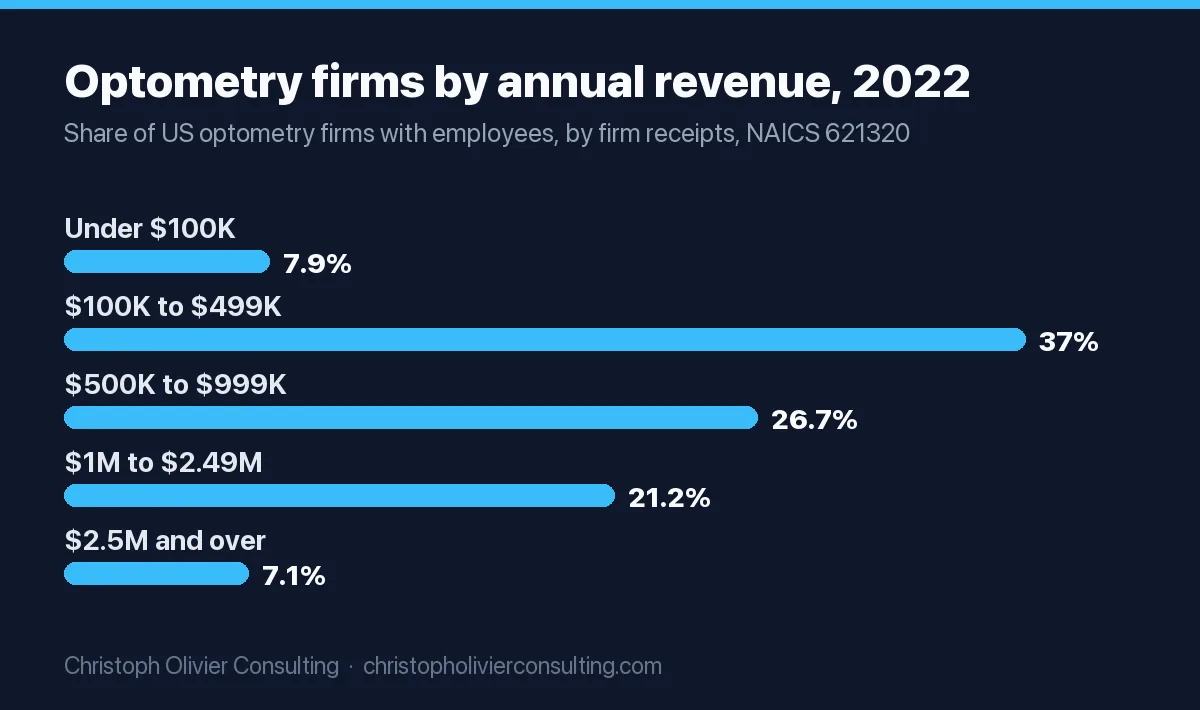
- The typical practice is a $500,000 to $1 million business. 44.9% of optometry firms took in under $500,000 and 26.7% took in $500,000 to $999,999, so the median firm sits in that band. Only 7.1% of firms took in $2.5 million or more, but they collected 44.1% of all receipts.
- Chains are a real slice of the market. 45 firms with 500 or more employees ran 1,626 locations and collected $2.70 billion, 13.0% of all optometry office receipts in 2022.
- Staff is the biggest cost. The average office had 6.5 employees and generated $139,191 per employee. Payroll was 33.4% of receipts, and that payroll includes salaried ODs.
The 10,528 optometry businesses with no employees are mostly side income. 45% took in under $25,000 in 2022 and the median falls between $25,000 and $49,999 (Census Nonemployer Statistics, decoded with the Census record layout). Think of fill-in doctors and independent contractors, not full practices.
Optometry practice revenue by state
Average receipts per office location vary by about $900,000 between the highest and lowest states. States with fewer, larger offices rank high; dense markets with many small offices rank lower. The averages are my calculation from the Census state file; cells marked with an asterisk carry Census “moderate noise” flags.
| State | Optometry offices (2022) | Receipts | Average per office |
|---|---|---|---|
| Maryland | 292 | $404.0M | $1,383,685 |
| Nevada* | 301 | $415.7M | $1,381,153 |
| Maine | 114 | $142.2M | $1,247,000 |
| North Carolina | 684 | $760.8M | $1,112,338 |
| Michigan | 628 | $674.7M | $1,074,290 |
| United States | 22,781 | $20,706.4M | $908,931 |
| Texas | 2,133 | $1,936.4M | $907,849 |
| Florida | 1,509 | $1,297.1M | $859,565 |
| New York | 940 | $800.7M | $851,845 |
| California | 2,806 | $2,235.5M | $796,691 |
| New Jersey | 641 | $471.0M | $734,805 |
| Hawaii | 109 | $74.5M | $683,229 |
Delaware ($1.61 million) and the District of Columbia ($1.44 million) top the list, but both have fewer than 50 offices and noise flags, so they are left out of the table. The same pattern shows in income surveys: Review of Optometry’s 2023 respondents in the South averaged $222,813, while Western ODs averaged $165,467.
Optometry practice profit margin: what the data actually shows
“Profit margin” means three different things in optometry, which is why forum answers disagree. Here are the three, with the number for each:
| Margin definition | Value | Source | What is already deducted |
|---|---|---|---|
| Practice net (doctor pay plus profit) | 31% median; middle 60% of practices 25% to 38% | IDOC 2025 benchmarks | Cost of goods, non-OD staff, rent and overhead. Not the doctors’ pay. |
| Unadjusted EBITDA | 16% median | IDOC 2025 benchmarks | Everything above plus doctor compensation (median OD compensation was 18% of revenue) |
| Sole proprietor net profit (Schedule C) | 18.1% all returns; 27.9% for returns with a profit | IRS SOI, tax year 2023 (my calculation: $682.5M net income ÷ $3,777.3M receipts) | All business expenses including employee payroll; the owner’s own draw is not an expense, so this is the owner’s pre-tax income |
IDOC’s median cost structure for 2025: cost of goods 26% of revenue, non-OD staff 24%, occupancy 6%, general and administrative 9% and marketing typically 1% to 2%. Its template targets about 50% for cost of goods plus non-OD staff, under 20% for fixed overhead and over 30% for doctor pay plus profit.
The IRS data shows the downside, too. Of 15,382 optometry sole proprietorship returns in tax year 2023, 3,284 (21.3%) reported zero profit or a loss. The average net income across all returns was $44,367, and $65,238 among those with a profit (my calculations). Those returns include part-time and fill-in ODs, so they understate what a full-time owner makes, but they are a useful reminder that ownership is not a guaranteed raise.
What is a good EBITDA for an optometry practice?
IDOC’s 2025 median unadjusted EBITDA was 16% of revenue, after paying doctors (median 18% of revenue). That is the closest published benchmark for independent practices. If you are preparing for a sale, a buyer will normalize (“adjust”) that number by resetting owner pay to a market wage, so your adjusted EBITDA may differ. No public, primary-sourced sale multiple for optometry practices turned up in the research for this page, so none is quoted here.
Worked example: owner pay at three practice sizes
This is my own calculation, not survey data. It applies IDOC’s 2025 aggregated ratios (cost of sales 51%, fixed overhead 17%, practice net 32%) to IDOC’s 20th percentile, median and 80th percentile collections. IDOC expects at least $1 million in collections per full-time OD, so the larger practices assume associate doctors, each paid the BLS May 2025 median wage for ODs in offices of optometrists ($129,250).
| Line (own calculation) | Solo owner, $800K collections | Owner + 1 associate, $1.57M | Owner + 2 associates, $2.64M |
|---|---|---|---|
| Collected revenue | $800,000 | $1,570,000 | $2,640,000 |
| Cost of sales: frames, lenses, contacts, lab, non-OD staff (51%) | −$408,000 | −$800,700 | −$1,346,400 |
| Fixed overhead: rent, equipment, software, insurance, G&A (17%) | −$136,000 | −$266,900 | −$448,800 |
| Practice net, pool for doctor pay plus profit (32%) | $256,000 | $502,400 | $844,800 |
| Associate OD wages at $129,250 each | $0 | −$129,250 | −$258,500 |
| Owner’s pre-tax income before debt service | $256,000 | $373,150 | $586,300 |
Assumptions and what this leaves out:
- Debt. If you bought the practice or financed a build-out, loan payments come out of the owner line. Many new owners take home far less than this until the note is paid.
- Associate benefits. The BLS figure is wages only. Payroll taxes, malpractice, health insurance and CE allowances push the real cost of an associate higher.
- Owner benefits and taxes. Your own health insurance, retirement contributions and self-employment or payroll taxes are not deducted.
- Medians are not a plan. A practice at the 20th percentile of revenue rarely hits median margins. IDOC’s middle 60% of practices ranged from 25% to 38% practice net, which moves the solo owner line between $200,000 and $304,000 at $800,000 of collections.
The solo result lands close to the survey averages (AOA $198,023, Review of Optometry $243,650), and the larger practices line up with the $315,159 and $397,470 reported for group and multi-doctor owners. That cross-check is the reason I trust the ratios more than any single survey.
Copy-ready owner pay worksheet
Fill in your last 12 months from your books. Compare each ratio with the IDOC median.
| Line | Your number | Your % of collections | IDOC 2025 median |
|---|---|---|---|
| A. Collected revenue (not billed) | $______ | 100% | $1.57M per practice |
| B. Cost of goods (frames, lenses, contacts, lab) | $______ | B ÷ A | 26% |
| C. Non-OD staff wages and benefits | $______ | C ÷ A | 24% |
| D. Occupancy (rent, utilities) | $______ | D ÷ A | 6% |
| E. General and administrative, including marketing | $______ | E ÷ A | 9% (marketing 1% to 2%) |
| F. Practice net = A − B − C − D − E − other overhead | $______ | F ÷ A | 31% |
| G. Associate OD compensation | $______ | G ÷ A | All OD comp 18% |
| H. Debt service on practice loans | $______ | H ÷ A | Not benchmarked |
| Owner pay = F − G − H | $______ |
If line B plus C is above 51%, the fix is usually optical pricing, frame inventory or staffing. If line E is under 1% and the schedule has open slots, you are probably underinvesting in new patients; the numbers in the optometry marketing guide show what a new patient costs by channel, and this guide on setting a marketing budget walks through the math.
Where an optometry practice’s money comes from
Owner income depends on payer mix more than on exam fees. In the AOA’s 2021 data, owner doctors’ gross billings came from these sources: direct patient payment 31%, self-directed vision plans 30%, private medical insurance 23%, government programs 16% and other sources 3% (as published; the shares sum to more than 100%).
Medicare is a smaller check than many expect. In CMS’s Medicare Physician and Other Practitioners by Provider file for 2024, 31,979 optometrists billed traditional Medicare Part B. Medicare paid them $943.8 million in total. My calculations from that file:
| Medicare Part B payments per optometrist, 2024 | Amount |
|---|---|
| 10th percentile | $2,453 |
| 25th percentile | $6,172 |
| Median | $16,054 |
| Average | $29,512 |
| 75th percentile | $35,840 |
| 90th percentile | $68,123 |
The file counts what traditional Medicare Part B paid each provider; vision plans, commercial insurance and Medicaid are separate payers and are not in it. Even so, the takeaway is clear: for the median OD, traditional Medicare is well under 5% of a $1 million practice. The money is in exams paid by patients and vision plans, and above all in the optical: IDOC’s 26% cost-of-goods line exists because frames, lenses and contacts are sold at a markup. Practices that grow medical eye care (dry eye, glaucoma, diabetic exams billed to medical insurance) shift that mix, which is one reason the BLS shows higher wages in medical settings.
Owner vs employed optometrist pay by setting
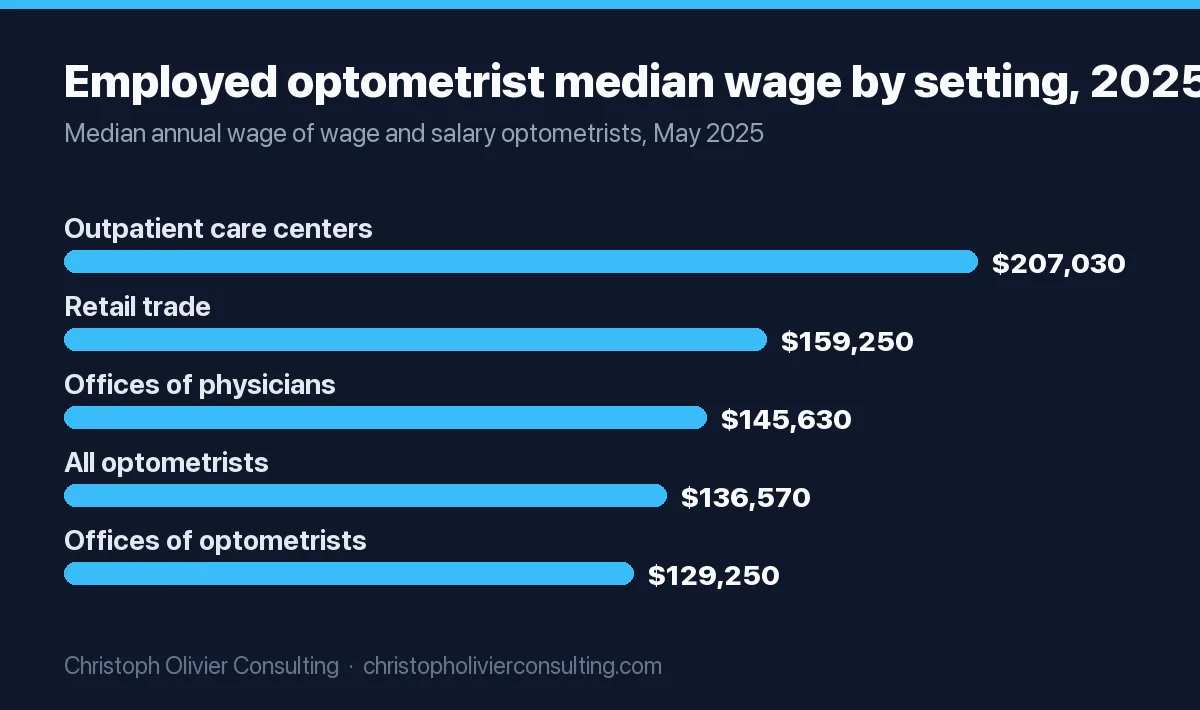
BLS publishes median wages for employed ODs by the kind of employer. Retail (optical stores) pays employed ODs more than private optometry offices, which matches the AOA finding that owners, not employees, capture the upside in private practice.
| Setting | Pay | Measure and source |
|---|---|---|
| Owner, private practice with 4+ doctors | $397,470 | Average, 2024 income, ODs on Finance as reported by Modern Optometry |
| Owner, group or partnership practice | $315,159 | Average, Review of Optometry 2023 |
| Owner, solo private practice | $212,251 | Average, Review of Optometry 2023 |
| Owner, private practice | $198,023 | Average net, 2021, AOA 2022 survey |
| Employed, outpatient care centers | $207,030 | Median wage, May 2025, BLS |
| Employed, retail trade (optical stores) | $159,250 | Median wage, May 2025, BLS |
| Employed, offices of physicians | $145,630 | Median wage, May 2025, BLS |
| Employed, offices of optometrists | $129,250 | Median wage, May 2025, BLS |
| Non-owner, corporate affiliated practice | $124,724 | Average net, 2021, AOA 2022 survey |
BLS also shows where employed ODs work: 61% in offices of optometrists, 14% in offices of physicians, 13% in retail trade and 4% in outpatient care centers, with self-employed workers 5% of the total.
What type of optometrist makes the most money?
By the published data, owners of multi-doctor private practices earn the most ($397,470 in the ODs on Finance 2025 report; $315,159 for group owners in Review of Optometry 2023). Among employees, ODs in outpatient care centers have the highest BLS median at $207,030. Experience matters too: in Review of Optometry’s 2024 survey, ODs with 31 or more years earned $230,238 versus $176,857 for those with 10 years or less.
Is owning an optometry practice worth it?
On income alone, usually yes over a career, but not in year one and not for every practice. The AOA owner premium was only $8,364 for ODs under 30 and $83,882 for ODs 7 to 10 years into practice. Graduates also carry heavy debt: the ODs on Finance 2025 report puts average student debt at graduation at $228,674, as reported by Modern Optometry, and practice loans stack on top.
Use this check before you buy, start or stay in a practice. Each line has a published benchmark and a pass/fail test.
| Check | Pass if | Benchmark source |
|---|---|---|
| Collections per full-time OD | $1,000,000 or more | IDOC 2025 (minimum it expects; a full schedule often exceeds $1.5M) |
| Cost of goods plus non-OD staff | 51% of collections or less | IDOC 2025 aggregated; 80th percentile was 56% |
| Fixed overhead | Under 20% of collections | IDOC 2025 template |
| Occupancy | About 6%; up to 10% to 12% only if relocating | IDOC 2025 |
| Practice net (doctor pay plus profit) | 25% or more (IDOC’s middle-60% floor) | IDOC 2025 |
| Owner pay after associates and debt | Above what you would earn employed: $129,250 to $159,250 median wage by setting | BLS May 2025 |
| Revenue growth | Above 6% a year | IDOC 2025 median; the 20th percentile had no growth |
If you fail two or more lines, the practice can still be worth owning, but the price and your first-year pay should reflect the work it needs. Have a CPA who works with eye care practices review any purchase.
Can an optometrist own their own practice?
Yes. In the AOA’s 2022 survey, 37% of responding ODs worked in private practice, and 62% of those were solo owners. Another 20% of ODs in corporate affiliated settings were independent contractors or lessees, which is a form of ownership with a landlord retailer. State optometry boards regulate ownership, corporate employment and leasing arrangements, so check your state’s practice act before signing a lease or buying into a group.
How profitable are optometry practices?
The median independent practice kept 31% of collections for doctor pay plus profit in 2025 and 16% as EBITDA after doctor pay (IDOC). Census data show the typical firm collects $500,000 to $1 million, and the average office collects about $909,000. Practices that are clinically busy but weak on optical sales or staffing ratios fall well below those medians. If growth is the bottleneck, comparing your numbers with other owner-run practices helps: here is the same breakdown for dental practices, chiropractic offices and physical therapy clinics, plus margins across 94 industries in profit margin by industry.
In my view, the practices that move from the solo column to the multi-doctor column in the worked example do it by filling a second doctor’s schedule, which is a new-patient problem before it is a hiring problem. If you want a second set of eyes on your collections per OD and new-patient cost, you can book a consultation.
Ready to scale your revenue?
Book a free 30-min consultation. We’ll diagnose your growth bottleneck and map out the 3 highest-leverage moves for your business.
Frequently asked questions
How much do optometrist owners make?
Practice owners average about $198,000 to $244,000 a year in net income. The AOA's 2022 survey put owners in private practice at $198,023 for 2021, and Review of Optometry's 2024 survey put self-employed ODs at $243,650. Owners of practices with four or more doctors reported $397,470 in the ODs on Finance 2025 report, as reported by Modern Optometry.
What is the optometry practice owner salary compared with an employed OD?
Owners earn roughly $50,000 to $90,000 more. Review of Optometry's 2024 survey found $243,650 for self-employed ODs versus $156,819 for employed ODs, and the AOA found $204,773 for all owners versus $145,432 for non-owners in 2021. The BLS median wage for employed optometrists was $136,570 in May 2025.
What is the average optometry practice profit margin?
Independent practices kept a median 31% of collections for doctor pay plus profit in 2025, with the middle 60% between 25% and 38%, according to IDOC's benchmarks of 175-plus practices. After paying the doctors, median unadjusted EBITDA was 16%. Optometrist sole proprietors kept 18.1% of receipts as net profit in tax year 2023 (IRS data, own calculation).
How much revenue does an optometry practice make?
The average optometry office with employees took in $908,931 in 2022 (Census, own calculation from $20.7 billion across 22,781 offices). The median firm collects $500,000 to $999,999. IDOC's 2025 benchmark put median collections for independent practices at $1.57 million, with the 20th percentile at $800,000 and the 80th at $2.64 million.
How much does an optometrist make a year?
Employed optometrists earned a median wage of $136,570 in May 2025, per BLS, with the lowest 10% under $74,870 and the top 10% over $202,180. Pay was highest in outpatient care centers ($207,030 median) and lowest in offices of optometrists ($129,250). BLS excludes self-employed owners, who report higher averages in industry surveys.
Do optometrists make 200k?
Most employed optometrists do not: the BLS top 10% threshold was $202,180 in May 2025. Practice owners often do. The AOA's average for all owners was $204,773 in 2021, and Review of Optometry's 2024 survey reported $243,650 for self-employed ODs. Group and multi-doctor practice owners report $315,000 to $397,000.
Is owning an optometry practice worth it?
Usually over a career, but not right away. The AOA found the owner premium was only $8,364 for ODs under 30, rising to $83,882 for ODs 7 to 10 years into practice. A practice should collect at least $1 million per full-time OD and keep 25% or more as practice net (IDOC 2025) to beat employed pay after associates and debt.
Practice economics benchmarks